95 RON AUDI A8 2018 Owners Manual
[x] Cancel search | Manufacturer: AUDI, Model Year: 2018, Model line: A8, Model: AUDI A8 2018Pages: 356, PDF Size: 54.71 MB
Page 264 of 356

Child safety
would not be restrained and could be
seriously injured in an accident .
- Always read and heed all WARNINGS when
ever using a child restrained in a vehicle is
being used
¢ page 249 . Special precautions
apply when installing a child safety seat on
the front passenger seat
c> page 228, Child
restraints on the front seat -some impor
tant things to know.
LATCH system (Lower
anchorages and tethers
for children)
Child Restraint System anchors and how
are they related to child safety
To provide a simpler and more practicable way to
attach the child restraint on the vehicle seat,
Federal regul ations require special lower ancho
rages in vehicles and devices on new child re
straints to attach to the vehicle anchorages.
In the United States, the combination of the
tether anchorages and the lower anchorages is
now generally called the LATCH system for
"Lower Anchorages and Tethers for Children" . In
Canada, the terms "top tether" with "lower uni
versal anchorages" (or "lower universal anchor
age bars") are used to describe the system.
In other countries the term "ISO F IX" is used to
describe the lower anchorages .
Forward-facing child restraints manufactured af
ter Sep tember 1 , 1999, are required by U .S. fed
eral regulations to comply with new child head movement performance requirements. These
new performance requirements make a tether
necessary on most new child seats.
Installing a child restraint that requires a top
tether without one can seriously impair the per
formance of the child restraint and its ability to
protect the child in a collision . Installing a child
restraint that requires a top tether without the
top tether may be a vio lation of state law.
Child restraint manufacturers offer LATCH lower
anchorages on their ch ild seats with hook-on or
262
push-on connectors attached to adjustable
straps.
In addition to the LATCH lower anchorages, these
child restraint systems usually require the use of
tether straps to help keep the child restraint
firmly in place.
A WARNING
Improper installation of child restraints will increase the risk of injury and death in a
crash.
-Always follow the instructions provided by the manufacturer of the child restraint you intend to install in your vehicle.
-Never install a child restraint without a
properly attached top tether strap if the
child restraint manufacturer's instructions
require the top tether strap to be used.
-Improper use of child restraint LATCH lower
anchorage points can lead to injury in a colli
sion . The LATCH lower anchorage points are
designed to withstand only those loads im
posed by correctly fitted child restra ints.
- Never mount two child restraint systems on
one LATCH lower anchorage point.
- Never secure or attach any luggage or other
item to the LATCH lower anchorages.
Location
Fig. 244 Schema tic ove rview: LATCH anchorage poi nt loc a
t ions
The illustration shows the seating locations in
your vehicle which are equipped with the lower
anchorages system.
Page 268 of 356
Child safety
that could be caused by striking the vehicle inte
rior .
Forward facing child restraints manufactured af
ter September 1, 1999, are required by U .S. fed
eral regulations to comply with new child head
movement performance requirements. These
new performance requirements make a tether
necessary on most new child safety seats .
A WARNING
Improper installation of child restraints will
increase the risk of injury and death in a
crash.
- Always follow the instructions provided by
the manufacturer of the child restraint you intend to install in your Audi .
- Improper use of child restraint anchors (in
cluding tether anchors) can lead to injury in
a collision . The anchors are designed to
withstand only those loads imposed by cor rectly fitted child restraints.
- Never mount two child restraint systems on
one LATCH lower anchor point.
- Never attach two child restraint systems to
one tether strap or tether anchorage.
- Never attach a tether strap to a tie-down
hook in the luggage compartment.
- Never use child restraint tether anchorages
to secure safety belts or other kinds of occu pant restraints.
- Never secure or attach any luggage or other
items to the LATCH lower anchorages or to
the tether anchors.
- If a tether or other strap is used to attach a
child restraint to the front passenger seat,
make sure that it is not so tight, that it
causes the weight-sensing mat to measure
more weight than is actually on the seat.
- The heavier weight registered can make the
Advanced Airbag System work as though an
adult were on the seat and deploy the Ad
vanced Airbag when it must be suppressed causing serious or even fatal injury to the
child.
- If you must install a rearward facing child
safety seat on the front passenger seat be
cause of exceptional circumstances and the
266
'
PASSENGER AIR BAG OFF light does not
come on and stay on, immediately install
the rear-facing child safety seat in a rear
seating position and have the airbag system
inspected by your Audi dealer .
Installing the upper tether strap on the
anchorage
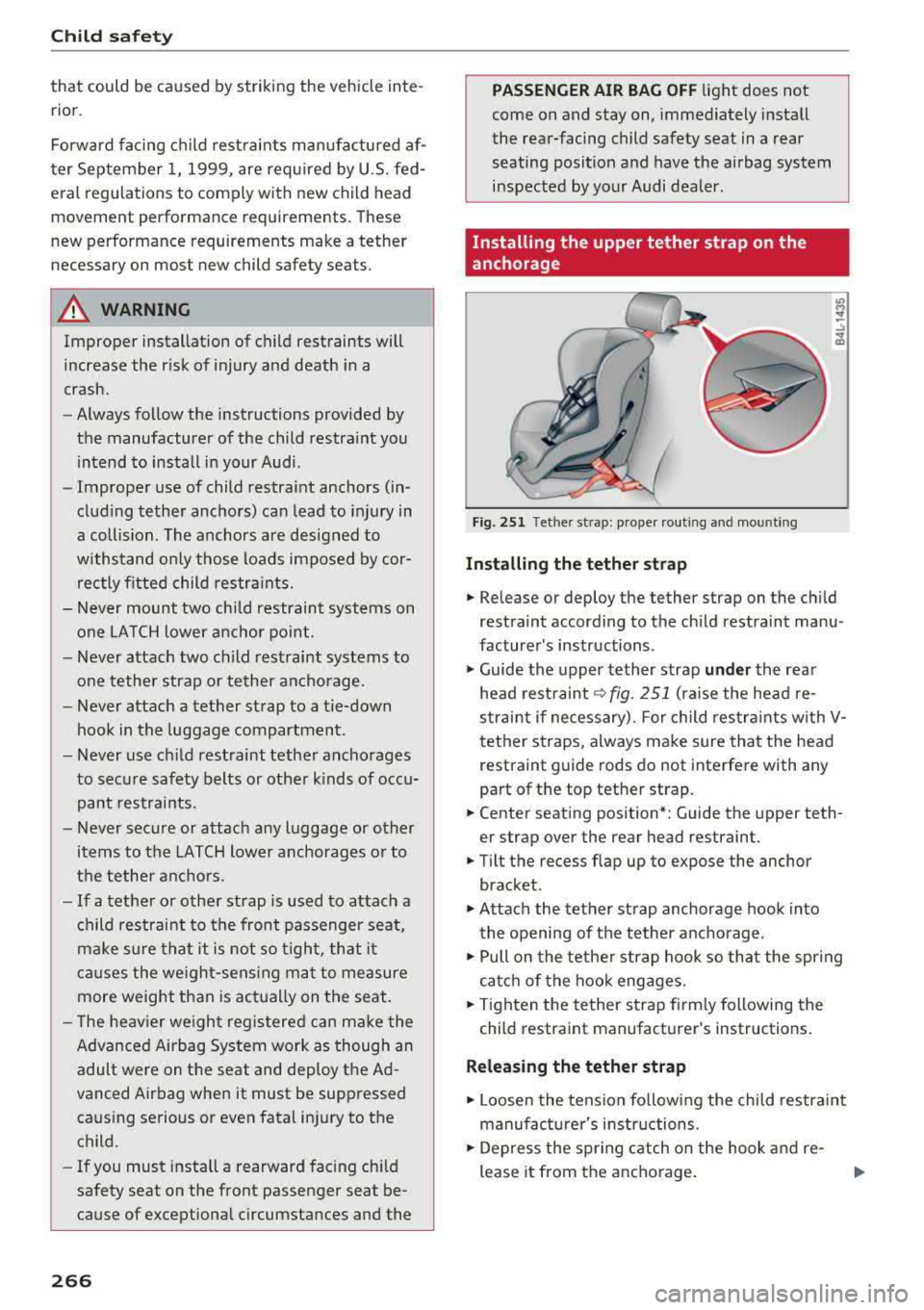
Fig. 251 Tet her s trap: pro per routing an d mo unting
Installing the tether strap
.,. Release or deploy the tether strap on the child
restraint according to the child restraint manu
facturer's instructions .
.,. Guide the upper tether strap under the rear
head
restraint ~ fig. 251 (raise the head re
straint if necessary). For child restraints with V
tether straps, always make sure that the head
restraint guide rods do not interfere with any
part of the top tether strap .
.,. Center seating position*: Guide the upper teth
er strap over the rear head restraint.
.,. Tilt the recess flap up to expose the anchor bracket .
.,. Attach the tether strap anchorage hook into
the opening of the tether anchorage .
.,. Pull on the tether strap hook so that the spring
catch of the hook engages.
.,. Tighten the tether strap firmly following the
child restraint manufacturer's instructions.
Releasing the tether strap
.,. Loosen the tension following the child restraint
manufacturer's instructions .
.,. Depress the spring catch on the hook and re
lease it from the anchorage.
Page 269 of 356
u. co .... N
" N .... 0 0 :c '
If you leave the child restraint with the tether
strap firm ly installed for severa l days, this
could leave a mark on the upholstery on the
seat cush ion and backrest in the area where
the tether strap was installed . The upholstery
would also be permanently stretched around
the tether strap . This applies especially to
leather seats .
Using tether straps on rearward-facing
child restraints
Current ly, few rear-facing chi ld restraint systems
come with a tether. Please read and heed the
child rest raint sys tem manufacturer 's instruc
tions carefully to determine how to properly in
stall the tether .
A WARNING
A child in a rea rward-facing ch ild safety seat
installed o n the fro nt passenge r seat w ill be
ser ious ly injured and can be killed if t he fron t
airbag infla tes -even w it h a n Advanced A irbag
System.
- T he inflat ing air bag w ill hit t he chi ld safety
sea t or infan t carrie r wi th g reat force and
wi ll smash the chi ld safety seat and chi ld
against t he backrest, center armrest, o r
door .
- A tight tether or other strap on a rearward
facing child restraint attached to the front
passenger seat can put too m uch pressure
on the weight-mat in the seat and register a
heav ier weight in the Advanced Airbag Sys
tem . The heav ier we ight registered can
make the system wo rk as though an adult
we re o n the seat and deploy the Adva nced
Airbag whe n it mus t be sup pressed ca u sing
ser ious o r even fa tal injur y to the c hild.
-If you must install a rearward fac ing c hild
safety seat on t he front passenger seat be
ca use of exceptiona l circumst ances and the
PASSENGER AIR BAG OFF lig ht does not
come on and stay on, immediate ly install
the rear-fac ing ch ild safety seat in a rear
seat ing pos it ion and have the airbag system
inspected by your Audi dealer.
Ch ild saf ety
Additional information
Sources of information about child
restraints and their use
T here are a number of sources o f additional in
formation about child restraint se lection, instal
l ation and use :
N HT SA advises that the best ch ild safety seat is
the one that f its your child and fi ts in your vehi
cle, and that you wi ll use correct ly and consis
tent ly.
T ry befo re yo u buy!
U.S . National Highway Traffic S afet y A dminis
tration
T el. : 1-888-3 27- 42 36 ( TTY: 1-800 -424-9153)
http:/ /www.nh tsa.gov
http:/ /www.sa ferca r.gov
National SAFE KIDS Camp aig n
Tel. : (202) 66 2-0600
http:/ /www.safekids .org
Safety BeltSaf e U.S .A
Te l.: (800) 745 -SA FE (E nglish)
T el. : (800) 747-SANO (Spanish)
http://www.ca rsea t.o rg
Tran sport C anada Information Centre
Tel. : 1-800-333-0371 o r ca ll 1 -613-998-86 16 if
yo u are in the Ottawa area
http://www.tc.gc.ca/ eng/ roadsafety/men u. h tm
Audi Cu stomer Relation s
Tel.: (800) 822-2834
267
Page 270 of 356
Checking and Filling
Checking and Filling
Gasoline
Fuel supply
Applies to: vehicles with gasoline engine
Using the right fuel helps keep the environment
clean and prevents engine damage .
Fuel recommendation
The fuel recommended for your vehicle is unlead
ed premium
grade gasoline . Audi recommends
using TOP TIER Detergent Gasoline with a mini
mum octane rating of91 AKI (95 RON). For more
information on TOP TIER Detergent Gasoline,
please go to the offic ial website
(www.toptiergas .com).
The recommended gasoline octane rat ing for
your engine can also be found on a label located
on the ins ide of the fuel filler flap. This rating
may be specified as AK I or RON .
Your veh icle may also be operated using unlead
ed regular gasoline with a minimum octane rat
ing of 87 AKl/91 RON . However, using 87 AKI/91
RON octane fuel w ill slightly reduce engine per
formance.
Use unleaded gasoline only. Unleaded gasoline
is available throughout the USA, Canada, and in
most European countries. We recommend that
you do not take your vehicle to areas or count ries
where un leaded gasoline may not be available.
For more information on refueling your vehicle,
see
~ page 269 .
Octane rating
Octane rating indicates a gasoline's ability to re
sist engine damaging "knock" caused by prema
ture ignit ion and detonation . T herefore, buy ing
the correct grade of gasoline is very important to
he lp prevent possible engine damage and a loss
of eng ine pe rformance.
Gasoline most commonly used in the United
States and Canada has the following octane rat
ings that can usually be found on the filler pump:
- Premium Grade: 91 - 96 AKI
268
-Regular Grade: 87 -90 AK I
Explanation of the abbreviations :
AKI =
Anti Knock Index = (R +M)/2 = (RON +MON)/
2
RON = Research Octane Number
MON= Motor Octane Number.
@ Note
- Do not us e any fuel with octane ratings low
er than 87 AKI or 91 RON otherwise expen
sive engine damage will occur .
- Do
not us e leaded gasoline. The use of lead
ed gasoline will severely damage your vehi
cle's catalytic converter and its ability to
contro l exhaust emissions .
Blended gasoline
Applies to: vehicles with gasoline engine
Use of gasoline containing alcohol or MTBE
(methyl tertiary butyl ether)
You may use unleaded gasoline blended with al
cohol or MTBE (commonly referred to as oxygen
ates) if the blended mixture meets the follow ing
criteria :
Blend of gasoline methanol (wood alcohol or
methyl alcohol)
-Anti -knock index must be 87 AKI or higher.
- Blend must contain no more than 3% metha-
nol.
- Blend must contain more than 2% co-solvents.
Blend of gasoline and ethanol (grain alcohol or
ethyl alcohol)
- Anti-knock index must be 87 AKI or h igher .
- Blend must not conta in more than 15% etha-
nol.
Blend of gasoline and MTBE
-Anti -knock index must be 87 AK I or h igher.
- Blend must not contain more th an 15% MTBE.
Seasonally adjusted gasoline
Many gasoline grades are blended to perform es
pecially well for winter or summer dr iv ing . Dur-
i ng seasonal change-over, we suggest that you
IJIJ,
Page 271 of 356
u. co .... N
" N .... 0 0 :c '
adjustment is more like ly to be made in time .
@ Note
-Methanol f uels whi ch do not meet these re
quirements may ca use corrosion and dam
age to plastic and rubber components in the
fuel system .
- Do not use fuels that fai l to meet the speci
fied criteria in this c hapter.
- If you are unable to determine whether or not a particular fue l blend meets the speci
fications, ask your service station or its fuel
supplier.
- Do not use fuel for which the contents can
not be identif ied.
- Fuel system damage and performance prob
l ems resulting from the use of fue ls differ
ent from those specif ied are not the respon
s ibility of Audi and are not covered under
the New Veh icle or the Emiss ion Control
System Warrant ies .
- If you experience a loss of fue l economy or
driveability and performance problems due
to the use of one of these fuel blends, we
r ecommend that you switch to unblended
fuel.
Gasoline additives
Applies to: vehicles with gasoline engine
A majo r concern among many auto manufactur
ers is carbon deposit build-up caused by the type
of gasoline you use.
A lthough gasoline grades d iffer from one manu
facturer to another, they have cer tain things in
common . A ll gasoline grades contain substances
that can cause deposits to collect on vita l engine
parts, such as fue l injectors and intake valves . A l
though most gasoline brands include additives to keep engine and fuel systems clean, they are not
equally effective.
Audi recommends using TOP TIER Detergent Gas
oline. For more informat ion on TOP TIER Deter
gent Gasoline, please go to the official website (www .toptiergas .com) .
Check ing and F illing
A fter an extended period of using inadequate
fuels, carbon deposit bui ld-ups can rob your en
gine of peak performance.
@ Note
Damage or ma lf u nction due to poor fue l qual
ity is not covered by the A udi New Vehicle
L imited Warranty .
Refueling
Fuel filler neck
The fue l filler neck is located on the rig ht rea r
s ide panel behind the fuel fille r flap .
If the power lock ing system should fa il, yo u can
st ill open the flap manually - fo r detailed instruc
tions see
~page 271.
You can find the fuel tank capacity of your vehicle
i n
~ page 334 .
The label on the inside of the fuel filler flap tells
you the correct fuel for your vehicle. For more in
format ion about fuel spec ificat ions, see
~ page 268 .
Your vehicle fuel tank has an onboard refuelling
vapor recovery system. T his feature helps to pre
vent fuel vapors from escaping from the tank and polluting the environment wh ile you refuel your
vehicle. In o rder to fill the tank proper ly w hile
prote ct ing t he env ironment, p lease follow t his
r ef uel ing p rocedure carefully.
& WARNING
= -
Unde r normal opera ting condi tions, neve r ca r
r y additional f uel containers in your car. Gas
canisters and other containers used to trans
port fue l can be dangerous. Such containers,
f u ll or empty, may leak and could cause a fire
i n a collision. If you must transport fuel to
use for your lawn mower, snow blower, etc.,
be ve ry ca refu l and always observe loca l a nd
state laws rega rding the use, transpo rta tion
a nd stor age of su ch f uel con tainers. Make cer
t ai n t he co nta iner meets indus try standards
(A NSI/AS TM F8S2 - 86) .
269
Page 273 of 356
lL t:0 ....
"' ......
"' .... 0 0 :c '
while it is in or on the vehicle. Stat ic elec
tr icity is discharged when filling which can
cause the fuel vapors to ignite and in
creases the r isk of an explos ion.
- Always p lace a fuel container on the
ground before fi lling.
- Always hold the fuel nozzle comp letely in
the fuel container when f il li ng .
- If the fuel container is made of metal, the
fuel nozzle must always be in contact with the conta iner when filling it w ith fuel. Th is
prevents static electr ic ity from discharg
ing.
- Never sp ill fuel in the veh icle or the lug
gage compartment. Evaporated fue l is ex
p losive and increases the risk of serio us in
jury or dea th.
- Follow legal requir ements when using,
sto ring and transpor ting fue l contai ners .
- M ake sure the fuel conta iner confo rms to
i nd ust ry st anda rds (ANSI/AS TM F852 -86).
(D Note
- Remove spilled fuel from vehicle paint im
mediate ly, because it can damage paint.
- Never dr ive unti l th e fuel tank is comp letely
empty . The ir regular supply of fuel that re
su lts from that ca n caus e engine misfires.
U ncomb usted fuel w ill enter the exha ust
system a nd i ncre ase the risk of damage to
the c atalyt ic converter.
@) For the sake of the environment
Do not overfi ll the fuel tank , othe rw ise fue l
can leak out whe n the vehicle is warm ing up.
(D Tips
The f uel f iller door on your vehicle does not
loc k if you lock the vehicle from the inside.
Chec king and Filling
Fuel filler door emergency release
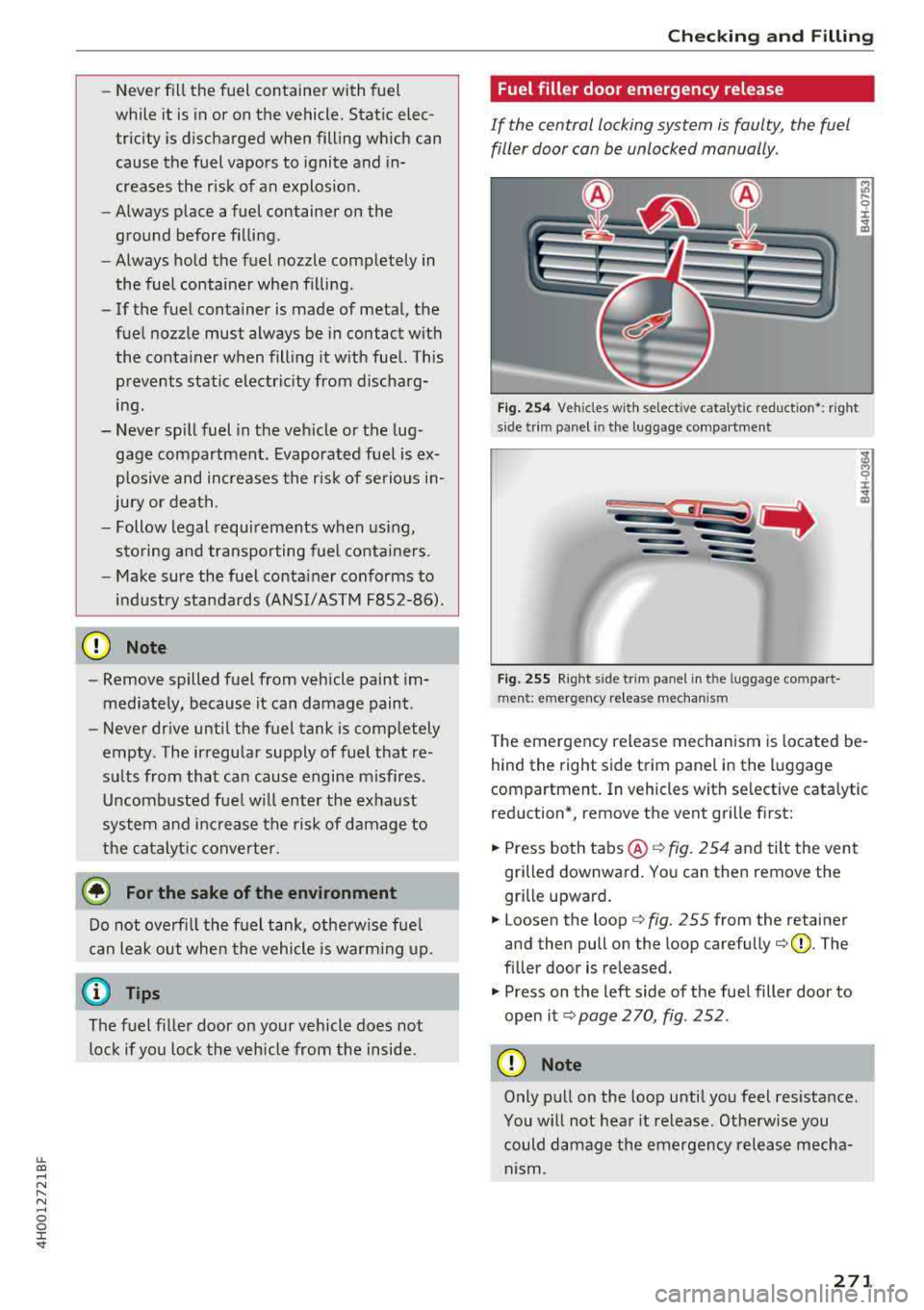
If the central locking system is faulty, the fuel
filler door can be unlocked manually.
F ig . 25 4 Veh icles w it h se lect ive catalyt ic reduct io n•: right
side trim pa nel in t he luggage compa rtme nt
Fi g. 25 5 Righ t sid e tr im pa nel in t he luggage compart·
ment : emergency release mechanism
T he emergency release mechanism is located be
hind the rig ht side trim pane l in the luggage
compartment . In vehicles with se lective cata lytic
reduction*, remove the vent grille f irst:
.,. Press bo th tabs @¢fig. 254 an d tilt the vent
grilled downward. Yo u can then remove the
grille upwar d .
.,. Loosen the loop¢ fig. 255 from the retainer
and then pull on the loop caref ully
¢ (D . The
fi ller door is released.
.,. Press on t he left side of the fue l filler door to
open
it ¢ page 2 70, fig . 252.
~ Note
Only p ull on the loop until yo u feel resista nce.
You w ill not hear it re lease. Othe rw ise you
could damag e the emergency rel ease mecha
n ism.
271
Page 275 of 356
lL t:0 ....
"' ......
"' .... 0 0 :c '
Service Facility.
- To reduce the risk of electric shock and in
jury, never touch the following components
when the eng ine is running or is being start
ed :
- I gnition cable
- Othe r components in the electronic h igh-
voltage ignition system
- If you must check o r perform work on the
engi ne while it is run ning:
- Set the parking bra ke and p lace the se lec
tor lever in the P (pa rk) position first .
-Always p roceed with extreme ca utio n so
that clothing, jewelry or long ha ir do not
become caught in the radiator fan, fan
belt or other moving components or do
not come into contact with hot compo
nents . Tie back long ha ir before beginning
work and do not wear cloth ing that can
hang down into the engine .
- L imit your exposure to exhaust a nd chemi
cals to as short a time as poss ible ¢
A.
A WARNING
California Proposi tion 6S Warn ing:
- Engine exhaust, some of its constituents,
and certain vehicle components contai n or
em it chem icals known to the State of C ali
forn ia to ca use cancer and bi rth defects an d
re produc tive harm. In ad dition , ce rtain fl u
ids contained in vehicl es and certa in prod
ucts of com ponent wear contain o r emit
chemica ls known to the State of California
to cause cancer and birth defects or other
reproduct ive harm.
- Battery posts, termina ls and re lated acces
sories contain lead and lead compounds,
chemica ls known to the State of California
to cause ca ncer and reproduct ive harms .
Wash hands after handling .
(D Note
When fil ling fl uids, be sure not to mix the flu
ids up . Otherwise severe ma lfunctions and en
gine damage w ill occur.
Chec king and Filling
@) For the sake of the environment
You should regularly check t he gro und under
your vehicle in order to detect leaks quick ly .
If
the re are visible spots from o il or other fluids,
b ring your veh icle to an authorized A udi deal
er o r aut ho rized Aud i Serv ice Facility to be
checked .
Opening/closing the hood
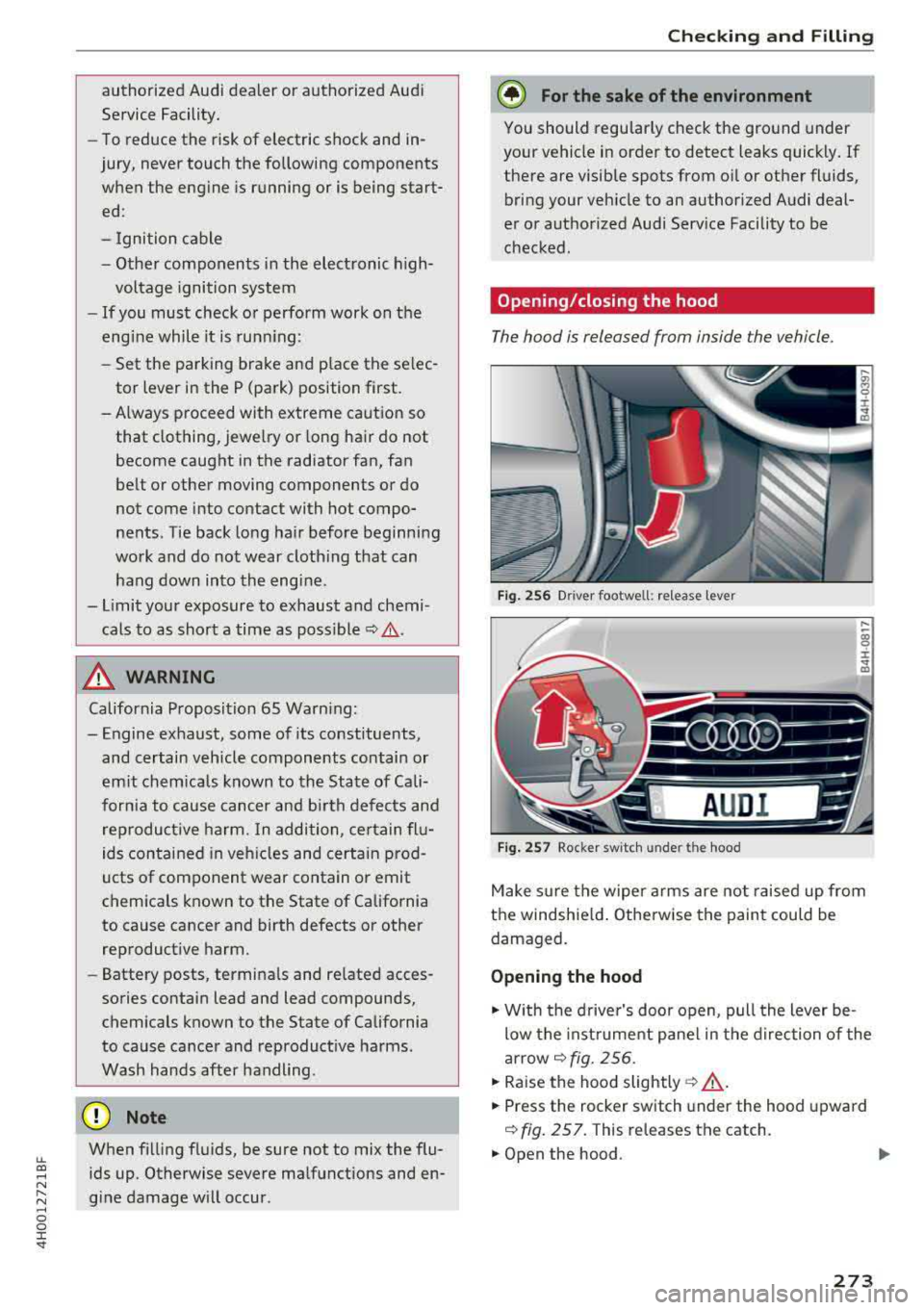
The hood is released from inside the vehicle .
Fig. 256 Drive r footwell : re lea se leve r
Fig. 25 7 Rocker sw itc h unde r the hood
M ake s ure th e wipe r arms are no t rais e d up from
t h e windshie ld . Otherwise the pain t could be
damaged.
Opening the hood
.,. With the d rive r's doo r open, pull the lever be
low t he instrume nt pane l in the direction of the
ar row ¢
fig. 256.
.,. Ra ise the hoo d slightly¢&_ .
.. Press the rocker switch under the hood upward
¢ fig . 257. T his re leases the catch.
.,. Open the hood . ..,.
273
Page 276 of 356
Checking and Filling
Cl osing the ho od
~ Push the hood down until you override the
force of the strut .
~ Let the hood fall light ly into the latch. Do not
press it in.
c::> .&_ .
A WARNING
-Never open the hood when there is steam or
coolant escaping from the engine compart
ment, because there is a risk that you could
be burned. Wait until no steam or coolant is
escaping.
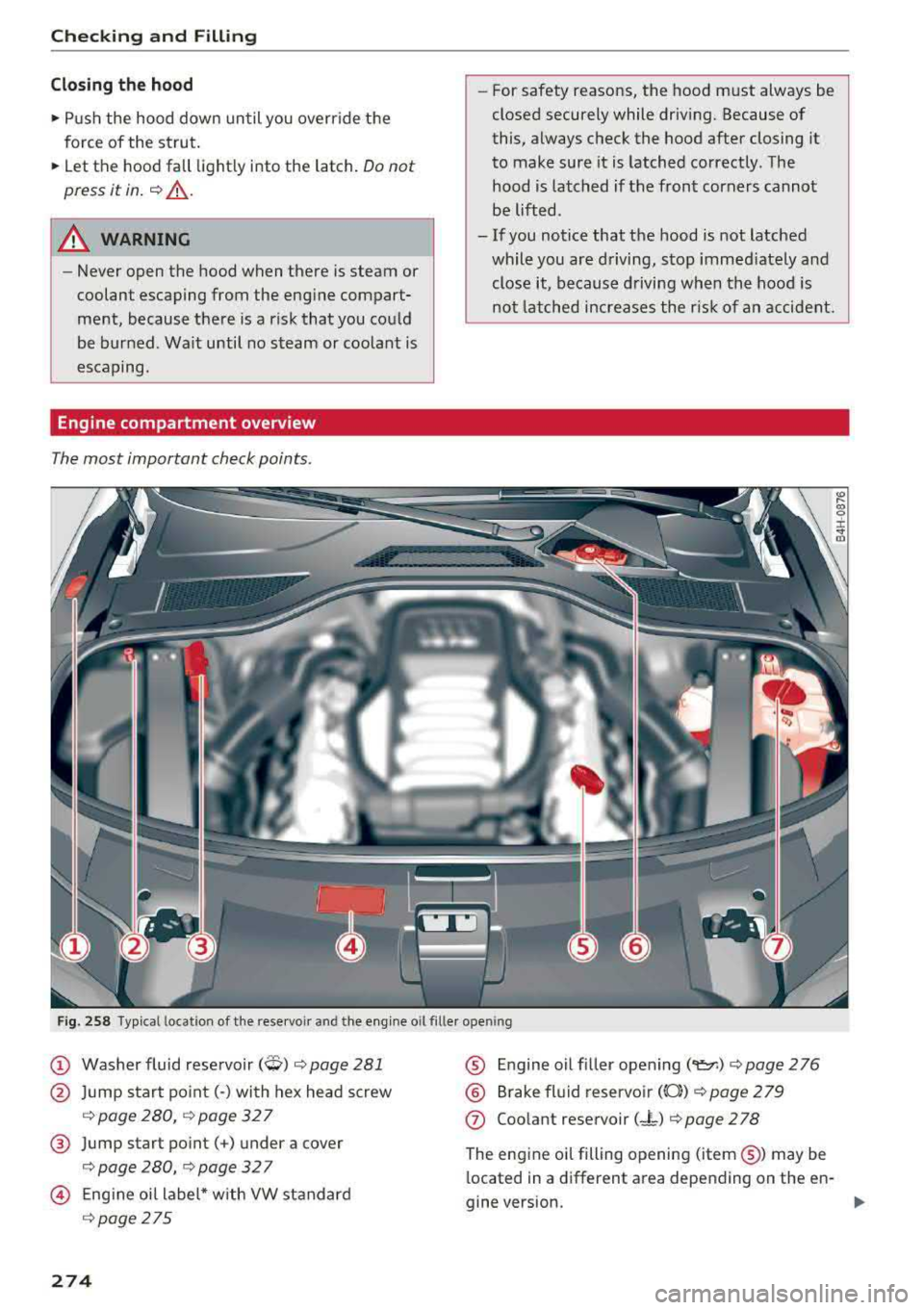
Engine compartment overview
The most important check points .
-For safety reasons, the hood must always be
closed securely while driv ing. Because of
this, always check the hood after closing it
to make sure it is latched correctly . The
hood is latched if the front corners cannot
be lifted.
-If you notice that the hood is not latched
while you are driving, stop immed iate ly and
close
it, because d riving when the hood is
not latched increases the r is k of an accident.
Fig. 258 Typical locatio n of the rese rvoir and the engi ne o il fille r open ing
(D Washer fluid reservoir (Q) c::> page 281
@ J ump start point(-) with hex head screw
c::> page 280, c::> page 32 7
® Jump start point(+) under a cover
c::> page 280, c::> page 32 7
@ Engine oil label * w ith VW standard
c::> page 2 75
274
® Engine oil filler opening (
@ Brake fl uid reservo ir ((0)) c::> page 2 79
(J) Coolant reservoir (-L) c::> page 2 78
The engine oil filling opening (item @) may be
l ocated in a different area depending on the en-
gine version.
.,.
Page 277 of 356
u. co ..... N
" N ..... 0 0 :c '
Read and follow all WARNINGS before check
ing anything in the engine
compartment~ .&.
in Working in the engine compartment on
page 272.
Engine oil
If the engine oil level is too low
If you need to add engine oil, use an oil that is listed on the sticker.
The sticker is located at the
front of the engine
compartment ~ page 274,
fig.
258.
If the recommended engine oil is not available,
in an emergency you may add a maximum of 1
quart
(I liter) of ACEA C3 or API SN engine oil
one time until the next oil change.
For more information on the correct engine oil
for your vehicle, contact an authorized Audi deal
er or authorized Audi Service Facility. Have the oil
changed by an authorized Audi dealer or author ized Service Facility.
Audi recommends
«;;castrol I /g@@g PrtfTr.:!\.7.Tri,'lAl.
Audi recommends using the Longlife high-per·
formance engine oil from Audi Genuine Parts.
Checking the engine oil level
The engine oil level can be checked in the Info
tainment system
Observe the safety precautions ~ A in Working
in the engine compartment on page 2 72.
~ Park your vehicle on a level surface.
~ Shut the engine off when it is warm.
~ Switch only the ignition back on.
~ Wait approximately two minutes.
~ Select: the ICARI function button> (Car)* Sys
tems
control button > Service & control > Oil
level.
~ Read the oil level in the Infotainment system .
Add engine oil if the bar in the oil level indica
tor is just before
"min"~ page 2 76.
Checking and Filling
@ Note
The engine oil level must not be under the
"min" marking, as this will increase the risk of
engine damage.
(D Tips
The oil level indicator in the display is only an
informational display.
If the oil level is too
low, a minimum oil warning appears in the in
strument cluster. Add oil and close the hood.
The current oil level is displayed in the Info
tainment system the next time the ignition is
switched on.
(D Tips
The engine oil consumption may be up to
0.5 quart/600 miles (0 .5 liter/1,000 km), de
pending on driving style and operating condi
tions. Consumption may be higher during the
first 3,000 miles (5,000 km). Because of this,
the engine oil level must be checked regular
ly. It is best to check each time you refuel
your vehicle and before long drives.
- In order to provide effective lubrication and
cooling of internal engine components, all
internal combustion engines consume acer
tain amount of oil. Oil consumption varies
from engine to engine and may change sig
nificantly over the life of the engine. Typi
cally, engines with a specified break-in peri
od consume more oil during the break-in pe
riod than they consume after oil consump
tion has stabilized.
- Under normal conditions, the rate of oil
consumption depends on the quality and
viscosity of the oil, the RPM (revolutions per
minute) at which the engine is operated, the
ambient temperature and road conditions.
Further factors are the amount of oil dilu
tion from water condensation or fuel resi
due and the oxidation level of the oil. As any
engine is subject to wear as mileage builds
up, the oil consumption may increase over
time until replacement of worn components
may become necessary.
.,.
275
Page 279 of 356
u. co .... N
" N .... 0 0 :c '
-Oil should never enter the sewer system or
come into contact with the ground.
- Pay attention to legal requirements when
disposing of empty oi l containers .
Changing the engine oil
We recommend that hove your oil changed by on
authorized Audi dealer or a qualified service sta
tion .
Before you check anyt hing in the engine compart
ment,
alw ays re ad and h eed all W ARNINGS ¢ &
in Working in the engine comportment on
page 272.
The engine oil must be changed according to the
intervals specified in your Warranty
& Mainte
nance booklet . This is very important because the
lubricating properties of oil diminish gradually
during normal vehicle use.
Under some circumstances the engine oi l should
be changed more frequently. Change oil more of
ten if you drive mostly short distances, operate
the vehicle in dusty areas or under predominantly
stop-and-go traffic condit ions, or have your vehi
cle where temperatures remain below freezing
for extended periods .
Detergent additives in the oil will make fresh oil
look dark after the engine has been running for a
short t ime . Th is is normal and is not a reason to
change the oil more often than recommended .
Because of the problem of proper disposal, along
with the special tools and necessary expertise re
qu ired, we strongly recommend that you have
your oil changed by an authorized
A ud i d ea ler or
a qualified se rvice station .
If you choo se to chang e your o il y ou rse lf, please
note the following important information:
A WARNING
T o reduce the r isk of personal injury if you
must change the engine oil in your ve hicle
yourse lf:
- Wear eye protection .
-
Check ing and F illing
- To reduce the risk of burns from hot engine
oil, let the engine cool down to the touch.
- When removing the oil drain p lug with your
fingers, stay as far away as possible. Always keep your forearm parallel to the ground to
help prevent hot oil from running down your
arm.
- Drain the oil into a container designed for
this purpose, one large enough to hold at least the total amount of oil in your engine.
- Engine oil is poisonous. Keep it well out of
the reach of children .
- Continuous contact with used engine o il is
harmful to your skin. Always protect your
skin by wash ing oil off thoroughly with soap
and wate r.
@ Note
Never mix oil additives with your engine oil.
These add itives can damage your engine and
adversely affect your Audi L imited New Vehi
cle War ranty .
@ For the sake of the environment
-Before chang ing your o il, first make sure
you know where you can properly d ispose of
the used oil.
- Always dispose of used engine o il properly .
Do not dump it on garden so il, wooded
areas, i nto open streams o r down sewage
dra ins.
- Recycle used eng ine o il by tak ing it to a used
eng ine oi l collection fac ility in yo ur area, or
c ontact a se rvice station.
Cooling system
Coolant
The eng ine cooling system is filled w ith a mixture
of purified water and coolant additive at the fac
tory. This coolant must not be not changed .
The coo lant level is mon itored through
the . in
dicator
light¢ page 20. However, we do recom
mend occasionally checking the coolant level
manually .
.,.
277