engine AUDI ALLROAD 2000 Owners Manual
[x] Cancel search | Manufacturer: AUDI, Model Year: 2000, Model line: ALLROAD, Model: AUDI ALLROAD 2000Pages: 306, PDF Size: 9.95 MB
Page 242 of 306
Radiator
fan
The radiator fan is driven by the engine via
the V-belt. The viscous clutch regulates the
speed of the fan according to the tempera
ture of the coolant.
An auxiliary electric radiator fan switches on
and off depending on coolant temperature
and other vehicle operation conditions.
� WARNING
• Always use extreme caution to
prevent clothing. jewelry, or long
hair from getting caught in the en
gine driven radiator fan, V-belt or
other moving parts.
• Never touch the auxiliary elec
tric radiator fan. The fan can
switch on suddenly and injure you.
Always heed all WA RNINGS
on page 232. Power
steering
Yo ur vehicle is equipped with a Servotro
nic power steering. The degree of
power assistance is regulated electronically
according to road speed.
The fluid reservoir is in the engine compart
ment near the windshield washer container.
The correct fluid level in the reserv oir is im
portant for the proper functioning of power
steer ing.
The power steering fluid level is checked
during the scheduled Maintenance ser
vices.
If the electronic regulating system is not
working properly, this is most noticeable
when turning the steering wheel at low
speeds (for example when parking) -more
effort will be required than usual. The fault
should be rectified by an Audi Dealer as
soon as possible. VEH
ICLE CARE
Note
• When the engine is running, never hold
the steering wheel turned all the way to the
right or to the left for longer than 15 sec
onds. The power steering pump will over
heat the hydraulic fluid if you hold the steer
ing wheel all the way turned.
This will damage the power steering
system.
Each time the steering wheel is turned all
the way to the right or left when stopped,
you will hear noises caused by the severe
stress placed on the power steering pump.
At the same time, engine idle speed drops.
• If the power steering system
should fail, or if the engine is not
running (for example, while being
towed). you will still be able to steer
the vehicle, however. more effort
will be required.
• If the power steering system should
have a leak, or is not functioning properly,
contact your authorized Audi Dealer imme
diately.
241
Page 243 of 306
VE
HICLE CA
RE----------------------------------------------------
Brake fluid
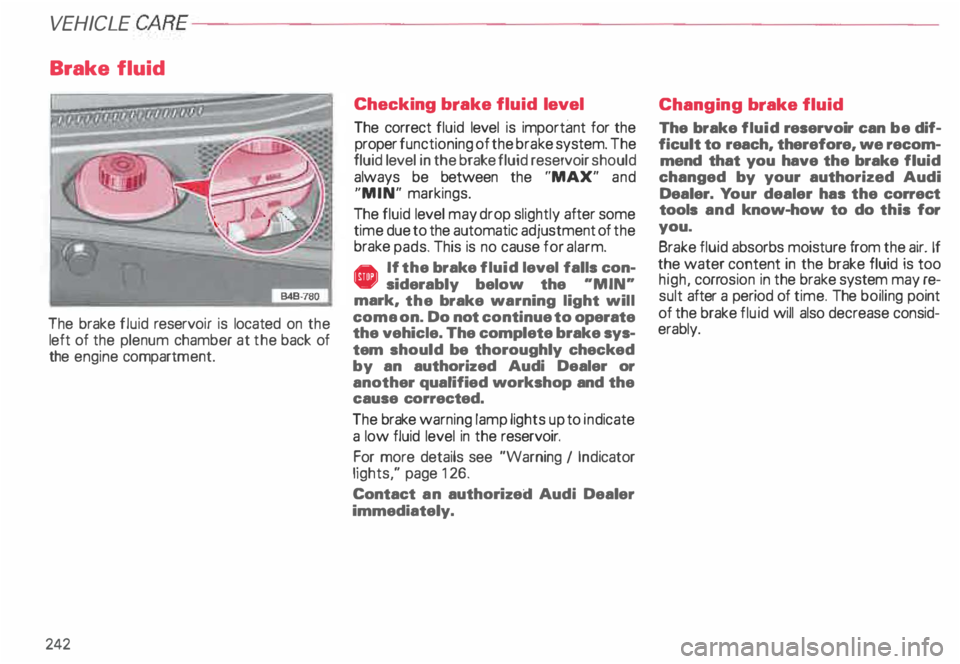
The brake fluid reservo ir is located on the
left of the plenum chamber at the back of
the engine compartm ent.
242 Checking
brake fluid level
The correct fluid level is important for the
proper functioning of the brake system. The
fluid level in the brake fluid reservoir should
always be between the "MAX" and
"MIN" markings.
The fluid level may drop slightly after some
time due to the automatic adjustment of the
brake pads. This is no cause for alarm.
• If the brake fluid level falls con
siderably below the "MIN"
mark, the brake warning light will
coma on. Do not continue to operate
the vehicle. The complete brake sys
tem should be thoroughly checked
by an authorized Audi Dealer or
another qualified workshop and the
cause corrected.
The brake warning lamp lights up to indicate
a low fluid level in the reservoir.
For more details see "Warning I Ind icator
lights," page 126.
Contact an authorized Audi Dealer
immediately. Changing
brake fluid
The brake fluid reservoir can be dif
ficult to reach, therefore, we recom
mend that you have the brake fluid
changed by your authorized Audi
Dealer. Your dealer has the correct
tools and know-how to do this for
you.
Brake fluid absorbs moisture from the air. If
the water content in the brake fluid is too
high, corrosion in the brake system may re
sult after a period of time. The boiling point
of the brake fluid will also decrease consid
erably.
Page 246 of 306
-------------------------VEHICL E CA RE
Do not disconnect the vehicle bat
tery when the ignition is switched
on or when the engine is running.
Otherwise, you will damage elec
tronic components in the electrical
system.
When working on the engine, pro
tect the battery housing from ultra
violet (UV) rays by not parking the
vehicle in direct sunlight. Winter
operation
During the winter months, battery capacity
tends to decrease as temperatures drop.
More power is also consumed while start
ing, and the headli ghts, rear window defog
ger, etc., are used more often.
Av oid unne cessary power consumption,
particularly in city traffic or when trave:ling
only short distances. Let your authonzed
Audi Dealer check the capacity of the ve
hicle battery before winter sets in. A well
charged battery will not only prevent start
ing problems but will also last longer.
If your vehicle is left standing for
several weeks at extremely low tem
peratures, the vehicle battery
should be removed and stored
where it will not freeze. This will
prevent it from being damaged. Location
of vehicle battery
g Always heed all WAR NINGS
� on page 232.
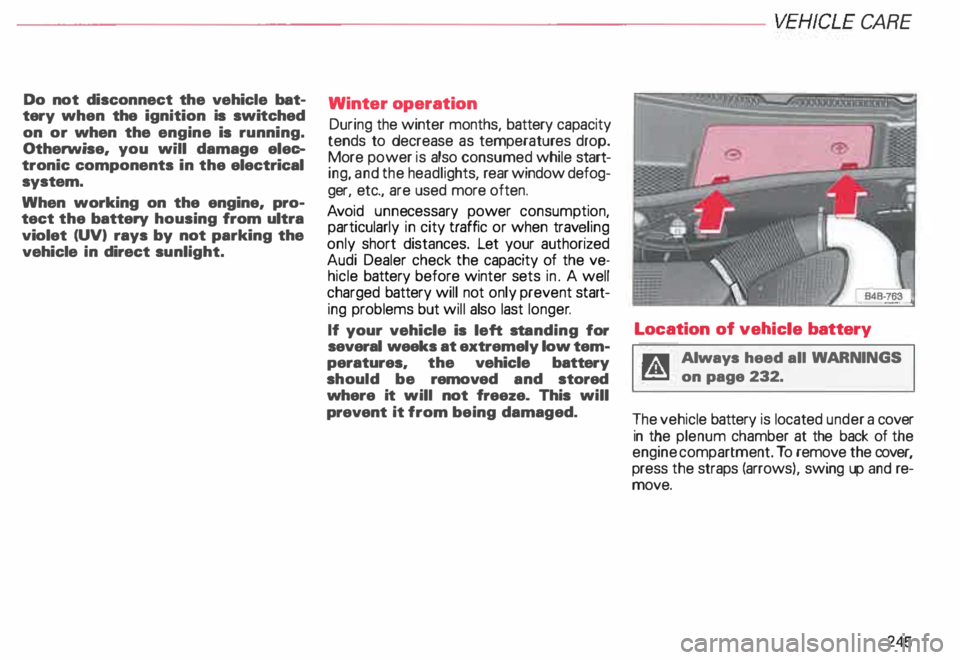
The vehicle battery is located under a cover
in the plenum chamber at the back of the
engine compartment. To remove the cover,
press the straps (arrows ), swing up and re
move.
245
Page 248 of 306
f4 WARNING
continued
• Never charge a frozen battery. It
may explode because of gas
trapped in the ice. Allow a frozen
battery to thaw out first.
• Do not reuse batteries which
have fr ozen. The baUery housing
may have cracked and weakened
when the battery froze.
Always heed all WA RNINGS
on page 232.
• Battery acid that may spill during
charging should be washed off with
a solution of warm water and baking
soda to neutralize the acid.
• Never use a fast charger as a boo
ster to start the engine. This will se
riously damage sensitive electronic
components, such as control units,
relays, radio, etc., as well as the bat
tery charger. Slow
battery charging
�W ARNING
Heed all WA RNINGS and follow in
structions that come with your
battery charger.
• Before charging the battery, switch off
the ignition and all electrical consumers.
• Make sure the area is well ventilated
when you charge the battery.
• It is not necessary to remove the battery
from the engine compartment, and it is also
not necessary to disconn ect the cables.
• Make sure the electrolyte level in each
cell is between the .. min" and "max ..
marks. If the fluid level is below the "min"
mark, let your authorized Audi Dealer cor
rect the condition. VE
HICLE CARE
• Conne ct charger cables.
Charger cables must be connected
POSITIVE (+ ) to POSITIVE (+ ) and
NEGATIVE (-) to NEGATIVE (-).
�W ARNING
To reduce the danger of explosion,
never connect or disconnect char
ger cables while the charger is op
erating.
• Switch on charger.
• Charging rate not over 6 amps.
Normal ly, a battery should be charged at no
more than 1 0 percent of its rated capacity.
For example, a charging current of 4.5 amps
would be used on a battery rated at 45 Ah.
Rated capacity of the battery in your vehicle
is listed on the battery housing.
• After charging, first turn off the charger
and then disconnect charger cables. g Always heed all WARNINGS
� on page 232.
247
Page 249 of 306
VEHICLE CA
RE----------------------------------------------------
When disconnecting and
connecting the battery ...
When you disconnect the vehicle battery
please note the following:
- some data stored in the driver informa-
tion system are erased,
- the clock goes out,
- the factory installed radio locks up,
- the Engine management system,
- the one-touch-u p and one-touch-down
functions of the power windows no lon
ger work,
- all stored seat positions in the memory*
are erased.
Af teryou reconnect the battery, you must
reset the clock. � page 118.
You also have to reset the Engine manage
ment system -see "Starter Switch "
�pa ge 113.
You also have to reset the one-touch-up and
one-touch�down feature on power win
dows -see "Power windows "
�p age 71.
248 You
have also reset the seat memory* -see
"Seats"
� page 81.
The radio must be re-coded with the correct
radio code - see your radio Operating In
structions.
Replacement battery
A replacement battery must have the same
specifications and dimensions as the origi
nal equipment battery. Specifications are
listed on the battery housing.
When installing the battery, make sure the
ignition and all electrical consumers are
switched off.
r.Gb. Because of the problem of �proper di
sposal of a battery, we
recommend that you have your au
thorized Audi Dealer change the
battery for you. Batteries contain
sulfuric acid and lead and must al
ways be disp osed of properly ob
serving all environmental regula
tions. Air
cleaner
A dir ty air cleaner element not only reduces
the engine output and increases fuel con
sumption considerably but can also cause
premature engine wear.
Normally, it is not necessary to service the
air cleaner more often than recommended
in the Maintenance booklet. If the vehicle is
driven on very dusty roads, the air cleaner
must be serviced more frequently, even dai
ly.
If your air cleaner element must be
changed mora frequently, we rec
ommend that you have the air clean
er serviced by your authorized Audi
Dealer or a qualified workshop.
The air cleaner element must never
be cleaned or soaked with gasoline,
cleaning solvents or oil.
g Always heed all WARN INGS
t!!3 on page 232.
Page 250 of 306
-------------------------VEHICLE
CARE
Spark plugs
Spark plugs are replaced during the Audi
scheduled Maintenance Service.
If you have to replace the spark plugs be
tween the Audi Maintenance services, be
sure to note the following:
• Engine, spark plugs and the ignition sys
tem are matched to each other. To avoid
faulty operation or engine damage, use only
Original Audi spark plugs. It is especially im
portant to note the number of electrodes on
the spark plug and the heat value.
• Since spark plug specifications may
change for technical reasons during a model
year, we recommend that you obtain your
spark plugs from an authorized Audi Dealer,
who has the latest information.
Always heed all WARNINGS
on page 232. Belts
Ribbed V-Belt
The radiator fan, hydraulic pump (power
steering), alternator and air conditioner
compressor are driven by one V-belt.
The installed V-belt conforms to the highest
quality requirements. The V-belt adjusts its
own tension.
Replacing of the V-belt should be
performed by your authorized Audi
Dealer or a qualified workshop.
When replacing a belt, it is not sufficient to
use just any belt of the same size. For safe
and reliable operation, use only Genuine
Audi V-belts specially designed for your ve
hicle. The correct belts can be obta ined at
your authorized Audi Dealer. �W
ARNING
To prevent serious personal inju
ries stay well clear of the V-belt,
The radiator fan and the V-belt
driven accessories when the en
gine is running. The V-belt will be
inspected and replaced by your au
thorized Audi Dealer during a
scheduled Maintenance Service.
Timing belt
• Yo ur engine is equipped with a long last
ing toothed belt. The belt will be in
spected and replaced during a scheduled
Maintenance Service.
Always heed all WA RNINGS
on page 232.
249
Page 251 of 306
VEHI
CLE CA
RE---------------------------------------------------
Windshield I headlight washer container
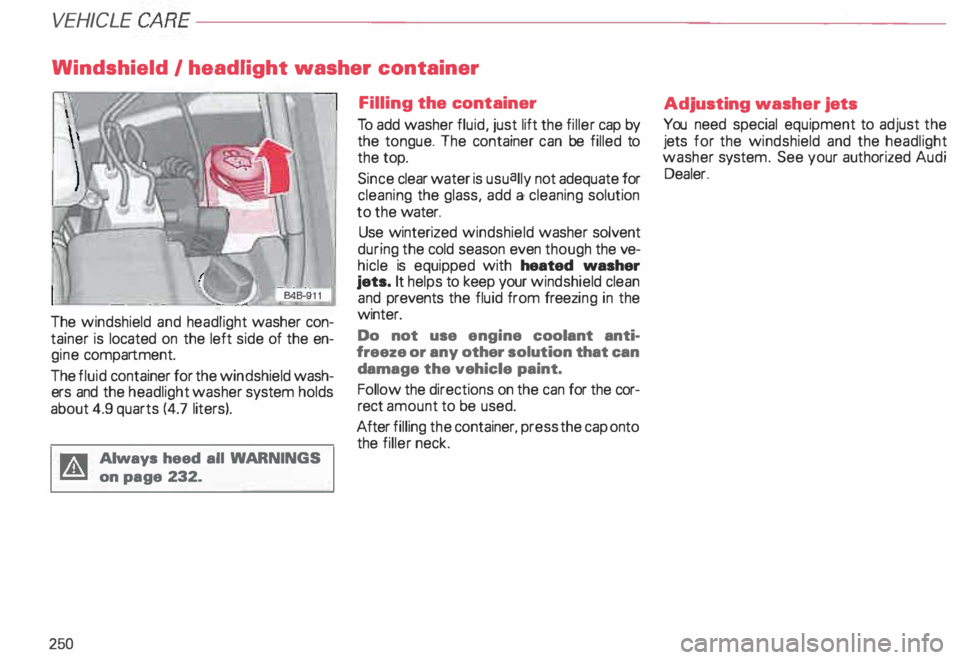
The windshield and headlight washer con
tainer is located on the left side of the en
gine compartment.
The fluid container for the windshield wash
ers and the headlight washer system holds
about 4.9 quarts (4.7 liters).
A Always heed all WAR NINGS
� on page 232.
250 Filling
the container
To add washer fluid, just lift the filler cap by
the tongue. The container can be filled to
the top.
Since clear water is usually not adequate for
cleaning the glass, add a cleaning solution
to the water.
Use winterized windshield washer solvent
during the cold season even though the ve
hicle is equipped with heated washer
jets. It helps to keep your windshield clean
and prevents the fluid from freezing in the
winter.
Do not use engine coolant anti·
freeze or any other solution that can
damage the vehicle paint.
Follow the directions on the can for the cor
rect amount to be used.
After filling the container, press the cap onto
the filler neck. Adjusting
washer jets
You need special equipment to adjust the
jets for the windshield and the headlight
washer system. See your authorized Audi
Dealer.
Page 262 of 306
• Winter tires with studs should be run
only at moderate speeds when new in order
to give the studs time to settle.
Do not drive a vehicle equipped with
winter tires at prolonged high
speed.
Winter tires use a softer rubber compound
and a deeper tread pattern and therefore
have a lower speed rating and reduced trac
tion and durability when used on dry roads.
• When winter tires or all season tires are
mounted, make sure you observe the
speed limitations for which the tire is rated.
The following speed rating code letters are
applicable:
0- up to 1 00 mph (160 km/h)
T- up to 118 mph (190km/h)
H- up to 130 mph (210 lcm/h). �W
ARNING
• Winter tires available for your
vehicle may have a maximum
speed rating which is less than the
maximum speed of your vehicle.
• Driving faster than the maxi
mum speed for which tires are
rated and approved will lead to
sudden tire failure. This can cause
loss of vehicle control and lead to
an accident and personal injury.
• Never operate a vehicle at
speeds greater than the maximum
speed rating of its tires.
• Always observe speed limits
and adjust your vehicle to prevail
ing road and traffic conditions.
Snow chains
• For engineering reasons, snow chains
must only be installed on special winter ti
res• 1).
11 Not available at the time of printing. VEHI
CLE CARE
• If you want to mount snow chains
on your vehicle, consult your Audi
Dealer for proper rim I tire combina
tion.
• Snow chains should only be
installed on the rear wheels, never
on the front wheels.
Where snow chains are mandatory
on certain roads, this normally also
applies to vehicles with All Wheel
Drive.
When you install snow chains,
check the tire air pressure first to
make sure it's correct, otherwise the
chains will not fit the wheel prop
erly.
Only use chains with fine pitch links protrud
ing no more than 1h inch (15 mm), including
tensioner, from tire tread and side walls.
Wheels must rotate freely in all steering
positions with chains mounted to prevent
damage to body, axle or brake components.
Drive slowly and follow the chain
manuf acturer's instructions.
Remove chains when roads are free of
snow. Otherwise, the chains can damage
the tires and impair vehicle handling.
261
Page 265 of 306
DO-IT-Y
OURSELF SERVICE----------------------
Jack and
tools
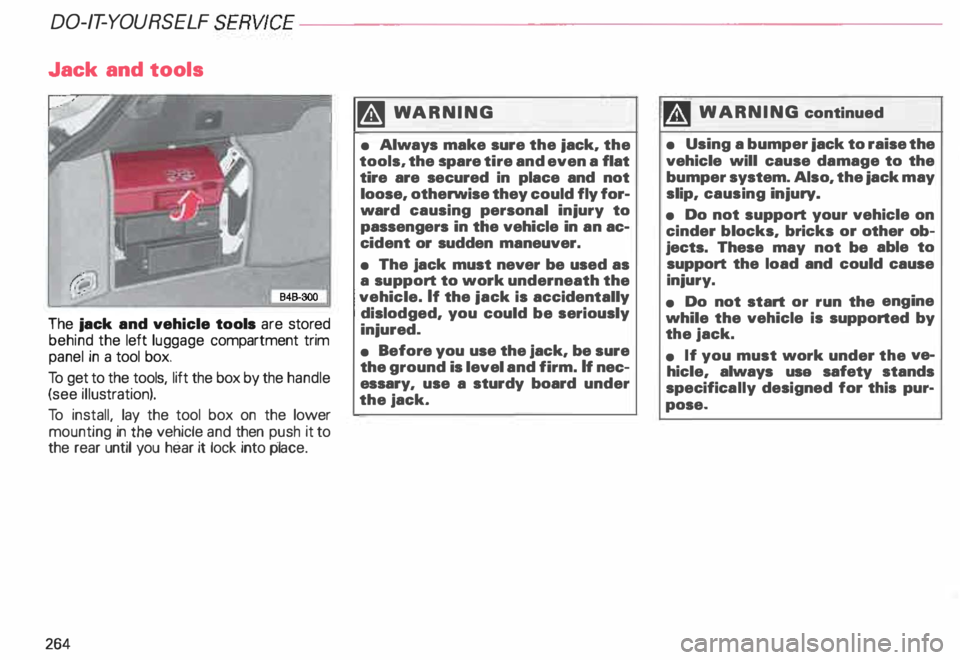
The jack and vehicle tools are stored
behind the left luggage compartment trim
panel in a tool box.
To get to the tools, lift the box by the handle
(see illustration).
To install, lay the tool box on the lower
mounting in the vehicle and then push it to
the rear until you hear it lock into place.
264 �W
ARNING
• Always make sure the jack. the
tools, the spare tire and even a flat
tire are secured in place and not
loose, otherwise they could fly for
ward causing personal injury to
passengers in the vehicle in an ac
cident or sudden maneuver.
• The jack must never be used as
a support to work underneath the
vehicle. If the jack is accidentally
dislodged, you could be seriously
injured.
• Before you use the jack, be sure
the ground is level and firm. If nec
essary, use a sturdy board under
the jack.
, ... WARNING continued
• Using a bumper jack to raise the
vehicle will cause damage to the
bumper system. Also, the jack may
slip, causing injury.
• Do not support your vehicle on
cinder blocks, bricks or other ob
jects. These may not be able to
support the load and could cause
injury.
• Do not start or run the engine
while the vehicle is supported by
the jack.
• If you must work under the ve
hicle, always usa safety stands
specifica lly designed for this pur
pose.
Page 267 of 306
DO-IT-YOURSELF
SERVICE----------------------
Spare wheel
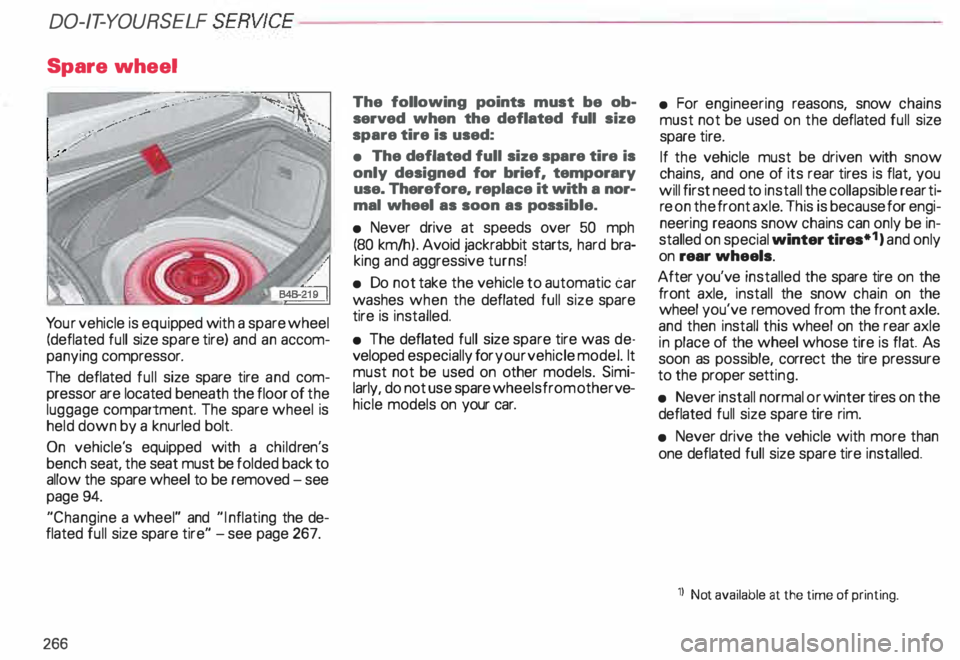
Yo ur vehicle is equip ped with a spare wheel
(deflated full size spare tire) and an accom
panying compressor.
The deflated full size spare tire and com
pressor are located beneath the floor of the
luggage compartment. The spare wheel is
held down by a knurled bolt.
On vehicle' s equipped with a childr en's
bench seat, the seat must be folded back to
allow the spare wheel to be removed -see
page 94.
"Changine a wheel" and "Inflating the de
flated full size spare tire" -see page 267.
266 The
following points must be ob
served when the deflated full size
spare tire is used:
• The deflated full size spare tire is
only designed for brief, temporary
use. Therefore, replace it with a nor
mal wheel as soon as poss ible.
• Never drive at speeds over 50 mph
(80 km/h). Avoid jackrabbit starts, hard bra
king and aggressive turns!
• Do not take the vehicle to automatic car
washes when the deflated full size spare
tire is installed.
• The deflated full size spare tire was de
veloped especially for your vehicle model. It
must not be used on other models. Simi
larly, do not use spare wheels from other ve
hicle models on your car. •
For engineering reasons, snow chains
must not be used on the deflated full size
spare tire.
If the vehicle must be driven with snow
chains, and one of its rear tires is flat, you
will first need to install the collapsible rear ti
re on the front axle. This is because for engi
neering reaons snow chains can only be in
stalled on special winter tires*1) and only
on rear wheels.
After you've installed the spare tire on the
front axle, install the snow chain on the
wheel you've removed from the front axle.
and then install this wheel on the rear axle
in place of the wheel whose tire is flat. As
soon as possible, correct the tire pressure
to the proper setting.
• Never install normal or winter tires on the
deflated full size spare tire rim.
• Never drive the vehicle with more than
one deflated full size spare tire installed.
11 Not available at the time of printing.