boot AUDI Q2 2021 Owner´s Manual
[x] Cancel search | Manufacturer: AUDI, Model Year: 2021, Model line: Q2, Model: AUDI Q2 2021Pages: 364, PDF Size: 87.77 MB
Page 64 of 364
Seats and storage
A WARNING
Applies to: vehicles with coat hooks
- Make sure
that
any items of clothing hang
ing from the coat hooks do not obstruct
your view to the rear.
- Only use the coat hooks for light items of
clothing and make sure that there are no
heavy or sharp objects in the pockets.
- Do not use clothes hangers to hang up the
clothing,
as this could interfere with the
function of the head-protection airbags.
Luggage compartment
General notes
A
WARNING
Please refer to the important safety notes on
<=>page
272, Stowing luggage safely.
Luggage compartment cover
Applies to: vehicles with luggage compartment cover
The
luggage compartment cover blocks the view
into the luggage compartment.
c
Fig.
57
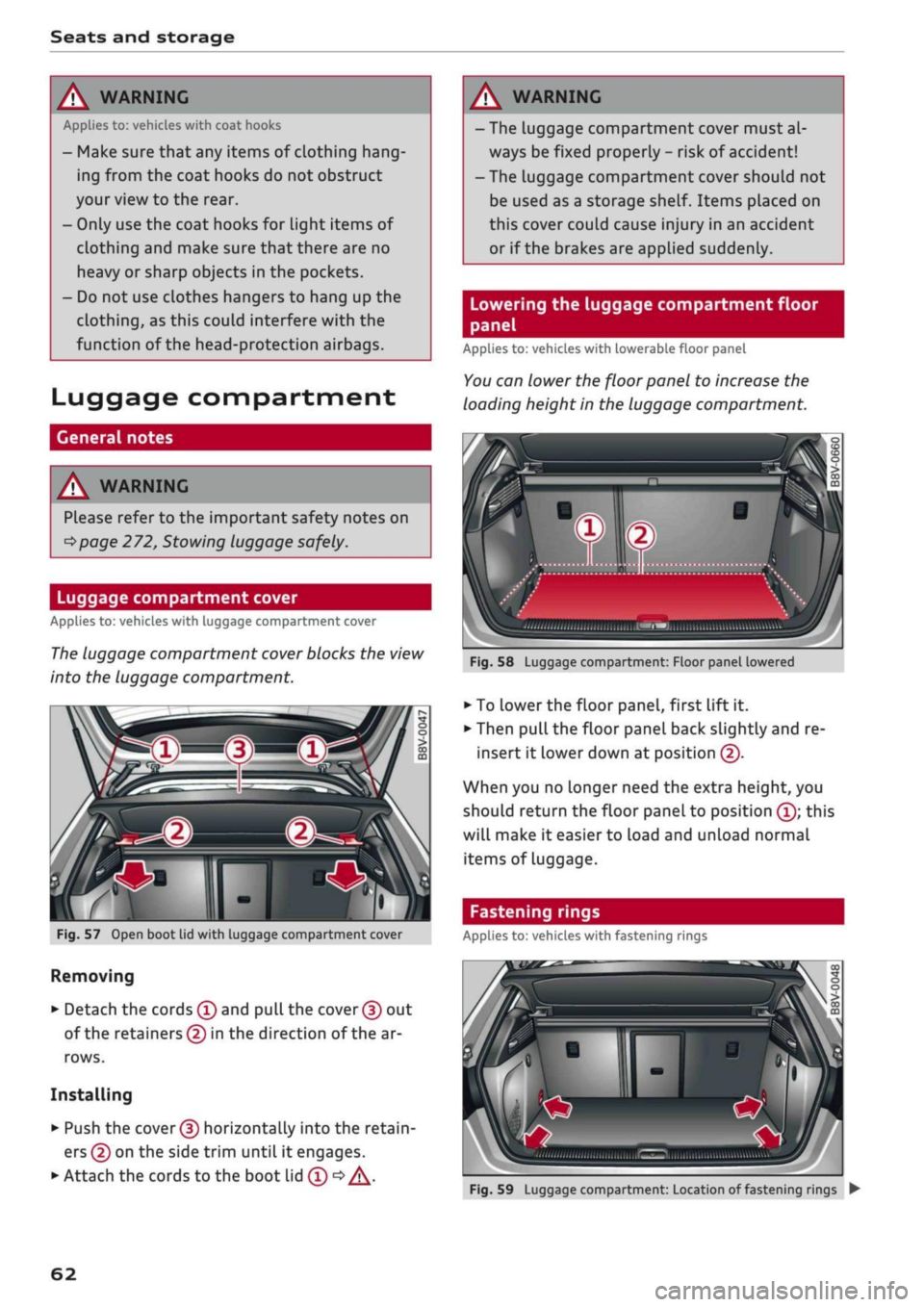
Open boot lid with luggage compartment cover
Removing
• Detach the cords
(f)
and
pull
the
cover (f)
out
of the retainers (5) in the direction of the ar
rows.
Installing
• Push the
cover (D
horizontally into the retain
ers
(?)
on the side trim until
it
engages.
• Attach the cords to the boot lid
(T) •=>
A.
A WARNING
- The luggage compartment cover must al
ways be fixed properly
-
risk of accident!
- The luggage compartment cover should not
be used as a storage shelf. Items placed on
this cover couLd cause injury in an accident
or if the brakes are applied suddenly.
Lowering the luggage compartment floor
panel
Applies to: vehicles with lowerable floor panel
You
can lower the floor panel to increase the
loading height in the luggage compartment.
'•iii.nii,,,,
,„„„
„„,,
iilSMBIiimi
ulwu'l
Fig.
58
Luggage compartment: Floor panel lowered
• To
Lower
the floor panel, first lift
it.
• Then pull the floor panel back slightly and re
insert
it
lower down at position
(f).
When you no longer need the extra height, you
should return the floor panel to position
(Î);
this
will make
it
easier to load and unload normal
items of Luggage.
Fastening rings
Applies to: vehicles with fastening rings
Fig.
59
Luggage compartment: Location of fastening rings
•
62
Page 67 of 364
Seats and storage
CO
rN
rN
•-i
00
roof load limit applies to the combined weight
of the roof carrier, the additional elements and
the Load itself. Please do not exceed the maxi
mum carrying load of the carrier system you are
using.
A WARNIN
- Note the fitting instructions provided by the
manufacturer of the roof carrier system. If
you do not secure the roof carrier system
and roof load correctly, they can become
separated from the vehicle and cause an ac
cident.
- The use of
a
roof carrier system affects the
vehicle's handling by shifting the centre of
gravity and increasing susceptibility to cross
winds - risk of accident! Take extra care
when driving and adjust your speed accord
ingly.
CAUTION
- Any damage to the vehicle caused by the
use of other types of roof rack or incorrect
installation will not be covered by the facto
ry warranty. The roof carrier system must
therefore be installed exactly according to
the instructions provided.
- Please take care that the boot lid and panor
ama sun roof* do not come into contact
with the roof load when opened.
(•)
For
the sake of the environment
The increased air resistance means that the
vehicle uses more
fuel.
For this reason you
should always take off the roof carrier when it
is not in use.
65
Page 95 of 364
Driving
CO
< o rN
iv
rN
i—i
00
Releasing the selector lever manually (left-
hand drive vehicles)
Applies to: vehicles with automatic gearbox
The
selector lever can be released manually if
the electrical power supply should
fail.
K
Fig.
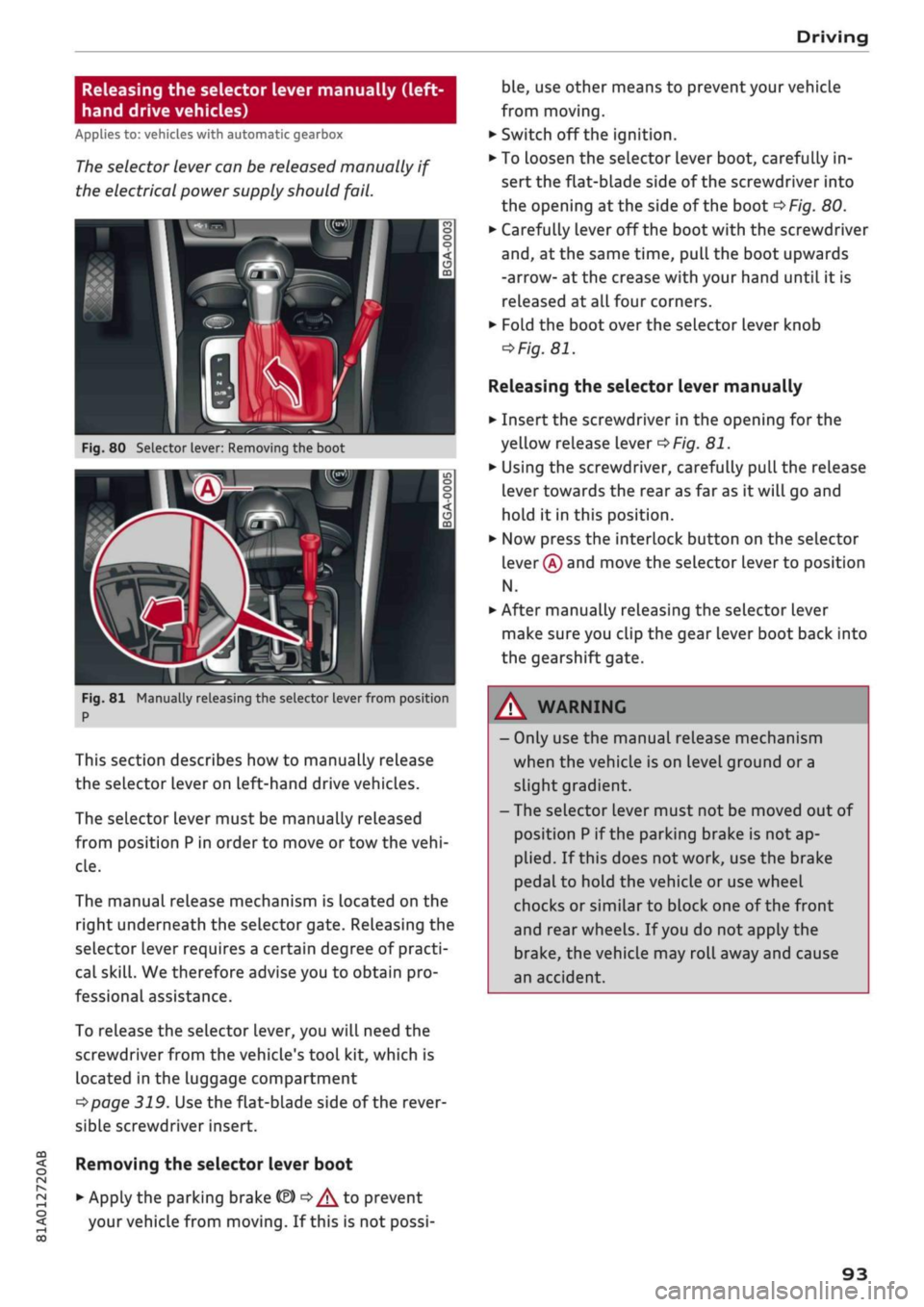
80 Selector lever: Removing the boot
Fig.
81 Manually releasing the selector lever from position
P
This section describes how to manually release
the selector Lever on Left-hand drive vehicles.
The selector lever must be manually released
from position
P
in order to move or tow the
vehi
cle.
The manual release mechanism is Located on the
right underneath the selector gate. Releasing the
selector lever requires a certain degree of practi
cal
skill.
We therefore advise you to obtain pro
fessional assistance.
To release the selector lever, you
wilL
need the
screwdriver from the vehicle's tool kit, which is
located in the luggage compartment
^>page
319. Use the flat-blade side of the rever
sible screwdriver insert.
Removing the selector lever boot
• Apply the parking brake
& ^/^
to prevent
your vehicle from moving. If this is not possi
ble,
use other means to prevent your vehicle
from moving.
•
Switch off the ignition.
• To loosen the selector lever boot, carefully in
sert the flat-blade side of the screwdriver into
the opening
at
the side of the boot
^>Fig.
80.
•
Carefully lever off the boot with the screwdriver
and,
at the same time, pull the boot upwards
-arrow- at the crease with your hand until it is
released at all four corners.
•
Fold the boot over the selector lever knob
=>
Fig.
81.
Releasing the selector lever manually
•
Insert the screwdriver in the opening for the
yellow release lever
^>Fig.
81.
•
Using the screwdriver, carefully pull the release
lever towards the rear as far as it will go and
hold it in this position.
•
Now press the interlock button on the selector
lever
®
and move the selector lever to position
N.
•
After manually releasing the selector lever
make sure you clip the gear lever boot back into
the gearshift gate.
A WARNING
- Only use the manual release mechanism
when the vehicle is on level ground or a
slight gradient.
- The selector lever must not be moved out of
position
P
if the parking brake is not ap
plied.
If this does not work, use the brake
pedal to hold the vehicle or use wheel
chocks or similar to block one of the front
and rear wheels. If
you
do not apply the
brake,
the vehicle may roll away and cause
an accident.
93
Page 96 of 364
Driving
Releasing the selector lever manually
(right-hand drive vehicles)
Applies to: vehicles with automatic gearbox
The
selector lever can be released manually if
the electrical power supply should
fail.
n
Fig.
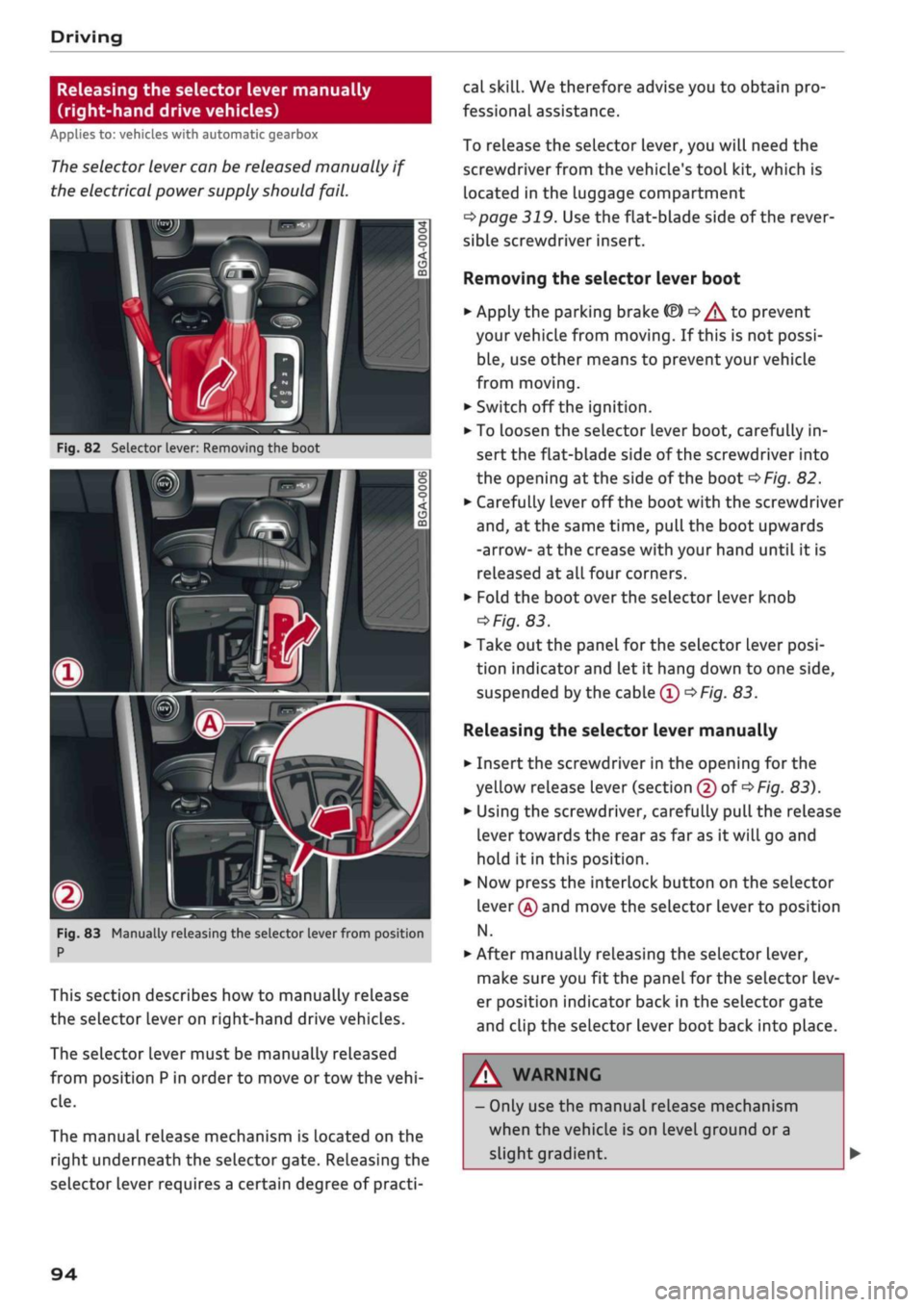
82 Selector lever: Removing the boot
m
i
Fig.
83 Manually releasing the selector lever from position
P
This section describes how to manually release
the selector lever on right-hand drive vehicles.
The selector lever must be manually released
from position
P
in order to move or tow the
vehi
cle.
The manual release mechanism is located on the
right underneath the selector gate. Releasing the
selector lever requires a certain degree of practi
cal
skill.
We therefore advise you to obtain pro
fessional assistance.
To release the selector lever, you will need the
screwdriver from the vehicle's tool kit, which is
located in the luggage compartment
^>page
319. Use the flat-blade side of the rever
sible screwdriver insert.
Removing the selector lever boot
•
Apply the parking brake fâ)
o^
to prevent
your vehicLe from moving. If this is not possi
ble,
use other means to prevent your vehicle
from moving.
•
Switch off the ignition.
• To Loosen the selector lever boot, carefully in
sert the flat-blade side of the screwdriver into
the opening
at
the side of the boot
^>Fig.
82.
*•
Carefully lever off the
boot
with the screwdriver
and,
at the same time, pull the boot upwards
-arrow- at the crease with your hand until it is
released at
alL
four corners.
•
Fold the boot over the selector lever knob
^Fig.
83.
•
Take out the panel for the selector Lever
posi
tion indicator and Let it hang down to one side,
suspended by the cable
0 •=>
Fig.
83.
Releasing the selector lever manually
•
Insert the screwdriver in the opening for the
yellow release lever (section
@
of
<$
Fig.
83).
•
Using the screwdriver, carefully pull the release
lever towards the rear as far as it will go and
hold it in this position.
•
Now press the interlock button on the selector
lever
@
and move the selector Lever to position
N.
•
After manually releasing the selector lever,
make sure you fit the panel for the selector lev
er position indicator back in the selector gate
and clip the selector lever boot back into place.
A WARNING
- Only use the manual release mechanism
when the vehicle is on level ground or a
slight gradient.
94
Page 139 of 364
Parking aids
Reversing camera
CO
<
O
rN
iv
rN
t-H
o < 00
Introduction
Applies to: vehicles with reversing camera
Fig.
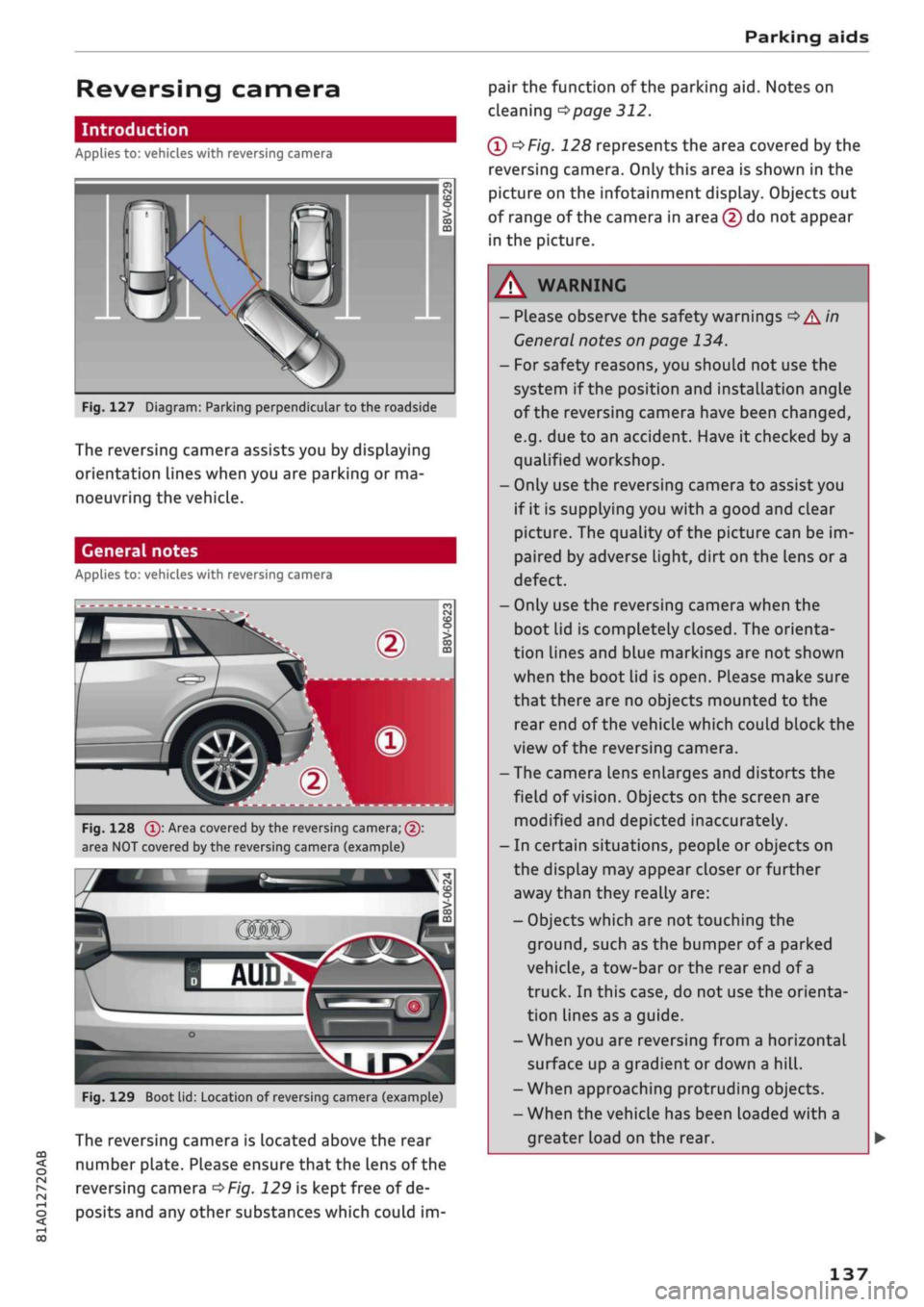
127 Diagram: Parking perpendicular to the roadside
The reversing camera assists you by displaying
orientation lines when you are parking or ma
noeuvring the vehicle.
General notes
Applies to: vehicles with reversing camera
Fig.
128
®
: Area covered by the reversing camera;
@:
area NOT covered by the reversing camera (example)
Fig.
129 Boot lid: Location of reversing camera (example)
The reversing camera is located above the rear
number plate. Please ensure
that
the lens of the
reversing camera
^>Fig.
129 is
kept
free of de
posits and any other substances which could im
pair the function of the parking aid. Notes on
cleaning
^>page
312.
Q)c$Fig.
128 represents the area covered
by
the
reversing camera. Only this area is shown in the
picture on the infotainment display. Objects out
of range of the camera in area (2) do not appear
in the picture.
WARNING
-Please observe the safety warnings
oA'fi
General notes on page 134.
- For safety reasons, you should not use the
system if the position and installation angle
of the reversing camera have been changed,
e.g.
due to an accident. Have it checked by a
qualified workshop.
- Only use the reversing camera to assist you
if it is supplying you with a good and clear
picture. The quality of the picture can be im
paired by adverse light, dirt on the lens or a
defect.
- Only use the reversing camera when the
boot lid is completely closed. The orienta
tion lines and blue markings are not shown
when the boot lid is open. Please make sure
that there are no objects mounted to the
rear end of the vehicle which could block the
view of the reversing camera.
- The camera lens enlarges and distorts the
field of
vision.
Objects on the screen are
modified and depicted inaccurately.
- In certain situations, people or objects on
the display may appear closer or further
away than they really are:
- Objects which are not touching the
ground,
such as the bumper of
a
parked
vehicle, a tow-bar or the rear end of
a
truck. In this case, do not use the orienta
tion Lines as a guide.
- When you are reversing from a horizontal
surface up a gradient or down a
hill.
-When approaching protruding objects.
- When the vehicle has been loaded with a
greater load on the rear.
137
Page 277 of 364
Safe driving
•
Distribute the load evenly in the luggage com
partment.
•
Place heavy items as far forward as possible in
the luggage compartment and secure them
properly
<^>Fig.
214.
•
Secure the load with the stretch net* or with
non-elastic straps secured to the fastening
rings
^>page
62.
© CAUTION
A WARNING
- Loose items in the luggage compartment
are a safety hazard: they can move suddenly
and impair the handling of the vehicLe as a
result of the change in weight distribution.
- In an accident or a sudden manoeuvre, loose
objects in the passenger compartment can
be flung forward - risk of injury! Always
stow objects safely in the luggage compart
ment and secure them on the fastening
rings.
Use suitable securing straps, particu
larly when transporting heavy objects.
- Transporting heavy objects may affect the
vehicle's handling by shifting the centre of
gravity - this could cause an accident. Take
extra care when driving and adjust your
speed accordingly.
- Never exceed the maximum axle loads or
the maximum gross weight for the vehicLe
^>page
342. Exceeding the permitted axle
loads or gross weight Limit can affect the ve
hicle's handling characteristics, and increase
the risk of accidents, personal injuries or
damage to the vehicle.
- Never leave your vehicLe unattended when
the boot lid is open. Children could climb in
to the boot and close the boot lid from the
inside.
In this case the child would be un
able to get out of the vehicle without help.
This could have fatal consequences.
- Never allow children to play in or around the
vehicle. Always close and lock the boot lid
and all the doors when you leave the
vehi
cle.
- Never let passengers ride in the luggage
compartment. All occupants must be prop
erly restrained by the seat belts at all times
•=>
page
27'5.
Make sure that no hard objects chafe against
the wires of the heating element in the rear
window and damage them.
©
Note
- The tyre pressure must be adjusted accord
ing to the load the vehicle is carrying
<^>page
307.
- Air circulation in the vehicle helps reduce
fogging of the windows. Used air escapes
through ventilation slots in the rear of the
vehicle. Make sure that these ventilation
slots are not obstructed.
- Suitable belts for securing loads to the fas
tening rings* are commercially available.
Fastening rings
Unsecured loads are a hazard to all vehicle occu
pants.
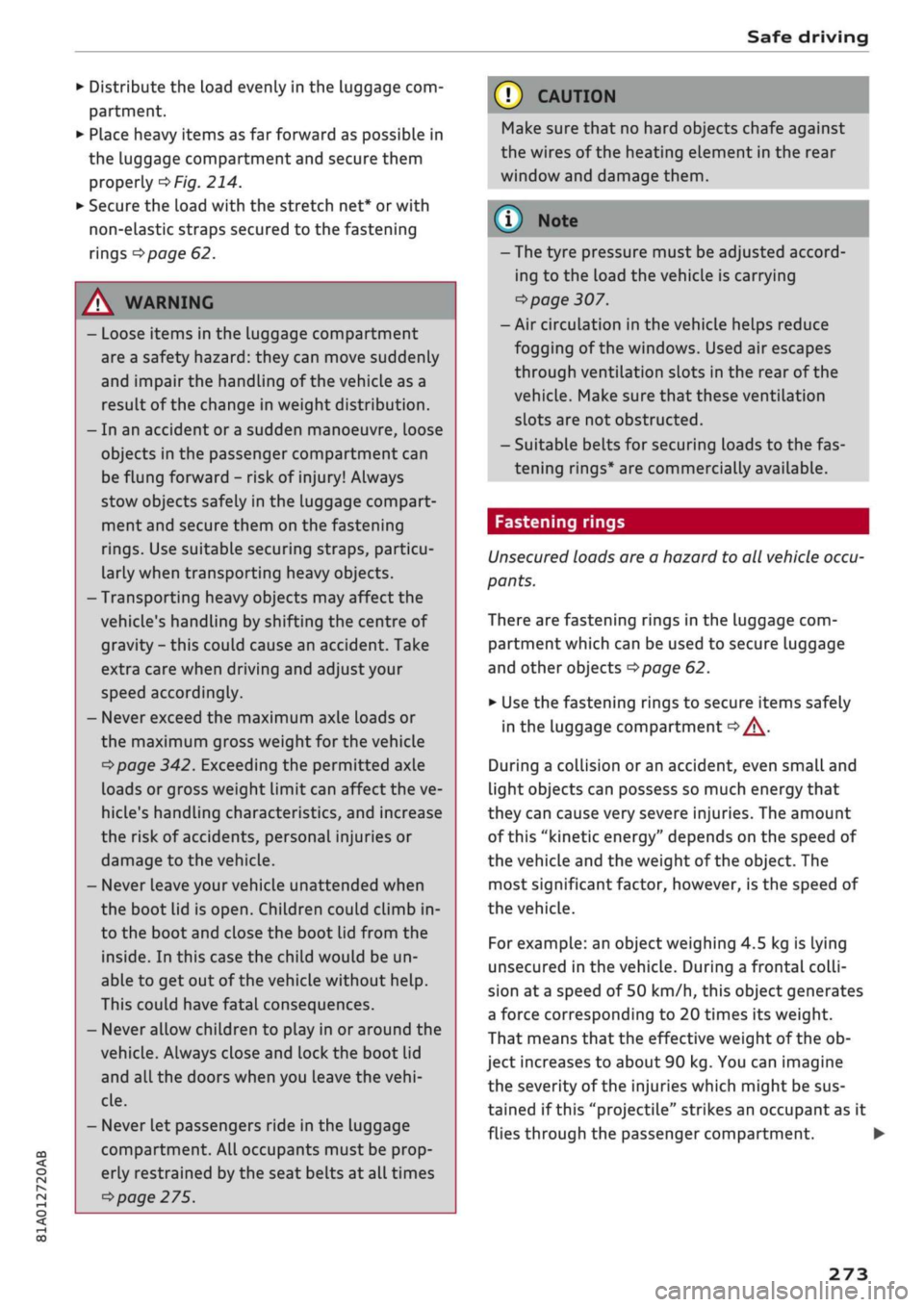
There are fastening rings in the luggage com
partment which can be used to secure luggage
and other objects
^>page
62.
•
Use the fastening rings to secure items safely
in the luggage compartment
<=> A.
During a collision or an accident, even small and
light objects can possess so much energy that
they can cause very severe injuries. The amount
of this "kinetic energy" depends on the speed of
the vehicLe and the weight of the object. The
most significant factor, however, is the speed of
the vehicLe.
For example: an object weighing 4.5 kg is lying
unsecured in the vehicle. During a frontal
colli
sion at a speed of 50 km/h, this object generates
a force corresponding to 20 times its weight.
That means that the effective weight of the ob
ject increases to about 90 kg. You can imagine
the severity of the injuries which might be sus
tained if this "projectile" strikes an occupant as it
flies through the passenger compartment. •
00
273
Page 316 of 364
Care of vehicle and cleaning
Care of vehicLe and
cleaning
General notes
Regular and careful care helps to maintain the
value of the vehicLe. This may also be one of the
requirements for upholding any warranty claims
in the event of corrosion or paint defects.
Qualified workshops carry stocks of suitable car
care products. PLease
foLLow
the instructions for
use on the packaging.
A WARNING
- Cleaning products and other materials used
for car care can damage health if misused.
- Car care products can contain toxic substan
ces and must always be kept in a safe place
out of reach of children.
+) For
the sake of the environment
- Please choose care products that are not
harmful to the environment.
- Surplus cleaning materials should not be
disposed of together with ordinary house
hold waste.
Washing the vehicle
The longer residues like insects, bird droppings,
resinous tree sap or road salt are alLowed to re
main on the vehicle, the more damage they can
do to the paintwork. High temperatures (for in
stance in direct sunlight) further intensify the
damage.
Before washing, soak heavy dirt with plenty of
water.
Stubborn dirt, such as bird droppings or resinous
tree sap, is best removed with plenty of water
and a micro-fibre cloth.
After the period when salt is put on the roads,
have the underside of the vehicLe washed thor
oughly.
High-pressure cleaners
When cleaning the vehicle with a high-pressure
cleaner, always follow the operating instructions
for the equipment. This applies particularly to
the operating pressure and the spraying dis
tance.
Do not point the spray jet directly at the
seals on the windows, doors, boot lid, bonnet or
panorama sun roof*, or at the tyres, rubber ho
ses,
insulating material, sensors* or camera
len
ses*.
Maintain a distance of at least 40 cm.
Do not use a high-pressure cleaner to remove
snow and ice.
Never use high-pressure cleaners with a round-
jet nozzle or "dirt blasters".
The water must not be hotter than 60 °C.
Automatic car washes
Spray the vehicle with water before washing.
Ensure that the windows and panorama sun roof*
are closed and that the windscreen wipers are
switched off. Follow the car wash operator's rules
and recommendations, especially if any accesso
ries are attached to your vehicle.
If possibLe use a brushless car wash.
Washing by hand
Clean the car with a soft sponge or brush, start
ing on the roof and working down. Use solvent-
free cleaning agents.
Washing matt-painted vehicles by hand
To avoid damaging the paintwork when washing
the car, first remove any dust, sand and grit. In
sects,
grease stains and fingerprints are best re
moved using a special cleaning agent for matt-
painted surfaces.
Apply the product with a micro-fibre cloth. Do
not apply too much pressure to avoid damaging
the paintwork.
Rinse the car thoroughly with water. Then clean
the car with a neutral shampoo and a soft micro-
fibre cloth.
Rinse the car with lots of water again and then
let it dry in the air. Remove any water stains with
a chamois. •
312
Page 322 of 364
Mobility
Mobility
General notes
•
If your vehicle experiences technical problems,
stop the car well away from moving traffic. If
you have a flat tyre, you should park the car on
a level surface. Be particularly careful if you are
on a slope.
•
Apply the parking brake.
•
Switch the hazard warning lights on.
•
Put on a high-visibility vest if one is available.
•
Place the warning triangle in a visible location
tapage
318.
•
Instruct all passengers to leave the car when it
is safe to do so. They should wait in a safe place
(for instance behind the roadside crash barrier).
A
WARNING
You should note the procedure described
above for your own safety and that of other
road users.
Equipment
Warning triangle
Applies to: vehicles with warning triangle
w®
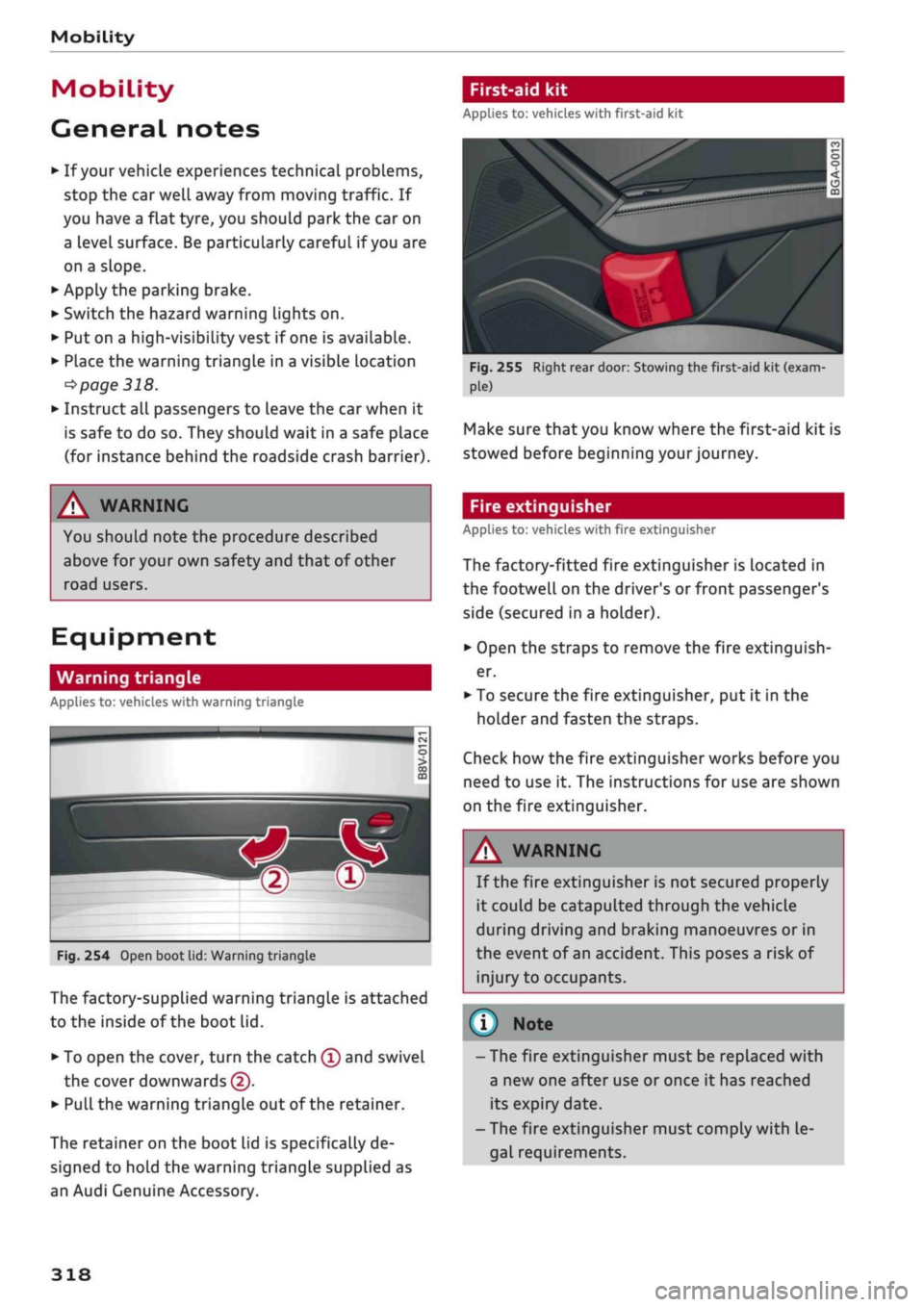
Fig.
254 Open boot lid: Warning triangle
The factory-supplied warning triangle is attached
to the inside of the boot lid.
• To open the cover, turn the catch
©
and swivel
the cover downwards (5).
• Pull
the warning triangle out of the retainer.
The retainer on the boot lid is specifically de
signed to hold the warning triangle supplied as
an Audi Genuine Accessory.
First-aid kit
Applies to: vehicles with first-aid kit
V
Fig.
255 Right rear door: Stowing the first-aid kit (exam
Make sure that you know where the first-aid kit is
stowed before beginning your journey.
Fire extinguisher
Applies to: vehicles with fire extinguisher
The factory-fitted fire extinguisher is located in
the footwell on the driver's or front passenger's
side (secured in a holder).
•
Open the straps to remove the fire extinguish
er.
•
To secure the fire extinguisher, put it in the
holder and fasten the straps.
Check how the fire extinguisher works before you
need to use it. The instructions for use are shown
on the fire extinguisher.
A WARNING
If the fire extinguisher is not secured properly
it could be catapulted through the vehicle
during driving and braking manoeuvres or in
the event of an accident. This poses a risk of
injury to occupants.
© Note
- The fire extinguisher must be replaced with
a new one after use or once it has reached
its expiry date.
- The fire extinguisher must comply with le
gal requirements.
318
Page 323 of 364
Mobility
Tool kit/tyre repair kit/compressor Using the tyre repair kit
Applies to: vehicles with tool kit/tyre repair kit/compressor Applies to: vehicles with tyre repair kit
CO
rN
IV
rN
•-i
00
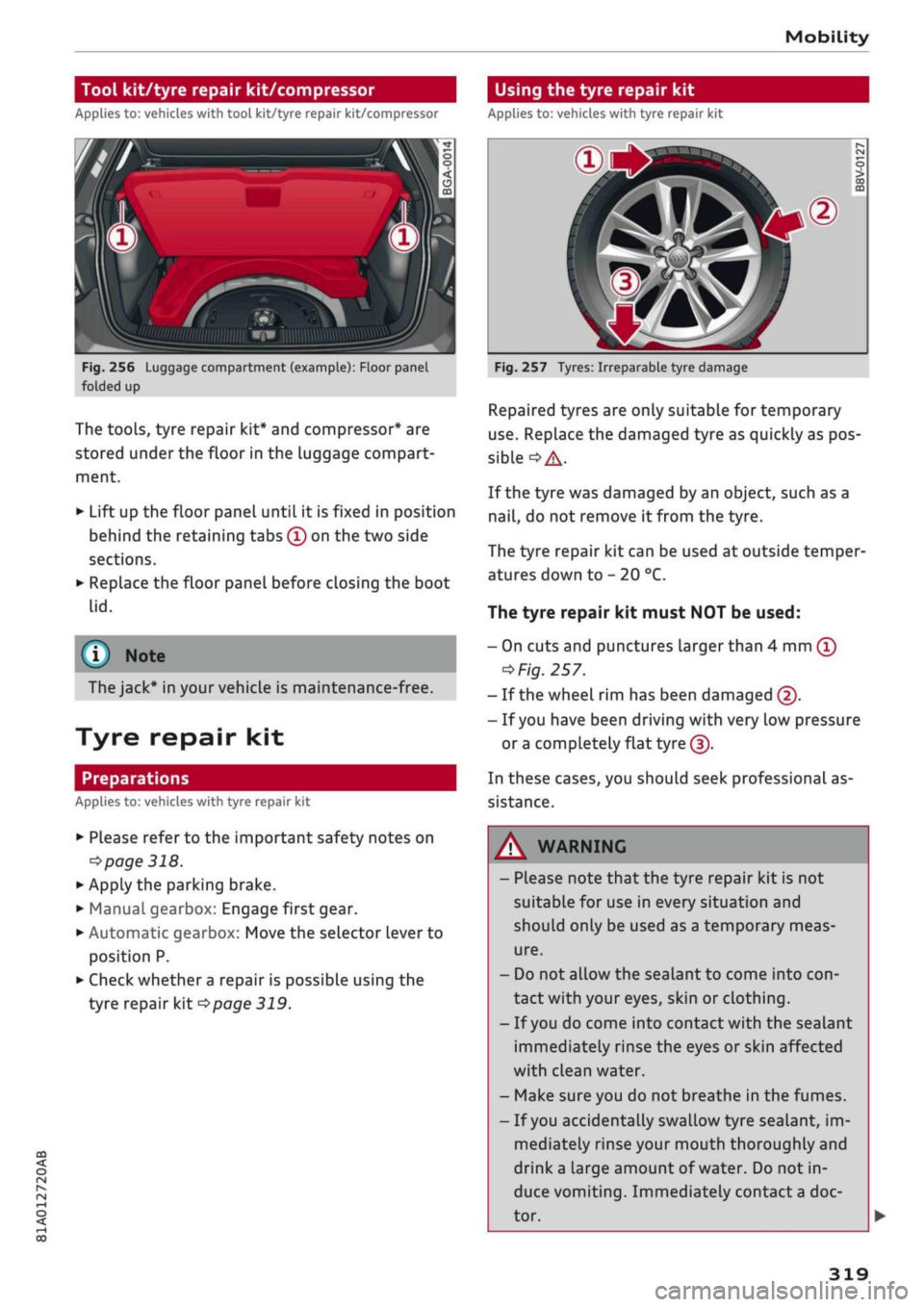
Fig.
256 Luggage compartment (example): Floor panel
folded up
The tools, tyre repair kit* and compressor* are
stored under the floor in the luggage compart
ment.
•
Lift up the floor panel until it is fixed in position
behind the retaining tabs
©
on the two side
sections.
•
Replace the floor panel before closing the boot
lid.
(T)
Note
The jack* in your vehicle is maintenance-free.
Tyre repair kit
Preparations
Applies to: vehicles with tyre repair kit
•
Please refer to the important safety notes on
•=>
page 318.
•
Apply the parking brake.
•
Manual gearbox: Engage first gear.
• Automatic gearbox: Move the selector lever to
position P.
•
Check whether
a
repair is possible using the
tyre repair kit
^page
319.
Fig.
257 Tyres: Irreparable tyre damage
Repaired tyres are only suitable for temporary
use.
Replace the damaged tyre as quickly as pos
sible
°=>A-
If the tyre was damaged by an object, such as a
nail,
do not remove it from the tyre.
The tyre repair kit can be used at outside temper
atures down to - 20 °C.
The tyre repair kit must NOT be used:
- On cuts and punctures larger than 4 mm
©
^Fig.
257.
- If the wheel rim has been damaged ©.
- If
you
have been driving with very low pressure
or a
completely flat
tyre(|).
In these cases, you should seek professional as
sistance.
A
WARNING
- Please note that the tyre repair kit is not
suitable for use in every situation and
should only be used as a temporary meas
ure.
- Do not allow the sealant to come into
con
tact with your eyes, skin or clothing.
- If
you
do come into contact with the sealant
immediately rinse the eyes or skin affected
with clean water.
- Make sure you do not breathe in the fumes.
- If
you
accidentally swallow tyre sealant, im
mediately rinse your mouth thoroughly and
drink
a
large amount of water. Do not in
duce vomiting. Immediately contact
a
doc
tor.
319
Page 337 of 364
Fuses and bulbs
: -•.
-
i:i
m
R2 R3
F22
F-XII
F31
F30
:-:-.'
'.,
FM F43
F49
F!)3
F52
F51
R!,
a
R6
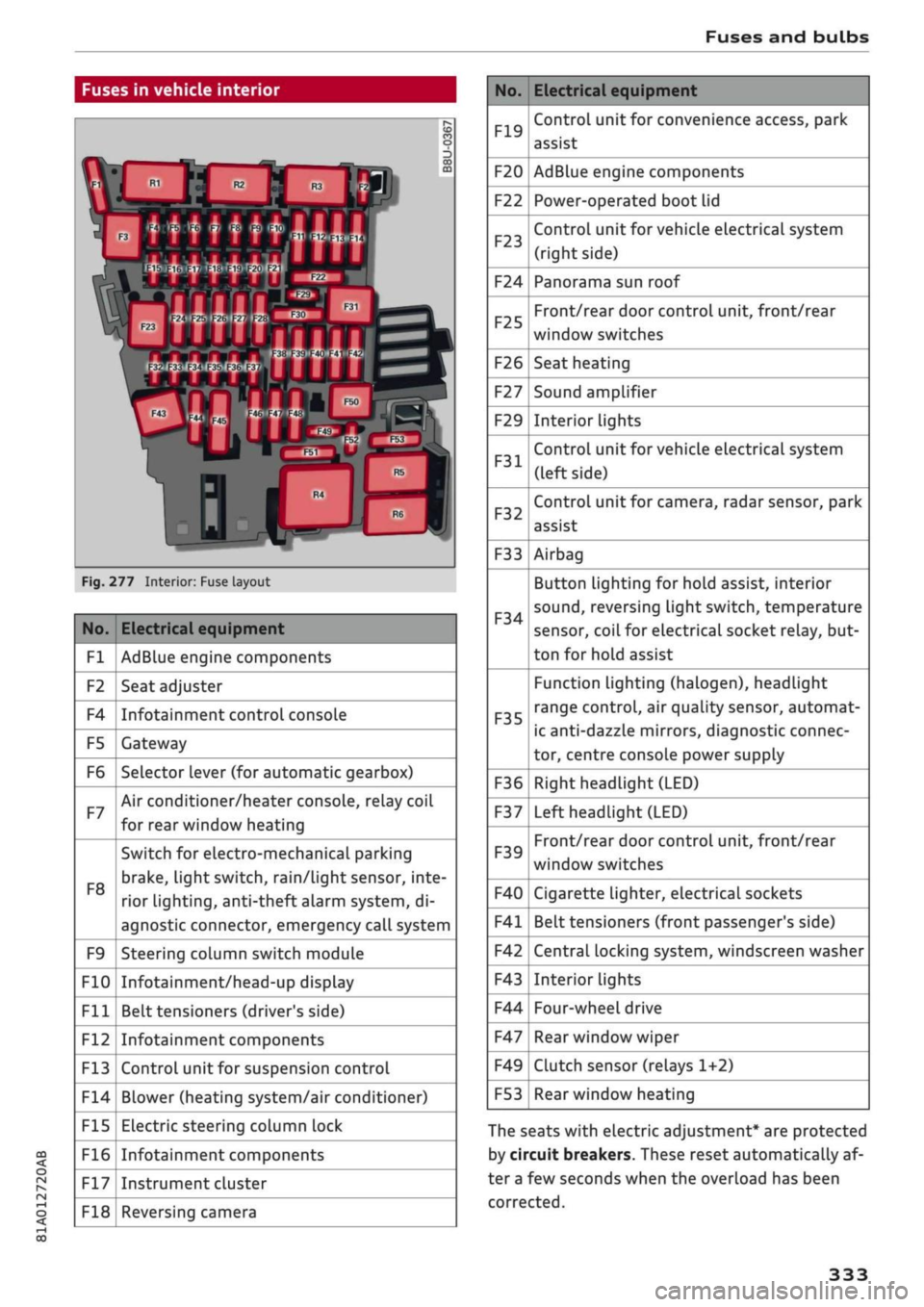
Fig.
277 Interior: Fuse layout
No.
Fl
F2
F4
F5
F6
F7
F8
F9
F10
Fll
F12
F13
F14
F15
F16
F17
F18
Electrical equipment
AdBlue engine components
Seat adjuster
Infotainment control console
Gateway
Selector lever (for automatic gearbox)
Air conditioner/heater console, relay coil
for rear window heating
Switch for electro-mechanical parking
brake,
light switch,
rain/Light
sensor, inte
rior lighting, anti-theft
aLarm
system, di
agnostic connector, emergency call system
Steering column switch module
Infotainment/head-up display
Belt tensioners (driver's side)
Infotainment components
Control unit for suspension control
Blower (heating system/air conditioner)
Electric steering column lock
Infotainment components
Instrument cluster
Reversing camera
No.
F19
F20
F22
F23
F24
F25
F26
F27
F29
F31
F32
F33
F34
F35
F36
F37
F39
F40
F41
F42
F43
F44
F47
F49
F53
Electrical equipment
Control unit for convenience access, park
assist
AdBlue engine components
Power-operated boot lid
Control unit for vehicle electrical system
(right side)
Panorama sun roof
Front/rear door control unit, front/rear
window switches
Seat heating
Sound amplifier
Interior lights
Control unit for vehicle electrical system
(left side)
Control unit for camera, radar sensor, park
assist
Airbag
Button Lighting for hold assist, interior
sound,
reversing light switch, temperature
sensor, coiL for electrical socket reLay, but
ton for hold assist
Function lighting (halogen), headlight
range control, air quality sensor, automat
ic anti-dazzle mirrors, diagnostic connec
tor, centre console power supply
Right headlight (LED)
Left headlight (LED)
Front/rear door control unit, front/rear
window switches
Cigarette lighter, electrical sockets
Belt tensioners (front passenger's side)
Central locking system, windscreen washer
Interior lights
Four-wheel drive
Rear window wiper
Clutch sensor (relays 1+2)
Rear window heating
The seats with electric adjustment* are protected
by circuit breakers. These reset automatically af
ter a few seconds when the overload has been
corrected.
333