warning engine AUDI Q2 2021 Owner´s Manual
[x] Cancel search | Manufacturer: AUDI, Model Year: 2021, Model line: Q2, Model: AUDI Q2 2021Pages: 364, PDF Size: 87.77 MB
Page 330 of 364
Mobility
Removing the bass box (version 2)
Applies to: vehicles with bass box in spare wheel well
You
must remove the bass box before you can
take out the spare wheel*.
f
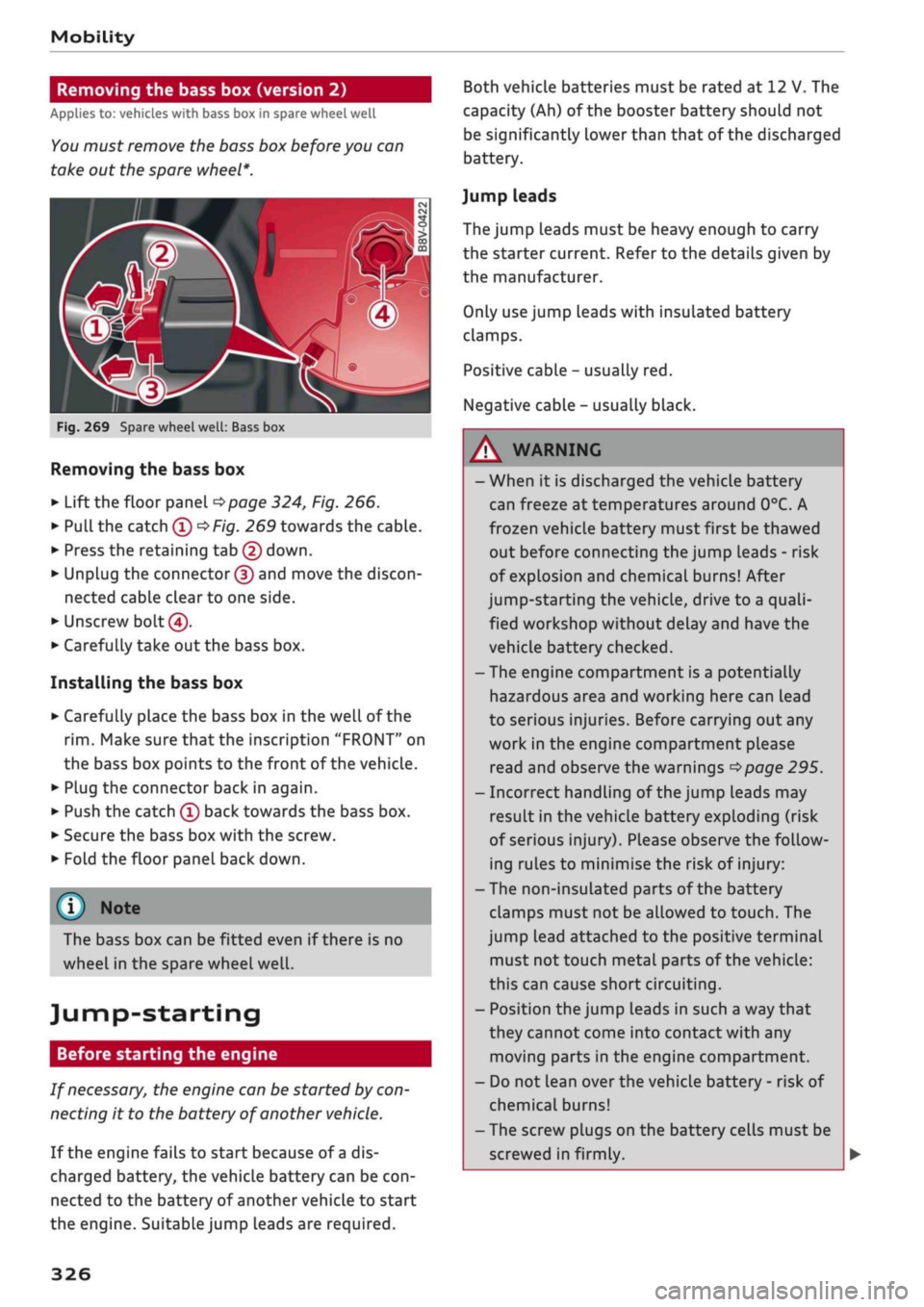
Fig.
269 Spare wheel
well:
Bass box
Removing the bass box
• Lift the floor panel
*page
324, Fig. 266.
•
Pull
the
catch
Q^F/g.
269 towards the cable.
• Press the retaining tab © down.
• Unplug the connector © and move the discon
nected cable clear to one side.
• Unscrew
bolt
(4).
• Carefully take out the bass box.
Installing the bass box
• Carefully place the bass box in the well of the
rim.
Make sure that the inscription "FRONT" on
the bass box points to the front of the vehicle.
• Plug the connector back in again.
• Push the catch © back towards the bass box.
• Secure the bass box with the screw.
• Fold the floor panel back down.
Note
The bass box can be fitted even if there is no
wheel in the spare wheel
welL.
Jump-starting
Before starting the engine
If
necessary,
the engine can be started by con
necting it to the battery of another vehicle.
If the engine fails to start because of
a
dis
charged battery, the vehicle battery can be
con
nected to the battery of another vehicle to start
the engine. Suitable jump leads are required.
Both vehicle batteries must be rated at 12 V. The
capacity (Ah) of the booster battery should not
be significantly lower than that of the discharged
battery.
Jump leads
The jump Leads must be heavy enough to carry
the starter current. Refer to the details given by
the manufacturer.
Only
use
jump leads with insulated battery
clamps.
Positive cable - usually red.
Negative cable - usually black.
WARNING
- When it is discharged the vehicle battery
can freeze at temperatures around 0°C. A
frozen vehicle battery must first be thawed
out before connecting the jump leads - risk
of explosion and chemical burns! After
jump-starting the vehicle, drive to a quali
fied workshop without delay and have the
vehicle battery checked.
- The engine compartment is a potentially
hazardous area and working here can lead
to serious injuries. Before carrying out any
work in the engine compartment please
read and observe the warnings
*page
295.
- Incorrect handling of the jump leads may
result in the vehicLe battery exploding (risk
of serious injury). Please observe the follow
ing rules to minimise the risk of injury:
- The non-insulated parts of the battery
clamps must not be allowed to touch. The
jump lead attached to the positive terminal
must not touch metal parts of the vehicle:
this can cause short circuiting.
- Position the jump leads in such a way that
they cannot come into contact with any
moving parts in the engine compartment.
- Do not lean over the vehicle battery - risk of
chemical burns!
- The screw plugs on the battery cells must be
screwed in firmly.
326
Page 333 of 364

Mobility
CO
rN
IV
rN
•-i
00
Additional notes on towing by breakdown
truck
If one of the axles has to be raised in order to
tow the vehicLe, please refer to the following ta
ble to determine the appropriate axle
for
your
gearbox/drive combination:
Manual
gearbox
Automatic
gearbox
Front-wheel
drive
Front or rear
axle
Front axle
Four-wheel
drive
Front or rear
axle
Front axle
Applies to vehicles with four-wheel drive: If the
vehicle is to be towed with one of the axles
raised,
the ignition must be switched off; other
wise the drive train can be damaged.
Notes on tow-starting
Applies to vehicles with automatic gearbox: For
technical reasons, your vehicle must not be tow-
started.
Applies to vehicles with manual gearbox: As a
general rule, tow-starting is not recommended.
If the engine will not start, it is best to try start
ing it using the battery of another vehicle
*>page
326 before attempting to tow start. If
this is not possible, you can try to push-start or
tow-start the vehicle
*page
330, Tow-starting.
A WARNING
There is a high risk of accidents when towing/
tow-starting, as the towed vehicle can easily
be driven into the towing vehicle.
UTION
- If it is not possible to tow the vehicle as de
scribed above (e.g. due to a gearbox failure
or if the vehicle has to be towed further
than 50 km), it must be transported on a
special car transporter or trailer.
- Towing a vehicle with the wrong axle raised
can cause serious damage to the gearbox.
- Applies to vehicles with automatic gearbox:
It is not possible to move the selector lever
out of position
P
if the electrical power sup
ply fails. Before the vehicle can be recov
ered/manoeuvred you must manually re
lease the selector lever; left-hand drive
vehicles
*page
93, right-hand drive
vehicles
*page
94.
- Please observe the relevant regulations
when towing or tow-starting.
Towing away
Please observe the important safety warnings on
*
page 328.
Preparations
• Attach the tow-rope or the tow-bar only to the
towing anchorages provided
for
this purpose
opage
330,
*page
331.
• Please ensure that the tow-rope is not twisted
as it could otherwise unscrew the towline an
chorage while the vehicle is being towed.
• The hazard warning lights of both vehicles
must normally be switched on
*page
52. How
ever, observe any regulations to the contrary.
Towing vehicle (front)
• Ensure that the tow-rope is taut before you
drive off.
• Manual gearbox: Engage the clutch very gently
when starting to move and accelerate with par
ticular care.
• Automatic gearbox: Accelerate slowly and
grad
ually.
• Avoid unnecessary braking and manoeuvres.
Vehicle being towed (rear)
• Ensure that the ignition is switched on, the
steering wheel is not locked, and
that
you can
operate the turn signals, horn or windscreen
wipers if necessary
<=>/t\-
• The brake servo only works when the engine is
running.
The power steering only works when
329
Page 334 of 364

Mobility
the ignition is on and the vehicle is moving1'.
Otherwise you will need to press the brake
ped
al significantly harder and apply more force to
move the steering wheel.
• Please ensure that the steering wheel is un
locked and that it moves freely.
• Release the parking brake
*page
82.
• Applies to vehicles with manual gearbox: Put
the gear lever in neutral.
• Applies to vehicles with automatic gearbox:
Move the selector lever to position N.
• Ensure that the tow-rope remains taut at all
times when towing.
© CAUTION
A WARNING
If the vehicle has no electrical power, do NOT
use a tow-bar or tow-rope to tow the vehicle
© Note
You can use the turn signals to indicate a
change of direction (or lane) even when the
hazard warning lights are on. The hazard
warning lights will be interrupted temporari-
Ly.
Tow-starting
Please observe the important safety warnings on
*page
328.
Important: Your vehicle must be fitted with a
manual gearbox. If your vehicle has a petrol en
gine,
it must not be towed further than 50 me
tres
*(J).
• Attach the tow-rope or the tow-bar only to the
towing anchorages provided
for
this purpose
*page
330,
*
page 331.
• Engage second or third gear before moving off.
• Press the clutch and hold the pedal down.
• Switch on the ignition.
• Once both vehicles are moving, release the
clutch.
• As soon as the engine starts, press the clutch
pedal and put the gear lever in neutral.
When tow-starting the vehicle, do not tow it
further than 50 metres; otherwise the cata
lytic converter could be damaged.
Front towline anchorage
»
Fig.
271 Front bumper (right side): Removing cover cap
Fig.
272 Front bumper (right side): Towline anchorage
screwed in
The screw connection for the towline anchorage
is located behind a cover cap on the right side of
the front bumper.
• Take the towline anchorage out of the vehicle's
tool kit
*
page 319.
• Press the cover cap briefly but firmly inwards
-arrow-, detach it from the bumper and take it
out*Fig.
271.
• Screw the towline anchorage into the screw
connection as far as
it
will go
*Fig.
272 and
tighten it with the box spanner.
• Put the towline anchorage back in the tool kit
after use.
11
Important: The vehicle battery must be adequately charg
ed.
330
Page 336 of 364
Fuses and bulbs
Fuses and bulbs
Fuses
Changing fuses
To see whether a fuse has blown, check whether
the metal strip has melted.
3
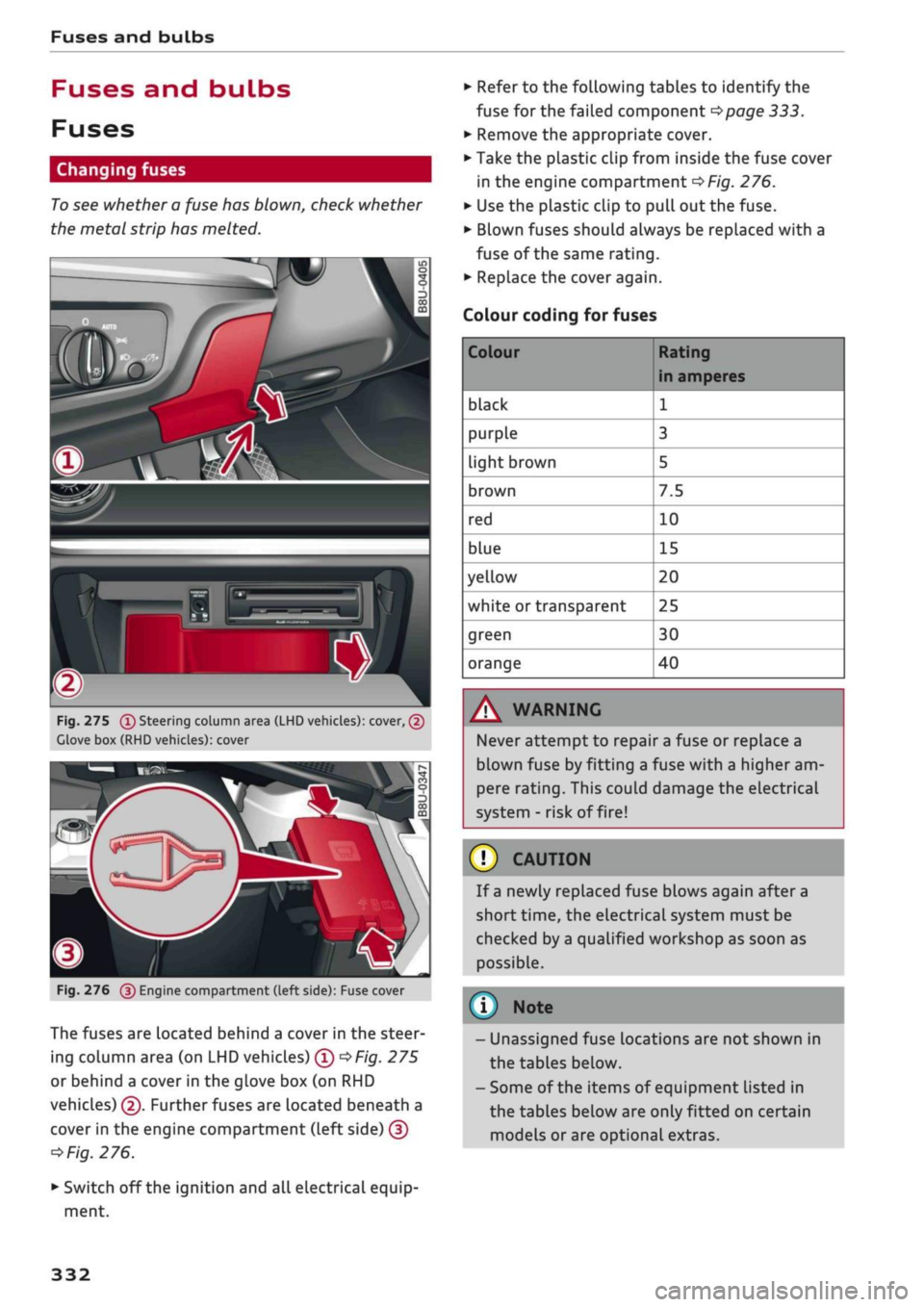
Fig.
275
(T)
Steering column area (LHD vehicles): cover, (2)
Clove box (RHD vehicles): cover
Fig.
276
@
Engine compartment (left side): Fuse cover
The fuses are located behind a cover in the steer
ing column area (on LHD vehicles) ©
*Fig.
275
or behind a cover in the glove box (on RHD
vehicles) ©. Further fuses are located beneath a
cover in the engine compartment (Left side) ©
*
Fig.
276.
• Switch off the ignition and all electrical equip
ment.
• Refer to the following tables to identify the
fuse for the failed component
*page
333.
• Remove the appropriate cover.
• Take the plastic clip from inside the fuse cover
in the engine compartment
*Fig.
276.
• Use the plastic clip to pull out the fuse.
• Blown fuses should always be replaced with a
fuse of the same rating.
• Replace the cover again.
Colour coding for fuses
Colour
black
purple
light brown
brown
red
blue
yellow
white or transparent
green
orange
Rating
in amperes
1
3
5
7.5
10
15
20
25
30
40
A WARNING
Never attempt to repair a fuse or replace a
blown fuse by fitting a fuse with a higher am
pere rating. This could damage the electrical
system - risk of fire!
© CAUTION
If a newly replaced fuse blows again after a
short time, the electrical system must be
checked by a qualified workshop as soon as
possible.
©
- Unassigned fuse locations are not shown in
the tables below.
- Some of the items of equipment listed in
the tables below are only fitted on certain
models or are optional extras.
332
Page 338 of 364
Fuses and bulbs
Fuses in engine compartment
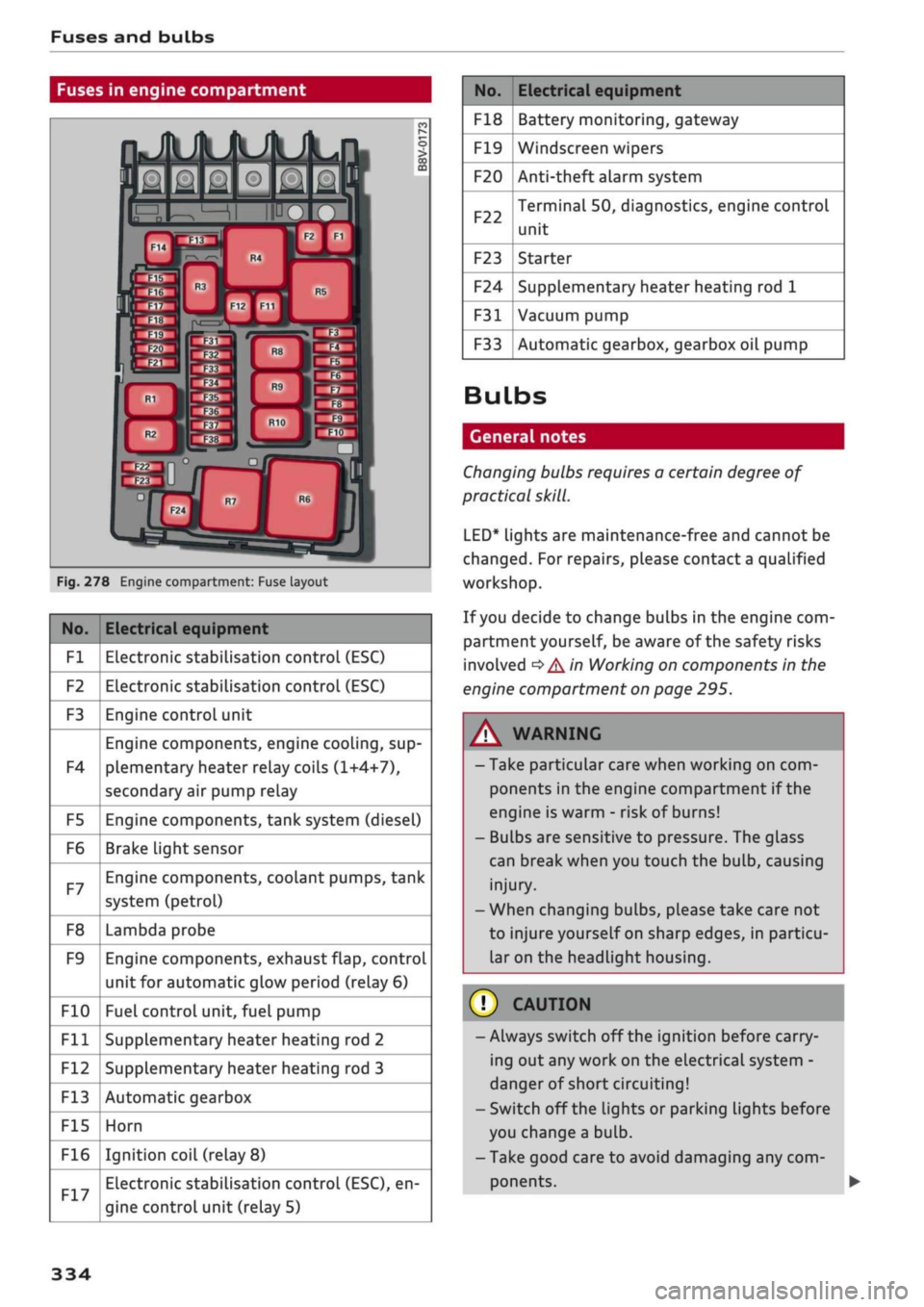
Fig.
278 Engine compartment: Fuse layout
No.
Fl
F2
F3
F4
F5
F6
F7
F8
F9
F10
Fll
F12
F13
F15
F16
Electrical equipment
Electronic stabilisation control (ESC)
Electronic stabilisation control (ESC)
Engine control unit
Engine components, engine cooling, sup
plementary heater relay coils (1+4+7),
secondary air pump relay
Engine components, tank system (diesel)
Brake Light sensor
Engine components, coolant pumps, tank
system (petrol)
Lambda probe
Engine components, exhaust flap, control
unit for automatic glow period (relay 6)
Fuel control unit, fuel pump
Supplementary heater heating rod 2
Supplementary heater heating rod 3
Automatic gearbox
Horn
Ignition coil (relay
8)
Electronic stabilisation control (ESC), en
gine control unit (relay 5)
No.
F18
F19
F20
F22
F23
F24
F31
F33
Electrical equipment
Battery monitoring, gateway
Windscreen wipers
Anti-theft alarm system
Terminal 50, diagnostics, engine control
unit
Starter
Supplementary heater heating rod 1
Vacuum pump
Automatic gearbox, gearbox oil pump
Bulbs
General notes
Changing bulbs requires a certain degree of
practical
skill.
LED*
lights are maintenance-free and cannot be
changed.
For repairs, please contact a qualified
workshop.
If
you
decide to change bulbs in the engine com
partment yourself, be aware of the safety risks
involved
*
A in Working on components in the
engine compartment on page 295.
WARNING
- Take particular care when working on com
ponents in the engine compartment if the
engine is warm - risk of burns!
- Bulbs are sensitive to pressure. The glass
can break when you touch the bulb, causing
injury.
- When changing bulbs, please take care not
to injure yourself on sharp edges, in particu
lar on the headlight housing.
© CAUTION
-Always switch off the ignition before carry
ing out any work on the electrical system -
danger of short circuiting!
- Switch off the Lights or parking lights before
you change a bulb.
- Take good care to avoid damaging any com
ponents.
334
Page 359 of 364
Index
CO
< o rN
iv
rN
t-H
o <
•H
00
Navigation 217
Radio 231
Speech dialogue system 256
System
(MMI)
255
Telephone 187
Shuffle
see Random playback 246
Side airbag 285
Side assist
see Audi side assist 127
Sidelights
49
SIM card
see Embedded SIM card 191
SIM card reader 176, 191, 192
Smartphone
see Telephone 172
SMS
see Text messages 182
Snow chains 309
Software update
see Map update 200
see System update (MMI) 259
Software (MMI)
Licence conditions 262
Update 259
Version 259
Sound settings 260
Source overview 243
Spanner 319
Spare key 38
Spare wheel 324
Special destination 211
Speech dialogue system 164
Commands 165
External 170
Multi-function steering wheel 17
Operation 164
Settings 256
Volume 262
Speed-dependent volume control 261
Speed limit display
see Traffic sign recognition 108
Speed limiter 106
Speed limits
see Traffic sign recognition 108
Speedometer 12
Speed warning 104
Speller 159
Start/stop system 79
START ENGINE STOP (convenience key) . 76,77
Starting with jump leads 326
Station memory
see Favourites 231
Station search (radio)
see Updating station list (radio) 231
Steering 148
Locking (button) 77
Locking (ignition lock) 75
Steering wheel
Adjusting 74
Paddle levers (automatic gearbox) 90
see also Multi-function
steering wheel
15,17,
18
Stopover (navigation) 213
Storage compartments 61
Streaming
see Online media 239
S tronic (automatic gearbox) 85
Subtitles (DVD) 246
Subwoofer 261
Sun roof
see Panorama sun roof 48
Sun visors 54
Supplementary heater (vehicles with diesel
engine) 66
Surround sound 261
Suspension control 131
Switching between calls 180
Switching between tabs
see Multi-function steering wheel . 15, 17, 18
Switching character sets (MMI touch) 155
Symbols 161
Navigation 219
Traffic 225
System settings (MMI)
255
System update (MMI) 259
System volume 261
T
TDI clean diesel
see AdBlue 292