battery AUDI Q3 2015 User Guide
[x] Cancel search | Manufacturer: AUDI, Model Year: 2015, Model line: Q3, Model: AUDI Q3 2015Pages: 258, PDF Size: 64.9 MB
Page 71 of 258
M N M N
0 ::i co
rl I.O
"' ,....,
"' rl
@ Tips
-After starting a cold engine, there may
be a brief period of increased noise be
cause the oil pressure must first build up
i n the hydraulic valve adjusters . This is
norma l and not a cause for concern .
Switching engine off
Applies to vehicles: with conven ience key
• Bring your veh icle to a complete stop .
• Move the selecto r lever to the P or N posi
t ion.
• Press the
!S TA RT ENGINE S TO PI button
~ pag e 68, fig. 75.
Steering lock
The steering locks when you turn the engine
off us ing the
I START ENGIN E STOP I button
and ope n the dr iver 's door. The locked stee r
i n g helps preven t vehicle theft.
Emergenc y Off functi on
If necessary in an emergency, the engine can
be sw itched off while the vehicle is st ill mov
ing. Press the
I S TAR T ENG IN E ST OPI button
tw ice in quick succession or ho ld it in for lon
ger than two seconds .
_& WARNING
-Never t urn off the engine before the ve
h icle has come to a complete stop . The
full function of the brake booster and the power steering is not guaranteed. You
must use more force to turn or brake if
necessary . Because you cannot steer and
brake as you usually would, this could
lead to crashes and serious injur ies .
- For safety reasons, you should always
park your vehicle with the se lector lever
in P. Otherwise, the ve hicl e co uld inad
vertent ly roll away.
- The rad iator fan can continue to run for
up to 10 min utes even after you have
t urned off the eng ine and removed the
ignition key . The radiator fan can also
turn on again if the engine coolant heats
On th e road 69
up because of intense sunlight or heat
bui ld-up in the engine compartment.
- Always take the key with you whenever
you leave your vehicle. Otherwise, the
engine could be started or electrical
equipment such as the power windows
could be operated . This can lead to seri
ous injury.
(D Note
If the engine has been under heavy load
for an extended period, heat bu ilds up in
the eng ine compartment after the engi ne
i s sw itched off - there is a r isk of damag ing
the engine . A llow the engine to run at idle
for about two minutes before switching it
off .
Starting the engine after a malfunction
Applies to vehicles: wit h convenience key
If the remote control key battery is exhausted
or if radio interference or a system malfunc
tion o ccurs, extra steps may be necessary in
order to start the engine .
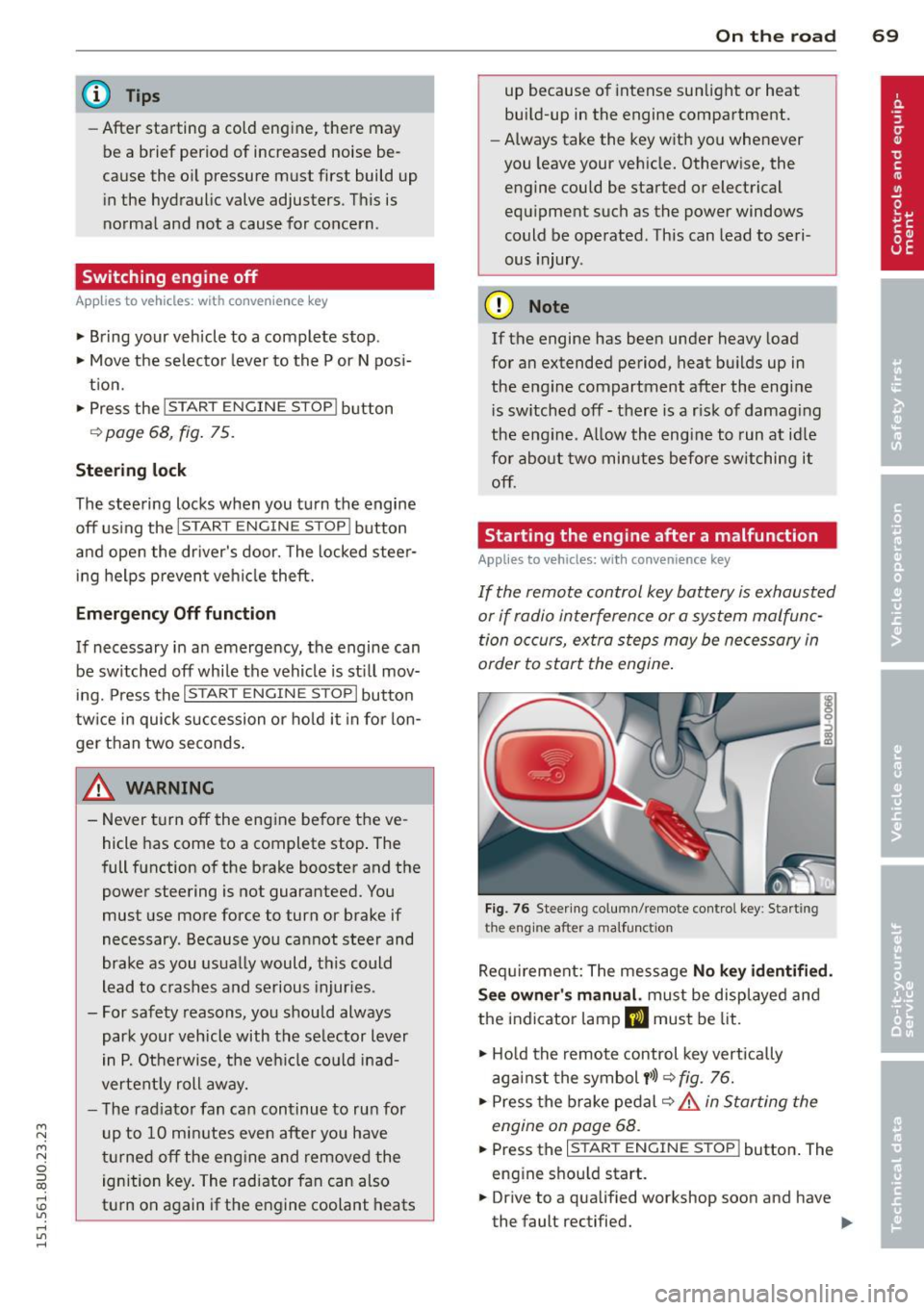
Fig. 76 Steer ing co lumn/remote contro l key : Start ing
t he en gi ne a fter a m alfu ncti on
Requ irement: The message No k ey identifi ed.
S ee owner' s manu al.
must be displayed and
the indicator lamp
m must be lit .
• Ho ld the remote control key vertically
aga inst the symbol
y >l) ~ fig . 76.
• Press the b rake pedal ~.&.
in Starting the
engin e on page 68 .
• Press the ~ I s =T -A -R =T ~ E= N~ G~IN ~ E-s=T -O ~ P~I button. The
eng ine shou ld start.
• Drive to a qualified workshop soon and h ave
the faul t rectified. .-
Page 72 of 258
70 On the road
@ Tips
You ca n call up the dr iver message aga in
by pressi ng the
!ST ART ENGINE STOPI but
ton.
Driver messages
Turn off ignition. Battery discha rging
T his message appears and a war ning tone
sounds if yo u open the dr iver's door when the
ignit io n is switched on.
Press brakepedal to start engine .
This message appears if you do not press t he
b rake pedal to start the engine in a vehicle
with a n automatic t ransmission .
Please engage N or P .
This message appears if you try to start or
switch off the eng ine when the selector lever
is not i n Nor P. The eng ine can then not be
started or sw itched off.
fll Is key in the vehicle?
If t h e in dicator lamp lights up and the mes
sage appears, the convenience key* was re
moved from the vehicle while the e ngine was
runni ng .
If the convenience key is not in the
ve hicle you will not be able to switch on the
ignit io n or restart the engine after it has been
switched off . You w ill also not be ab le to l ock
the veh icle from the outside .
Shift to P, vehicle can roll away . Doors can
only be locked in P.
F or safety reasons , this messa ge will ap pear
together with a wa rning tone if t he se lector
l eve r is not in position P when you switch off
the ign ition. Put the selector lever in posi
tion P; otherw ise the vehicle can roll away and
cannot be locked .
II No key identified. See owner's manual.
If the indi cator lamp lights up and the mes
sage ap pears, a malfunct ion has occ urred
c:::> poge 69.
Electromechanical
parking brake
Operation
The ele ctrome chani cal parking brake replace s
t he hand broke.
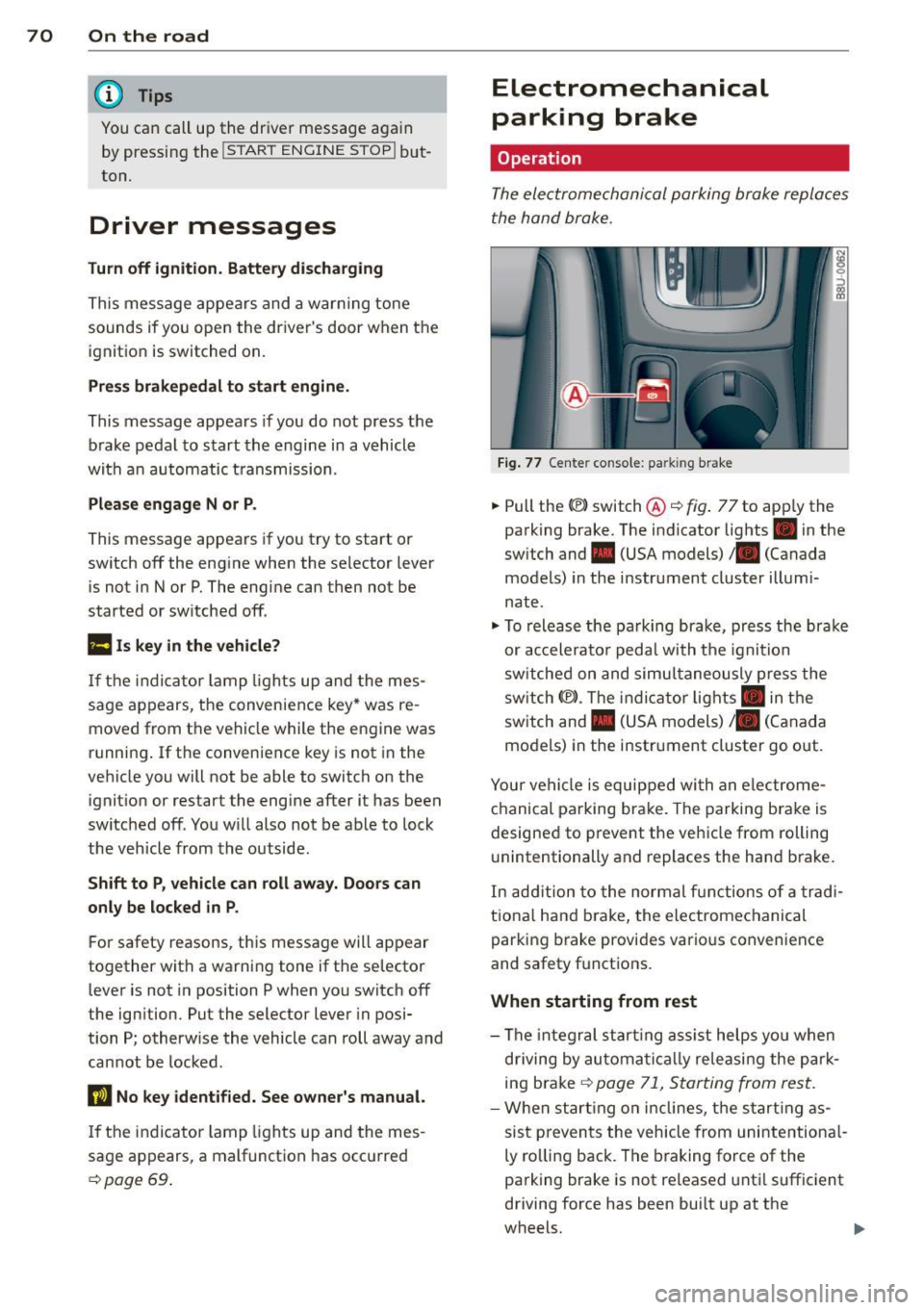
Fi g. 77 Center co nsole: pa rk in g b rake
.,. Pull the(®) switch@ c:::> fig. 77 to app ly the
parking brake. The indicator lights . in the
sw itch and . (USA models)/ . (Canada
models) in the instrument cluster illumi
nate.
.,. To releas e th e pa rking bra ke, pr ess the bra ke
or ac celera to r peda l with t he igni tion
sw itche d on and simu ltaneously p ress the
sw itch (®) . Th e in d ic ator lig hts . in the
sw itch and . (USA models)/ . (Canada
mo dels) in the instr ument cluster go out.
Your ve hicle is equipped wi th a n ele ctro me
ch anical parking brake. The parkin g bra ke is
designe d to prevent the ve hicle from rolling
u nintentionally and replaces the hand b rake.
In ad diti on to the normal fu nctions o f a tra d i
tio na l han d brake, the e lectromechanical
parking brake provi des vario us convenience
and safety f unct ions .
When starting from rest
- The integral s tart ing as sist help s you when
d riving by au toma tically re leasi ng the pa rk
ing brake
c:::> poge 71, S tarting from res t.
- W he n star ting o n incl ines, t he s tar tin g as
sis t p reven ts the vehicle from uni nte ntion al
ly ro lling back . The braking force of the
parking brake is not re leased unt il suffic ient
driving force has been bui lt up at the
wheels .
Page 80 of 258
78 Audi side assist
- Side assist is not active wh ile you are
making the adjus tment.
- Your settings are automatically sto red
and ass igned to the remote control key
being used.
Driver messages
App lies to vehicles: with Audi side assist
If s ide ass ist switches off by itse lf, t he LED in
the butto n tur ns off a nd a message will ap
pear in t he instr ume nt cl uster d is p lay:
Audi side assist: Unavailable. Sen sor view
The radar sensors' vision is affected. Do not
c o ver the area in fr ont of the senso rs with bike
wheels, stickers, dirt or other objects. Clean
the area in front of the sensors, if necessary
c::;, page 76, fig . 82.
Audi side as sist: Unavailable.
Side assist cannot be switched on tempo rari ly
beca use there is a malfunctio n (for example,
the battery charge leve l may be too low).
Aud i side assist: System fault!
The system ca nnot guara ntee that it w ill de
tect ve hicles co rrectly a nd it is switched off .
The sensors have been displaced or are faulty.
H ave the system checked by an authorized
Aud i dea le r or aut horized Aud i Service Fac ility
soon .
Audi side assist: Unavailable when
towing.
Side assist sw itches off automatically whe n a
factory -insta lled trailer hitch is connected to
the ele ct rical connector on t he trailer . There is
n o guara ntee the system will switc h off whe n
usi ng a retrofit ted traile r hi tch . D o not use
si de assis t whe n towing a trailer .
Page 161 of 258
with all-wheel drive¢ page 211, Snow
chains .
Replacing wheels /tire s
Vehicles w ith all-wheel drive mus t always
h ave tires o f the same size. Also avoid t ires
with different tread depths. For details see
page
c::> page 206, New tires and replacing
tires and wheels.
A WARNING
Always adjust your driving to road and traf
fic condit ions. Do not let the extra safety
afforded by all-wheel drive tempt you into
taking extra risks.
- Although the all-wheel dr ive is very ef
fective, always remember that braking capacity is limited by t ire traction . You
should therefore not dr ive at excess ive
speeds on icy or slippery road surfaces.
- On wet road surfaces, be careful not to
dr ive too fast because the front wheels
c ou ld beg in to s lide on top of the water
(aquaplaning). If this sho uld oc cur, you
will have no warning from a sudden in crease in engine speed as with a front
wheel drive vehicle. A lways drive at
speeds which are suited to the road con
ditions -risk of crash.
Energy management
Starting ability is optimized
Energy management controls the distribution
of electrical energy and thus optimizes the
availability of electrical energy for starting
the engine .
If a vehicle with a conventional energy system
is not driven for a long period of time , the bat
tery is discharged by idling cu rrent consumers
(e.g. immobilizer). In ce rtain c ircumstances it
can result in there being insufficient energy
M avai lab le to start the engine . N
M N
0 ::i co ,...., \!) 1.1'1 ,...., 1.1'1 ,....,
Intelligent energy management in your veh i
cle handles the d istribution of elec trical ener
gy . Starting abi lity is markedly improved and
the life of the battery is extended .
Intellig ent technolog y 159
Basica lly, energy management consists of
b att ery diag nosis , id lin g cur rent man age
ment
and dyn amic en ergy m anag ement.
Batte ry diagnosis
Battery diagnosis continuously determines
the state of the battery . Sensors determine
battery voltage, battery current and battery
temperature . This determines the current
state of charge and the power of the batte ry .
Idlin g current manag ement
Id ling current management reduces energy
consumption while the vehicle is standing.
With the ig nition switched off, it controls the
energy supply to the various electrical compo nents. Data from battery diagnosis is cons id
ered.
Depending on the battery's state of charge ,
individual consumers are gradually turned off
to prevent excessive discharge of the batte ry
and thus maintain starting capability .
Dynamic energy manag ement
While the vehicle is being driven, dynamic en
ergy management distributes the energy gen
erated according to the needs of the individ u
al components . It regulates consumption, so
that more electrical energy is not being used
than is being generated and ensures an opti
mal state of charge for the battery .
(D Tips
-But even energy management cannot
negate the limits of physics. Consider
that the power and life of a battery are
limited.
- If start ing ability is threatened, the indi
cator light (•) ;ippears
c::> page 15.
What you should know
The highest priority is given to maintaining
starting capability .
The battery is severe ly taxed in short-distance
driving , in ci ty traff ic and during the cold time
of year . Abundant electrical energy is .,.
•
•
Page 162 of 258
160 Intelligent technology
required, but on ly a little is generated. It is al
so critical if the engine is not running and
e lectrical components are turned on. In this
instance energy is being consumed but none
is being genera ted.
It is in precisely these situations that you wi ll
notice energy management actively regulat
ing the distrib ution of energy.
Vehicle stands fo r an e xte nded p eriod
If yo u do not drive you r vehicle over a pe riod
of severa l days or weeks, elect rical compo
nents are grad ually cut back or switched off.
This reduces energy consumption and main
tains starting capab ility over a longer period.
Some of the conven ience functions may not
operate, such as the inter ior lig hts or the
power seat adjustment . Th e conven ience
functions w ill be ava ilable again when you
switch on the igni tion and start the engine.
With the engine turned off
If you listen to the radio, for example, with
the eng ine turned off or use other MMI func
tions, the ba tte ry is being d ischarged .
If starting capability is jeopardi zed due to en
ergy consumpt ion, an error message appears
in the MMI display .
The warning message indicates that the sys
tem will be turned off automat ically. If you
wish to continue using the functions , you have
to start the engine .
With the engine running
Altho ugh electrical energy is generated when
the vehicle is being driven, the battery can be
come discharged . T hi s happens most ly when
little energy is be ing generated and a great
deal consumed and the battery 's state of
cha rge is not optimal.
To br ing the energy balance back into equili
brium, consumers which require especia lly
large amounts of energy are tem pora rily cut
back o r switched off . Heati ng sys tems in par
ticular requ ire a g reat dea l of energy. If you
n otice, fo r example , that the heated se ats* or
the heated re ar window are not hea ting, they have been tempora
rily cut back or switched
off. These systems wi ll be available again as
soon as the energy balance has been restored .
You w ill also no tice th at engine id le speed h as
been increased slightly. This is normal and not
a cause for concern . By inc reasing engine id le
speed the additional energy required is gener
ated and the battery is charged.
Page 164 of 258

162 Driving and en vironm ent
The cata lytic converter is an efficient "clean
up" device built into the exhaust system of
the veh icle. The catalytic converter burns
many of the pollutants in the exhaust gas be
fore they are released into the atmosphere.
The exclusive use of unleaded fuel is critically
important for the life of the catalytic convert
er and proper functioning of the engine.
A WARNING
-The temperature of the exhaust system
is high, both when driv ing and after stop
ping the engine.
- Never touch the exhaust tail p ipes once
they have become hot. This could result
in burns .
- Do not park or operate the veh icle in
areas where the hot exhaust system may
come in contact with dry grass, brush,
fuel spill or other material which can
c ause a fi re.
- Do not apply additional undercoating or
rustproofing on o r near the exhaust
man ifold, exhaus t pipes, catalytic con
verte r o r heat shie lds. D uring driving, the
substance used for undercoating cou ld
overheat and cause a fire.
(D Note
- Be aware th at just one tank fi lling with
leaded fue l will already seriously de
grade the performance of the catalytic
conve rter .
- Do not exceed the correc t engine oil leve l
~page 184.
-Do not drive un til the fue l tank becomes
completely empty . The engine could mis
fire. Unburned f uel could a lso get into
the exhaust system and this could cause
the catalyt ic converter to overheat.
- Do not turn off the ignit ion while the ve
hicle is moving.
- Do not continue to operate yo ur vehicle
u nder these conditions , as otherw ise fuel
can reac h the catalytic converter. This
could result in overheat ing of the con
verter, requ iring its replacement. -
To assu re efficient operation of the Emis
sion Control System :
- Have your vehicle maintained properly and in accordance w ith the service rec
ommendat ions in your Warranty &
M ain tenance book let.
- L ack of prope r maintenance as we ll as
i mproper use of t he vehicle wi ll impair
the function of the em ission cont ro l
sys tem an d could lea d to damage.
~ For the sake of the environment
Eve n when the Emiss io n Control System is
ope rat ing proper ly, the exha ust gas c an
have a sul fur- like ex haust gas smell under
some ope rat ing states . This depends on
the sulfur content of the fuel being used. Using a different brand of fue l may help,
or f illing the tank with lead-free super
grade gasoline.
Shutting down vehicle
If you would like your vehicle to remain inop
erative for a longer per iod of time, contact an
Audi or other specialized dealer. They can ad
vise you on necessary precautions e .g . corro
s ion p revention, maintenance and sto rage .
Pay attent ion to additional info rmat io n con
ce rn in g the battery. Refe r to~
page 190.
Operate your vehicle
economically and
minimize pollution
Gene ral
Your personal style of driving will determine
the economy of your vehicle, as well as ex
haust and noise levels .
Fuel economy, e nvir onme nta l impact, and
we ar on your eng ine, b rakes and tires la rgely
depend on three fac to rs:
- your personal driving style
- operati ng conditions
- technical limitations
Page 182 of 258
180 Checking and filling
coolant can be seen or heard before
carefully opening the hood.
- Keep children away from the engine com
partment.
- Never spill fluids on hot engine compo
nents. They can cause a fire.
- Never touch the radiator fan. The auxili ary electric fan is temperature controlled
and can switch on suddenly.
- Never open the coolant reservoir cap
when the engine is still warm. The cool
ant system is pressurized and hot cool
ant could spray out .
- Protect your face, hands and arm from
steam or hot engine coolant by placing a
thick rag over the cap when you open the
coolant reservoir .
- Do not remove the engine cover under
any circumstances. This increases the
risk of burns.
- If work on the fuel system or the electri
cal system is necessary:
- Always disconnect the battery .
- Never smoke or work near heaters or
open flames. Fluids in the engine com
partment could start a fire.
- Keep an approved fire extinguisher im
mediately available.
- To avoid electrical shock and personal in
jury while the engine is running or being
started, never touch:
- Ignition cables
- Other components of the high voltage
electronic ignition system.
- If you must perform a check or repair
with the engine running:
- First, fully apply the parking brake,
move selector lever of automatic trans
mission to "P" (Park) .
-Always use extreme caution to prevent
clothing, jewelry, or long hair from get- ting caught in the
radiator fan, V-belts
or other moving parts, or from contact
ing hot parts. Tie back hair before
starting, and do not wear clothing that
will hang or droop into the engine .
- Minimize exposure to emission and
chemical hazards
c> A .
A WARNING
-California Proposition 65 Warning:
- Engine exhaust, some of its constituents,
and certain vehicle components contain
or emit chemicals known to the State of
California to cause cancer and birth de
fects and reproductive harm. In addition,
certain fluids contained in vehicles and
certain products of component wear con
tain or emit chemicals known to the
State of California to cause cancer and
birth defects or other reproductive harm.
- Battery posts, terminals and related ac
cessories contain lead and lead com
pounds, chemicals known to the State of
California to cause cancer and reproduc
tive harms. Wash hands after handling.
(D Note
When adding fluids, always make sure that
they are poured into the proper container
or filler opening, otherwise serious dam
age to vehicle systems will occur.
@ For the sake of the environment
To detect leaks in time, inspect the vehicle
floor pan from underneath regularly. If
you see spots from oil or other vehicle flu
ids, have your vehicle inspected by an au
thorized Audi dealer.
Page 192 of 258
190 Checking and filling
@ For the sake of the environment
Because of the problem of proper disposa l
of brake flu id as we ll as the special tools
req uired and the necessary expert ise, we
recommend that you have the b rake fluid
changed by your author ized Audi dealer.
Battery
General information
Unde r normal operating conditions, the bat
tery in your A udi does not need any mainte
nance. With
high outside temperatures or
long daily dr ives we recommend that you have
the elect ro lyte level checked by an authorized
Aud i dea ler o r qualified workshop . The elec
trolyte leve l sho uld a lso be c hecked each t ime
the battery is c harged
c::> page 192.
H ave the battery checked when you take your
ve hicle in for service . Yo u are well adv ised to
replace a bat tery that is older tha n 5 yea rs .
W ith certa in types of a irbag deployment, t he
battery is d isconnected from the vehicle elec
tr ica l system fo r safety reasons
c::> & in Re
pair, core and disposal of the airbags on
page 126.
Disconnecting the battery terminals
Some veh icle functions (power w indow regu
lato rs, for example) are lost if the battery ter
m inals a re discon nected. These functions have
to be re lea rned after the batte ry terminals a re
c onnec ted agai n. T o prevent this, the battery
should o nly be di sconnec ted from the vehicle
e lec trica l syste m when absolu tely necess ary
for repairs.
Vehicles not driven for long periods
I f yo u do not dr ive you r vehicle over a pe riod
of severa l days or weeks, elec trical co m po
n en ts are gr adually cu t back o r swi tched off .
T his reduces energy cons ump tion and main
tains sta rting capab ility over a lon ger perio d
c::> page 159 .
Some o f the conven ien ce f unct ions m ay no t
ope rate, su ch as the in ter ior lights o r the power seat adjus
tment . The convenience
funct ions wi ll be available again when yo u
tu rn on the ign ition and sta rt t he engine .
Winter operation
During the w inte r mon th s, batt ery c apac ity
tends to dec rease as tempera tures drop . This
is beca use more power is a lso consumed w hile
starting, and the headlights, rear win dow de
f ogger, etc., are used more often.
Avoid unnecessa ry powe r consumpt ion, pa r
ticu lar ly in ci ty traffic o r when traveling only
sho rt distances . Let yo ur autho rized A udi
dealer check the capacity of the vehicle bat
tery before w inter sets in
<=:> page 192. A well
charged battery will not on ly prevent starting
problems when the weather is cold, but w ill
also last longer .
@ Tips
If your vehicle is left standing for seve ral
w eeks at extremely low temperatures, the
vehicle battery s hou ld be removed and
s tored w her e it w ill not freeze. This will
preve nt i t fr om be ing d amaged and having
t o be repla ced .
Working on the battery
Be especially careful when working on or near
the battery.
T he battery is loc ated in the luggage compar t
ment under the floo r. B efo re you che ck any
t hi ng in the luggage co mpartmen t,
read and
heed all WARNINGS
c::> .&_ .
Always heed t he safety warnings , when work
i ng on the veh icle ba tte ry or the vehicle e le c
t ric al sys tem to p reven t inju ry.
The following WARNINGS are very
important when working on the battery:
Always heed the following WARNING SYM ·
BOLS and safety precautions when working
on the battery .
®
Always wear eye protection .
Page 193 of 258
M N
M N
0 ::i co ,...., \!) 1.1'1 ,...., 1.1'1 ,....,
&
Battery acid contain s sulfuric acid. Al ·
wa ys wear glove s and e ye protection .
@
No
· sparks
- flame s
- smoking .
~
When a battery i s ch arged, it p roduce s
. hy drogen g as whi ch i s exp losive and
could cau se per sonal inju ry.
®
Always keep the batt ery well out of
re ach of children .
A WARNING
Whenever working on the battery or on
the electrical system, there is the r isk of
injury, acc ident and even fire. Read and
heed the following WARNINGS :
- Always wear eye protection. Do not let
battery acid or any lead particles get on
your sk in or cloth ing. Sh ield your eyes .
Explosive gases can cause blindness o r
other injury.
- Battery acid contains sulfuric acid . Sulfu
ric acid can cause blind ness and severe
burns.
- Always wear gloves and eye p rotection.
Do not tilt the battery because ac id
could leak out of the vent ilation open
ings.
- If you get battery acid in yo ur eyes or
on your sk in, immed iately r inse with
cold water for severa l m inutes and get
medical attention.
- If you should ingest any battery acid,
seek med ica l attention immediately.
- Do not expose the battery to an open
flame, electric sparks or an open light.
- Do not smoke.
- Do not interchange the positive and neg-
ative cab les .
- When working on the battery, be sure
not to short-circuit the terminals with
tools or other metal objects. This would cause the battery to heat up very quickly,
wh ich could lead to damage or explosion
and personal injury.
-
Checkin g and fillin g
-When a battery is charged, it produces
hyd rogen gas which is explos ive and
could cause personal injury.
- Always keep the battery well out of the
reach of children.
- Before work is done on the elect rical sys
tem, disconnect the negative ground ca ble.
- Before performing any work on the e lec
trical system, switch
off the eng ine and
ignit ion as well as any electrical equip
ment. The negative cable on the battery
must be disconnected. If yo u are just go
ing to replace a light bulb, then it is
enough to switc h
off the lights.
- Before disconnecting the battery, switch
off the anti-theft alarm system! Other
wise you wi ll set
off the al arm.
- When disconnecting the battery, first
discon nect the negat ive cab le and then
the posit ive cab le.
- Before reconnecting the batte ry, ma ke
sure all e lectr ica l consumers are sw itch
ed off . Re connect the pos it ive cable first
and then the negative cable. Neve r in ter
change the cables -this could start a fire!
- Never cha rge a frozen or a thawed-out
battery.
It could exp lode! If a battery has
frozen, then it must be replaced . A dis
charged battery can freeze over at 32°F
(QOC).
- Make s ure the vent hose is always attach
ed to the opening on the side of the bat
tery.
- Never use batteries which are damaged.
There is the danger of an explosion! A l
ways rep lace a damaged batte ry.
A WARNING
Ca lifornia Proposition 65 Warning:
- Battery posts, terminals and related ac
cessories conta in lead and lead com
pounds, chemicals known to the State of
Ca lifornia to cause cance r and reproduc
tive problems. Wash hands after han- dling.
~
19 1
•
•
Page 194 of 258
192 Checking and filling
(D Note
- Do not disconnect the vehicle battery
when the ignition is switched on or when
the engine is running, otherwise, you will
damage e lectronic components i n the
electrical system.
- If your vehicle is going to stand for a
long period of time without being driven,
protect t he battery from "freezing", oth
e rwise it w ill be damaged and w ill then
have t o be repla ced.
Battery charging
Starting the engine requires a well charged
battery.
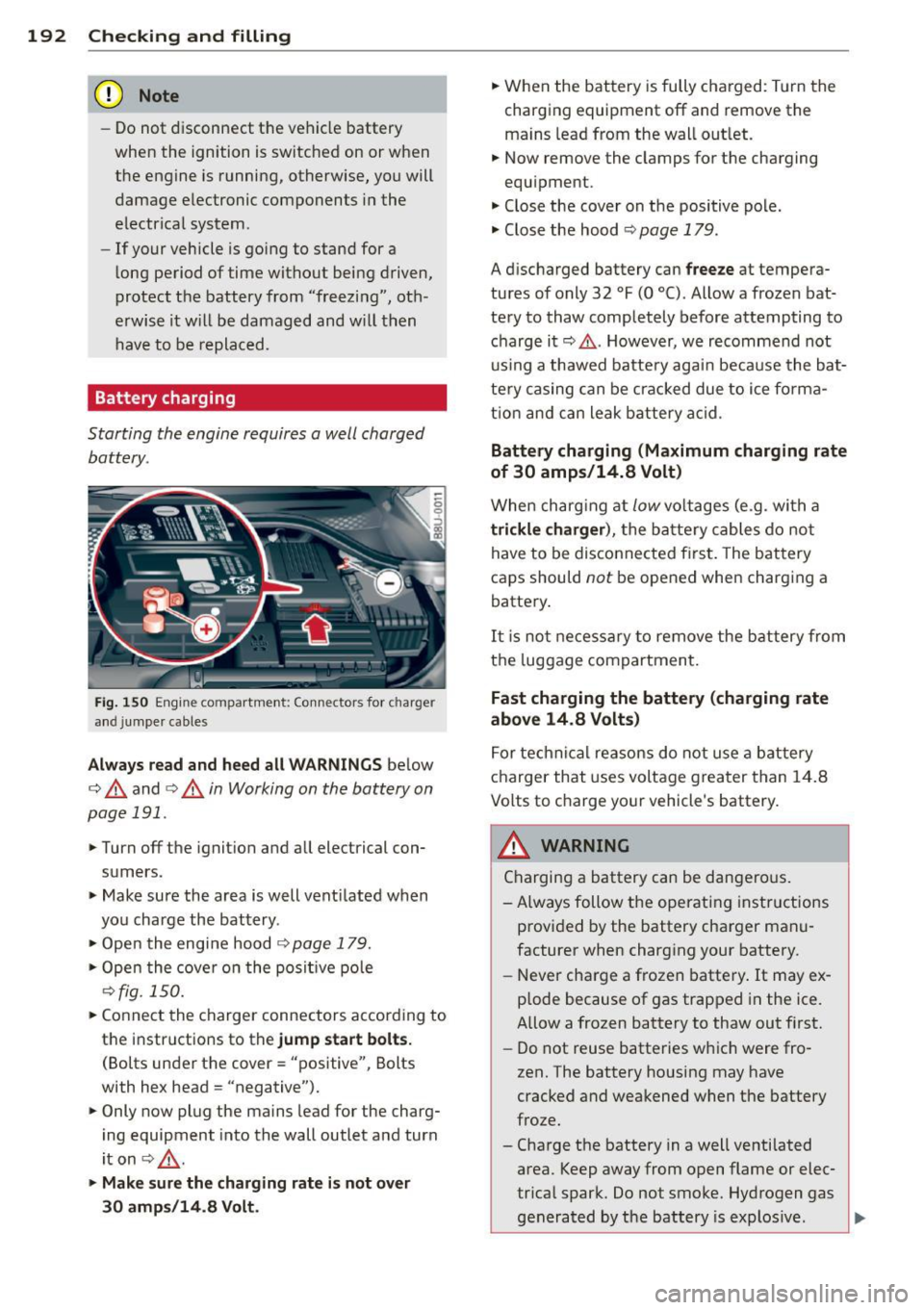
Fig. 150 Eng ine compartment: Connectors for charger
a nd jumper cables
Always read and heed all WARNINGS be low
c::> & and c::> & in Working on the battery on
page 191 .
•Turnoff th e ignit ion and all electrical con
sumers.
• Make sure the area is well vent ilated when
yo u cha rge the battery .
• Ope n the engi ne hood
c::> page 179.
• Open the cove r o n the pos it ive pole
c::> fig. 150.
• Connect the charger connectors according to
the instructions to the
jump start bolts.
(Bo lts under the cover = "positive", Bolts
with hex head= "negative").
• Only now plug the mains lead for the charg
i ng equipment into the wall outlet and turn
i t on
c::> .&,. .
• Make sure the charging rate is not over
30 amps /14.8 Volt .
• When the battery is fully charged: Turn the
charging equipment off and remove the
mains lead from the wall out let.
• Now remove the clamps for the charging
equ ipment.
.,. Close the cover on the positive pole .
.,. Close the hood
c::> page 179 .
A discharged battery can freeze at tempera
tures of only 32 °F (0 °C). Allow a frozen bat
tery to thaw comp letely before attempting to
charge i t
c::> .&.. However, we recommend not
u sing a thawed batte ry aga in because the ba t
te ry casing can be c racked due to i ce fo rm a
t io n an d can leak battery a cid.
Battery charging (Maximum charging rate
of
30 amps/14.8 Volt)
When charg ing at low vo lta ges (e.g. wi th a
trickle charger ), the ba tte ry cables do not
have to be disconnected f irs t. T he bat tery
caps should
not be opened when charg ing a
battery .
It is no t necessa ry to remove the b attery from
the luggage compartmen t.
Fast charging the battery (charging rate
above 14 .8 Volts)
F or te chnica l re asons do not use a batt ery
ch arger that uses voltage greater than
14 .8
Volts to c harge yo ur vehicle's battery.
A WARNING
.------
C harging a battery can be dangero us.
-A lways follow the operati ng instr uctions
p rovi ded by the battery charger manu
facturer when charg ing your battery.
- Never charge a frozen batte ry . It may ex
p lode because of gas trapped in the ice.
Allow a frozen battery to thaw out f irst.
- Do not reuse batteries w hich were fro
zen. The battery housing may have
cracked and weakened w hen the battery
froze .
- Charge the battery in a we ll ventilated
area. Keep away from open flame or elec
tr ica l spark. Do not s moke. Hydrogen gas
genera ted by t he battery is explos ive .