battery AUDI Q3 2015 Owner's Manual
[x] Cancel search | Manufacturer: AUDI, Model Year: 2015, Model line: Q3, Model: AUDI Q3 2015Pages: 258, PDF Size: 64.9 MB
Page 195 of 258
M N
M N
0 ::i co ,...., \!) 1.1'1 ,...., 1.1'1 ,....,
-To r educe the danger of explosion, never
connect or disconnect charger cables
while the charger is operating.
- Fast charg ing a battery is dangerous and
should only be attempted by a compe
tent technician w ith the proper equip
ment .
- Battery acid that may spill during charg
ing should be washed
off with a solution
of warm water and baking soda to neu
t ralize the acid .
Never use a fast charger as a booster to
start the engine . This will seriously dam
age sensitive elect ronic components, such
as control units, relays, radio, etc. , as we ll
as t he battery charger.
Battery replacement
The new battery must have the same specifi
cations and dimensions as the original equip
ment battery.
Intell igent energy management in your veh i
cle is respons ible for d istr ibuting the e lectr i
cal energy throughout you r vehicle
¢ page 159. The inte lligen t en ergy ma nage
men t system w ill keep the engine b attery
charged be tter then vehicles w ithout this sys
tem . To make sure t he additional e lectrica l e n
ergy is available once again after you have
changed t he battery, we recommend that you
install ba tteries of the same type and man u
facture only (the same as t hose installed at
the t ime your vehicle was delivered) . Specifi
cations a re listed on the battery hous ing . You r
author ized Audi dealer must code the bat tery
in the energy management system to enable
you to use the energy management functions
correctly after rep lac ing the battery .
I f it is not poss ible to use a battery of this
type, the new bat tery mus t have the s ame ca
pacity, vo ltage ( 12-volts), ampe rage, con
struction and pl ug sea ling.
Checkin g and fillin g 193
When installing the battery, make su re the ig
nition and a ll electrical consume rs a re turned
off.
Q) Note
M ake sure the ven tilat ion hose on the side
of the batte ry is connecte d, otherwise
fumes o r batte ry acid can leak out .
@ For the sake of the environment
Because o f the p rob lem of proper disposal
of a battery, we recommen d your author
i zed A udi dealer change the battery for
you. Batteries contain sulfur ic acid and
l ead and must always be disposed of prop
erly in comp liance with a ll environmental
r egula tions . Dispos ing of vehicle batter ies
i mprope rly is v ery dange rous to th e envi
r o nmen t.
Windshield washer
container
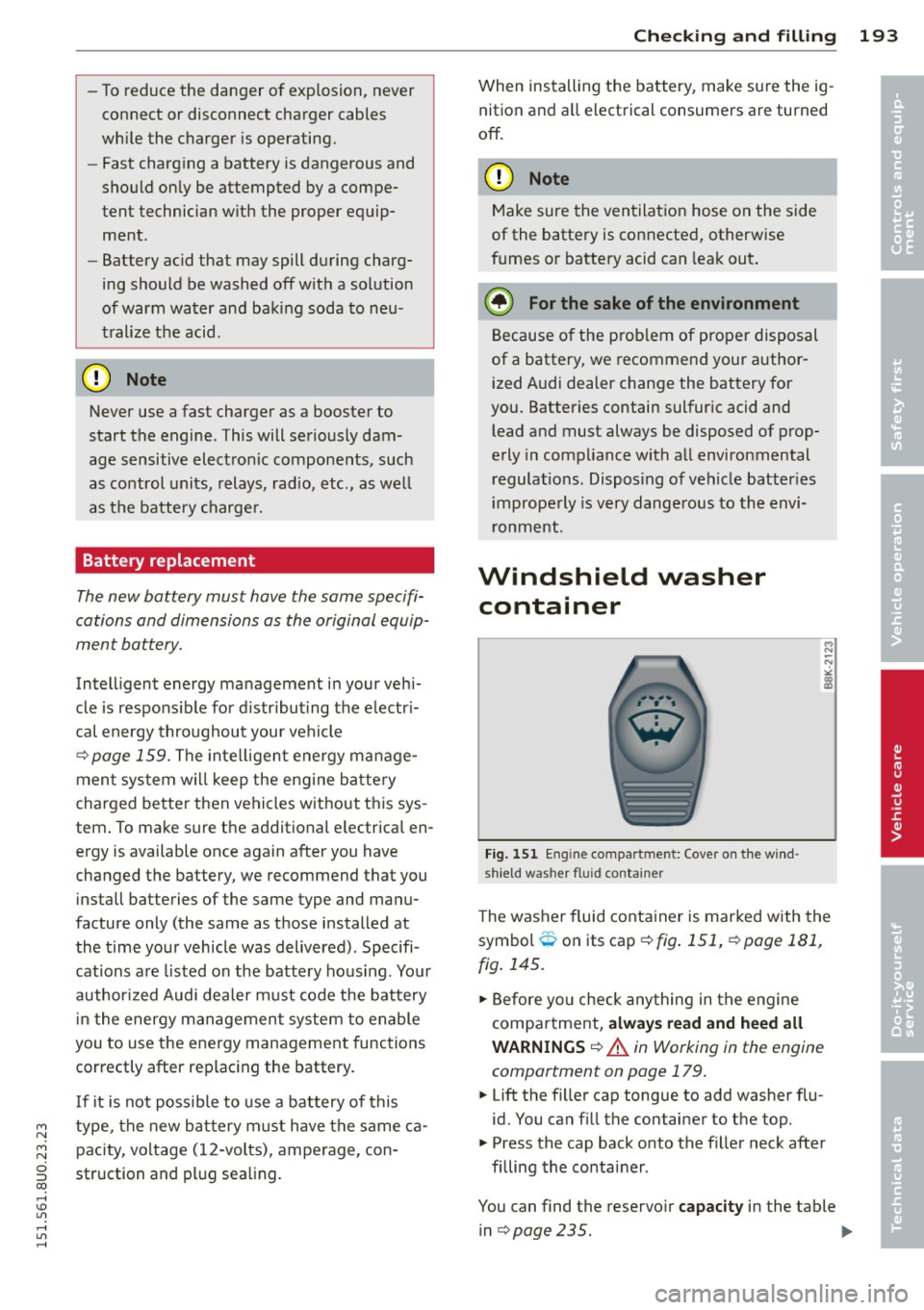
Fi g. 151 En gin e co mpa rtm en t: Cove r o n th e wind
s hi eld was her fluid conta in e r
The washer fluid conta iner is mar ked w ith the
symbol
O on its cap ¢ fig . 151, ¢page 181,
fig . 145.
.. Before yo u check any thing in t he engine
compa rtment,
alwa ys re ad and heed all
WARNINGS ¢ & in Working in the engine
compartment on page 179 .
.. Lift the fi ller cap tongue to add washer flu
id. You can f ill the container to t he top.
.. Press the cap back o nto the fi lle r neck after
filling the co nta iner .
You can find the reservo ir
capacity in the table
in
¢ page 235. 111>
•
•
Page 199 of 258
M N
M N
0 ::i co ,...., \!) 1.1"1 ,...., 1.1"1 ,....,
Tires and wheels 197
Gross Vehicle Weight Rating ("GVWR") Ply
means the maximum total loaded weight of
the vehicle .
Groove
means the space between two adjacent tread
ri bs.
Load rating (code)
means the maximum load that a tire is rated
to carry for a given inflat ion pressure . You
may not find this informat ion on all tires be
cause it is not requ ired by law.
Maximum load rating
means the load rating for a t ire at the max i
mum permissible inflation pressure for that
tire .
Maximum loaded vehicle weight
means the sum of:
(a) Curb weight
(b) Accesso ry weight
(c) Vehicle capacity weight, and
(d) Production opt ions we ight
Maximum (permissible) inflation pressure
means the maximum co ld inf lation pressure
to which a tire may be inflated . Also called
"maximum inflation pressure."
Normal occupant weight
means 150 lbs . (68 kilograms) times the
number of occupants seated in the vehicle up
to the tota l seating capacity of your vehicle.
Occupant distribution
means distribution of occupants in a veh icle.
Outer diameter
means the overall diameter of an inflated new
tire .
Overall width
means the linear distance between the exteri
ors of the sidewalls of an inflated tire, includ
ing e levations due to labeling, decorations, or
protective bands or ribs. means a layer of
rubber-coated parallel cords.
Production options weight
means the combined weight of those installed
regular production opt ions we ighing over 5
lbs. (2.3 kg) in excess of those standa rd items
which they replace, not previously considered
in curb weight or accessory weight, including
heavy duty brakes, ride levelers, roof rack,
heavy duty battery, and spec ial trim.
Radial ply tire
means a pneumatic tire in which the ply cords
that extend to the beads are laid at substan
tially 90 degrees to the centerline of the
tread.
Recommended inflation pressure
see r::!;> page 196, Cold tire inflation pressure .
Reinforced tire
means a tire design to operate at higher loads
and at higher inflation pressures than the cor
responding standard tire. Reinforced tires
may be identified as "XL", "xl", "EXTRA LOAD",
or "RF" on the sidewal l.
Rim
means a metal support for a tire or a t ire and
tube assembly upo n which the tire beads are
seated .
Rim diamete r
means nominal diameter of the bead seat. If
you change your wheel s ize, you wi ll have to
purchase new tires to match the new r im di
ameter .
Rim size designation
means rim diameter and width.
Rim width
means nominal distance between rim flanges.
Sidewall
means that portion of a t ire between the
tread and bead .
•
•
Page 230 of 258
228 Emergency situations
Emergency situations
General
This chapter is intended for trained emer
gency crews and working personnel who
have the necessary tools and equipment to
perform these ope rations.
Starting by pushing or
towing
Q;) Note
Vehicles with an automati c transmission
cannot be started by pushing or towing .
Starting with jumper
cables
If necessary, the engine can be started by
connecting it to the battery of another vehi
cle.
If the engine should fail to start because of a
discharged or weak battery, the battery can be
connected to the battery of
another veh icle,
using a
pair of jumper cables to start the en
g ine .
Jumper cables
Use only jumper cables of sufficiently large
cross section to carry the starter current safe
ly. Refer to the manufacturer's specifications.
Use only jumper cables with
insulated termi
na l clamps which are distinctly marked:
plus(+) cable in most cases colored red
minu s(-) cable
in most cases colored black .
A WARNING
Batteries contain electricity, ac id, and gas .
Any of these can cause very serious or fatal
inju ry. Follow the instructions below for
safe handling of your veh icle's battery.
- Always shield you r eyes and avoid lean
ing over the battery whenever possible.
- A discharged battery can freeze at tem
peratures just be low 32 °F (0 °C). Before connecting a
jumper cable, you must
thaw the frozen battery complete ly, oth
erwise it could explode.
- Do not allow battery acid to contact eyes
or skin . Flush any contacted area with
water immediately .
- Improper use of a booster battery to start a vehicle may cause an explosion.
- Vehicle batteries generate explosive gas
es. Keep sparks, flame and lighted ciga
rettes away from batteries.
- Do not try to jump start any vehicle with a low ac id level in the battery.
- The vo ltage of the booster battery must
also have a 12-Volt rating . The capacity
(Ah) of the booster battery should not be
lower than that of the discharged bat
tery . Use of batteries of d ifferent voltage
or substantially different "Ah" rating
may cause an exp losion and personal in
jury.
- Never charge a frozen batte ry. Gas trap
ped in the ice may cause an explosion.
- Never charge or use a battery that has
been frozen. The battery case may have
be weakened.
- Use of batter ies of different voltage or
substantially different capacity (Ah) rat
ing may cause an exp losion and injury.
The capacity (Ah) of the booster battery
should not be lower than that of the dis
charged battery.
- Before you check anything in the engine
compartment, always read and heed a ll
WARNINGS ¢
page 179.
(D Note
-App lying a higher voltage booster bat
tery will cause expensive damage to sen
sitive electronic components, such as
control units, relays, radio, etc .
- Th ere must be no electrical contact be
tween the vehicles as otherwise current cou ld already start to f low as soon as the
positive(+) terminals are connected. .,.
Page 231 of 258
M N M N
0 :::i co
rl I.O
"' rl
"' rl
@ Tips
- The discharged battery must be properly
connected to the vehicle's electrical sys
tem. When jump start ing or charging the
battery, never connect the negative
ground cable to the battery negative post because the battery manager sys
tem must be able to detect the battery's
state of cha rge . A lways connect the neg
ative g round cab le to the negative
gro und post o f the battery manage r con
trol uni t.
Use of jumper cables
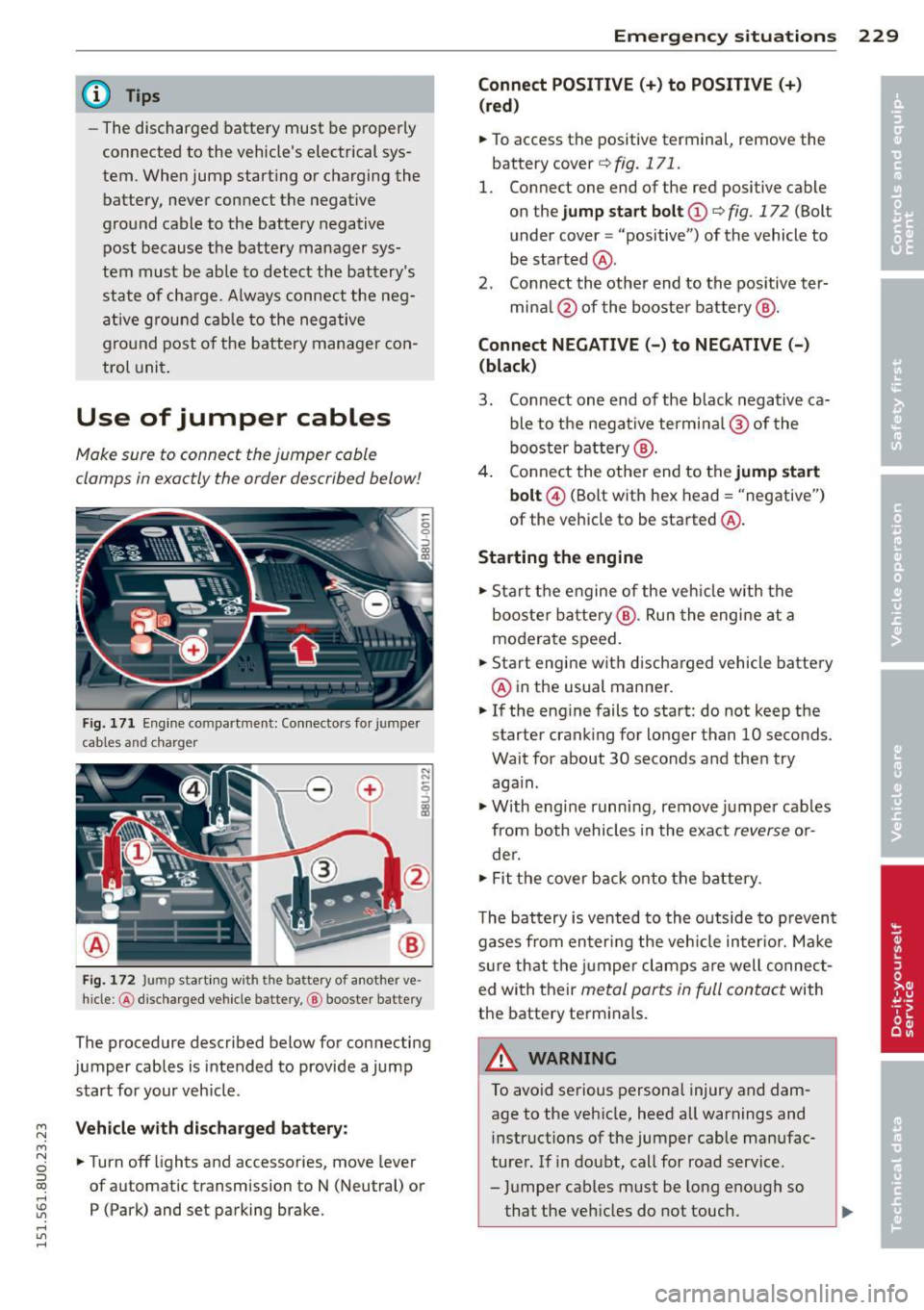
Make sure to connect the jumper cobl e
clomps in exactly the order describ ed b elow!
F ig. 171 Engine co mpartmen t: Con ne ctors fo r jum per
c ables a nd char ger
Fi g. 172 Jump s tart in g w ith t he ba ttery of a not her ve
hi cle :@ disch arged vehicle battery ,@ booster bat tery
The procedure described below for connecting
jumper cables is intended to provide a jump
start for your veh icle .
V ehicle with discharged batter y:
.. Tu rn off lights and accessories, move lever
of automatic transmission to N (Neutral) or P (Park) and set parking brake .
Emergency situ ation s 229
Connect POSITIVE(+ ) to POSITIVE (+ )
(red )
.. To access the positive terminal, remove the
battery cover
c::> fig. 1 71.
1. Connect one end of the red positive cable
on the
jump sta rt bolt (D c::> fig . 172 (Bolt
under cover = "positive") of the vehicle to
be started @.
2 . Connect th e other end to the pos itive ter-
mina l@ of the booster battery @.
Connect NEGATIVE( -) to NEGATIVE(-)
( black )
3. Connect one end of the black negative ca ble to the negat ive termina l@ of the
booster battery @.
4 . Connect the othe r end to the
jump start
bolt @
(Bolt with hex head = "negative")
of the vehicle to be started @.
Starting the engine .,. Sta rt the engine of the veh icle w ith the
booste r ba tte ry @ . Ru n the engine at a
moderate speed .
.. Start engine w it h discharged vehicle battery
@ in the usual manner .
.. If the eng ine fails to start: do not keep the
starter c ranking for longer than 10 seconds.
Wait for about 30 seconds and the n try
aga in .
.. With eng ine runni ng, remove jumpe r cab les
from both vehicles in the exact
reverse o r
de r .
.,. Fit the cover b ack o nto the battery.
T he battery is vented to th e outside to p revent
gases from enter ing the veh icle inter io r. Ma ke
s u re that the j umper clamps are well connec t
ed with their
metal parts in full contact with
the battery term inals.
,8. WARNING
To avoid serious personal injury and dam
age to the veh icle, heed all warnings and
instructions of the jumper cable man ufac
turer. If in doubt, call for road service .
- J umper cables m ust be long enough so
that the veh icles do not touch.
-
Page 232 of 258
230 Emergency sit uat ions
-When connecting jumper cables, make
sure that they cannot get caught in any
moving parts in the eng ine compart
ment.
- Do not bend over the batteries - danger
of chemical burns!
- The battery cell locking screws must be tightened securely.
- Before you check anything in the engine
compartment, always read and heed all
WARNINGS
r=>page 179.
Improper hook-up of jumper cables can r u
in the generator.
- Always connect POSITIVE( +) to POS I
TIVE(+), and NEGATIVE( -) to NEGATIVE
(-) ground post of the battery manager
control unit.
- Check that a ll screw plugs on the battery
cells are screwed in firmly. If not, tighten
plugs prior to connecting clamp on nega
tive battery terminal.
- Please note that the procedure for con
nect ing a jumper cable as described
above applies spec ifically to the case of
you r vehicle being jump started. When
you are givi ng a jump start to a nothe r ve
hicle, do
not connect the negat ive (-) ca
ble to the negat ive (-) term inal on the
discharged battery @r=>
fig. 172. In
stea d, securely connect the negative( -)
cable to e ithe r a solid metal component
that is firm ly bolted to the engine block
or to the engine block itse lf. If the bat
tery that is being charged does not vent
to the outside, escaping battery gas
could ignite and exp lode!
Emergency towing
with commercial tow
truck
General hints
Your Audi requires special handling for tow
ing.
T he following information is to be used by
commercial tow truck operators who know
how to operate their equipment safely.
- Ne ver tow your Audi , towing will cau se
damage to the engine and transmi ssion .
- Ne ver wrap th e safet y chains or winch ca
ble s around the brak e lines.
- To prevent unne cessar y damage, your Audi
must be tr an sp o rted with a flat bed tru ck.
- To load th e vehi cle on to the fl at bed, use
the towing l oop found in the ve hicle to ols
and atta ch to th e front or rea r anchorage
r=> page 231 and Qpage 231 .
& WARNING
= -
A vehicle being towed is not safe for pas-
sengers. Never allow anyone to ride in a
vehicle being towed, for any reason.
Page 236 of 258
234 Technical Data
Technical Data
Vehicle identification
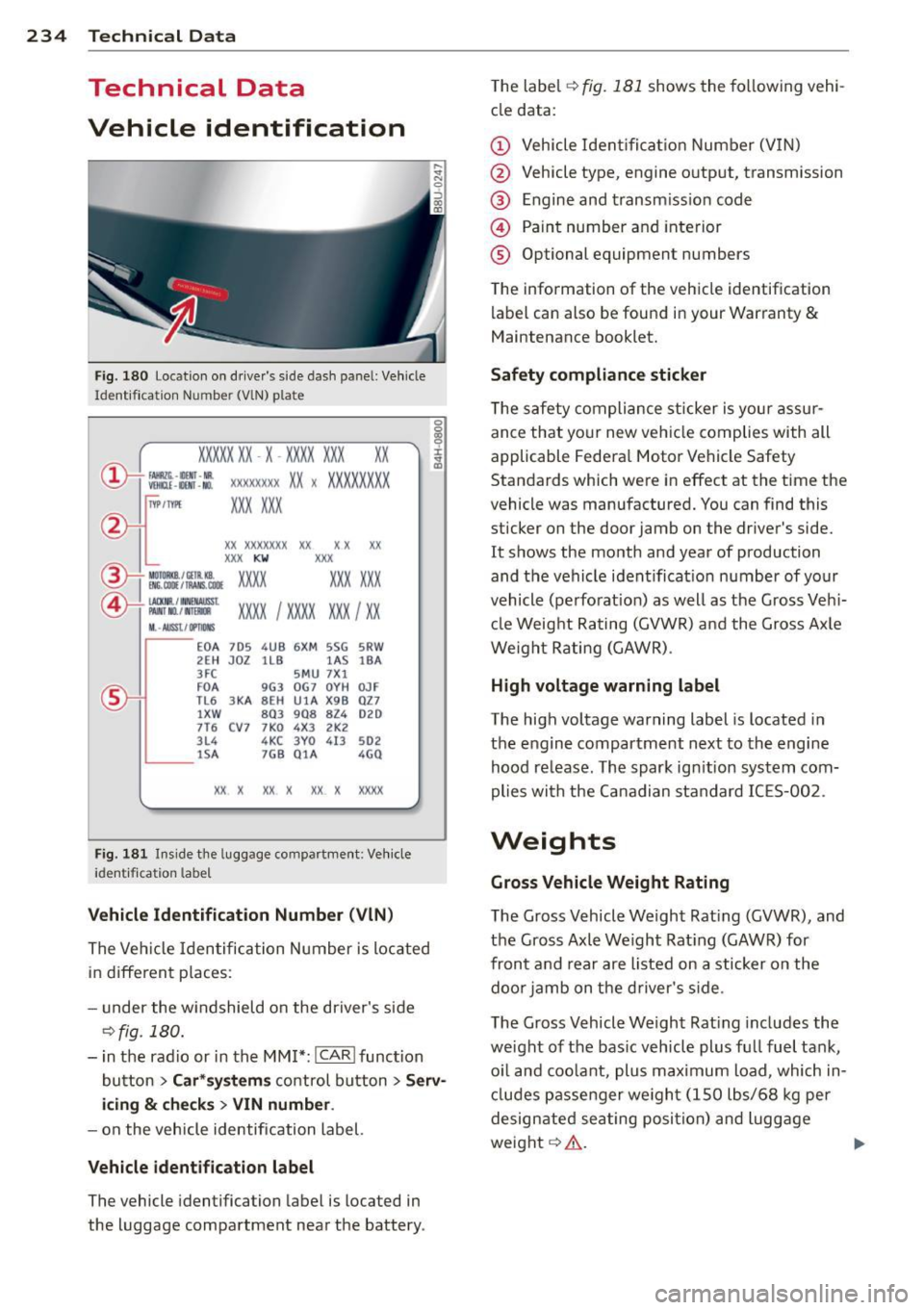
Fig . 180 Location on driver 's s ide dash pane l: Vehicle
Identifica tion Numbe r (V IN) p la te
XXXXX XX · X -XXXX XXX xx
r,'\__l f~ -11!11 1 · Nil ~ V!Hlll -llllll . NO.
IYP IT'fl'E
XXXXXXXX XX X XXXXXXXX
XXX XXX
XX XXXX XXX X X X X XX
XXX
KW XXX
®i ~~: f :l~~ XXXX XXX XXX
@+ ~~r= XXXX I XXXX XXX I XX M,. AIIISl. / lflllllS
EO A 7D5 4 UB 6XM SSG 5RW
2E H JDZ llB l AS lBA
3FC 5MU 7X l
FO A
9G3 OG7 OYH OJF
TL6 3
KA BEH
UlA X9B QZ7
l XW
8Q3 9Q8 82 4 020
7T6 CV 7 7KO 4X3 2K2
3 L4 4 KC 3YO 4I3 502
lSA 7GB Q1 A 4GQ
XX X
XX X XX X XXXX
Fig. 181 Inside the luggage compartme nt: Vehicle
i dentifica tion label
Vehicle Identification Number (VlN)
The Vehicl e Identification Number is located
in different p laces :
- under the w indshield on the driver's side
r=v fig . 180.
-in the radio or in the MM!": !CAR ! function
button
> Car"systems control button > Serv
icing
& checks > VIN number.
- on the vehicle identification label.
Vehicle identification label
The vehicle identification label is located in
the luggage compartment near the battery . T
he label
r=v fig. 181 shows the following vehi
cle data:
(D Vehicle Ident ificat ion Number (VIN)
@ . Vehicle type, engine output, transmission
® Engine and transm ission code
@ Paint number and interior
® Optional equipment numbers
The information of the vehicle identification
label can also be found in your Warranty
&
Maintenance booklet.
Safety compliance sticker
The safety compliance sticker is your assur
ance that your new veh icle complies with all
applicable Federal Motor Vehicle Safety
Standards which were in effect at the time the
vehicle was manufactured. You can find this
sticker on the door jamb on the driver's side.
It shows the month and year of production
and the vehicle ident ificat ion number of your
vehicle (perforat ion) as well as the Gross Veh i
cle Weight Rating (GVWR) and the Gross Axle
Weight Rating (GAWR) .
High voltage warning label
The high voltage warning label is located in
the engine compartment next to the engine
hood re lease . The spark ignition sys tem com
plies with the Canadian standard IC ES-002.
Weights
Gross Vehicle Weight Rating
The Gross Vehicle Weight Rat ing (GVWR), and
the Gross Axle Weight Rat ing (GAWR) for
front and rear are listed on a sticker on the
doo r jamb on the driver's s ide .
The Gross Vehicle Weight Rating includes the
weight of the bas ic vehicle plus fu ll fuel tank,
o il and coolant, plus max imum load, which in
cludes passenger weight (lSO lbs/68 kg per
designated seating position) and luggage
weight ~&, . .,.
Page 245 of 258
M N
M N
0 ::i co ,...., \!) ..,.,
,...., ..,., ,....,
Selector lever ...................... 81
Selector lever emergency release . . . . . . 86
Automatic wipers .......... .... .. .... 46
Auto Safety Hotline ........ .. .. .. .. . 101
Average speed . . . . . . . . . . . . . . . . . . . . . . . 22
Avoid damaging the vehicle ...... ... .. 161
B
Bass box .. .. ............. .... .. .. . 217
Battery . . . . . . . . . . . . . . . . . . . . . . . 15, 190
Battery location inside the luggage com-
partment .. .. ........... .. .. .. ... 190
Charging . .. ............. .... .. ... 192
Important warnings when working on
the battery . ................ ... ... 190
Jump starting .... .. ...... .. .. .. .. . 228
Low ... .. .. .. ... .. ..... ... .. .. .. . 159
Replacing the battery ..... .. .. .. .. . 193
State of charge . . . . . . . . . . . . . . . . . . . . 159
Winter operation ............ ... .. . 190
Working on the battery ....... ... .. . 190
Before driving . . . . . . . . . . . . . . . . . . . . . . . 94
Blended gasoline .......... .... .. .. . 17 5
Blower (automatic climate control) . . . . . . 65
Booster seats ................ ... ... 141
Brake fluid Changing the brake fluid ... .. .. .. .. . 189
Checking the brake fluid level . .. .. .. . 189
Reservoir .. ... ... .... ... .. .. .. .. . 189
What is the correct brake fluid level? .. 189
What should I do if the brake fluid warn-
ing light comes on? ....... .. .. .. .. . 189
Brake system . . . . . . . . . . . . . . . . . . . . . . . 189
Brake assist system . . . . . . . . . . . . . . . . 153
Brake fluid ........... ...... .... .. 189
Brake fluid specifications for refill and re-
placement . ............. .... .. .. . 189
Brake light defective ...... .. .. .. .. .. 18
Brake power assist unit ...... .. .. .. . 156
Brakes ..... .. ................ .... 156
Electromechanical parking brake .. .. .. 70
General information ......... ... .. . 156
Warning/indicator lights ..... .. .. .. .. 13
Worn brake pads symbol . . . . . . . . . . . . . 17
Braking Emergency braking function . . . . . . . . . . 72
Starting on inclines . . . . . . . . . . . . . . . . . 72
Index 243
Break-in period . ..... ............... 161
Tires 161
Bul bs ........ .. .. ................. 226
C
California Proposition 65 Warning ... .. 180
Battery specific .................. . 191
Capacities .. .. .. .. ............... .. 235
Caps for wheel bolts, removing ...... .. 220
Carbon parts Cleaning . . . . . . . . . . . . . . . . . . . . 172, 173
Care ....... .. .. .. ................. 170
Cargo area
refer to Loading the luggage compart-
ment ....... .. .... ............... 100
Catalytic converter ................. . 161
Center armrest Adjusting . .. .. .. .. ............... . 51
Storage compartment . ...... ..... .. . 51
Central locking . ..... ................ 28
Central locking switch ............... 32
Convenience key . . . . . . . . . . . . . . . . . . . . 31
Remote control key . . . . . . . . . . . . . . . . . 30
Certification . . . . . . . . . . . . . . . . . . . . . . . 240
Changing a flat tire ... . .. .. .. .... .... 218
Changing a wheel ...... ............. 218
Changing engine oil .. ........... .... 185
Checking Engine coolant level ............... . 186
Checking tire pressure .............. . 201
Child restraints
Danger of using child restraints in the
front seat . . . . . . . . . . . . . . . . . . . . . . . . 114
System anchors .. .. .............. . 146
Where can I get additional information
about child restraints and their use? .. 151
Child safety ... .. ...... ........... .. 133
Convertible locking retractor ........ . 143
Important safety instructions for using
child safety seats ... .............. . 136
Important things to know when driving
with children .. .. ............... .. 133
Installing a child restraint using the
LATCH system . . . . . . . . . . . . . . . . . . . . . 148
Mounting and releasing the anchorage
hook ... .. .. .. .. .. . ....... ..... .. 148
•
•
Page 247 of 258
M N
M N
0 ::i co ,...., \!) 1.1'1 ,...., 1.1'1 ,....,
Dimming the rearview mirro r .. .. .. .. .. 45
Displays Cleaning . .. ............. .... .. ... 172
Doors Ch ild safety locks .. .... .... . .. .. .. .. 36
emergency locking ............ ... ... 33
Driver information system CD/radio display . . . . . . . . . . . . . . . . . . . . 20
Driver messages . . . . . . . . . . . . . . . . . . . . 20
Efficiency program . . . . . . . . . . . . . . . . . . 24
Open door/hood/rear lid warning . . . . . . 20
Operation by multifunction steering
wheel ... .. ................. .. .... 2 1
Opera tion by windsh ie ld wiper lever .. .. 2 1
Outside temperat ure display .. .. .. .. .. 20
Overv iew . . . . . . . . . . . . . . . . . . . . . . . . . . 20
Trip computer . . . . . . . . . . . . . . . . . . . . . . 22
Driver seat
refer to Seat ing pos ition ... .. .. .. .. .. 95
Drive se lect . . . . . . . . . . . . . . . . . . . . . . . . . 79
Dynamic steering .............. .... . 79
Sett ing the d riving mode ... .. .. .. .. .. 79
Driving offroad . . . . . . . . . . . . . . . . . . . . . 164
D riving safely . . . . . . . . . . . . . . . . . . . . . . . 94
Driving through water ...... .. .. .. .. . 165
D riving time ... ... ..... ... .. .. .. .... 22
Dust filter
refer to Po llutant filte r (au tomatic cli-
mate con trol) . . . . . . . . . . . . . . . . . . . . . . 63
Dynamic steering . . . . . . . . . . . . . . . . . . . . 79
E
Efficiency program . . . . . . . . . . . . . . . . . . . 24
Fuel economy messages . . . . . . . . . . . . . 25
Othe r equipment . . . . . . . . . . . . . . . . . . . 24
Elect rical accessories
refer to Socket . . . . . . . . . . . . . . . . . . . . . 54
E le ctr ical seat adjustment
refer to Seat ad justmen t ... .. ...... .. 51
Electromechanical parking b rake
E merg ency braking . . . . . . . . . . . . . . . . . 72
Par king .. .. ............. .... .. .... 7 1
Rele asing and clos ing ..... .. .. .. .. .. 70
S tart in g assis t . . . . . . . . . . . . . . . . . . . . . 7 1
S tarting from rest . . . . . . . . . . . . . . . . . . 71
Starting off with a trai le r . .. .. .. .. .. .. 72
Warn ing/ indicator lights . .. .. .. .. .. .. 14
Inde x 245
Electromechanical steer ing .... ... .. .. 158
Indicator lights .. .. . ... .... ... .. .. 158
El ectronic d ifferential lock
Wa rning/ind icator lights ........ .. .. . 16
E lectronic differential lock (EDL) . .. .. .. 153
E lectronic immob ilizer . .. ..... ... .. .. . 33
E lectronic power control
( EP C) warning/ indica to r ligh t .... .. .. . 17
E lectronic Stabilization Contro l (ESC) . .. 153
Hill descent assist .. .............. . 155
Offroad mode .. .. .. . .. .... .... .. .. 155
Warning/ind icator lights ........... .. 16
Emergency actuat ion
Doo~ ........ .. .................. 33
Panorama sunroof .. .............. .. 39
Rea r lid . . . . . . . . . . . . . . . . . . . . . . . . . . . 36
Su n shade (roof) ................. .. 39
Emergency brak ing . ............. .. .. . 72
Emergency fl ashe r .................. . 43
Warning/ind icator lights ..... ... .. .. . 19
Emergency key .. .... .. .. ...... ...... 29
Emergency operation Emergency brak ing funct ion (park ing
brake) .... .. .. .. ................. . 72
Emergency re lease
Se lector lever . . . . . . . . . . . . . . . . . . . . . . 86
E mergency starti ng ............. .. .. 228
Emergency towing . .. ........... .... 230
Energy management .. .. ..... ... .. .. 159
Battery power ..... . .. ..... ... .. .. . 15
Driver notification . . . . . . . . . . . . . . . . . . 15
E ngine
Comp artment . . . . . . . . . . . . . . . . . . . . . 181
Coolant ... .. .... .. . .. .. ..... ... .. 186
Data ... .. .. .... .. . .. .. ..... ... .. 236
Hood ... .. .. .. .... . ... ...... ... .. 179
Starting . . . . . . . . . . . . . . . . . . . . . . 66, 68
Starting with jumper cables ....... .. 228
Stopping .. .. .. .. .. . .. .. ..... .. 67, 69
Engine compartment Safety instr uctions . . . . . . . . . . . . . . . . . 179
Working the eng ine compartment 179
E ngine coolant
Indicator lig ht ... .. .. ...... ... .. .. . 14
Engine coolant system ............... 186
Adding coo lant . .................. . 187
Check ing coolant level . ......... .. .. 186
•
•
Page 248 of 258
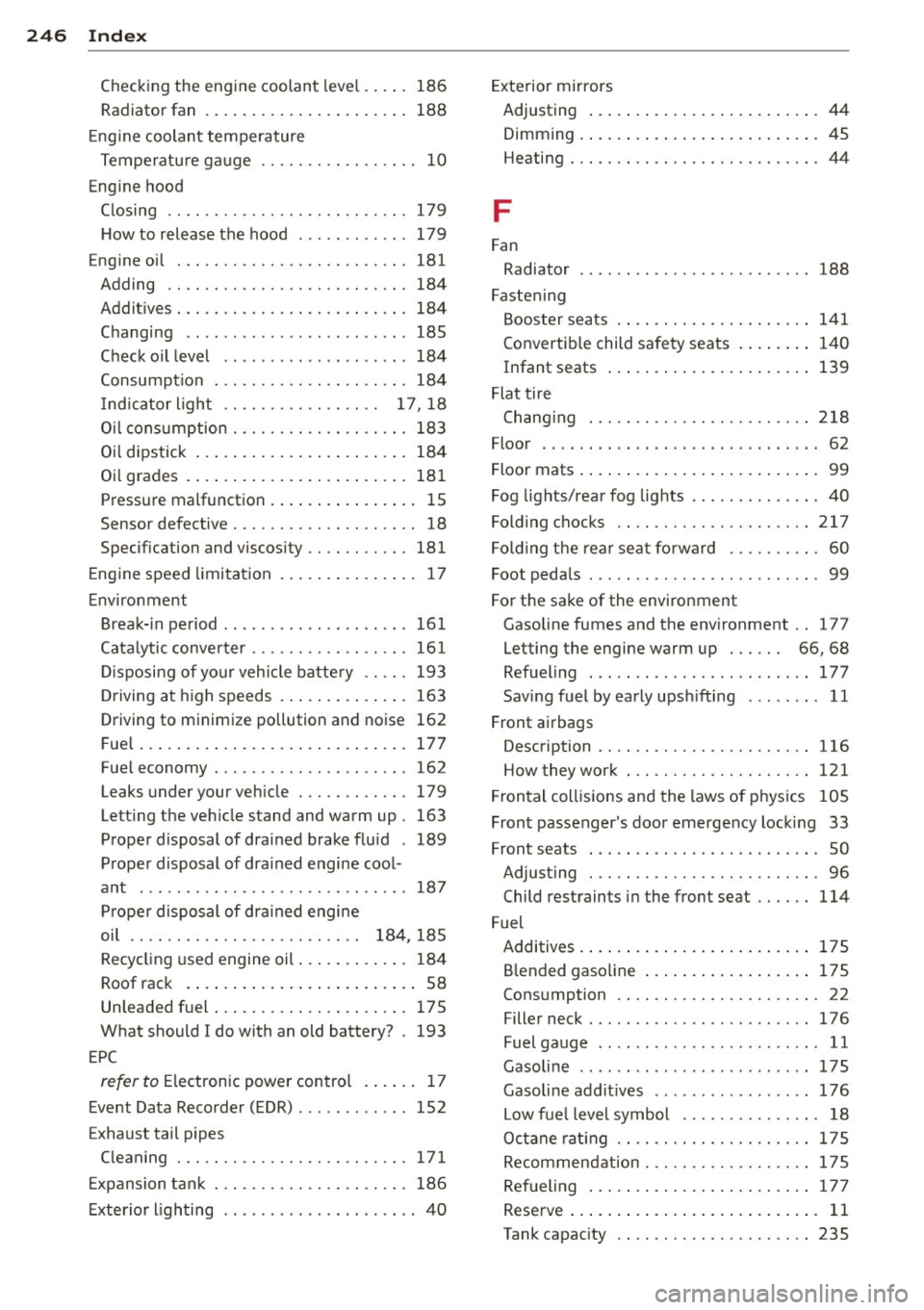
246 Index
Checking the engine coolant leve l .... . 186
Radiator fan . . . . . . . . . . . . . . . . . . . . . . 188
E ng ine coolant temperature
Temperature gauge ..... .. .. .. .. .. .. 10
Eng ine hood
Closing .... .......... ...... ... .. . 179
H ow to release the hood . . . . . . . . . . . . 179
E ngine oi l ..... ........... .... .... . 181
Adding .. .. ............. .. .. .. ... 184
Addi tives . . . . . . . . . . . . . . . . . . . . . . . . . 184
Changing .. ................ ... .. . 185
Check oil level ............ ... .. .. . 184
Consumpt ion . ........... .. .. .... . 184
I ndicator light . . . . . . . . . . . . . . . . . 17, 18
O il consumption .......... .... .... . 183
Oil dipstick ............... ... .... . 184
Oil grades . ................. ..... . 181
Pressure malfunction ....... .... ... .. 15
Sensor defective . . . . . . . . . . . . . . . . . . . . 18
Specification and viscosity .. .. .. .. .. . 181
Engine speed limitation ......... .... . . 17
Environment Break-in period ... ..... ... .. .. .. .. . 161
Cata lytic converter ............ ..... 161
Disposing of your vehicle battery .. .. . 193
Driving at high speeds ......... .. .. . 163
Driving to minimize pollution and noise 162
Fuel ... .... ................ ..... . 177
Fue l economy .............. .. .... . 162
Leaks under your vehicle ... .. .. .... . 179
Le tting the vehicle stand and warm up . 163
Proper disposal of dra ined brake fluid . 189
Proper disposal of dra ined engine cool-
ant . .. .... ... .......... .. .. .. .. . 187
Proper disposal of dra ined engine
oil . . . . . . . . . . . . . . . . . . . . . . . . . 184, 185
Recycling used engine oil ......... .. . 184
Roof rack . . . . . . . . . . . . . . . . . . . . . . . . . 58
Unleaded fuel ..................... 175
What should I do with an old battery? 193
EPC
refer to Electronic power control . . . . . . 17
Event Data Recorder (EDR) . ........ .. . 152
Exhaust tail pipes Cleaning . ............... ........ . 171
Expansion tank ............ .. .. .. .. . 186
Exterior lighting ............ ... .. ... . 40 Exterior
mirrors
Adjusting ..... .. .. .............. .. 44
Dimm ing . ... .. .. .. .............. .. 45
Heating ... .... .. ............. .... . 44
F
Fan
Radiator
Fastening Booster seats .... ................ .
Convertib le child safety seats ..... .. .
Infant seats ..... ............. ... .
Flat tire 188
141
140
139
Changing . .... .. ............. .... 218
Floor .. .. .. .. .. .. .. ...... .... ..... . 62
Floor mats . . . . . . . . . . . . . . . . . . . . . . . . . . 99
Fog lights/rear fog lights ...... ... .. .. . 40
Folding chocks .. .. ... .......... .... 217
Folding the rear seat forward ... .. .. .. . 60
Foot pedals ..... .. .......... ...... .. 99
For the sake of the environment Gasoline fumes and the environment .. 177
Le tting the engine warm up . . . . . .
66, 68
Refueling . . . . . . . . . . . . . . . . . . . . . . . . 177
Sav ing fuel by early upshifting ........ 11
Front airbags Description . . . . . . . . . . . . . . . . . . . . . . . 116
How they work . .. ............. .... 121
Frontal collis ions and the laws of physics 105
Front passenger's door emergency lock ing 33
Front seats . . . . . . . . . . . . . . . . . . . . . . . . . 50
Adjusting . .... .. ............. .... . 96
Child restraints in the front seat .. .. .. 114
Fuel Additives . ..... .. ................ . 175
B lended gasoline ................. . 175
Consumption .. ... ................ . 22
Filler neck . .... .. ............. .... 176
Fuel gauge . . . . . . . . . . . . . . . . . . . . . . . . 11
Gasoline .. ... ... ................ . 175
Gasoline additives ................ . 176
Low fuel level symbol . . . . . . . . . . . . . . . 18
Octane rating .. .. ............. .... 175
Recommendation ... ........... .. .. 175
Refueling . . . . . . . . . . . . . . . . . . . . . . . . 177
Reserve ........................... 11
Tank capacity .. .. ... .......... .... 235
Page 250 of 258
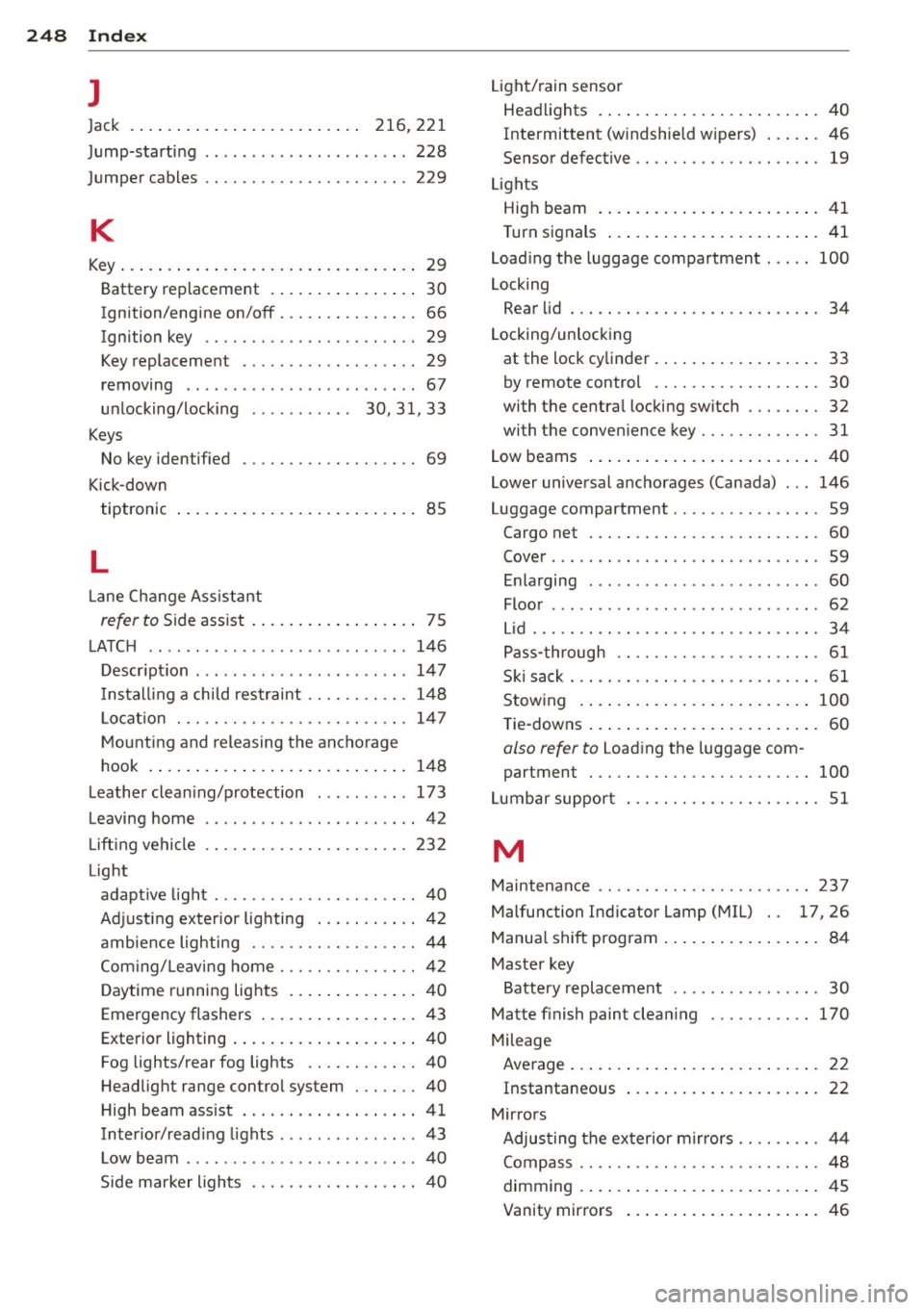
248 Index
l
Jack . . . . . . . . . . . . . . . . . . . . . . . . . 216, 221
Jump-starting ... ... ... .... .. .. .. .. . 228
Jumper cables ............. .. .. .. ... 229
K
Key ..... .... ................ ..... .. 29
Battery replacement . . . . . . . . . . . . . . . . 30
Ignition/engine on/off . . . . . . . . . . . . . . . 66
Ignition key . . . . . . . . . . . . . . . . . . . . . . . 29
Key replacemen t . . . . . . . . . . . . . . . . . . . 29
removing .. ..... ........... ... .. .. 67
unlocking/locking ........ .. . 30, 31, 33
Keys No key identified . . . . . . . . . . . . . . . . . . . 69
Kick-down tiptronic . . . . . . . . . . . . . . . . . . . . . . . . . . 85
L
La ne Change Assistant
refer to Side assist .......... .. .... .. 75
LATCH .. .. .. ................ ... ... 146
Description ........... .... ... .. .. . 147
I nstall ing a chi ld restraint .. .. .. .... . 148
L ocat ion ..... ........... .. .. .. .. . 147
Mounting and releasing the anchorage
hook .... ................. .. .... . 148
Leather cleaning/protection ... .. .. .. . 173
Leaving home ............. .. .. .. .. .. 42
Lifting vehicle ... .......... .. .. .. .. . 232
Light adaptive light ............. ... .. .... 40
Adjusting exterior lighting . .. .. .. .. .. 42
ambience lighting . ... .. .. .. .. .. .. .. 44
Com ing/ Leaving home ....... .. .. .. . . 42
Daytime running lights ........ .... . . 40
Emergency flashers . . . . . . . . . . . . . . . . . 43
Exterior lighting .................... 40
Fog lights/rear fog lights .. .. .. .... .. 40
Headlight range control system ....... 40
High beam assist .... .... ... .. .. ... . 41
Interior/reading lights ..... .. .. .. .. . . 43
L ow beam .. ..... ........... ... .. .. 40
Side marker lights ........ .. .. .. .. .. 40 Light/rain
sensor
Headlights . ..... ................ .. 40
Intermittent (windshield w ipers) ...... 46
Sen sor defective .. ......... .... .... . 19
Lights High beam .... .. ................ .. 41
Turn signals ..... .................. 41
Loading the luggage compartment . .. .. 100
Locking Rear lid . . . . . . . . . . . . . . . . . . . . . . . . . . . 34
Locking/unlocking at the lock cylinder ................ .. 33
by remote control ............... .. . 30
with the central locking switch . .. .... . 32
wi th the convenience key ........ .. .. . 31
Low beams ..... .. ................ .. 40
Lower universal anchorages (Canada) ... 146
Luggage compa rtment . . . . . . . . . . . . . . . . 59
Cargo net . . . . . . . . . . . . . . . . . . . . . . . . . 60
Cover ...... ... .. .. ... ........... .. 59
Enlarging . . . . . . . . . . . . . . . . . . . . . . . . . 60
Floor ........ ... .. .............. .. 62
Lid ..... .. .. .. .. .. ........... .. .. . 34
Pass-through .. .. ............. .. .. . 61
Ski sack ... .. .. . ............ ...... . 61
Stowing .. .... .. .. .............. . 100
Tie-downs . . . . . . . . . . . . . . . . . . . . . . . . . 60
also r efe r to Loading the luggage com
partment . . . . . . . . . . . . . . . . . . . . . . . . 100
Lumbar support ... ............. .... . 51
M
Maintenance .. .. .. ... ... ... .... .... 237
Malfunc tion Indicator Lamp (MIL) . . 17, 26
Manual shift program ................. 84
Master key
Battery replacement . . . . . . . . . . . . . . . . 30
Matte finish paint cleaning ....... .. .. 170
Mileage Average ........................... 22
Instantaneous ... ................ .. 22
Mirrors Adjusting the exterior mirrors .. .. .... . 44
Compass .. .. .. .. ... .......... .... . 48
dimming . ..... .. ............. ..... 45
Vanity mirrors ... .................. 46