ignition AUDI Q3 2015 Workshop Manual
[x] Cancel search | Manufacturer: AUDI, Model Year: 2015, Model line: Q3, Model: AUDI Q3 2015Pages: 258, PDF Size: 64.9 MB
Page 173 of 258
M N
M N
0 ::i co ,...., \!) 1.1'1 ,...., 1.1'1 ,....,
Vehicle care and cleaning 171
Rinse the vehicle thoroughly again and let it
air dry. Remove any water residue using a
shammy .
A WARNING
- Only wash the vehicle when the ignition
is off and follow the instructions from
the car wash operator to reduce the risk
of accidents .
- To reduce the r isk of cuts, protect your
self from sharp metal components when
wash ing the underbody or the inside of
the wheel housings.
- After washing the vehicle, the braking ef
fect may be de layed due to moisture on
the brake rotors or ice in the winter. The
brakes must be dried first with a few
careful brake applications.
([) Note
-If you wash the vehicle in an automatic
car wash, you must fold the exterior m ir
rors in to reduce the ris k of damage to
the mirrors. Power folding exterior mir
rors* must only be folded in and out us
ing the power folding function. -
To prevent paint damage, do not wash
the vehicle in direct sunlight.
- To reduce the risk of damage to the sur
face, do not use insect removing spong
es, kitchen sponges or similar items.
- Matte finish painted vehicle compo
nents:
- To reduce the risk of damage to the
surface, do not use polishing agents or
hard wax.
- Never use car wash cycles that apply
protective wax.
It can destroy the
matte finish effect .
- Do not place any stickers or magnet ic
signs on vehicle parts painted w ith
matte fin ish paint. The paint could be
damaged when the stickers or magnets
are removed.
@ For the sake of the environment
Only wash the vehicle in facilities spec ially
designed for that purpose . This will red uce
the r isk of dirty water contam inated with
oil from entering the sewer system.
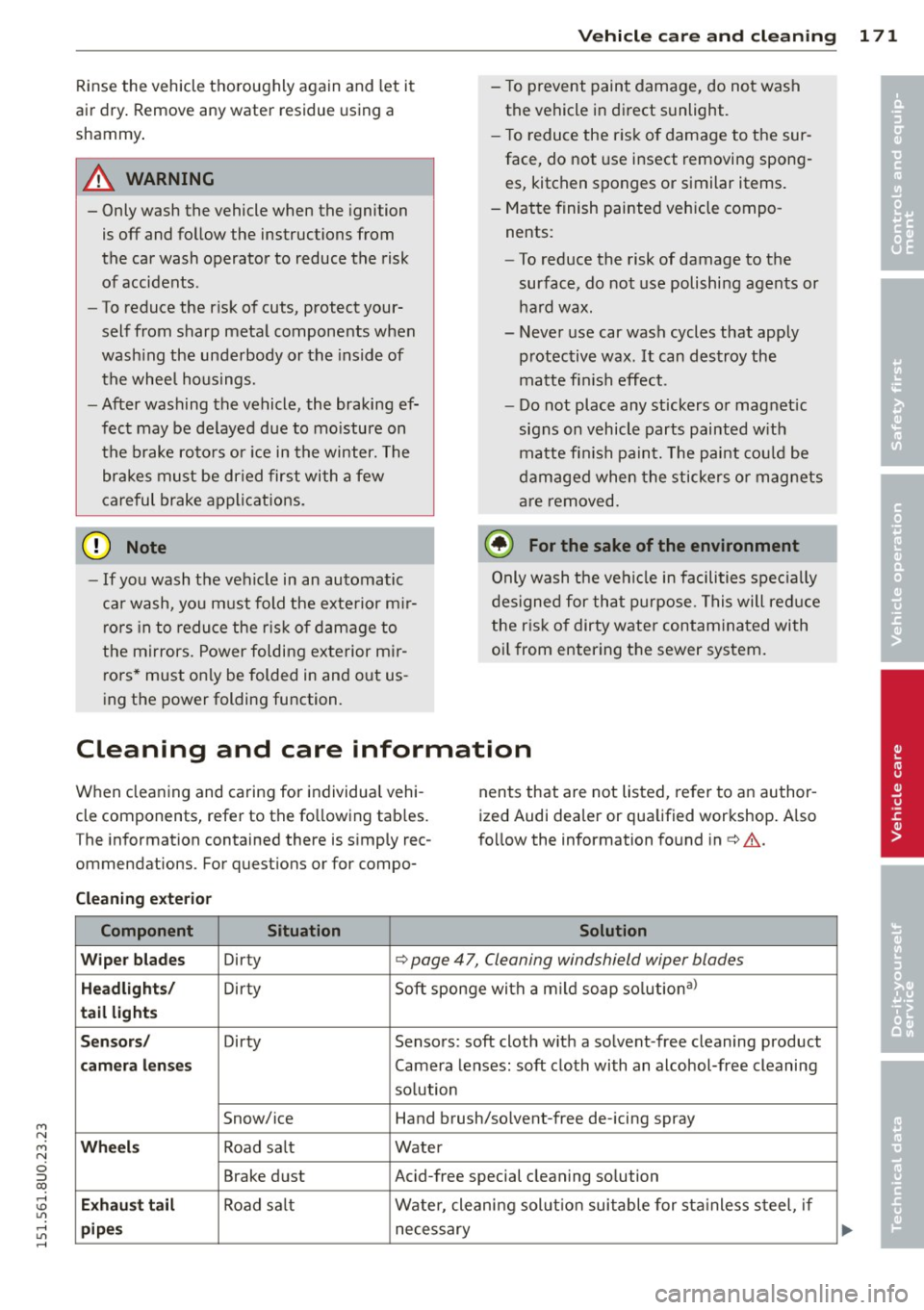
Cleaning and care information
When cleaning and caring for individual vehi
cle components, refer to the following tab les .
The information contained there is simply rec
ommendations . For questions or for compo- nents that are not listed,
refer to an author
ized Audi dealer or qualified workshop. A lso
follow the information found in ¢ ,& .
Cleaning exterior
Component Situation Solution
Wiper blades
Dirty Q page 4 7, Cleaning windshield wiper blades
Headlights/ Dirty Soft sponge with
a m ild soap solutiona>
tail lights
Sensors/
Dirty Sensors: soft cloth with a solvent -free cleaning product
camera lenses Camera lenses: soft cloth with an alcohol-free cleaning
solution
Snow/ice Hand brush/solvent-free de-icing spray
Wheels Road sa lt Water
Brake dust Acid-free special cleaning solution
Exhaust tail Road salt Water, cleaning solut ion suitable for stainless steel, if
pipes necessary
•
•
Page 177 of 258
M N
M N
0 ::i co ,...., \!) 1.1'1 ,...., 1.1'1 ,....,
Fuel supply and filling
your f uel tank
Gasoline
Fuel supply
Using the right fuel helps keep the environ
ment clean and prevents engine damage.
Fuel recommendation
The fuel recommended for your vehicle is un
leaded premium
grade gasoline. Audi recom
mends using TOP TIER Detergent Gasoline
with a minimum octane rating of 91 AKI (95
RON) . For more information on TOP TIER De
tergent Gasoline, please go to the official
website (www.toptiergas.com).
The recommended gasoline octane rating for
your engine can also be found on a label locat
ed on the inside of the fuel filler flap. This rat
ing may be specified as AKI or RON.
Your vehicle may also be operated using un leaded regular gasoline with a minimum oc
tane rating of 87 AKI/91 RON. However, using
87 AKI/91 RON octane fuel will slightly re
duce engine performance.
Use unleaded gasoline only. Unleaded gaso
line is available throughout the USA, Canada,
and in most European countries. We recom
mend that you do not take your vehicle to
areas or countries where unleaded gasoline
may not be available.
For more information on refueling your vehi
cle, see~
page 176.
Octane rating
Octane rating indicates a gasoline's ability to
resist engine damaging "knock" caused by
premature ignition and detonation. Therefore,
buying the correct grade of gasoline is very
important to help prevent possible engine
damage and a loss of engine performance.
Gasoline most commonly used in the United
States and Canada has the following octane ratings that can usually be found on the filler
pump:
Fuel supply and filling your fuel tank 175
- Premium Grade: 91 -96 AKI
- Regular Grade: 87 -90 AKI
Explanation of the abbreviations:
AKI = Anti Knock Index= (R+M)/2 = (RON
+MON)/2
RON= Research Octane Number
MON= Motor Octane Number.
@ Note
-Do not use any fuel with octane ratings
lower than 87 AKI or 91 RON otherwise
expensive engine damage will occur.
- Do
not use leaded gasoline. The use of
leaded gasoline will severely damage
your vehicle's catalytic converter and its
ability to control exhaust emissions.
Blended gasoline
Use of gasoline containing alcohol or
MTBE (methyl tertiary butyl ether)
You may use unleaded gasoline blended with
alcohol or MTBE (commonly referred to as
oxygenates) if the blended mixture meets the
following criteria:
Blend of gasoline methanol (wood alcohol or
methyl alcohol)
- Anti-knock index must be 87 AKI or higher.
- Blend must contain no more than 3% meth-
anol.
- Blend must contain more than 2% co-sol-
vents.
Blend of gasoline and ethanol (grain alcohol
or ethyl alcohol)
- Anti-knock index must be 87 AKI or higher.
- Blend must not contain more than 15%
ethanol.
Blend of gasoline and MTBE
- Anti-knock index must be 87 AKI or higher.
- Blend must contain not more than 15%
MTBE.
Seasonally adjusted gasoline
•
•
Page 179 of 258

M N M N
0 :::i co
rl I.O
"' rl
"' rl
cause a fire in a co llision. If you must
transport fue l to use for yo ur lawn mowe r,
snow blower, etc., be very careful and al
ways observe local and state laws regard
ing the use, transportat ion and storage of
such fuel containers . Make certain the con
t ainer meets industry standards (ANSI/
AS TM F 852 -86).
(D Note
Never drive yo ur vehicle unt il the fuel tank
is completely empty . The irregular supp ly
of fuel can cause misfi ring. Gasoline could
enter the exhaust system and damage the
catalyt ic converte r.
Refueling
Fig. 140 Rig ht rea r veh icle s ide: Opening t he fuel f iller
fl ap
Fi g. 14 1 Fu el filler fla p with attach ed fu el c ap
When activating the central locking, the fuel
f ill er flap is automatically unlocked or locked .
Refue l the vehicle with the ignition turned
off.
Tak ing th e fuel cap off
• Press the left side of the fue l filler flap to
open it ¢
fig . 140 -arrow- .
• Unscrew fuel cap counter-clockwise and
hang it on the fuel f iller flap ¢
fig. 141.
Fuel suppl y and filling your fuel t ank 17 7
Refueling procedure
• Insert the fuel nozzle from the gasoline
pump into the fuel fi ller neck as far as it wi ll
go .
• Select a medium refueling rate so that the
no zz le switches off automatically when the
tank i s full .
Putting th e fuel cap bac k on
• After filling your tank, twist the fuel cap
clockw ise as far as it will go .
• Close the fue l filler flap.
T o avoid fuel spill ing or evaporating from the
fuel tank always close fuel cap properly and
completely . An improper ly closed fuel filler
cap may also cause the MIL lamp ¢
page 26
to come on.
A WARNING
Improper refue ling or handling of fuel can
cause fire, explosion and severe burns.
- Fuel is highly flammable and can cause
severe burns and other injur ies .
- Failure to shut the engine off while refu
eling and/or to insert the pump nozzle
fully into the fuel filler neck could cause
fue l to spray out of filler neck or to over
flow. Fue l spray and overflowing fuel can
cause a fire .
- Never use a ce llu lar telephone while re
fue ling. The electromagnet ic rad iation
can cause sparks that can ignite f uel va
pors and cause a fire.
- Never get back into yo ur vehicle while re
fuel ing.
If in excep tional circumstances
you must get back in your vehicle while refueling, make certain that you close
the door and touch metal to discharge static electricity before touching the fill
er nozzle again . Static electr icity can
cause sparks that can ignite fuel vapors
released during refueling.
- Never smoke or have an open f lame any
where in or near your veh icle when refu
eling or filling a portab le fuel conta iner .
- For your safety, we strongly recommend
that you do not t ravel with a portable
Page 181 of 258
M N M N
0 ::i co
rl I.O
"' rl
"' rl
Checking and filling Engine hood
Releasing and opening the engine hood
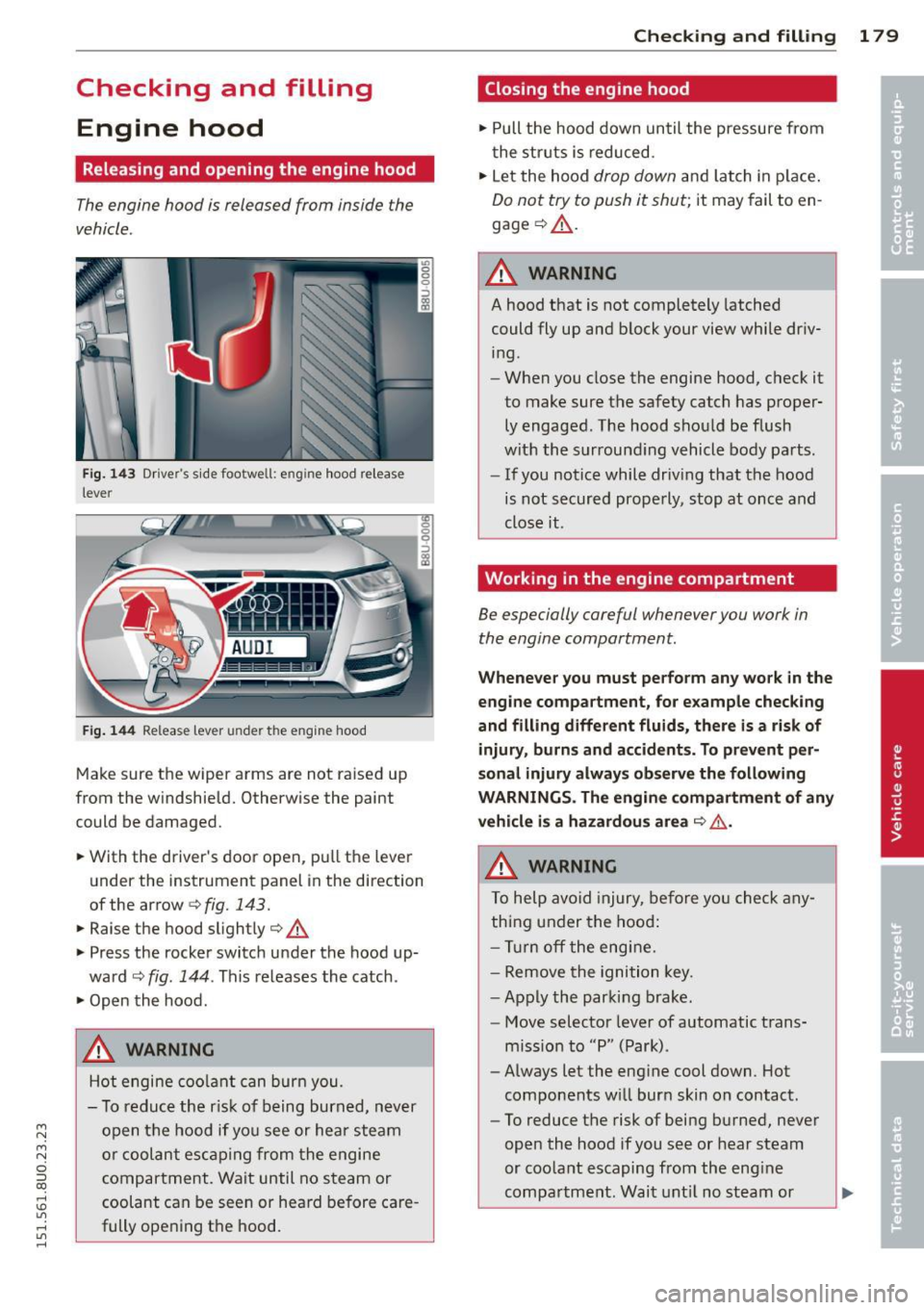
The engine hood is released from inside the
vehicle .
Fig. 1 43 Dr iver's side footwell: eng ine hood release
lever
F ig . 144 Re lease lever un der the engine hood
Make sure the wiper arms are not raised up
from the w indshield. Otherw ise the paint
could be damaged .
.. With the driver's door open, pu ll the lever
under the instrument panel in the direction
of the arrow
c> fig. 143.
.. Raise the hood slightly c> .&,
.. Press the rocker switch under the hood up
ward
c> fig. 144 . This releases the catch .
.. Open the hood.
A WARNING
Hot engine coo lant can burn you.
- T o reduce the r is k of being burned, never
open the hood if you see or hear steam
or coolan t escaping from the engine
compartment. Wait until no steam or
coolant can be seen or heard be fore care
fully opening t he hood.
Checkin g and fillin g 179
Closing the engine hood
.. Pull the hood down un til the pressure from
t he stru ts is reduced.
.. Let the hood
drop down and latch in p lace .
Do not try to push it shut; it may fail to en
gage¢ .&,.
A WARNING
-
A hood that is not completely latched
could fly up and b lock your view while dr iv
ing.
- When you close the engine hood , check it
to make sure the safety catch has proper
ly engaged. The hood shou ld be flush
with the surround ing vehicle body parts.
- If you notice while dr iving that the hood
is not secured properly, stop at once and
close it.
Working in the engine compartment
Be especially careful whenever you work in
the engine compartment.
Whene ve r you must pe rform an y wo rk in the
eng ine compa rtment , for e xample check ing
and filling different fluids, there is a risk of
injury , burns and accidents. To prevent per
so nal injury alway s observe th e foll owing
WARNINGS . Th e engin e compartm ent of an y
v e hicle i s a ha zardou s area
c> .&, .
A WARNING
To help avoid injury, be fore yo u check any
thing under the hood:
- Tu rn off the engi ne .
- Remove the ignition key.
- Apply the parking brake .
- Move selector leve r of automatic trans-
miss ion to "P" (Park) .
- Always let the engine cool down. Hot
components w ill bur n skin on contact.
- To reduce the risk of being burned, never
open the hood if you see or hear steam
or coo la nt escaping from the eng ine
compa rtment. Wait unt il no steam or
Page 182 of 258
180 Checking and filling
coolant can be seen or heard before
carefully opening the hood.
- Keep children away from the engine com
partment.
- Never spill fluids on hot engine compo
nents. They can cause a fire.
- Never touch the radiator fan. The auxili ary electric fan is temperature controlled
and can switch on suddenly.
- Never open the coolant reservoir cap
when the engine is still warm. The cool
ant system is pressurized and hot cool
ant could spray out .
- Protect your face, hands and arm from
steam or hot engine coolant by placing a
thick rag over the cap when you open the
coolant reservoir .
- Do not remove the engine cover under
any circumstances. This increases the
risk of burns.
- If work on the fuel system or the electri
cal system is necessary:
- Always disconnect the battery .
- Never smoke or work near heaters or
open flames. Fluids in the engine com
partment could start a fire.
- Keep an approved fire extinguisher im
mediately available.
- To avoid electrical shock and personal in
jury while the engine is running or being
started, never touch:
- Ignition cables
- Other components of the high voltage
electronic ignition system.
- If you must perform a check or repair
with the engine running:
- First, fully apply the parking brake,
move selector lever of automatic trans
mission to "P" (Park) .
-Always use extreme caution to prevent
clothing, jewelry, or long hair from get- ting caught in the
radiator fan, V-belts
or other moving parts, or from contact
ing hot parts. Tie back hair before
starting, and do not wear clothing that
will hang or droop into the engine .
- Minimize exposure to emission and
chemical hazards
c> A .
A WARNING
-California Proposition 65 Warning:
- Engine exhaust, some of its constituents,
and certain vehicle components contain
or emit chemicals known to the State of
California to cause cancer and birth de
fects and reproductive harm. In addition,
certain fluids contained in vehicles and
certain products of component wear con
tain or emit chemicals known to the
State of California to cause cancer and
birth defects or other reproductive harm.
- Battery posts, terminals and related ac
cessories contain lead and lead com
pounds, chemicals known to the State of
California to cause cancer and reproduc
tive harms. Wash hands after handling.
(D Note
When adding fluids, always make sure that
they are poured into the proper container
or filler opening, otherwise serious dam
age to vehicle systems will occur.
@ For the sake of the environment
To detect leaks in time, inspect the vehicle
floor pan from underneath regularly. If
you see spots from oil or other vehicle flu
ids, have your vehicle inspected by an au
thorized Audi dealer.
Page 188 of 258
186 Checking and filling
Engine cooling system
Coolant
The engine coolant performs two functions: it
keeps the engine from overheating and it pro
tects the engine from freezing in the winter .
The cooling system is sealed and generally re
qu ires little attention .
The cooling system has been filled at the fac
tory with a permanent coo lant which does not
need to be changed. The coolant consists of a
mixture of spec ially conditioned water and the
manufacturer's glycol-basedcoolant addi-
tive G13 antifreeze with ant icorros ion addi
tives (50% for USA models; 60% for Ca nada
models) . This mixture both assures the neces
sary frost protection and protects metal com
ponents in the engine's cooling system from
corrosion and scaling.
It a lso raises the boil
ing point of the coo lant.
Do not reduce the concentration o f the coo l
ant in the summer by adding plain water .
The
proportion of coolant additive must be at
least 50% but not more than 60%
to main
tain antifree ze protection and cooling efficien
cy. If the coolant frost protect ion is too low,
the coolant could freeze and damage the veh i
cle heating and engine cooling system .
For year-round driving, antifree ze is added at
the factory for temperatures down to:
- -31°F(-35°C)USA
- - 40 °F ( -40 °C) Canada.
I f you must add coo lant, use a mixture of wa
ter and coolant addit ive. Mixing the coolant
additive with distilled water is recommended.
_& WARNING
Before yo u check anything in the engine
compartment, always read and heed all
WARNINGS
~ &. in Working in the engine
compartment on page 179.
(D Note
- Before winter sets in, have the coolant
checked to see if the coolant additive in
-
your vehicle is sufficient to meet the cli mate conditions . This is especia lly impor
tant if you live in a reg ion where the win
ter is extreme ly cold. If necessary, in
crease the proportion of coolant add itive
to 60% .
- When adding coolant additive to your
cooling system, remember:
- We recommend using only coolant ad
ditive G12++ or G13 for your vehicle.
This coolant additive is available at au
thorized Audi dealers. Other types of
antifreeze can significantly reduce cor rosion protection. The resulting corro
sion can cause a loss of coolant and se
rious engine damage .
- Do not add any type of rad iator leak seal
ant to your vehicle's engine coolant.
Adding radiator repair flu id may adverse
ly affect the function and performance of
your cooling system and could result in
damage not covered by your New Vehicle
Limited Warranty.
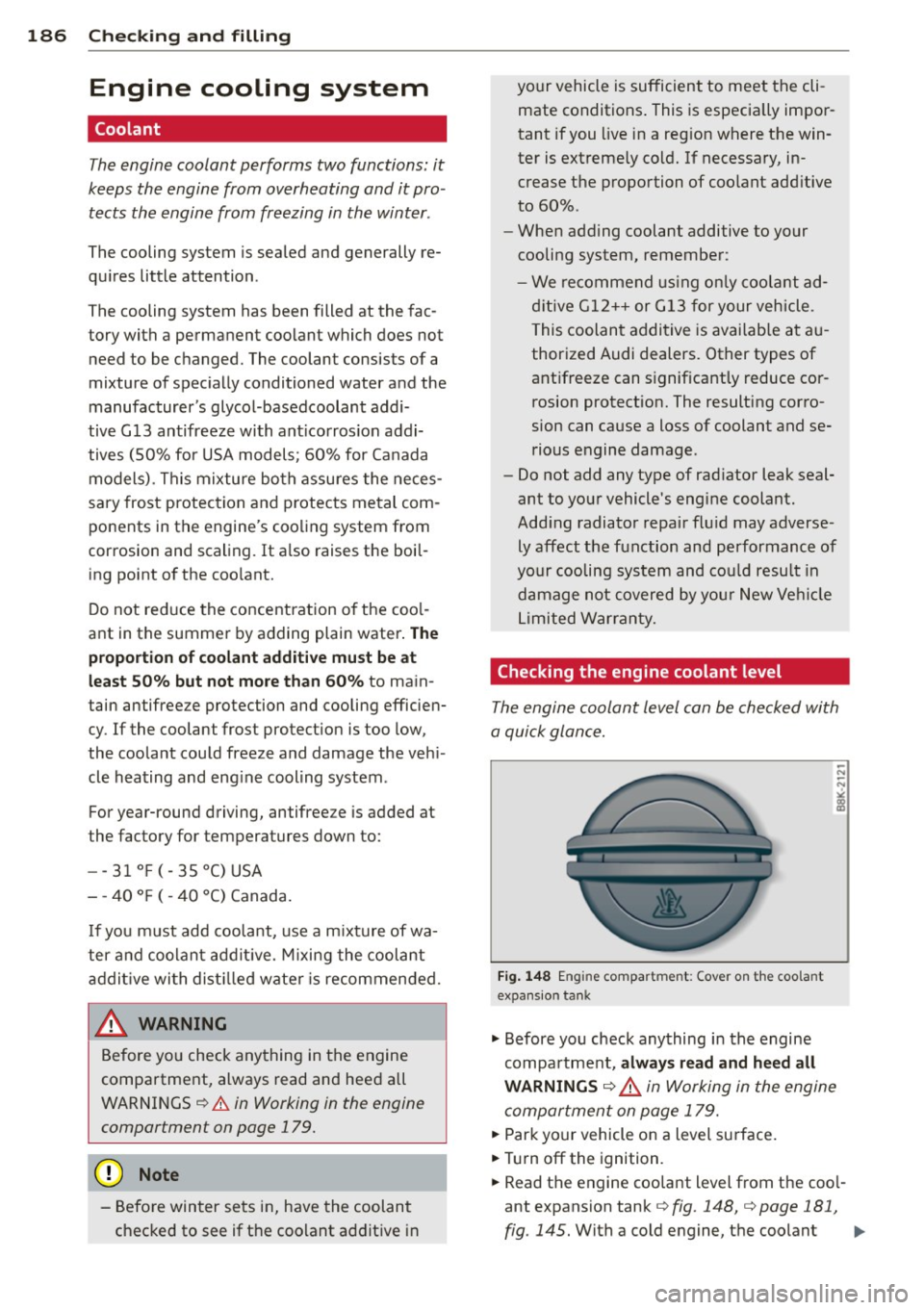
Checking the engine coolant level
The engine coolant level can be checked with
a quick glance.
Fig. 148 E n gin e compart men t: Cover on the coo la n t
expans io n tank
.,. Before you check anything in the engine
compa rtment,
always read and heed all
WARNINGS ~ ,& in Working in the engine
compartment on page 179.
.,. Park your vehicle on a level surface .
.,. Tur n off the ignition.
.,. Read the engine coolant level from the coo l
ant expansion tank
c:> fig . 148, c:> page 181,
fig. 145.
With a cold engine, the coolant Iii>-
Page 190 of 258
188 Checking and filling
Do not fill coolant above the "MAX" mark. Ex
cess coolant will be forced out through the pressure re lief valve in the cap when the en
g ine becomes hot.
A WARNING
- The coo ling system is under pressure and
can get very hot. Reduce the risk of
scalding from hot coolant by following
these steps.
- Turn
off the eng ine and a llow it to cool
down.
- Protect your face, hands and arms from
escaping fluid and steam by covering
the cap with a large, thick rag.
- Turn the cap slowly and very ca refully
i n a co unte r-clockwise d irection while
apply ing light, downward press ure on
the top of the cap.
- To avoid being burned, do not spi ll an
tifreeze or coolant on the exhaust sys
tem or hot engine parts. Under certa in
conditions, the ethylene glyco l in en
g ine coolant can ca tch f ire.
- Antifreeze is poisonous. Always store an
t ifreeze in its original container and we ll
o ut of the reac h of children.
- If you drain the coolant, it must be
caught and safely stored in a p roper con
ta iner clear ly ma rked "poison".
(D Note
- Do not add coolant if the expansion tan k
i s empty. A ir could enter the cooling sys
tem and damage the eng ine. If this is
the case, do not continue driving. Seek
professional assistance.
- Coolant po llutes the e nv ironment and
could cause an engine fire. Excess coo l
ant will be forced ou t through the pres
su re re lief v alve in the ca p when the en
gine becomes hot .
- If, in an emergen cy, only water can be
added, the corre ct ratio be twee n wa te r
and antifr eeze¢
page 186 must be re
stored as soon as possib le .
{® For the sake of the environment
D rained coo lant should not be reused . A l
ways d ispose of used coolant whi le observ
i ng a ll environmental regulations.
Radiator fan
The radiator fan switches on automatically by
itself
T he rad iator fan is driven by the engine v ia the
V-belt. The viscous clutch regulates the spee d
of the fan acco rding to the temperature of the
coolant.
An a uxiliary electric radiator fan* sw itches on
and
off depending on coolant temperature
and othe r vehicle ope rat ing condit ions .
A ft er yo u sw itc h t he eng ine
off, the aux iliary
f an can continue running for up to 10 m inutes
- even wit h the ignition
off. It can even switc h
on again later by itself¢.&. , if
- t he tempe rature of the engine coo lant rises
due to the heat build -up from the engine in
the engine compa rtment, or
- the engine compa rtment heats up because
the vehicle is parked in i ntense sunlig ht.
A WARNING ~
- To reduce the risk of perso na l inj ury nev -
er touch the radiator fan.
- The a uxiliary electric fan is tempe rat ure
contro lled and can sw itch on sud denly
even when the engine is not running.
- The a uxiliary radiator fan sw itches on a u
tomatically when the engine coo lant
reac hes a certa in temperature and will
continue to ru n until the coolant temper
ature drops.
Page 194 of 258
192 Checking and filling
(D Note
- Do not disconnect the vehicle battery
when the ignition is switched on or when
the engine is running, otherwise, you will
damage e lectronic components i n the
electrical system.
- If your vehicle is going to stand for a
long period of time without being driven,
protect t he battery from "freezing", oth
e rwise it w ill be damaged and w ill then
have t o be repla ced.
Battery charging
Starting the engine requires a well charged
battery.
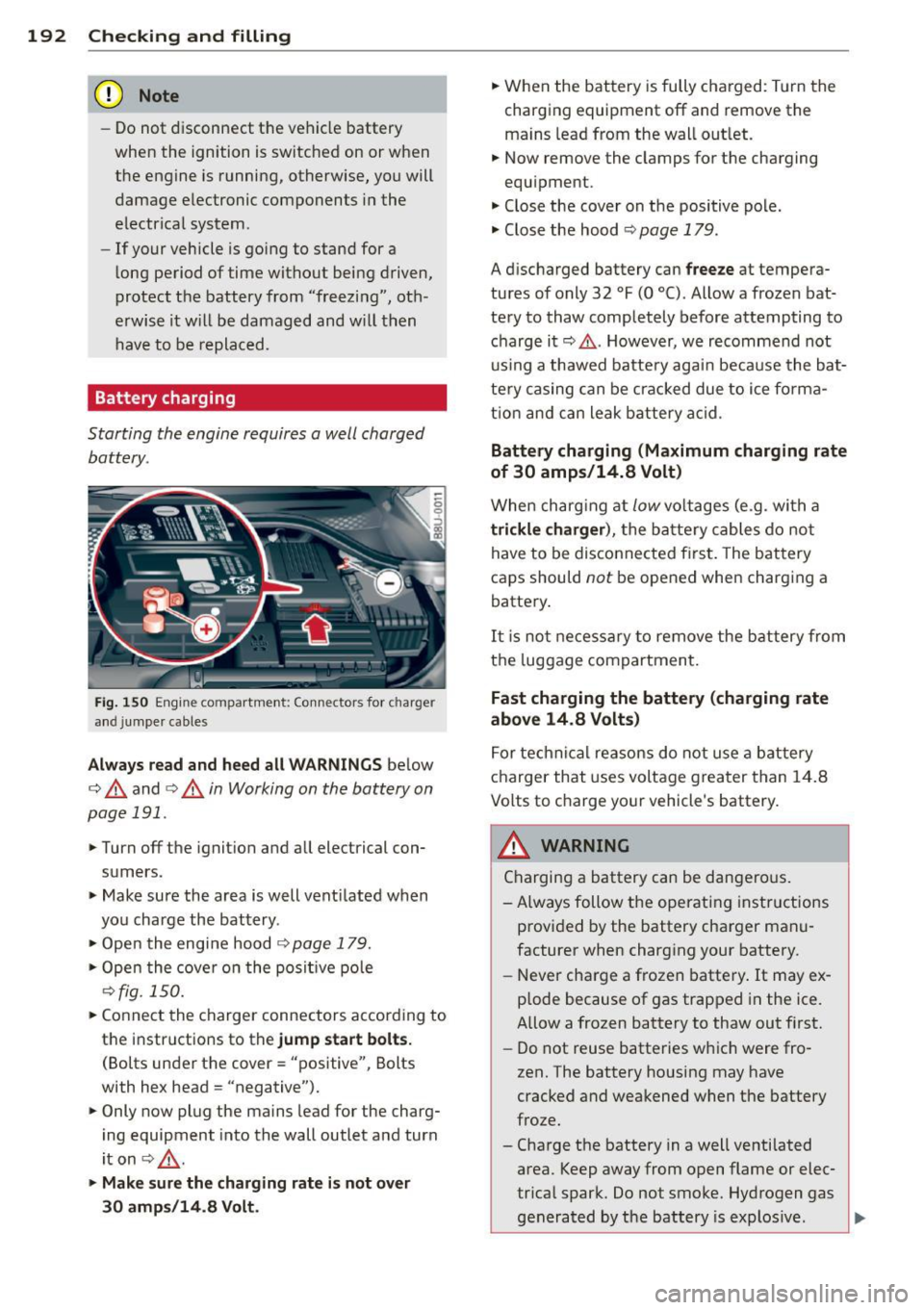
Fig. 150 Eng ine compartment: Connectors for charger
a nd jumper cables
Always read and heed all WARNINGS be low
c::> & and c::> & in Working on the battery on
page 191 .
•Turnoff th e ignit ion and all electrical con
sumers.
• Make sure the area is well vent ilated when
yo u cha rge the battery .
• Ope n the engi ne hood
c::> page 179.
• Open the cove r o n the pos it ive pole
c::> fig. 150.
• Connect the charger connectors according to
the instructions to the
jump start bolts.
(Bo lts under the cover = "positive", Bolts
with hex head= "negative").
• Only now plug the mains lead for the charg
i ng equipment into the wall outlet and turn
i t on
c::> .&,. .
• Make sure the charging rate is not over
30 amps /14.8 Volt .
• When the battery is fully charged: Turn the
charging equipment off and remove the
mains lead from the wall out let.
• Now remove the clamps for the charging
equ ipment.
.,. Close the cover on the positive pole .
.,. Close the hood
c::> page 179 .
A discharged battery can freeze at tempera
tures of only 32 °F (0 °C). Allow a frozen bat
tery to thaw comp letely before attempting to
charge i t
c::> .&.. However, we recommend not
u sing a thawed batte ry aga in because the ba t
te ry casing can be c racked due to i ce fo rm a
t io n an d can leak battery a cid.
Battery charging (Maximum charging rate
of
30 amps/14.8 Volt)
When charg ing at low vo lta ges (e.g. wi th a
trickle charger ), the ba tte ry cables do not
have to be disconnected f irs t. T he bat tery
caps should
not be opened when charg ing a
battery .
It is no t necessa ry to remove the b attery from
the luggage compartmen t.
Fast charging the battery (charging rate
above 14 .8 Volts)
F or te chnica l re asons do not use a batt ery
ch arger that uses voltage greater than
14 .8
Volts to c harge yo ur vehicle's battery.
A WARNING
.------
C harging a battery can be dangero us.
-A lways follow the operati ng instr uctions
p rovi ded by the battery charger manu
facturer when charg ing your battery.
- Never charge a frozen batte ry . It may ex
p lode because of gas trapped in the ice.
Allow a frozen battery to thaw out f irst.
- Do not reuse batteries w hich were fro
zen. The battery housing may have
cracked and weakened w hen the battery
froze .
- Charge the battery in a we ll ventilated
area. Keep away from open flame or elec
tr ica l spark. Do not s moke. Hydrogen gas
genera ted by t he battery is explos ive .
Page 216 of 258
214 Tire s and wheel s
When the malfunction indicator is illuminat
ed, the system may not be able to det ect or
signal low t ire pressure as intended . TPMS
malfunct ions m ay occur for a variety of re a
sons, including the installa tion of replace
ment or a lternate tires or wheels on the vehi
cle that prevent the TPMS from funct ioning
properly . Always check the TPMS malfunct ion
tellta le afte r replacing one or more t ires or
wheels on your veh icle to ensure that the re
p lacement or a lternate tires and wheels allow
the TPMS to continue to function properly.
Tire pressure indicator appears
Applies to vehicles: with tire pressure monito ring system
The tire pressure indicator in the instrument
cluster informs you if the tire pressure is too
low or if there is a system malfunction.
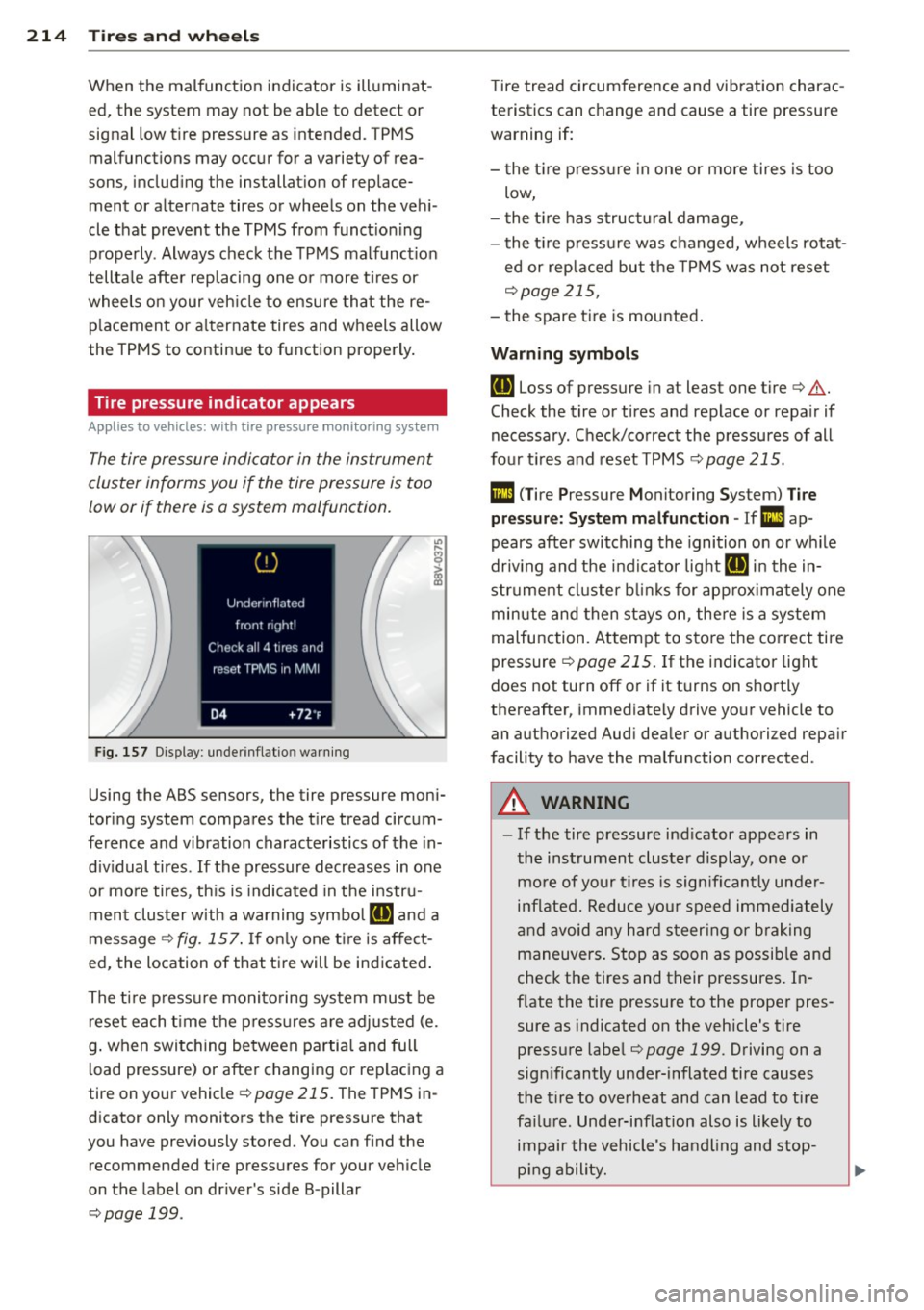
F ig. 157 Display : under inflatio n warning
Using the ABS sensors, the tire pressure moni
toring system compares the t ire tread circum
ference and vibration characteristics of the in
d iv idual tires . If the pressure decreases in one
or more tires, th is is indicated in the instru
ment cluster w ith a warning symbo l
RE and a
message¢
fig. 157 . If on ly one ti re is affect
ed, the location of that tire will be indicated .
The t ire p ressu re monito ring system must be
reset each t ime the press ures a re adjusted (e.
g . when switching between partia l and full
l oad pressure) or after changing or replacing a
tire on your vehicle ¢
page 215. The TPMS in
dicator only monitors the tire p ressu re that
you have previously s tored. You can find the
recommended tire pressures for your vehicle
on the label on dr iver 's side B -pillar
¢ page 199.
Tire tread circumference and vibration charac
teristics can change and cause a tire pressure
warning if:
- t he t ire press ure in one or more tires is too
low,
- t he t ire has s tructural damage ,
- the t ire p ressure was changed, wheels rotat -
ed or replaced but the TPMS was not reset
¢ page 215,
-the spare t ire is mou nted.
Warning symbo ls
RE Loss of pressure in at least one tire¢.& .
Check the tire or tires and replace or repa ir if
necessary . Check/correct the pressures of all
four t i res and reset TPMS
¢ page 215 .
Ill (T ire Pressure Monitoring Sys tem) T ire
pr ess ure: S y ste m m alfun ction -If l!I ap
pears after switching the ignition on or wh ile
driv ing and the indicator light
RE in the in
strument cluster b links for app rox imately one
minute and then stays on , the re is a system
malfunction . Attempt to sto re the correct tire
pressure
¢ page 215 . If the indicator light
does not turn off or if it turns on shortly
thereafter, immediately drive yo ur vehicle to
an authori zed Aud i dea ler or authori zed repa ir
facility to have the malfunction corrected .
A WARNING
--- If the tire pressure indicator appears in
the instrument cluster display, one or mo re of your t ires is sign ifi cantly unde r
i n flated. Reduce yo ur speed immedi ately
and avoid any hard steer ing or b raking
maneuve rs. Stop as soon as possib le and
check the tires and their pressures. In
f late the tire pressure to the proper pres
sure as indicated on the vehicle's tire
pressure labe l
¢page 199. Driving on a
significantly under-i nflated tire causes
the t ire to overheat and can lead to ti re
fa ilu re. Unde r-inflation also is likely to
impair the vehicle's handling and stop
p ing ability.
Page 217 of 258
M N
M N
0 ::i co ,...., \!) 1.1'1 ,...., 1.1'1 ,....,
-The driver is responsible for maintaining
the correct tire pressures. You must
check the tire pressures regularly.
- Under certain conditions (such as a spor
ty driving style, winter conditions or un
paved roads), the pressure monitor indi
cator may be delayed.
- Ask your authorized dealer if run-flat
tires may be used on your vehicle. Your
vehicle registration becomes invalid if
you use these tires when not permitted .
Damage to your vehicle or accidents
could also result.
- The tire pressure monitoring system may
stop working when there is an ESC mal
function.
- Using snow chains may result in a system
malfunction.
- The tire pressure monitoring system on
your Audi was developed using tires with
the "AO" or "RO" identification on the
tire sidewall
¢page 206. We recom
mend using these tires.
Reset tire pressure monitoring system
Applies to vehicles: with tire pressure monit oring sys te m
If the tire pressure is adjusted, wheels are ro
tated or changed, the TPMS must be reset.
"'Before storing the new tire pressures, check
that the current pressures on all four tires correspond to the specified values and
adapt the pressures to the current load
¢ page 199.
"'Sw itch on the ignition.
"' Select: the
I CAR I function button > Car* sys
tems
contro l button > Servicing & checks >
Tire pressure monitoring > Store tire pres
sures > Yes, store now .
(D Tips
Do not store the tire pressure if there are
snow chains on the tire. Otherwise, a sys
tem malfunction may occur.
Tires and wheels 215
•
•