transmission AUDI Q3 2016 User Guide
[x] Cancel search | Manufacturer: AUDI, Model Year: 2016, Model line: Q3, Model: AUDI Q3 2016Pages: 252, PDF Size: 62.81 MB
Page 180 of 252
Checking and Filling
-Keep children away from the engine com
partment.
- Never spill fluids on hot engine compo
nents. They can cause a fire.
- Never touch the radiator fan. The auxiliary
electric fan is temperature controlled and
can switch on suddenly.
- Never open the coolant reservoir cap when
the engine is still warm. The coolant system
is pressurized and hot coolant could spray
out.
- Protect your face, hands and arm from steam or hot engine coolant by placing a
thick rag over the cap when you open the
coolant reservoir .
- Do not remove the engine cover under any
circumstances. This increases the risk of
burns .
- If work on the fuel system or the electrical
system is necessary:
-Always disconnect the battery.
- Never smoke or work near heaters or open
flames. Fluids in the engine compartment
could start a fire.
- Keep an approved fire extinguisher imme
diately available.
- To avoid electrical shock and personal injury
while the engine is running or being started,
never touch:
- Ignition cables
- Other components of the high voltage
electronic ignition system.
- If you must perform a check or repair with
the engine running:
- First, fully apply the parking brake, move
selector lever of automatic transmission
to "P" (Park).
- Always use extreme caution to prevent
clothing, jewelry, or long hair from get-
178
ting caught in the radiator fan, V-belts or
other moving parts, or from contacting
hot parts. Tie back hair before starting,
and do not wear clothing that will hang or
droop into the engine.
- Minimize exposure to emission and chemi
cal hazards
c::> & .
A WARNING
California Proposition 65 Warning:
- Engine exhaust, some of its constituents,
and certain vehicle components contain or
emit chemicals known to the State of Cali
fornia to cause cancer and birth defects and
reproductive harm. In addition, certain flu
ids contained in vehicles and certain prod
ucts of component wear contain or emit
chemicals known to the State of California
to cause cancer and birth defects or other
reproductive harm .
- Battery posts, terminals and related acces
sories contain lead and lead compounds,
chemicals known to the State of California
to cause cancer and reproductive harms.
Wash hands after handling.
([) Note
When adding fluids, always make sure that
they are poured into the proper container or
filler opening, otherwise serious damage to
vehicle systems will occur.
@ For the sake of the environment
To detect leaks in time, inspect the vehicle
floor pan from underneath regularly. If you
see spots from oil or other vehicle fluids, have
your vehicle inspected by an authorized Audi dealer .
Page 222 of 252
Fuses and bulbs
(D Tips
- The following table does not list fuse loca
tions that are not used.
- Some of the equipment listed in the follow
ing tables applies only to certain model ver
sions or certain optional equipment.
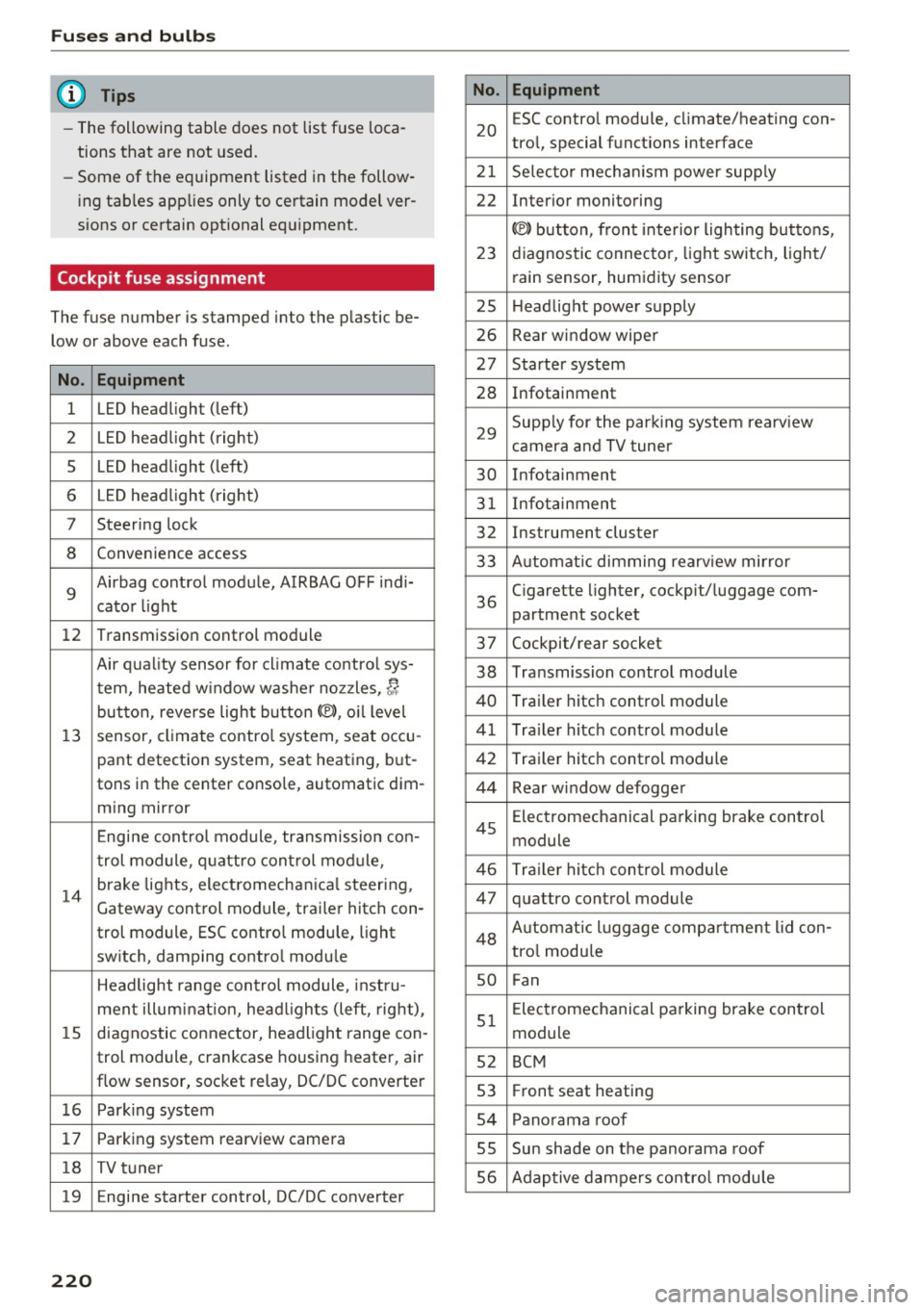
Cockpit fuse assignment
The fuse number is stamped into the plastic be
low or above each fuse.
No. Equipment
1 LED headlight (left)
2 LED headlight ( right)
5 LED headlight (left)
6 LED headlight (right)
7 Steering lock
8 Convenience access
9
Airbag control module, AIRBAG OFF indi-
cator light
12 Transmission control module
Air quality sensor for climate contro l sys-
tern, heated w indow washer nozzles,~
button, reverse light button<®>, oil level
13 sensor, climate control system, seat occu-
pant detection system, seat heating , but-
tons in the center console, automatic dim-
ming mirror
Engine control module, transmission con-
trol module, quattro control module,
14
brake lights, electromechanica l steering,
Gateway cont rol module, trailer hitch con-
trol module, ESC contro l module, light
switch, damping control module
Headlight range control module, instru-
ment illuminat ion, headl ights (left, right),
15 diagnostic connector, headlight range con-
trol module, crankcase housing heater, air
flow sensor, socket relay, DC/DC converter
16 Park ing system
17 Parking system rearview camera
18 TV tuner
19 E ngine starter control, DC/DC converter
220
No . Equipment
20
ESC contro l module, climate/heating con-
tro l, special functions interface
21 Selecto r mechanism power supply
22 Interior monitoring
© button, front interior lighting buttons,
23 diagnostic connector, light switch, light/
rain sensor, humidity sensor
25 Headlight power supply
26 Rear window wiper
27 Starter system
28 Infotainment
29
Supply for the park ing system rearv iew
camera and TV tuner
30 Infotainment
31 Infotainment
32 Instrument cluster
33 A utomat ic dimming rearview mirror
36
Cigarette lighter, cockpit/ luggage com-
partment socket
37 Cockpit/rear socket
38 Transmission control module
40 Trailer hitch control module
41 Trailer hitch control module
42 Trailer hitch control module
44 Rear window defogger
45
Electromechanical parking brake control
module
46 Trailer hitch control module
47 quattro control module
48 Aut omat ic lu ggage compartment lid con-
tro l module
so Fan
51
Electromechanical parking brake control
module
52 BCM
53 Fr ont seat heating
54 Panorama roof
55 Sun shade on the panorama roof
56 Adaptive dampers control module
Page 225 of 252
Emergency situations
General
This chapter is intended for trained emergency
crews and working personnel who have the nec
essary tools and equipment to perform these
operations.
Starting by pushing or
towing
(D Note
Vehicles with an automatic transmission
cannot be started by pushing or towing.
Starting with jumper
cables
If necessary, the engine can be started by con
necting it to the battery of another vehicle .
If the engine should fail to start because of a dis
charged or weak battery, the battery can be con
nected to the battery of
another vehicle, using a
pair of jumper cables to start the engine.
Jumper cables
Use only jumper cables of sufficiently large cross
section
to carry the starter current safely. Refer
to the manufacturer's specifications.
Use only jumper cables with
insulated terminal
clamps which are distinctly marked :
plus(+) cable in most cases colored red
minus(·) cable
in most cases colored black.
A WARNING
Batteries contain electricity, acid, and gas.
Any of these can cause very serious or fatal in
jury. Follow the instructions below for safe
handling of your vehicle's battery.
-Always shield your eyes and avoid leaning
over the battery whenever possible.
-A discharged battery can freeze at tempera
tures just below 32 °F (0 °C). Before con
necting a jumper cable, you must thaw the
Emergency situations
frozen battery completely, otherwise it
could explode .
- Do not allow battery acid to contact eyes or
skin. Flush any contacted area with water immediately.
- Improper use of a booster battery to start a
vehicle may cause an explosion.
- Vehicle batteries generate explosive gases.
Keep sparks, flame and lighted cigarettes
away from batteries.
- Do not try to jump start any vehicle with a
low acid level in the battery .
- The voltage of the booster battery must also
have a 12-Volt rating. The capacity (Ah) of
the booster battery should not be lower
than that of the discharged battery. Use of
batteries of different voltage or substantial
ly different "Ah" rating may cause an explo
sion and personal injury .
- Never charge a frozen battery. Gas trapped
in the ice may cause an explosion.
- Never charge or use a battery that has been
frozen . The battery case may have be weak
ened .
- Use of batteries of different voltage or sub
stantially different capacity (Ah) rating may
cause an explosion and injury. The capacity
(Ah) of the booster battery should not be
lower than that of the discharged battery.
- Before you check anything in the engine
compartment, always read and heed all
WARNINGS
r::!)page 177.
(D Note
-Applying a higher voltage booster battery
will cause expensive damage to sensitive
electronic components, such as control
units, relays, radio, etc.
- There must be no electrical contact between
the vehicles as otherwise current could al
ready start to flow as soon as the positive
(+) terminals are connected.
(D Tips
- The discharged battery must be properly
connected to the vehicle's electrical system. ..,.
223
Page 226 of 252
Emergency situations
When jump starting or charging the bat
tery, never connect the negative ground ca
ble to the battery negative post because the
battery manager system must be able to de
tect the battery's state of charge. Always
connect the negative ground cable to the
negative ground post of the battery manag
er contro l unit.
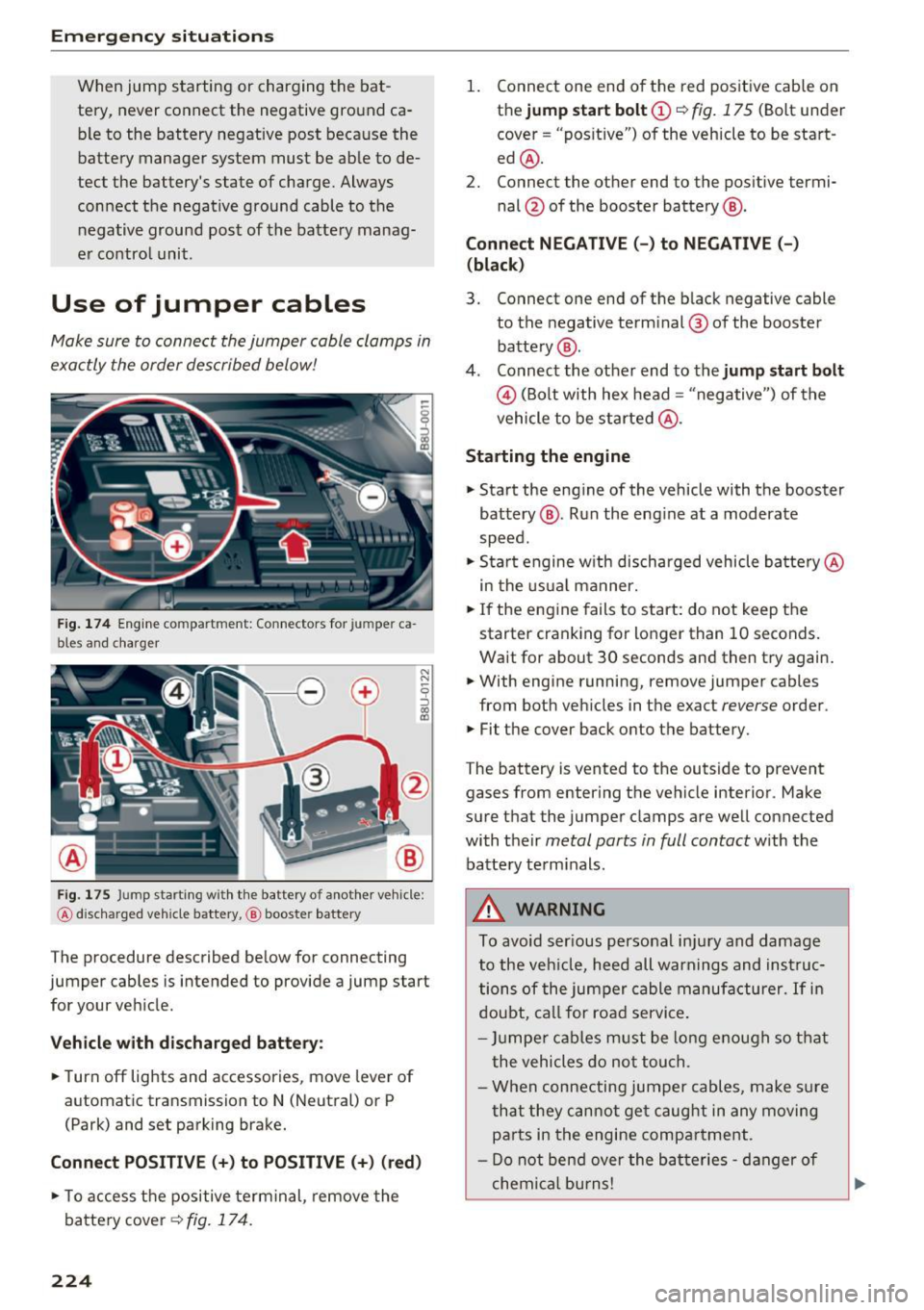
Use of jumper cables
Make sure to connect the jumper cable clamps in
exactly the order described below!
F ig . 1 74 Engine compar tment: Connectors for jumper ca
bles and charger
N N ~ 9 ::, 00 CXl
F ig. 175 Jump starti ng wit h the battery of another veh icle:
@ discharged vehicle battery,@booster battery
The procedure described below for connecting
jumper cables is intended to provide a jump start for your vehicle.
Vehicle with discharged battery:
• Turn off lights and accessories, move lever of
automatic transmission to N (Neutral) or P
(Park) and set parking brake.
Connect POSITIVE (+) to POSITIVE (+) (red)
• To access the positive terminal, remove the
battery cover
c::> fig. 17 4.
224
1. Connect one end of the red pos itive cable on
the
jump start bolt (D c::> fig. 175 (Bolt under
cover= "positive") of the vehicle to be start
ed @.
2. Connect the other end to the positive termi-
nal @ of the booster battery @.
Connect NEGATIVE (- ) to NEGATIVE (-)
(black)
3. Connect one end of the black negative cable
to the negative term inal @ of the booster
battery @.
4. Connect the other end to the
jump start bolt
@ (Bolt with hex head = "negative") of the
vehicle to be started @.
Starting the engine
• Start the eng ine of the vehicle with the booster
battery @. Run the eng ine at a moderate
speed.
• Sta rt engine w ith discharged vehicle ba ttery @
in the usual manner.
• If the engine fails to start: do not keep the
starter cranking for longer than 10 seconds.
Wait for about 30 seconds and then try again.
• With engine running, remove jumper cables
from both vehicles in the exact
reverse order.
• Fit the cover back onto the battery.
The battery is vented to the outside to prevent
gases from entering the vehicle interior . Make
sure that the jumper clamps are well connected
with their
metal parts in full contact with the
battery terminals.
&_ WARNING
To avoid ser ious personal injury and damage
to the vehicle, heed all warnings and instruc
tions of the jumper cable manufacturer. If in
doubt, call for road service.
- Jumper cables must be long enough so that
the vehicles do not touch .
- When connecting jumper cables, make sure
that they cannot get caug ht in any moving
parts in the engine compartment.
- Do not bend over the batteries - danger of
chemical burns!
Page 227 of 252
.... N
c:i ::J CX)
.... I.Cl U"I
N I.Cl ......
-The battery cell lock ing screws must be
t ightened secure ly.
- Befo re yo u check anything in the en gine
compartment, a lways read and heed a ll
WARNINGS
¢ page 177.
(D Note
Imp ro per hook -u p of jum pe r cables can r uin
the gene rato r.
-Always con nect POSIT NE
(+ ) to POSITI VE
(+ ), and NEGATIVE( -) to NEGATIVE( -)
ground post of the battery manager contro l
u nit .
- Check that all sc rew p lugs on the batter y
ce lls are screwed in firmly . If not, t ighten
pl ugs prior to connecting clamp on negative
batte ry te rminal.
- Please note t hat the procedure fo r con nect
i ng a jumper cab le as desc ribed above ap
p lies specif ica lly to the case of yo ur vehicle
being jump start ed. Wh en you are giv ing a
ju mp sta rt to anothe r vehicle, do
not con
n ec t t he neg ative (-) ca b le to the negative
( -) t ermina l on the disch arged b attery @
¢
fig. 175. In ste ad , secure ly connec t the
negative( -) ca b le to either a solid me tal
com ponent th at is f irm ly bolted to the e n
gine block o r to t he engine block i tsel f. If
the battery that is be ing c ha rged does not
vent to the outs ide, escap ing batte ry ga s
could ignite and exp lode!
Towing with a tow truck
General hints
Your Audi requires s pecial handling for towing .
The following informa tion is to be used by com
mercia l tow tr uck operators who know how to op
e ra te the ir equip men t safely.
- Ne ver tow your Audi, towing will cause dam
age to the engine and transmission .
- Never wrap the safety chains or winch cables
around the brake lines.
- To prevent unnecessary damage, your Audi
must be transported with a flat bed truck .
Emergency situations
-To load the vehicle on to the flat bed , use the
towing loop found in the vehicle tools and at
tach to the front or rear anchorage
¢ page 225 and ¢ page 226.
A WARNING
A veh icle being towed is not safe for passen
ge rs. Neve r allow a nyo ne to ride in a vehicle
b eing towed, for any reason .
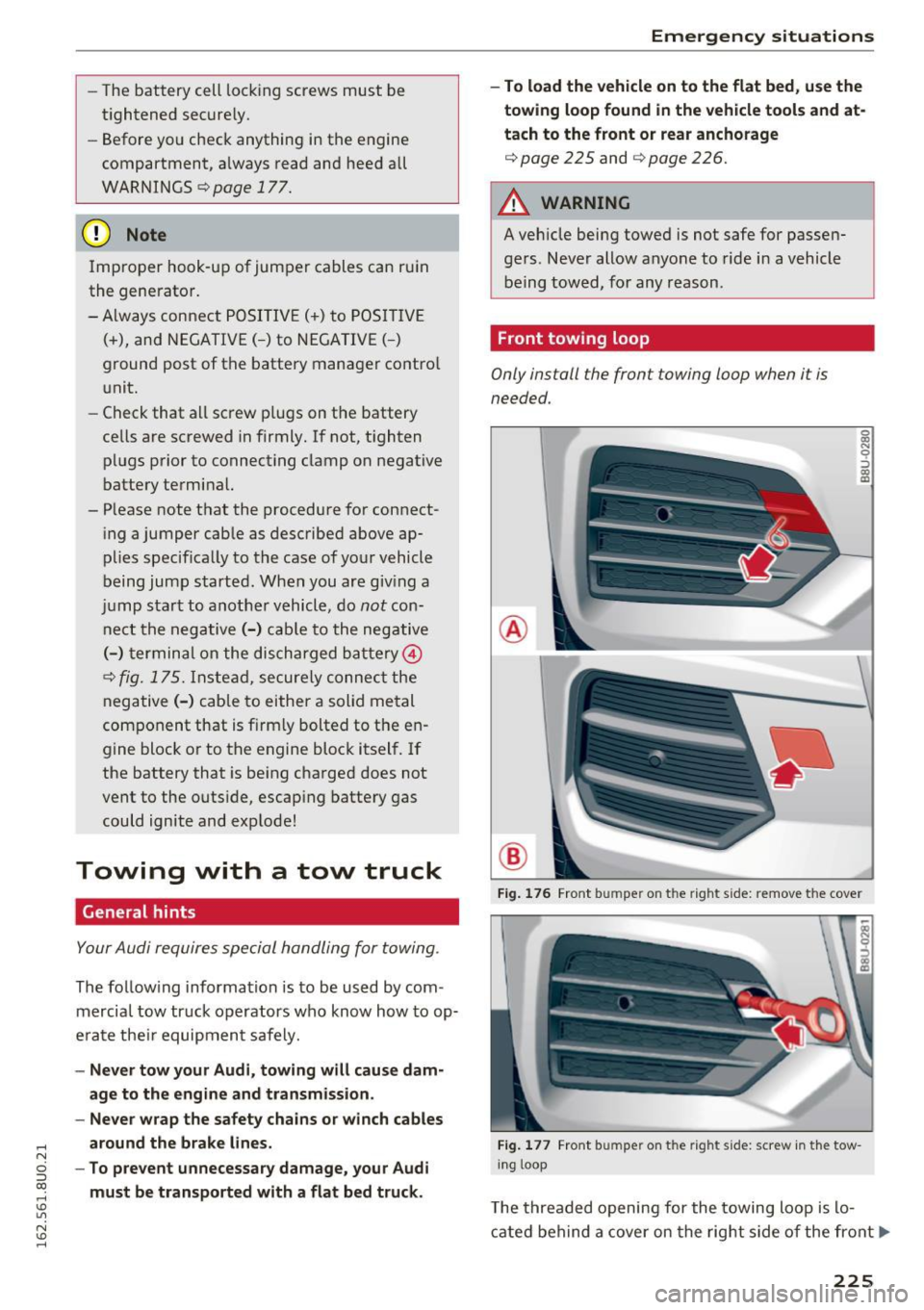
Front towing loop
Only ins tall the front towing loop when i t is
needed .
®
®
-
0 0) N 9 ::>
gi
Fig. 176 Front bum pe r o n th e rig "h t side : remove t he co ver
Fi g. 177 Fron t bum per o n th e right sid e: screw in t he tow
in g loop
The threaded opening for the towing loop i s lo
cate d be hind a cove r on t he rig ht side of the front .,.
225
Page 230 of 252
Emergency situations
-The vehicle should never be lifted or
jacked up from underneath the engine oil
pan, the transmission housing, the front
or rear axle or the body side members.
This could lead to serious damage.
- To avoid damage to the underbody or
chassis frame, a rubber pad must be in
serted between the floor jack and the lift
points .
- Before driving over a workshop hoist,
check that the vehicle weight does not
exceed the permissible lifting capacity of
the hoist .
- Before driving over a workshop hoist, en
sure that there is sufficient clearance be
tween the hoist and low parts of the ve hicle.
228
Page 231 of 252
.... N
c:i ::J CX)
.... I.Cl U"I
N I.Cl ....
Technical data
Vehicle identification
F ig. 183 Location on d river 's side dash panel: Vehicle Iden·
ti fic ation Number (VlN) p late
XXXXX XX -X -XXXX XXX XX
CD+ ~t :1:: xxxxxxxx xx x xxxxxxxx
TVP/fffl XXX XXX
XX XXXXXXX XX X X xx
XXX KW XXX
®i ~:J·f lfils~~ XXXX XXX XXX
®-+ ~N:a=i~l xxxx ; xxxx xxx ; xx
II. · AUSS, I OPTIONS
,__ __
EO A 7D5
2EH J0Z
3FC
FOA
TL6 3KA
lXW
7T6 CV7
3L4
lSA
4UB 6XM 5SG
llB l AS
SMU 7Xl
9G3 0G7 0YH
8EH
Ul A X 98
803 908 824
7K0 4X3 2K2
4KC 3Y0 413
7GB 01A
5RW
18 A
0JF
Q Z7
020
502
4G0
XX . X XX X XX X XXXX
Fig. 184 Inside the luggage compartment: Vehicle identifi
cat ion labe l
Veh icle Identification Number (VlN )
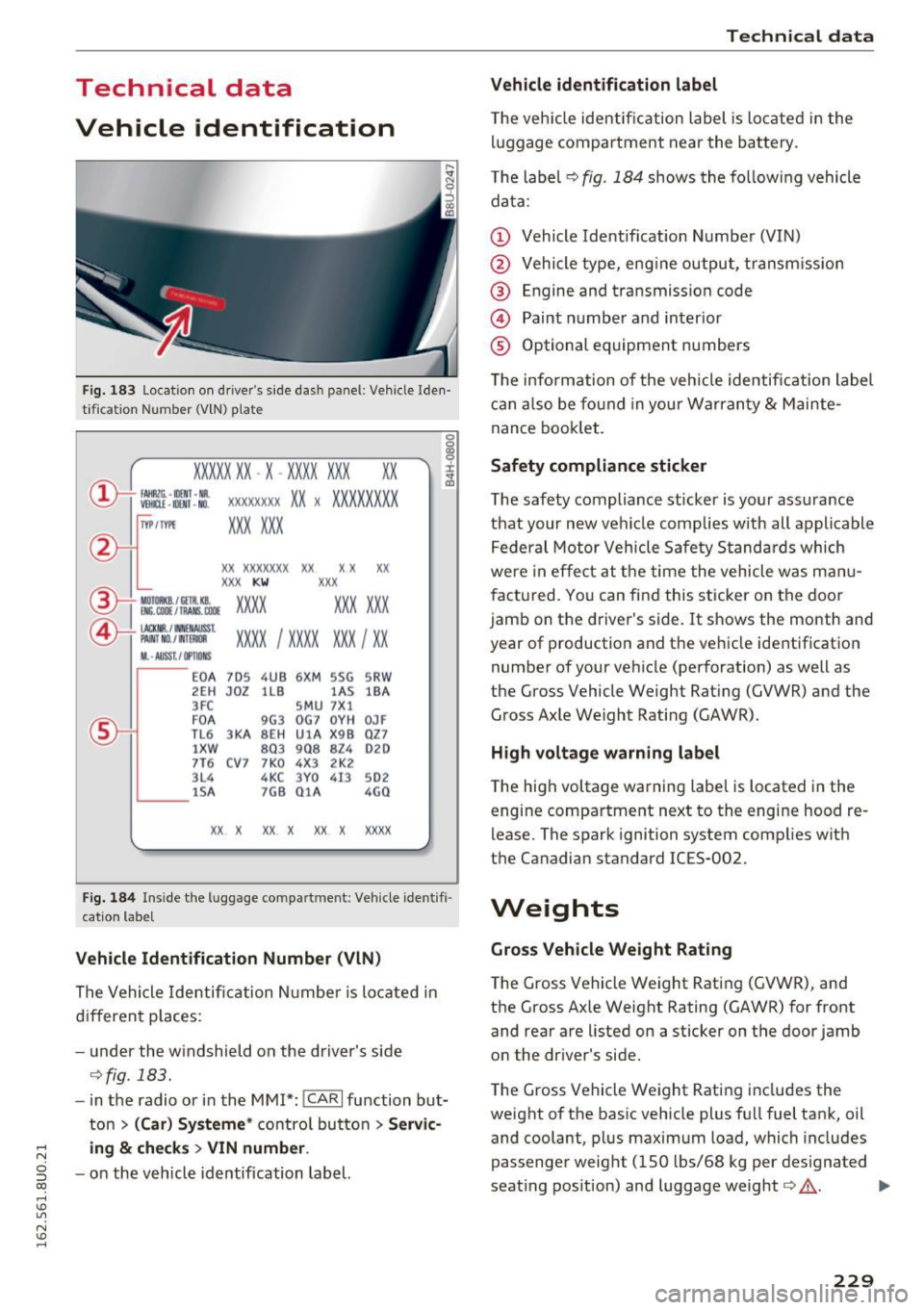
The Vehicle Identification Number is located in
different p laces :
- under the windshield on the driver's side
¢ fig . 183.
-in the radio or in the MMI*: !CARI function but
ton
> ( Car ) Systeme * control button > Servic
ing
& checks > VIN number .
-on the vehicle identification label.
Technical data
Vehicle identification label
The veh icle identification label is located in the
luggage compartment near the battery.
T he label¢
fig. 184 shows the following vehicle
data:
(D Vehicle Identification Number (VIN)
@ Vehicle type, eng ine output, transm ission
@ Engine and transmission code
@ Paint number and interior
® Optional equipment numbers
T he information of the veh icle identification label
can also be found in your Warranty
& Mainte
nance booklet.
Safety compliance sticker
The safety compliance sticker is your assurance
that your new vehicle complies w ith all applicable
Federal Motor Vehicle Safety Standards which
were in effect at the time the vehicle was manu
factured. You can find this sticker on the door
jamb on the driver 's side. It shows the month and
year of production and the vehicle identification number of your vehicle (perforation) as well as
the Gross Vehicle Weight Rat ing (GVWR) and the
Gross Axle Weight Rating (GAWR).
H igh voltage warning label
The high voltage warning label is located in the
engine compartment next to the engine hood re
lease. The spark ignition system complies with
the Canadian standard ICES-002.
Weights
Gross Vehicle Weight Rating
The Gross Vehicle Weight Rating (GVWR), and
the Gross Axle Weight Rating (GAWR) for front
and rear are listed on a sticker on the door jamb
on the driver 's side.
The Gross Vehicle Weight Rating includes the
weight of the basic vehicle plus full fuel tank, oil
and coolant, plus maximum load, which includes
passenger weight (150 lbs/68 kg per des ignated
seating position) and luggage weight
c:> .&, . .,.
229
Page 235 of 252
today's automobiles, have steadily reduced the
scope of maintenance and repairs which can be
carried out by vehicle owners.
Also, safety and
environmental
concerns place very strict limits
on the nature of repairs and adjustments to en
gine and transmission parts which an owner can perform .
Maintenance, adjustments and repairs usually re
quire special tools, testing devices and other
equipment available to specially trained work
shop personnel in order to assure proper per
formance, reliability and safety of the vehicle and
its many systems.
Improper maintenance, adjustments and repairs
can impair the operation and reliability of your
vehicle and even void your vehicle warranty .
Therefore, proof of servicing in accordance with
the maintenance schedule may be a condition for upholding a possible warranty claim made within
the warranty period.
Above all , operational safety can be adversely af
fected, creating unnecessary risks for you and
your passengers.
If in doubt about any servicing, have it done by
your authorized Audi dealer or any other properly equipped and qualified workshop. We strongly urge you to give your authorized Audi dealer the
opportunity to perform all scheduled mainte nance and necessary repairs. Your dealer has the
facilities, original parts and trained specialists to keep your vehicle running properly .
Performing limited maintenance yourself
The following pages describe a limited number of
procedures which can be performed on your vehi
cle with ordinary tools, should the need arise and
trained personnel be unavailable. Before per
forming any of these procedures, always thor
oughly read all of the applicable text and careful ly follow the instructions given . Always rigorously
observe the
WARNINGS provided .
Before you check anything in the engine com
partment, always read and heed all WARNINGS
c::> .&. and c::> .&. in Working in the engine compart
ment on page 177. Consumer information
A WARNING
-
Serious personal injury may occur as a result
of improperly performed maintenance, ad
justments or repairs .
- Always be extremely careful when working
on the vehicle. Always follow commonly ac
cepted safety practices and general com
mon sense. Never risk personal injury.
- Do not attempt any of the maintenance,
checks or repairs described on the following pages if you are not fully familiar with these
or other procedures with respect to the ve hicle, or are uncertain how to proceed.
- Do not do any work without the proper tools
and equipment. Have the necessary work
done by your authorized Audi dealer or an
other properly equipped and qualified work
shop.
- The engine compartment of any motor vehi cle is a potentially hazardous area. Never
reach into the area around or touch the radi
ator fan.
It is temperature controlled and
can switch on suddenly - even when the en
gine is off and the ignition key has been re
moved. The radiator fan switches on auto
matically when the coolant reaches a certain
temperature and will continue to run until
the coolant temperature drops.
- Always remove the ignition key before any
one gets under the vehicle.
- Always support your vehicle with safety
stands if it is necessary to work underneath
the vehicle. The jack* supplied with the vehi
cle is not adequate for this purpose and
could collapse causing serious personal in
jury.
- If you must work underneath the vehicle
with the wheels on the ground, always make
sure the vehicle is on level ground, that the
wheels are always securely blocked and that the engine cannot be started.
- Always make sure the transmission selector
lever (automatic transmission) is in P (Park
position) and the park brake is applied.
233
Page 238 of 252
Index
A
A/C (a utomat ic cl imate contro l system) . . . . 65
A/C (manua l cl imate contro l system) . . . . . . 63
Accessories .. .. .. .... .. ....... .... 53,234
Adap tive dampe rs . . . . . . . . . . . . . . . . . . . . . . 80
Adapt ive dampers ( indicator light) . . . . . . . . 18
Adapt ive Light (defective) . . . . . . . . . . . . . . . 1 8
Adding Eng ine coolant .. ............. .... .. .
E ng ine oi l .. .. .. .. . ... ... .... .. .. .. .
Addit ional accessories
Additives 184
18
1
234
Eng ine oil . . . . . . . . . . . . . . . . . . . . . . . . . . 181
Ad justab le s teer ing colum n . . . . . . . . . . . . . . 67
Ad justi ng
Steer ing colum n . . . . . . . . . . . . . . . . . . . . . . 67
Adj usting the center conso le lighting . . . . . . 43
A irbag .... .. .. .... .... · · · · · · · · · · · · · · 1
12
W arning/indi cator lights . . . . . . . . . . . . . . . 16
Airbag system .... .. ........ ...... ... .
Advanced Airbag-System .......... ... .
Advanced Airbag System components .. .
Ca re .... .. .. ............... .... .. .
Ch ildren . .. .. .. .. . .......... .. .. .. . 1
27
116
1 18
125
133
Ch ild rest raints . . . . . . . . . . . . . . . . . . . . . 134
Components (front airbags) . . . . . . . . . . . 118
Danger of fitting a child safety seat on the
front passenger seat . . . . . . . . . . . . . . . . . 113
Disposal . . . . . . . . . . . . . . . . . . . . . . . . . . . 125
Front airbags . .................. 116, 117
H ow do the front airbags work? . . . . . . . . 120
H ow many airbags does my vehicle have? 118
H ow the Advanced A irbag System compo-
nents work together . . . . . . . . . . . . . . . . . 120
I mportant inform ation . . . . . . . . . . . . . . . 112
I ndicator light . . . . . . . . . . . . . . . . . . . . . . 122
Monitoring . . . . . . . . . . . . . . . . . . . . . . . . . 122
PASSENGER AIR BAG OFF light . . . . . . . . . 122
Repairs . . . . . . . . . . . . . . . . . . . . . . . . . . . . 125
Safety instructions . . . . . . . . . . . . . . . . . . . 124
Side airbags . . . . . . . . . . . . . . . . . . . . . . . . 126
Side curtain airbags . . . . . . . . . . . . . . . . . . 129
We ight-sens ing mat . . . . . . . . . . . . . . . . . 133
When must the system be inspected? . . . 122
All season tires . . . . . . . . . . . . . . . . . . . . . . . 206
All weathe r lights . . . . . . . . . . . . . . . . . . . . . . 39
236
All wheel drive
Alte rna to r
refer to Gene rato r .. .. ............. .. .
Ant i-free ze
Windshie ld washer system . .. .... ... . .
also refer to Engine coolant system .... .
Anti- lock b raking system 156
15
190
1 83
Warn ing/ indicator lights . . . . . . . . . . . . . . . 16
Ant i-Lock Br aking Sys tem . . . . . . . . . . . . . . 151
Ant i- slip regulat io n
War ning/ indicato r ligh ts . . . . . . . . . . . . . . . 16
Anti-Slip Regulation . . . . . . . . . . . . . . . . . . . 151
Ant i-theft systems
E lec tron ic immobilizer. . . . . . . . . . . . . . . . . 32
Armrest . . . . . . . . . . . . . . . . . . . . . . . . . . . . . . 51
Asht ray . . . . . . . . . . . . . . . . . . . . . . . . . . . . . . 53
Audi Se rvice Repair Manuals and Literatu re 232
A UTO
Automat ic climate control system . . . . . . . 65
Automat ic headl igh ts . . . . . . . . . . . . . . . . . 39
Automatic be lt retractor . . . . . . . . . . . . . . . 107
A utomat ic key . . . . . . . . . . . . . . . . . . . . . . . . . 28
Automat ic post-collis ion braking system . . 152
Automatic transmission . . . . . . . . . . . . . . . . . 82
Dr iving tips . . . . . . . . . . . . . . . . . . . . . . . . . . 83
Hill descent control . . . . . . . . . . . . . . . . . . . 85
K ick-down . . . . . . . . . . . . . . . . . . . . . . . . . . . 86
Se lector lever emergency release . . . . . . . . 86
Se lector lever positions . . . . . . . . . . . . . . . . 82
S hi ft ing manually . . . . . . . . . . . . . . . . . . . . 85
Steering wheel with sh ift padd les . . . . . . . . 85
t ipt roni c mode . . . . . . . . . . . . . . . . . . . . . . . 85
Automat ic w ipe/wash system . . . . . . . . . . . . 45
Auto Sa fe ty Hotline . . . . . . . . . . . . . . . . . . . 102
Average consumpt ion . . . . . . . . . . . . . . . . . . . 22
Average speed . . . . . . . . . . . . . . . . . . . . . . . . 22
Avo id dam ag ing t he ve hicle . . . . . . . . . . . . . 159
B
Battery . . . . . . . . . . . . . . . . . . . . . . . . . . 15, 187
Battery lo cat ion insi de the luggage compa rt-
ment..... .. .. .. .. .. ... .... ........ 18 7
Charge leve l . . . . . . . . . . . . . . . . . . . . . . . . 157
Charging . . . . . . . . . . . . . . . . . . . . . . . . . . . 189
Energy managem ent . . . . . . . . . . . . . . . . . 157
Page 243 of 252
Fueling
Fuel filler door em ergency rel ease . . . . . . 176
Fuel gauge . . . . . . . . . . . . . . . . . . . . . . . . . . 11
Fuses Assignment . . . . . . . . . . . . . . . . . . . . . . . . 220
Replacing . . . . . . . . . . . . . . . . . . . . . . . . . . 219
G
Garment hooks . . . . . . . . . . . . . . . . . . . . . . . . 56
Gas discharge lamps......... ...... ... . 221
Generator Warning/indicator lights . . . . . . . . . . . . . . . 15
Glossary of tire and load ing terminology . . 193
Glove compartment . . . . . . . . . . . . . . . . . . . . 55
Cooling box . . . . . . . . . . . . . . . . . . . . . . . . . 55
Gross Vehicle W eight Rating (GVWR) . . . . . 229
Ground clearance . . . . . . . . . . . . . . . . . . . . . 162
H
Headlight
Headlight assist . . . . . . . . . . . . . . . . . . . . . . 40
Headlight range control system . . . . . . . . . . 39
H eadlights
Cleaning . . . . . . . . . . . . . . . . . . . . . . . . . . . 169
Defective . . . . . . . . . . . . . . . . . . . . . . . . . . . 18
Headlight range control . . . . . . . . . . . . . . . 18
Headlight range cont rol system . . . . . . . . . 39
Head restra ints . . . . . . . . . . . . . . . . . . . . . . . . 98
adjusting . . . . . . . . . . . . . . . . . . . . . . . . . . . 52
Adjusting . . . . . . . . . . . . . . . . . . . . . . . . . . . 98
Front seats . . . . . . . . . . . . . . . . . . . . . . . . . . 51
removing and installing . . . . . . . . . . . . . . . . 52
Heated Exterior mirrors . . . . . . . . . . . . . . . . . . . . . . 43
Rear window . . . . . . . . . . . . . . . . . . . . . . 64, 66
Wash er no zzles . . . . . . . . . . . . . . . . . . . . . . 45
H eavy clothing and safety belts . . . . . . . . . . 106
High beam . . . . . . . . . . . . . . . . . . . . . . . . . . . . 40
High voltage warning label . . . . . . . . . . . . . 229
Hill descent assist . . . . . . . . . . . . . . . . . . . . . 153
Hill descent cont rol . . . . . . . . . . . . . . . . . . . . 85
H ill holdH . . . . . . . . . . . . . . . . . . . . . . . . . . . . 73
Horn . . . . . . . . . . . . . . . . . . . . . . . . . . . . . . . . . 8
How are child restraint syst em anchors relat -
ed to child safety . . . . . . . . . . . . . . . . . . . . . 144
Index
How many airbags does my vehicle have? . . 118
How safety belt pretensioners work . . . . . . 110
I
Ignition
Indicator light . . . . . . . . . . . . . . . . . . . . . . . 18
Switching on and off (convenience key) . . . 69
Switching on and off (ignit ion lock) . . . . . . 67
Imbalance (wheels) . . . . . . . . . . . . . . . . . . . 199
Important things to do before driving . . . . . 95
Improperly worn safety belts ........... 110
Indicato r lights .. .. ...... ..... ...... .. . 11
Airbag system . . . . . . . . . . . . . . . . . . . . . . 122
PASSENGER AIR BAG O FF . . . . . . . . . . . . . 122
Infant seats . . . . . . . . . . . . . . . . . . . . . . . . . 13 7
Inflation pressure (tires) . . . . . . . . . . . . . . . 201
I nspe ction interval . . . . . . . . . . . . . . . . . . . . . 25
Installing child safety seats
Safety belts . . . . . . . . . . . . . . . . . . . . . . . . 141
Installing the upper tether strap on the an-
chorage . . . . . . . . . . . . . . . . . . . . . . . . . . . . . 148
Inst rument clus te r . . . . . . . . . . . . . . . . . . . . . 10
Indi cato r lights . . . . . . . . . . . . . . . . . . . . . . 11
Messages . . . . . . . . . . . . . . . . . . . . . . . . . . . 11
Instruments . . . . . . . . . . . . . . . . . . . . . . . . . . 10
Adjusting the lighting . . . . . . . . . . . . . . . . . 43
Interior l ighting . . . . . . . . . . . . . . . . . . . . . . . 42
Front and rear . . . . . . . . . . . . . . . . . . . . . . . 42
Intermittent (windshield wipers) . . . . . . . . . 45
J
Ja ck 216
Jump-starting . . . . . . . . . . . . . . . . . . . . . . . . 223
Jumper cables . . . . . . . . . . . . . . . . . . . . . . . . 224
K
Key ..... .... ... .. .. ... ........... ... . 28
Key not recognized . . . . . . . . . . . . . . . . . . . 70
Replacement key . . . . . . . . . . . . . . . . . . . . . 28
Replacing the battery . . . . . . . . . . . . . . . . . 29
unlocking/locking . . . . . . . . . . . . . . . . . 29, 30
Unlocking/locking . . . . . . . . . . . . . . . . . . . . 32
Kick -down
Automatic transmission . . . . . . . . . . . . . . . 86
241