door lock AUDI Q3 2016 Owner's Manual
[x] Cancel search | Manufacturer: AUDI, Model Year: 2016, Model line: Q3, Model: AUDI Q3 2016Pages: 252, PDF Size: 62.81 MB
Page 74 of 252
Driving
When start ing from a stop
- T he in tegr al hi ll sta rt as sis t helps y ou when
driving by automatically releasing the park ing
brake¢
page 72, Starting from a stop.
- When starting on incl ines, the hill start assist
prevents the vehicle from unintentionally roll
ing back . The braking force
of the parking brake
is only released if sufficient drive power has
been built up at the wheels.
Em erg enc y bra ke f unction
An emergency braking functions ens ures that the
vehicle can be s lowed down even if the
normal
brakes fail¢ page 73, Emergency braking
function.
,&. WARNING
- Do not press the accelerator pedal inadver
tently when the veh icle is stationary and the
engine is running and a gear is selected.
Otherwise t he vehicle w ill start to move im
med iate ly and could result in a c rash.
- If the power supply fa ils, the released park
ing bra ke can no longe r engage. In th is
case, pa rk the veh icle on leve l ground and
sec ure it by placing the selector lever in the
P position. See an author ized Audi dealer or
authorized Aud i Service Faci lity for assis
tance .
(D Tips
-If the parking b rake is set while the ignition
i s sw itched off, the. indicator light in the
b utton and -(USA models) /. (Cana
da models) will turn off after a certain
amount of time.
- Occasiona l noises when the parking brake is
set and re leased are normal and are not a
cause for concern.
- When the vehicle is parked, the parking
brake goes thro ugh a self-test cycle at reg u
l ar intervals. Any no ises assoc iated with this
are normal.
- If there is a power fa ilure, the parking brake
will not set if it is re leased, and it will not
release if it is set¢,&. See an authorized
72
-
Audi dealer or author ized Audi Service Fa
cility for assistance.
Parking
.. Press the brake pedal to stop the veh icle.
.. To set the park ing brake, pull on the© switch.
.. Select the P position .
.. Turn the engine off¢,& .
.. Turn the steering wheel when par king on in
cl ines so that the wheels w ill roll into the cu rb
if the vehicle starts moving.
,&. WARNING
- Always take the veh icle key with yo u when
leaving the vehicle, even for a short period
of time. This applies part icularly when chil
dren remain in the vehicle. Otherwise chil
dren could start the engine, release the
parking brake or operate electrical equip
ment such as power w indows, which in
creases the risk of an accident.
-
- No one should remain in the veh icle w hen it
is locked, especially ch ild ren. Locked doors
make it more difficult for emergency work
ers to get into the veh icle, wh ich puts lives
at risk.
Starting from a stop
The start assist function ensures that the park
ing broke is released automatically upon start
ing.
Stopping and setting the parking brake
.. To set the park ing brake, pull on the(®) switch.
Starting and automat ically r elea sing the
parking brake
.. When you press the acce lerator pedal, the
parking brake is automat ica lly re leased and
your vehicle beg ins to move .
When stopping at a traffic signa l or stopping in
c ity traff ic, the parking brake can be applied . The
vehicle does not have to be held with the brake pedal. The park ing brake elim inates the tendency
to c reep when a se lector lever position is engag-
ed. As soon as yo u press t he accelerator pedal,
1J1>
Page 75 of 252
the parking brake releases automatically and the
vehicle starts to move.
Starting on hills
When start ing on inclines, the hill start ass ist
prevents the vehicle from unintentionally roll ing
back. The braking force of the parking brake is
only released if sufficient drive power has been
bui lt up at the whee ls.
(D Tips
For safety reasons, the parking brake is re
leased automatically only when the driver's
safety belt is fastened and the driver's door is
locked.
Starting to drive with a trailer
To prevent rolling back unintentionally on an in
cline, do the following:
.. Keep pulling the<®> switch and press the acce l
erator pedal. The parking brake stays applied
and prevents the vehicle from ro lling backward.
.. You can re lease the<®> switch once you are sure
that you are transferring enough dr iving force
to the whee ls by pressing the accelerator pedal.
Depending on the weight of the rig (vehicle and
trailer) and the severity of the incline, you may
roll backwards as you start.
Hill hold
A ppl ies to vehicles: with H ill Hol d
Hill hold makes it easier to start on hills .
Requirement: The driver's door must be closed,
the seat belt must be buckled and the engine
must be running.
The system is activated when the brake pedal is
p ressed
for a few seconds.
To prevent the vehicle from roll ing back when
starting, the brake power is held for a brief mo
ment after releasing the brake pedal. During this
~ time, you can easi ly begin to move you r vehicle .
ci ::, co ,....,
A WARNING
- The intelligent technology of Hill Hold can
not overcome the limitat ions imposed by
natural physical laws. The increased comfort
offered by Hill Hold should not cause you to
take safety risks.
- Hill Hold cannot hold the vehicle in all hill
start situations (for example, if the g round
is slippery or icy).
- If you do not beg in moving immediately af
ter releasing the brake peda l, the vehicle
could begin to roll backward under certain
circumstances . Press the brake pedal or set
the parking brake immediately.
-If the engine "stalls", press the brake pedal
or set the parking bra ke immediate ly.
- To prevent the vehicle from roll ing back un
intentionally when starting in s top-and-go
traffic, keep the brake pedal pressed for a
few seconds before driving off .
(D Tips
You can find out if your vehicle is eq uipped
wi th Hill Hold by checking at an authorized
Audi dealer or authorized Audi Service Facili
ty.
Emergency braking function
This is used if the conventional brake system
fails or locks up.
.,. To brake your veh icle using the parking brake in
an emergency, pu ll the(®) switch and keep it
pulled.
.. The braking stops as soon as you release the<®>
switch or acce lerate .
If you pu ll the(®) switch and hold it above a
speed of about 5 mph (8 km/h) , the emergency
braking function is activated. The vehicle brakes
at all four whee ls by activating the braking hy
draulics. The brake performance is similar to
heavy brak ing .
c::> .&.
In order not to activate the emergency brake
function by mistake, a warning tone (buzzer)
sounds when the(®) switch is pulled. As soon as .,.
73
Page 87 of 252
.... N
c:i ::J CX)
.... I.Cl U"I
N I.Cl ......
c> page 177. Otherwise, any increase in en
gine speed may set the vehicle in motion,
even with the parking brake applied.
(D Note
- When stopping on an incline, do not try to
hold the vehicle in place by pressing the ac
celerator pedal whi le a driv ing gear is se
lected. This can cause the automatic trans
mission to overheat and can damage it . Set
the parking brake or press the brake pedal
to prevent the vehicle from ro lling.
- Allow ing the vehicle to roll when the eng ine
i s stopped and the selector lever is in
N po
s ition w ill damage the automatic transm is
s ion because i t is not lubricated under those
ci rc u ms tances.
- The transmiss ion can over heat and be dam
aged under certain driving and traffic co ndi
t ions s uch as frequent starts, creeping for a
l ong time, or stop -and -go traffic. When the
• indicator light turns on, stop the vehicle
at the next opportunity and let the trans
mission cool down
c> page 86.
@ Tips
For safety reasons, the parking brake is re
leased automatically only when the driver 's
safety belt is fastened and the dr iver 's door is
locked.
Hill descent control
Hill descent control assists the driver when dr iv
ing down hills.
Hill descent contro l is activated wh en th e se lec
tor lever is in the D or S position and you p ress
the b rake pedal. The transm ission automat ically
select s a gear that i s suitable for the incline . H ill
descent control tries to maintain the speed ach
ieved at the time of braking, within phys ical and
techn ical limitations . If may st ill be necessary to
adj ust the speed with the b rake pedal.
Hill descent control switches off once the hill lev
e ls out or you press the accelerator pedal.
Aut oma tic tr ansm iss ion
A WARNING
-Hill descent control cannot overcome physical
limitat io ns, so it may not be able to ma intain
a constant speed under all conditions . Always
be ready to app ly the brakes .
Shifting manually (tiptronic mode)
The tiptronic allow the driver to shi~ the gears
manually.
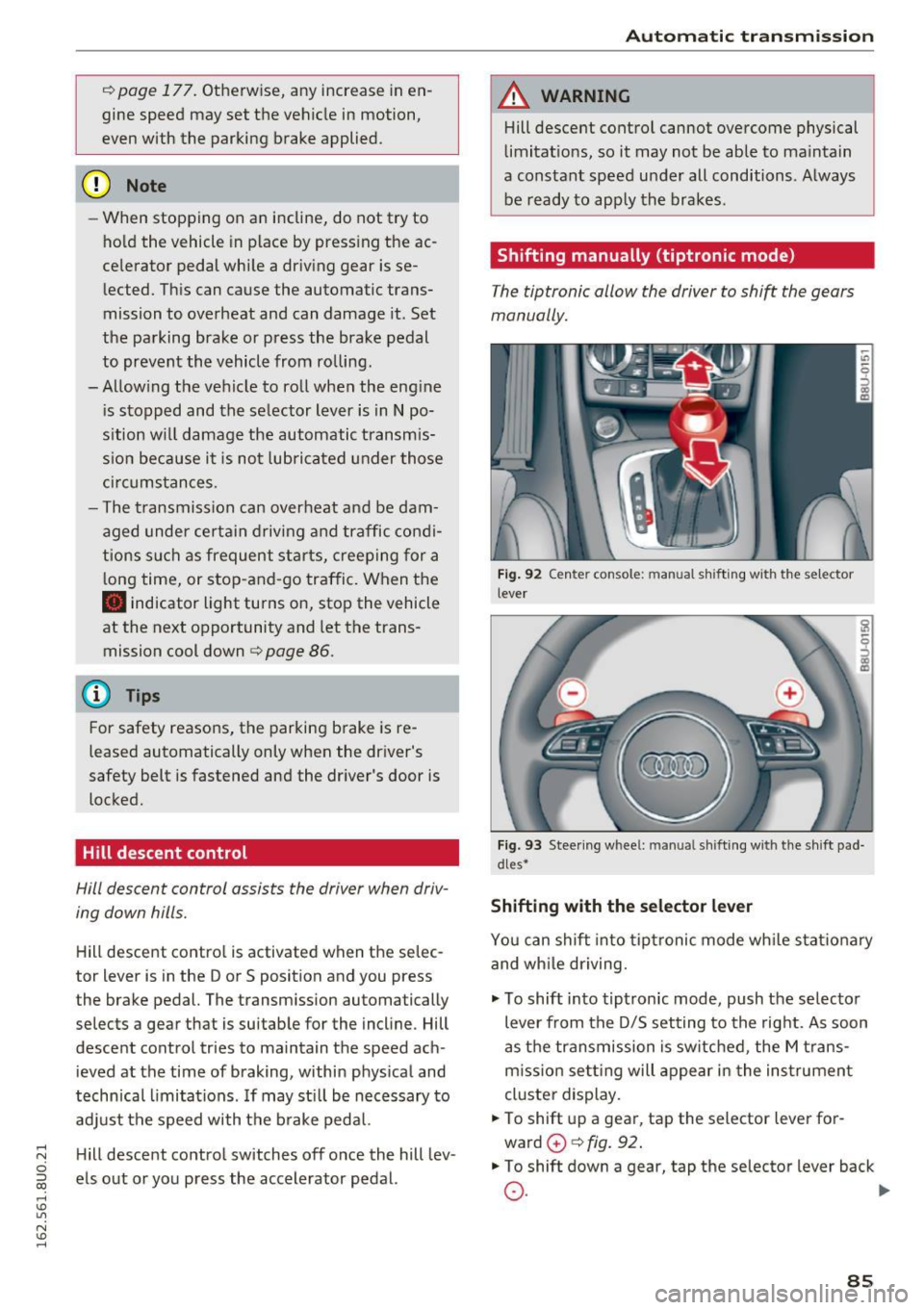
F ig. 92 Cente r con so le: m anu al shi ft ing w ith t he sel ect or
leve r
Fig . 93 Stee ring w hee l: manual s hift ing w ith the shi ft pad
d les•
Shifting with the selector lever
You can shift into tip tronic mode wh ile stat iona ry
and wh ile driving.
"' To shift into tiptronic mode, push the selecto r
lever from the D/S setting to the right. As soon
as the transmission is switched , the M trans
m iss ion se tting will appear in the ins trument
cluste r display.
"' To shift up a gea r, tap the selector lever for
ward
0 c> fig . 92 .
"'To shift down a gea r, tap the se lector lever back
0 . ~
85
Page 103 of 252
-Always put objects, for example, luggage or
other heavy items in the luggage compart
ment.
- Always secure objects in the luggage com
partment using the tie-down eyelets and
suitable straps.
A WARNING
Heavy loads will influence the way your vehi
cle handles . To help reduce the risk of a loss
of control leading to serious personal injury:
- Always keep in mind when transporting
heavy objects, that a change in the center of
gravity can also cause changes in vehicle
hand ling:
- Always distribute the load as evenly as
possible.
- Place heavy objects as far forward in the
luggage compartment as possible.
- Never exceed the Gross Axle Weight Rating
or the Gross Vehicle Weight Rating specified
on the safety compliance sticker on the left
door jamb. Exceeding permissible weight
standards can cause the vehicle to slide and
handle differently .
- Please observe information on safe driving
¢page 95.
A WARNING
To help prevent poisonous exhaust gas from
being drawn into the vehicle, always keep the
rear lid closed while driving .
- Never transport objects larger than those
fitting completely into the luggage area be
cause the rear lid cannot be fully closed .
- If you absolutely must drive with the rear lid
open, observe the following notes to reduce
the risk of poisoning:
- Close all windows,
- Close the Pano ramic sliding sunroof*,
- Open all air outlets in the instrument pan-
el,
- Switch off the air recirculation,
- Set the fresh air fan to the highest speed .
Driving safety
A WARNING
-
Always make sure that the doors, all win
dows, the Panoramic sliding sunroof* and the
rear lid are securely closed and locked to re
duce the risk of injury when the vehicle is not
being used .
-After closing the rear lid, always make sure
that it is properly closed and locked.
- Never leave your vehicle unattended espe
cially with the rear lid left open. A child
could crawl into the vehicle through the lug
gage compartment and close the rear lid be
coming trapped and unable to get out. Be
ing trapped in a vehicle can lead to serious
personal injury.
- Never let children play in or around the vehi
cle.
- Never let passengers ride in the luggage
compartment. Vehicle occupants must al
ways be properly restrained in one of the ve
hicle's seating positions.
(D Tips
-Air circulation helps to reduce w indow fog
ging . Stale air escapes to the outside
through vents in the trim panel. Be sure to
keep these slots free and open.
- The tire pressure must correspond to the
load. The tire pressure is shown on the tire
pressure label. The tire pressure label is lo
cated on the driver's side B-pillar . The tire
pressure label lists the recommended cold
tire inflation pressures for the vehicle at its
maximum capac ity weight and the tires that
were on your vehicle at the time it was man
ufactured. For recommended t ire pressures
for normal load conditions, please see chap
ter ¢
page 201.
Tie-downs
The luggage compartment is equipped with four
tie-downs to secure luggage and other items.
Use the tie-downs to secure your cargo properly
<=? page 100, Loading the luggage compartment. ..,_
101
Page 140 of 252
Child safety
child in a forward -facing child seat. It is a very
dangerous place for an infant or a larger child in
a rearward-facing seat.
A WARNING
Not using a child safety seat, using the wrong
child safety seat or improper ly installing a
child restra int increases the r isk of serious
personal injury and death in a crash .
- Never install rear-facing child safety seats
or infant carr iers on the front passenger
seat -even with an Advanced Airbag System.
A ch ild w ill be seriously injured and ca n be
k illed when the infla ting airbag hits the
child safety seat or infant carr ier with great
force and smashes the child safety seat and
child against the backrest, center armrest,
door or roof
Q page 113, Child restraints on
the front seat- some important things to
know .
-Always install rear-facing child safety seats
or infant carr iers on the rear seat.
- Never install a rear-facing child restraint in
the forward-facing direction. Such restraints are designed for the spec ial needs of infants
and very small children and cannot protect
them properly if the seat is forward -facing .
- If you must install a rearward fac ing ch ild
safety seat on the front passenger seat be
ca use of exceptional circumstances and the
PASSENGER AIR BAG OFF light does not
c ome on and stay on, immed iate ly install
the rear-fa cing ch ild safety seat in a rear
seating pos ition and have the airbag system
inspected by your Audi dealer.
- Always read a nd heed all WARN INGS when
ever using a child restrained in a vehicle is
being used¢
page 104, Safety belts,
¢ page 112, Airbag system
and
¢ page 132 , Important information.
138
Convertible child safety seats
Properly used convertible child safety seats can
help protect toddlers and children over age one
who weigh between 20 and 40 lbs. (9 and 18 kg)
in a crash .
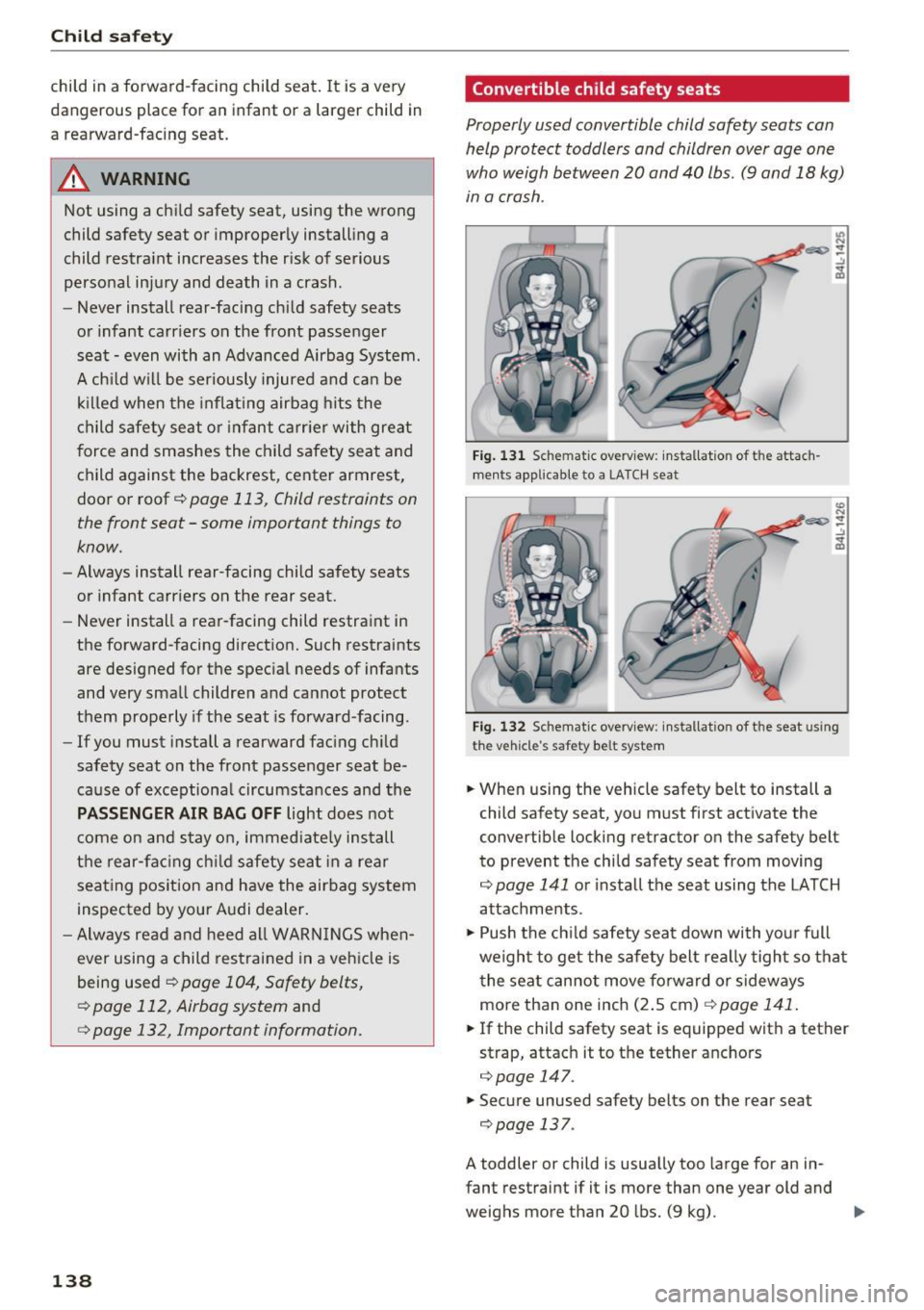
Fig. 131 Sc hem at ic overv iew : installat ion of t he attach
ment s applicable to a LA TCH seat
Fig. 132 Sc hemat ic overv iew : installat ion of t he seat using
the vehicle's sa fety bel t system
.. When using the vehicle safety belt to install a
child safety seat, you must first activate the
convertib le locking retractor on the safety belt
to prevent the child safety seat from moving
¢page 141 or install the seat using the LATCH
attachments .
.. Push the chi ld safety seat down wi th your full
we igh t to get the safe ty belt really tight so that
the seat cannot move forward or sideways
more than one inch (2 .S cm)
<=> page 141 .
.. If the child safety seat is equipped with a tether
strap, attach it to the tether anchors
¢ page 147 .
.. Secure unused safety belts on the rear seat
Q page 137.
A toddler or child is usually too large for an in
fant restraint if it is more than one year old and
weighs more than 20 lbs. (9 kg).
ll>-
Page 145 of 252
-Always move the passenger seat into its
rearmost position in the seat's fore and a ft
adjustment range , as fa r away from the air
bag as possible before installing the for
ward-facing child r estra int. T he backrest
must be adjusted to an upright posit io n.
- Make sure tha t th e
PA SSEN GER AIR BAG
OFF
light comes on and stays on all the tim e
w henever the ignition is switched on.
A WARNING
Rearwa rd-facing child restra ints:
- A ch ild in a rearward-facing child safety seat
installed on the front passenger seat wi ll be
seriously injured and can be killed if the
front airbag inflates - even with an Ad
vanced Airbag System .
- The inflating a irbag w ill hit the child safety
seat or infant carrier with great force and
will smash the chi ld safety seat and chi ld
against the backrest, center armrest, door
or roof.
- Always be especially careful if you must in
stall a rearward facing child safety seat on
the front passenger seat in exceptional c ir
cumstances.
- A tight tether strap on a rearward-facing
child restraint attached to the front passen
ger seat can put too much pressure on the
we ight-mat in the seat and register a heavi
er we ight in the Advanced Airbag System.
The heavier we ight registered can make the
system work as though an adult were on the
seat and deploy the Advanced Airbag when
it m ust be suppressed c ausing serious or
even fatal injury to the child.
- Make sure tha t the
PASSENGER AIR BAG
OFF
light comes on and stays on all the time
whenever the ignition is switched on .
-If the PASSENGER AIR BAG OFF light does
not come on and stay on, immedia tely in
stall the rear-facing child safety seat in a
rear seating position and have the airbag
system inspected by your Aud i dealer .
Child safety
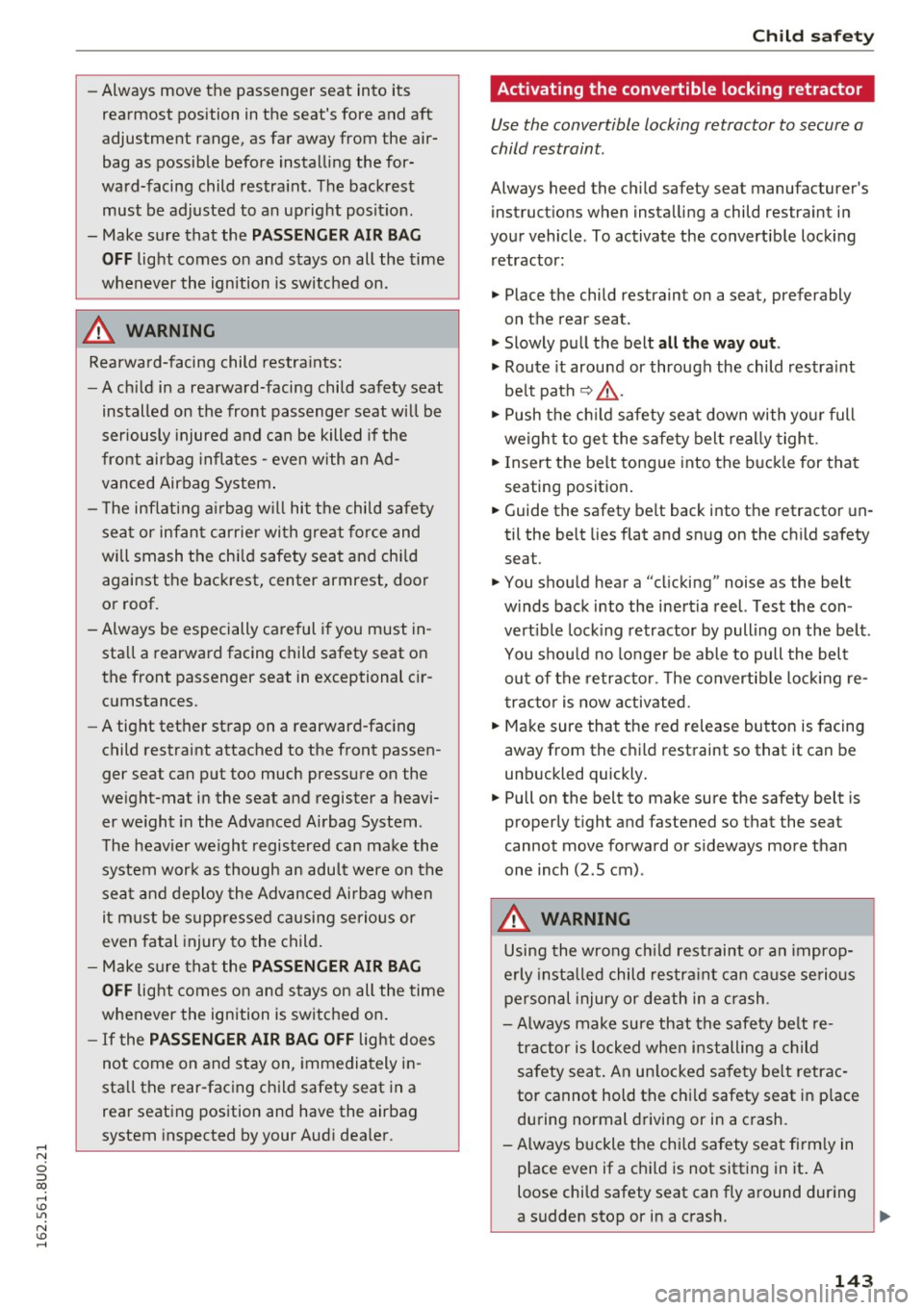
Activating the convertible locking retractor
Use the convertible locking retractor to secure a
child restraint .
Always heed the ch ild safety seat manufacturer 's
instruct ions when installing a child restraint in
your vehicle. To activate the convertible locking retractor:
.. Place the child restraint on a seat, preferably
on the rear seat .
.. Slowly pull the belt
all the w ay out .
.. Route it around or through the child restra int
be lt path
¢ & .
.. Push the ch ild safety sea t down with you r full
weigh t to ge t the safety belt really tight.
.. Insert the belt tong ue into the b uck le for that
seating position .
.. Guide the safety belt back into the retractor un
til the belt lies flat and snug on the child safety
seat .
.. You should hear a ''cl icking" noise as the belt
w inds back into the inertia reel. Test the con
vert ib le lock ing retractor by pull ing on the belt .
You shou ld no longer be able to pull the belt
out of the re tractor. The convertib le loc kin g re
t ractor is now activated.
.. Make sure that the red release button is facing
away from the c hild rest raint so that it can be
unbuckled quickly .
.. Pull on the belt to make sure the safety belt is
properly tight and fastened so that the seat
cannot move forward or sideways more than
one inch (2 .5 cm) .
A WARNING
Using the wrong ch ild rest raint o r an improp
e rly inst alled child restra int can cause se rious
person al injury or death in a crash.
- Always make sure that the safety be lt re
tr actor is locked when installing a child
safety seat . An un locked safety be lt retrac
tor cannot hold the ch ild safety seat in p lace
during normal driving or in a crash.
- Always buckle the child safety seat fi rm ly in
p lace even if a child is not sitting in it. A
loose child safety seat can fly a round during
a sudden stop or in a c rash. .,.
143
Page 178 of 252
Fuel and Refueling
while filling and can ignite fuel vapors
causing a fire.
- Always p lace a portable fuel container on
the ground before filling.
- Always keep the filler nozzle completely
inside the portable container before and
during filling.
- If filling a portable container made of
metal, the filler nozzle must a lways be in
contact with the container . This will help
prevent static electricity from discharging
and cause a fire .
- Never spill fuel inside the vehicle or lug
gage compartment. Fuel vapors are highly
flammable .
- Always observe local and state/provincial
laws regarding t he use, storage and trans
portation of fuel containers .
- Make certa in the fuel container meets in
dustry standards (ANSI/ ASTM
F852-86) .
CD Note
If any fuel has spilled onto the car, it should
be removed immediately to prevent damage
to the paint.
@ For the sake of the environment
As soon as the correctly operated nozz le
switches off automatically for the first time ,
the tank is full. Do not try to add more fuel
because fuel may spill out . In addition, the
expansion space in the fuel tank will be filled -
causing the fuel to overflow when it becomes
wa rm and pollute the environment.
(0 Tips
- Running your engine while refueling may
cause vapors to escape or even cause fuel to
sp ill out of the tank. This would then shut
off the fuel nozzle before the tank is full.
- Do not refuel your vehicle with the ignition
turned on. The fuel gauge may otherwise
not indicate the correct fue l level after refu
eling.
- The fuel filler flap of your vehicle is not
l ocked when you lock the veh icle from the
inside.
176
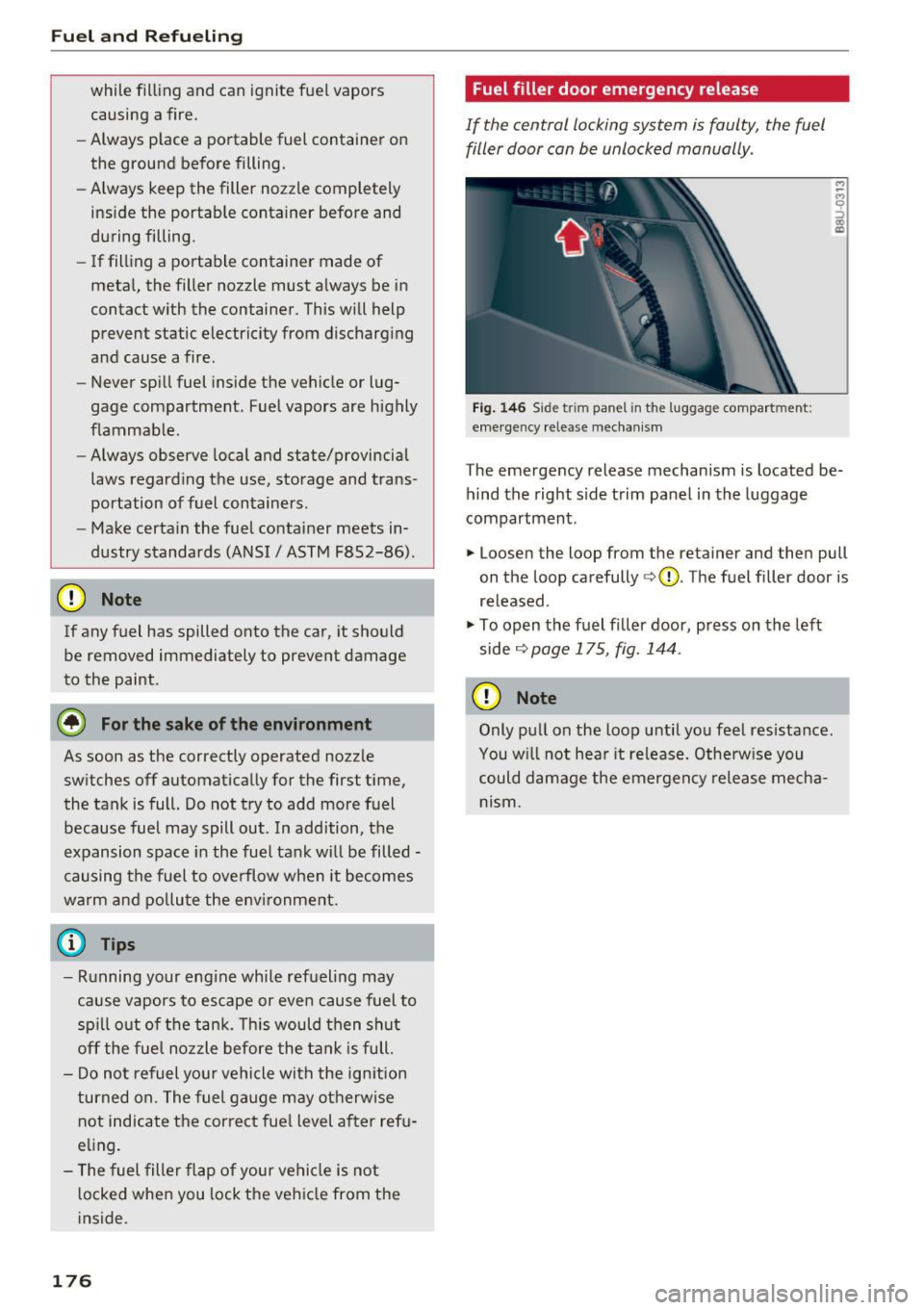
Fuel filler door emergency release
I f the cen tral locking system is faulty, the fuel
filler door can be unlocked manually .
Fig. 146 Side tr im pane l in t he lug gage compar tmen t:
emergency release mechanism
The emergency release mechanism is located be
hind the right side trim panel in the luggage
compartment .
.,. Loosen the loop from the retainer and then pull
on the loop carefully
<=> (D . The fuel filler door is
released .
.,. To open the fuel filler door, press on the left
side
Q page 175, fig. 144 .
CD Note
Only pull on the loop until you feel res istance .
You will not hea r it re lease. Othe rw ise you
could damage the emergency release mecha
nism.
Page 223 of 252
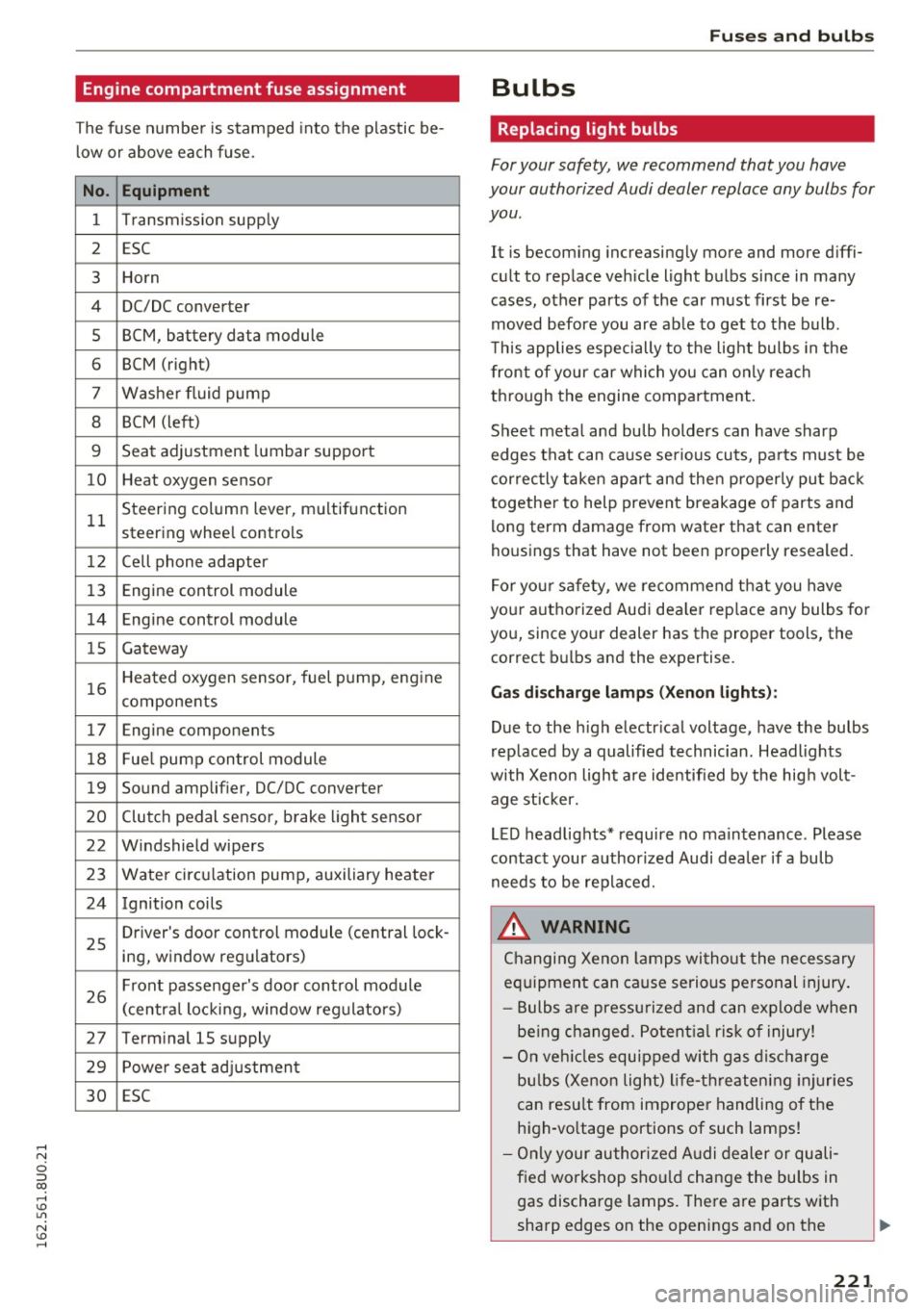
Engine compartment fuse assignment
The fuse number is stamped into the plastic be
low or above each fuse.
No. Equipment
1 Transmiss ion supply
2 ESC
3 Horn
4 DC/DC
converter
5 BCM, battery data module
6 BCM (right)
7 Washer fluid pump
8 BCM (left)
9 Seat adjustment lumbar support
10 Heat oxygen sensor
11 Steering
column lever, multifunction
steering wheel contro ls
1 2 Cell phone adapter
13 Engine control
module
14 Engine control module
15 Gateway
16 Heated oxygen sensor, fuel pump,
engine
components
17 Engine components
18 Fue l pump control module
19 Sound
amplifier, DC/DC converter
20 Clutch pedal sensor, brake light sensor
22 Windshield wipers
23 Water circu
lation pump, auxiliary heater
24 Ignition coils
25 Driver's door
control module (central lock-
ing, window regu lators)
26 Front
passenger's door control module
(centra l locki ng, window reg ulators)
27 Terminal 15 supply
29 Powe r seat adjustment
30 ESC
Fuses an d bulb s
Bulbs
Replacing light bulbs
For your safety, we recommend that you have
your authorized Audi dealer replace any bulbs for
you .
It is becoming increasingly more and more diffi
cult to replace vehicle light bulbs since in many
cases, other parts of the car m ust first be re
moved before you are able to get to the bulb .
T his applies especially to the light bulbs in the
front of your car which you can only reach
through the engine compartment .
Sheet metal and bu lb holders can have sharp
edges that can cause serious cuts, pa rts must be
correctly taken apart and then properly put back
together to help prevent breakage o f parts and
long term damage from water that can enter
housings that have not been properly resealed.
For your safety, we recommend t hat you have
your authorized Aud i dea le r rep lace any bulbs fo r
you, since your dealer has the proper tools, the
correct bulbs and the expertise.
Gas di schar ge la mps (Xe no n light s):
Due to the high electr ical voltage, have the bulbs
rep laced by a qualified technician. Headlights
with Xenon light are identified by the hig h volt
age st icker.
LED headlights* require no maintenance . Please
contact your authorized Audi dea ler if a bulb
needs to be replaced.
_&. WARNING
Changing Xenon lamps wi thout the necessary
equipment can cause serious personal injury .
- Bulbs are pressu rized and can explode when
be ing changed. Potent ial ris k of injury!
- On veh icles equipped with gas disc harge
bu lbs (Xenon light) life-threatening injuries
can resu lt from improper handling of the
high-vo ltage portions of such lamps!
- Only your authorized A udi dealer or quali
fied workshop sho uld change the bulbs in
gas discharge lamps. There are parts with
sharp edges on the openings and on the
221
Page 239 of 252
Important warnings when working on the
battery . . . . . . . . . . . . . . . . . . . . . . . . . . . .
187
Jump starting . . . . . . . . . . . . . . . . . . . . . . . 223
Replacing the battery . . . . . . . . . . . . . . . . 190
Winter operation . . . . . . . . . . . . . . . . . . . . 187
Working on the battery . . . . . . . . . . . . . . . 187
Before driving . . . . . . . . . . . . . . . . . . . . . . . . . 95
Belt tensioners . . . . . . . . . . . . . . . . . . . . . . . 110
Blended gasoline . . . . . . . . . . . . . . . . . . . . . 173
Blower
Automatic climate control system . . . . . . .
65
Manual climate control system . . . . . . . . . . 63
Booster seats . . . . . . . . . . . . . . . . . . . . . . . . 140
Brake fluid
Changing the brake fluid . . . . . . . . . . . . . .
186
Checking the brake fluid level . . . . . . . . . . 186
Brakes . . . . . . . . . . . . . . . . . . . . . . . . . . . . . . 154
Brake booster . . . . . . . . . . . . . . . . . . . . . . . 154
New brake pads . . . . . . . . . . . . . . . . . . . . . 154
Parking brake . . . . . . . . . . . . . . . . . . . . . . . . 71
Brake system
Brake fluid . . . . . . . . . . . . . . . . . . . . . . . . .
186
Brake fluid specifications for refill and re
placement . . . . . . . . . . . . . . . . . . . . . . . . . 186
Brake light defective . . . . . . . . . . . . . . . . . .
18
Fluid reservoir . . . . . . . . . . . . . . . . . . . . . . 186
Warning/indicator lights . . . . . . . . . . . . . . . 13
Worn brake pads symbol . . . . . . . . . . . . . . . 16
Braking
Brake assist . . . . . . . . . . . . . . . . . . . . . . . .
151
Emergency braking funct ion . . . . . . . . . . . . 73
Starting on inclines . . . . . . . . . . . . . . . . . . . 73
Break-in period
Tires . . . . . . . . . . . . . . . . . . . . . . . . . . . . . .
159
Breaking in . . . . . . . . . . . . . . . . . . . . . . . . . . 159
New tires . . . . . . . . . . . . . . . . . . . . . . . . . . 198
Bulbs . . . . . . . . . . . . . . . . . . . . . . . . . . . . . . . 221
C
California Proposition 65 Warning . . . . . . . 178
Battery specific . . . . . . . . . . . . . . . . . . . . . 188
Capacities . . . . . . . . . . . . . . . . . . . . . . . . . . . 230
Engine oil . . . . . . . . . . . . . . . . . . . . . . . . . . 179
Caps for wheel bolts , removing . . . . . . . . . . 215
Care . . . . . . . . . . . . . . . . . . . . . . . . . . . . . . . . 168
Index
Cargo area
refer to Loading the luggage compart-
ment...... ... .. .. .................
100
Cargo floor . . . . . . . . . . . . . . . . . . . . . . . . . . . 61
Catalytic converter . . . . . . . . . . . . . . . . . . . . 159
Center armrest . . . . . . . . . . . . . . . . . . . . . . . . 51
Centra l locking . . . . . . . . . . . . . . . . . . . . . . . . 27
Central locking sw itch . . . . . . . . . . . . . . . . . 31
Convenience key . . . . . . . . . . . . . . . . . . . . . . 30
Emergency locking . . . . . . . . . . . . . . . . . . . . 32
Luggage compartment lid . . . . . . . . . . . . . . 33
Panorama roof . . . . . . . . . . . . . . . . . . . . . . . 37
Powe r windows . . . . . . . . . . . . . . . . . . . . . . 3 7
Remote control key . . . . . . . . . . . . . . . . . . .
29
Certification . . . . . . . . . . . . . . . . . . . . . . . . . 235
Changing engine oil . . . . . . . . . . . . . . . . . . . 182
Checking
Engine coolant level . . . . . . . . . . . . . . . . . .
183
Child restraints
Danger of using child restraints in the front
seat....... ... .. .. ................ .
113
Where can I get additional information
about child restraints and their use? . . . .
149
Child restraints system anchors. . . . . . . . . . 144
Child safety . . . . . . . . . . . . . . . . . . . . . . . . . .
132
Important safety instructions for using child
safety seats . . . . . . . . . . . . . . . . . . . . . . . .
135
Important th ings to know when driving with
children . . . . . . . . . . . . . . . . . . . . . . . . . . .
132
Installing a child restraint using the LATCH
system . . . . . . . . . . . . . . . . . . . . . . . . . . . .
146
Mounting and re leasing the anchorage
hook . . . . . . . . . . . . . . . . . . . . . . . . . . . . . .
146
Tether anchors . . . . . . . . . . . . . . . . . . . . . . 147
Tether s traps . . . . . . . . . . . . . . . . . . . . . . . 147
Child safety lock
Rear doors . . . . . . . . . . . . . . . . . . . . . . .
35, 36
Child safety seats
Booster seats . . . . . . . . . . . . . . . . . . . . . . .
140
Convertible child seats . . . . . . . . . . . . . . . 138
Convertible locking retractor . . . . . . . . . . 143
Danger of using child restraints in the front
seat...... .... .. .. ............... ..
113
How do I properly install a child safety seat
in my vehicle? . . . . . . . . . . . . . . . . . . . . . . .
135
Infant seats . . . . . . . . . . . . . . . . . . . . . . . . 137
LATCH system . . . . . . . . . . . . . . . . . . . . . . 146
237
Page 241 of 252
Declarat ion of compliance
Au di side assist . . . . . . . . . . . . . . . . . . . . . 23 5
Ce ll phone package . . . . . . . . . . . . . . . . . . 235
Convenience key. . . . . . . . . . . . . . . . . . . . . 235
Cruise contro l . . . . . . . . . . . . . . . . . . . . . . . 235
Electronic immob ilizer . . . . . . . . . . . . . . . . 235
Remo te control key . . . . . . . . . . . . . . . . . . 235
Defective light bulb warning . . . . . . . . . . . . . 18
D efro st ing (windows)
M anual clima te con trol system . . . . . . . . . . 64
Defrost ing (winds hield)
Automatic climate control system . . . . . . . 65
D EF (instrument cluster) . . . . . . . . . . . . . . . . 23
D eter mini ng cor rec t load l imit . . . . . . . . . . 205
Dig ita l compass . . . . . . . . . . . . . . . . . . . . . . . 47
D imensions . . . . . . . . . . . . . . . . . . . . . . . . . . 230
D istance . . . . . . . . . . . . . . . . . . . . . . . . . . . . . 2 2
Doors Chi ld safety lock . . . . . . . . . . . . . . . . . . . 35, 36
Emergency locking . . . . . . . . . . . . . . . . . . . . 32
Door, hood or luggage compartment lid wa rn-
ing ... .. .. .. .. ............. .. .. .... .. 23
D river inform ation syste m . . . . . . . . . . . . . . . 20
E ff ic iency p rogram . . . . . . . . . . . . . . . . . . . . 23
On -board compu ter . . . . . . . . . . . . . . . . . . . 22
Operating using m ultifunction steering
wheel . . . . . . . . . . . . . . . . . . . . . . . . . . . . . . 21
Operating using windshie ld w iper lever . . . 21
Overview . . . . . . . . . . . . . . . . . . . . . . . . . . . . 20
Service interval display . . . . . . . . . . . . . . . . 25
D river seat
refer to Seat ing pos ition . . . . . . . . . . . . . . . 96
D rive se lect . . . . . . . . . . . . . . . . . . . . . . . . . . . 80
I ndica tor ligh t . . . . . . . . . . . . . . . . . . . . . . . 18
Steer ing . . . . . . . . . . . . . . . . . . . . . . . . . . . . 80
Driving offroad . . . . . . . . . . . . . . . . . . . . . . . 162
Driving safe ly . . . . . . . . . . . . . . . . . . . . . . . . . 95
D riving throug h wate r . . . . . . . . . . . . . . . . . 162
Driving t ime . . . . . . . . . . . . . . . . . . . . . . . . . . 22
D ust filte r
refer to Pollutant filter . . . . . . . . . . . . . . . . 62
E
Economical driving . . . . . . . . . . . . . . . . . . . . 160
Index
Efficiency program . . . . . . . . . . . . . . . . . . . . . 23
Fuel economy messages . . . . . . . . . . . . . . . 24
Other equ ipment . . . . . . . . . . . . . . . . . . . . . 24
Overv iew . . . . . . . . . . . . . . . . . . . . . . . . . . . . 23
El ectrome chanical parking b rake
War ning/ indica to r lig hts . . . . . . . . . . . . . . . 14
also refer to Parking b rake . . . . . . . . . . . . . 71
El ectrome chanical steering . . . . . . . . . . . . . 156
I nd icator lig ht . . . . . . . . . . . . . . . . . . . . . . 156
E lectron ic differentia l lock
War ning/ indicator lights . . . . . . . . . . . . . . . 16
E lectron ic Diffe rential Lock . . . . . . . . . . . . . 151
El ectron ic immobilizer . . . . . . . . . . . . . . . . . . 32
E lectron ic power contro l
(EPC) warn ing/ indicator light . . . . . . . . . . . 17
E lectron ic stabilization control
ESC offroad mode . . . . . . . . . . . . . . . . . . . 152
Hill descent assist . . . . . . . . . . . . . . . . . . . 153
El ectron ic St abiliz ati on Contro l . . . . . . . . . . 151
E lectron ic Stabi liza tion Contro l (ESC)
War ning/ indica to r li ghts . . . . . . . . . . . . . . . 16
Emergency f lasher . . . . . . . . . . . . . . . . . . . . . 42
Warning/ indicato r lights . . . . . . . . . . . . . . . 19
E mergency locking fro nt passenge r's door . . 32
E mergency operation
E mergency b raking function . . . . . . . . . . . . 73
Front passenger 's doo r . . . . . . . . . . . . . . . . 32
F uel fi lle r doo r . . . . . . . . . . . . . . . . . . . . . . 176
L uggage comp artmen t lid . . . . . . . . . . . . . . 35
Panorama roo f . . . . . . . . . . . . . . . . . . . . . . . 38
Sun shade (roof) . . . . . . . . . . . . . . . . . . . . . 38
E mergency release
Se lector lever . . . . . . . . . . . . . . . . . . . . . . . . 86
Emergency start ing . . . . . . . . . . . . . . . . . . . 223
Energy management . . . . . . . . . . . . . . . . . . 157
Battery power. . . . . . . . . . . . . . . . . . . . . . . . 1S
Driver notif ication . . . . . . . . . . . . . . . . . . . . 15
En gine
C oo lant . . . . . . . . . . . . . . . . . . . . . . . . . . . . 18 3
Data ... .. .. .. .. .. .... . ..... ... .. .. 231
Starting with jumpe r cab les . . . . . . . . . . . 223
Start ing (convenience key) . . . . . . . . . . . . . 69
Start ing ( ignition lock) . . . . . . . . . . . . . . . . 67
Stopping (conven ience key) . . . . . . . . . . . . . 70
Stoppi ng ( ignition lock) . . . . . . . . . . . . . . . . 68
239