warning light AUDI Q3 2016 Repair Manual
[x] Cancel search | Manufacturer: AUDI, Model Year: 2016, Model line: Q3, Model: AUDI Q3 2016Pages: 252, PDF Size: 62.81 MB
Page 144 of 252
Child safet y
A WARNING
Improperly installed child safety seats in
crease the risk of serious personal injury and
death in a collision.
- Always make sure that the safety belt re
tractor is locked when installing a child
safety seat . An unlocked safety belt retrac
tor cannot hold the child safety seat in place
dur ing no rma l driving or in a crash.
- Always buckle the child safety seat firmly in
pla ce even if a child is not s itting in i t. A
loose child safety seat can f ly around d uring
a sudden stop or in a coll is ion .
- Always make sure that the rear seat bac k
rest to which the center rea r safety be lt is
attached is securely latched whenever the
rear center safety belt is being used to se
cure a chi ld restraint.
- If the backrest is no t securely latched, the
child and the child restraint will be thrown
forward together with the backrest and will
strike parts of the vehicle interior. The child
can be seriously injured or killed.
- Never install rear-facing child safety seats or infant carr iers on the front passenger
seat. A child will be seriously injured and
can be killed when the passenger airbag in
flates .
- The inflating a irbag w ill hit the child safety
seat or infant car rier with great force and
will smash the chi ld safety seat and child
against the backrest, center armrest, doo r
o r roof.
- Always install rear-facing child safety seats
o r infant carr iers on the rear seat.
- Forward-facing ch ild safety seats or infant
carr iers installed on the front passenger's
seat may inte rfere with the deployment of
the airbag and cause serious injury to the
child.
- It is safer to install a forward-facing ch ild
safety seat on the rear seat.
- Always read and heed all WARN INGS when
ever using a child restrained in a veh icle is
being used
r=> page 132. Specia l preca utions
apply when installing a child safety seat on
the front passenger seat
r=> page 113, Child
142
restraints on the front seat -some impor
tant things to know.
A WARNING
Always take special precautions if you must
install a forward or rearward-facing child re
stra int on the front passenger's seat in excep
tional s ituations:
- Whenever a forward or rearward-fac ing
child restraint is installed on the front pas
senger seat, the
PASSENGER AIR BAG OFF
light must come on and stay on whenever
the ignition is switched on.
- If the
PASSENGER AIR BAG OFF light does
not come on and stay on, perform the
checks described
r=> page 122, Monitoring
the Advanced Airbag System.
- Take the child restra int off the front passen
ger seat and install it prope rly at one of the
rear seat positions if the
PA SSENGER AIR
BAG OFF
light does not stay on whenever
the ignition is switched on .
- Improper installation of child restraints can reduce their effectiveness or even prevent
them from providing any protect ion .
- An improperly installed child restraint can
interfere with the airbag as it deploys and
serious ly injure or even kill the child.
- Always carefully follow the manufacturer's
instructions provided with the child safety
seat or carrier.
- Never p lace additiona l items on the seat
that can increase the tota l weight registered
by the weight-sensing mat and can cause in
jury in a crash.
A WARNING
Forward-facing child restra ints:
-Always make sure the forward-facing seat has been des igned and certified by its man
ufacturer for use on a front seat with a pas
senger front and side airbag .
- Never put the forward-facing child restraint
up, against or very near the instrument pan-
-
el. ~
Page 145 of 252
-Always move the passenger seat into its
rearmost position in the seat's fore and a ft
adjustment range , as fa r away from the air
bag as possible before installing the for
ward-facing child r estra int. T he backrest
must be adjusted to an upright posit io n.
- Make sure tha t th e
PA SSEN GER AIR BAG
OFF
light comes on and stays on all the tim e
w henever the ignition is switched on.
A WARNING
Rearwa rd-facing child restra ints:
- A ch ild in a rearward-facing child safety seat
installed on the front passenger seat wi ll be
seriously injured and can be killed if the
front airbag inflates - even with an Ad
vanced Airbag System .
- The inflating a irbag w ill hit the child safety
seat or infant carrier with great force and
will smash the chi ld safety seat and chi ld
against the backrest, center armrest, door
or roof.
- Always be especially careful if you must in
stall a rearward facing child safety seat on
the front passenger seat in exceptional c ir
cumstances.
- A tight tether strap on a rearward-facing
child restraint attached to the front passen
ger seat can put too much pressure on the
we ight-mat in the seat and register a heavi
er we ight in the Advanced Airbag System.
The heavier we ight registered can make the
system work as though an adult were on the
seat and deploy the Advanced Airbag when
it m ust be suppressed c ausing serious or
even fatal injury to the child.
- Make sure tha t the
PASSENGER AIR BAG
OFF
light comes on and stays on all the time
whenever the ignition is switched on .
-If the PASSENGER AIR BAG OFF light does
not come on and stay on, immedia tely in
stall the rear-facing child safety seat in a
rear seating position and have the airbag
system inspected by your Aud i dealer .
Child safety
Activating the convertible locking retractor
Use the convertible locking retractor to secure a
child restraint .
Always heed the ch ild safety seat manufacturer 's
instruct ions when installing a child restraint in
your vehicle. To activate the convertible locking retractor:
.. Place the child restraint on a seat, preferably
on the rear seat .
.. Slowly pull the belt
all the w ay out .
.. Route it around or through the child restra int
be lt path
¢ & .
.. Push the ch ild safety sea t down with you r full
weigh t to ge t the safety belt really tight.
.. Insert the belt tong ue into the b uck le for that
seating position .
.. Guide the safety belt back into the retractor un
til the belt lies flat and snug on the child safety
seat .
.. You should hear a ''cl icking" noise as the belt
w inds back into the inertia reel. Test the con
vert ib le lock ing retractor by pull ing on the belt .
You shou ld no longer be able to pull the belt
out of the re tractor. The convertib le loc kin g re
t ractor is now activated.
.. Make sure that the red release button is facing
away from the c hild rest raint so that it can be
unbuckled quickly .
.. Pull on the belt to make sure the safety belt is
properly tight and fastened so that the seat
cannot move forward or sideways more than
one inch (2 .5 cm) .
A WARNING
Using the wrong ch ild rest raint o r an improp
e rly inst alled child restra int can cause se rious
person al injury or death in a crash.
- Always make sure that the safety be lt re
tr actor is locked when installing a child
safety seat . An un locked safety be lt retrac
tor cannot hold the ch ild safety seat in p lace
during normal driving or in a crash.
- Always buckle the child safety seat fi rm ly in
p lace even if a child is not sitting in it. A
loose child safety seat can fly a round during
a sudden stop or in a c rash. .,.
143
Page 149 of 252
.... N
c:i :::J CX)
.... I.Cl U"I
N I.Cl ......
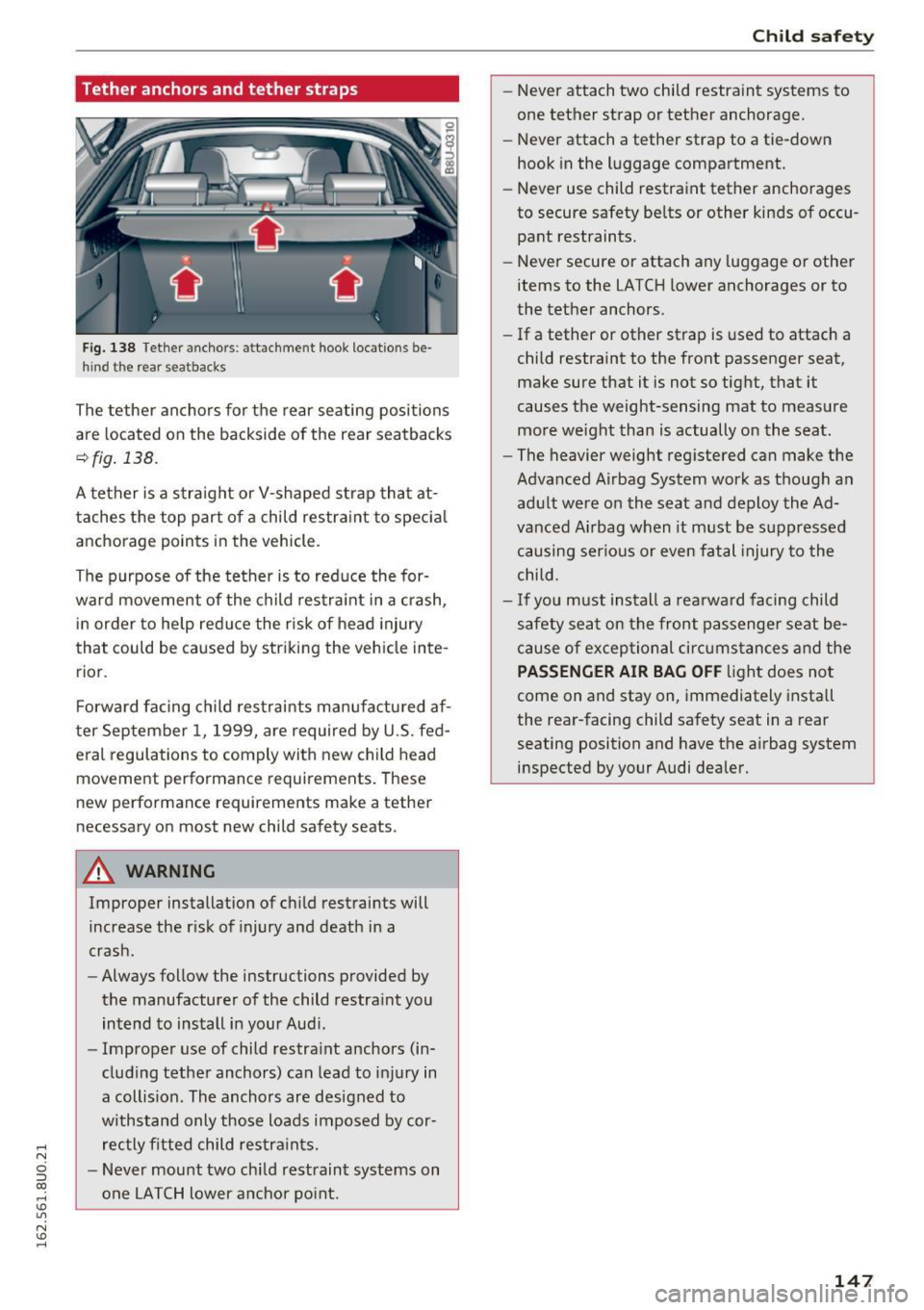
Tether anchors and tether straps
Fig. 138 Tether ancho rs: attachment hook locatio ns be
h ind the rear seatbacks
The tether anchors for the rear seating positions
are located on the backside of the rear seatbacks
¢fig. 138.
A tether is a straight or V-shaped strap that at
taches the top part of a child restraint to special anchorage points in the vehicle.
The purpose of the tether is to reduce the for
ward movement of the child restraint in a crash,
in order to help reduce the risk of head injury
that could be caused by striking the vehicle inte
rior.
Forward facing child restraints manufactured af
ter September 1, 1999, are required by U.S. fed
eral regulations to comply with new child head
movement performance requirements. These
new performance requirements make a tether
necessary on most new child safety seats.
A WARNING
Improper installation of child restraints will
increase the risk of injury and death in a
crash.
- Always follow the instructions provided by
the manufacturer of the child restraint you intend to install in your Audi.
- Improper use of child restraint anchors (in
cluding tether anchors) can lead to injury in
a collision. The anchors are designed to
withstand only those loads imposed by cor rectly fitted child restraints .
- Never mount two child restraint systems on
one LATCH lower anchor point .
Child safety
- Never attach two child restraint systems to
one tether strap or tether anchorage.
- Never attach a tether strap to a tie-down
hook in the luggage compartment.
- Never use child restraint tether anchorages
to secure safety belts or other kinds of occu
pant restraints.
- Never secure or attach any luggag e or other
items to the LATCH lower anchorages or to
the tether anchors.
- If a tether or other strap is used to attach a
child restraint to the front passenger seat,
make sure that it is not so tight, that it
causes the weight-sensing mat to measure more weight than is actually on the seat.
- The heavier weight registered can make the
Advanced Airbag System work as though an
adult were on the seat and deploy the Ad
vanced Airbag when it must be suppressed
causing serious or even fatal injury to the
child.
- If you must install a rearward facing child
safety seat on the front passenger seat be
cause of exceptional circumstances and the
PASSENGER AIR BAG OFF light does not
come on and stay on, immediately install
the rear-facing child safety seat in a rear
seating position and have the airbag system
inspected by your Audi dealer.
147
Page 150 of 252
Child safety
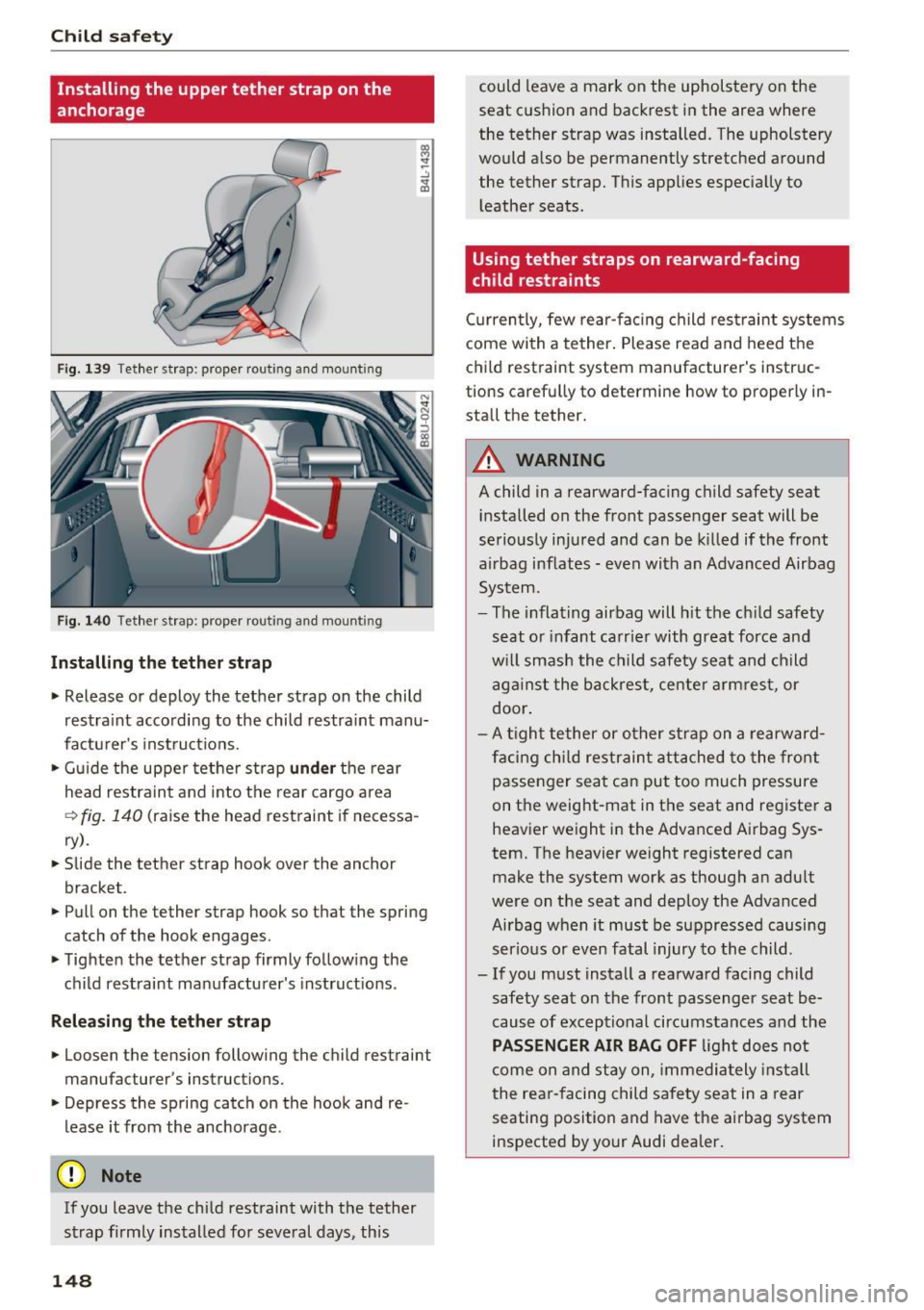
Installing the upper tether strap on the
anchorage
Fig. 139 Te ther strap : proper rout ing and moun ting
Fig. 140 Tether strap : p roper ro utin g and moun ting
Inst all ing th e te th er strap
• Release or deploy the tether strap on the child
restra int according to the child restra int manu
factu rer 's instruct ions.
• Gu ide the upper tether strap
und er the rear
head restraint and into the rear cargo area
¢ fig. 140 (raise the head restraint i f necessa
ry) .
• Slide the tether strap hook ove r the anchor
bracket.
• Pullon the tether strap hook so that the spring
catch of the hook engages .
• Tighten the tether strap firmly follow ing the
child restraint manufacturer's instruct ions .
Relea sing the te the r st rap
• Loosen the tension following the child restraint
manufacturer's instructions.
• Depress the spring catch on the hook and re
lease it from the anchorage .
@ Note
If you leave the child restraint with the tether
strap firmly installed for several days , this
148
could leave a mark on the upholstery on the
seat cushion and backrest in the area where
the tether strap was installed. The upholstery
would a lso be permanently stretched around
the tether strap. This applies especially to leather seats .
Using tether straps on rearward-facing
child restraints
Currently, few rear -fac ing child rest raint systems
come with a tether . Please read and heed the
child restraint system manufacturer's instruc
tions carefully to determine how to properly in
stall the tether.
A WARNING
-A child in a rearward-facing child safety seat installed on the front passenger seat will be
seriously injured and can be k ilted if the front
a ir bag inflates - even with an Advanced Airbag
System.
- The inflating airbag will h it the ch ild safety
seat or infant ca rr ier with great force and
w ill smash the child safety seat and child
aga inst the backrest, center a rmrest, or
door.
- A t ight tether or o ther strap on a rearward
fac ing chi ld restraint attached to the front
passenger seat can put too much pressure
on the weight-mat in the seat and register a
heavier weight in the Advanced Airbag Sys
tem. The heavier weight reg istered can
make the system work as though an adu lt
were on the seat and deploy the Advanced Airbag when it must be suppressed causing
ser ious or even fatal injury to the child.
- If you must install a rea rwa rd facing child
safety seat on the front passenger seat be
cause of exceptional circumstances and the
PAS SENGER AIR BAG OFF light does not
come on and stay on, immediately inst all
the rear-facing child safety seat in a rear
seating position and have the airbag system
inspected by your Audi dealer.
Page 155 of 252
.... N
c:i ::J CX)
.... I.Cl U"I
N I.Cl ......
- Driving on rough terrain when much of the car's weight is lifted off the wheels (axle articu la
t ion)
- Driving downhill whi le brak ing on loose gro und
ESC levels
Intelligent Technology
For yo ur safe ty, switch off the ESC offroad mo de
in advance.
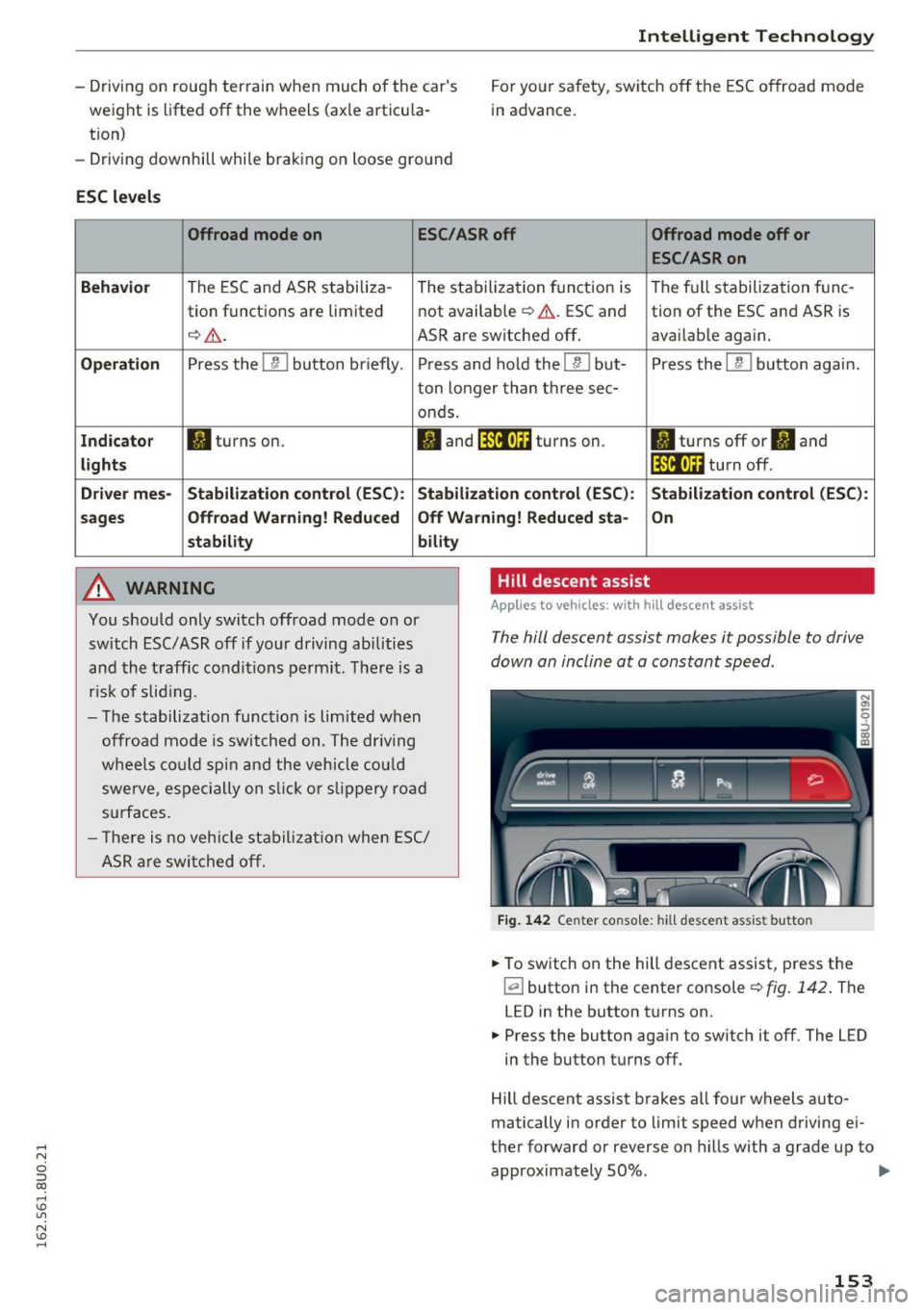
Offroad mode on ESC/ASRoff Offroad mode off or
ESC
/ASRon
Behavior
The ESC and ASR stabiliza -
The stabiliza tion f unction is The f
ull stabiliza tion fu nc-
tion functions are limited not available
Q .&. . ESC and
tion of the ESC and ASR is
~ &. ASR are switched off . available again.
Operation Press the IJJ button briefly. P ress and ho ld the IJJ but- Press the IJJ button aga in.
ton longer than th ree sec-
onds.
Indicato r fl turns on. fil and !;ill•)H turns on. II turns off or II and
lights !;ill•)H turn off .
Driver mes- Stab ilization control (ESC ): Stabil ization control (ESC): Stabilization control (ESC ):
sage s Offroad Warning! Reduced Off Warning! Reduced sta-
On
st ability
bility
A WARNING
You should only switch offroad mode on or
switch ESC/ASR off if your driving ab ilities
and the t raffic conditions perm it. Th ere is a
r is k of sli ding.
- The stabilization function is limited when
offroad mo de is switched on. Th e dr iving
w heels co uld spin and the vehicle cou ld
swe rve, e speci ally on s lick o r slip pery r oad
s u rfaces.
- T here is no veh icle s tabilizat ion whe n ESC/
ASR are swi tched off .
-
Hill descent assist
Applies to vehicles: with hill descent assist
The hill descent assist makes it possible to drive
down an incline at a constant speed .
Fig. 142 Ce nte r console: hill descent ass ist button
.. To switch on the hill descent assist, p ress the
~ butto n in the center co nsole Q fig. 142 . The
LED in the button turns on .
.. Press the button again to switch it off. The LED
in the button turns off .
Hill descent assist brakes all four wheels auto
matically in order to limit speed when driving ei
ther forward or reverse on hills with a grade up to
approximately 50%. ..,_
153
Page 156 of 252
Intelligent Technology
When the hill descent assist is on, the current
driving speed, when your vehicle entered the in
cline is maintained. It is only possible to switch
on the assist when driving slower than 37 mph (60 km/h). The assist works between approxi
mately 2 and 19 mph (4 and 30 km/h). The driver
can increase or decrease the vehicle speed within
these limits by depressing the accelerator or brake pedal.
There must be however sufficient ground adhe
sion . The hill descent assist
cannot do its job if
the incline is icy or if the incline ground is loose
¢ ,&.
Active assistance at a specific speed up to about 19 mph (30 km/h) is shown in the instrument
cluster through a blinking indicator light •. The
indicator light shines continuously when in the
ready mode.
The system does not work at speeds between 19
and 37 mph (30 and 60 km/h) . The system is
then in the ready-mode. This is shown through
the LED turned on in the button . The system au
tomatically switched off when you drive faster
than 37 mph (60 km/h). The LED will also go out
in this scenario.
Hill descent assist is automatically activated un
der the following conditions:
- The LED in the button turns on ,
- the vehicle speed is lower than 19 mph (30 km/
h) ,
-the incline angle is at least around 10% .
A WARNING
-Always adapt your speed to the weather ,
road and traffic conditions . Do not let the
increased safety provided tempt you into
taking risks, because this increases the risk
of an accident.
- The hill descent assist system cannot over
come the laws of physics. Your driving style
must always be adapted to the current road
and traffic conditions.
- The hill descent assist may not be able to
hold your vehicle at a constant speed under
all conditions while driving on an incline (for
154
example if ground under the vehicle is
loose).
Brakes
New brake pads
New brake pads do not achieve their full braking
effect during the first
250 mi (400 km). They
must be "broken in" first¢& . However, you can
compensate for the slightly reduced braking
force by pressing firmly on the brake pedal. Avoid heavy braking during the break-in period.
Operating conditions and driving habits
The brakes on today's automobiles are still sub
ject to wear, depending largely on operating con
ditions and driving habits¢,& . On vehicles that
are either driven mostly in stop-and-go city traf
fic or are driven hard, the brake pads should be checked by your authorized Audi dealer more of
ten than specified in the
Warranty & Mainte
nance booklet.
Failure to have your brake pads
inspected can result in reduced brake perform
ance.
On steep slopes, you should use the braking ef
fect of the engine. This way, you prevent unnec
essary wear on the brake system. If you must use
your brakes, do not hold the brakes down contin
uously. Pump the brakes at intervals.
Operating noise
Noises may occur when braking depending on the
speed, braking force and outside conditions such
as temperature and humidity.
Effect of water or road salt
In certain situations, for example after driving
through water, in heavy rain, after overnight con densation or after washing your car , the braking
effect can be reduced by moisture or ice on the
brake rotors and brake pads. The brakes must be
"dried" first with a few careful brake applica
tions.
At higher speeds and with the windshield wipers
turned on, the brake pads press against the brake
rotors for a short amount of time. This action
which is not felt by the driver happens at regular .,.
Page 158 of 252
Intelligent Technology
Electromechanical
steering
The electromechanical steering sup ports the
driver's steering movements .
Power steering adapts electronically based on
the vehicle speed .
Indicator lights and mess ages
• Steering fault! Do not drive veh icle!
If thi s ind ic a tor light t urns o n and stays o n and
this message appears, the power steering may
have fa iled.
S top the veh icle in a safe lo cat io n as soo n as pos
sib le. Do
not c on tinue driving. See an author ized
Aud i dea ler o r authorized Aud i Serv ice Facility fo r
assistance.
If the ind icator lig ht t urns on, the steer ing wheel
may be mo re diff icu lt to move o r more sensitive
than usual. The stee ring wheel may also be at a n
angle when dr iving straight .
Dr ive s low ly to your author ized A udi dealer or au
thor ized Audi Se rvice Facility to have the ma l
f u nction co rrected.
E£-ij St eering lock: System fault! Plea se contact
deal er.
There is a malfunction in the electronic steering
lock.
D rive to an a uthorized Audi dea le r or a uthorized
Audi Service Facility immediately to have the
malfunct ion corrected.
@ Tips
If the . or Erj indicato r light on ly stays on
for a short time, you may continue driv ing.
All wheel drive (quattro)
Applies to vehicles: with all wheel drive
In oil wheel drive, oil four wheels ore powered .
General information
In a ll w heel d rive, the d rivi ng power is divided be
tween a ll four wheels . This happens au tomatical-
156
ly depending on yo ur driv ing behavior as we ll as
the cur rent road conditions . Refer to
Q page 151.
The all whee l dr ive concep t is designed fo r high
engine power. Yo ur vehicle is except ion ally pow
erf ul and has excellent drivin g charac teristics
both un der normal driving conditions and on
snow and ice . Always read and follow safety pre
cautions
c:> .&, .
Winter tires
By using all whee l dr ive, your ve hicle has goo d
f orward motion wi th standard tires in w inte r con
ditions . However, in winte r we recommend using
winter or all-season tires on all four wheels, be
cause this will improve the brak ing effect
c:> page 206, Winter tires .
Snow chains
If there are snow chain laws, snow chains m ust
also be used o n veh icles with all wheel drive
c:> page 206, Snow chains.
Replacing tires
Fo r vehicles with all wheel drive, on ly wheels with
t h e same ro lli ng circ umfe rence sho uld be used .
Avoid whee ls with different t read depths
Q page 198 , New tires or wheels .
A WARNING
-Also, in vehicles with all wheel drive, adapt
your driving sty le to the current road and
traffic conditions. Do not let t he increased
safety prov ided tempt you in to taking r isks,
because this inc reases t he risk of an acc i
dent.
- The braking ab ility o f your vehicle is limited
t o th e trac tion of th e wh eels. I n this way, it
is no t differe nt from a two wheel drive vehi
cle. Do no t be tempte d to accelerate to a
hi gh speed when the ro ad is slip pery this in
creases the risk of an accident .
- N ote tha t on wet s tree ts, the front wheels
can " hydrop lane" i f driv ing at spee ds tha t
are too high. Unlike front wheel drive
veh icles, t he engine does not
rev higher sud
de nly when t he vehicle begins hydroplan ing.
For this reason, pay attention to the road
Page 164 of 252
Driving and th e en vironm ent
- Do not alter or remove any component of
the Emission Control System unless ap proved by the manufacturer.
- Do not alter or remove any device, such as
heat shie lds, switches, ignition wires,
valves, which are designed to protect your
vehicle's Em ission Control System and other
i mportant vehicle components.
Fewer short trips
Fuel consumption will always be relatively high
on shor t trips.
... Try to avoid driving short distances with a cold
engine.
The engine and catalyt ic converter have to reach
their optimal
ope rating temperature to reduce
fue l cons umption and nox ious emissions effec
tively .
J ust after starting, a co ld eng ine in a m id -s ize ca r
only achieves a f uel economy of 6-8 miles p er
ga llon (30 -40 l/100 km). After about a half a
mile ; fu e l economy cl imbs to 12 mpg (20 l/100
km). After about
2.5 miles (4 km), the engine is
at its prope r operating temperature and fuel
economy has reached a normal level. So you can
see that you sho uld avoid short t rips whenever
possible.
The
outsid e temperature is also critical in this re
gard . Your car consumes more fuel in the w in ter
than in the summe r.
Driving offroad
General information
When driving offroad, the f unctions for the elec
tron ic stabili zation control (ESC) are expanded.
ESC offroad mode can be activated in dr iving sit
uations in which a whee l lock o r a d ifferent ial
lock fu nction is needed
r=.> page 152.
However, your Audi is not an offroad vehicle.
Never drive the vehicl e in terra in which is not
suitabl e for the vehicle, or which exceeds your
driving skills. Never take any unnecessary ri sks!
162
After driving offroad
- After driving off road, remove branche s and
other deb ris from the rad iator g rille, under
body, and w heels . Look especially fo r objects
(stones) that have been caught in the tire
tread.
- Clean the body and the ve hicle unde rbody and
i nspect the ve hicle for possible damages.
- Clean off the dirty windows, headlights, tail
lights and t he license plate.
- Per form a brake test (especia lly after d riving
throug h water) .
A WARNING
-Be especially aware and attentive when d riv
ing under diff icu lt cond itions. Damages to
the vehicle and injur ies may occur when
driving at an excess ively high speed o r with
incor rect d riving maneuvers .
- Always ad just yo ur speed and handling to
the roads, terra in, traffic and weathe r con
d itions . D rive especially s low if offroad wi th
low visibility.
- Please note that t he wheels can sp in mo re
and the vehicle can swerve when in ESC off
road mode , espe cially when the road is slip
pe ry o r has loose surfa ce m aterial.
- Driv ing stability is reduce d in the ESC
Off
road mode.
@ For the sake of the environment
Avo id harm ing t he env ironmen t and take na
ture into co nsideration .
(D Tips
Only drive where it is allowed and always stay
on the provided roads and paths .
Driving information
There is only one right way to drive in difficult
conditions: slowly and with caution!
Observe the following when driving on unpaved
r oads :
Ill-
Page 166 of 252
Trailer mod e
Trailer mode
Driving with a trailer
General information
Your Audi was designed primarily for passenger
transportation.
If you plan to tow a trailer, please remember that
the additional load will affect durability, economy and performance.
Trailer towing not only places more stress on the
vehicle, it also calls for more concentration from
the driver.
F or this reason, always follow the operating and
driving instructions provided and use common
sense.
Technical requirements
Tr aile r hitch
Use a weight-carrying hitch conforming to the
gross trailer weight. The hitch must be suitable
for your veh icle and trailer and must be mounted
securely on the vehicle's chassis at a technically
sound
location . Use only a trailer hitch with a re
movable ball mount . Always check w ith the t rail
er hitch man ufact urer to make su re that you are
using the co rrect hitch .
Do not use a bump er hit ch .
The hitch must be installed in such a way that it
does not interfere with the impact -absorbing
bumper system. No mod ificat ions should be
made to the vehicle exhaust and brake systems .
From t ime to t ime, check that a ll hitch mount ing
bolts rema in securely fastened.
When you are not tow ing a tra iler, remove the
tra iler hitch ba ll mount . This prevents the hitch
from caus ing damage shou ld your veh icle be
s truck from be hind ¢
,&..
Trailer brakes
If your trailer is equipped with a brak ing system,
check to be sure that it conforms to all regula
tions .
164
The trailer hydraulic brake system must not be
directly connected to the vehicle's hydraulic
brake system ¢&. .
Safety chains
Always use safety chains between you r vehicle
and the trailer.
Trailer lights
Traile r lights must meet all regulations . Be sure
to check w ith your author ized Audi dealer for cor
r ec t wiring , switches, and relays.
M irrors
If you are unable to see the traffic behind you us
ing the regular outs ide mirrors, then you
must in
stall extended mirrors . It is important that you
always have clear vision to the rear.
.&_ WARNING
- If a tra ile r has e lectr ica l brakes p lease no te
t hat these brakes are not activated by the
factory-fit ted contro l unit -risk of accident!
- After removing the trai ler hitch, do not
store it in your vehicle. In case of sudden
braking, the hitch co uld fly forward and in
jure you or yo ur passengers.
- Never install a "we ight distribu ting" or
"load eq ualizing" trailer hitch on your vehi
cle. The vehicle was not designed for these
kinds of trailer hitches. The hitch attach ment can fail, caus ing the tra iler to tear
loose from the vehicle.
- The Gross Vehicle Weight Rating for your
veh icle, found on the safety compliance la
be l on the driver's s ide B-pillar, must never
be exceeded under any circumstances . Ex
ceed ing the Gross Vehicle Weight Rat ing of
your veh icle is likely to damage yo ur vehicle,
and such damage will not be covered by
your Limited New Vehicle Warranty . Exceed
ing the Gross Vehicle Weight Rating will al
so change the performance and handling
characteristics of your vehicle, which could
cause a crash result ing in serious injury or
death.
Page 168 of 252
Trailer mod e
Weight d istribution
Towing a loaded trailer with an empty car res ults
in a high ly unstable distribution of weight . If this
cannot be avoided, drive at very low speeds on ly
to avoid the risk of losing steering control.
A "balanced" rig is easie r to operate and con trol.
This means that the tow vehicle should be loaded
to the extent possible and permissible, while
keeping the trai le r as light as possib le under the
circumstances. Whenever possible, transfer
some cargo to the luggage compartment of the
tow vehicle while observ ing tongue load requ ire
ments and vehicle loading considerat ions.
Spee d
The higher the speed, the more difficult it be
comes for the driver to contro l the rig. Do not
drive at the maximum permiss ible speed. Reduce
your speed even more if load, weather or w ind
conditions are unfavorable - part icularly when
goi ng downhill.
Reduce veh icle speed
immediatel y if the tra iler
shows the slightest sign of swaying .
Do not try
to stop the sway ing by acc ele rating .
Observe speed lim its. In some areas, speeds for
veh icles towing trailers are lower than for regular
ve hicles.
A lways app ly brakes early. When driving down
h ill, shift into a lower gear to use the engine
braking effect to slow the veh icle. Use of the
brakes alone can cause them to overheat and fail.
Coolant temp era ture
The coolant temperature gauge¢ page 10 must
be observed carefully. If the needle moves close
to the upper end of the scale, reduce speed im mediately and/or turn off the air conditioner.
If the coo lant temperature warning light in the
instr ument cluster starts flashing., pull off
the road, stop and let the engine
idle for about
two minutes to prevent heat bu ild-up.
A WARNING
Anyone not proper ly restrained in a moving
vehicle is at a much greater risk in an acci-
166
-
dent . Never let anyone ride in your car who is
not properly wear ing the restraints provided
by Audi.
Trailer mode notes
Important to know
You r vehicle handles differently when towing a
trailer because o f th e additiona l weight and dif
ferent weight distribution. Safety, performance
and economy will g reatly depend on how carefu l
l y you load your trai ler and operate your rig.
Before yo u actually tow your trailer, pract ice
turning, stopping and backing up in an area away
from traffic . Keep practicing unti l you have be
come complete ly familiar w ith the way your vehi
cle-tra iler combination behaves and responds.
Backing up is difficult and requires practice .
Backing up with a trailer genera lly requires steer
ing action opposite to that when backing up your
vehicle without a trailer.
Maintain a greater distance between your vehicle
and the one in fro nt of you . You will need more
room to stop. To compensate for the trailer, you
will need a larger than normal turning radius.
When passing, remember that you cannot accel erate as fast as you normally wo uld beca use of
the added load. Make sure you have enough room
to pass. After passing, allow p lenty of room for
your trailer before changing lanes again.
Avoid jerky starts, sharp turns or rapid lane
changes.
@ Tips
- Do not tow a trailer du ring the break-in peri
od of your vehicle.
- If you tow a trai le r, your Au di may requi re
more frequent maintenance due to the ex
t ra load ¢
page 232.