brake light AUDI Q3 2018 Owner's Manual
[x] Cancel search | Manufacturer: AUDI, Model Year: 2018, Model line: Q3, Model: AUDI Q3 2018Pages: 230, PDF Size: 57.03 MB
Page 97 of 230
0 co ......
"' ,....
"' ...... 0 0 :::,
00
With th e engin e switched off
The vehicle battery will d rain if yo u use I nfota in
ment f unctions such as listening to the radio
while the engine is switched off .
The vehicle 's ability to start may be impaired by
the energy use, a message will appear in the In
fotainment system disp lay .
The message ind icates that the system will
switch off au tomati cally soon. If you wou ld like
to continue using the funct ions, you must s tart
the engine.
With the engine running
Although electrical energy is gene rated whi le
d riving, the vehicle battery can drain. This can
h appen if l ittle energy is gene rated but much is
used, and the charge leve l of the veh icle ba ttery
is not optima l.
To restore the ba lance of energy, components
that requ ire large amo unts of energy are tempo
r ar ily scaled bac k or switched off. Heating sys
tems in part icular requi re a g reat deal of energy.
If
yo u notice, for example, that the seat heating*
or rear window defogger is not working, then it
has been temporarily reduced or switched off.
These systems are available again as soon as the
e nergy supply has been restored.
In addition, you may notice that the idle speed
has slightly increased. That is norma l and no
cause for concern. By increasing the idling speed,
the add itional required energy will be generated
and the vehicle battery will be cha rged.
Notice about data
recorded by the Event
Data Recorder and
vehicle control modules
Event Data Recorder
This vehicle is equipped with an Event Data Re
corder (EDR). The main purpose of an EDR is to
record, in certain crash or near crash-like situa
tions, such as an a irbag deployment or hitting a
road obstacle, data that will assist in understand
in g how a veh icle's systems performed. The EDR
Intellig ent Technology
is des igned to record data related to vehicle dy
namics and safety systems for a short period of
t ime, typ ica lly 30 seconds or less. The EDR in this
vehicle is designed to record such data as:
- How various systems in your vehicle were oper
ating;
- W het her o r not the drive r and passenge r safety
be lts were buckled/fastened;
- How far (if at all) the driver was depressing the
accelerator and/or brake pedal; and,
- How fast the vehicle was traveling.
These data can help provide a better understand
i ng of the circumstances in wh ich crashes and in
j u ries occur. NOT E: EDR da ta a re recorded by your
vehicle on ly if a non-trivial crash s ituation occurs;
no data are re co rded by the E DR under normal
driving conditions and no persona l data (e .g .,
name, gender, age, and crash location) are re
corded. However, other parties, such as law en
forcement, could comb ine the EDR data with the
type of personally identifying data rout inely ac
quired during a crash investigation .
To read data recorded by an EDR, special equ ip
ment is required, and access to the vehicle or the
EDR is needed. In addition to the ve hicle manu
fact urer, other pa rt ies, such as law e nforcement,
that have the special eq uipment, can read the in
fo rmat ion if they have access to the vehicle or the
ED R.
Some state laws restrict the retrieval o r down
load ing of data sto red by ED Rs installed in a ve hi
cle for the exp ress purpose of retriev ing data af
te r an a ccident or cras h event without the ow n
er's consent .
Audi will not access the EDR and/or sim ila r data
o r give it to others -
- unless the ve hicle owner (or lessee if the vehi
cle has been leased) agrees; or
- upon the official request by the police; or
- upon the order of a court of law or a govern-
ment agency; or
- for the defense of a lawsuit thro ugh t he judicia l
discovery process.
- Audi may a lso use the data for research abo ut
veh icle operation and safety performance or .,,.
95
Page 188 of 230

Care and cleaning
wash operator to reduce the risk of acci
dents.
- To reduce the risk of cuts, protect yourself
from sharp metal components when wash ing the underbody or the inside of the wheel
housings.
- After washing the vehicle, the braking effect
may be delayed due to moisture on the
brake rotors or ice in the winter. This in
creases the risk of an accident. The brakes
must be dried first with a few careful brake
applications.
(D Note
- If you wash the vehicle in an automatic car
wash, you must fold the exterior mirrors in
to reduce the risk of damage to the mirrors.
Power folding exterior mirrors* must only
be folded in and out using the power folding
function.
- To reduce the risk of paint damage, do not
wash the vehicle in direct sunlight. -
To reduce the risk of damage to the surface,
do not use insect removing sponges, kitchen
sponges or similar items.
- Matte finish painted vehicle components:
- To reduce the risk of damage to the sur-
face, do not use polishing agents or hard
wax.
- Never use protective wax. It can destroy
the matte finish effect.
- Do not place any stickers or magnetic
signs on vehicle parts painted with matte
finish paint. The paint could be damaged
when the stickers or magnets are re
moved.
@ For the sake of the environment
Only wash the veh icle in facilities spec ially de
signed for that purpose. This will reduce the
risk of dirty water contaminated with oil from
entering the sewer system.
Cleaning and care information
When clean ing and caring for individual vehicle
components, refer to the following tables. The
information contained there is simply recom
mendations. For quest ions or for components that are
not listed, consult an authorized Aud i
dealer or authorized Audi Service Facility. Also
follow the information found in¢&..
Exterior cleaning
Component Situation Solution
Windshield wiper
Deposits ¢ page 39, Cleaning the wiper blades
blades
Headlights/
Deposits Soft sponge with a mi ld soap solutiona >
Tail lights
Sensors/
Deposits Sensors: soft cloth with solvent-free cleaning solution
Camera lenses Camera lenses: soft cloth with alcohol-free cleaning solu-
tion
Snow/ice Hand brush/so
lvent-free de -icing spray
Wheels Road salt Water
Brake dust Acid-free special cleaning solution
Exhaust tail pipes Road salt Water, cleaning solution suitable for stainless steel, if
necessary
Decorative parts/ Deposits Mild soap solution al, a cleaning solution suitable for
Trim stainless steel, if necessary
186
Page 194 of 230

Emergency assistance
& WARNING
You or your passengers could be injured while changing a wheel if you do not follow these
safety precautions :
- If you have a flat ti re, move a safe d ista nee
off the road . Turn off the engine, turn the
emergency flashers on and use other warn·
ing devices to alert other motorists.
- Make sure that passengers wait in a safe
place away from the vehicle and well away
from the road and traffic.
- To help prevent the vehicle from moving
suddenly and possibly slipping off the jack,
always fully set the parking brake and block
the front and back of the wheel diagonally
opposite the wheel being changed with the
folding chocks or other objects. When one
front wheel is lifted off the ground, placing
the Automatic Transmission in "P" (Park)
will
not prevent the vehicle from moving.
- Before you change a wheel, be sure the
ground is level and firm. If necessary, use a
sturdy board under the jack .
- Always store the vehicle tool kit, the jack
and the replaced tire in the luggage com
partment
c:> page 102 .
(D Tips
Obey all laws.
Changing a wheel
When you change a wheel, follow the sequence
described below step-by-step and in exactly that
order.
1. Remove the decorative wheel cover* or the
wheel bolt caps*. For more details see also
<=:>page 193.
2. Loosen the wheel bolts c:> page 193.
3. Locate the proper mounting point for the
jack and align the jack below that point
<=:>page 194.
4. Lift the car with the jack c:> page 194 .
5. Remove the wheel with the flat tire and then
install the
spare tire <=:>page 195.
6. Tighten all wheel bolts lightly.
7.
Lower the vehicle with the jack.
192
8. Use the wheel bolt wrench and firmly tighten
all wheel bolts in a crisscross pattern
<=:>page 193.
9. Replace the decorative wheel cover* or the
wheel bolt caps*.
& WARNING
Always read and follow all WARNINGS and in
formation
c:> .&. in Raising the vehicle on
page 194
and <=:>page 196.
After changing a wheel
A wheel change is not complete without the do·
ing the following .
.,. Always store the vehicle tool kit, the jack* and
the replaced tire in the luggage compartment
c:>page 102.
.,. Check the tire pressure of the spare tire as soon
as possible .
.,. As soon as possible, have the
tightening tor·
ques
on all wheel bolts checked with a torque
wrench. The correct tightening torque is
10S ft lbs (140 Nm).
.,. Have the flat tire
replaced as soon as possible.
(D Tips
- If you notice that the wheel bolts are cor
roded and difficult to turn while changing a
tire, they should be replaced before you check the tightening torque.
- Drive at reduced speed until you have the
tightening torques checked .
Page 196 of 230
Emerg ency assis ta nce
Raising the vehicle
The vehicle must be li~ed with the jack first be
fore the wheel can be removed .
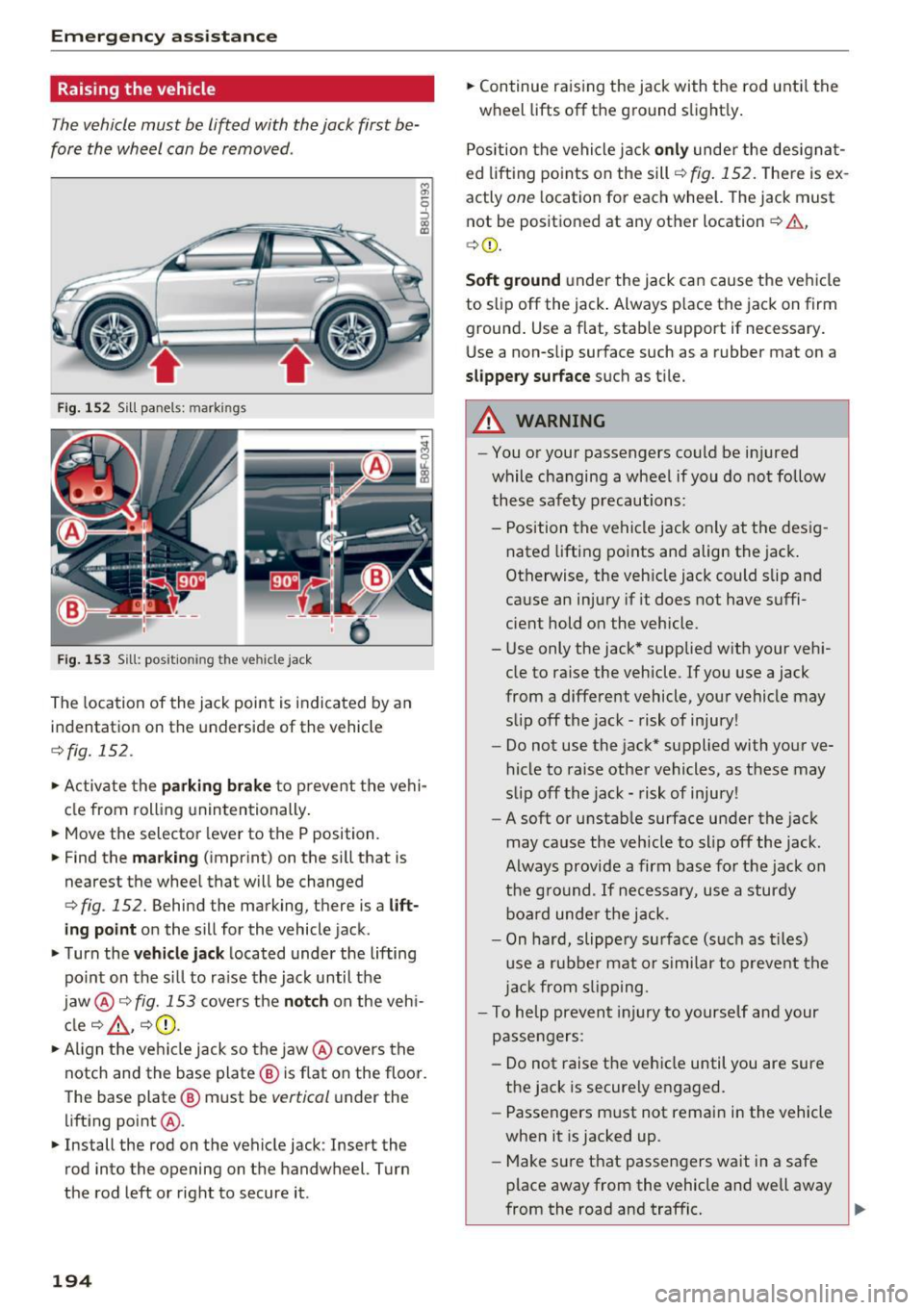
Fig. 152 Sill panels : mark in gs
Fig. 153 Sill : pos itio nin g th e ve hicle jack
The location of the jack point is indicated by an
indentation on the underside of the vehicle
¢ fig. 152 .
,.. Activate the pa rking brake to prevent the vehi
cle from rolling unintentionally .
,.. Move the selector lever to the P position.
,.. Find the
m arki ng (imprint) on the sill that is
nearest the wheel that will be changed
c> fig . 152. Behind the marking, there is a li ft
ing po int
on the sill for the vehicle jack.
• Turn the
veh icle jack located under the lifting
point on the s ill to ra ise the jack until the
jaw @¢
fig. 153 covers the notch on the veh i
cle ¢
.&_, ¢(D .
,.. Align the vehicle jack so the jaw @covers the
notch and the base plate @ is flat on the floor .
The base plate @ must be
vertical under the
lifting point @.
,.. Install the rod on the vehicle jack : Insert the
rod into the opening on the handwheel. Turn
the rod left or right to secure it .
194
• Continue raising the jack with the rod until the
wheel lifts off the ground slight ly.
Position the vehicle jack
only under the designat
ed lifting points on the sill
c> fig. 152. There is ex
actly
one l ocation fo r each wheel. The jack must
not be positioned at any other location
c> & ,
¢(I) .
So ft ground
under the jack can cause the vehicle
to slip off the jack . Always place the jack on firm
ground . Use a flat, stable support if necessary.
Use a non-slip surface such as a rubber mat on a
sl ippery su rf ace such as tile.
A WARNING
-
- You or your passengers could be injured
while changing a wheel if you do not follow
these safety precautions:
- Position the vehicle jack only at the desig
nated lifting points and align the jack .
Otherwise, the veh icle jack could slip and
cause an injury if it does not have suffi
cient hold on the vehicle.
- Use only the jack* supplied with your vehi cle to raise the vehicle. If you use a jack
from a different vehicle, your vehicle may
slip off the jack - risk of injury!
- Do not use the jack* supplied with your ve
hicle to raise other vehicles, as these may
slip off the jack - risk of injury!
- A soft or unstab le surface under the jack
may cause the vehicle to slip off the jack .
Always provide a firm base for the jack on
the gro und .
If necessary, use a sturdy
board unde r th e jack .
- On hard, slippe ry surface (such as t iles)
use a rubber mat or s imilar to prevent the
jac k from slipping.
- To he lp prevent injury to yourself and your
passengers:
- Do not raise the vehicle until you are sure
the jack is securely engaged.
- Passengers must not remain i n the vehicle
when it is jacked up .
- Make sure that passengers wait in a safe
place away from the vehicle and well away
from the road and traffic. .,,.
Page 197 of 230
-Make sure jack posit ion is correct , adjust
as necessary and then cont inue to raise
the jack.
- If work has to be done under the vehicle,
ensure that it is safely supported on su ita
ble stands -risk of injury!
- Never start the engine when the vehicle is
on the jack -risk of accident!
CD Note
Do not lift the vehicle by the sill. Position the
vehicle jack on ly at the designated lifting
points on the sill. Otherwise, your vehicle will
be damaged.
Taking the wheel off/installing the spare
tire
F ollow these instructions step-by-step for chang
ing the wheel .
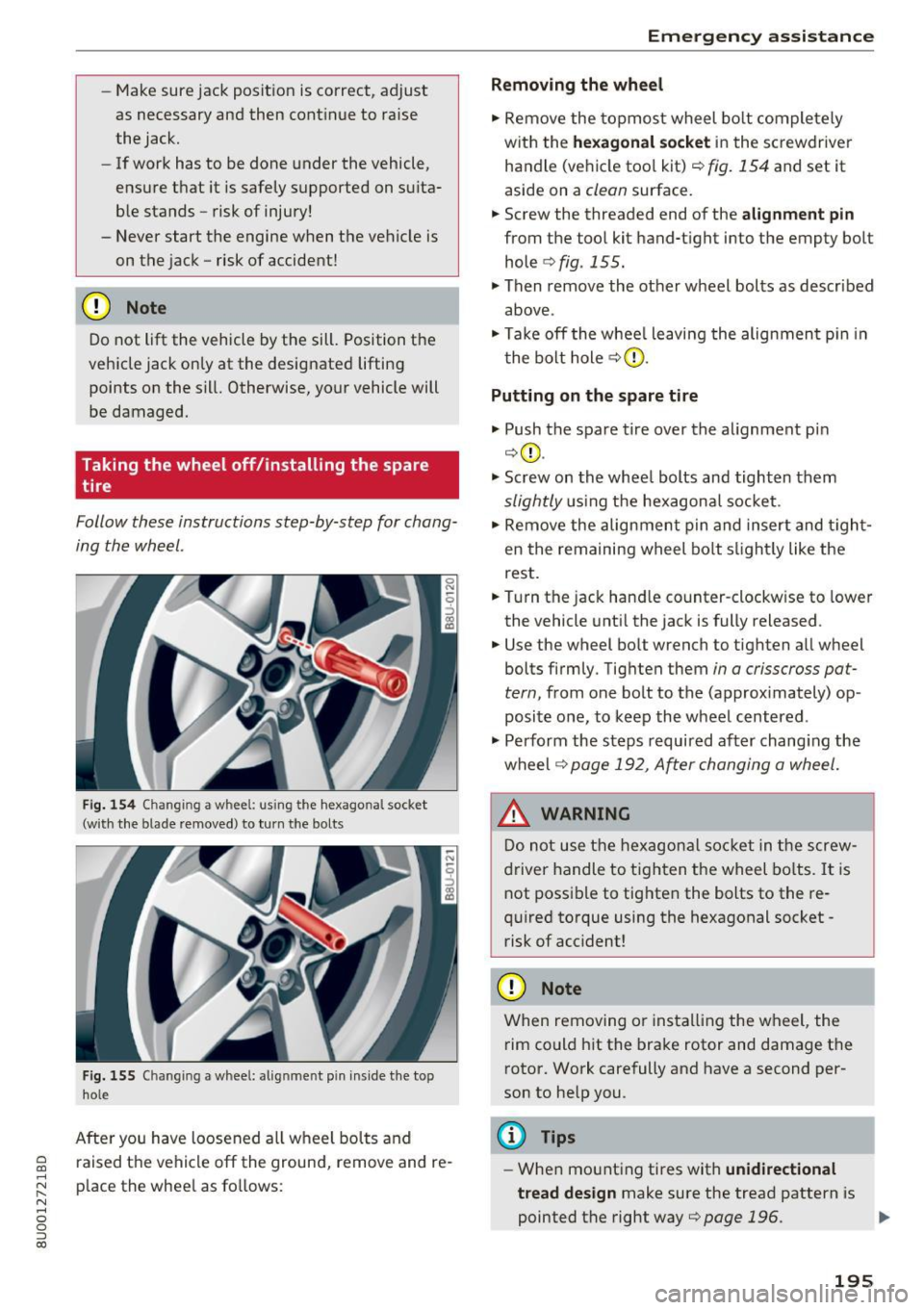
Fig. 154 C hangin g a w heel: using th e hexagonal s oc ket
(w it h the blade removed ) to turn t he bolt s
Fig. 155 Chan gin g a w hee l: a lig nm ent pin in side the to p
h ol e
After you have loosened all wheel bolts and
~ raised the vehicle off the ground, remove and re-....
~ place the whee l as follows:
N .... 0 0 ::, (X)
Em ergen cy a ssis tanc e
Removing the whe el
.,. Remove the topmost wheel bolt completely
with the
he xagona l s oc ket in the screwdriver
handle (vehicle too l kit) ¢
fig. 154 and set it
aside on a
clean surface.
.,. Screw the threaded end of the
alignment pin
from the tool kit hand-tight into the empty bolt
hole ¢
fig. 155 .
.,. Then remove the other wheel bolts as described
above .
.,. Take off the whee l leaving the alignment p in in
the bolt hole
r=.> G) .
Putting on the spare tire
.,. Push the spare tire over the alignment pi n
¢(D .
.,. Screw on the whee l bolts and tighten them
slightly u sing the hexagona l socket .
.,. Remove the alignment pin and insert and t ight
en the remaining wheel bo lt s lightly like the
rest .
.,. Turn the jack hand le count er-clockw ise to lower
the vehicle unti l the jack is fully released .
.,. Use the wheel bo lt wrench to tighten all wheel
bolts firmly . Tighten them
in a crisscross pa t
tern,
from one bolt to the (approx imately) op
posite one, to keep the wheel centered .
.,. Perform the steps required after chang ing the
wheel ¢
page 192, A~er changing a wheel.
_& WARNING
Do not use the hexagon al soc ket in the screw
driver handle to tighten the wheel bo lts. It is
not possible to tighten the bolts to the re
qu ired torque using the hexagonal socket -
risk of acc ident!
CD Note
When removing or installing the wheel, the
rim could h it the brake rotor and damage t he
rotor. Work carefully and have a second per
son to he lp you.
@ Tips
- When mounting tires with un idirectional
tread de sign
make sure the tread pattern is
pointed the right way
r=.> page 196. 1JJ,,
195
Page 202 of 230
Fuses and bulbs
(D Tips
-The following table does not list fuse loca
tions that are not used.
- Some of the equipment listed in the follow
ing tables applies only to certain model ver
sions or certain optional equipment.
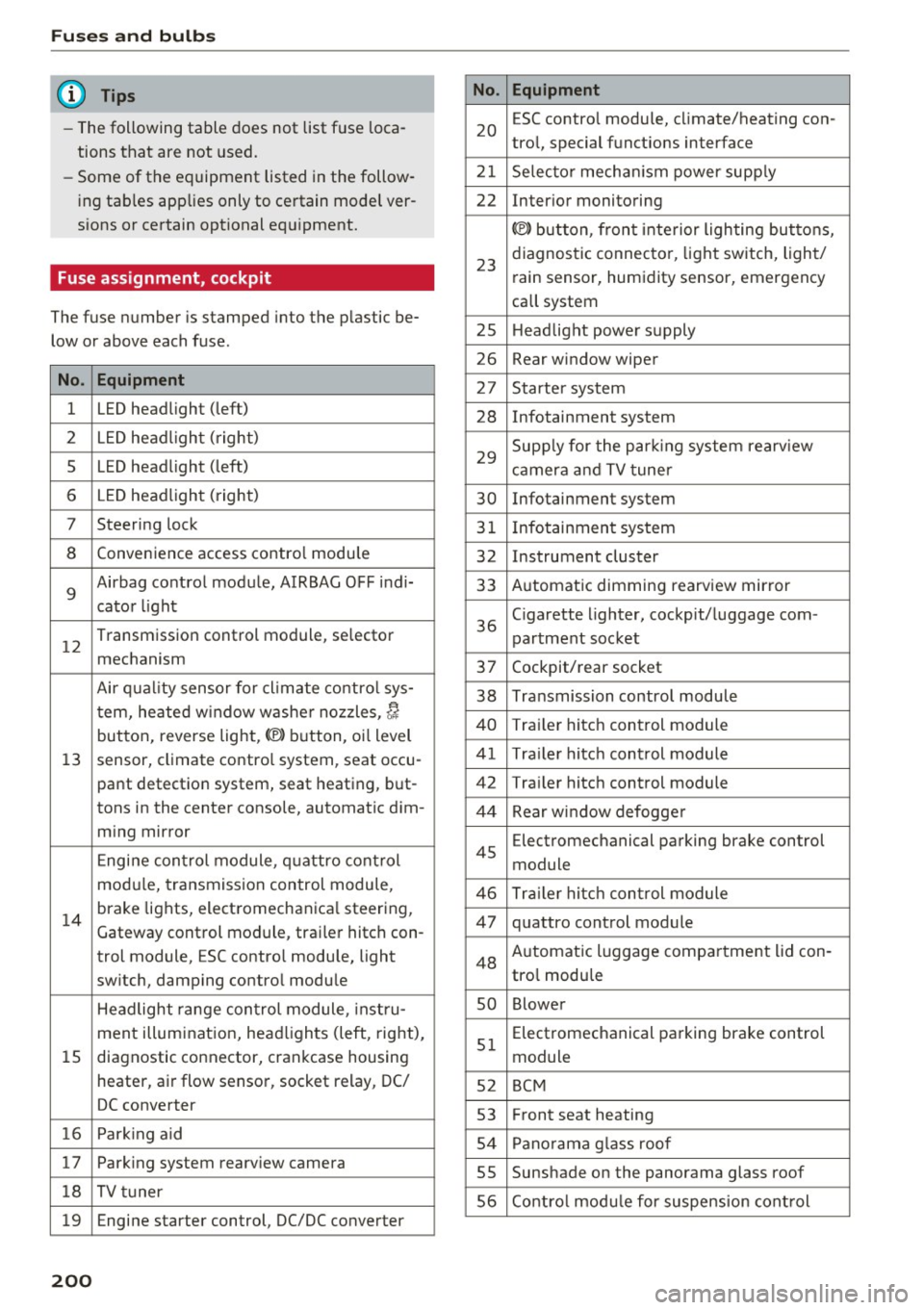
Fuse assignment, cockpit
The fuse number is stamped into the plastic be
low or above each fuse.
No. Equipment
1 LED headlight (left)
2 LED headlight (
right)
5 LED headlight (left)
6 LED headlight (right)
7 Steering lock
8 Convenience access contro
l module
9 Airbag control module, AIRBAG OFF
indi-
cator light
12
Transmission control module, selector
mechanism
Air quality sensor for cl imate control sys-
tern, heated w indow washer nozzles,~
button, reverse light,(®) button, oil level
13 sensor, climate contro
l system, seat occu-
pant detection system, seat heating, but-
tons in the center console, automatic dim-
ming mirror
Engine control module , quattro control
modu le, transmission control module,
14 brake lights, electromechanica
l steering,
Gateway control module, trai ler hitch con-
trol module, ESC control module, light
switch, damping control module
Headlight range control module, instru-
ment illumination, headlights (left, right),
15 diagnostic connector, crankcase housing
heater, a
ir flow sensor, socket relay, DC/
DC converter
16 Parking aid
17 Parking system rearview camera
18 TV tuner
19 Engine starter control, DC/DC converter
200
No
. Equipment
20 E
SC contro l module, climate/heating con-
trol, special functions interface
21 Selector mechanism power supply
22 Interior monitoring
(®) button, front interior lighting buttons,
23 diagnostic connector, light
switch, light/
rain sensor, humidity sensor, emergency
call system
25 Headlight power supply
26 Rear window wiper
27 Starter system
28 Infotainment system
29 Supply for
the park ing system rearview
camera and TV tuner
30 Infotainment system
31 Infotainment system
32 Instrument cluster
33 Automatic dimming rearview mirror
36 Cigarette lighter, cockpit/luggage com
-
partment socket
37 Cockpit/rear socket 38 Transmission contro l module
40 Trailer hitch control module 41 Trailer hitch control module
42 Trai ler hitch control module
44 Rear window defogge r
4S Electromechanical parking brake control
module
46 Trailer hitch control module
47 quattro control module
48 Automatic luggage compartment lid con-
tro
l modu le
so Blowe r
51 Electromechanical parking brake control
module
52 BCM
53 Front seat heating
54 Panorama gla ss roof
55 Sunshade on the panorama glass roof
56 Contro l modu le for suspension control
Page 203 of 230
0 co ......
"' ,....
"' ...... 0 0 :::,
00
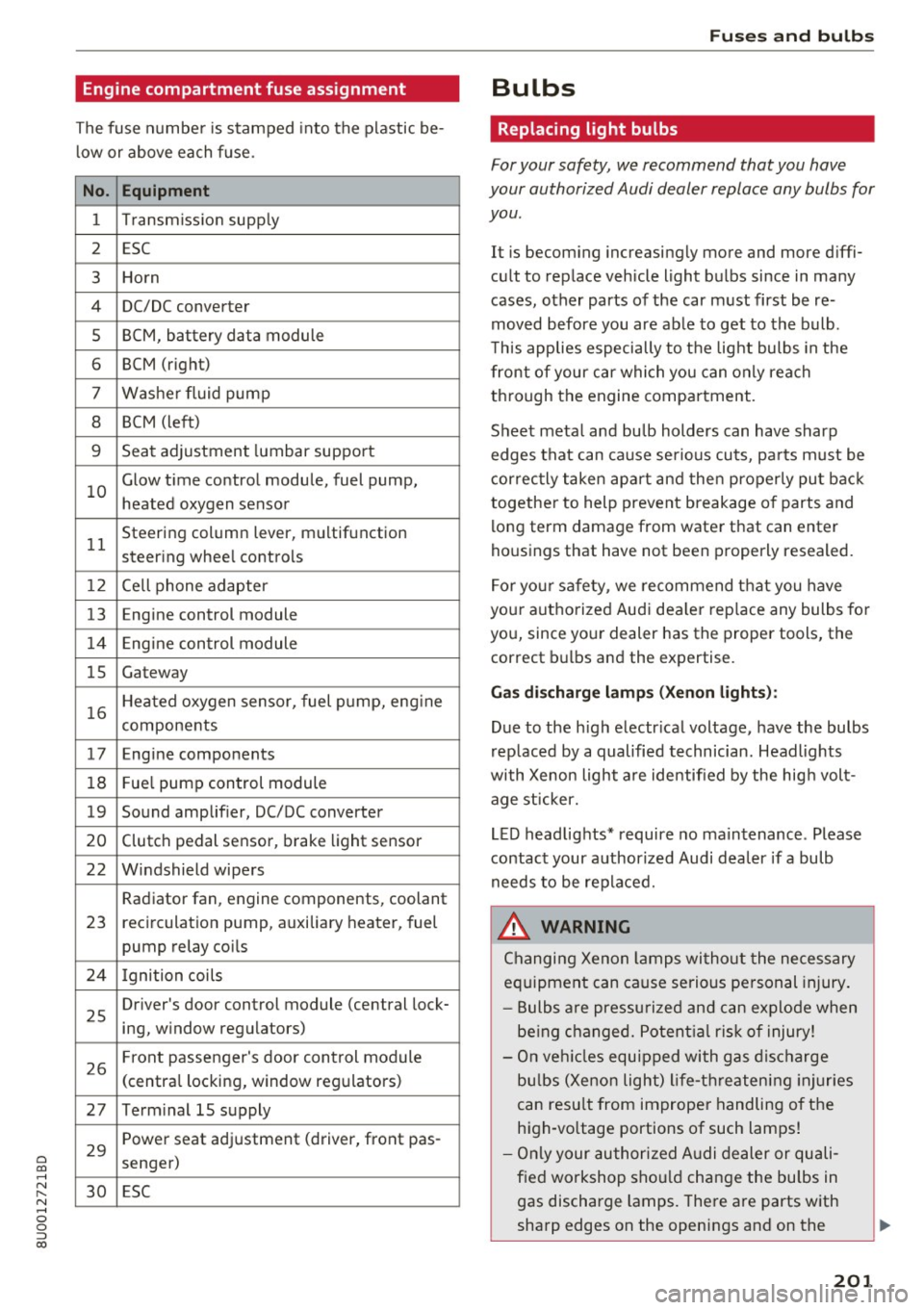
Engine compartment fuse assignment
The fuse number is stamped into the plastic be
low or above each fuse.
No. Equipment
1 Transmiss ion supply
2 ESC
3 Horn
4 DC/DC
converter
5 BCM, battery data module
6 BCM (right)
7 Washer fluid pump
8 BCM (left)
9 Seat adjustment lumbar support
10 Glow time
control module, fuel pump,
heated oxygen sensor
11 Steering
column lever, multifunction
steer ing whee l controls
1 2 Cell phone adapter
13 En
gine control module
14 Engine control module
15 Gateway
16 Heated oxygen sensor, fuel pump, eng
ine
components
17 Engine components
18 Fue
l pump control module
19 Sound amplifier, DC/DC converter
20 Clutch pedal sensor, brake light sensor
22 Windshield wipers Radiator fan, engine components, coolant
23 recirculation pump, auxiliary
heater, fuel
pump relay coils
24 Ignition coils
25 Driver's door
control module (central lock-
ing, window regulators)
26 Front passenger's door control module
(centra
l locking, window regulators)
27 Term inal 15 supply
29 Power seat adjustment (driver,
front pas-
senger)
30 ESC
Fu ses an d bulb s
Bulbs
Replacing light bulbs
For your safety, we recommend that you have
your authorized Audi dealer replace any bulbs for
you .
It is becoming increasingly more and more diffi
cult to replace vehicle light bulbs since in many
cases, other parts of the car must first be re
moved before you are able to get to the bulb .
T his applies especially to the light bulbs in the
front of your car which you can only reach
through the engine compartment .
Sheet metal and bu lb holders can have sharp
edges that can cause serious cuts, pa rts must be
correctly taken apart and then properly put back
together to help prevent breakage o f parts and
long term damage from water that can enter
housings that have not been properly resealed.
For your safety, we recommend that you have
your authorized Aud i dea ler rep lace any bulbs fo r
you, since your dealer has the proper tools, the
correct bulbs and the expertise.
Gas di schar ge la mps (Xe no n ligh ts):
Due to the high electr ical voltage, have the bulbs
rep laced by a qualified technician. Headlights
with Xenon light are identified by the hig h volt
age st icker.
LED headlights* require no maintenance . Please
contact your authorized Audi dea ler if a bulb
needs to be replaced.
_&. WARNING
Changing Xenon lamps wi thout the necessary
equipment can cause serious personal injury .
- Bulbs are pressu rized and can explode when
be ing changed. Potent ial ris k of injury!
- On veh icles equipped with gas disc harge
bu lbs (Xenon light) life-threatening injuries
can resu lt from improper handling of the
high-vo ltage portions of such lamps!
- Only your authorized A udi dealer or quali
f ied workshop sho uld change the bulbs in
gas discharge lamps. There are parts with
sharp edges on the openings and on the
201
Page 206 of 230
Emergency situations
@ Tips
The discharged battery must be properly con
nected to the vehicle's electrical system .
When jump starting or charging the battery,
never connect the negative ground cable to
the battery negative post because the battery
manager system must be able to detect the
battery's state of charge . Always connect the
negat ive ground cable to the negative ground
pos t of the battery manager control unit.
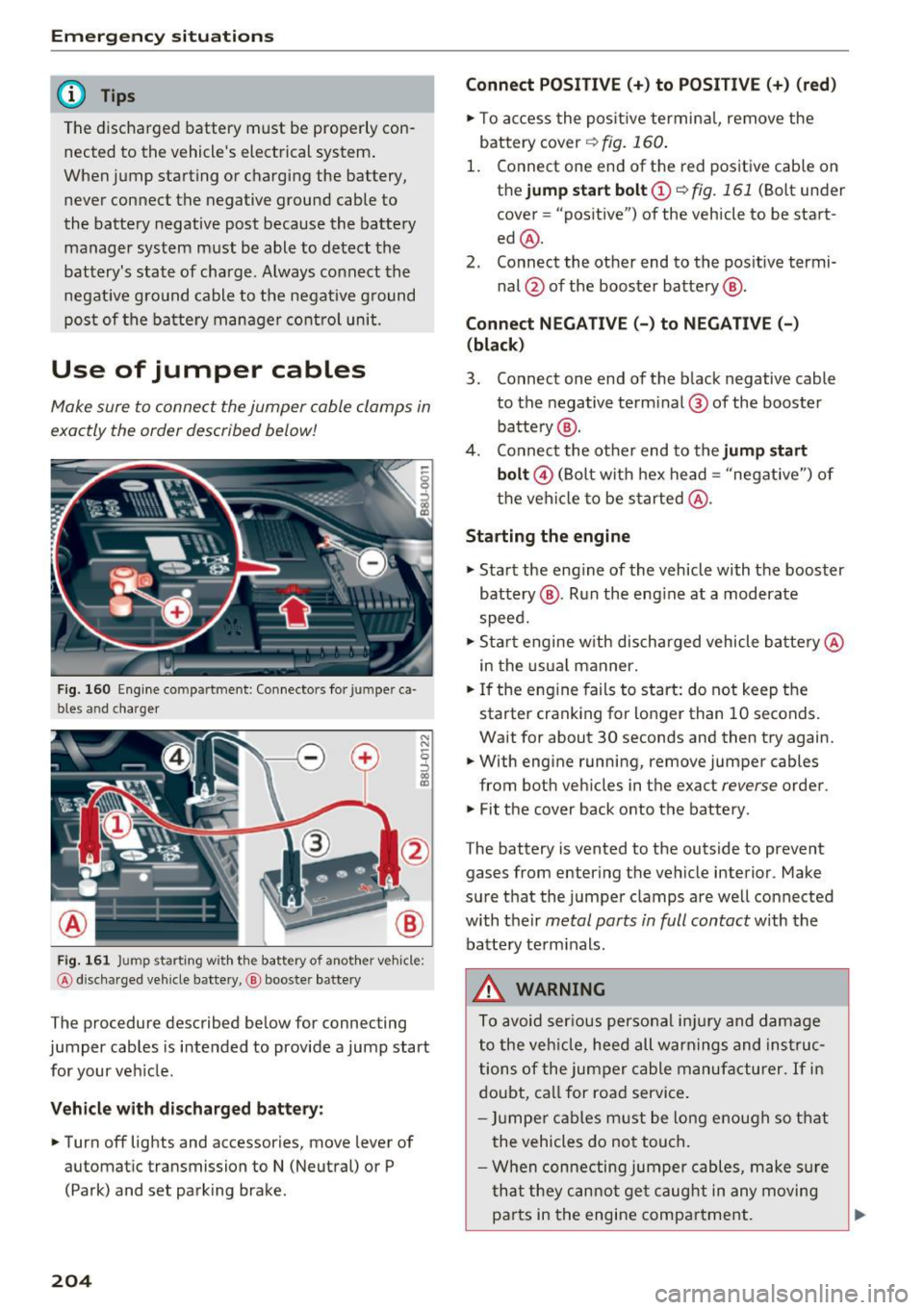
Use of jumper cables
Make sure to connect the jumper cable clamps in
exactly the order described below!
Fig. 160 Engine compartmen t: Connectors fo r ju m pe r ca
bles and charger
Fig. 161 J u mp starting w ith the battery of another vehicle :
@ discha rged vehicle bat te ry, @ booste r battery
The procedure described below for connecting
jumper cables is intended to provide a jump start
for your veh icle.
Vehicle with discharged battery:
.. Turn off lights and accessories, move lever of
automatic transmission to
N (Neutral) or P
(Park) and set park ing brake .
204
Connect POSITIVE(+) to POSITIVE (+) (red)
.. To access the positive terminal, remove the
battery cover
r:!) fig. 160.
1. Connect one end of the red positive cable on
the
jump start bolt (D ~ fig. 161 (Bolt under
cover= "positive") of the vehicle to be start
ed @.
2. Connect the other end to the positive termi-
nal@ of the booster battery @.
Connect NEGATIVE(-) to NEGATIVE(-)
(black)
3. Connect one end of the black negative cable
to the negative terminal ® of the booster
battery @.
4. Connect the other end to the
jump start
bolt @
(Bolt with hex head = "negative") of
the vehicle to be started @.
Starting the engine
"'Start the eng ine of the vehicle with the booster
battery @. Run the eng ine at a moderate
speed .
.,. Start engine w ith discharged vehicle battery@
in the usual manner.
.. If the engine fails to start: do not keep the
starter cranking for longer than 10 seconds.
Wait for about 30 seconds and then try again .
.. With engine running, remove jumper cables
from both vehicles in the exact
reverse order.
"' Fit the cover back onto the battery .
The battery is vented to the outside to prevent gases from entering the vehicle interior . Make
sure that the jumper clamps are well connected
with their
metal parts in full contact with the
batte ry terminals.
A WARNING
To avoid serious personal inju ry and damage
to the veh icle, heed all warnings and instruc
tions of the jumper cable manufacturer.
If in
doubt, call for road service.
- Jumper cables must be long enough so that
the vehicles do not touch .
- When connecting jumper cables, make sur e
that they cannot get caug ht in any moving
pa rts in the engine compartment. ..,.
Page 221 of 230
0 co ......
"' ,....
"' ...... 0 0 :::,
00
Dust filter
refer to Pollutant filter . . . . . . . . . . . . . . . . S 1
E
EDL
refer to Electronic Differential Lock . . . . . . 89
Efficiency program
Fuel economy messages . . . . . . . . . . . . . . .
21
Other equipment . . . . . . . . . . . . . . . . . . . . . 20
Overview . . . . . . . . . . . . . . . . . . . . . . . . . . . . 20
Electromechanical parking brake . . . . . . . . . 63
Electromechanical steering . . . . . . . . . . . . . . 93
E lectronic Differential Lock . . . . . . . . . . . . . .
89
Electronic immobilizer . . . . . . . . . . . . . . . . . . 23
Electronic stabilization control . . . . . . . . . . .
89
Electronic Stabilization Control
Hill descent assist . . . . . . . . . . . . . . . . . . . .
91
Offroad mode . . . . . . . . . . . . . . . . . . . . . . . . 90
Emergency assistance . . . . . . . . . . . . . . . . . 191
Emergency braking function . . . . . . . . . . . . . 64
Emergency flashers . . . . . . . . . . . . . . . . . . . . 34
Emergency locking the front passenger's door .26
Emergency operation
Front passenger's door . . . . . . . . . . . . . . . .
26
Fuel filler door . . . . . . . . . . . . . . . . . . . . . . 155
Luggage compartment lid . . . . . . . . . . . . . . 29
Panorama glass roof . . . . . . . . . . . . . . . . . . 32
Sunshade (roof) . . . . . . . . . . . . . . . . . . . . . . 32
Emergency release
Selector lever . . . . . . . . . . . . . . . . . . . . . . . .
72
E mergency starting . . . . . . . . . . . . . . . . . . . 203
Emergency unlocking/locking
On lock cylinder . . . . . . . . . . . . . . . . . . . . . .
26
Emissions control system
Catalytic converter . . . . . . . . . . . . . . . . . . .
155
Energy management . . . . . . . . . . . . . . . . . . . 94
Engine
Coolant . . . . . . . . . . . . . . . . . . . . . . . . . . . .
162
Starting/stopping (convenience key) . . 61, 62
Starting/stopping (ignition lock) . . . . . . . . 60
Starting with jumper cables . . . . . . . . . . . 203
Stopping (ign ition lock) . . . . . . . . . . . . . . . .
60
Engine compartment . . . . . . . . . . . . . . . . . . 155
Engine oil . . . . . . . . . . . . . . . . . . . . . . . . . . . 158
Adding . . . . . . . . . . . . . . . . . . . . . . . . . . . . 160
Changing . . . . . . . . . . . . . . . . . . . . . . . . . . 161
Index
Checking the engine oil level . . . . . . . . . . . 160
Dipstick . . . . . . . . . . . . . . . . . . . . . . . . . . . . 160
Economy... ... .. .. ................. 160
Oil consumption . . . . . . . . . . . . . . . . . . . . . 159
Oil grades . . . . . . . . . . . . . . . . . . . . . . . . . . 158
Specification and viscosity . . . . . . . . . . . . . 158
Engine speed limitation (indicator light) 15
Environment
Proper disposal of drained engine oil . . . .
161
Unleaded gasoline . . . . . . . . . . . . . . . . . . . 152
EPC (engine control) . . . . . . . . . . . . . . . . . . . . 14
ESC
refer to Electronic stabilization control . . . 89
Event Data Recorder (EDR) . . . . . . . . . . . . . . 95
Exterior lighting
33
Exterior mirrors Adjusting . . . . . . . . . . . . . . . . . . . . . . . . . . . 36
D. . 1mm1ng .. .. .. .. .. ............... .. . 36
Heating . . . . . . . . . . . . . . . . . . . . . . . . . . . . . 36
F
Fastening
Booster seats . . . . . . . . . . . . . . . . . . . . . . .
142
Convertible child safety seats . . . . . . . . . . 141
Infant seats . . . . . . . . . . . . . . . . . . . . . . . . 140
Federal Communications Commission (FCC) 215
Floor mats . . . . . . . . . . . . . . . . . . . . . . . . . . . 101
Folding the rear seats. . . . . . . . . . . . . . . . . . . 47
Foot pedals . . . . . . . . . . . . . . . . . . . . . . . . . . 101
For the sake of the environment
Environmentally-friendly driving . . . . . . . .
57
Fueling . . . . . . . . . . . . . . . . . . . . . . . . . . . . 153
Leaks. . . . . . . . . . . . . . . . . . . . . . . . . . . . . . 156
Roof rack . . . . . . . . . . . . . . . . . . . . . . . . . . . SO
Freeze protection Coo lant . . . . . . . . . . . . . . . . . . . . . . . . . . . .
162
Front airbags
Description . . . . . . . . . . . . . . . . . . . . . . . . .
118
How they work . . . . . . . . . . . . . . . . . . . . . . 122
Frontal collisions and the laws of physics . . 107
Front seats . . . . . . . . . . . . . . . . . . . . . . . . . . . 42
Adjusting . . . . . . . . . . . . . . . . . . . . . . . . . . . 99
Child restraints in the front seat ...... . .
Fuel
. . ...... ... .. .. ... ....... ... .. . .
115
152
Additives . . . . . . . . . . . . . . . . . . . . . . . . . . . 152
Blended gasoline . . . . . . . . . . . . . . . . . . . . 152
219
Page 223 of 230

0 co ......
"' ,....
"' ...... 0 0 :::,
00
Kick-down (automatic transmission) . . . . . . . 71
L
LATCH 147
Description . . . . . . . . . . . . . . . . . . . . . . . . . 148
Installing a child restraint . . . . . . . . . . . . . 149
Loc ation
Mounting and relea sing the anchorage
hook
. . .. .. .. ............... .. .... .
148
149
L eather care/clean ing . . . . . . . . . . . . . . . . . 188
Leaving home . . . . . . . . . . . . . . . . . . . . . . . . . 34
Light/rain sensor Headlights . . . . . . . . . . . . . . . . . . . . . . . . . . 33
Interval mode (windsh ield wipers) . . . . . . . 38
Lighting Exterior . . . . . . . . . . . . . . . . . . . . . . . . . . . . . 33
Interior . . . . . . . . . . . . . . . . . . . . . . . . . . . . . 35
L ights
I nterior/reading lights . . . . . . . . . . . . . . . . 35
Interior lighting . . . . . . . . . . . . . . . . . . . . . . 35
Loading the luggage compartment . . . . . . . 102
Locking/un locking
refer to Unlocking/locking . . . . . . . . . . . . . 24
L ow-profile tires . . . . . . . . . . . . . . . . . . . . . . 182
Low beam headlights . . . . . . . . . . . . . . . . . . . 33
Lower univ ersal anchorages (Canada) . . . . . 147
L uggage compartment. . . . . . . . . . . . . . . . . . 46
L uggage compartment lid . . . . . . . . . . . . . . 27
Storing cargo correctly . . . . . . . . . . . . . . . 102
also refer to Loading the luggage compart-
ment. ... .. .. ................. .... . 102
L uggage compartment net . . . . . . . . . . . . . . 47
Luggage rack . . . . . . . . . . . . . . . . . . . . . . . . . . 49
L umbar support . . . . . . . . . . . . . . . . . . . . . . . 42
M
M . t arn enance . .. ............. .. .. .... . 212
M . t . l arn enance mterva s . . . . . . . . . . . . . . . . . 165
Malfunction indicator lamp (MIL) . . . . . . 14, 17
Manual climate control system
refer to Climate control system
(manual) . . . . . . . . . . . . . . . . . . . . . . . . . 51, 52
Mirror compass . . . . . . . . . . . . . . . . . . . . . . . . 40
Mirrors . . . . . . . . . . . . . . . . . . . . . . . . . . . . . . 36
Monitoring the Advanced Airbag System . . 124
Index
Multifunction steering wheel. . . . . . . . . . . . . 19
N
Natural leather care/cleaning . . . . . . . . . . . 188
Net . . . . . . . . . . . . . . . . . . . . . . . . . . . . . . . . . 46
NH TSA
Contacting 104
Number of seats . . . . . . . . . . . . . . . . . . . . . . 106
0
Occupant seating positions . . . . . . . . . . . . . . 98
Octane rating (gasoline) . . . . . . . . . . . . . . . . 152
Odometer . . . . . . . . . . . . . . . . . . . . . . . . . . . . . 9
Oil
refer to Engine oil . . . . . . . . . . . . . . . 158, 160
Oil change interval . . . . . . . . . . . . . . . . . . . . 165
On-board computer . . . . . . . . . . . . . . . . . . . . 19
On-Board Diagnostic System (OBD) Data Link Connector (DLC) . . . . . . . . . . . . . . 17
Malfunction indicator lamp (MIL) . . . . . . . . 17
Opening.... .... .. .. ............... .. . 22
Fuel filler door . . . . . . . . . . . . . . . . . . . . . . 153
Hood . . . . . . . . . . . . . . . . . . . . . . . . . . . . . . 157
Luggage compartment lid . . . . . . . . . . . . . . 28
Panorama glass roof . . . . . . . . . . . . . . . . . . 31
Windows . .. .. .. .. ............. .... . 30
Opening/closing
refer to Unlocking/locking . . . . . . . . . . . . . 24
Other equipment (efficiency program) . . . . . 20
Outside temperature display . . . . . . . . . . . . . . 9
Overview (Cockpit) . . . . . . . . . . . . . . . . . . . . . . 6
p
Paint damage . . . . . . . . . . . . . . . . . . . . . . . . 187
Paint number . . . . . . . . . . . . . . . . . . . . . . . . 209
Panorama glass roof. . . . . . . . . . . . . . . . . . . . 31
Emergency closing . . . . . . . . . . . . . . . . . . . . 32
also refer to Convenience opening/closing 31
Parking brake
refer to Elect rome chanica l parking brake . 63
Parking lights . . . . . . . . . . . . . . . . . . . . . . . . . 33
Parking system Parking system plus . . . . . . . . . . . . . . . . . . . 83
also refer to Parking systems . . . . . . . . 83, 84
221