trailer AUDI Q5 2013 User Guide
[x] Cancel search | Manufacturer: AUDI, Model Year: 2013, Model line: Q5, Model: AUDI Q5 2013Pages: 316, PDF Size: 78.89 MB
Page 136 of 316
134 Parking system
- On -when the parking system is switched
on, either the visua l d isplay or the picture
from the rearview camera is disp layed .
Warning tones
-Front volum e -front sensor vol ume
- Front frequ enc y-front sensor frequency
-Re ar volum e -rear sensor volume
- Rear frequenc y -rear sensor frequency
- In -ca r entertainme nt fader /Mu sic volume
w hile pa rking -
when the parking system is
switched on , the volume of the active audio
source is lowered .
The new ly adjusted value is briefly heard from
the signal generator.
@ Tips
- The warning tones can a lso be adjusted
directly by the v is ual disp lay or the p ic
ture from the rearview camera. Simp ly
press the
Sett ings contro l button.
- Changed settings are activated when
parking system is switched on again.
- The settings are automatically stored
and ass igned to the remote control key.
Trailer hitch
Applies to vehicles: with Audi parking system plus w ith
rea rview camera a nd trailer hitch
For vehi cles with a facto ry installed trai ler
hitch, or a trai ler hitch installed according to
factory specifications, the parking system rear
sensors do not come on whenever you shift in
to reverse gear or when you press the
P, #J\.
switch. Remember, there is no warning for
d istances to the rear . The front sensors re
main activated. The visual display switches to
the trailer towing mode. The picture from the
rearv iew camera will not show the orientation
l ines nor the blue su rfaces.
If you install a hitch yourself, th is function
may not work .
Error messages
Applies to vehicles: wi th Audi parking sys te m plus with
rearv iew camera
T he re is an error in the system if t he LED on
the
p, q~ switch is blinking and you hea r a con
t in uous alarm for a few se conds after switch
ing on the parking system or when the park
ing system is already activated . Have yo ur au
thorized Audi dea ler correct the error.
(D Tips
If the error is not corrected before you
switch off the ignition, when you switch on
the parking system again, the LED in the
Pw J\. switch will blink.
Page 214 of 316
212 Trailertowing
Trailer towing
Driving with a trailer
General information
Your Audi was designed primarily for passen
ger transportation .
If you plan to tow a trai ler, p lease remember
that the additional load will affect durability,
economy and performance .
Trailer towing not on ly places more stress on
the vehicle, it also calls for more concentra
tion from the driver.
For this reason, always fo llow the operating
and driving instructions provided and use
common sense.
Technical requirements
T ra ile r hitch
Use a weight-carrying hitch conforming to the
gross trailer weight. The hitch must be suita
ble for your vehicle and trailer and mu st be
mounted securely on the veh icle's chassis at a
technically sound location. Use only a trailer
h itch with a removable ball mount. A lways
check with the trai ler h itch manufact urer to
make sure that you are using the correct
hitch.
Do n ot use a bumper hi tch.
The hitch must be installed in such a way that
it does not interfere with the impact-absorb
ing bumper system . No modifications should
be made to the vehicle exhaust and brake sys
tems . From t ime to time, check that all hitch
mounting bo lts remain securely fastened.
When you are not towing a trailer, remove the
trailer h itch ball mount. This prevents the
h itch from causing damage should your veh i
cle be struck from behind
¢ A .
Traile r brak es
If your tra iler is equipped w ith a braking sys
tem, check to be sure that it conforms to a ll
regulat ions . The trailer hydraulic brake system must not be
direct ly connected to the vehicle's hydraulic
brake system
~ A .
Saf ety ch ain s
Always use safety chains between your veh icle
and the trai le r.
Trail er light s
Trailer lights must meet all regulations. Be
sure to check w ith your authorized Audi dealer
for correct wiring, sw itches, and relays.
Mirror s
If you are unable to see the traffic behind you
using the regular outside mirrors, then you
must install extended mirrors .
It is important
that you always have clea r vis io n to the rear.
,8. WARNING
- I f a trai ler has electrical brakes p lease
note that these brakes are not activated
by the factory -fitted control unit -risk of
accident!
- Afte r removing the trailer hitch, do not
store it in your vehicle. In case of sudden
braking, the hitch could fly forward and
injure you or your passengers.
- Never install a "weight distributing" or
"load equalizing" trailer hitch on your ve
h icle. The vehicle was not designed for
these kinds of trailer h itches. The h itch
attachment can fail, caus ing the trailer
to tear loose from the veh icle.
- The Gross Vehicle Weight Rating for your
veh icle, found on the safety compliance
label on the driver's s ide B-pillar, must
never be exceeded under any c ircumstan
ces. Exceeding the Gross Vehicle Weight
Rating of yo ur vehicle is likely to damage
your vehicle, and such damage will not
be covered by yo ur Limited New Ve hicle
Warranty . Exceeding the Gross Vehicle
Weight Rating will a lso change the per
formance and handling characteristics of
your veh icle, wh ich could cause a crash
resulting in serious injury or death.
-
Page 215 of 316
Operating instructions
6"
~ ~
I 1,2 ..
-{ }
l::_
-
2
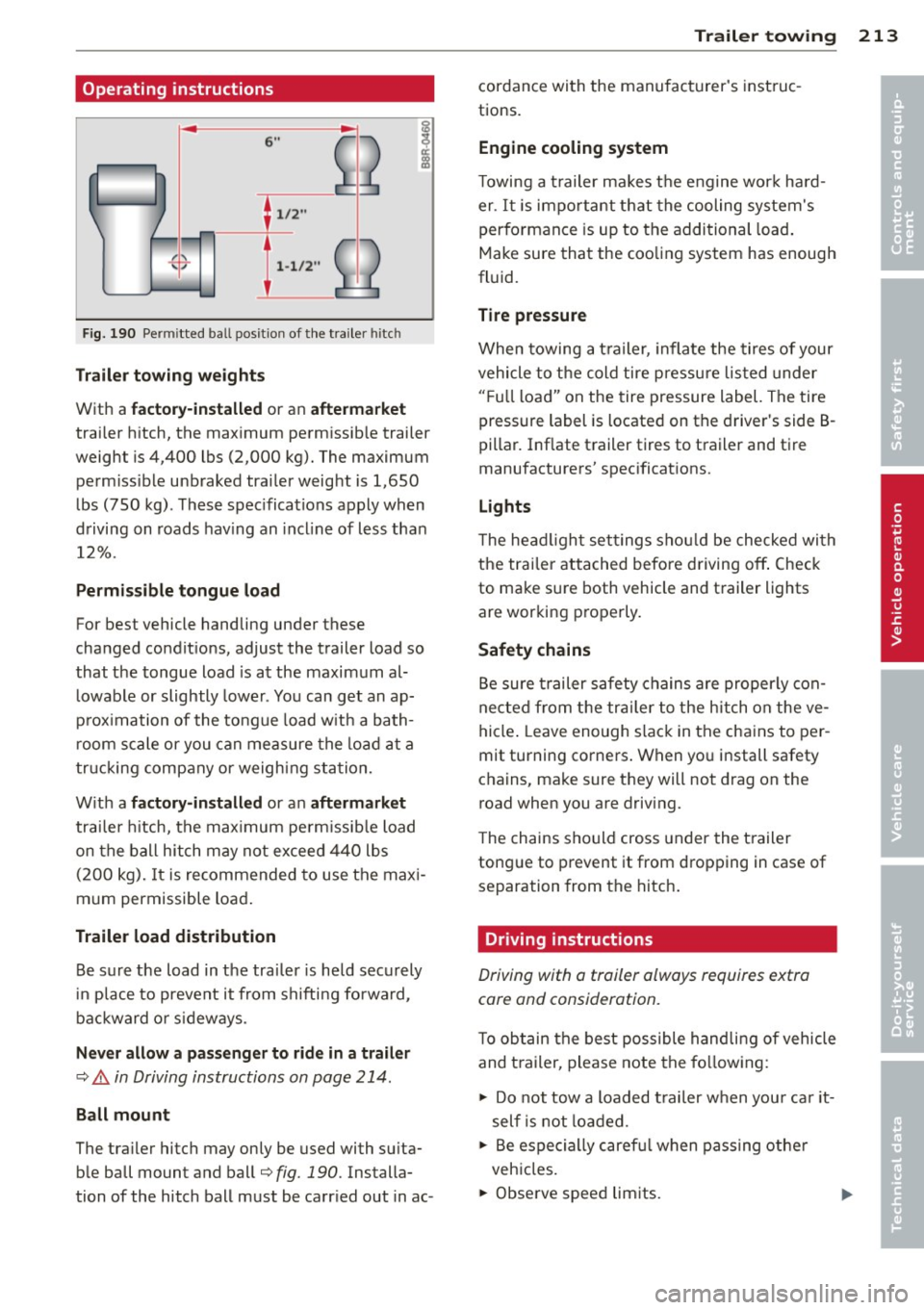
Fig. 190 Permit ted ball position of the trailer hitch
Trailer towing weights
With a factory-installed or an aftermarket
trailer hitch, the maximum permissible trailer
weight is 4,400 lbs (2,000 kg). The maximum permissible unbraked trailer weight is 1,650
lbs (750 kg) . These specifications apply when
driving on roads having an incline of less than
12%.
Permissible tongue load
For best vehicle handling under these
changed conditions, adjust the trailer load so
that the tongue load is at the maximum al
lowable or slightly lower . You can get an ap
proximation of the tongue load with a bath
room scale or you can measure the load at a
trucking company or weighing station.
With a
factory-installed or an aftermarket
trailer hitch, the maximum permissible load
on the ball hitch may not exceed 440 lbs
(200 kg).
It is recommended to use the maxi
mum permissible load.
Trailer load distribution
Be sure the load in the trailer is held securely
in place to prevent it from shifting forward,
backward or sideways.
Never allow a passenger to ride in a trailer
¢.&. in Driving instructions on page 214.
Ball mount
The trailer hitch may only be used with suita
ble ball mount and ball¢
fig. 190. Installa
tion of the hitch ball must be carried out in ac-
Trailer towing 213
cordance with the manufacturer's instruc
tions.
Engine cooling system
Towing a trailer makes the engine work hard
er .
It is important that the cooling system's
performance is up to the additional load.
Make sure that the cooling system has enough
fluid.
Tire pressure
When towing a trailer, inflate the tires of your
vehicle to the cold tire pressure listed under
"Full load" on the tire pressure label. The tire
pressure label is located on the driver's side B
pillar. Inflate trailer tires to trailer and tire
manufacturers' specifications.
Lights
The headlight settings should be checked with
the trailer attached before driving off. Check
to make sure both vehicle and trailer lights
are working properly.
Safety chains
Be sure trailer safety chains are properly con
nected from the trailer to the hitch on the ve
hicle. Leave enough slack in the chains to per
mit turning corners. When you install safety
chains, make sure they will not drag on the
road when you are driving.
The chains should cross under the trailer
tongue to prevent it from dropping in case of
separation from the hitch.
Driving instructions
Driving with a trailer always requires extra
care and consideration.
To obtain the best possible handling of vehicle
and trailer, please note the following :
.,. Do not tow a loaded trailer when your car it
self is not loaded .
.,. Be especially careful when passing other
vehicles.
.,. Observe speed limits.
•
•
Page 216 of 316
214 Trailer towing
• Do not drive at the maximum permissible
speed.
• Always apply brakes early .
• Monitor the temperature gauge.
W eig ht distribution
Towing a loaded tra ile r with an empty car re
sults in a highly unstable distribution of
weight . If this cannot be avoided, drive at very
low speeds only to avoid the risk of losing
steering control.
A "balanced" rig is easier to operate and con
trol. This means that the tow vehicle should
be loaded to the extent possible and permissi
b le, while keeping the trailer as light as possi
ble under the circumstances. Whenever possi
ble, transfer some cargo to the luggage com
partment of the tow vehicle wh ile observing
tongue load requirements and vehicle loading
considerations .
Speed
The higher the speed, the more difficult it be
comes for the driver to control the rig . Do not
drive at the maximum permissible speed . Re
duce your speed eve n mo re if load, weathe r or
wind condi tions are unfavorable -part icu larly
when going dow nhill.
Reduce vehicle speed immediately if the t rail
e r shows the slightest sign of swaying. Do not
tr y to s top the sw ayin g by acce ler atin g.
Observe speed limits . In some areas, speeds
for vehicles towing trailers are lower tha n for
regula r vehicles.
Always apply brakes early . When driv ing
downhill, shift into a lower gear to use the en
g ine b raking effect to slow the vehicle. Use of
the brakes alone can cause them to overheat
and fail.
Coolant temperature
T he coolant temperature gauge
c:> page 10
must be observed carefully . If the needle
moves close to the upper end of the scale , re
duce speed immed iate ly and/or turn off the
a ir cond itione r. If the coolant temperature warning light in
the instr ument cluster starts flashing., pull
off the road, stop and let the engine
idle for
about two minutes to prevent heat build-up.
A WARNING
Anyone not properly restrained in a mov
i ng vehicle is at a much greater risk in a n
accident . Never let anyone ride in your ca r
who is not p roperly wea ring the rest raints
p rov ided by Audi.
Trailer towing tips
Important to know
Your vehicle handles d ifferently when towing
-
a trai ler because of the additional weight and
different weight distr ibut ion. Safety, perform
ance and economy will greatly depend on how ca refully you load your trai ler and ope rate
you r rig.
Befo re you actually tow your tra iler, practice
turning, stopping and backing up in an area
away from t raffic. Keep pract ic ing unt il you
have become completely familiar wit h the way
yo ur vehicle-tra iler combination behaves and
responds.
Backi ng up is difficult and requ ires practice.
Backi ng up w ith a t railer gene rally requires
stee ring action opposite to tha t when backing
u p you r vehicle witho ut a tr ailer.
Maintai n a greater d ista nce between your ve
hicle and the one in front of you. You w ill need
more room to stop. To compensate fo r the
t railer, you w ill need a larger than normal
tu rning rad ius.
When passing, remembe r that you cannot ac
ce le rate as fas t as you no rma lly would be
ca use of the added load. Make sure yo u have
enough room to pass . After passing, a llow
plenty of room for yo ur trailer before cha ng
ing lanes again.
Avoid jer ky s tarts, sharp t urns o r rapid lane
changes.
Page 217 of 316
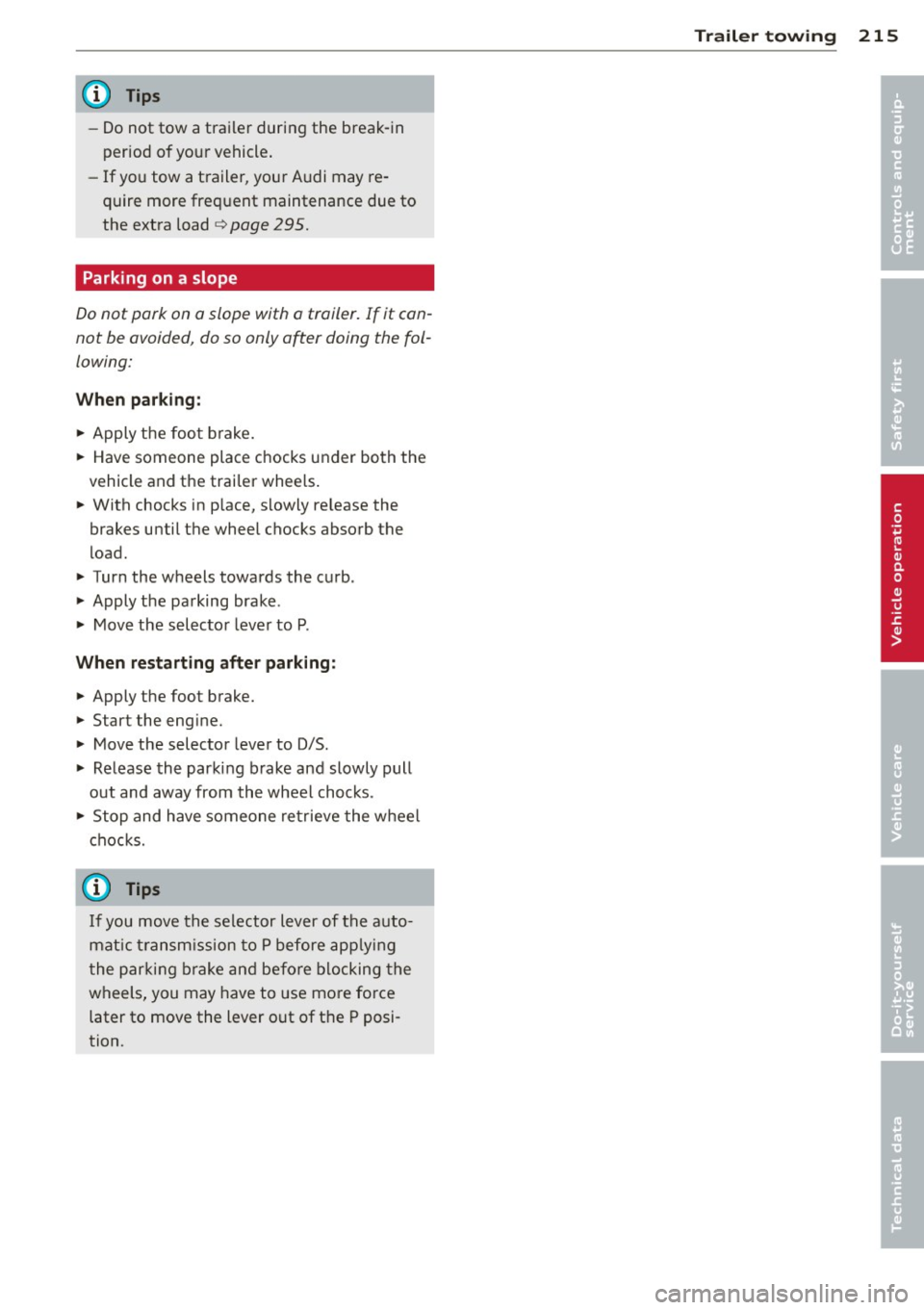
@ Tips
-Do not tow a traile r during the break-in
period o f your vehicle .
- If you tow a t railer, your A udi may re
quire more frequent maintenance due to
the extra load
¢ page 295.
Parking on a slope
Do not park on a slope with a trailer. If it can
not be avoided, do so only after doing the fol
lowing:
When parking:
.,. Apply t he foo t brake .
.,. Have someone place c hocks under bo th the
vehicle and the trai ler whee ls .
.,. With chocks in p lace, s lowly re lease the
brakes unti l th e wheel chocks absorb the
l oad .
.,. Turn the wheels towards the curb .
.,. Apply t he pa rking brake .
.,. Mov e the sel ecto r leve r to P .
When restarting after parking:
.,. Apply the foot brake .
.,. Start the eng ine .
.,. Move the selecto r lever to D/S .
.,. Re lease th e par kin g b rake and slowly pull
out and away from the whee l cho cks .
.,. Stop and have someone re tr ieve the w hee l
chocks.
(D Tips
If you move the selector lever of t he a uto
mat ic t ran sm ission to P before app lyi ng
t he p ark in g br ake an d bef ore blocking the
wheels, you may have to use mo re force
later to move the lever out of t he P posi
tion.
Trailer towin g 215
•
•
Page 256 of 316
254 Tire s and wheel s
A WARNING
Overloading a vehicle can cause loss of ve
hicle control, a crash or other accident, se
rious personal injury, and even death .
- Carrying more weight than your vehicle
was designed to carry will prevent the
vehicle from handling properly and in crease the risk of a loss of veh icle con
trol.
- The brakes on a vehicle that has been
overloaded may not be able to stop the
vehicle within a safe distance .
- Tires on a vehicle that has been overload
ed can fail suddenly causing loss of con
trol and a crash .
- Always make sure that the total load be
ing transported -including the we ight of
a tra iler hitch and the tongue weight of a
loaded trailer -does not make the veh i
cle heav ier than the veh icle's Gross Vehi
cle Weight Rating.
A WARNING
- Incorrect tire pressures and/or underin
flation can lead to a serious o r fatal acci
dent.
- Incorrect tire pressures and/or underin
flation cause increased tire wea r and can
affect the handling of the vehicle .
- Incorrect tire pressures and/or underin
flation can also lead to sudden tire fa il
ure, including a blowo ut and sudden de
flation, causing loss of vehicle control.
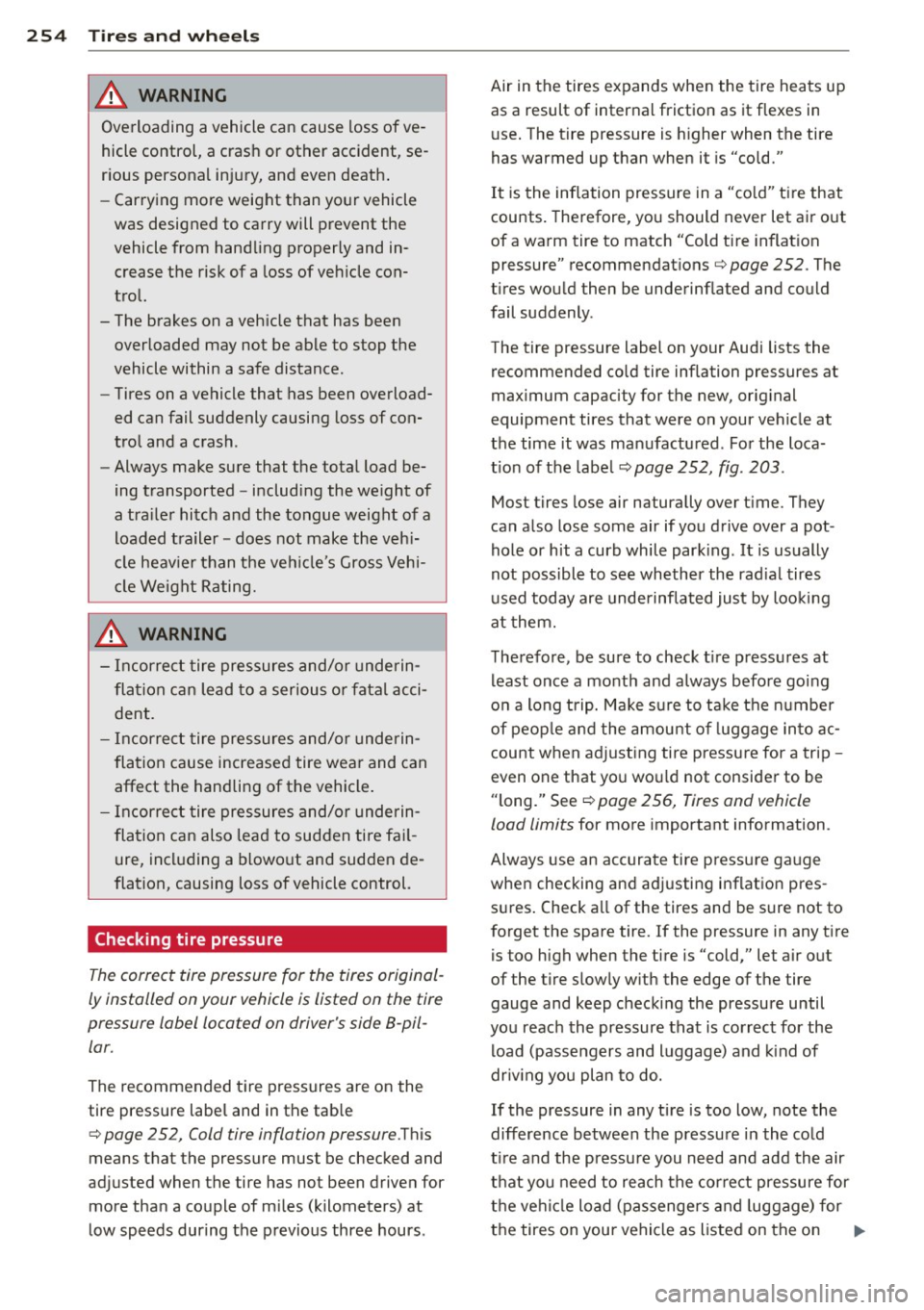
Checking tire pressure
-
The correct tire pressure for the tires originol
ly installed on your vehicle is listed on the tire
pressure label located on driver's side 8-pil
lar .
The recommended tire pressures are on the
tire pressure labe l and in the tab le
c:::> page 252, Cold tire inflation pressure .This
means that the pressure must be checked and
adjusted when the tire has not been driven for more than a couple of m iles (k ilometers) at
low speeds during the p revious three hours . Air in the tires expands when the tire heats up
as a result of interna l friction as it flexes in
u se . The tire pressure is h igher when the tire
has warmed up than when it is "cold."
It is the inflation pressure in a "co ld" tire that
counts . Therefore, you should never let air out
of a warm tire to match "Cold t ire inflat ion
pressure" recommendat ions
c:::> page 252 . The
t ires wou ld then be underinflated and could
fail suddenly .
The tire pressure label on your Audi lists the recommended co ld tire inflation pressures at
maximum capacity for the new, orig inal
equipment tires that were on your vehicle at
the time it was manufactured . Fo r the loca
t ion of the labe l
c:::>page 252, fig . 203 .
Most tires lose air naturally over t ime . They
can a lso lose some air if you drive over a pot
hole or hit a curb while park ing. It is usually
not possible to see whether the rad ia l tires
used today are underinflated jus t by looki ng
at them.
T he refo re, be sure to check t ire p ressures at
least once a month and always before going
o n a long trip. Ma ke sure to take the numbe r
of peop le and the amou nt o f luggage into ac
count when adjust ing tire pressu re for a trip -
even one that yo u wo uld not consider to be
" long." See
c:::> page 256, Tires and vehicle
load limits
for more important information .
Always use an ac curate tire p ress ure ga uge
when checking and adj usting inflation pres
s u res . Check a ll of the tires and be sure not to
forget the spare tire. If the pressure in any t ire
is too high when the tire is "cold," let air out
of the tire s low ly w ith the edge of the tire
gauge and keep checking the pressure until
you reach the pressure that is co rrect fo r the
load (passengers and luggage) and k ind of
dr iv ing you plan to do.
If the pressure in any tire is too low, note the
difference between the p ressure in the co ld
t ire and the pressure you need and add the air
t h at you need to reach the cor rect pressure for
t h e ve hicl e load (passengers and luggage) for
the tires on your vehicle as listed on the on
Page 258 of 316
256 Tire s and wheel s
-If the tire is not flat and you do not have
to change a wheel immed iately, drive at
reduced speed to the nearest service sta
t ion to check the tire pressure and add
air as required .
(D Note
Driving without va lve stem caps can cause
damage to the t ire valves . To prevent this,
always make sure that factory installed
valve stem caps on all wheels are securely mounted on the
valve .
@) For the sake of the environment
Underinf lated tires will a lso increase the
fue l consumption .
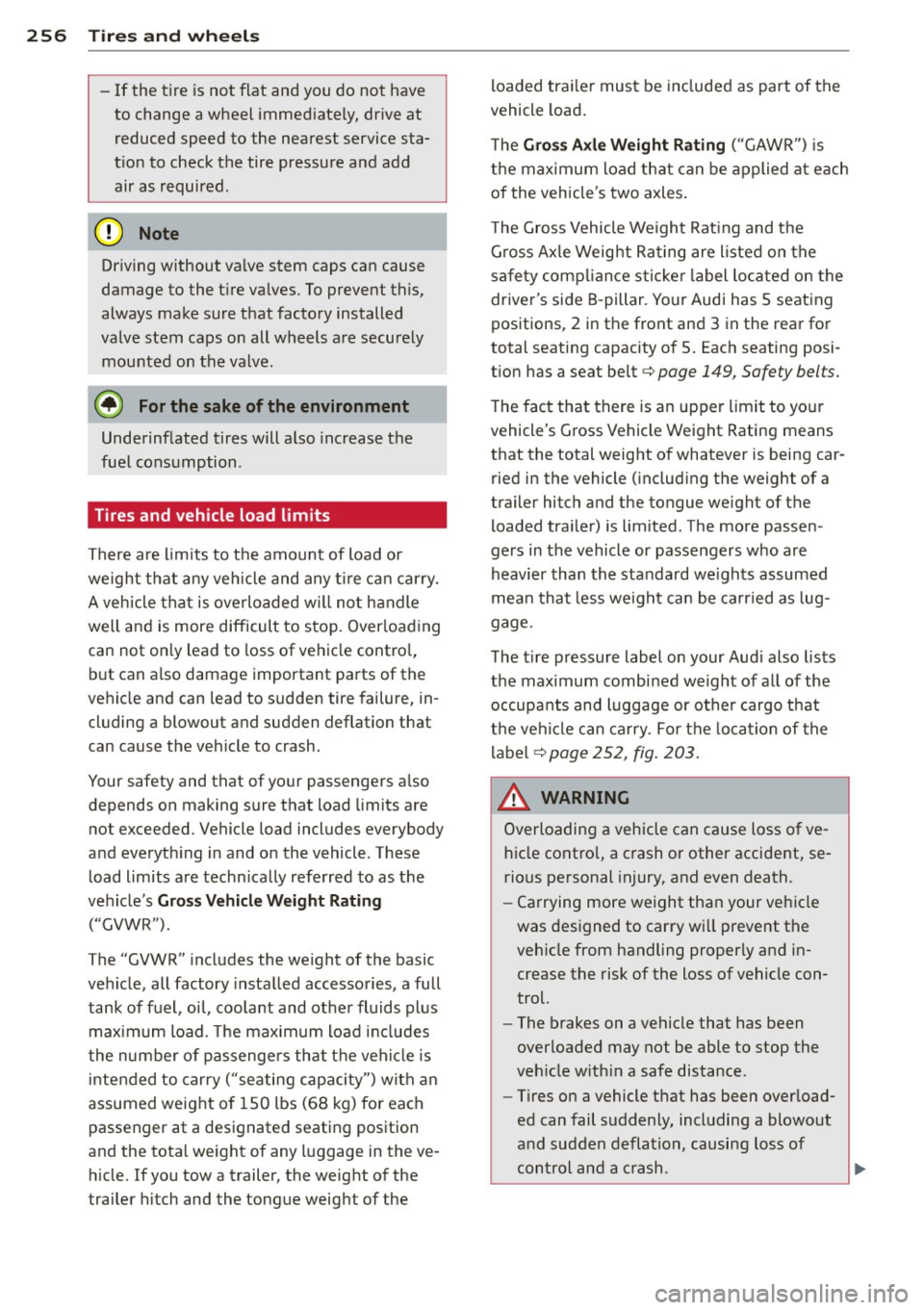
Tires and vehicle load limits
There are limits to the amount of load or
weight that any veh icle and any t ire ca n car ry.
A vehicle that is overloaded w ill not ha ndle
well a nd is more difficult to stop. Over load ing
can not on ly lead to loss of vehicle contro l,
but can a lso damage important parts of the
ve hicle and can lead to sudden tire failure , in
cluding a blowout and sudden deflation that
can cause the veh icle to crash .
Your safety and that of yo ur passenge rs a lso
depends on making sure that load limits are not exceeded. Vehicle load includes everybody
a nd everyth ing in and on the vehicle . T hese
load limits are tech nica lly refe rred to as the
ve hicle 's
Gross V ehicle Weight Rating
("GVWR").
The "GVWR" includes the we ight of the basic
vehicle, all factory insta lled accesso ries, a full
tank of fuel, oi l, coo la nt and othe r fluids pl us
maximum load. The maxim um load includes
the number of passengers that t he vehi cle is
intended to carry ("seating capacity") w ith an
assumed weight o f 150 lbs (6 8 kg) for each
passenger at a designated seating pos ition
and the tota l weight of any l uggage in th e
ve
hicle. If you tow a trailer, the weight of the
trailer hitch and the tongue weig ht of the loaded tra
ile r must be included as part of the
vehicle load .
T he
Gro ss Axle Weight Rating (" GAWR") is
the max imum load th at can be applied at e ach
of the vehicle's two axles .
T he Gross Vehicle Weight Rat ing and the
G ross Ax le Weight Ra ting are listed on the
sa fety comp liance s ticke r label lo cated on the
driver's side B-pillar. Your Audi has 5 seat ing
positions, 2 in the front and 3 in the rear fo r
total seat ing capac ity of 5. Each seating posi
t ion has a seat be lt
c:> page 149, Safety bel ts.
The fact that there is an upper limit to yo ur
vehicle's G ross Vehicle Weight Rating means
that the total weight of whatever is being car
ried in the vehicle ( includ ing the weight of a
tra iler hitch and the tongue weight of the
loaded tra iler) is lim ited . The more passen
gers in the vehicle or passenge rs w ho are
heavier than th e standard we ights assumed
mea n tha t less we ight can be carried as lug
gage .
T he t ire pressure label on your Aud i also lis ts
the max imum combi ned weig ht of a ll of the
occupants and luggage or other cargo that
the vehi cle can carry . For t he lo ca tion of the
label <=>page 252, fig. 203.
A WARNING
Overloading a vehicle can cause loss of ve
hi cle cont ro l, a c rash or other accident, se
rious personal injury, and even death.
- Ca rrying more we ight than your veh icle
was des igned to carry wi ll prevent the
veh icle from handling pr operly and in
crease the risk of the loss of vehicle con
trol.
- The brakes on a vehicle that has been
overloaded may not be able to stop the
veh icle w ith in a safe distance.
- Tires on a vehicle that has been overload
ed can fail s uddenly, including a blowout
a nd sudden defla tion, causing loss of
contro l and a c rash .
~
Page 259 of 316
-Always make sure that the total load be
ing transported - including the weight of
a trailer hitch and the tongue weight of a
loaded trailer -does not make the vehi
cle heav ier than the vehicle's Gross Vehi
cle Weight Rating.
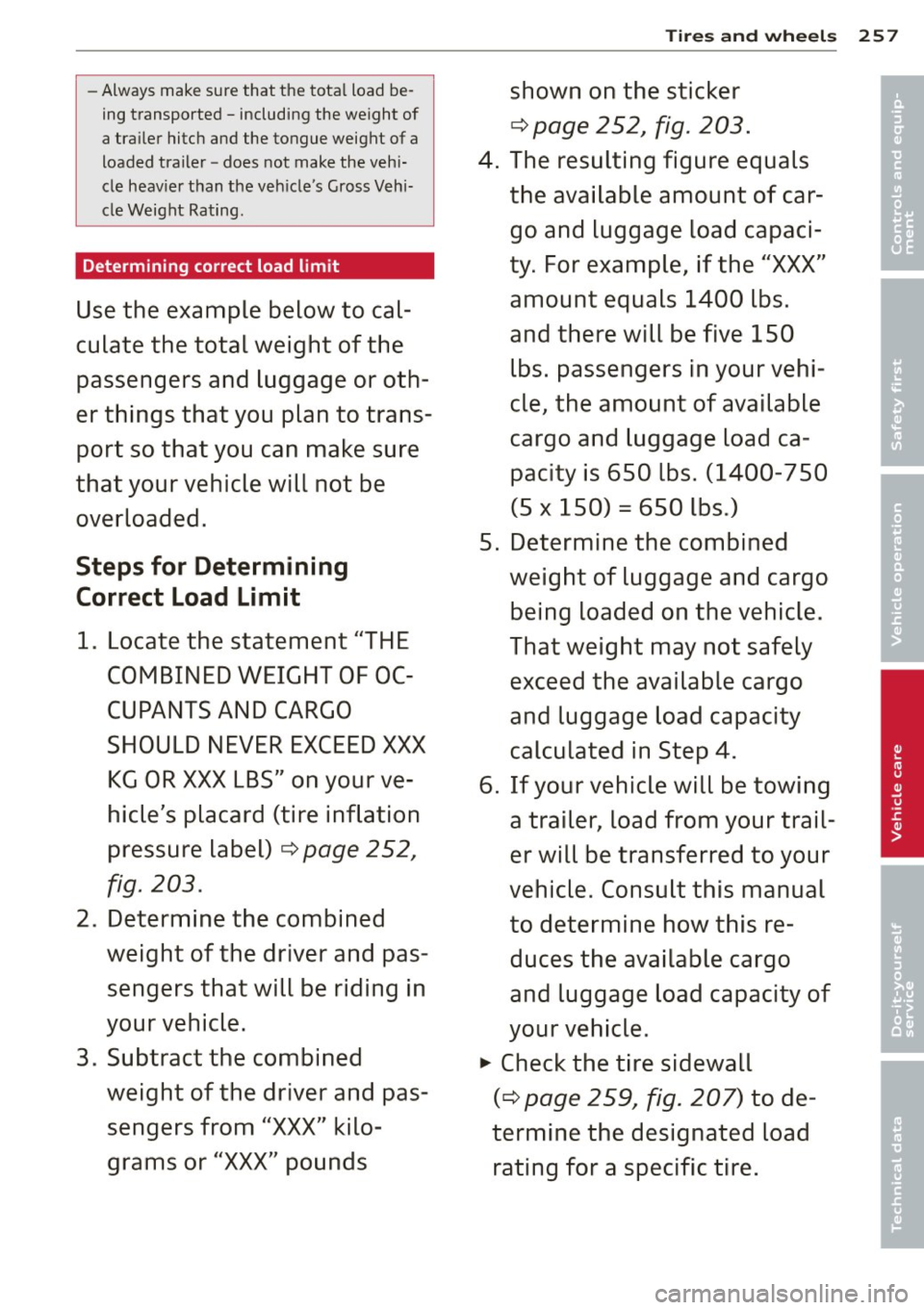
Determining correct load limit
Use the example below to cal
culate the total weight of the
passengers and luggage or oth
er things that you plan to trans
port so that you can make sure
that your vehicle will not be
overloaded.
Steps for Determining Correct Load Limit
1. Locate the statement "THE
COMBINED WEIGHT OF OC
CUPANTS AND CARGO
SHOULD NEVER EXCEED XXX KG OR XXX LBS" on your ve
hicle's placard (tire inflation
pressure label)
¢ page 252,
fig. 203.
2. Determine the combined
weight of the driver and pas sengers that will be riding in
your vehicle.
3. Subtract the combined
weight of the driver and pas sengers from
"XXX" kilo
grams or
"XXX" pounds
Tires and wheels 257
shown on the sticker
¢page 252, fig. 203.
4. The resulting figure equals
the available amount of car
go and luggage load capaci
ty. For example, if the
"XXX"
amount equals 1400 lbs.
and there will be five
150
lbs. passengers in your vehi
cle, the amount of available
cargo and luggage load ca
pacity is
650 lbs. (1400-7 50
(5
X 150) = 650 lbs.)
5. Determine the combined
weight of luggage and cargo being loaded on the vehicle.
That weight may not safely
exceed the available cargo
and luggage load capacity
calculated in Step
4.
6. If your vehicle will be towing
a trailer, load from your trail
er will be transferred to your
vehicle. Consult this manual
to determine how this re duces the available cargo
and luggage load capacity of
your vehicle.
.,. Check the tire sidewall
(¢ page 259, fig. 207) to de
termine the designated load rating for a specific tire.
•
•
'
Page 276 of 316
274 What do I do no w?
Special ca re is requ ired if you are repairin g
t he t ire o n a steep incline.
@ Tips
- Do not operate the compressor for more
than 12 minutes continuously, otherwise i t can overheat. Once the compressor has
cooled, you can continue to use it.
- If sealant has spi lled out, let it dry and
then you can remove it by pee ling it away
like a fo il.
- Remember to obtain a new bottle of
sealant from your authorized Audi dealer
after repairing a tire. After this, the func
tionality of the tire repair set is restored.
- Obey all laws.
Changing a wheel
Before changing a wheel
Observe the following precautions for your
own and your passenger's safety when chang
ing a wheel .
.,. After you experience a tire fa ilure, pull the
car well away from moving traffic and try to
reach
le ve l ground before yo u stop ¢&_ .
.,. All p assengers sho uld
le ave the c ar and
move to a safe location (for instance, behind
the guardrai l)¢
,A .
.,. Engage the parking brake to prevent your
vehicle from ro lling un intentionally¢ &_.
.,. Move
selecto r le ver to pos ition P ¢ ,A .
.,. If you are tow ing a trailer: unhitch the trail
er from your veh icle.
.,. Block the diagonally opposite wheel with
the fo ld ing chocks or other objects.
.,. Take the
jack * and the inflatab le spare tir e*
out o f the luggage compartmen t
¢page 269.
A WARNING
You or your passengers cou ld be injured
while changing a whee l if yo u do not fol
low these safety precautions:
-
- If you have a flat tire, move a safe d is
tance off the road. Turn off the engine,
turn the emergency flashers on and use
other warning devices to a lert other mo
torists.
- Make sure that passengers wait in a safe
place away from the vehicle and well
away from the road and traffic.
- To help prevent the vehicle from moving
suddenly a nd possib ly slipping off the
jack*, always fully set the pa rking brake
a nd b lock the wheel d iagonally opposite
t he wheel be ing c hanged w it h t he fold
ing chocks or other objec ts. When one
front wheel is lifted off the ground, plac
ing the Automatic Transmission in P
(Park) will
not prevent the vehicle from
mov ing.
- Before you change a wheel, be sure t he
ground is level and firm. If necessary,
use a sturdy board under the jack*.
- Always store the vehicle tool kit, the
jack * and the replaced tire in the luggage
compartment¢
page 145.
Changing a wheel
When you change a wheel, follow these
quence described below step-by-step and in
exactly that order.
1. Remove the decorative wheel cover* . For
more details see also ¢
page 2 75, Deco
rative wheel covers
or¢ page 2 75,
Wheels with wheel bolt caps .
2. Loosen the wheel bolts ¢ page 276 .
3. Locate the prope r mounting point fo r the
jack* and align the jack * below that point
¢ page 276.
4 .
Lift the c ar with t he jack *¢ page 2 76 .
5 . Remove the
wheel with the flat tir e and
then insta ll the
inflatable spare tire*
¢ page 277 .
6. Tighten all whee l bolts lightly.
7.
Lower the vehicle with the jack*.
8. Use the wheel bolt wrench and
firmly
t ighten all wheel bolts¢ page 276.
9. Replace the decorative
whe el cover *.
Page 283 of 316
I
I
I
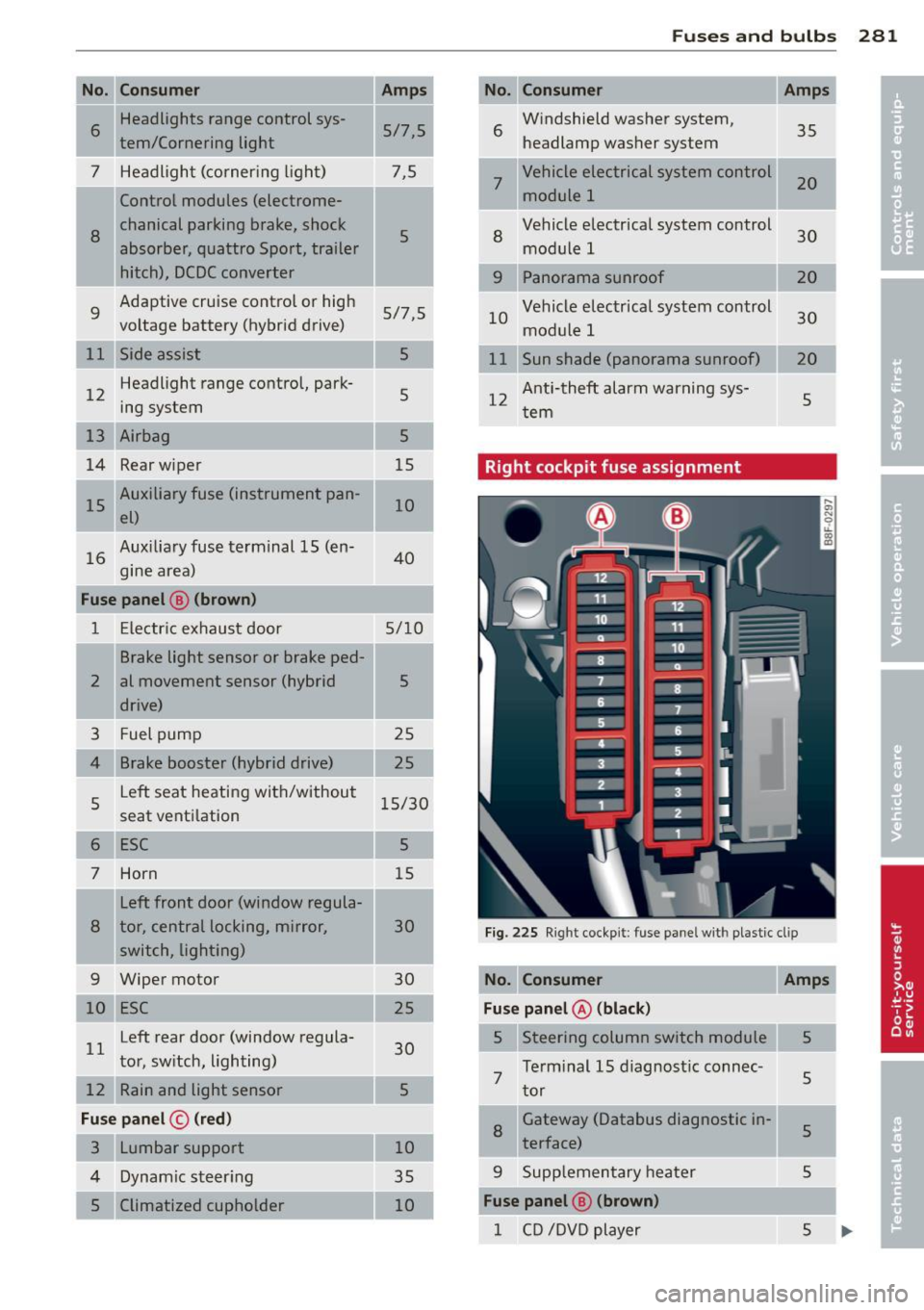
-No. Consumer
6
Headlights range control sys-
tern/Co rnering light
7 Headligh t (corner ing l ight)
Control modules (electrome-
8
chanical parking brake, shock
absorber, quattro Sport, trailer
hitch), DCDC converter
9 Adaptive cruise contro
l or high
voltage battery (hybrid drive)
12 Headlight range contro
l, park
ing system
13 Airbag
14 Rear wiper
15 Auxiliary fuse (ins
trument pan
el)
Auxilia ry fuse terminal 15 (en-
16 gine area)
Fuse panel
@ (brown )
1 E lectric exhaust door
2
3
4
5
6
7 Brake light sensor or brake ped
al movement sensor (hybrid
drive)
Fuel pump
Brake booster (hybrid drive)
Left seat heating with/without
seat venti
lation
ESC
Horn
Left fron t door (window regula -
8 tor, central locking, mirror,
sw itch, lighting)
-9 Wiper motor
10 ESC
Left rear door (window regula
l l tor, sw itch, light ing)
12 Rain and light sensor
Fuse panel © (red)
3 Lumbar support
4 Dynam ic ste ering
5 Climatized cupholder
-Amps
5/ 7,5
7,5
5
5/7,5
5
5
5
15
10
40
5/10
5
25
25
1 5/30
5
15
30
30
2 5
30
5
10
35 10
-
Fu se s and bulb s 281
No. Consumer
6 W
indshield washer system,
headlamp washer system 35
7
Vehicle electrical system control
module 1 20
8
Vehicle electrical system control
module 1 30
9 Panorama su
nroof
10 Vehicle elec
trical system control
30
mod ule 1
11 Sun shade (panorama sunroof)
20
12 Anti-theft alarm warning sys-
tern 5
Right cockpit fuse assignment
Fi g. 22 5 Right cockp it : fuse panel wit h plast ic cl ip
No. Consumer Amps
Fuse panel @ (black )
5 Steering column switch module 5
7 Te
rm inal 15 d iagnost ic connec-
tor
5
8 Gateway (Databus diagnostic in-5 terface)
-..
9 Supp
lementary heater 5
Fuse panel @ (brown)
1 CD /D V D p layer 5