battery AUDI Q5 2013 Owner's Manual
[x] Cancel search | Manufacturer: AUDI, Model Year: 2013, Model line: Q5, Model: AUDI Q5 2013Pages: 316, PDF Size: 78.89 MB
Page 103 of 316
-ESC offroad mode and hill descent assist
must not be turned on¢
page 198 .
The combust ion eng ine tu rns on and inter
rupts
the enhanced electric d rive mode when
the vehicle is accelerated. The gray indicator
light
l!I also turns on in the disp lay. The en
hanced electric drive mode resumes automati
cally once acceleration stops.
The enhanced e lectric drive mode is
deactivat
ed if at least one of the following conditions is
met :
- The ign ition is turned
off.
- Th e 1.:1"1 button is pressed again.
- The high voltage battery charge level is low .
- The vehicle speed is higher than approxi -
mately 62 mph (100 km/h).
- The S selector lever position or tiptronic
mode is selected .
- ESC offroad mode or hill descent assist is
switched on .
T he
ld" I button must be pressed to reactivate
it .
Start-Stop function
The combustion engine is operated on ly as
needed. Generally, the combustion engine
turns
off when the vehicle is stationary and
the high voltage battery powers the electrical
vehicle systems.
The purpose of automatica lly shutting the
combustion engine
off in hybrid drive mode is
to save fuel. All of the important veh icle sys
tems, such as steering, brakes and the A/C
system, cont inue to remain active. In some
cases , systems may require the combustion
engine to cont inue running when the vehicle
is stationary. When dr iv ing in congested traf
fic for long per iods of time, the comb ustion
engine w ill cycle on when the vehicle is sta
tionary to keep the high voltage battery
charged.
Gliding
I f the gas pedal is not pressed and the D posi
tion is selec ted, the combustion engine re-
Hybrid 101
mains turned off up to speeds of approxi
mately 99 mph (160 km/h). Driving conserva
tive ly like this can reduce fuel consumption.
Energy recovery (recuperation)
When braking, the electric motor will act as a
generator creating e lectric energy that is then
stored in the high voltage battery. This also
occurs when the ve hicle is coasting or driving
downhi ll. The combustion engine is automati
cally turned
off i n this case.
The vehicle is braked with the electric motor
by applying ear ly and even pressure to the
brakes and using short pedal movements
¢
page 98, fig. 108 @. By doing this, a large
amount of the kinetic energy is recovered and
may be stored as electric energy in the high
voltage battery . During heavy braking, the
convent ional brakes are also act ivated
¢ page 98, fig. 108 @.
The energy recovery is shown in the MMI dis
play ¢
page 104.
Automatic start of the combustion engine
Various operating conditions cause the com
bust ion engine to start automat ically :
- The high voltage battery charge leve l is low.
- The temperature of the combustion engine
is low.
- The temperature of the catalytic converter is
low .
- The power output needed for the A/C sys-
t em is high.
- The vehicle speed is high.
- The vehicle acceleration is high.
- The inclin e is steep.
- High charge level for the high voltage bat-
tery when coasting. In th is case, the h igh
voltage battery cannot absorb any more en
ergy and so the electric motor cannot slow
down the veh icle. The combustion engine
tu rns on (engine brake). In this situation the
h igh voltage battery will show a Max charge.
Page 104 of 316
102 Hybrid
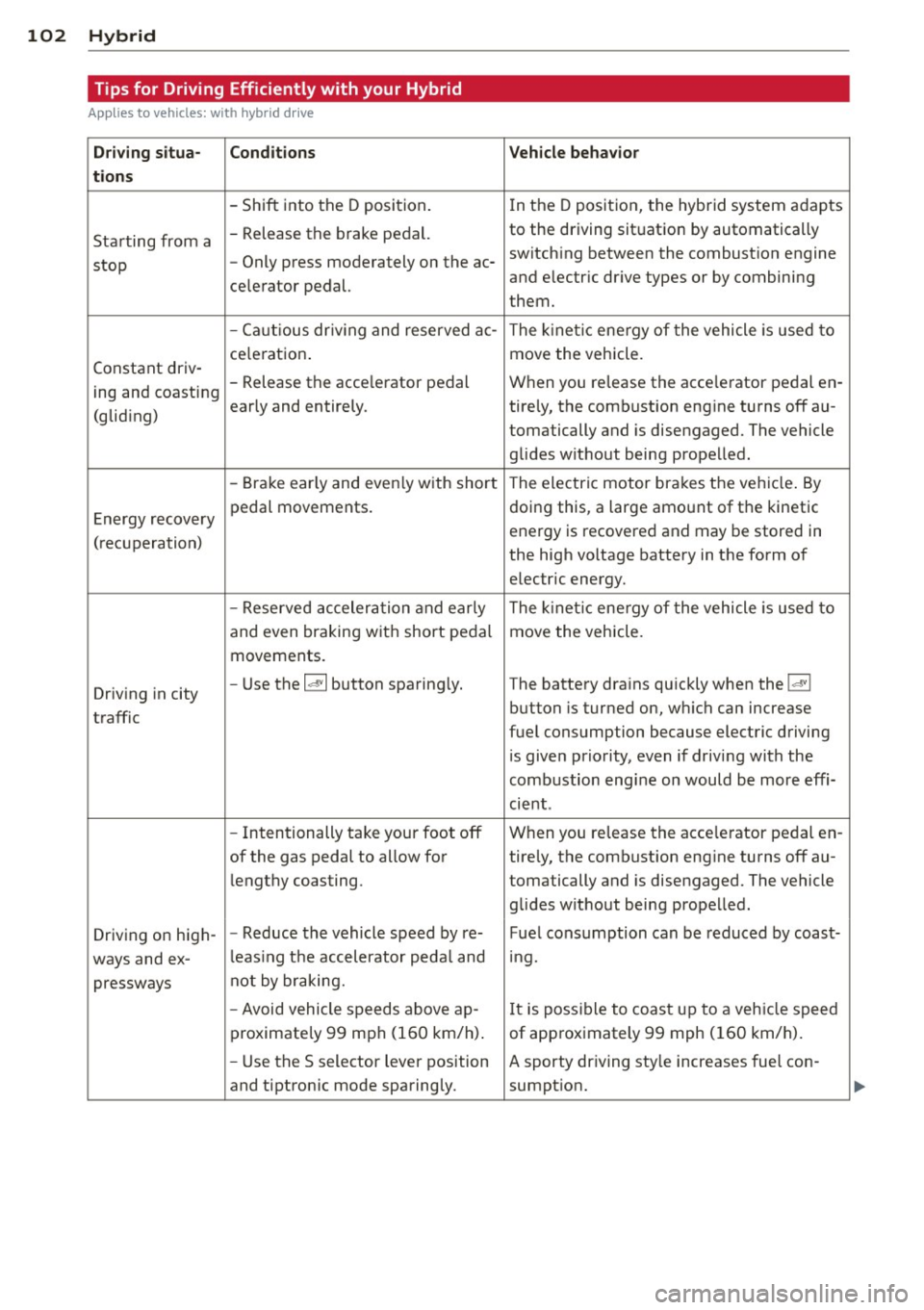
Tips for Driving Efficiently with your Hybrid
Applies to vehicles: with hybrid drive
Driving situa- Conditions Vehicle behavior
tions
- Shift into the D position.
In the D position, the hybrid system adapts
Starting from a -
Release the brake pedal. to the driving situation by automatically
stop -
Only press moderately on the ac- switching between the combustion engine
and electric drive types or by combining
celerator pedal.
them.
- Ca utious dr iv ing and reserved ac-
The kinetic energy of the vehicle is used to
ce leration . move the vehicle.
Constant driv-
ing and coasting -
Release the acce lerator pedal When you release the acce lerator pedal en -
early and entirely. ti rely, the combustion engine turns off au-
(gliding)
tomatically and is disengaged. The vehicle
glides without being propelled.
- Brake early and even ly with short The electric motor brakes the vehicle . By
Energy recovery pedal
movements. doing this, a large amount of the
kinetic
energy is recovered and may be stored in
( recuperation)
the high voltage battery in the form of
electric energy.
- Reserved acceleration and early The kinet ic energy of the vehicle is used to
and even braking w ith short pedal move the vehicle.
movements .
Driving in city -
Use the
la• I button sparing ly. The battery drains quickly when the laVI
button is turned on, which can increase
traffic
fuel consumption because electric driving
is given priority, even if driving with the
combustion engine on would be more effi-
cient .
- Intentionally take your foot off When you release the acce lerator pedal en-
of the gas pedal to allow for ti rely, the combustion engine turns off au-
lengthy coasting . tomatically and is disengaged. The vehicle
glides without being propelled.
Driv ing on high- -
Reduce the vehicle speed by re-Fuel consumption can be reduced by coast-
ways and ex-l
eas ing the accelerator peda l and mg.
pressways not by
braking.
- Avoid vehicle speeds above ajp-
It is possible to coast up to a veh icle speed
proximately 99 mph (160 km/h) . of approximately 99 mph (160 km/h).
- Use the S selector lever position A sporty driving sty le increases fuel con -
and tiptron ic mode sparingly. sumption.
Page 105 of 316
Hybrid 103
Driving situa -Condition s Vehicle behavior
ti ons
- Do not r un the combustion en- The temperature of the comb ustion eng ine
gine wh ile the vehicle is parked to rises very slowly and the fuel consumption
warm the engine . increases considerably.
- Use the rear w indow/exter ior This conserves the energy in the h igh vo lt-
Driv ing in cold mirro
r defroster and the seat heat- age battery so that it is ava ilab le to r un the
weather i
ng s par ingly. vehicl e in ele ct ric mode .
- Park the vehicle in a garage over-
This reduces ex pos ure of the hig h voltage
night.
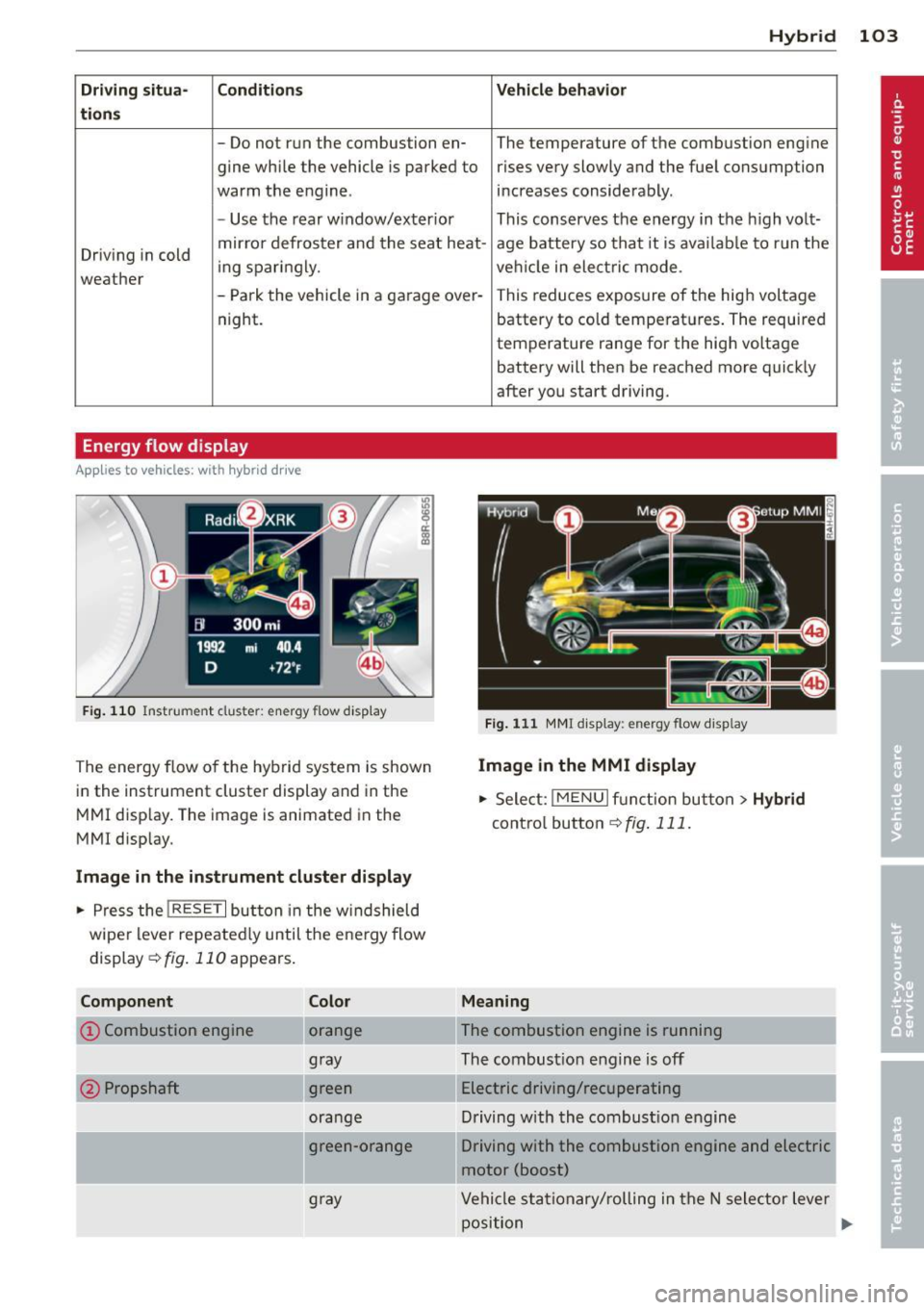
Energy flow display
Applies to vehicles: with hybrid dr ive
F ig. 110 Instrument cluster: e nergy flow disp lay
The energy flow o f the hybrid system is shown
i n the instrument cluster display and in the
M MI disp lay. The image is animated in the
MMI disp lay.
Image in the instrument cluster display
.. Pres s the !RESET I but ton in the w indshield
wipe r lever repeate dly until the e ne rgy flow
di splay
c::> fig . 110 appears .
Component
@Propshaft
Color
orange
gray
green
ora nge
g ra y battery to co
ld temperat ures . The required
temperature range for the high voltage
battery will then be reached more quick ly
after you start driving.
Fig. 1 11 M MI d isp lay: energy flow display
Image in the MMI display
.,. Select: I ME NU I fu ncti on bu tton > Hybrid
cont ro l button c::> fig . 111.
Meaning
The combustion engine Is running
The combust io n engin e is off
E lectric driving/recuperating
D riving w ith th e combus tion en gin e
Driving with the combustion engine and electric
motor (boost)
Vehi cle s ta tio nary/ rolling in the N sele ctor lever
p osition
Page 106 of 316
104 Hybrid
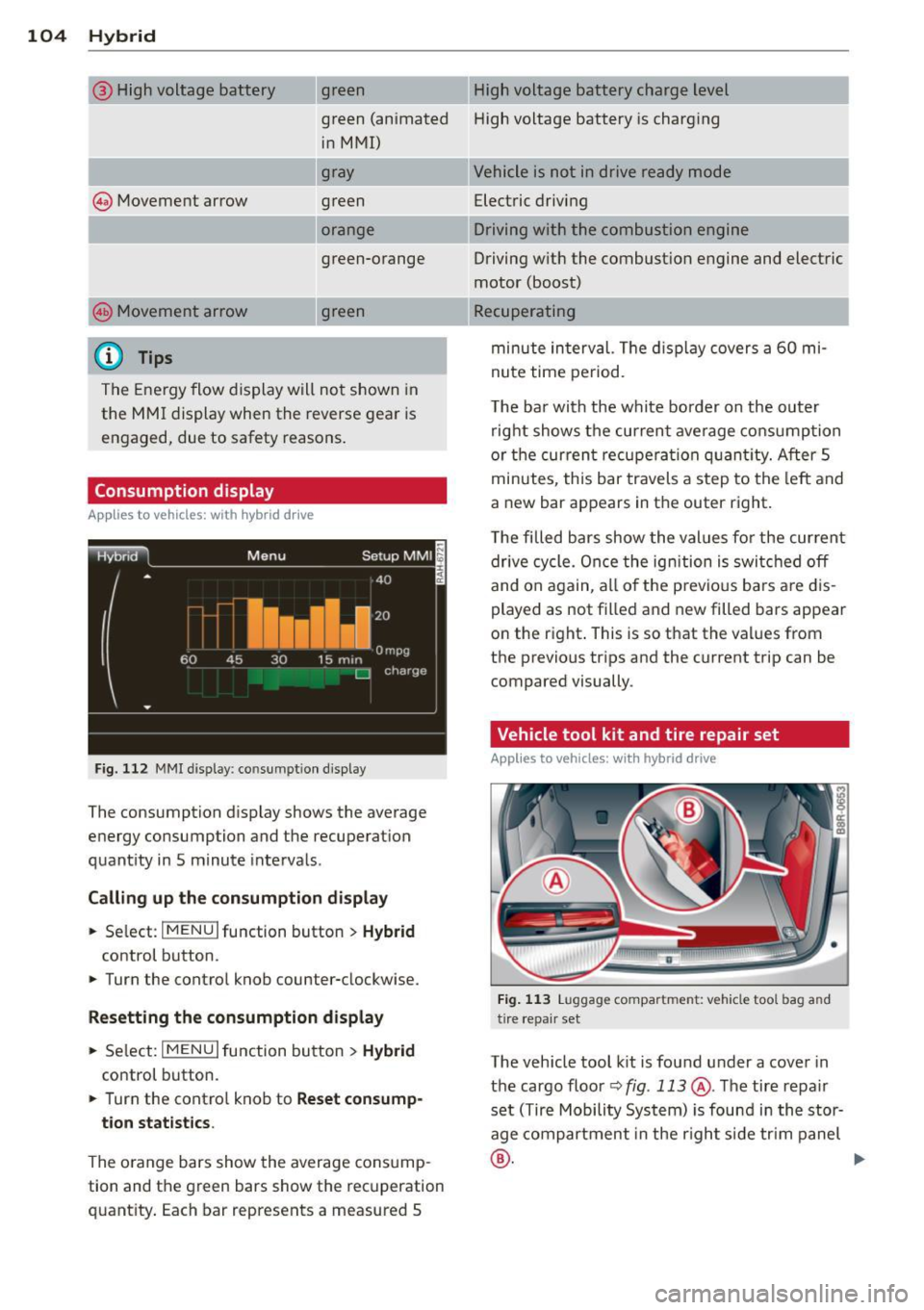
@ High voltage battery green High voltage battery charge level
green (animated High voltage battery is charging
@ Movement arrow in MMI)
gray
green
orange
---.. ,
green-orange
@ Movement arrow g
reen
@ Tips
The Energy flow display will not shown in
the MMI display when the reverse gear is engaged, due to safety reasons .
Consumption display
Applies to vehicles: with hybrid drive
Fig. 1 12 MM! display: consumpt ion disp lay
The consumption display shows the average
energy consumption and the recuperat ion
quantity in S minute interva ls.
Call ing up th e co nsumption displa y
.. Se lect: I MENU I function button > H ybrid
control button .
.. Turn the control knob counter-clockwise.
Res etting the con sumption display
.. Se lect: I MENU I function button> H ybrid
control button.
.. Turn the contro l knob to
Reset consump-
tion stat istics.
The o range bars show the average cons ump
tion and the green bars show the recuperation
quantity . Each bar represents a measured S Vehicle is not in drive ready mode
Electric driving
Driving with the combustion engine
Driving w ith the combust ion engine and electric
motor (boost)
Recuperating
minute interval. The d isplay
covers a 60 mi
nute time period.
The bar with the white border on the outer right shows the current ave rage consumption
or the cur ren t recupera tion quan tity. After 5
minutes, th is bar travels a step to the left and
a new bar appears in the outer right.
T he filled bars show the values fo r the current
drive cycle. Once the ignition is switc hed off
and on again, all o f the p revio us ba rs a re d is
played as not filled and new filled bars appear
on the right . This is so that the values from
the previous tr ips and the current trip can be
compared visually.
Vehicle tool kit and tire repair set
Applies to vehicles: with hybrid drive
Fig. 11 3 Luggage compartment: vehicle tool bag and
tire repair se t
The vehicle tool k it is found under a cove r in
the cargo floo r<=>
fig . 113 @. The tire repair
set (Tire Mobility System) is found in the stor
age compartment in the r ight s ide tr im panel
® · ~
Page 107 of 316
Additional information about the vehicle tool kit may be found under
c::> page 269 and
about the tire repa ir set under
c::> page 2 72 .
(D Tips
The right storage compartment in the lug
gage compartment and its contents must
always be kept in the vehicle. The veh icle
m ust not be operated w ithout the tire re
pa ir set.
Charging the batteries
Applies to vehicles: with hybrid drive
The vehicle is equipped with two 12 volt bat
ter ies and a h igh voltage battery.
If the
12 volt batter ies are dead, they may be
charged with a charger or the vehicle may be
jump started with assistance from another ve
hicle in the same way as a conventional vehi
cle .
The same applies to the high voltage battery
if it is d ischarged . However, in this case, the
charg ing process is accompanied w ith mes
sages in the inst rument cluste r display. The
i gnit ion m ust be switched on and all unneces
sary electric components m ust be turned off.
The connections in the engine compartment
are used for both charging and jump starting
c::> page 245 or c::> page 284.
Vehicle not ready to start. See owner's
manual
This message appears if the high voltage bat
tery charge level is too low. The vehicle can no
l onge r be started with its own power. The
high voltage battery must be charged with a
charger or the vehicle must be jump started
with the aid of another vehicle.
Afte r the connecting the cha rger or jumper ca
b les, the ignition must be turned off for ap
proximately two minutes and then turned on
again. After no more than one m inute, one of
the following indicator lights turns on in the instrument cluster d isp lay. Hybrid 105
II Charging battery. Please wait ...
If
the indicator light turns on and this mes
sage appears, the high voltage battery is
charging or the vehicle is being jump started
with assistance from another vehicle.
If the 12 vo lt batteries are dead, the -
indicator light turns on. The charging proce
dure takes longer in this case because the
12
volt batteries are charged first. The procedure
goes faster with the ignition switched off.
Vehicle ready to start.
This message appears if the charging proce
dure was successfu l. The vehicle may be start
ed again.
Battery could not be charged enough to
start vehicle.
T his message appears if the charging proce
dure was not successful or it was interrupted.
This may happen if the charger or the battery
in the veh icle that is assist ing is too weak.
If
the vehicle cannot be started, see an author
ized repa ir facility for assistance .
(D Tips
- The charger should deliver a current of at
least
30 A. Otherwise charging the high
voltage battery will take considerably longer. A current between
50 A and 70 A
is ideal.
- The ve hicle that is assist ing should be
somewhat within the same vehicle class
when jump starting a vehicle. A smaller
vehicle's battery may be drained.
- After approximately
30 minutes, the
c harging procedure ends because the ig
nition is automatically turned off.
If you
would like to continue to charge the bat
tery, turn the ignition on again.
Page 108 of 316
106 Hybrid
Vehicle transport
Applies to vehicles: wit h hybri d drive
The following contains information you
should know about transporting your vehicle .
The lithium ion battery (SANYO 72 UF 121
285) installed in your vehicle has passed test
38 .3 in accordance with UN handbook tests
and criteria. The vehicle may be transported
with the battery installed as conventiona l
class 9 haza rdous materials without addition
al off ic ial consent for air and sea transporta
tion (current law !CAO-TI and IMDG -Code
01.01.2012).
Page 121 of 316
@ Tips
-Side assist is not active whi le you are
making the adjustment.
- Your settings are automatically stored
and assigned to the remote control key
being used.
Driver messages
App lies to vehicles: with Audi side assist
If side ass ist switches off by itself, the LED in
the button turns off and a message will ap
pear in the instrument cluster d isplay:
Aud i side assist unavail able: S en sors
blocked
The radar sensors' vision is affected . Do not
cover the area in front of the senso rs with bike
wheels, st ickers, dirt or other objects . Clean
the area in front of the sensors, if necessary
~page 117, fig. 128.
Aud i side assi st: Currently un avail able
Side assist cannot be switched o n temporarily
because there is a malfunction (for example,
the battery charge leve l may be too low) .
Audi side assi st: S ystem fault!
The system cannot guarantee that it will de
tect vehicles correctly and it is switched off.
The sensors have been displaced or are faulty.
H ave the system checked by an authorized
Aud i dealer or authorized Aud i Service Fac ility
soon.
Audi side assist: Unav ailab le when towing
Side assist sw itches off automatically when a
factory- installed trailer h itch is connected to
the electrical connector on the trailer. There is n o guarantee the system will switc h off when
using a retrofitted tra iler hitch. Do not use
side assis t when towing a t railer.
Audi side a ssis t 119
Page 130 of 316
![AUDI Q5 2013 Owners Manual 128 Automatic transmission
Transmission malfunction
[O] Transmission: Press brake pedal and se·
lect g ear again.
Press the brake pedal and se lect t he des ired
selecto r lever posit](/img/6/57637/w960_57637-129.png "AUDI Q5 2013 Owners Manual 128 Automatic transmission
Transmission malfunction
[O] Transmission: Press brake pedal and se·
lect g ear again.
Press the brake pedal and se lect t he des ired
selecto r lever posit")
128 Automatic transmission
Transmission malfunction
[O] Transmission: Press brake pedal and se·
lect g ear again.
Press the brake pedal and se lect t he des ired
selecto r lever posit io n again . Yo u can then
continue dr iving .
[O] Transmission overheating: Please drive
conservatively.
The transmission temperature has increased
significantly d ue to the sporty driving ma nner.
Drive in a less sporty manne r unt il the tem
pe rat ure retu rns to the norma l range a nd the
i ndicator light switch es of.
[O] Transmission malfunct ion: You can con
tinue driving
There is a system ma lf u nct ion in the transmis
sion. You may continue driving. Drive to your
authorized Audi dealer or qualified repair fa
cility soon to have the malfunction corrected .
[O] Transmission malfunction: Limited driv
ing funct ionality
There is a sys tem ma lf u nction in t he transmis
sion. The transmission is sw itchi ng to emer
gency mode. Th is mode only sh ifts into cer
tain gea rs or will no lo nger shift at a ll. The en
g ine may stall . Drive to your auth orized A udi
deale r or qualified repair facility immed iately
to have the malf unction co rrec ted.
[O] T ransmission malfunction: Stop vehicle
and shift to park .
Do not continue d rivi ng . Select the P se lect or
l ever position and see yo ur authorized Aud i
dea ler or qualified repair facility for assis
tance .
(D Note
If the transmiss ion sw itches to emergency
mode, you sho uld take the vehicle to an
author ized Audi dealers hip as soon as p os
sibl e to have the cond ition co rrected.
Selector lever emergency release
If the vehicle 's power supply fails , th e selec
tor lever can be released in an emergency.
Fi g. 137 Fro nt center co nsole: Removing t he as htray
i nsert
Fig. 138 Selec tor lever e merg ency release
.. To access the emergency re lease mecha
nism, remove t he ashtray insert ® using the
release sw itch
® c> fig . 13 7 .
.. Loose n and remove the cap in the as htray
mou nt ¢
fig . 138 .
.. Yo u n ow have access to a p in. Using a s crew
d river or sim ilar obj ect , pre ss th e p in do wn
and hold i t in t hat p osition .
.. No w press t he re lease but to n and move the
selecto r lever to t he N posit io n.
T he sele ctor leve r ca n on ly be moved from the
P position i f the key is in the lock and the igni
t ion is switc hed on . If the power supply fails
(for example, the battery is discharged) and
the vehicle m ust be pushed or towed, move
t h e selecto r lever to the N posit ion first usi ng
t h e emerge ncy re lease.
Page 173 of 316
There are some important things you have to know to make sure that the effectiveness of
the system will not be impaired and that dis
carded components do not cause injury or pol
lute the environment.
A WARNING
Improper care, servicing and repair proce
dures can increase the risk of personal in
jury and death by preventing an airbag from deploying when needed or deploying an airbag unexpectedly:
- Never cover, obstruct, or change the
steering wheel horn pad or airbag cover
or the instrument panel or modify them
in any way.
- Never attach any objects such as cu
pholders or telephone mountings to the
surfaces covering the airbag units.
- For cleaning the horn pad or instrument
panel, use only a soft, dry cloth or one
moistened with plain water. Solvents or
cleaners could damage the airbag cover
or change the stiffness or strength of the
material so that the airbag cannot de
ploy and protect properly.
- Never repair, adjust, or change any parts
of the airbag system.
- All work on the steering wheel, instru
ment panel, front seats or electrical sys
tem (including the installation of audio
equipment, cellular telephones and CB
radios, etc.) must be performed by a
qualified technician who has the training
and special equipment necessary.
- For any work on the airbag system, we
strongly recommend that you see your
authorized Audi dealer or qualified work
shop.
- Never modify the front bumper or parts
of the vehicle body.
- Always make sure that the side airbag
can inflate without interference:
- Never install seat covers or replace
ment upholstery over the front seat
backs that have not been specifically
approved by Audi.
Airbag system 171
-Never use additional seat cushions that
cover the areas where the side airbags
inflate.
- Damage to the original seat covers or
to the seam in the area of the side air
bag module must always be repaired
immediately by an authorized Audi
dealer.
- The airbag system can be activated only
once. After an airbag has inflated, it
must be replaced by an authorized Audi
dealer or qualified technician who has
the technical information, training and
special equipment necessary.
- The airbag system can be deployed only
once. After an airbag has been deployed, it must be replaced with new replace
ment parts designed and approved espe
cially for your Audi model version. Re placement of complete airbag systems
or airbag components must be per
formed by qualified workshops only.
Make sure that any airbag service action
is entered in your Audi Warranty
& Main
tenance booklet under
AIRBAG REPLACE
MENT RECORD.
- In accidents when an airbag is deployed,
the vehicle battery separates the alterna
tor and the starter from the vehicle elec
trical system for safety reasons with a
pyrotechnic circuit interrupter.
- Work on the pyrotechnic circuit inter
rupter must only be performed by a
qualified dealer - risk of an accident!
- If the vehicle or the circuit interrupter
is scrapped, all applicable safety pre
cautions must be followed.
{® For the sake of the environment
Undeployed airbag modules and preten
sioners might be classified as Perchlorate Material -special handling may apply, see
www.dtsc .ca.gov/hazardouswaste/per-
ch lorate. When the vehicle or parts of the
restraint system including airbag modules
safety belts with pretensioners are scrap ped, all applicable laws and regulations
must be observed. Your authorized Audi .,..
•
•
Page 205 of 316
will have no warning from a sudden in
crease in engine speed as with a front
wheel drive vehicle. A lways drive at
speeds wh ic h are suited to the road con
ditions -risk of crash .
Energy management
Starting ability is optimized
Energy management controls the distribution
of electrical energy and thus optimizes the
availability of electrical energy for starting
the engine.
If a vehicle with a conventional energy system
i s not driven for a long pe riod o f time, the bat
tery is discharged by idling current consumers
(e .g. immobilizer) . In certain circumstances it
can result in there being insufficient energy
avai lab le to start the engine.
I ntelligen t energy management in your vehi
cle hand les the distribution of electrical ener
gy . Starting ability is marked ly improved and
the life of the battery is extended .
Basically, energy management consists o f
batter y diagno sis, idling cur rent man age
m ent
and dyn amic en e rg y m anagement.
Battery diagnosis
B attery d iagnosis continuously dete rmines
the state of the battery. Sensors determ ine
battery vo ltage, battery current and battery
temperature. This determines the current
state of charge and the power of the battery.
Idling curr ent management
Idling current management redu ces energy
consumption while the vehicle is stand ing.
With the ignition switched off, it contro ls the
energy supply to the various electrica l compo
nents . Data from battery diagnosis is consid
ered.
Depending on the battery's state of charge,
individual consumers are grad ually turned off
to prevent excessive discharge of the battery
and thus mainta in start ing capability.
Int ellig ent technolog y 203
Dynamic energy management
While the vehi cle is being driven, dynamic en
ergy management distrib utes the energy gen
erated according to the needs of the individ u
al components. It regulates consumption, so
that more e lectrical energy is not being used
than is being generated and ensures an opti
mal state of charge fo r the battery .
{!) Tips
- But even energy management cannot
negate the limits of physics. Consider
that the power and life of a battery are
limited .
- If start ing ability is threatened, the indi
cator light(•] appears ¢
page 34.
What you should know
The highest priority is given to maintaining
starting capability.
The battery is severe ly taxed in short -distance
driv ing, in city traff ic and during the cold time
of year. Abundant electrical energy is re
quired, but on ly a little is generated . It is also
c rit ical if the engine is not running and electri
ca l components are turned on . In this in
stance ene rgy is be ing consumed but none is
being genera ted .
It is in precisely these situations t hat you will
notice ene rgy management active ly regu lat
i ng the d istribu tion of ene rgy.
Vehicle stands for an extended period
If you do not drive your vehicle over a period
of several days or weeks, electr ical compo
nents are gradually cut back or switched off .
T h is reduces energy consumption and ma in
ta ins start ing capability over a longer pe riod .
Some of the convenience functions may not
operate, such as the interior ligh ts or the
power seat adjustment. The convenience
functions wi ll be available again when you
switch on the ignition and start the engine.
•
•