roof AUDI Q5 2013 Owner's Manual
[x] Cancel search | Manufacturer: AUDI, Model Year: 2013, Model line: Q5, Model: AUDI Q5 2013Pages: 316, PDF Size: 78.89 MB
Page 208 of 316
206 Driving and en vir onm ent
Catalytic converter
It is very important that your emission con
trol system (catalytic converter) is function
ing properly to ensure that your vehicle is run
ning in an environmentally sound manner .
• Always use lead-free gasoline¢ page 228,
Fuel supply.
• Never run the tank down all the way to
empty .
• Never put too much motor oil in your en-
gine ¢
page 238, Adding engine oil~-
., Never try to push- or tow -start your veh icle.
The catalytic converter is an eff ic ient "clean
up" device built into the exhaust system of
the vehicle. The catalytic converter burns many of the pollutants in the exhaust gas be
fore they are released into the atmosphere.
The exclusive use of unleaded fuel is critically
important for the life of the cata lytic conve rt
e r and proper functioning of the engine.
& WARNING
-
- Do not park o r operate the vehicle in
areas where the hot exhaust system may
come in contact with dry grass, brush,
fuel spill or other material which can cause a fire.
- Do not apply additional undercoating or
rustproofing on or near the exhaust
man ifold, exhaust p ipes, catalytic con
verter or heat shields . During driving, the
substance used for undercoating could
overheat and cause a fire .
@ Note
-Be aware that just one tank filling with
leaded fuel will already seriously de
grade the performance of the catalytic
conve rter .
- Do not exceed the correct engine oil level
¢ page 238.
-Do not drive until the fuel tank becomes
completely empty. The eng ine could mis
fire . U nburned f uel could a lso get into the exhaust system and this co
uld cause
the cata lytic converter to overheat .
- Do not turn off the ignition while the ve
hicle is moving.
- Do not continue to ope rate your veh icle
under these conditions, as otherwise fuel
can reach the catalytic converter. This
cou ld result in overheating of the con
verter, requir ing its replacement.
- To assure efficient operation of the Emis
sion Control System:
- H ave your vehicle maintained properly
and in accordance w it h the service rec
ommendat ions in your Warranty &
M ain tenance book let.
- L ack of prope r maintenance as we ll as
improper use of the vehi cle will impair
the function of the em iss ion contro l
system and could lead to damage .
@ For the sake of the environment
Even when the Emiss ion Control System is
operat ing proper ly, the exha ust gas can
have a sul fur -li ke exhaust gas smell under
some operating states . This depends on
the sulfur content of the fuel being used .
Using a different brand of fue l may help,
or f il li ng the tank with lead-free super
grade gasoline .
Avoid damaging the
vehicle
When you are d rivi ng on poor roads, or over
c u rbs, steep ramps, etc., ma ke certai n that
low- ly ing parts s uch as spoilers and exha ust
system parts do not bottom o ut and get dam
aged.
T his is espe cially true for ve hicles with low
s lung chassis (spor ts chassis)* and fully load
ed vehicles .
Page 219 of 316
Automatic car wash
The vehicle can be washed in almost any
modern automatic car wash .
The vehicle paint is so durable that the vehicle
can normally be washed without problems in
an automatic car wash. However, the effect on
the paint depends to a large extent on the de
sig n of the fac ility, the filtering of the wash
water, the type of wash and care mater ial , etc.
If the paint has a dull appearance afte r go ing
through the car wash or is scratched, bring
this to the attention of the operator immedi
ately. If necessary, use a different car wash.
Before going through a ca r wash, be s ure to
take the usual precautions such as closing the
windows and the roof . Factory installed an
tennas m ust not be removed.
If you have installed additional accessor ies on
the vehicle -such as spoilers, roof rack, etc. -
it is best to ask the car was h operator if these
should be removed .
A WARNING
Please take note of the follow ing po ints
before going through an automatic car
wash with your vehicle, so that you can
avoid damage to your vehicle.
- Compare the track of your vehicle with
the distance between the gu ide rails of
the fac ility- there is a risk of damage to
the wheels and t ires.
- Compare the height and w idth of your
vehicle with the he ight and width of the
tunnel at the fac ility.
- Fold the exte rior mi rrors flat -there is a
r isk of damag ing the exte rior m irrors.
Power folding ex terior m irrors* must not
be folded in o r out by hand . Use the pow
er function !
- Do not a llow the wipe r blade to fall o nto
t he windsh ield after the vehicle is dried -
there is a r isk o f damag ing the pa int on
the hood .
- Always read and heed all WARN INGS and
other information ¢
page 216.
-
Cleaning and protec tion 217
Washing the vehicle by hand
A lot of water is needed when washing a vehi
cle by hand .
.,. Before you start washing, make sure you
have read and u nderstood the WARNINGS
Q .&. in General information on page 216 .
.,. First soak all dried d irt unt il it is soft, then
r inse it off.
.,. As you clean your vehicle , start w it h the
roof and wor k your way down to the bottom,
using a sponge, a sponge g love or a clean
brush.
.,. Rinse the sponge o r the sponge g love often,
flushing it clean each time.
.,. Use specia l car shampoo only for
very per
sistent d irt .
.,. Rinse the car thoroughly with water .
.,. Use a chamo is leather to gent ly w ipe the ex-
ter ior d ry.
Use a separate sponge for cleaning the
whee ls, door sills and othe r regions exposed
to road dirt . In this way, you w ill not scratch
the pa int w it h coarse par ticl es imbedded in
the sponge the next time you wash the ca r.
& WARNING ~ -
- Wash your vehicle only when the ignition
is switched off to red uce the risk of a
crash.
-A lways read and heed a ll WARNI NGS and
other information
~ page 216.
{(D Note
-Never try to remove dirt, mu d or dus t if
t he su rface o f the ve hicle is dry. Never
use a dry cloth or sponge, s ince this
co uld scratch your vehicle's paint or win
dows.
- Never wash your car in bright s unlight .
Drops of water act as magnifying lenses
and may damage yo ur paint .
- When you wash your car in the winter: if
you rinse yo ur vehicle with a hose, be
careful not to aim the stream of water
directly at locks, or at door or hatch
openings - they can freeze shut . •
•
Page 220 of 316
218 Clea ning and protec tio n
- Never use sp onges designed to remove
insects, or a ny kitchen scouring sponges
or similar products . They can dama ge
you r paint f inish.
- Never use a dry cloth or s ponge to clean
the headligh ts. On ly use wet clot hs or
sponges to prevent scratches.
It i s best
to use soapy water.
- You should rem ove debris (suc h as in
sects) from the headlight lenses on a
regular basis, fo r example when refuel
i ng your vehicle. Never clean the head
li ghts w ith a dry cloth or sponge. Use a
wet cloth or sponge.
It is best to use
soapy water.
@ For the sake of the environment
On ly wash the vehicle in facilit ies specially
designed for that pu rpose. This w ill reduce
t he risk of d irty water contami nated with
oil from en tering the sewer system. In
some areas, washing vehicles outside of
these facilities is prohibited .
Washing your vehicle with a power
washer
Cleaning the exterior of your car with a high
pressure power washer is safe as long as you
observe a few simple rules.
.. Before us ing the power washe r, make sure
you have read and understood the WARN
INGS¢
A in General information on
page 216 .
• Always follow the operating instructions for
the power washer .
• Make sure that the jet o n the spray hose
produces a "fan shaped sp ray ".
• Do
not ho ld the spray nozzle too close t o
soft materia ls.
Keep a d istance from soft mate rials such as
rubber hoses or insulat ing mater ial as well as
sensors and camera lenses .
When clea ning the veh icle w it h a power wash
e r
always fo llow the operating instructions.
This applies particul arly to the operating pres
sure and the spraying distance. Do not po int the spray di
rectly at the seals around the side
windows, around the doors, on the rear lid or
on the Panoram ic sliding sunroof* . Likewise,
do not po int it direct ly at tires, rubber hoses,
insulat ion material or sensors
¢ page 219.
Hold the spray nozz le at least 1.3 ft (0.4 m)
away from the vehicle.
Do not use a high-pressure power washer to
remove snow and ice .
Do not use a jet which sprays water in a direct
stream or one that has a rotating jet .
Water tempera ture sho uld no t exceed 140 ° F
(60 °().
_& WARNING
Neve r wash tires with a jet t hat sprays wa
ter in a direct stream . Th is could cause in
v is ible damage to the t ires and weaken
them, even if the spray is from a relative ly
l ong distance and for a short time. Dam
aged and weakened tires can fail and cause
accidents and personal in ju ry .
(D Note
To avoid damaging you r vehicle, always
make sure that there is suffic ient d istance
between the spray head and soft materia ls
l ike rubber hoses, plast ic pa rts and sound
deade ning mater ia ls as well as sensors
and camera lenses. Never a im the sp ray
head at the same point fo r a long time .
This also applies to cleaning headlights
and painted bumpers. Remembe r: the
closer the nozzle is to the surface of the
mater ia l, the greater the stress on the ma
terial.
Page 224 of 316
222 Cleaning and protec tio n
-To h elp prevent dirt fr om scratch ing the
win dow, always scrape in a f orward di
rection -pu shing the scraper away from
you -never back and fo rth.
- Water leaking from the inside of the rear
windows may damage sensitive electrical
components located either under the
rear parcel shelf or in the rear trunk area.
Always ensure that water
never leaks
through the body sect ion of the vehicle.
You can do this by using waterp roof pro
tection
over the vehi cle's electr ical com
ponen ts (e.g., when ins tall ing window
tinting) .
- Damage or malf unct ion of electrical
componen ts due to wa ter damage or any
other outside influence is not covered by
the Audi New Vehicle Limited Warranty .
See your Warranty
& Maintenance book
l et for add itiona l details about your war
ranty.
Cast (light ) alloy wheels
Cast (light) alloy wheels require special care.
... Wash the whee ls w ith a sponge or hose
brush
every other week .
... For deep cleaning afterwards, use only a
dedicated
acid-free cast alloy wheel cleaner.
., Rub a coat of
liquid wa x onto the r ims every
three month . Be sure to reach and treat a ll
parts of the rim .
To preserve the decorat ive appearance of the
cast a lloy whee ls, some specia l care is neces
sary. In add it io n to road dirt and sa lt, b rake
dust is a lso cor ros ive . If left o n for too long,
b rake dust ca n cause pitting.
Use on ly special
acid-free cleaners formulated
for a lloy rims . Safe products are available at
your author ized Audi dealer. Never leave the
cleane r on the r ims longe r than spec ified o n
the label.
If no t rinsed off p romp tly, the a cid
con tained in some cleaners can attack the
threads on the whee l bolts.
Never use ab ras ive or metal polishing clean
i ng agen ts.
If the pro te ct ive coa ting has been chipped, e.g
. by kicked up road dirt, to uch it
u p as soon as possible.
A WARNING
--
- Moisture and ice on b rakes may affect
brak ing eff ic iency
c::> page 200, Brake sys
tem.
Test the brakes carefully each t ime
you wash the vehicle .
- Always read and heed all WARNINGS and
other information
c::> page 216.
Body cavity sealing
The body cavity sealing does not need to be
checked.
All body cavit ies which could be affected by
corros ion have been thorough ly protected at
the factory.
T his sealing does not require any inspection or
additional treatment. If any wax shou ld seep
o ut of the cavity when the ambient tempera
ture is high, it can be
removed with a p lastic
scraper and a suitable solvent .
A WARNING
-Solvents can be dangerous.
- Benz ine is flammab le and toxic. If you
use benz ine for removing the wax, keep
sparks , flame and lighted cigarettes
away . Never dump benz ine on the
g round, into open streams or down sew
age d rains.
- Be s ure to
observe all safety and environ
men tal regulat ions. Follow all instruc
tions on the container.
- Always read and heed all WAR NINGS and
other info rmation
c::> page 216.
Chassis
Have the undercoating checked for damage
from time to time .
The lower body shell of your Aud i is also thor
oughly protected against corros io n.
Any damage to the undercoat ing ca used by
road hazards should be repaired prompt ly.
Page 225 of 316
& WARNING
Too much undercoating in the wrong pla
ces can cause a fire.
- Do not apply additional undercoating or
rustproofing on or near the exha ust
manifold, exhaust pipes, cata lytic con
verter or heat shie lds . Wh ile driving, the
substance used for undercoating could overheat and cause a f ire.
- Always read and heed all WARNINGS and other information
c:> page 216.
Exhaust tail pipes
-
Road sa lt and other corros ive materia ls will
damage the mater ial in the exhaust tail p ipes
if they are not cleaned regula rly . Do not clean
the ta il p ipes with whee l cleaner, paint polis h,
chrome polish or othe r abrasive cleane rs.
C lean the tail p ipes wi th car care prod ucts
that are s uitab le for stain less stee l.
Your authori zed Audi dealer can provide clean
in g p roducts t hat have been tested and ap
p roved for you r vehi cle.
Care of interior
Radio and MMI* display
.,. Clean the d isp lay w ith a soft clea n cloth and
an LCD cleane r.
The display can be cleaned w ith a professio
na lly available "LCD cleaner". The cloth shou ld
be slightly dampened with the clean ing flu id
to clean the display .
(D Note
To avoid scratching the display, you should
never clean it dry .
MMI control console
Applies to vehicles: with MMI
.. First clean the MMI control console with a
brus h to remove dust from the hous ing .
.,. The n w ipe the MMI con tro l c onso le w ith a
cl ean, soft, s ligh tly damp cloth .
Cleaning and protec tion 223
The M MI contro l console sho uld be cleaned
with a brush first so that no dirt is t rapped be
tween the buttons and the housing . We rec
ommend giving the MMI control conso le a fi
nal wipe with a cloth moistened with water
and dish washing detergent .
(D Note
To prevent damage, make s ure that no flu
i d ever gets into t he MMI contro l conso le.
Aluminum trim
Use only neutral-pH products to remove spots
and deposits from aluminum surfaces .
Chrome care products a nd a lkaline cleaners
will attack a luminum surfa ces and ca n dam
age them over t ime .
& WARNING ~
Always read and heed all WARN INGS and
other info rmation
c:> page 216.
Fabrics and fabric coverings
Fabrics and fab ric coverings (e.g . seats, door
trim pane ls, etc .) sho uld be cleaned at regular
intervals w ith a vacuum cle aner. This removes
su rface dirt particles which could become em
bedded in the fabric through use . Steam
cleaners sho uld not be used , because the
steam te nds to p ush the dirt deeper into the
fabric and lo ck it the re.
Normal cleaning
Generally, we recommend us ing a soft sponge
o r a lint -free microfibe r clo th to t he clean fab
r ic. B rushes s hou ld only be used for carpets
and floo r mats, since othe r fabr ic surfa ces
cou ld be harmed by br ushes.
Normal su rface stains can be cleaned using a
comme rc ially availab le foam cleaner . Spread
the foam o n the su rface of t he fabric with a
soft sponge and wo rk it in gently . D o no t satu
ra te the f abric. Then pat the foam dry using
absorbent, dry cloths (e .g . m icrofi ber cloth)
and vac uum it after it has dried compl etely .
Ill>
•
•
Page 239 of 316
Detergent additives in the oil will make fresh
oil look dark after the engine has been run
n ing for a short time . This is norma l and is not
a reason to change the o il more often than
recommended.
D amage o r m alfu nctions due to lac k of
m ainten ance
It is essen tial that yo u change your oil at the
recommended inte rva ls using only engine oil
that complies with A udi oil standard
VW 502 00 . Your Lim ited New Vehicle War
ranty does not cover damage or malfunctions
due to failure to follow recommended mainte nance and use requ ireme nts as set forth in
the Audi Owner 's Manual and Warranty
&
M aintenance book let . Your dea ler will have to
deny warranty coverage u nless you p resent to
the dea ler proof in the form of Serv ice or Re
pa ir Orde rs that all scheduled maintenance
was performed in a timely manner.
Engine oil consumption
The engine in your vehicle depends on an ade
quate amount of oil to lubricate and cool all
of its moving ports.
I n o rder to prov ide effective l ubr ication and
cooling of internal engine components, a ll in
ternal comb ustion engines consume a certain
amo unt of oi l. Oi l cons umption varies from
engine to engine and may change significantly
over the life of the eng ine . Typ ically, eng ines
with a specified break-in per iod (see
c:> page 205) consume more o il during the
break-in per iod than they consume after oil
consumption has stab ilized .
Under normal conditions, the rate of oil con
sumpt io n depends on the quality and viscosity
of the oil, the RPM (revolutions per m inute) at
which the engine is ope rated, the ambient
temperature and road condi tions. Furt her fac
tors are the amo unt of oil d ilution from wate r
condensation or fuel residue and the oxida
tion level of the oi l. As any engine is subject to
wear as mileage bui lds up, the oil consump
tion may increase over time until rep lacement
of worn components may become necessary.
Checkin g and fillin g 237
With a ll these variab les coming into p lay, no
standard rate of oil consumption can be es
tab lished or spec ified . There is no alte rnative
to regular and frequent check ing of the o il lev
el, see
Note .
If the yellow engine oil leve l warning symbo l
in the instrument cluster
Ill li ghts up, you
sho uld check the oil leve l as soon as possib le
c:> page 238. Top off the oil at your earliest
convenience
c:> poge 238.
A WARNING
Before you check anything in the eng ine
compartment, always read and heed all
WAR NINGS
c:> & in Working in the engine
compor tment on page 233.
(D Note
D riving w it h an insufficient o il level is like
l y to cause severe damage to the engine.
© Tips
- The oil pr essur e warn ing display. i s
not an indicator of th e oil level. Do not
rely on it. Instead, check the oil level in
your engine at regu lar int erval s, pr ef
erably e ach time you refu el, and alway s
before going on a long trip .
-If you have the impression yo ur engi ne
c ons umes excess ive amoun ts of oil , we
recommend that you consu lt an author
ized Audi dea ler to have the cause of
your conce rn properly d iagnosed. Keep in
mind that the accurate measurement of
oil consumption requ ires great care and
may take some t ime . An authorized Aud i
deale r has instructions about how to
measu re oi l consumption accurate ly .
-
•
•
Page 249 of 316
install batteries of the same type and manu
facture only (the same as those installed at
the t ime your vehicle was delivered) . Specifi
cations are listed on the battery housing. Your
authorized dealer must code the battery in
the energy management system to enable you
to use the energy management functions cor rectly after replacing the battery .
If it is not possible to use a battery of this
type, the new battery must have the same ca
pacity, voltage (12 volts), amperage, con
struction and plug sea ling .
When installing the battery, make sure the ig
nition and all electr ica l consumers are turned
off.
(D Note
- Make sure the ventilation hose on the
s ide of the batte ry is connected, other
wise fumes or battery acid can leak out .
- Vehicles with the Start-Stop-System* are
equipped with a special cycle-proof AGM
battery . Installing a different type of
battery can cause problems in the vehi
cle elec trical system. When replacing the
vehicle battery, always insta ll one with
the same specifications as the original
battery.
@ For the sake of the environment
Because of the problem of proper disposal
of a battery, we recommend your author
ized Audi dealer change the battery for
you. Batteries contain su lfuric acid and
lead and must always be disposed of prop
erly in compliance with all environmental
regu lations . D isposing of vehicle batteries
improperly is very dangerous to the envi
ronment .
Checkin g and fillin g 247
Windshield/headlight
washer container
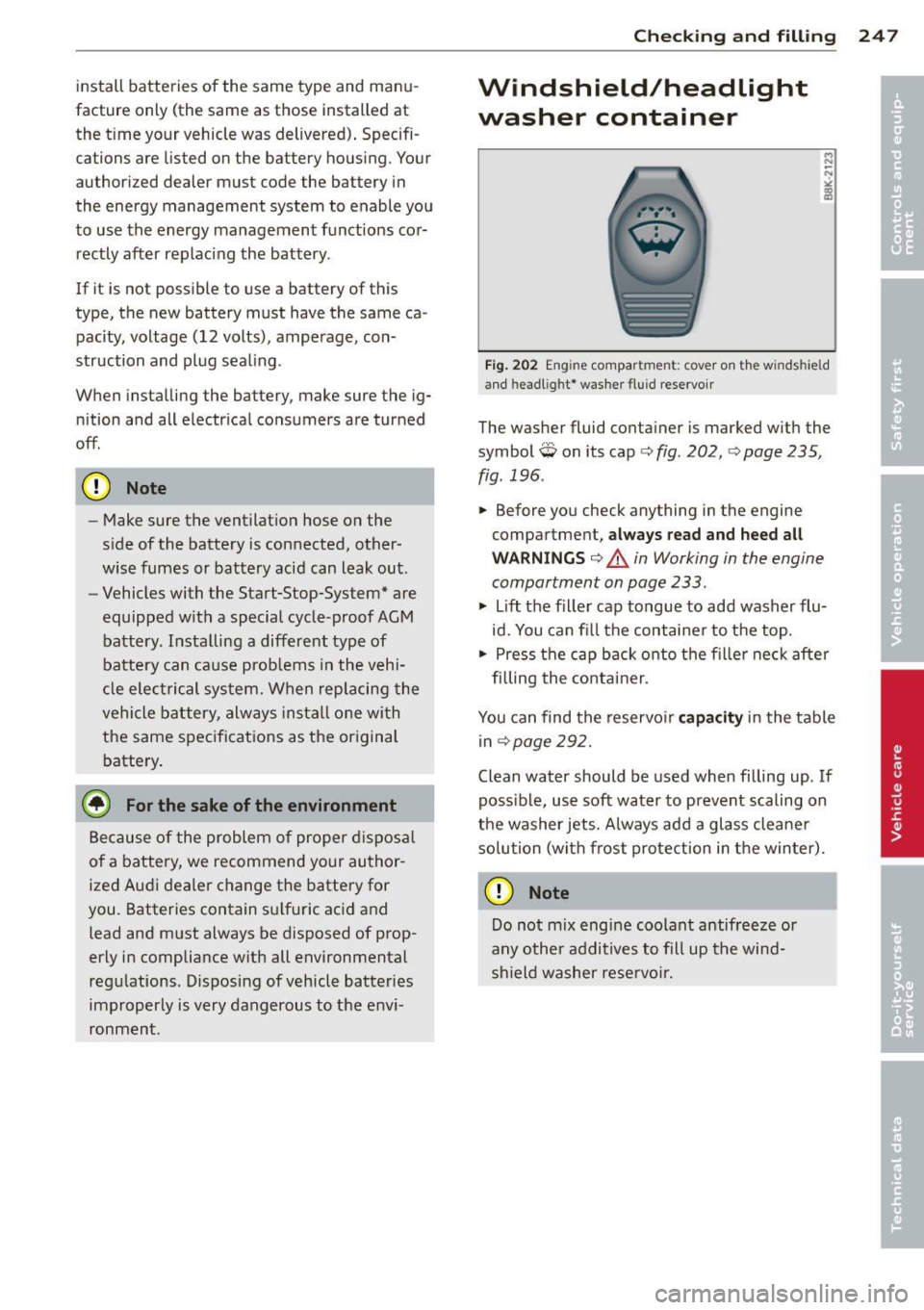
Fig. 202 Eng in e compar tment: cov er on the w inds hield
and headl ight* washe r fl uid reservoir
The washer fluid container is marked with the
symbol
Q on its cap c::> fig. 202, c::> page 235,
fig . 196 .
.., Before you check anything in the engine
compartment,
always read and heed all
WARNINGS c::> &. in Working in the engine
compartment on page 233 .
.., Lift the filler cap tongue to add washer flu
id . You can fill the container to the top.
.., Press the cap back onto the filler neck after
f illing the container.
You can find the reservoir
capacity in the table
in
c::> page 292.
Clean water should be used when filling up. If
possible, use soft water to prevent scaling on
the washer jets. A lways add a glass cleaner
solution (with frost protection in the winter).
(D Note
Do not mix engine coolant antifreeze o r
any other additives to fill up the wind
sh ield washer reservoir.
Page 252 of 316

250 Tires and wheels
Groove
means the space between two adjacent tread
ribs .
Load rating (code)
means the maximum load that a tire is rated
to carry for a given inflation pressure. You
may not find this informat ion on all tires be
cause it is not req uired by law.
Maximum load rating
means the load rating for a t ire at the max i
mum permissible inflation pressure for that
tire.
Maximum loaded vehicle weight
means the sum of:
(a) Curb weight
(b) Accessory weight
(c) Vehicle capacity we ight, and
(d) Production options weight
Maximum (permissible) inflation pressure
means the maximum cold inflation pressure
to which a tire may be inflated. Also called
"maximum inflation pressure ."
Normal occupant weight
means 150 lbs. (68 kilograms) times the
number of occupants seated in the vehicle up
to the total seating capacity of your vehicle .
Occupant distribution
means distribution of occupants in a vehicle.
Outer diameter
means the overa ll diameter of an inflated new
tire.
Overall width
means the linear distance between the exteri
ors of the sidewalls of an inflated tire, includ
ing elevations due to labeling, decorations, or
protective bands o r ribs .
Ply
means a layer of rubber-coated parallel cords.
Production options weight
means the combined weight of those insta lled
regular production options weighing over 5
lbs. (2.3 kg) in excess of those standard items
which they replace, not previously considered
in curb weight or accessory we ight, including
heavy duty brakes, ride levelers, roof rack,
heavy duty battery, and special tr im .
Radial ply tire
means a pneumat ic tire in which the ply cords
that extend to the beads are laid at substan
t ia lly 90 degrees to the center line of the
tread .
Recommended inflation pressure
see<=> page 249, Cold tire inflation pressure.
Reinforced tire
means a t ire design to operate at higher loads
and at h igher inflation pressures than the cor
responding standa rd tire. Reinforced tires
may be identified as "XL" "xl" "EXTRA LOAD"
' ' '
or "RF" on the sidewa ll.
Rim
means a metal support for a tire or a tire and
tube assembly upon which the tire beads are
seated.
Rim diameter
means nom inal diameter of the bead seat. If
you change your wheel s ize, you will have to
purchase new tires to match the new rim di
ameter.
Rim size designation
means r im diameter and width .
Rim width
means nominal distance between rim flanges.
Sidewall
means that portion of a tire between the
t read and bead.
Page 283 of 316
I
I
I
-No. Consumer
6
Headlights range control sys-
tern/Co rnering light
7 Headligh t (corner ing l ight)
Control modules (electrome-
8
chanical parking brake, shock
absorber, quattro Sport, trailer
hitch), DCDC converter
9 Adaptive cruise contro
l or high
voltage battery (hybrid drive)
12 Headlight range contro
l, park
ing system
13 Airbag
14 Rear wiper
15 Auxiliary fuse (ins
trument pan
el)
Auxilia ry fuse terminal 15 (en-
16 gine area)
Fuse panel
@ (brown )
1 E lectric exhaust door
2
3
4
5
6
7 Brake light sensor or brake ped
al movement sensor (hybrid
drive)
Fuel pump
Brake booster (hybrid drive)
Left seat heating with/without
seat venti
lation
ESC
Horn
Left fron t door (window regula -
8 tor, central locking, mirror,
sw itch, lighting)
-9 Wiper motor
10 ESC
Left rear door (window regula
l l tor, sw itch, light ing)
12 Rain and light sensor
Fuse panel © (red)
3 Lumbar support
4 Dynam ic ste ering
5 Climatized cupholder
-Amps
5/ 7,5
7,5
5
5/7,5
5
5
5
15
10
40
5/10
5
25
25
1 5/30
5
15
30
30
2 5
30
5
10
35 10
-
Fu se s and bulb s 281
No. Consumer
6 W
indshield washer system,
headlamp washer system 35
7
Vehicle electrical system control
module 1 20
8
Vehicle electrical system control
module 1 30
9 Panorama su
nroof
10 Vehicle elec
trical system control
30
mod ule 1
11 Sun shade (panorama sunroof)
20
12 Anti-theft alarm warning sys-
tern 5
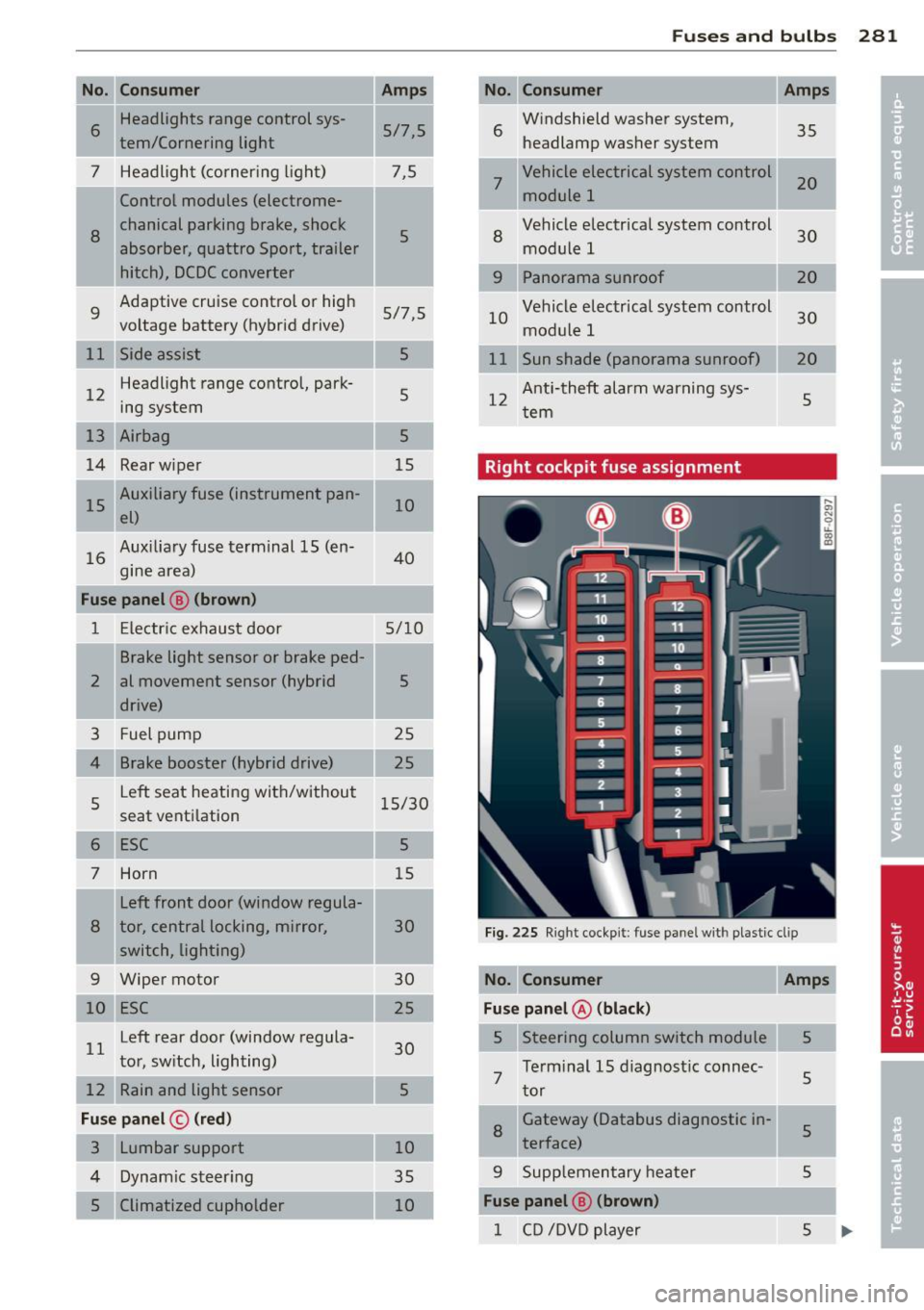
Right cockpit fuse assignment
Fi g. 22 5 Right cockp it : fuse panel wit h plast ic cl ip
No. Consumer Amps
Fuse panel @ (black )
5 Steering column switch module 5
7 Te
rm inal 15 d iagnost ic connec-
tor
5
8 Gateway (Databus diagnostic in-5 terface)
-..
9 Supp
lementary heater 5
Fuse panel @ (brown)
1 CD /D V D p layer 5
Page 293 of 316
designated seating position) and luggage
weight ~&. .
Gross Axle Weight Rating
The G ross Axle Weight Rating is the maximum
lo ad that can be applied at each axle of the
vehicle
q .&. .
Vehicle capacity weight
The vehicle capac ity we ight (max. load) is list
ed on the driver 's side 8-p illar.
Roof weight
The maximum permissible roof weight is
165 lbs (75 kg). The roof weight is made up
of the weight of the roof rack system and the
weight of the object be ing transported
q page 72, Roof load .
..&, WARNING
- The actual Gross Axle Weight Rating at
the front and rear axles sho uld not ex
ceed the permissible weights, and their
combination must not exceed the Gross
Vehicle Weight Rating.
- Exceeding permissible we ight ratings can
result in vehicle damage, accidents and
persona l injury.
Q) Note
- The vehicle capacity weight figures apply
when the load is distributed evenly in the
vehicle (passengers and luggage). When
transporting a heavy load in the luggage
compartment, carry the load as near to
the rear axle as possible so that the veh i
cle's handling is not impaired.
- Do not exceed the maximum permissible
axle loads or the maximum gross vehicle
weight . Always remember that the vehi
cle's handling will be affected by the ex
tra load. Therefore, adjust your speed ac
cordingly.
- Always observe local regulations.
-
General information 291
Dimensions
The specifications refer to the basic model.
Differences may occur depending on the mod
el type and options ordered, for example, tire
sizes.
(D Note
When driving up steep ramps, on rough
roads, over curbs, etc. it is important to re
member that some parts of your vehicle,
such as spoilers or exhaust system compo nents, may be close to the ground . Be
careful not to damage them .
•
•