airbag AUDI Q5 2013 Workshop Manual
[x] Cancel search | Manufacturer: AUDI, Model Year: 2013, Model line: Q5, Model: AUDI Q5 2013Pages: 316, PDF Size: 78.89 MB
Page 191 of 316
and child against the backrest, center
armrest, door or roof.
- Always install rear-facing child safety
seats or infant carriers on the rear seat.
- Forward-facing child safety seats or in
fant carriers installed on the front pas
senger's seat may interfere with the de
ployment of the airbag and cause serious
injury to the child.
- It is safer to install a forward-facing
child safety seat on the rear seat.
- Always read and heed all WARNINGS whenever using a child restrained in ave
hicle is being used¢
page 178. Special
precautions apply when installing a child
safety seat on the front passenger seat
¢ page 158, Child restraints on the front
seat -some important things to know.
A WARNING
Always take special precautions if you
must install a forward or rearward-facing
child restraint on the front passenger's
seat in exceptional situations:
-Whenever a forward or rearward-facing
child restraint is installed on the front
passenger seat, the
PASSENGER AIR
BAG OFF
light must come on and stay on
whenever the ignition is switched on.
- If the
PASSENGER AIR BAG OFF light
does not come on and stay on, perform
the checks described ¢
page 168, Moni
toring the Advanced Airbag System.
- Take the child restraint off the front pas
senger seat and install it properly at one
of the rear seat positions if the
PASSEN
GER AIR BAG OFF
light does not stay on
whenever the ignition is switched on.
- Improper installation of child restraints
can reduce their effectiveness or even
prevent them from providing any protec
tion.
- An improperly installed child restraint
can interfere with the airbag as it de
ploys and seriously injure or even kill the
child.
Child Safety 189
- Always carefully follow the manufactur
er's instructions provided with the child
safety seat or carrier.
- Never place additional items on the seat
that can increase the total weight regis
tered by the weight-sensing mat and can
cause injury in a crash.
A WARNING
Forward-facing child restraints:
- Always make sure the forward-facing
seat has been designed and certified by its manufacturer for use on a front seat
with a passenger front and side airbag.
- Never put the forward-facing child re straint up, against or very near the in
strument panel.
- Always move the passenger seat into its rearmost position in the seat's fore and
aft adjustment range, as far away from
the airbag as possible before installing
the forward-facing child restraint. The
backrest must be adjusted to an upright
position.
- Make sure that the PASSENGER AIR BAG
OFF
light comes on and stays on all the
time whenever the ignition is switched
on.
A WARNING
Rearward-facing child restraints:
- A child in a rearward-facing child safety
seat installed on the front passenger
seat will be seriously injured and can be killed if the front airbag inflates -even
with an Advanced Airbag System.
- The inflating airbag will hit the child
safety seat or infant carrier with great
force and will smash the child safety seat
and child against the backrest, center
armrest, door or roof.
-Always be especially careful if you must
install a rearward facing child safety seat
on the front passenger seat in exception-
al circumstances. .,.
•
•
Page 192 of 316
190 Child Safety
-A tight tether strap on a rearward-facing
child restraint attached to the front pas
senger seat can put too much pressure on the weight-mat in the seat and regis
ter a heavier weight in the Advanced Air
bag System . The heavier weight regis
tered can make the system work as
though an adult were on the seat and de
ploy the Advanced Airbag when it must
be suppressed causing serious or even
fatal injury to the child.
- Make sure that the
PASSENGER AIR BAG
OFF
light comes on and stays on all the
time whenever the ignition is switched
on.
- If the
PASSENGER AIR BAG OFF light
does not come on and stay on, immedi
ately install the rear-facing child safety
seat in a rear seating position and have
the airbag system inspected by your Audi dealer.
Activating the convertible locking
retractor
Use the convertible locking retractor to se
cure a child restraint.
Always heed the child safety seat manufactur
er's instructions when installing a child re
straint in your vehicle . To activate the conver
tible locking retractor:
• Place the child restraint on a seat, prefera
bly on the rear seat.
• Slowly pull the belt
all the way out .
• Route it around or through the child re
straint belt path¢,& .
• Push the child safety seat down with your
full weight to get the safety belt really tight.
• Insert the belt tongue into the buckle for
that seating position.
• Guide the safety belt back into the retractor
until the belt lies flat and snug on the child
safety seat .
• You should hear a "clicking " noise as the
belt winds back into the inertia reel. Test the
convertible locking retractor by pulling on
the belt. You should no longer be able to pull the belt out of the retractor.
The con
vertible locking retractor is now activated.
• Make sure that the red release button is fac
ing away from the child restraint so that it
can be unbuckled quickly.
• Pull on the belt to make sure the safety belt
is properly tight and fastened so that the
seat cannot move forward or sideways more
than one inch
(2.5 cm).
_&. WARNING
-
Using the wrong child restraint or an im
properly installed child restraint can cause
serious personal injury or death in a crash.
- Always make sure that the safety belt re-
tractor is locked when installing a child
safety seat. An unlocked safety belt re
tractor cannot hold the child safety seat
in place during normal driving or in a
crash.
- Always buckle the child safety seat firmly in place even if a child is not sitting in it.
A loose child safety seat can fly around
during a sudden stop or in a crash.
- Always make sure the seat backrest to
which the child restraint is installed is in
an upright position and securely latched
into place and cannot fold forward . Oth
erwise, the seatback with the child safety
seat attached to it could fly forward in
the event of an accident or other emer
gency situation.
- Always read and heed all WARNINGS
whenever using a child restrained in ave
hicle is being used
~page 178. Special
precautions apply when installing a child
safety seat on the front passenger seat
¢ page 158, Child restraints on the front
seat -some important things to know .
Page 196 of 316
194 Child Safe ty
Tether anchors and tether straps
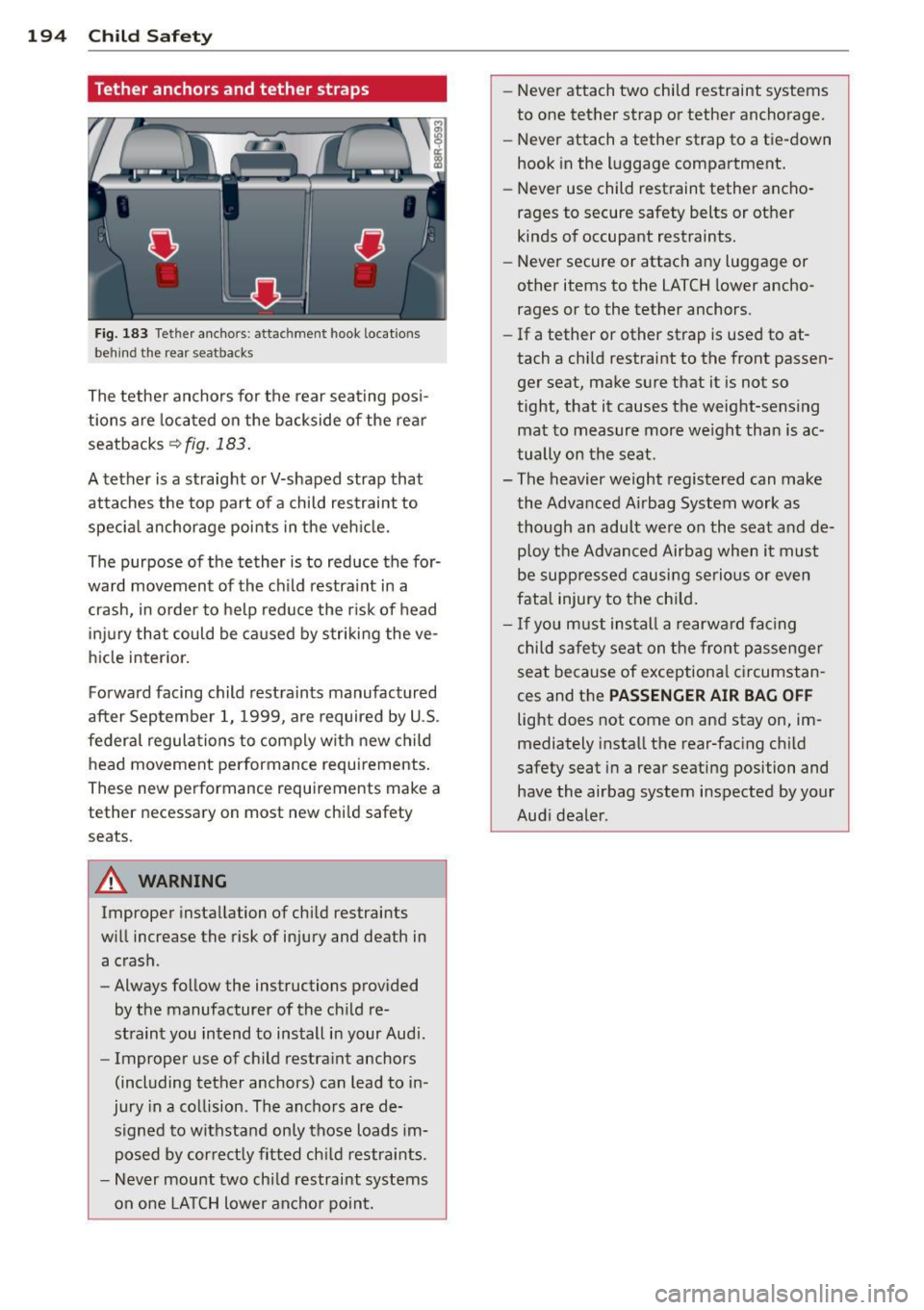
Fig. 183 Tethe r ancho rs: attachment hook locatio ns
behind the rea r sea tbacks
The tether anchors for the rear seating posi
tions are located on the backside of the rea r
seatbacks
~ fig. 183.
A tether is a straight or V-shaped strap that
attaches the top part of a child restraint to
specia l anchorage points in the veh icle.
The purpose of the tether is to reduce the for·
ward movement of the ch ild restra int in a
crash, in order to help reduce the r isk of head
in ju ry that could be ca used by striking the ve
hicle interior.
Forward facing child restra ints manufactured
after September 1, 1999, are required by U .S .
federal regulations to comply with new child
head movement performance requirements.
These new performance requ irements make a
tether necessary on most new chi ld safety
seats.
A WARNING
Improper insta llation of chi ld restraints
w ill increase the risk of injury and death in
a crash.
- Always follow the instructions prov ided
by the manufacturer of the ch ild re
stra int you intend to install in your Audi.
- Improper use of c hild restra int anchors
(including tether anchors) can lead to in ·
jury in a co llision. Th e anchors are de·
sign ed to withstand only those loads im
posed by cor rect ly fi tted ch ild restraints.
- Never mou nt two chi ld restraint systems
on one LA TCH lower anchor po int. -
Never attach two child restraint systems
to one tether strap or tether anchorage .
- Never attach a tether strap to a tie-down
hook in the luggage compartment.
- Never use child restraint tether ancho
rages to secure safety belts or other
kinds of occupant restraints.
- Never secure or attac h any luggage or
other items to the LATCH lower ancho
rages or to the tether anchors.
- If a tether or other strap is used to at
tach a chi ld restraint to the front passen
ger seat, make sure that it is not so
tight, that it causes the weight-sensing mat to measure more we ight than is ac
tually on the seat.
- The heavier weight registered can make the Advanced Airbag System work as
though an adult were o n the seat and de·
p loy the Advanced Airbag when it mus t
be supp ressed causi ng serio us or even
fatal injury to the ch ild .
- If you must ins tall a rearw ard fa cing
c h ild safe ty seat on the fro nt passenger
seat because of exceptiona l circumstan
ces and the
PASSENGER AIR BAG OFF
light does not come on and stay on , im
mediately insta ll the rear-fac ing child
safety seat in a rear seating position and have the airbag system inspected by your
Aud i deale r.
Page 197 of 316
Installing the upper tether strap on the
anchorage
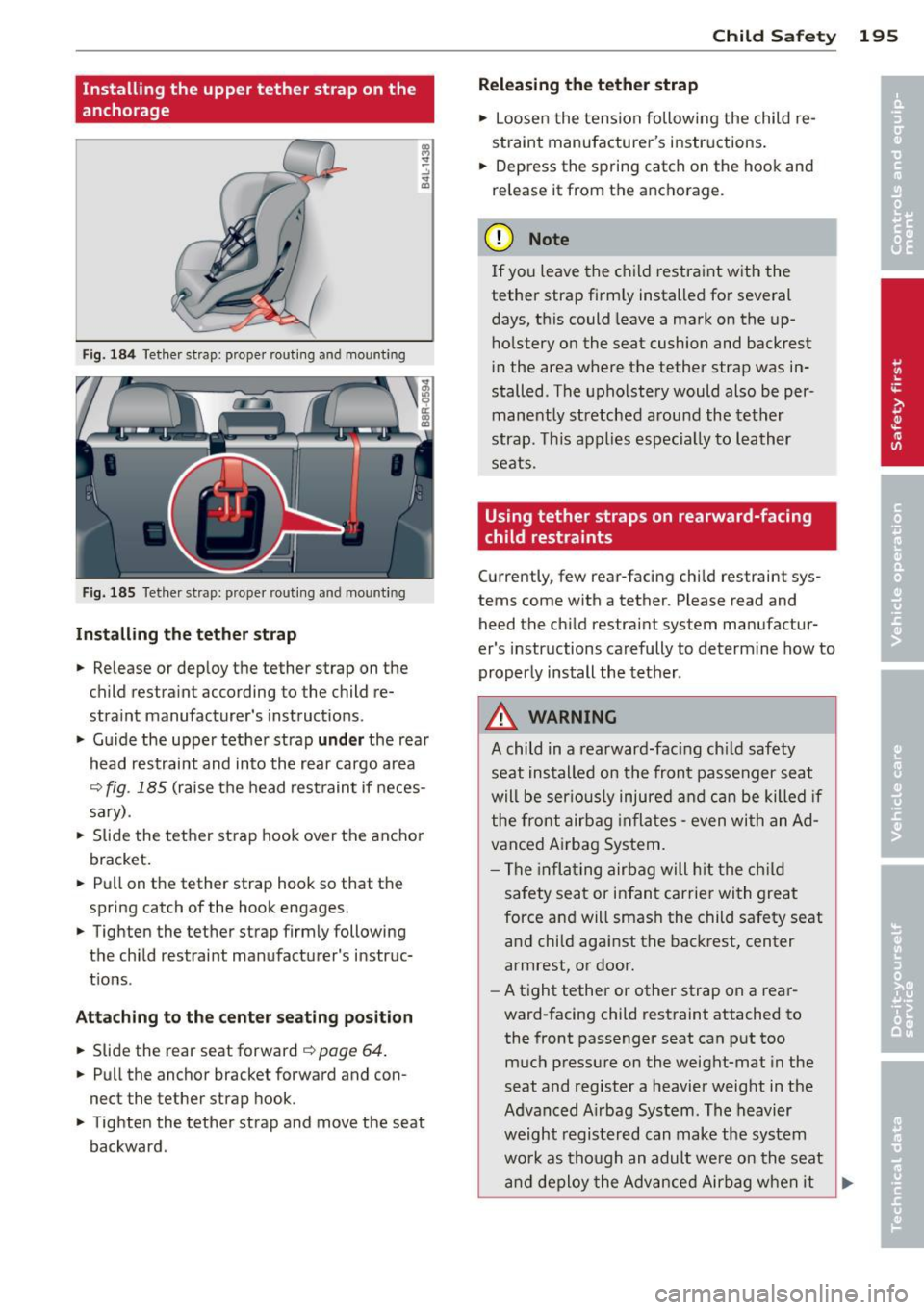
Fig. 184 Tether strap: proper routi ng and mounting
Fig. 185 Tether strap: proper rou ting and mounting
In sta ll ing the tether strap
• Release or deploy the tether strap on the
child restra int according to the child re
straint manufacturer's instructions .
• Gu ide the upper tether strap
under the rear
head restraint and into the rear cargo area
Q fig. 185 (raise the head restraint if neces
sary) .
• Slide the tether st rap hook over the ancho r
bracket.
• Pu ll on the tether strap hook so that the
spring catch of the hook engages.
• Tighten the tether strap firmly following
the child restrai nt manufacturer's instruc
t ions .
Attaching to the cent er seating po sition
• Slide the rear seat forward ¢ page 64.
• Pull the anchor bracket forward and con
nect the tether strap hook.
• Tighten the tether strap and move the seat
backward .
Child Safet y 195
Releasing th e teth er strap
• Loosen the tension following the child re
straint manufacturer's instructions.
• Depress the spring catch on the hook and
release it from the anchorage.
(D Note
If you leave the child restraint w ith the
tether strap firmly installed fo r several
days, t his could leave a mark on the up
holstery on the seat cushion and backrest
in the area where the tether strap was in
stalled . The upholstery would also be per
manently stretched around the tether
strap. This applies especia lly to leather
seats.
Using tether straps on rearward-facing
child restraints
Currently, few rear-facing child restraint sys
tems come with a tether. Please read and
heed the ch ild restraint system manufactur
er's instructions carefully to determine how to
properly install the tether .
A WARNING
A child in a rearward-fac ing ch ild safety
seat installed on the front passenger seat
will be ser ious ly injured and can be killed if
the front airbag inflates -even with an Ad
vanced Airbag System.
- The inflating airbag will h it the ch ild
safety seat or infant carrier with great
force and will smash the child safety seat
and child against the backrest, center
armrest, or door.
- A tight tether or other strap on a rear
ward-facing child restraint attached to
the front passenger seat can put too
much pressure on the weight-mat in the
seat and register a heavier weight in the
Advanced A irbag System. The heavier
weight registered can make the system
wo rk as though an adult we re on the seat
a nd deploy the Advanced Airbag when it
Page 199 of 316
Intelligent technology Notice about data
recorded by vehicle
control modules
Your vehicle is not equipped with an Event Da
ta Recorder (EDR), installed by some manu
facturers for the express purpose of capturing
data for retrieval after an accident or crash
event. EDR's are sometimes called "crash re
corders".
Some state laws restrict the retr ieval or down
loading of data stored by EDR's that were in
stalled in a vehicle for the express purpose of
retrieving data after an accident or crash
event without the owner's consent.
Although your vehicle is not equipped with an
EDR, it is equipped with a number of electron
ic control modules for various vehicle systems
such as, for examp le, engine function, emis
sion control, as well as for the airbags and
safety belts.
These electronic control modules also record
vehicle-related data during norma l vehicle op
eration for diagnostic and repair purposes.
The recording capacity of the electronic con
trol modules is limited to data (no sound is re
corded) and only a small amount of data is ac
tually recorded over a very limited period of
time and stored when a system fault or other
condition is sensed by a control unit. Some of
the data then stored may relate to vehicle
speed, direction, braking as we ll as restraint
system use and performance in the event of a
crash or other condition. Stored data can only be read and downloaded with special equip
ment.
Electronic Stabilization
Control (ESC)
Description
The Electronic Stabilization Control (ESC) rein
forces driver safety. It reduces the risk of slip
ping and improves driving stability. ESC de
tects critical s ituations such as the vehicle
Intelligent technology 197
oversteering and understeering or the whee ls
spinning . The vehicle is stabilized by applying
the brakes or reducing eng ine torque . Once
the ESC is active, the indicator light
G1 blinks
in the instrument cluster.
ESC includes the anti-lock brake system (ABS),
brake assist system, anti-slip regulation
(ASR), electronic differential lock (EDL), dy
namic steering*, hill descent assist and selec
tive wheel torque control.
Anti-lock braking system (ABS)
ABS prevents the whee ls from locking up
when braking . The vehicle can still be steered
even during hard braking. App ly steady pres
sure to the brake pedal. Do not pump the ped
al. A pulsing in the brake pedal indicates that
the system is helping you to brake the vehicle .
Brake assist system
The brake assist system can decrease braking
distance. It increases braking power when the
driver presses the brake pedal quickly in emer
gency situations . You must press and hold the
brake pedal until the situation is over . In
vehicles with adaptive cruise control*, the
brake assist system is more sensitive if the
distance detected to the vehicle ahead is too
small.
Anti-slip regulation (ASR)
ASR reduces engine power when the drive
wheels beg in to sp in and adapts the force to
the road conditions. This makes it easier to
start, accelerate and drive up hill s.
Electronic differential lock (EDL)
The EDL brakes wheels that are spinning and
transfers the drive power to the othe r whee ls .
T his function is available up to about 78 mph
(125 km/h) .
In extreme cases, EDL automatically switches
off to help keep the brake on the braked wheel
from overheat ing. EDL will switch on again au
tomatically when conditions have returned to
normal.
•
•
Page 226 of 316
224 Cleaning and protection
Cl ean ing s ta ins
Stains caused by beverages (e.g. coffee, fruit
juice, etc.) can be treated with a mild deter
gent solution. App ly the detergent so lution
with a sponge. In the case of stubborn stains,
a detergent paste can be applied directly to
the stain and worked into the fabric. After
wards, use copious amounts of clean water to remove the remaining detergent . Apply the
water with a damp cloth or sponge and pat
the fabric d ry w ith an absorbent, dry cloth.
Stains from chocolate or makeup should have
detergent paste rubbed into them. After
wards, remove the soap w ith water (damp
sponge) .
Alcohol can be used to treat stains from
grease, oil, lipstick or a ballpo int pen. Melted
grease or dye must be patted off using ab
sorbent material.
It may be necessary to re
treat the a reas with dete rgent paste and wa
ter.
In the case of genera l so iling of the uphols
tery and cover mater ial, we recommend h iring
a specialist that has the eq uipment to clean
the sea t covers and other fabric surfaces by
shampooing and spray extraction.
& WARNING
Always read and heed a ll WARNINGS and
the information
¢ page 216.
(D Tips
Open Ve lcro fasteners on your cloth ing can
damage the seat cover. P lease make sure
that Ve lcro fasteners are closed .
Plastic parts and instrument panel
Always use a clean cloth moistened in clear
water to clean these areas. For pers istent dirt
use an Audi approved
solv ent-fr ee plastic
cleaner/protectant.
& WARNING
Solvents can change the properties of
some p lastics and make it harder fo r the
a ir bag to deploy.
-
- Never clean the instrument panel or the
surface of airbag modu les w ith cleaning
products that conta in solvents.
- Products containing solvents will make
the surface of this pa rt porous.
- Ser ious injuries can resu lt if p lastic parts
come loose when the a irbag is deployed .
- Always read and heed all WARNINGS and
other information ¢
page 216.
(D Note
Cleaning agents conta ining so lvents wi ll
attack the material and can change the
way it behaves.
Natural leather
Applies to vehicles: with natural leather
Audi makes great efforts to maintain the
properties, natural look and feel of interior
leather.
General
We offer many different types of leather on
o u r vehicles. Most are d ifferent types of nappa
l eather, which has a smooth surface and
comes in various colors.
The intensity of the co lor determines the visu
al characteristics and appea rance. If the sur
face of the leather has a typica l natural look,
then the leather is a nappa leather that has
been left in a relative ly natural condit ion. This
leather offers particularly good comfort and
breathes we ll. Fine veins, closed grains, insect
bites, sk in fo lds, and subt le variations in color
rema in v is ible. These charac ter istics demon
strate that the mate rial is natura l.
Natural nappa leather is not covered by a co l
o r finish.
It is therefo re more sensit ive to soil
ing and wea r, which is someth ing you need to
consider if children, animals or other fac tors
mig ht prove to be particu larly hard on the
l eather . ..,
Page 245 of 316

thoroughly checked by an authorized Audi
dealer or qualified workshop and the cause
corrected .
If the brake fluid level is too low ,
the brake warning/indicator light will i llum i
nate. Con tact an au thori zed Aud i dealer
im ·
mediately .
Changing brake fluid
Have the brake fluid changed by an experi
enced technician .
Brake fluid absorbs moist ure from the a ir. If
the water con tent in the brake fluid is too
h igh, corrosion in the brake system may resul t
after a per iod of t ime . The bo iling po int of the
brake fluid w ill also decrease considerably and
decrease b raking performance .
There fore, the brake flu id must be changed
e very two years . Always use new brake fluid
which conforms to Fede ral Motor Vehicle
Standard "FMVSS 116 DOT 4 ".
The brake flu id reservoir can be difficult to
reac h, therefore , we recommend that you
h ave the brake flu id changed by your author
iz ed
Audi dealer . Your deale r has the co rrect
too ls, the right b rake fluid and the know-how
to do this fo r you.
_& WARNING ,~
- Brake fluid is po isonous. I t must be s to r
ed only in the closed orig inal container
o ut o f the reac h of c hildren!
- Brake fa ilure can resu lt from old o r inap
propriate b rake fluid. Observe these pre
cautions :
- Use o nly bra ke fluid t hat meets SAE
specification
J 1703 and confo rms to
Federal Motor Vehicle Sta ndard 116 .
Always check wi th you r auth orized Audi
deale r to make s ure you are using the
correct brake f luid . The co rrec t type of
brake fluid is a lso indicated on the
brake fluid reservoir .
- The brake f lui d m ust be new. Heavy use
of the b rakes can ca use a vapor lock if
the brake fl uid is left in the system too
long . This can ser io usly affect the effi-
Checkin g and fillin g 243
ciency of the brakes as well as your
safety. Th is co uld resu lt in an accident.
(D Note
B ra ke fluid will damage the pa int o f you r
vehicle .
@ For the sake of the environment
Because o f the p rob lem of proper disposal
of bra ke fluid as well as the spec ia l t oo ls
r equire d an d the necessary expe rtise, we
recommend that yo u have the brake f luid
changed by yo ur authorized Aud i dea ler.
Battery
General information
Under n o rmal ope ra ti ng cond itions , the b at
te ry in yo ur Audi does not need any ma inte
nance . With
high outside temperat ures or
l ong daily drives we recommend that you have
the e lectrolyte leve l checked by an authorized
Audi dealer or qualified workshop. The elec
troly te level should also be checked each t ime
the battery is charged
c:> page 245 .
Have the battery checked when yo u take you r
vehicle in for service. You are well advised to
replace a battery that is older than 5 years .
With certain types of airbag deployment, the battery is disconnected from the veh icle elec
trical system for safety reasons
c:> .&. in Re
pair, care and disposal of the airbags on
page 171 .
Hybrid drive* : you can find important informa
tion about the high voltage battery under
c:> page 97.
Di sconnecting the battery terminals
Some vehicle functions (power window reg u
lators, for example) are lost if t he battery te r
mina ls are disconnected. These f unctions have
to be relearned after the ba ttery termina ls are
con nected aga in . To prevent th is, the battery
shou ld only be d isconnected from the veh icle
electrica l system when abso lutely necessary
fo r repa irs. ..,_
•
•
Page 283 of 316
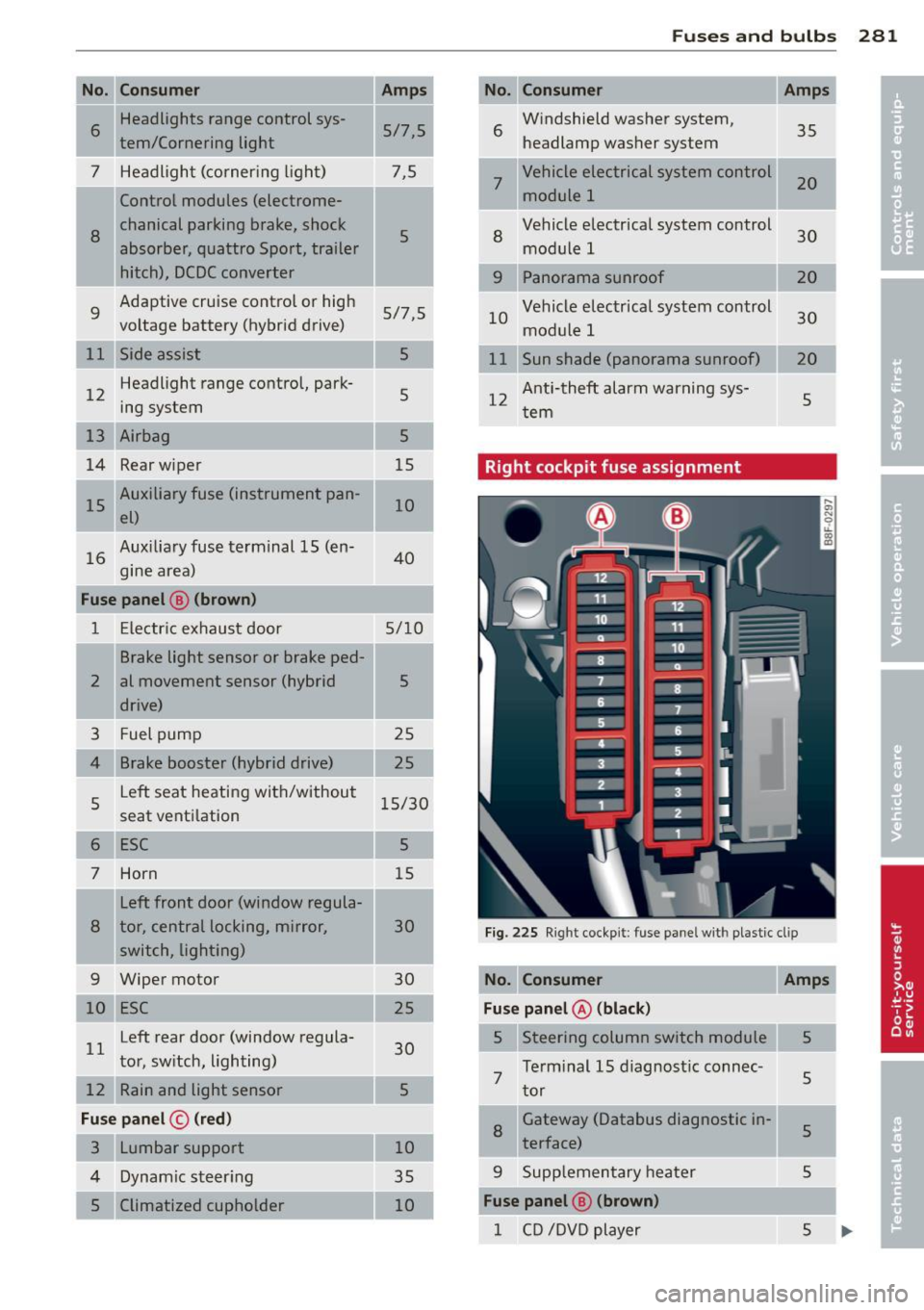
I
I
I
-No. Consumer
6
Headlights range control sys-
tern/Co rnering light
7 Headligh t (corner ing l ight)
Control modules (electrome-
8
chanical parking brake, shock
absorber, quattro Sport, trailer
hitch), DCDC converter
9 Adaptive cruise contro
l or high
voltage battery (hybrid drive)
12 Headlight range contro
l, park
ing system
13 Airbag
14 Rear wiper
15 Auxiliary fuse (ins
trument pan
el)
Auxilia ry fuse terminal 15 (en-
16 gine area)
Fuse panel
@ (brown )
1 E lectric exhaust door
2
3
4
5
6
7 Brake light sensor or brake ped
al movement sensor (hybrid
drive)
Fuel pump
Brake booster (hybrid drive)
Left seat heating with/without
seat venti
lation
ESC
Horn
Left fron t door (window regula -
8 tor, central locking, mirror,
sw itch, lighting)
-9 Wiper motor
10 ESC
Left rear door (window regula
l l tor, sw itch, light ing)
12 Rain and light sensor
Fuse panel © (red)
3 Lumbar support
4 Dynam ic ste ering
5 Climatized cupholder
-Amps
5/ 7,5
7,5
5
5/7,5
5
5
5
15
10
40
5/10
5
25
25
1 5/30
5
15
30
30
2 5
30
5
10
35 10
-
Fu se s and bulb s 281
No. Consumer
6 W
indshield washer system,
headlamp washer system 35
7
Vehicle electrical system control
module 1 20
8
Vehicle electrical system control
module 1 30
9 Panorama su
nroof
10 Vehicle elec
trical system control
30
mod ule 1
11 Sun shade (panorama sunroof)
20
12 Anti-theft alarm warning sys-
tern 5
Right cockpit fuse assignment
Fi g. 22 5 Right cockp it : fuse panel wit h plast ic cl ip
No. Consumer Amps
Fuse panel @ (black )
5 Steering column switch module 5
7 Te
rm inal 15 d iagnost ic connec-
tor
5
8 Gateway (Databus diagnostic in-5 terface)
-..
9 Supp
lementary heater 5
Fuse panel @ (brown)
1 CD /D V D p layer 5
Page 299 of 316
-Always make sure the transm ission se
lector lever (automatic transmiss ion) is
in P (Park position) and the park brake is
applied.
@) For the sake of the environment
- Changing the eng ine settings w ill ad
versely affect em ission levels. This is det
rimental to the environment and increas
es fuel consumption .
- Always observe env ironmental regula
tions when d isposing of old engine oil,
used brake fluid, dirty engine coolant,
spent batter ies or worn out t ires.
- Undeployed airbag modules and preten
s ioners might be classified as Perchlo
rate Material -specia l hand ling may ap
ply, see www.dts c.ca .gov/hazardous
waste/perch lorate. When the veh icle or
parts of the restraint system includ ing
airbag modules safety belts with preten
sioners are scrapped, all applicable laws
and regulations must be observed. Your
a uthorized Audi dea ler is familiar w ith
these requirements and we recommend
that you have your dea ler perform this
serv ice for you .
Additional accessories,
modifications and
parts replacement
Additional accessories and parts
replacement
Always consult an authorized Audi dealer be
fore purchasing accessories.
Your veh icle incorporates the latest safety de
sig n featu res ensu ring a high standard of ac
tive and passive safety.
This safety could be compromised by non-ap proved changes to the veh icle. For this reason,
if parts have to be replaced, please observe
the following points when install ing addition
a l accessories:
Con sumer In formation 297
Approved Audi accesso ries and genuine Audi
parts are available from authorized Audi deal
ers.
T hese dea lers a lso have the necessary facili
ties, tools and trained specialists to install the
parts and accessories proper ly.
A WARNING
Using the wrong spare parts or using non
approved accessories can cause damage to
the vehicle and serious persona l injury.
- Use on ly accessories express ly approved
by Audi and genu ine Audi spare parts
- These parts and accessories have been
specially designed to be used on your ve
hicle .
- Never install accessories such as tele
phone cradles or beverage holders on air
bag covers or within the airbag deploy
ment zones . Do ing so will increase the
risk of injury if a irbags are triggered in an
accident!
- Before you check anything in the engine
compa rtment, always read and heed all
WARNINGS ~
page 226.
(D Note
-If items other than genuine Audi spare
parts, add-on equipment and accessory
items are used or if repair work is not
performed accord ing to specified meth
ods, this can result in severe damage to
your vehicle's engine and body (such as
corrosion) and adversely affect your vehi
cle's warranty .
- If emergency repairs must be performed
elsewhere, have the vehicle examined by
an authorized Audi dealer as soon as
possible.
- The manufacturer cannot be held liable
for damage wh ich occurs due to failure
to comply with these stipulations.
•
•
Page 302 of 316
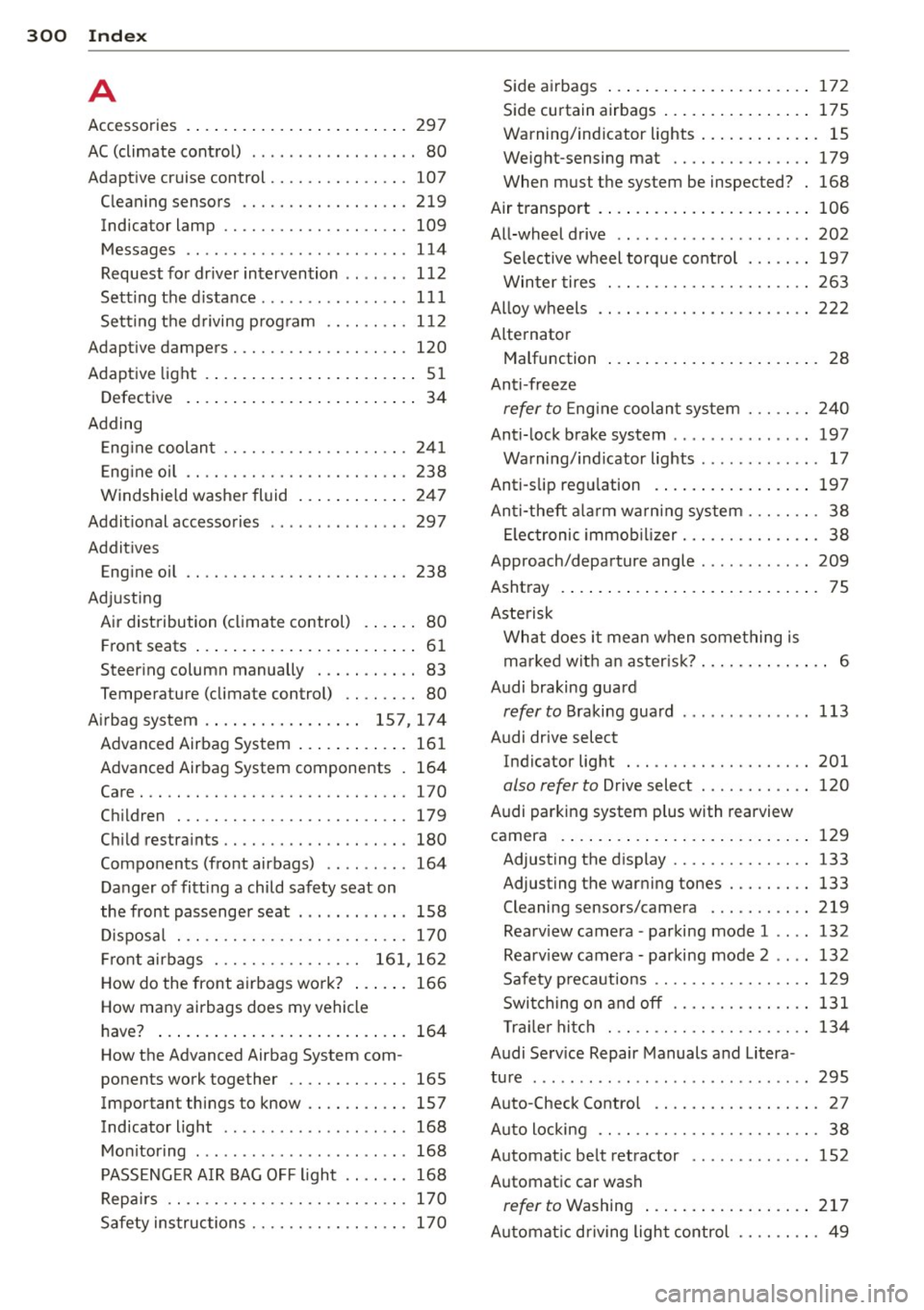
300 Index
A
Accessories 297
AC (climate control) . . . . . . . . . . . . . . . . . . 80
Adaptive cruise control . . . . . . . . . . . . . . . 107
Cleaning sensors ......... .. .. .... . 219
Indicator lamp . . . . . . . . . . . . . . . . . . . . 109
Messages .. ..... ........... ... .. . 114
Request for dr iver intervention . . . . . . . 11 2
Setting the d istance ........ ... .. ... 111
Setting the d riving p rog ram .. .. .... . 112
Adapt ive dampers . . . . . . . . . . . . . . . . . . . 120
Adaptive light . .. . ...... ... ... ..... .. 51
Defective . . . . . . . . . . . . . . . . . . . . . . . . . 34
Adding
E . l ngine coo ant ........... .. .. .... . 241
E ng ine oi l ............... .. .. .. .. . 238
W indshie ld washer fluid ... .. .. .... . 247
Addit ional accesso ries ... ... .. .. .. .. . 297
Additives
Eng ine oil .... ........... .. .. .... .
238
Adjusting
A ir dist ribution (climate control) . .... .
80
Front seats .... .. ..... ... .. .. .... .. 6 1
Steer ing column manually . .. .. .... .. 83
Temperature (climate control) .. .. .. . . 80
A irbag system . . . . . . . . . . . . . . . . . 157, 174
Advanced Airbag System ... .. .. .... . 161
Advanced Airbag System components . 164
Care . .. .. ............... .. .. .... . 170
Chi ldren . ............... .... .... . 179
Ch'ld t .
1 res ra 1nts ........... .. .. .. .. . 180
Components (front airbags) .. .. .. .. . 164
Danger of fitting a child safety seat on
the front passenger seat . .. .. .. .... .
158
Disposa l ..... ........... .. .. .. .. . 170
Fr ont airbags . . . . . . . . . . . . . . . . 16 1, 16 2
How do the front airbags work? ..... . 166
How many airbags does my vehicle
have? ..... ... .. ..... ... .. .. .... .
164
How the Advanced Airbag System com-
ponents work together ...... .. .... .
165
Important things to know .. .. .. .. .. . 157
Ind icator light ..... ...... .. .. .. .. . 168
Monitoring . ................ ... ... 168
PASSENG ER A IR BAG OFF light .. .. .. . 168
Repa irs .. .. .. . .......... .. .. .. .. . 170
Safety ins tructions ........ .. .. .. .. . 170
S ide a irbags ..... ... .. ..... .... . .. 172
Side curtain airbags .... ..... ... .. .. 175
Warning/ind icator lights ..... ... .. .. . 15
w. ht .
e1g -sensing mat . . . . . . . . . . . . . . . 179
When must the system be inspected? . 168
Air t ransport . ..... .. ... ..... ... .. .. 106
All-wheel drive .. .. ................ . 202
Selective wheel torque co ntrol . . . . . . . 19 7
Winter tires ... .. ............. .... 2 63
Al loy wheels .... .. ... .......... .... 222
Alternator
Malfunction . . . . . . . . . . . . . . . . . . . . . . .
28
Anti-free ze
refer to E ng ine coolan t sys tem ... .. .. 2 40
Anti- lock brake system .............. . 197
Warning/ind icator lights .. ... ..... .. . 17
Anti-slip reg ulation . .. .. ..... .... . .. 197
An ti-theft a la rm warn ing system . .. .. .. . 38
El ectronic immob il iz er .......... .... . 38
Approach/depa rture angle ........... . 209
Ashtray .... .... .. .. ... .. ..... ... .. . 75
Aste risk
What does it mean when something is
ma rked wit h an as ter isk? ..... ... .. .. .. 6
Audi braking guard
refer to Braking gua rd ............. . 113
Audi drive select
Indicator lig ht . .. ............. .. ..
201
also refer to Drive select .. ...... .... 120
Audi parking system plus with rearview
camera . ... .... .. .. ... .. ..... ... ..
129
Adjusting the d isplay ............. .. 133
Adjusting the war ning tones ..... .... 133
Cleaning sensors/camera ... .... .. .. 219
Rearv iew camera -parking mode 1 ... . 132
Rea rv iew camera -parking mode 2 .. .. 132
Safety p recautio ns ............. .... 129
Swi tch ing on a nd off ........... .... 131
Tra ile r hi tch . .. .. ... .......... .... 134
Audi Serv ice Repair Manuals a nd Litera -
ture . .. ... ... .. .. .. ... ... ... .. .. ..
295
Auto-Check Contro l . . . . . . . . . . . . . . . . . . 27
A ut o locking . . . . . . . . . . . . . . . . . . . . . . . . 38
Automat ic be lt retractor . .. ... ..... .. 152
Automatic car wash
refer to Washing ... ... ..... ... .. .. 217
A utomat ic d riving light control ...... .. . 49