lock AUDI Q5 2014 Repair Manual
[x] Cancel search | Manufacturer: AUDI, Model Year: 2014, Model line: Q5, Model: AUDI Q5 2014Pages: 316, PDF Size: 78.41 MB
Page 185 of 316
as possible before installing the child
restraint.
- Always make sure that nothing pre
vents the front passenger's seat from
be ing moved to the rearmost position
in its fore and aft adjustment range.
- Always make sure that the backrest is
in the upr ight position.
- Always buck le the child safety seat firmly
in place even if a child is not sitting in it.
A loose ch ild safety seat can fly around
dur ing a sudden stop or in a col lision .
- Always read and heed all WARNINGS
whenever using a child restrained in ave
hicle is being used
c::> page 149, Safety
belts,
c::> page 157, Airbag system and
c::> page 178, Child Safety.
A WARNING
T o reduce t he ris k of serious injury, make
sure that the
PASSENGER AIR BAG OFF
light comes on and stays on whenever a
child rest raint is installed on the front pas
senger seat and the ignition is switc hed
on.
- Take the child restraint off t he fro nt pas
senger seat and install it properly at one
of the rear seat positions if the
PASSEN ·
GER AIR BAG OFF
light does not stay on.
- Have the airbag system inspected by
your authorized Aud i dealer immediate
ly.
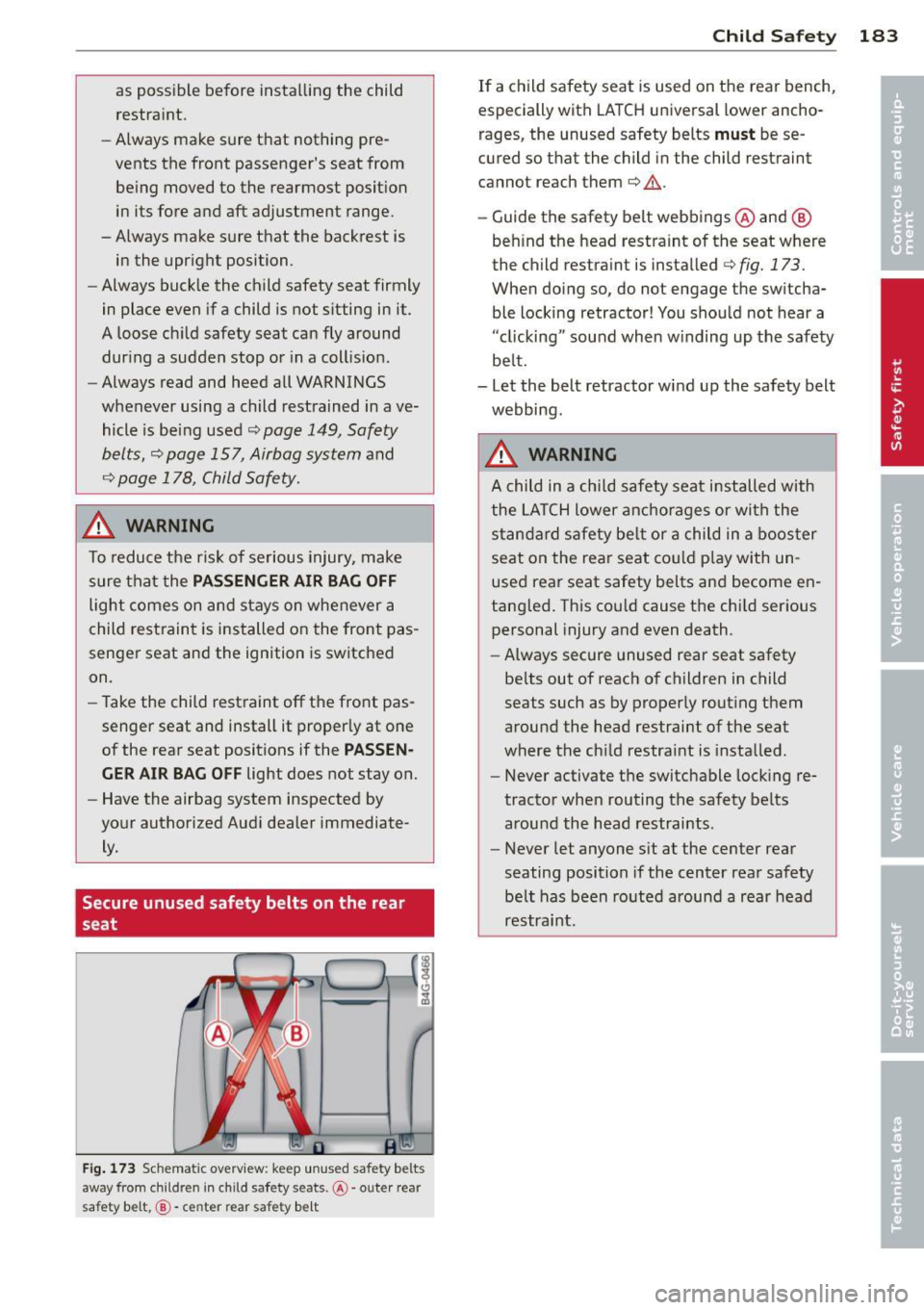
Secure unused safety belts on the rear
seat
F ig. 173 Schematic overv iew: keep un used safety belts
away from children in child safety seats.@-oute r rear
safety belt,
@ -center rear safety belt
Child S afety 183
If a child safety seat is used on the rea r bench,
especially with LATCH universal lower ancho
rages, the unused safety belts
must be se
cured so that the child in the child restraint
cannot reach them
c::> &.
-Guide the safety belt webbings @and @
beh ind the head restraint of the seat where
the child restra int is insta lled
c::> fig. 173.
When doing so, do not engage the switcha
ble locking retractor! You should not hear a
"cl icking" sound when w inding up the safety
be lt .
- Let the belt retractor wind up the safety belt
webbing.
A WARNING
A child in a chi ld safety seat i nstalled with
the LA TCH lower ancho rages or with the
standard s afety be lt or a child in a boos ter
seat on the rea r seat co uld p lay with un
use d rea r seat safety belts and become en
tang led . This could cause t he chi ld ser ious
personal injury and even death.
- Always secure unused rear seat safety
be lts out of reach of children in child
seats such as by proper ly rout ing them
around the head restrai nt of the seat
where the ch ild restraint is installed.
- Never activate t he switchable l ock ing re
tracto r when routing the safety be lts
around the head restraints.
- Never let anyone s it at the center rear
seating position if the center rea r safety
be lt has been routed around a rear head
restraint.
Page 186 of 316
184 Child Safet y
Child safety seats
Infant seats
Babies and infants up to about one year old
and 20 lbs. or 9 kg need special rearward-fac
ing child restraints that support the back,
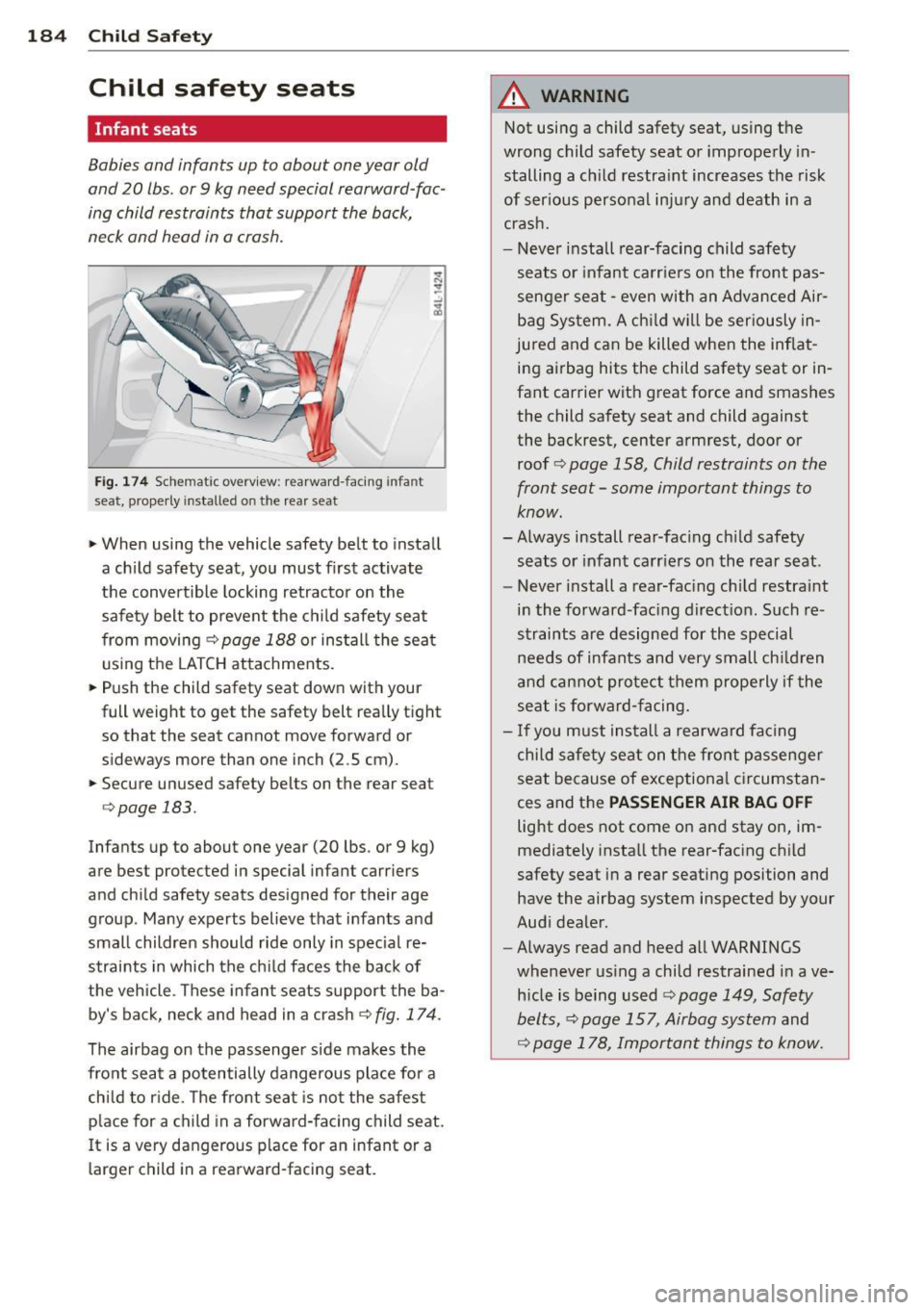
neck and head in a crash.
-- /
Fig . 174 Sche matic overview: rearward- facing infant
seat, properly installed o n the rear seat
> When using the vehicle safety belt to install
a ch ild safety seat, you must first activate
the convertible locking retractor on the
safety belt to prevent the child safety seat
from moving ¢
page 188 or install the seat
using the LATCH attachments.
> Push the child safety seat down with your
full weight to get the safety belt rea lly tight
so that the seat cannot move forward or
sideways more than one inch (2.5 cm).
> Secure unused safety belts on the rear seat
¢page 183.
Infants up to about one year (20 lbs. or 9 kg)
are best protected in special infant carriers
and child safety seats designed for their age
group . Many experts believe that infants and
small children should ride only in spec ial re
straints in which the ch ild faces the back of
the vehicle . These infant seats support the ba
by's back, neck and head in a crash ¢
fig. 174.
The airbag on the passenger side makes the
fro nt seat a potentially dangerous place for a
child to r ide . The front seat is not the safest
p lace for a child in a forwa rd-facing child seat.
I t is a very dangerous p lace for an infant or a
larger child in a rearward-facing seat.
A WARNING
-Not using a child safety seat, using the
wrong child safety seat o r improperly in
stalling a ch ild restra int increases the risk
of ser ious personal in ju ry and death in a
crash.
- Never install rear-facing child safety
seats or infant ca rr ie rs o n the front pas
senger sea t -even with an Advanced Air
bag Sys tem. A c hild will be ser iously in
jured and can be killed whe n the inflat
ing ai rbag hits the child safety seat or in
fant carrier with great force and smashes the child safety seat and child against
the backrest, center armrest, door or
roof ¢
page 158, Child restraints on the
front seat -some important things to
know.
- Always install rear-facing ch ild safety
seats or infant ca rr ie rs on the rear seat .
- Never install a rear-fac ing ch ild restra int
in th e forward-fac ing direct ion. Such re
straints are designed for the special needs of infants and very small ch ild ren
an d cannot protect them prope rly if the
seat is forward- facing.
- If you m ust insta ll a rearwa rd fa cing
child safety seat on the fro nt passenger
seat be cause of exceptiona l circumstan
ces and the
PASSENGER AIR BAG OFF
light does not come o n and stay on, im
mediately insta ll the rear-fac ing child
safety seat in a rear seating position and
have the airbag system inspected by your
Aud i deale r.
- Always read and heed all WARNINGS
whenever us ing a child restrained in ave
h icle is being used
¢ page 149, Safety
belts, ~page 157, Airbag system
and
c::> page 178, Importan t things to know.
Page 187 of 316
Convertible child safety seats
Properly used convertible child safety seats
can help protect toddlers and children over
age one who weigh between 20 and 40 lbs. (9
and 18 kg) in a crash.
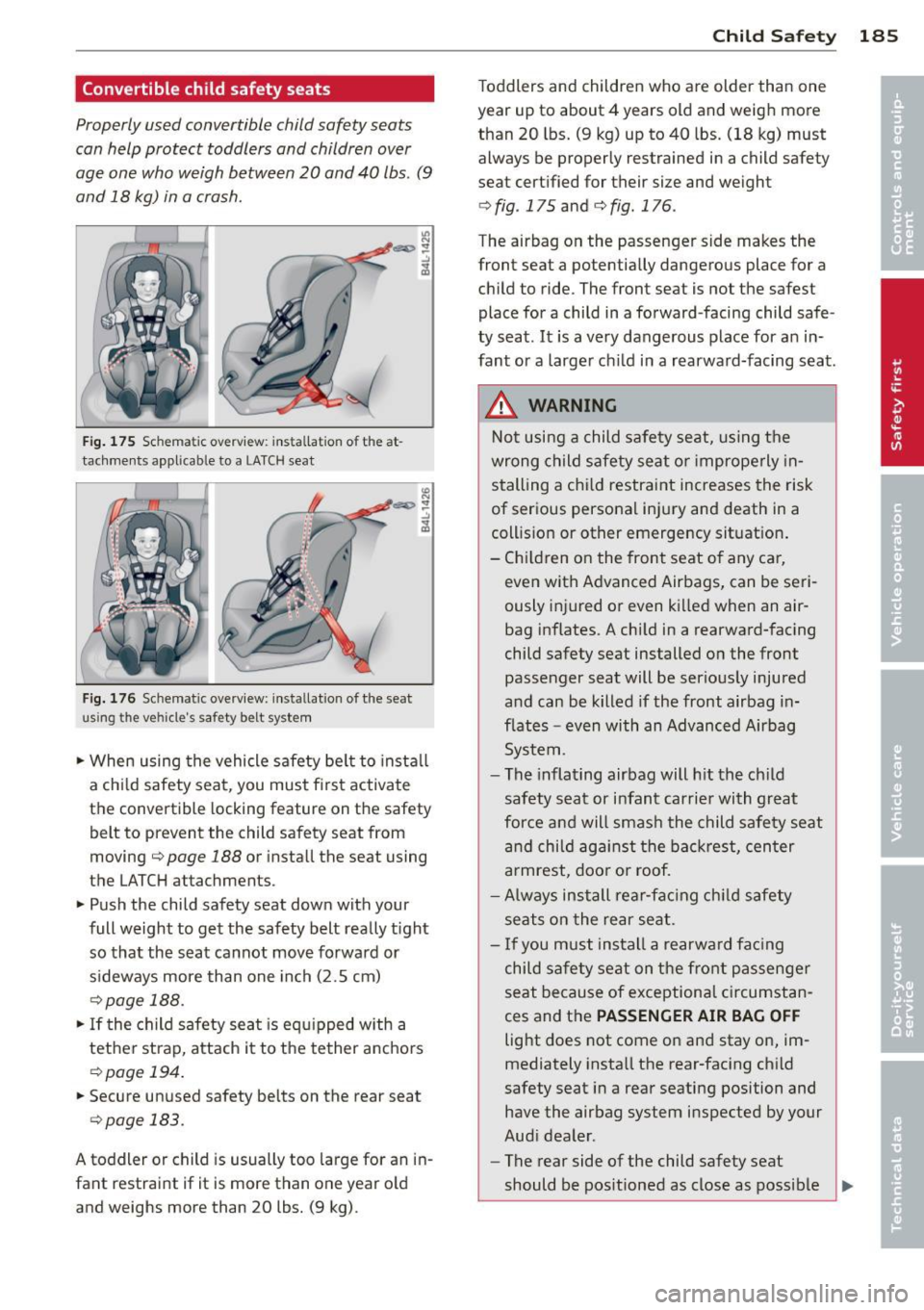
F ig . 175 Sche mati c overvi ew : ins tallat ion o f the at
tachments appl icable to a LA TCH seat
F ig. 176 Schem atic overview: installat ion of t he seat
u sing the ve hicle' s safety b elt sy stem
.. When using the vehicle safety be lt to insta ll
a chi ld safety seat, you must f irst activate
the convertible locking feature on the safety
belt to prevent the child safety seat from
moving
c::> page 188 or install the seat using
the LATCH attachments .
.,. Push the child safety seat down with your
full weight to get the safety belt really t ight
so that the seat cannot
move forward or
s ideways more than one inch (2.5 cm)
c:;, page 188.
.,. If the child safety seat is equ ipped with a
tet her strap, attach it to the tether anchors
c:;, page 194 .
.. Secure unused safety belts on the rear seat
c:;, page 183.
A toddler or child is usually too large for an in
fant restraint if it is more than one year o ld
and weighs more than 20 lbs. (9 kg) .
Child Safety 185
Toddlers and children who are older than one
year up to about 4 years old and weigh more
than 20 lbs. (9 kg) up to 40 lbs. (18 kg) must always be properly restrained in a child safety
seat cert ified for their si ze and weight
c:;, fig . 175 and c:;, fig. 176 .
The airbag on the passenger side makes the
front seat a potentially dangerous place for a
child to ride . The front sea t is not the sa fest
place for a child in a forward -facing child safe
ty seat .
It is a very dangerous place for a n in
fant or a large r ch ild in a rearward-facing seat .
.&_ WARNING
Not using a child safety seat, using the
wrong child s afety seat o r imprope rly in
stalling a chi ld restraint increases the risk
of serious personal injury and death in a
collision or other emergency situation .
- Ch ildren on the front seat o f any car,
even with Advanced Airbags, can be se ri
ously injured or
even killed when an air
bag inflates. A chi ld in a rearward-facing
child safety seat installed o n the front
passenger seat will be serious ly injured
and can be k illed if the front airbag in
flates -
even with an Advanced Airbag
System .
- The inflating airbag will h it the ch ild
safety seat or infant carrier with great
force a nd will smash the child safety seat
and child against the ba ckrest, center
a rmrest, doo r or roof.
- Always install rear-fac ing ch ild safety
seats o n the rear seat .
- If you must install a rearwa rd fac ing
child safety seat on the fro nt passenger
seat because of exceptiona l circumstan
ces and t he
PASSENGER AIR BAG OFF
light does not come on and stay on, im
mediately insta ll the rear -fac ing chi ld
safety seat in a rear seating position and have the airbag system inspected by your
Aud i dea ler .
- The rear side of the child safety seat
should be pos itioned as close as poss ib le
~
Page 188 of 316
186 Child Safety
to the backrest on the vehicle seat. Ad
just or remove the rear seat head restraint if it is difficult to install the
child seat with the head restraint in place
<=> page 65 . Install the head restraint
again immediately once the child seat is
removed. Driving without head restraints
or with head restraints that are not prop
erly adjusted increases the risk of serious
or fatal neck injury dramatically.
- Always read and heed all WARNINGS
whenever using a child restrained in ave
hicle is being used
<=> page 149, Safety
belts,¢ page 157, Airbag system
and
i=> page 178, Important things to know.
A WARNING
If exceptional circumstances require the
use of a forward-facing child restraint on
the front passenger's seat, the child's safe
ty and well-being require that the follow
ing special precautions be taken:
- Make sure the forward-facing seat has been designed and certified by its manu
facturer for use on a front seat with a passenger front and side airbag.
-Always follow the manufacturer's in
structions provided with the child safety
seat or infant carrier.
- Always move the front passenger seat in
to the rearmost position of the passen
ger seat's fore and aft adjustment range,
and as far away from the airbag as possi
ble before installing the child restraint.
- Always make sure that nothing prevents
the front passenger's seat from being
moved to the rearmost position in its
fore and aft adjustment range.
- Always make sure the backrest is in an
upright position.
- Make sure that the
PASSENGER AIR BAG
OFF
light comes on and stays on all the
time whenever the ignition is switched
on.
- If the light does not stay on, perform the
checks
¢ page 168, Monitoring the Ad
vanced Airbag System.
-
- Take the child restraint off the front pas
senger seat and install it properly at one
of the rear seat positions if the
PASSEN
GER AIR BAG OFF
light does not stay on
whenever the ignition is switched on.
Booster seats and safety belts
Properly used booster seats can help protect
children weighing between about 40 lbs. and
80 lbs. (18 kg and 36 kg) who are less than 4
ft. 9 in . (57 inches/1 .45 meters) tall .
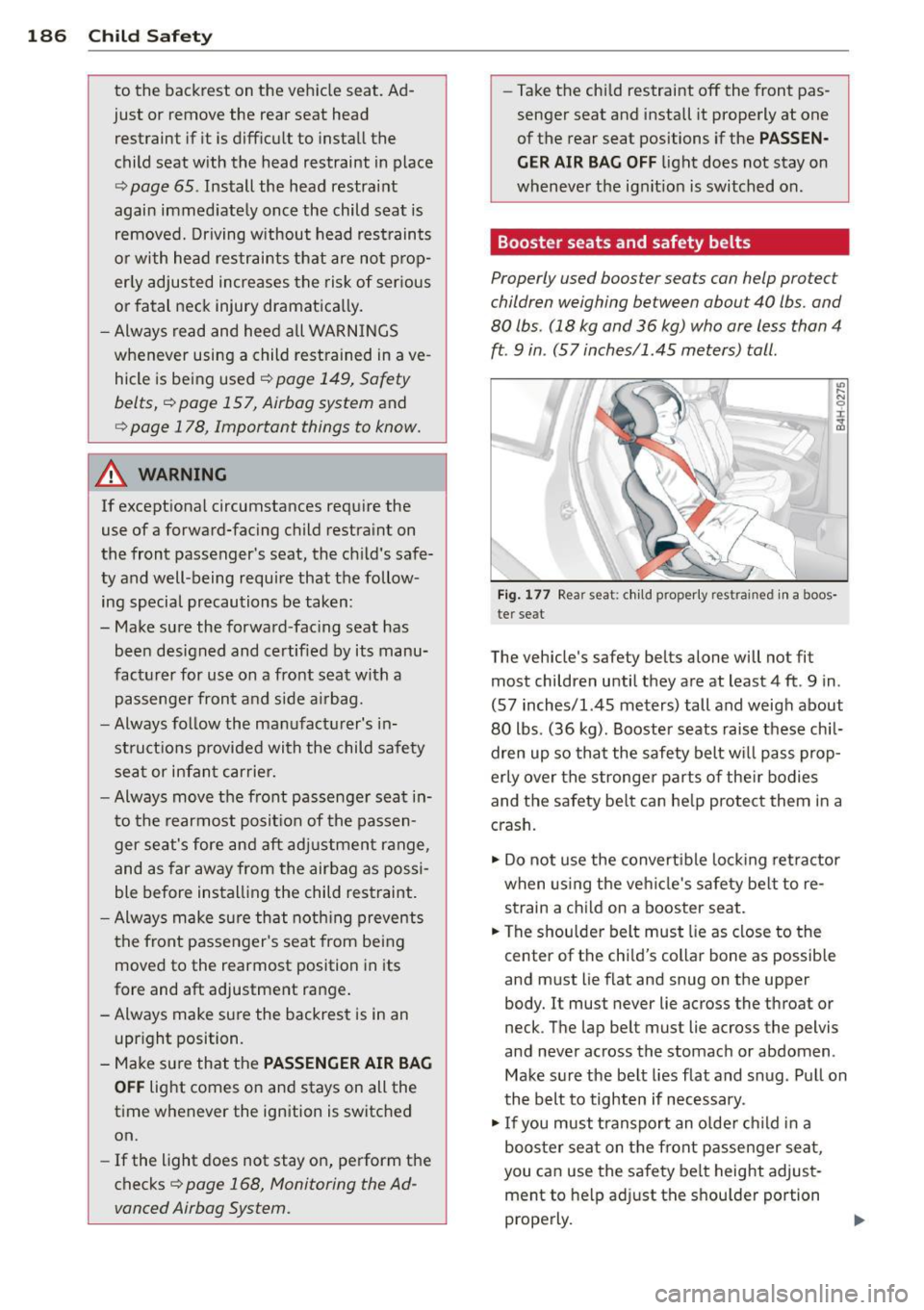
"' ....
"' 0 ±
o5
Fig. 177 Rear seat: ch ild properly rest rai ned in a boos
te r seat
The vehicle 's safety belts alone will not fit
most children until they are at least 4 ft . 9 in .
(57 inches/1.45 meters) tall and weigh about
80 lbs. (36 kg). Booster seats raise these chil
dren up so that the safety belt wil l pass prop
erly over the stronger parts of their bodies
and the safety belt can he lp protect them in a
crash.
"' Do not use the convertible locking retractor
when using the vehicle's safety belt to re
strain a child on a booster seat.
"'The shoulder belt must lie as close to the
center of the child's collar bone as possible
and must lie flat and snug on the upper
body. It must never lie across the throat or
neck . The lap belt must lie across the pelvis
and never across the stomach or abdomen .
Make sure the belt lies flat and snug . Pull on
the belt to tighten if necessary .
"'If you must transport an older child in a
booster seat on the front passenger seat,
you can use the safety belt height adjust
ment to help adjust the shoulder portion
properly.
Page 190 of 316
188 Child Saf ety
- Childre n on the front seat of any car,
even w ith Advanced A irbags, can be seri
ous ly injured or even killed when an a ir
bag inflates .
- Never let a child stand or knee l on any
seat, for examp le the front seat.
- Never let a child ride in the cargo area of your vehicle .
- Always remember that a ch ild lean ing
forward, sitt ing s ideways or out of posi
t ion in any way during an acc ident can be
st ruck by a deploying airbag . This will re
sult in serious personal injury o r dea th .
- If you must install a booster seat on the
front passenger seat because of excep
t io nal circumstances the
PASSENGER
AIR BAG OFF
light must come on and
stay on, whenever the igni tion is sw itch
ed on.
- If the
PASSENGER AIR BAG OFF ligh t
doe s not come on and stay on, perform
the chec ks described
¢ page 168, Moni
toring the Advanced Airbag System.
- T ake the child rest rain t off th e fron t pas
senger seat and install it properly at one
of the rea r seat positions if the
PASSEN
GER AIR BAG OFF
light does not stay on
whenever the ignition is switched on.
- Always read and heed all WAR NIN GS
whenever using a child restrained in ave
hicle is being used¢
page 149 , Safety
belts,¢ page 157, Airbag system
and
¢ page 178, Important things to know.
Installing a child safety
seat
Securing a child safety seat using a
safety belt
Safety bel ts for the rear sea ts and the front
passenger can be locked with the conver tible
locking retractor to properly secure child
safety seats .
The safety belts emergency locking retractors
for the rear seats safety belts and for the
front passenge r's seat safety belt have a co n
ve rtible locking retracto r fo r child restra ints . T
he safety belt m ust be locked so that be lt
web bing cannot unree l. The retractor can be
activated to lock the sa fety belt and prevent
the safety belt webbing from loosening up
duri ng norma l dr iving . A chi ld safety seat can
o n ly be prope rly insta lled when t he safety belt
i s loc ked so that the ch ild and child safety
sea t w ill stay in place .
Always remember: Even tho ugh your vehicle is
equipped with an Advanced Airbag system , all
c h ildren, especially thos e 12 years and young
er, sho uld alw ays r ide in the back seat prope r
l y restra ined fo r the ir age and size.
_& WARNING
Im prop erly ins talled ch ild safety sea ts in
crease the risk o f serious pe rsonal injury
and death in a co llision.
- Always make s ure that the sa fe ty bel t re
trac to r i s loc ked w hen insta lling a child
safety seat . An un locke d safety belt re
tracto r cannot hold the child safety seat
in place dur ing no rma l driving o r in a
crash.
- Always buckle the child sa fety seat firmly
in place even if a ch ild is not sitt ing in it .
A loose child safety seat can fly around du ring a s udden stop or in a collision .
- Always make sure that the rear seat
backrest to wh ic h the center rear safety
be lt is attached is securely latched when
eve r the rea r center saf ety belt is being
used to secure a c hild restr aint.
- If the backrest is not securely la tched,
the child and the child res traint will be
throw n forward togethe r with t he back
rest and will strike part s of t he vehi cle
interior. The child can be seriously in
jured or killed.
- Never insta ll re ar-f acing child s afety
seats or in fant ca rrie rs on the front pas
sen ger seat . A child will be serious ly in
jured and can be killed when the passen ge r airbag in flates.
- The inflating air bag will h it the c hild
safety seat or infant carrier with great
force and will smash the child safety seat ..,.
Page 192 of 316
190 Child Safety
-A tight tether strap on a rearward-facing
child restraint attached to the front pas
senger seat can put too much pressure on the weight-mat in the seat and regis
ter a heavier weight in the Advanced Air
bag System . The heavier weight regis
tered can make the system work as
though an adult were on the seat and de
ploy the Advanced Airbag when it must
be suppressed causing serious or even
fatal injury to the child.
- Make sure that the
PASSENGER AIR BAG
OFF
light comes on and stays on all the
time whenever the ignition is switched
on.
- If the
PASSENGER AIR BAG OFF light
does not come on and stay on, immedi
ately install the rear-facing child safety
seat in a rear seating position and have
the airbag system inspected by your Audi dealer.
Activating the convertible locking
retractor
Use the convertible locking retractor to se
cure a child restraint.
Always heed the child safety seat manufactur
er's instructions when installing a child re
straint in your vehicle . To activate the conver
tible locking retractor:
• Place the child restraint on a seat, prefera
bly on the rear seat.
• Slowly pull the belt
all the way out.
• Route it around or through the child re
straint belt path¢,& .
• Push the child safety seat down with your
full weight to get the safety belt really tight.
• Insert the belt tongue into the buckle for
that seating position.
• Guide the safety belt back into the retractor
until the belt lies flat and snug on the child
safety seat .
• You should hear a "clicking " noise as the
belt winds back into the inertia reel. Test the
convertible locking retractor by pulling on
the belt. You should no longer be able to pull the belt out of the retractor.
The con
vertible locking retractor is now activated.
• Make sure that the red release button is fac
ing away from the child restraint so that it
can be unbuckled quickly.
• Pull on the belt to make sure the safety belt
is properly tight and fastened so that the
seat cannot move forward or sideways more
than one inch
(2.5 cm).
_&. WARNING
-
Using the wrong child restraint or an im
properly installed child restraint can cause
serious personal injury or death in a crash.
- Always make sure that the safety belt re-
tractor is locked when installing a child
safety seat. An unlocked safety belt re
tractor cannot hold the child safety seat
in place during normal driving or in a
crash.
- Always buckle the child safety seat firmly in place even if a child is not sitting in it.
A loose child safety seat can fly around
during a sudden stop or in a crash.
- Always make sure the seat backrest to
which the child restraint is installed is in
an upright position and securely latched
into place and cannot fold forward . Oth
erwise, the seatback with the child safety
seat attached to it could fly forward in
the event of an accident or other emer
gency situation.
- Always read and heed all WARNINGS
whenever using a child restrained in ave
hicle is being used
~page 178. Special
precautions apply when installing a child
safety seat on the front passenger seat
¢ page 158, Child restraints on the front
seat -some important things to know .
Page 193 of 316
Deactivating the convertible locking
retractor
The convertible locking retractor for child re
straints will be deactivated automatically when the belt is wound all the way back into the retractor.
" Press the red button on the safe ty belt bu ck
le. The bel t tongue w ill pop out of the buck
l e .
" Guide the safety be lt all the way back into
its stowed position .
A lways le t the safety belt retrac t complete ly
into its stowed posit ion . The sa fety belt can
now be used as an ordinary safety belt with
out the convertib le locking ret ractor for chi ld
restra ints.
I f the convertible locking retracto r shou ld be
activated inadve rtently, the safety belt m ust
be unfastened and guided comp letely back in
to its stowed position to deactivate th is fea
ture. If the co nvertib le locking retractor is not
deactivated, the safety belt will gradually be
come tighter and u ncomfo rtable to wea r.
A WARNING
Imprope rly insta lled child saf ety seats in
c rease the risk of ser ious perso nal inju ry
a n d death in a colli sion.
- Never unf asten the safety belt to deacti
va te the convert ible lo cking re tr actor for
c hild re st rain ts w hile the veh icle is mov
ing. You woul d not be rest rained and
cou ld be ser iously injure d in an accident.
- Always read and hee d all WARN INGS
whenever using a child rest rained in ave
hicle is being use d
¢page 178. Special
precautions apply when installing a ch ild
safety seat on the front passenger seat
¢ page 158, Child restraints on the front
seat -some important things to know.
Child Sa fet y 191
LATCH Lower
anchorages and tethers
for children
Child Restraint System anchors and how
are they related to child safety
To p rov ide a simple r and more practicable way
to attach the chil d restra in t on t he vehi cle
seat, Federal regulat ions req uire spec ia l lower
an cho rages in vehicles and devi ces on new
c h ild restraints to at tach to the vehicle ancho
rages.
T he combination o f the tether ancho rages and
th e lower ancho rages is now gener ally c alled
the
LATCH system fo r "L owe r Anchorages and
T ethers for Chil d ren."
Fo rw ard- facing ch ild restr ain ts manufa ctured
after September 1, 19 99, are requ ired by U .S .
f edera l reg ulations to comply wi th new child
head movement performance req uir ements .
These new performance requirements make a
tether necessary on most new child seats.
Installing a chi ld restraint that requires a top
tether without one can seriously impair the performance of the c hild restra int and its abil
ity to protect the child in a coll is ion. Insta lling
a chi ld restraint that requi res a top tether
without the top tether may be a violat io n of
state law.
Child restraint manufacturers offer LATCH
lower anchorages on their child seats w ith
hook-on or push-on con nectors attached to
adjustable straps.
In add ition to the LATCH lower anchorages,
these chi ld restraint systems usually require
the use of tether straps to he lp keep the chi ld
r est raint fi rmly in place .
A WARNING
Imp roper installat io n of ch ild restra ints
will i ncrease the r is k of inj ury a nd deat h in
a c rash.
-
•
•
Page 195 of 316
restraints that are not equipped with the low
er anchorage attachments can still be instal
led in compliance with the ch ild restra int
manufacturer's instructions on using vehicle
safety belts.
A WARNING
Improper use of LATCH lower anchorages
can cause serious personal injury in an ac
cident.
-Always carefully follow the ch ild re
straints manufacturer's inst ruct ions for
proper installation of the child restra int
and proper use of the lowe r anchorages
or safe ty belts in your vehicle.
- Never secure o r attach any luggage or
other items to the
LATCH lower ancho
rages.
- Always read and heed the important in
formation about ch ild restra ints in this
chapter and WARNINGS
~ page 178,
Child Safety.
Installing a child restraint with LATCH
lower anchorages
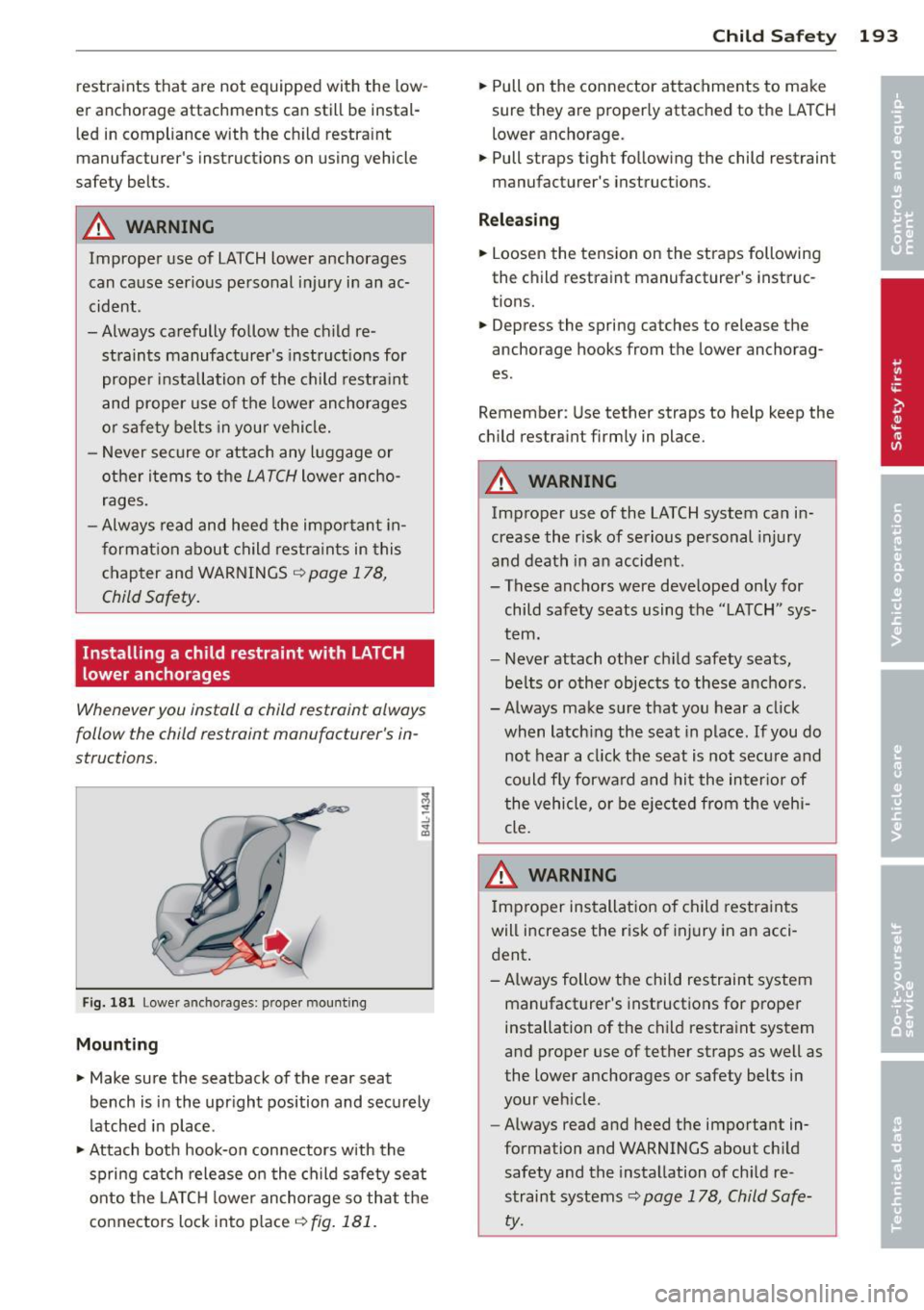
Whenever you install a child restraint always
follow the child restraint manufacturer's in
structions.
F ig. 181 Lower ancho rages: proper mount ing
Mounting
~ Make sure the seatback of the rear seat
bench is in the upr ight position and securely
latched in place.
~ Attach bot h hook-on connectors with the
spring catch release o n the child safety seat
onto the LATC H lower anchorage so that the
connectors lock into place~
fig. 181.
Child S afety 193
~Pullon the connector attachments to make
sure they are properly attached to the LATCH
lower anchorage.
~ Pull straps tight follow ing the child restraint
manufacturer's instructions.
R ele a sing
~ Loosen the tension on the straps following
the child restraint manufacturer's instruc
tions.
~ Depress the spring catches to release the
anchorage hooks from the lower anchorag
es .
Remember: Use tether straps to help keep the
ch ild restraint firmly in place.
A WARNING
Improper use of the LATCH system ca n in
crease the r isk of serious personal injury
and death in an accident.
- These anchors were developed only for
child safety seats using the "LATCH" sys
tem.
- Never attach other ch ild safety seats,
be lts or other objects to these anchors.
- Always make sure that you hear a click when latch ing the seat in place. If you do
not hear a click the seat is not secu re and
could fly forwa rd and hit the inter ior of
the vehicle, or be e jected from the vehi
cle.
A WARNING
Improper installat ion of child restraints
will i ncrease the risk of injury in an acci
dent .
- A lways follow the child restraint system
manufacturer's instructions for proper
installation of the ch ild restra int system
and proper use of tether straps as well as
the lower anchorages or safety belts in
your veh icle.
-Always read and heed the important in
formation and WARNINGS about child
safety and the instal lation of ch ild re
straint systems~
page 178, Child Safe
ty.
-
Page 199 of 316
Intelligent technology Notice about data
recorded by vehicle
control modules
Your vehicle is not equipped with an Event Da
ta Recorder (EDR), installed by some manu
facturers for the express purpose of capturing
data for retrieval after an accident or crash
event. EDR's are sometimes called "crash re
corders".
Some state laws restrict the retr ieval or down
loading of data stored by EDR's that were in
stalled in a vehicle for the express purpose of
retrieving data after an accident or crash
event without the owner's consent.
Although your vehicle is not equipped with an
EDR, it is equipped with a number of electron
ic control modules for various vehicle systems
such as, for examp le, engine function, emis
sion control, as well as for the airbags and
safety belts.
These electronic control modules also record
vehicle-related data during norma l vehicle op
eration for diagnostic and repair purposes.
The recording capacity of the electronic con
trol modules is limited to data (no sound is re
corded) and only a small amount of data is ac
tually recorded over a very limited period of
time and stored when a system fault or other
condition is sensed by a control unit. Some of
the data then stored may relate to vehicle
speed, direction, braking as we ll as restraint
system use and performance in the event of a
crash or other condition. Stored data can only be read and downloaded with special equip
ment.
Electronic Stabilization
Control (ESC)
Description
The Electronic Stabilization Control (ESC) rein
forces driver safety. It reduces the risk of slip
ping and improves driving stability. ESC de
tects critical s ituations such as the vehicle
Intelligent technology 197
oversteering and understeering or the whee ls
spinning . The vehicle is stabilized by applying
the brakes or reducing eng ine torque . Once
the ESC is active, the indicator light
G1 blinks
in the instrument cluster.
ESC includes the anti-lock brake system (ABS),
brake assist system, anti-slip regulation
(ASR), electronic differential lock (EDL), dy
namic steering*, hill descent assist and selec
tive wheel torque control.
Anti-lock brake system (ABS)
ABS prevents the whee ls from locking up
when braking . The vehicle can still be steered
even during hard braking. App ly steady pres
sure to the brake pedal. Do not pump the ped
al. A pulsing in the brake pedal indicates that
the system is helping you to brake the vehicle .
Brake assist system
The brake assist system can decrease braking
distance. It increases braking power when the
driver presses the brake pedal quickly in emer
gency situations . You must press and hold the
brake pedal until the situation is over . In
vehicles with adaptive cruise control*, the
brake assist system is more sensitive if the
distance detected to the vehicle ahead is too
small.
Anti-slip regulation (ASR)
ASR reduces engine power when the drive
wheels beg in to sp in and adapts the force to
the road conditions. This makes it easier to
start, accelerate and drive up hill s.
Electronic differential lock (EDL)
The EDL brakes wheels that are spinning and
transfers the drive power to the othe r whee ls .
T his function is available up to about 78 mph
(125 km/h) .
In extreme cases, EDL automatically switches
off to help keep the brake on the braked wheel
from overheat ing. EDL will switch on again au
tomatically when conditions have returned to
normal.
•
•
Page 212 of 316
210 Driving o ff road
Driving off road
Driving in difficult road
conditions and offroad
General information
The operation of the E lectronic Stabilization
Control (ESC) is expanded for operation away
from paved roads. In situations where slip or a
d ifferential locking function is required, the
offroad mode can be activated
c::;, page 197.
Your Audi also has permanent all -wheel drive
in addit ion.
However, your Aud i is not a pure offroad vehi
cle . It was not built for driving under extreme
conditions , e.g . for trips that are in the nature
of an expedition .
D riv e only on roads and off road sections
which match the design of your vehicle and
your abil ities a s a driver . Never take ri sks!
Before driving offro ad
- Check the engine oi l level, tire press ure,
coolant leve l, and the fluid level in the w ind
shield washer reservo ir.
- Stow luggage items and other objects in the
l uggage compartment, and secure them
against slid ing around .
After driving offroad
- After trips offroad, remove any twigs and other foreign objects from the grill, the un
derbody and the wheels. Pay specia l atten
t ion to fore ign ob jects (stones) which have
become lodged in the tire tread.
- Clean the body and the vehicle unders ide,
and inspect the veh icle for possible damage.
- Clean dirty w indows, headlamp lenses, rear
li ghts, and license plates .
- Perform a brake check (part icu larly after
trave lling through water) .
A WARNING
- Drive especially attentively and plan
ahead in difficult road conditions and
w hen offroad . Excess ive speed or incor-
-
rect mane uvers can cause injuries and
damage to the vehicle.
- Always adapt your speed and driving
style to road, offroad, traff ic, and weath
er cond itions. Drive especially slowly off
road when your v iew is restricted.
- Please be aware that in offroad mode,
particularly on a smooth and slippery
road , the whee ls may have an increased
tendency to sp in and the vehicle may
b reak away- dange r of skiddi ng!
- Stability is limited in the offroad mode .
® For the sake of the environment
Avoid damage to the environment and re
spect nature.
(D Tips
Only drive w here it is permitte d and stay
on marked roads and paths.
Explanation of some technical terms
The following data refer to ideal cond it ions .
Depend ing on veh icle load and ground condi
t ions and the environment, the numbers may
vary. It is the d river 's responsib ility to d ecide
whethe r a ve hicl e can overcome a spe cific s it
u ati on
c::;, ,&. .
Gradient angle
The number of meters in alt itude ga ined over
a di sta nce of 109 .4 yards or 100 mete rs
(grade) a re given as a pe rcentage o r degrees .
Info rmation abou t the gra dien t the veh icle
c an climb under i ts own power (depends in
part on t he road surfa ce and engine power).
Maximum pe rm itted gra de : 3 1
°
Lateral angle (slope of vehicle)
Ind icates the angle up to which the vehicle
can be d riven diagona lly or a cross the fall line
o n a s lope wi tho ut the vehicle tip ping over
s ideways (depends on center of gravity) . Maxi -
mum pe rmitted lateral angle: 25°
Ill-