ignition AUDI Q5 2014 Manual Online
[x] Cancel search | Manufacturer: AUDI, Model Year: 2014, Model line: Q5, Model: AUDI Q5 2014Pages: 316, PDF Size: 78.41 MB
Page 234 of 316
232 Checking and filling
-Apply the parking brake.
- Move selector lever of automatic trans- mission to P (Park).
- Always let the engine cool down. Hot components will burn skin on contact.
- To reduce the risk of being burned, never
open the hood if you see or hear steam
or coolant escaping from the engine
compartment. Wait until no steam or
coolant can be seen or heard before care
fully opening the hood.
- Keep children away from the engine com partment.
- Never spill fluids on hot engine compo
nents. They can cause a fire.
- Never touch the radiator fan. The auxili
ary electric fan is temperature controlled
and can switch on suddenly.
- Never open the coolant reservoir cap
when the engine is still warm. The cool
ant system is pressurized and hot cool ant could spray out .
- Protect your face, hands and arm from
steam or hot engine coolant by placing a
thick rag over the cap when you open the
coolant reservoir .
- Do not remove the engine cover under
any circumstances. This increases the
risk of burns.
- If work on the fuel system or the electri
cal system is necessary:
- Always disconnect the battery.
- Never smoke or work near heaters or
open flames. Fluids in the engine com
partment could start a fire.
- Keep an approved fire extinguisher im
mediately available.
- To avoid electrical shock and personal in
jury while the engine is running or being
started, never touch:
- Ignition cables
- Other components of the high voltage
electronic ignition system.
- If you must perform a check or repair
with the engine running: -
First, fully apply the parking brake,
move selector lever of automatic trans
mission to P (Park).
- Always use extreme caution to prevent
clothing, jewelry, or long hair from get
ting caught in the radiator fan, V-belts
or other moving parts, or from contact ing hot parts. Tie back hair before
starting, and do not wear clothing that
will hang or droop into the engine.
- Minimize exposure to emission and
chemical hazards
c:> &, .
&_ WARNING
California Proposition 65 Warning:
- Engine exhaust, some of its constituents,
and certain vehicle components contain
or emit chemicals known to the State of
California to cause cancer and birth de
fects and reproductive harm. In addition,
certain fluids contained in vehicles and
certain products of component wear con
tain or emit chemicals known to the
State of California to cause cancer and
birth defects or other reproductive harm.
- Battery posts, terminals and related ac
cessories contain lead and lead com
pounds, chemicals known to the State of
California to cause cancer and reproduc
tive harms. Wash hands after handling.
(D Note
When adding fluids, always make sure that
they are poured into the proper container
or filler opening, otherwise serious dam
age to vehicle systems will occur.
@ For the sake of the environment
To detect leaks in time, inspect the vehicle
floor pan from underneath regularly. If
you see spots from oil or other vehicle flu
ids, have your vehicle inspected by an au
thorized Audi dealer.
Page 242 of 316
24 0 Ch eck ing and filling
pressure relief valve in the cap when the en
gine becomes hot.
A WARNING
- The coo ling system is under pressure and
can get very hot. Reduce the risk of
sca lding from hot coolant by following
these steps.
- Turn off the eng ine and a llow it to cool
down.
- Protect your face, hands and arms from escap ing fl uid and steam by cover ing
the cap with a large, thick rag.
- T urn the cap slowly and very carefully
in a counter-clockwise direction while
applying light, downward pressure on
the top of the cap.
- To avo id being burned, do not sp ill an
tifreeze or coolant on the exhaust sys
tem or hot engine parts. Under certain
conditions, the ethylene glyco l in en
g ine coolant can catch fire.
- Antifreeze is poisonous. Always store an
t ifreeze in its or iginal container and well
out of the reach of children.
- If you drain the coolant, it must be caught and safely stored in a proper con
tainer clear ly marked "poison".
- Coolant pollutes the environment and
could cause an engine fire. Excess coo l
ant will be forced out through the pres
sure re lief valve in the cap when the en
gine becomes hot.
- If, in an emergency, only water can be
added, the correct ratio between water
and antifreeze~
page 238 must be re
stored as soon as possib le.
@ For the sake of the environment
Dra ined coolant should not be reused. Al
ways dispose of used coolant while observ
ing all environmental regulations.
Radiator fan
The radiator fan switches on automatically by
itself.
The radiator fan is driven by the engine via the
V-belt. The viscous clutch regulates the speed
of the fan according to the temperature of the
coolant .
An auxiliary electric radiator fan* sw itches on
and off depending on coolant temperature
and other vehicle operat ing condit ions.
After you switch the engine off, the aux iliary
fan can continue running for up to 10 m inutes
- even w ith the ignition off. It can even switc h
on again later by itself
c> &. , if
- the temperature of the engine coo lant r ises
due to the heat build-up from the engine in
the engine compartment, or
- the engine compartment heats up because the vehicle is parked in intense sunlight.
A WARNING
- To reduce the risk of personal injury nev
er touch the radiator fan .
- The auxiliary electric fan is temperature
controlled and can sw itch on suddenly
even when the engine is not running.
- The auxiliary radiator fan sw itches on au
tomatically when the engine coo lant
reaches a certain temperature and w ill
con tinue to run until the coolant tempe r
a ture drops.
Page 246 of 316

244 Checking and filling
A WARNING
California Proposition 65 Warning:
- Battery posts, terminals and related ac
cessories contain lead and lead com
pounds, chemicals known to the State of
California to cause cancer and reproduc
tive problems. Wash hands after han
dling.
(D Note
- Do not disconnect the vehicle battery
when the ignition is switched on or when
the engine is running, otherwise, you will
damage electronic components in the
electrical system.
- If your vehicle is going to stand for a
long period of time without being driven,
protect the battery from "freezing ", oth
erwise it will be damaged and will then have to be replaced .
Battery charging
Starting the engine requires a well charged
battery.
Fig. 203 E ng ine compar tment: Connectors for charger
a nd jumper cab les
Always read and heed all WARNINGS below
¢
.&. and ¢ .&. in Working on the battery on
page 243.
• Hybrid drive*: read the important informa
tion concerning a dead high voltage battery
under
¢page 105.
•Turnoff the ignition and all electrical con
sumers.
• Make sure the area is well ventilated when
you charge the battery. •
Open the engin e hood ¢
page 231.
• Remove th e cover (D by pressing on the ar
row
¢fig. 203.
• Open the cover @on the positive terminal.
• Connect the charger co nnectors according to
the instructions to the
jump start bolts .
(Bolts under the cover = "pos itive", Bolts
with hex head= "negative ").
• Only now plug the mains lead for the charg
ing equipment into the wall outlet and turn
it on¢ .&_.
• Make sure the charging rate is not over
30 amps/14.8 Volt.
• When the battery is fully charged: T urn the
charg ing equipment off and remove the
mains lead from the wall outlet.
• Now remove the clamps for the charging
equipment.
• Close the cover @on the positive terminal
and re-install the cover
(D.
• Close the hood¢ page 231.
A discharged battery can freeze at tempera
tures of only 32 °F (0 °C). Allow a frozen bat
tery to thaw completely before attempting to
charge it¢.&.. However, we recommend not
using a thawed battery again because the bat
tery casing can be cracked due to ice forma
tion and can leak battery acid.
Battery charging (Maximum charging rate
of 30 amps/14.8 Volt)
When charging at low voltages (e.g. with a
trickle charger), the battery cables do not
have to be disconnected first. The battery
caps should
not be opened when charging a
battery.
It is not necessary to remove the battery from
the luggage compartment.
Fast charging the battery (charging rate
above 14.8 Volts)
For technical reasons do not use a battery
c h arger that uses voltage greater than 14.8
Volts to charge your vehicle's battery.
A WARNING
--
Charging a battery can be dangerous. ~
Page 268 of 316
266 Tire s and wheels
When the malfunction indicator is illuminat
ed, the system may not be able to detect or
signal low t ire pressure as intended. TPMS
malfunctions may occur for a variety of rea
sons, including the installation of replace
ment or alternate tires or wheels on the vehi
cle that prevent the TPMS from funct ioning
properly . Always check the TPMS malfunct ion
tellta le after replacing one or more t ires or
wheels on your veh icle to ensure that the re
p lacement or a lternate tires and wheels allow
the TPMS to continue to function properly.
Tire pressure indicator appears
Applies to vehicles: with tire pressure monitoring system
The tire pressure indicator in the instrument
cluster informs you if the tire pressure is too
low or if there is a system malfunction.
N
I
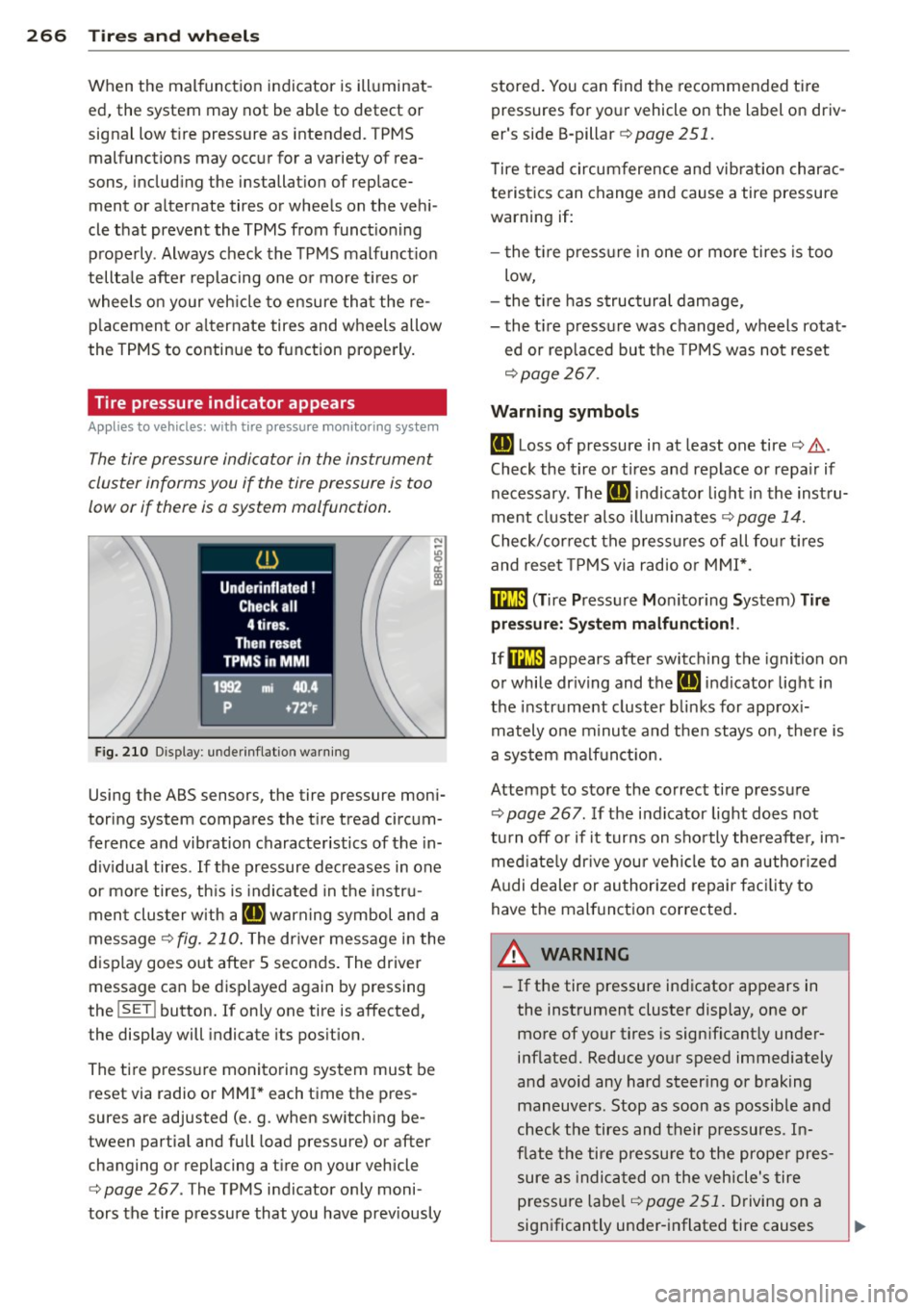
Fig. 210 Display: underinflation warning
Using the ABS sensors, the tire pressure moni
toring system compares the tire tread circum
ference and vibration characteristics of the in
dividual tires. If the pressure decreases in one
or more tires, th is is indicated in the instru
ment cluster w ith a
IE warning symbol and a
message
¢fig . 210. The dr iver message in the
display goes out after 5 seconds. The driver
message can be displayed again by pressing
the
! SET ! button. If on ly one tire is affected,
the display will indicate its position.
The tire pressure monitoring system must be
reset via radio or MMI * each time the pres
sures are adjusted (e. g . when switching be
tween partia l and full load pressure) or after
changing or replacing a tire on your vehicle
¢
page 267. The TPMS indicator only moni
tors the tire pressure that you have prev iously stored
. You can find the recommended tire
pressures for your vehicle on the label on driv
er's side B-pillar ¢
page 251.
Tire tread circumference and vibration charac
teristics can change and cause a tire pressure
warning if:
- the tir e pressure in one or more tires is too
low,
- the tir e has structural damage,
- the tir e pressure was changed, wheels rotat-
ed or replaced but the TPMS was not reset
¢page 267.
Warning symbols
IE Loss of pressure in at least one tire¢ .&..
Check the tire or tires and replace or repa ir if
necessary. The
IE indicato r light in the inst ru
ment cluster als o illuminates
¢ page 14.
Check/correct the pressures of all four tires
and reset TPMS via radio or MMI*.
ffim (T ire Pressure Mon itor ing System) Tire
pressure: System malfunction!.
If@m appears after switching the ignition on
or while dr iving and the
IE indicator light in
the instrume nt cluster blink s for app rox i
mately one minute and then stays on, there is
a system malfunction.
Attempt to store the correct tire pressure
¢
page 267 . If the indicator light does not
tu rn
off or if it turns on shortly thereafter, im
mediately drive you r vehicle to an authorized
A udi dealer or authorized repair facility to
have the malfunction corrected.
A WARNING
=
- If the tire pressure indicator appears in
the instrument cluster display, one or
more of your tires is sign ificant ly under
inflated. Reduce your speed immediately
and avoid any hard steer ing or braking
maneuvers. Stop as soon as possible and
check the tires and their pressures. In
flate the tire pressure to the proper pres
sure as ind icated on the vehicle's tire
p ressu re lab el¢
page 251. Driving on a
significantly under-inflated tire causes
Page 269 of 316
the tire to overheat and can lead to tire
failure. Under-inflation also is likely to
impair the vehicle's handling and stop
ping ability .
- The driver is responsible for maintaining
the correct tire pressures. You must
check the tire pressures regularly.
- Under certain conditions (such as a spor
ty driving style, winter conditions or un paved roads), the pressure monitor indi
cator may be delayed.
-Ask your authorized Audi dealer if run flat tires may be used on your vehicle .
Your vehicle registration becomes invalid if you use these tires when not permit
ted. Damage to your vehicle or accidents
could also result.
@ Tips
- The tire pressure monitoring system
stops working when there is an ESC/ABS
malfunction.
- Using snow chains may result in a system
malfunction.
- The tire pressure monitoring system on
your Audi was developed using tires with the "AO" or "RO" identification on the
tire sidewall¢
page 258. We recom
mend using these tires.
Reset tire pressure monitoring system
Applies to vehicles: with tire pressure monitoring system
If the tire pressure is adjusted, wheels are ro
tated or changed, the TPMS must be reset via
radio or MMI* .
.,. Before resetting the TPMS, the current pres
sures of all four tires must correspond to
the specified values. Adjust the tire pressure and reset the pressure in the tire pressure
monitoring system according to the load
you are carrying
¢ page 251 .
.. Turn on the ignition .
.,. Select :
I CARI function button > Tire pressure
monitoring
> Store now . Or
.,. Select: I CARI function button > Car systems*
control button > Servicing & checks > Tire
pressure monitoring
> Store tire pressures.
Tires and wheels 267
(D Tips
Do not store the tire pressure if there are
snow chains on the tire.
•
•
Page 283 of 316
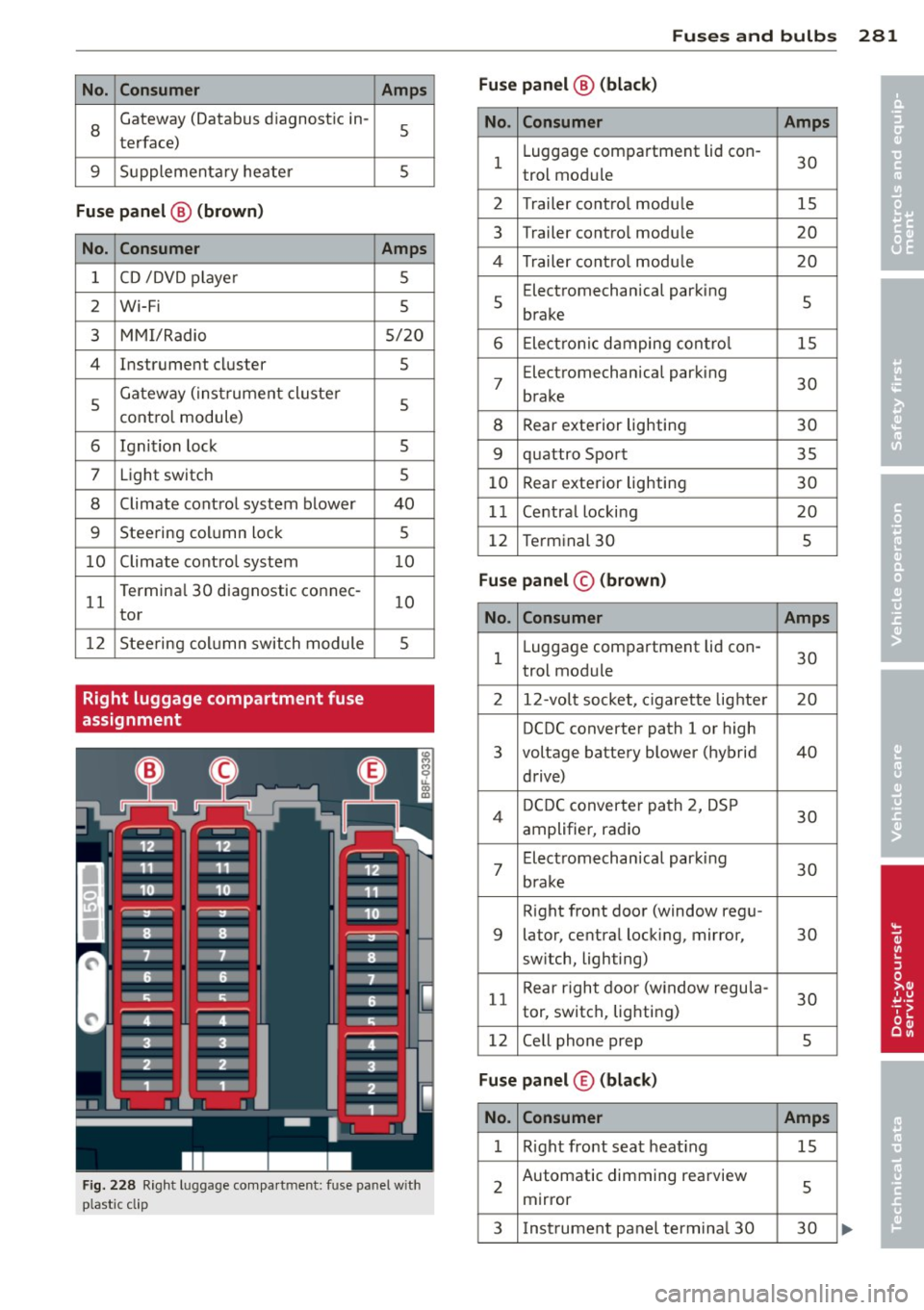
No. Consumer
8
Gateway (Databus d iagnostic in-
terface)
9 Supplementary heater
Fuse p anel @ (b rown )
N o. Con sumer
1 CD /DVD player
2 Wi-Fi
3 MMI/Radio
4 Instrument cluster
5 Gateway
(instrument cluster
cont rol module)
6 Ignition lock
7 Light switch
8 Climate control system blower
9 Steering column lock
10 Climate contro l system
11 T
erminal 30 diagnostic connec-
tor
12 Steering column switch module
Right luggage compartment fuse
assignment Amps
5
5
Amps
5
5
5/20
5
5
5 5
40
5
10
1 0
5
Fig. 228 Right luggage compa rtment: fuse panel w ith
ptastic cl ip
Fu ses and bulb s 281
Fus e panel@ (bla ck)
•
N o. Consumer Amps •
1 Luggage
compartment lid con-
30
trol module
2 Trailer contro l modu le 15
3 Trailer contro
l modu le
20
4 Trailer cont ro l modu le 20
5 Electromechanical
parking
5
brake
6 Electronic damping contro l 15
7
Electromechanical parking
30
brake
8 Rear exterior lighting
30
9 quattro Sport
35
10 Rear
exterior lighting
30
1 1 Centra l locking 20
12 Terminal 30 5
Fuse pan el© (brown )
No . Consumer Amps
1 Luggage compartment lid con-
30
trol module
2 12-vo lt socket, c igarette lighte r 20
DCDC converter path 1 or high
3 voltage
battery blower (hybrid 40
drive)
4 D
CDC converter path 2, DSP
30
amplifier, radio
7
Electromechan ical parking
30
brake
Right front door (window regu-
9 lator, central locking, mirror,
30
switch, lighting)
11 Rear
right door (window regu la-
30
tor, switch, lighting)
12 Cell phone prep
5
Fuse panel ® (bla ck )
No. Consumer Amps
1 Right front seat heat ing 15
2 Automatic dimming
rearview
5
mirror
3 Instrument panel termina l 30 30
Page 301 of 316
-----------------------------~I~n~d~e~x 299
Audi Service Repair Manuals and Litera-
ture ...... .. ................. .. ... 293
Auto-Check Control ........ .. .. .. .. .. 27
Auto locking ... ........... .. .. .. .... 38
Automatic belt retractor ....... ... .. . 1S2
Automatic driving light control ... ... ... 49
Automatic Shift Lock (ASL) ... ... .. .. . 124
Automatic transmission .............. 123
Automatic Shift Lock (ASL) ... .. .. .. . 124
Driving . . . . . . . . . . . . . . . . . . . . . . . . . . 125
Emergency mode ............ ... .. . 128
Emergency release .............. .. . 128
Hill descent control ................ 126
Kick-down
. . ............. .... .. ... 127
Manual shift program .............. 127
Removal lock (ignition key) . .. .. .. .. .. 83
Selector lever ..................... 123
Shift buttons ............ .... .. ... 127
Automatic wipe/wash system . . . . . . . . . . 54
Auto Safety Hotline .............. .. . 146
AUTO (climate control) . . . . . . . . . . . . . . . . 80
Average speed . . . . . . . . . . . . . . . . . . . . . . . 23
Avoid damaging the vehicle .. .. .. .. .. . 207
B
Bass box .......................... 269
Battery . . . . . . . . . . . . . . . . . . . . . . . . . . . 242
Battery location inside the luggage com-
partment ................ ...... .. 242
Charging . . . . . . . . . . . . . . . . . . . . 105 , 244
Important warnings when working on
the battery . . . . . . . . . . . . . . . . . . . . . . . 242
Jump starting . ........... .. .. .. ... 283
L ow ............................. 203
Replacing the battery ........ ... .. . 245
State of charge .............. ... ... 203
Voltage ........................... 34
Winter operation .................. 242
Working on the battery . . . . . . . . . . . . . 242
Before driving ................. .. ... 139
Bio-ethanol (Fuel) ........... ... ... .. 223
Blended gasoline .......... .. .. .. .. . 222
Blow er (climate control) . . . . . . . . . . . . . . . 80
Booster seats .............. ...... .. 186 Brake fluid
Changing the brake fluid ............ 241
Checking the brake fluid level ...... .. 241
Reservoir . .. .. .. ................. 241
What is the correct brake fluid level? .. 241
What should I do if the brake fluid warn-
ing light comes on? .. .. .. ..... ..... 241
Brake system . ... .. .. ............... 241
Anti-lock brake system . . . . . . . . . . . . . . 17
Brake assist system ................ 197
Brake booster .. .. ................. 200
Brake fluid .. .. .. .. . .. ... .... .... . 241
Brake fluid specifications for refill and re-
placement .. .. .. ................. 241
Brak e light defective . . . . . . . . . . . . . . . . 33
Brak e pads . ... .. .. ............... 205
Electromechanical parking brake ..... . 88
General information .............. . 200
How does moisture or road salt affect the
brakes? ... .. .. .. .... ........... .. 200
Malfunc tion . . . . . . . . . . . . . . . . . . . . . . . 29
Warning/indicator lights ............. 18
Worn brake pads symbol . . . . . . . . . . . . . 33
Braking guard . . . . . . . . . . . . . . . . . 107, 113
Messages . .. .. .. ............... . .
Settings .. .. .. .. ................ .
Switching on and off .............. .
Break-in period . ..... .............. .
Brake pads . ... .. .. .............. .
Tires
B reakover angle ... ............... . .
Bulbs ......... ... .. .............. .
C
California Proposition 65 Warning ... . .
Battery specific ... ............... .
Capacities
Carbon parts 114
114
114
205
205
205
210
282
232
244
290
Cleaning . . . . . . . . . . . . . . . . . . . . 219,220
Care .............................. 217
Cargo area
refer to Load ing the luggage compart
ment
..... .. .. .. .. .. ........... .. 145
Cargo floor . . . . . . . . . . . . . . . . . . . . . . . . . 70
Catalytic converter ... .............. . 206
•
•
Page 302 of 316
300 Index
Center armrest
Adjusting . ................. ..... .. 66
Storage compartment . . . . . . . . . . . . . . . 66
Certification . . . . . . . . . . . . . . . . . . . . . . . 296
Changing A flat tire .. .......... ...... ... .. . 273
A wheel .. .. ................ ... ... 273
E ng ine oil ... ............ .. .. .. .. . 237
Checking Engine coolant level ....... .. .. .... . 239
Tire pressure .............. ... .. .. . 253
Child restraints Danger of using child restraints in the
front seat .... ........... .. .. .... . 158
System anchors .......... .. .. .. .. . 191
Where can I get additional information
about child restraints and their use? . . 196
Chi ld safety ................. .. .... . 178
Convertible locking retractor .. .. ..... 188
Important safety instructions for using
child safety seats ............. .. ... 181
Important things to know when dr iving
with chi ldren . ... ..... ... .. .. .. .. . 178
I nstalling a child restraint using the
L A T CH system . ......... .. .. .. .. .. . 193
Mounting and releasing the anchorage
hook .... ................ ... .... . 193
Tether anchors ............ ... .... . 194
Tether straps .............. .. .... . 194
Ch ild safety locks
Rear doors ............... ... .... .. 46
Child safety seats . .......... ... .. .. . 184
Booster seats ............. ... .. ... 186
Conve rtible child seats .... .. .. .. .. . 185
Conve rtible locking retractor .. .. .. .. . 188
Danger of using child restraints in the
front seat .. ................ ..... . 158
How do I properly install a child safety
seat in my vehicle? ........ .. .. .... . 181
Infant seats ............. .. .. .. .. . 184
Installing ................. .. .... . 188
LA TCH system ......... .... ... .. .. . 193
Lower anchorages ......... ... .. .. . 192
Safety instructions ... ..... .. .. .... . 181
Unused safety belts on the rear seat .. 183
Cigarette lighter ........... .. .. .. .. .. 75
C leaning .................... ..... . 217 Climate control
.... ............. ..... 79
Air vents . ..... .. .. .............. .. 81
Automatic recircu lation .......... ... . 81
Operation . . . . . . . . . . . . . . . . . . . . . . . . . 80
Setup .... .... .. ............. .... . 81
Supplementary .. ................ .. 82
Synchronizing . ... ....... ...... .. .. . 81
Climatized cupholder ................. 74
Clock .. .. .. .... .. ............. ..... 12
Closing Panoramic sliding sunroof ........ ... . 47
Coat hooks ..... .. .. .............. .. 77
Cold tire inflation pressure .......... .. 251
Compass mirror . . . . . . . . . . . . . . . . . . . . . 59
Compliance ..... .. .. .............. . 296
Consumer Information . . . . . . . . . . 146, 293
Contacting NHTSA . ............... .. 146
Controls Cleaning .. .... .. .. .............. . 219
Convenience Closing ...... ... .. .............. .. 47
Open ing .. .... .. ............. .... . 47
Convenience key . .. ............. .... . 40
Indicator lights .. ..... ........... .. 87
Locking and unlocking vehicle ........ . 40
Start ing engine (START ENGINE STOP
button) ..... .. .. .. ........... .... . 86
Stopping the engine (START ENGINE
STOP button) .... ............... .. . 87
Switching on ignition ............ ... . 86
Convertible child safety seats . .. ... ... 185
Convertible locking retractor Activating . .... .. ............. .... 190
Deactivat ing . ... . ... ... .... ... .. .. 191
Using to secure a child safety seat 1.88, 190
Coolant system .... ................ . 238
Cooled cupholder ............... .... . 7 4
Cooling box in glove compartment . . . . . . 77
Cooling mode (climate control) ..... ... . 80
Cooling System Expansion tank ... ............. .... 239
Cornering light .. .. ............. .... . 51
Cruise control
Changing speed
Preselect speed .
. ................ .. 95
96
Switching off .. .. ............. .. .. . 96
Page 304 of 316
302 Index
Electronic differential lock (EDL) ...... . 19 7
Warning/indicator lights ... .. ... . 15, 17
E lect ronic immobilize r ...... .. .. .... .. 38
Electronic power control (EPC) warn ing/ indicator light . .. .. .. .. 15
Elect ronic Stabilization Control (ESC) . .. 197
Hill descent assist ..... ... .. .. .... . 199
Offroad mode . ........... .... .... . 198
Warn ing/ indicator lights ... .. .. .. .. . . 15
E mergency braking . . . . . . . . . . . . . . . . . . . 90
Emergency flasher . . . . . . . . . . . . . . . . . . . 52
Warn ing/ indicato r lights ....... .. .. .. 16
Emergency key . .... ....... .. .. .... .. 36
Starting engine ............ .. .... .. 85
Emergency locking of the doors ..... ... . 4 2
Eme rgency operation
L uggage compartment lid .. .. .. .. .. . . 45
Emergency release Selector lever ............ .. .. .. .. . 128
Emergency starting ..... ... .. .. .... . 283
Emergency towing ............. .. ... 285
Emergency unlocking Ignition key . . . . . . . . . . . . . . . . . . . . . . . 38
E nergy management .. ... .. .. ... ... . 203
Eng ine
Compartment . .. ...... ... .. .. .. .. . 233
Coolant .. .... ........... .. .. .. .. . 238
D ata .. .. ... ............ .. .. .. .. . 291
H ood . ...... .. .. ..... ... .. .. .... . 23 1
Jump starting .. .. ..... ... .. .. .... . 105
Start-Stop-System . . . . . . . . . . . . . . . . . . 91
Starting . . . . . . . . . . . . . . . . . . . 83, 86, 98
Starting with jumper cables .. .. .... . 283
Stopping . . . . . . . . . . . . . . . . . . . 85, 87, 98
Engine compartment Safety instructions . . . . . . . . . . . . . . . . . 23 1
Working the engine compartment .... 231
E ng ine coolan t sys tem ...... .. .. .... . 238
Adding coolant . .. ..... ... .. .. .... . 239
Checking coolant leve l ... .. .. ... ... . 239
Malfunction . . . . . . . . . . . . . . . . . . . . . . . 30
Radiator fan ............. .. .. .. .. . 240
E ng ine coolan t temperature
Tempe ratu re ga uge .. ... .. .. .... .. .. 1 0
E ng ine hood
C losing .. .. ................ ... .. . 23 1
H ow to release the hood . .. .. .. .. .. . 23 1 E
ngine oi l .. .... .. ... .. ..... .... . .. 233
Adding ... .... .. .. ... ..... ... .. .. 236
Additives . ... .. .. .. ... ..... ... .. .. 236
Changi ng ..... .. ............. .... 237
Check oil level . .. ............. .... 236
Consumption .. .. ................ . 236
Level .... ... .. .. .. ... .. ... ..... .. . 34
Oil consumpt io n .. .......... ...... . 235
Oil g rades . .. .. . .............. .. .. 233
Press ure ma lfu nction ........... .. .. . 30
Senso r defec tive . . . . . . . . . . . . . . . . . . . . 34
S peci fication and viscosit y ........ . .. 233
E ngine speed limitation . . . . . . . . . . . . . . . 34
Environment Break-in per iod . .. ............. .... 205
Catalytic co nverter ................ . 206
Diesel pa rticula te filter .......... ... 206
Dispos ing of your veh icle battery . . . . . 245
Driv ing at high speeds .......... .. .. 20 7
D riv ing to minimize po llution and noise 20 7
F uel .. .. .. .. .. . .............. .. .. 226
Fuel economy .... .. ... ..... ... .. .. 207
Leaks under you r vehicle ..... ... .. .. 231
Letting the vehicle stand and warm up. 208
Proper disposal of drained brake fluid . 241
Proper disposal of drained eng ine cool-
ant .. ..... ... .. .. ... ........... . 239
Proper d isposal of drained eng ine
o il . . . . . . . . . . . . . . . . . . . . . . . . . 236,237
Recycling used eng ine oil ........ .. .. 236
Roof rack . .. .. .. ............. .. .. . 72
U nleaded fuel .... .. .... .... ... .. .. 222
What s hou ld I do with an o ld battery? . 245
E P C
refer to Elect ro nic powe r contro l ... .. . 15
ESC
refer to Electronic Stabilization Control
(ESC) ........ ... .. .............. .. 15
Ethy l alcohol (Fuel) ... ... ..... ... .. .. 223
E vent Data Recorde r (EDR ) ........ .... 19 7
Exhaust tail pipes Cleaning ...... .. .. ... ........... . 219
Expansion tank .... ... .. ..... ... .. .. 239
E xplanation of some technical te rms 210
Exterior mirrors Adjusting ..... .. .. ... ........... .. 57
Dimm ing .. ... ... .. .............. .. 58
Heating ..... .. .. .. ... .. ... ..... .. . 57
Page 306 of 316
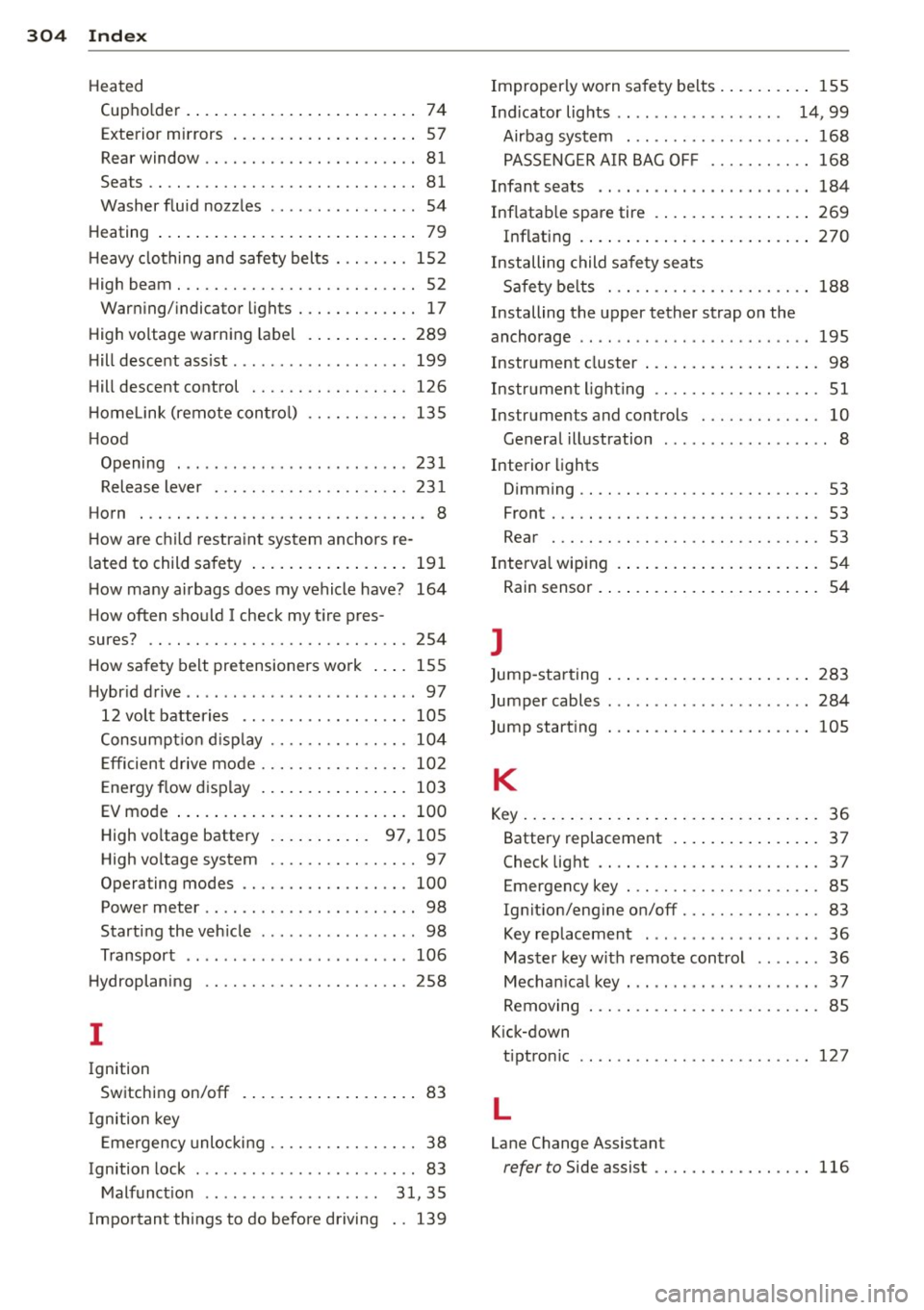
304 Index
Heated (upho lder . .... . ...... ... .. .. .... .. 74
Exterior m irrors ... .... ... .. .. .... .. 57
Rear window ............. .... ...... 81
Seats .. ...... ........... ........ .. 81
Washer fluid nozz les . . . . . . . . . . . . . . . . 54
H eating ...... .. .. ..... ... .. .. .... .. 79
H eavy clothing and safety belts . .. ..... 1 52
High beam . .. ............. .. .. .. ... . 52
War ning/ indicato r lights ... .. .. .. .. . . 17
High voltage warning labe l .. .. .... .. . 289
H ill descent assist . . . . . . . . . . . . . . . . . . . 199
Hill descent control ........ .. .. .... . 126
H omelink (remote con tro l)
H ood 135
Opening . .. .. .. .. .......... ... .. . 23 1
Release lever . ........... .. .. .... . 23 1
Ho rn . .. ...... ........... .... .... .. . 8
H ow are c hild restra int sys tem anchors re -
l ated to child sa fe ty ..... ... .. .. .... . 19 1
H ow many airbags does my vehicle have? 164
How often sho uld I check my t ire pres-
sures? .. .. ................. .. .... . 254
H ow sa fety belt pretensioners wo rk ... . 1 55
H ybr id d rive .. .. .. ...... .... ... .. .. .. 97
12 vo lt batteries .... ... .. .. .. .. .. . 105
Consumpt io n disp lay ...... .. .. .... . 10 4
E fficien t drive mode ....... .. .. .... . 10 2
E ne rgy flow d isplay .. ... .. .. .. .... . 103
EV mode ... ... .. ..... ... .. .. .... . 100
H igh vo ltage battery . . . . . . . . . . . 97, 105
High vo ltage system .......... .. .. .. 97
Operating modes ......... .... .... . 100
Power meter . . . . . . . . . . . . . . . . . . . . . . . 98
Start ing the veh icle ...... ... .. .. .... 98
Transport . . . . . . . . . . . . . . . . . . . . . . . . 106
H ydroplaning ............... .. .... . 258
I
Ignition
Switching on/off . ..... ... .. .. .... .. 83
I gnition key
E mergency unloc king . . . . . . . . . . . . . . . . 3 8
Ignition lock . . . . . . . . . . . . . . . . . . . . . . . . 83
M alfunct io n . . . . . . . . . . . . . . . . . . . 31, 3 5
Important things to do before driving .. 139 Improperly worn sa
fety belts . ... .. .. .. 155
Ind icator lig hts . . . . . . . . . . . . . . . . . . 14 , 99
Airbag system ................ .... 168
P ASS ENG ER A IR BAG OF F ....... .. .. 168
Infant seats .. .. .. .... .... ..... .. .. 184
Inflatab le spare tire . .. .. ..... ... .. .. 269
I n flating . ..... .. .. ... ..... ... .. .. 270
Installing child safety sea ts
S af ety be lts . . . . . . . . . . . . . . . . . . . . . . 188
Installing the upper tether strap on the
ancho rage .. .. .. .. ... .. .. ... ..... .. 195
Instrument cluster .... .. ..... ... .. .. . 98
Instrument ligh ting ............. .... . 51
Instruments and controls ........ .. .. . 10
General illustration . . . . . . . . . . . . . . . . . . 8
Interior lights
Dimming .. ..................... .. . 53
Front . .. .. .... ............... ..... 53
Rea r ..... .. .. .. .. ........... .... . 53
Interval wiping .... ... .. ..... .... . .. . 54
Rain sensor . . . . . . . . . . . . . . . . . . . . . . . . 54
J
Jump-star ting 283
Jumper cables ... .. ... .. .. ... ..... .. 284
Jump start ing .................. .... 105
K
Key ... ... .. .... .. .. ... .. ..... ... .. . 36
Battery replacement . . . . . . . . . . . . . . . . 3 7
Check light . . . . . . . . . . . . . . . . . . . . . . . . 3 7
Emergency key . . . . . . . . . . . . . . . . . . . . . 85
Ig nit io n/engine o n/off .............. . 83
Key replacement . . . . . . . . . . . . . . . . . . . 36
Master key with remote control . . . . . . . 36
Mechan ica l key . .. .... .... ..... .. .. . 37
Removing . .. .. .. ... .......... .... . 85
K ick-down
t iptro nic .. .. .. .. ... .. .. ... ..... .. 127
L
Lane Change Assistant
refer to Side assist . . . . . . . . . . . . . . . . . 116