engine oil AUDI Q5 2015 User Guide
[x] Cancel search | Manufacturer: AUDI, Model Year: 2015, Model line: Q5, Model: AUDI Q5 2015Pages: 302, PDF Size: 75.01 MB
Page 201 of 302
M N
co
a:
co
,...., \!) 1.1'1
N 1.1'1 ,....,
-Do not apply additional undercoating or
rustproofing on or near the exhaust man i
fold, exhaust pipes, catalytic converter or heat shields. During driving, the substance
used for undercoating could overheat and
cause a fire.
Q) Note
- Be aware that just one tank filling with lead
ed
fuel will already seriously degrade the
performance of the catalytic converter .
- Do not exceed the correct engine oil level
¢page 225.
-Do not drive until the fuel tank becomes
completely empty . The engine could misfire.
Unburned fuel could also get into the ex
haust system and this could cause the cata
l ytic converter to overheat.
- Do not turn off the ignit ion while the veh icle
i s mov ing .
- Do not continue to operate your vehicle un
der these cond it ions, as otherwise fuel can
reach the catalyt ic converte r. This cou ld re
su lt in overheating of the converter, requir
i ng its replacement.
- To assure efficient operat ion of the Emission
Control System:
- Have your veh icle maintained properly and
in accordance with the service recommen
dations in your Warranty
& Maintenance
booklet.
- Lack of proper maintenance as well as im
proper use of the vehicle will impair the
function of the em ission control system
and could lead to damage.
@) For the sake of the environment
Even when the Em ission Control System is op
erating properly, the exhaust gas can have a
sulfur-like exhaust gas smell under some op
erating states. This depends on the sulfu r
content of the fuel being used. Using a differ
ent brand of fuel may help, or filling the tank
wit h lead-free super grade gasoline.
Dri ving and th e en vir onm ent
Diesel particulate filter
Applies to veh icles: w ith diesel en gine
The diese l particu late filter filters nearly all of
the soot particles out of the exhaust. The filter
cleans itself automatica lly under norma l driving
conditions. If the filter cannot clean itself (for ex
ample, because you are only driving short distan
ces), the filter becomes clogged with soot and
the
II symbol for the diese l particulate filter il
luminates
¢ page 34 .
_&. WARNING
-Do not park your veh icle over flammab le
materia ls such as grass or leaves because
the high temperature of the diesel particu
late filter could start a fire .
-
-Do not app ly an underbody protectant in the
exhaust system area or a fire cou ld start.
Avoid damaging the
vehicle
When you are driving on poor roads, or over
curbs, steep ramps, etc., make certain that low
lying parts such as spoilers and exhaust system
parts do not bottom out and get damaged.
This is especially true for vehicles with low-slung
chassis (sports chassis)* and fully loaded
vehicles.
Economical and environ
mentally-friendly driving
General
Your personal style of driving will determine the
economy of your vehicle, as well as exhaust and
noise levels.
Fuel economy, environmenta l impact, and wear
on your engine, brakes and tires largely depend
on three factors:
- your pe rsonal d riving style
- operating conditions
- technical limitat ions
If you ant icipate what you need to do next and
drive economically, you can easily cut your fuel
199
Page 202 of 302
Driving and th e environment
consumption by 10-15 percent. This section will
give you some tips on how you can help the envi ronment and your pocketbook.
(D Tips
The consumption estimates as published by ENVIRONMENTAL PROTECTION AGENCY (EPA)
and Transport Canada may not correspond to
your actual consumption on the road, wh ich
w ill vary depend ing upon vehicle load and
speed, road and weather conditions, trip
length, etc .
Drive smoothly and keep a lookout ahead
Vehicles use the most fuel when they are acceler
ating .
"'Avoid unnecessary accelerating and braking.
Vehicles use the most fuel when they are acceler
ating . If you anticipate what is going to happen
next, you will need to brake less and, thus, accel
erate less. Let the vehicle coast whenever possi
ble -for example when you see that the next traf
fic light is red .
Avoid full throttle
Driving at moderate speeds saves fuel and im
proves your mileage.
"' Try and keep well be low your car's max imum
speed.
Accelerating gently reduces fuel consumption,
engine wear, and does not disturb the environ
ment.
Fue l consumption, exhaust emissions and engine
noise increase disproportionately at high speeds.
If you drive at approximately three quarters of
top speed, fuel consumpt ion w ill be reduced by
one half. Never dr ive faster than the posted
speed lim it and weather conditions permit .
200
· Reducing unnecessary idling
Even when your car is just idling it burns up fuel .
"'Shut the engine off when you are not driving
the vehicle.
"' Do not warm up the vehicle by letting the en-
gine run at idle .
The idling phase is automatically reduced for
vehicles with the Start-Stop-System*. It is effi c ient to sw itch off the eng ine in vehicles w ithout
the Start-Stop-System* when stopped at railroad
crossings and long red lights. Turn ing the engine
off for just 30-40 seconds saves more fuel than is
burned by start ing the eng ine again.
It takes a long t ime for the engine to warm up
fully when it is runn ing at id le . However, wear
and noxious emissions are especia lly high when
the engine is warming up. So you sho uld drive
away as soon as you start the eng ine and avoid
running at high rpms whi le the engine is s till
warming up.
Q) Note
Do not leave engine id ling unattended after
starting. If warning lights should come on to
indicate improper operation, they would go
unheeded. Extended idling also produces
heat, which could result in overheating or oth
er damage to the veh icle or other property.
· Regular maintenance
A badly tuned engine unnecessarily wastes a lot
of fuel.
"' Have your vehicle serviced at regu lar intervals.
By having your veh icle reg ularly serv iced by an
authorized Aud i dea le r helps to ensure that i t
runs proper ly and economica lly. The condition of
your vehicle not on ly affects its safety and ability
to hold its value, it also affects
fuel consump
t ion .
Chec k your oil ea ch t ime y ou fill your tank.
The amount of o il used is re lated to engine load
and speed. .,.
Page 203 of 302
M N
co
a:
co
,...., \!) 1.1'1
N 1.1'1 ,....,
It is normal for the oil consumption of a new en
gine to reach its lowest va lue after a certain mile
age has been driven.
You must d rive yo ur vehicle about 3,000 miles
(5,000 kilometers) before you can properly as
sess oi l consumption.
This also applies to fuel consumption and engine
output.
(y Note
- Have you r vehicle maintained properly and
in accordance with the service recommenda
tions in your Warranty
& Maintenance book
l et. Lack of proper maintenance as well as
improper use of the vehicle will impair the
funct ion of the emission control system and
could lead to damage.
- Do not alter or remove any component of
the Emission Contro l System unless ap
proved by the manufacturer.
- Do not alter or remove any device, such as
heat shields, switches, ign it ion w ires,
valves, wh ich are designed to protect your
vehicle's Emission Control System and other i mportant vehicle components.
Fewer short trips
Fuel consumption will always be relatively high
on short trips .
.. Try to avoid driving short distances with a cold
engine.
The engine and catalytic converter have to reach
their optimal
operating temperature to reduce
fuel consumption and noxious emissions effec
tively.
Just after starting, a cold engine in a mid-size car
only achieves a fuel economy of 6-8 miles per
gallon (30-40 l/100 km). After about a half a
mile, fuel economy cl imbs to 12 mpg (20 l/100
km) . After about
2.5 miles (4 km), the engine is
at its proper operating temperature and fuel
economy has reached a normal level. So you can
see that you should avoid short trips whenever
possib le.
Driving and the environment
The outside temperature is also critical in this re
gard. Your car consumes more fuel in the winter
than in the summer.
201
Page 216 of 302
Fuel and Refu elin g
Many gasoline grades are blended to perform es
pecially we ll for winter or summer driving . Dur
ing seasona l change-over, we suggest that you
fill up at busy gas stations where the seasonal
adjustment is more likely to be made in time.
@) Note
-Fuels containing a high percentage of etha
nol such as ESO and E85 may only be used in
vehicles with flexible fuel* engines. Using
high ethanol fuel in vehicles not equipped
with flexible fuel* engines can cause severe
engine damage.
- Methanol fuels which do not meet these re quirements may cause corros ion and dam
age to plastic and rubber components in the
fuel system.
- Do not use fuels that fail to meet the spec i
fied criter ia in this chapter.
- If you are unable to determine whether or
not a particular fue l blend meets the speci
ficat ions, as k your service station o r its fuel
supplier.
- Do not use fuel for wh ich the contents can
not be identified.
- Fuel system damage and performance prob
lems resu lting from the use of fue ls differ
ent from those specified are not the respon
sibility o f Audi and are not covered unde r
the New Vehicle or the Emission Control
System Warranties .
- If you experience a loss of fue l economy or
driveability and performance problems due
to the use of one of these fuel b lends we
'
recommend that you switch to unblended
fuel.
Ethanol fuel (Bio -ethanol)
App lies to vehicles: with flex ible fuel engine
You con recognize vehicles with a flexible fuel
engine by looking at the label on the inside of
the fuel filler flop.
Vehicles with flexible fuel engines may be operat
ed with bio-ethanol fuels such as E85 (85% etha
nol and 15% gasoline) or with unleaded gasoline
(91 AKI/ROZ 95). The vehicle may also be operat
ed w ith a m ixture of these fuels.
214
Your fuel consumption wi ll increase when using
bio -ethano l fue ls due to the lower amount of en
ergy contained per unit volume in ethano l.
Warming up the fle xible fuel engin e in low
t e mperatu res
Due to the chemical composition of bio -ethanol,
a certain amount of fuel ends up in the engine oil
when driving short distances in very low temper
atures. This fuel evaporates again when the en
gine is warmed up.
II Please war m up e ngi ne .
If the driver message appears in the instrument
cluster disp lay, drive with a warm engine to re
duce the oil leve l.
(D Note
-Never fill with methanol or with a h igher
percentage of bio-ethanol than 85% (E85).
A higher percentage of bio-ethanol in the
fuel can cause damage to the engine or to
the fuel system.
- If you use only E85, it is recommended to
fill the fue l tank comp lete ly with unleaded
premium grade gasoline every 5,000 miles.
- If you experience starting, rough id le or hes
itat ion driveab ility problems, fill the fuel
tank comp letely with unleaded premium
grade gasoline and drive it normally until
the gaso line is used. See your author ized
Audi dealer if the problem persists .
- Inform your author ized Audi dealer that you
are operating or have operated the vehicle
with E8S.
- Read and follow the information and t ips
about gasoline~
page 213 .
(D Tips
It may take longer to start the engine when
the outs ide temperature is very cold. If poss i
ble, use winterized fue l if tempe ratures are
below freezi ng.
Page 217 of 302
M N
co
a:
co
,...., \!) 1.1'1
N 1.1'1 ,....,
Gasoline additives
Appl ies to vehicles: with gaso line engine
A major concern among many auto manufactur
ers is carbon deposit build-up caused by the type
of gasoline yo u use.
Although gasoline grades differ from one manu
facture r to another, they have certa in things in
common. A ll gasoline grades contain substances
that can cause deposits to collect on v ita l engine
parts, such as fue l injectors and intake va lves. A l
though most gasoline brands include additives to
keep engine and fuel systems clean, they are not
equally effective.
Audi recommends using TOP TIER Detergent Gas
oline. For more information on TOP TIER Deter
gent Gasoline, please go to the official website
(www.toptiergas.com).
After an extended period of using inadequate
fuels, built-up carbon deposits can rob your en
gine of peak performance .
CD Note
-Damage or malf u nction due to poor fuel
quality is not covered by the Audi New Vehi
cle Limited Warranty.
- Do not add aftermarket fuel additive prod
ucts to your fuel tank.
Diesel fuel
Applies to veh icles: with d iesel e ng in e
Always use ULSD (Ultra Low Sulfur Diesel) No. 2.
The ULSD No. 2 meets the ASTM O97S.
Diesel fuel with concentrat ions of biodiesel high
er than S
% such as B11, B2O or B1OO are strictly
prohibited.
Service station fuel pumps are labeled w ith the
correct fuel information for easy recognition by
the user .
If the diesel fuel pump is not labeled
ask the station operator what fuel is being d is
pensed before filling up your vehicle.
ULSD No. 2 may not be ava ilab le outside the USA
and Canada. Be sure to check before traveling to
other countries .
Fuel and Refueling
ULSD No. 2 can become thicker in very cold tem
peratures, and this can impair the engine's start
ing and running. Depend ing on the season, gas
stations provide ULSD No. 2 that flows better in cold temperatures so that you can cont inue oper
ating your vehicle as usual.
CD Note
- Your vehicle's diesel engine was designed
soley for use w ith ULSD No. 2. Therefore,
never use gasoline, heating oil, other fuels
or flow improvers. These contain substances
that will severe ly damage the fuel system
and the engine. Such damage will not be
covered by your New Vehicle Limited War
ranty.
- If you put any amount of incorrect fuel in
the fuel tank, do not start the engine under
any circumstances. Immediately contact the
nearest authorized Audi dealer or author
ized Aud i Service Facility for assistance .
These fuels contain substances that can se
vere ly damage the fuel system and the en
gine if the engine is started.
Refueling
Fuel filler neck
The fue l filler neck is located on the right rear
side panel behind the fuel filler flap .
If the power lock ing system should fail, you can
still open the flap manually -for detailed instruc
tions see
¢ page 217.
You can find the fuel tank capacity of your vehicle
in
¢ page 278.
The label on the inside of the fuel f iller flap tells
you the correct fuel for your veh icle. For more in
formation about fuel specifications, see
¢page 213.
Your vehicle fuel tank has an on-board refuelling
vapor recovery system. This feature helps to pre
ven t fu el vapors from escap ing from the tank and
polluting the environment while yo u refuel your
vehicle. In order to fill the tank properly while
protecting the environment, please follow this
refueling procedure carefully .
215
Page 224 of 302
Checking and Filling
-Always let the engine cool down. Hot com
ponents will burn skin on contact .
- To reduce the risk of being burned, never
open the hood if you see or hear steam or
coolant escaping from the engine compart
ment . Wait until no steam or coolant can be
seen or heard before carefully opening the
hood.
- Keep children away from the engine com
partment .
- Never spill fluids on hot engine compo
nents . They can cause a fire .
- Never touch the radiator fan. The auxiliary
electric fan is temperature controlled and
can switch on suddenly.
- Never open the coolant reservoir cap when
the engine is still warm. The coolant system
is pressurized and hot coolant could spray
out .
- Protect your face, hands and arm from steam or hot engine coolant by placing a
thick rag over the cap when you open the coolant reservoir .
- Do not remove the engine cover under any
circumstances. This increases the risk of
burns.
- If work on the fuel system or the electrical
system is necessary :
- Always disconnect the battery.
- Never smoke or work near heaters or open
flames . Fluids in the engine compartment
could start a fire.
- Keep an approved fire extinguisher imme
diately available.
- To avoid electrical shock and personal injury
while the engine is running or being started, never touch:
- Ignition cables
- Other components of the high voltage
electronic ignition system.
- If you must perform a check or repair with
the engine running:
- First, fully apply the parking brake , move
selector lever of automatic transmission
to P (Park).
222
- Always use extreme caution to prevent
clothing, jewelry, or long hair from getting
caught in the radiator fan, V-belts or other
moving parts, or from contacting hot
parts . Tie back hair before starting, and do
not wear clothing that will hang or droop
into the engine.
- Minimize exposure to emission and chemi
cal hazards
~ ,&. .
&, WARNING
California Proposition 65 Warning:
- Engine exhaust , some of its constituents,
and certain vehicle components contain or
emit chemicals known to the State of Cali
fornia to cause cancer and birth defects and
reproductive harm. In addition, certain flu
ids contained in vehicles and certain prod
ucts of component wear contain or emit
chemicals known to the State of California
to cause cancer and birth defects or other
reproductive harm.
- Battery posts, terminals and related acces sories contain lead and lead compounds,
chemicals known to the State of California
to cause cancer and reproductive harms .
Wash hands after handling .
('.!) Note
When adding fluids, always make sure that
they are poured into the proper container or
filler opening, otherwise serious damage to
vehicle systems will occur.
@ For the sake of the environment
To detect leaks in time, inspect the vehicle
floor pan from underneath regularly. If you
see spots from oil or other vehicle fluids, have
your vehicle inspected by an authorized Audi dealer.
Page 225 of 302
M N
co ~ co
rl I.O
"' N
"' rl
Checking and Filling
Engine compartment
Engine compartment
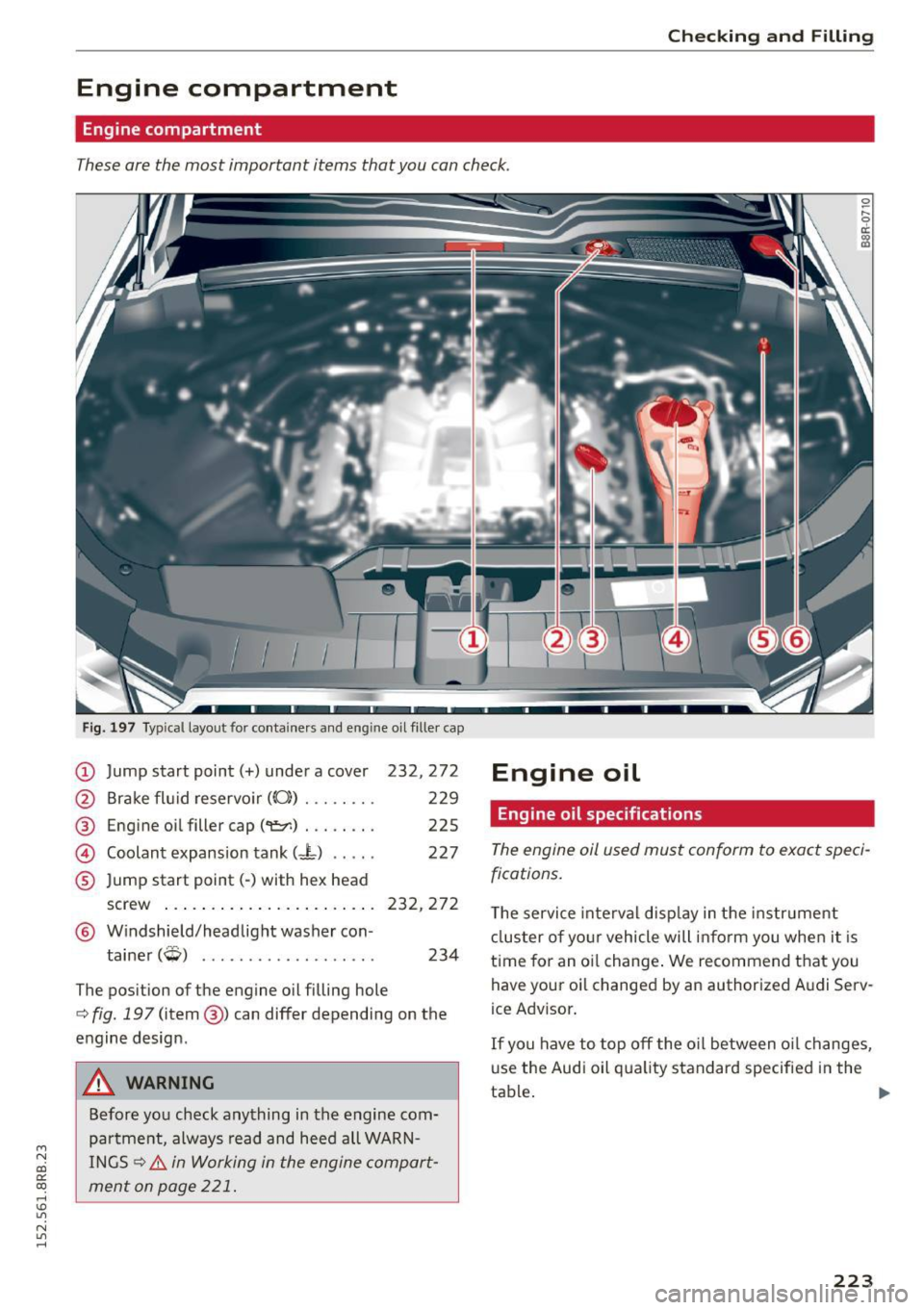
These are the mos t important item s that you can check .
Fig. 197 Typical layou t fo r container s and e ngine oil filler ca p
(D Jump start point(+) under a cover 23 2, 272
@ Brake fluid reservoir (0) . . . . . . . . 229
@ Engine oil filler cap(~) . . . . . . . . 225
@ Coolant expansion tank (- L) . . . . . 227
® Jump start point(-) w ith hex head
s crew . . . . . . . . . . . . . . . . . . . . . . . 232, 272
@ Windshield/headlight washer con -
tainer
(Q) . . . . . . . . . . . . . . . . . . . 234
T he po sit ion of the engine oil filling hole
c:> fig. 197 (item @) can differ depending on the
engine design .
A WARNING
Before you check anything in the engine com
partment, always read and heed all WARN
INGS
c:> &. in Working in the engine compart
ment on page 221.
Engine oil
Engine oil specifications
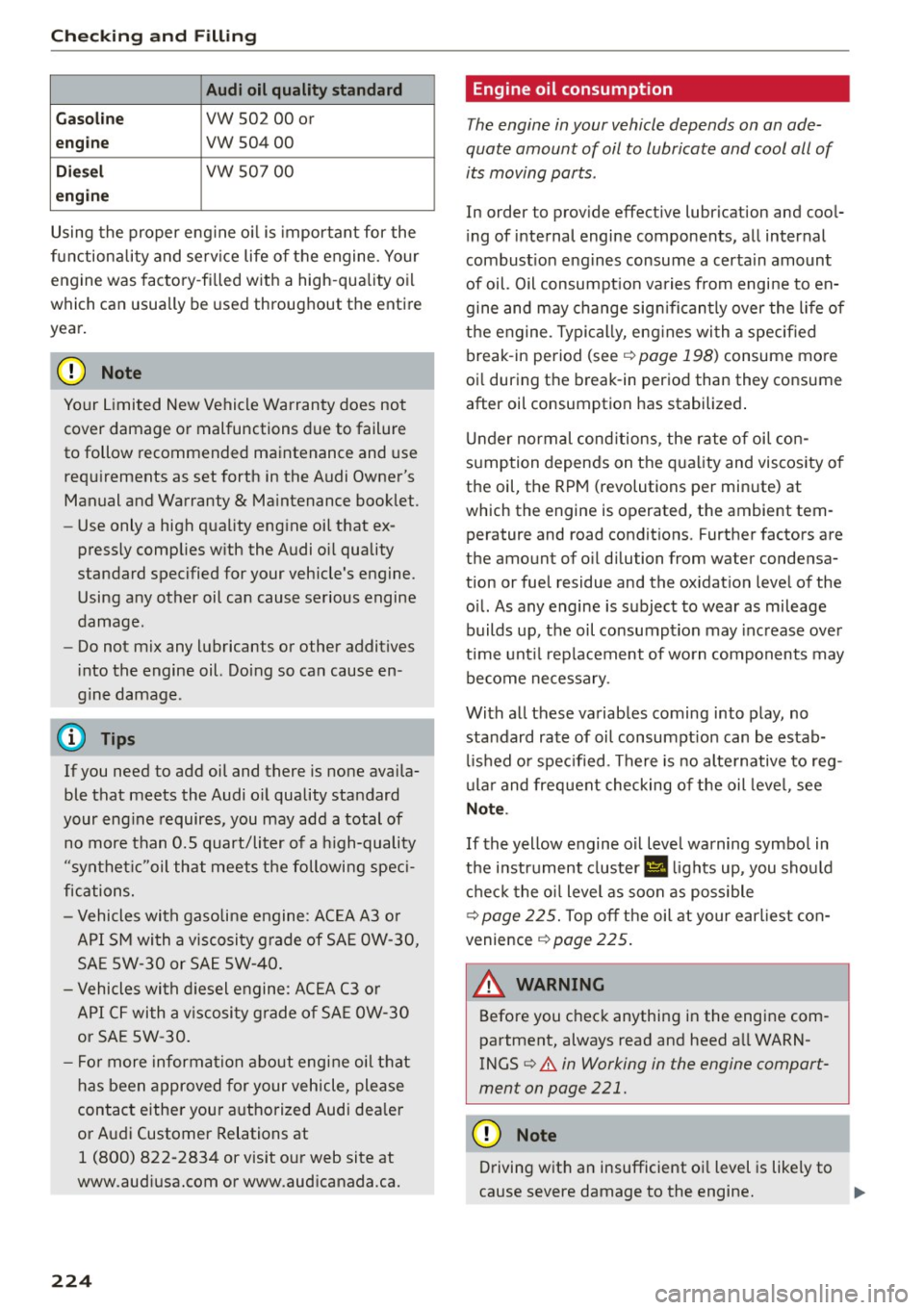
The engine oil used must conform to exact sp eci
f ications.
T he service interval disp lay in the instrument
cluster of your vehicle will inform you when it is
time for an oi l chang e. We recommend that you
hav e your oil chang ed by an authori zed A udi Serv
ic e Advi sor .
If you have to top off the oil between oil changes,
use the Audi oil qua lity standa rd specified in the
tab~ .
~
223
Page 226 of 302
Checking and F ill in g
Audi oil quality standard
Gas oline VW 502 00 or
engi ne
vw 504 00
Die sel
vw 50 7 00
e n g in e
Using the proper engine o il is important for the
functionality and serv ice life of the engine. Your
engine was facto ry-filled with a high-qua lity oil
which can usually be used throughout the entire
year.
(D Note
Your Limited New Vehicle Warranty does not
cover damage or malfunctions due to failure
to follow recommended maintenance and use
requirements as set forth in the Audi Owner's Manual and Warranty
& Ma intenance booklet.
- Use only a high qua lity eng ine oil that ex-
pressly complies w ith the Audi o il quality
standard specified for your vehicle's engine.
Using any other oil can cause serious engine
damage.
- Do not mix any lubricants or other additives
into the engine oil. Doing so can cause en
gine damage.
(D Tips
If you need to add oil and there is none availa
ble that meets the Audi o il quality standard
your eng ine requires, you may add a total of
no more than 0.5 quart/liter of a h igh-quality
"synthe tic"oil that meets the followi ng speci
fications.
- Vehicles with gasoli ne engine: AC EA A3 o r
API SM wi th a viscosity g rade of SAE OW-30,
SA E SW-30 or SAE SW-40 .
- Vehicles wi th d iesel engine: AC EA C3 o r
API CF wi th a v iscosi ty grade of SA E OW-30
or SAE SW-30.
- Fo r more information abo ut eng ine oil t hat
has been approved for your vehicle, please
contact eithe r your a uthorized Audi dea le r
or A udi Customer Relations at
1 (800) 822-2834 or visit our web site at
www.aud iusa.com or www .aud icanada.ca.
224
· Eng ine oil consumption
The engine in your vehicle depends on an ade
quate amount of oil to lubricate and cool all of
its moving parts.
In order to prov ide effective lubrication and coo l
i ng of internal engine components, all internal
combust ion engines consume a certa in amount
of oil. Oil consumpt ion va ries from engine to en
gine and may change sig nificantly over the life of
the engine. Typically, eng ines wi th a specified
break -in period (see¢
page 198) consume mo re
o il during t he b reak-in period than they co nsume
after oil consumption has stabilized .
Un der normal cond itions, the rate o f oi l con
sumption depends on the q uality and viscos ity o f
the oil, the RPM (revolutions per min ute) at
which the engine is operated, the ambient tem perature and road condit ions. Further factors are
the amount of o il dilution from water condensa
tion or fuel residue and the ox idat ion leve l of the
o il. As any engine is subject to wear as mileage
builds up, the oil consumption may inc rease over
time unt il rep lacement of worn compone nts may
become necessary.
With a ll these variab les coming into p lay, no
standard rate of oil consumpt ion can be estab
li shed or spec ified. There is no alte rnative to reg
u lar and frequent checking of the oil leve l, see
Note .
If the yellow engine oil leve l warning symbo l in
the i nstrument cluster
II lights up, you should
c h ec k t he o il level as soon as poss ible
cf> page 2 25. Top off the oil at your ear liest con
venience
r:!> page 225.
A WARNING
Before you check anything in the engine com
partment, always read and heed a ll WARN
INGS¢ .&.
in Working in the engine compart
ment on page 221.
(D Note
Driving wit h an insufficient oi l level is likely to
cause severe damage to the engine.
liJJ,
Page 227 of 302
M N
co ~ co
rl I.O
"' N
"' rl
@ Tips
-The oil pressure warning display. is not
an indicator of the oil level. Do not rely on
it. Instead, check the oil level in your en
gine at regular intervals, preferably each
time you refuel , and always before going
on a long trip .
-If you have the impression your engine con
sumes excess ive amounts of o il, we recom
m end th at you cons ult an a uthorized Aud i
deal er to have th e cau se of yo ur co nc ern
p ro perly di ag no se d . Keep i n mi nd th at the
a ccurate meas ureme nt o f oil c onsu mpti on
r equires great care and m ay ta ke some time.
An a uthorized Audi dea ler has i nstr uctions
abo ut how to meas ure o il cons umption ac
curate ly.
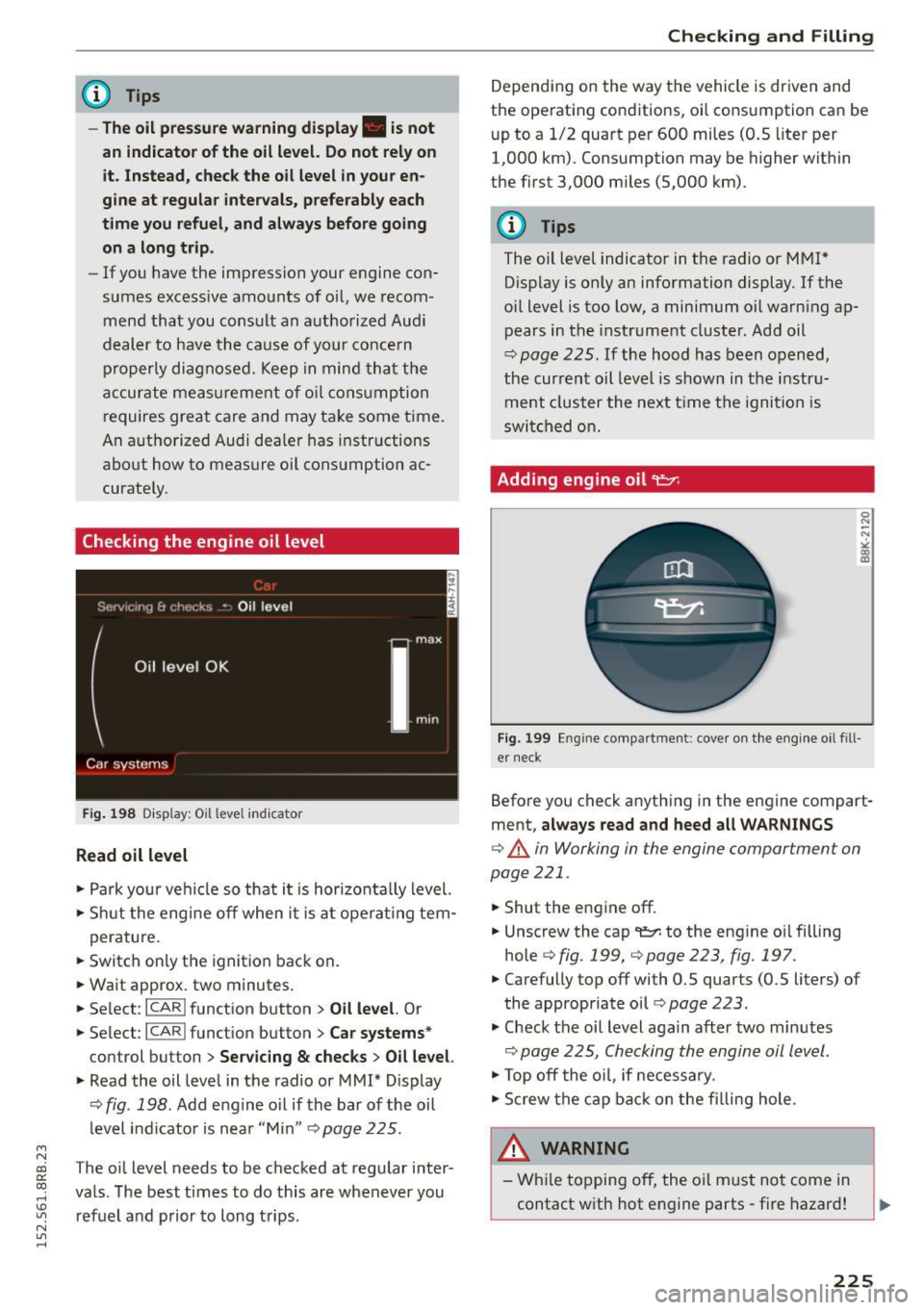
Checking the engine oil level
F ig. 19 8 Disp lay: O il level indicator
Read oil level
.. Pa rk your vehicle so that i t is hor izont ally level.
.. Shu t the engine off when i t is at oper ating te m-
perature.
.. Switc h on ly the ignition back on.
.. Wa it approx. two minutes .
.. Se lect:
I CARI funct ion button > Oil level. Or
.. Select:
ICARI funct ion button> Car systems *
control button > Servicing & checks > Oil level.
.. Read the oil leve l in the radio or MMI* Display
¢ fig . 198. Add e ng in e oil if the bar of the oil
l evel i ndicator is nea r "M in"
9page 225.
The oil level needs to be c hec ked at regular inter
va ls. The best t im es to do this are whenever you
ref uel and prior to long t rips.
Checking and Filling
D epend ing on the way t he vehicle is dr iven and
the ope rat ing cond itions, oil consumption ca n be
u p to a 1/2 quart pe r 600 miles (0 .5 liter per
1,000 km). Consumption may be higher within
the fi rst 3,000 mi les (5,000 km).
(D Tips
The oil leve l indicator in t he ra dio or MMI*
D isp lay is only an information display. If t he
o il level is too low , a minimum oi l warn ing ap
p ears in the instrume nt cl uster. Add oil
¢ page 225. If the hood has been o pen ed,
t h e cur ren t oil leve l is shown in t he instru
m ent cl uster the n ext tim e the ig niti on i s
sw itch ed on.
Adding engine oil
Fig . 199
Engine compa rtment: cove r on th e e ng in e oi l fill
er neck
Befo re you check a nyth ing in the engine compart
ment ,
always read and heed all WARNINGS
¢ & in Working in the engine compartment on
page 221 .
.. Shut the eng ine off .
.. Unscrew the cap
'l!:7-to the eng ine o il filling
hole
¢ fig. 199, 9page223, fig.197 .
.. Carefully top off with 0.5 quarts (0.5 liters) of
the appropriate oil ¢
page 223 .
.. Check t he oil level aga in after two m inutes
<:> page 225, Checking th e e ngin e oil l eve l.
.. Top off the o il, if necess ary .
.. Scr ew the cap back on the filling hole.
& WARNING
-
- W hile to p pin g off , the o il m ust not come in
contact w ith hot e ngine parts - fire hazar d!
225
Page 228 of 302
Checking and F ill in g
- The oi l fi ller cap mus t be pr operly secured to
p re vent oil from being sprayed on the hot
engine and exhaust system when the engine
is running - fire hazard!
- If your skin has come in contact with the en
gine oil, you must subsequently clea nse it
tho roughly .
CD Note
-Check the o il level using the radio or the
MMI*. If the message
Please reduce oil lev
el
appears, contact your authorized Audi
dealer or other qualified wo rkshop to have
excess oil ext racted if necessa ry .
- Audi does not recommend the use of oil
additive s. They may damage the engine
and adversely affect your New Vehicle War
ranty .
@ For the sake of the environment
- Under no circ umstances ca n the o il come in
contact w ith the sewage network o r the soil.
- Observe and fo llow lega l regu lations whe n
dispos ing of empty oil co ntaine rs .
Changing the engine oil
We recommend that have your oil changed by an
authorized Audi dealer or a qualified service sta
tion .
Before you check any thing in the engine compart
ment,
always read and heed all WARNINGS c> .&.
in Working in the engine compartment on
page 221 .
The engine oil must be changed according to the i n terva ls specified in your Warranty
& Mainte
nance booklet . This is ve ry impo rtant because the
lubricat ing propert ies of o il diminish gradua lly
du ring normal ve hicl e use.
Unde r some circumstances the eng ine o il should
be changed more frequent ly. Change oil more of
ten if yo u drive most ly short distances, operate
t he vehicle in d usty areas or unde r predom inan tly
s top-and-go traff ic co ndit io ns, o r have you r vehi
cle where tem peratures rema in be low freezing
for extended periods .
226
Detergent additives in the oil will make fresh oil
l ook dark after the engine has been running fo r a
short time. Th is is norma l and is not a reason to
c h ange the oi l more often than recommended.
Beca use o f the p rob lem of p roper disposal, along
with t he specia l too ls and necessary expertise re
quired, we strongly recommend that yo u have
your oi l changed by an authori zed
Audi dealer or
a q ua lified service station.
If you choose to change your oil yourself , please
note the fo llow ing important info rmat ion:
_& WARNING
To reduce the risk of personal inj ur y if you
must change the eng ine oil in your vehicle
yourself:
- Wear eye protect ion.
- To reduce t he risk of burns from hot eng ine
oil, let the engine coo l d own to the to uch.
-
- W hen removing the o il dra in p lug with your
fingers, stay as far away as possible. Always
keep you r forearm parallel t o the ground to
he lp prevent hot o il from running down your
arm .
- Dra in the oil i nto a container designed for
this purpose , one large enough to hold at
l e ast the tota l amount o f oil in you r engine.
- Engine oil is poisonous. Keep it we ll out of
the reach of ch ildren .
- Continuous contact w it h used eng ine oi l is
ha rmf ul to your skin . Always protect your
skin by washi ng oil off tho roughly wi th soap
a nd wate r.
CD Note
N eve r mix oil additives with you r engine oil.
These add itives can damage your engine and
adverse ly affec t your Aud i Lim ited New Vehi
cle Warranty.
@ For the sake of the environment
-Before changi ng your oil , first make sure
you know wh ere you ca n prope rly dispose of
t h e us ed oil.
- Always disp ose of used eng ine oil properly.
Do not dump it o n garden soi l, wooded