engine oil AUDI Q5 2015 Owner's Manual
[x] Cancel search | Manufacturer: AUDI, Model Year: 2015, Model line: Q5, Model: AUDI Q5 2015Pages: 302, PDF Size: 75.01 MB
Page 229 of 302
M N
co
a:
co
,...., \!) 1.1'1
N 1.1'1 ,....,
areas, into open streams or down sewage
drains.
- Recycle used engine oil by taking it to a used
engine oil collection facility in your area, or
contact a service station.
Cooling system
Coolant
T he engine coolant performs two functions: it
keeps the engine from overheating and it pro
tects the engine from freezing in the winter .
The cooling system is sealed and generally re
qu ires little attention .
T he cooling system has been filled at the factory
with a permanent coolant which doe s not need to
be changed . T he cool ant consists of a mixture of
specia lly condit io ned water and the ma nufactur
e r's g lycol-basedcoo lant additive G 13 antifreeze
w ith a nticorros ion add itives (50% for USA mod
e ls; 60% for Canadian models) . Thi s m ixt ure bot h
a ssures the ne cessary frost protection and pro
tec ts meta l components in the engine 's cooling
system from corrosion and sca ling. It a lso raises
the boiling point of the coolant.
D o not red uce the conce ntra tion o f th e coo lant i n
the summer by add ing p la in wa ter.
The propor
tion of coolant additive must be at least 50% but not more than 60 %
to maintain antifreeze
protection and cooling efficiency . If the coolant
frost protection is too low, the coolan t could
freeze and damage t he vehicle heat ing and en
g ine cooling system .
For yea r-round driving, antifree ze is added at the
factory for tempe ratu res down to:
- -31°F ( -35°C) USA
- - 4 0°F ( - 40°C) C anada .
I f yo u mu st add coo lant, use a m ixt ure of wate r
a nd coolant add it ive. Mixing the coolant additive
with d istilled water is recommende d.
_& WARNING
Be fore yo u check any thing i n the engine com
par tment, always read and hee d all WAR N-
Checking and Fillin g
IN GS ¢ .& in Working in the engine compart
ment on page 221.
@ Note
- Be fore winte r sets in , have the coo lant
checke d to see if the coolant additive in you r
vehicle is sufficient to meet the climate con diti ons. This is espec ia lly important if you
live in a region where the winter is extreme
ly cold . If necessary, increase the p ropo rtion
o f coolan t addi tive to 60%.
- Whe n adding coolant additive to your cool
ing system, remember :
- We recommend using o nly coo lan t add i
tive G12++ o r G13 fo r yo ur vehicle . This
coolant ad dit ive is available at author ized
A ud i dealers . Othe r types of antifreeze ca n
significantly reduce cor rosion protect ion .
The resulting cor rosion can ca use a loss of
coolant a nd serious e ngine damage .
- Do not add any type of rad iator leak sealant
to your vehicle's engine coolant. Adding ra diat or repa ir flu id may adverse ly affect the
function and perfo rmance of your cooling
system and cou ld result i n damage not cov
ere d by your New Vehicle Lim ited W arra nty .
Checking the engine coolant level
Th e engine coolant level can be checked with a
quick glance.
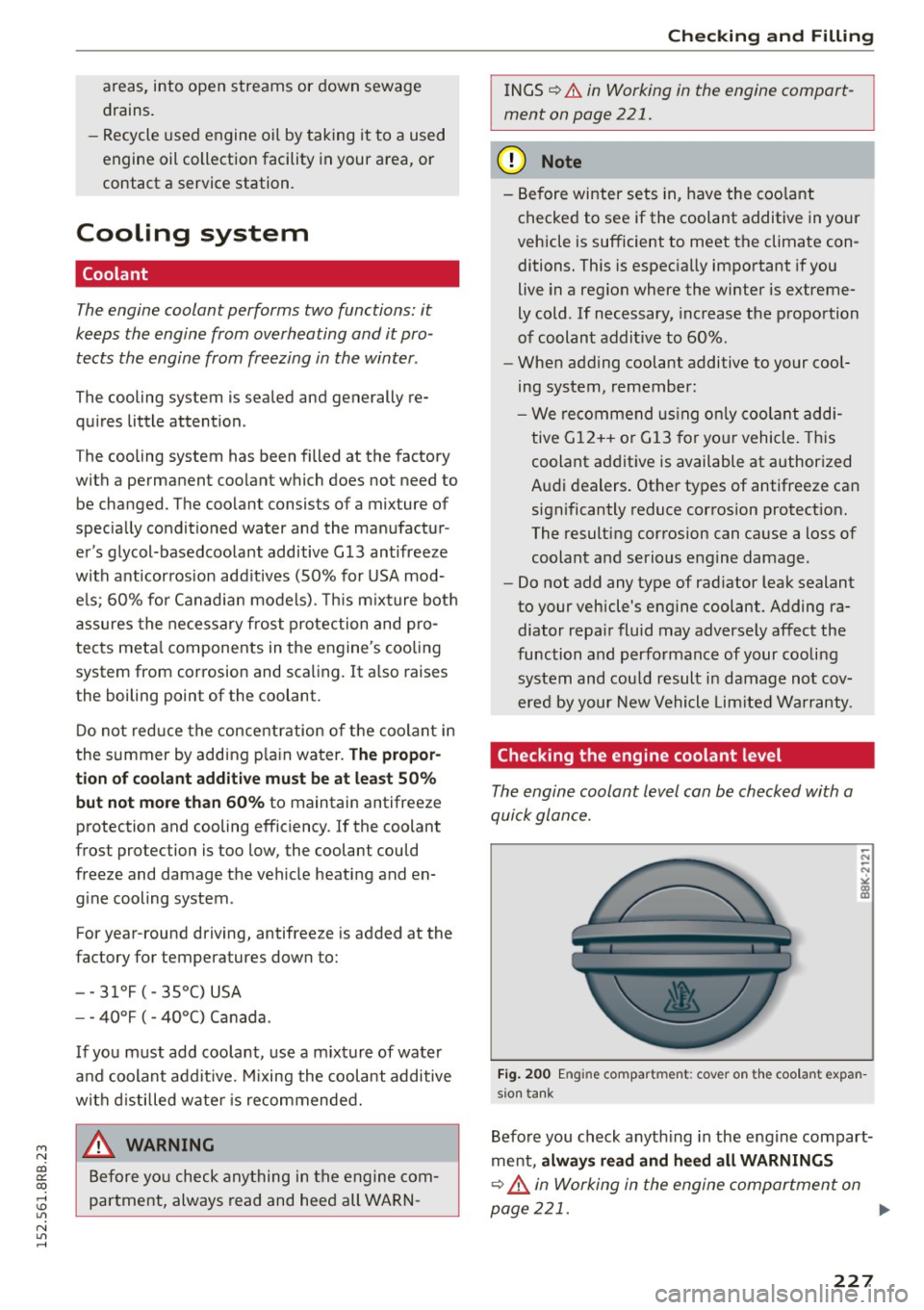
Fi g. 200 Engin e compar tmen t: cov er on th e coo lant ex pan
s io n ta nk
Befo re you ch eck a nyth ing in the eng in e compart
me nt,
always read and heed all WARNINGS
¢ ,& in Working in the engine compartmen t on
page 221.
~
227
Page 230 of 302

Checking and Filling
"'Park your vehicle on a level surface.
"'Turn off the ignition.
"'Read the engine coolant level from the coolant
expansion tank
c:> fig . 200, <=> page 223,
fig. 197. With a cold engine, the coolant level
should be between the "MIN" and "MAX" mark
ings . When the engine is warm, the level may
be slightly above the "MAX" marking .
The location of the coolant expansion tank can be
seen in the engine compartment illustration
<=> page 223 .
To obtain an accurate reading, the engine must
be switched off.
The expansion tank in your vehicle is equipped
with an electric coolant level sensor.
When the coolant level is too low, the warning
light in the Auto-Check System
c::> page 29 will
blink until you add coolant and the level has been
restored to normal. Even though there is an elec
tric coolant level sensor, we still recommend you
check the coolant level from time to time .
Coolant loss
Coolant loss may indicate a leak in the cooling
system. In the event of coolant loss, the cooling
system should be inspected immediately by your
authorized Audi dealer. It is not enough merely
to add coolant .
In a
sealed system, losses can occur only if the
boiling point of the coolant is exceeded as a re
sult of overheating.
0 Note
Do not add any type of radiator leak sealant
to your vehicle's engine coolant . Adding radia
tor repair fluid may adversely affect the func
tion and performance of your cooling system
and could result in damage not covered by
your New Vehicle Limited Warranty .
Adding coolant
Be very careful when adding engine coolant.
Before you check anything in the engine compart
ment,
always read and heed all WARNINGS
228
c::> A in Working in the engine compartment on
page
221.
Requirement: There must be a residual amount
of coolant in the expansion tank
<=>(i) .
"'Turn off the engine.
"' Let the engine cool down.
"' Place a thick rag over the coolant expansion
tank
c::> page 22 7, fig. 200 and carefully turn
the cap counter-clockwise
c::> .&, .
"'Add coolant mixed in the correct ratio
c::> page 22 7, Coolant up to the MAX marking.
"'Make sure that the fluid level remains stable.
Add more coolant if necessary .
"'Twist the cap on again
tightly.
Replacement engine coolant must conform to ex
act specifications
c::> page 22 7, Coolant.
We recommend using only coolant additive Gl2+
+, Gl3
or in an emergency Gl2+. Do not use a
different additive. In an emergency use plain wa
ter until you can get the correct additive and can
restore the correct ratio. This should be done as
soon as possible.
If you have lost a considerable amount of cool
ant, then you should add cold antifree ze and cold
water only when the engine is cold.
Always use
new engine coolant when refilling.
Do not fill coolant above the "MAX" mark. Excess
coolant will be forced out through the pressure
relief valve in the cap when the engine becomes
hot.
A WARNING
- The cooling system is under pressure and
can get very hot. Reduce the risk of scalding
from hot coolant by following these steps.
- Turn off the engine and allow it to cool
down.
- Protect your face, hands and arms from
escaping fluid and steam by covering the
cap with a large, thick rag.
- Turn the cap slowly and very carefully in a
counter-clockwise direction while applying
light, downward pressure on the top of
the cap.
ll-
Page 232 of 302
Checking and F ill in g
The brake fluid reservoir is located at the rear
partition of the engine compartment on t he left
side ¢
page 223.
The fl uid level may drop slightly after some time
due to the automatic adjustment of the brake
pads. This is not cause for alarm.
If the b ra ke fluid level fal ls considerably below
the "MIN" mark, the brake warn ing/indicator
light (U.S. models:
1111 , Canadian models: . )
will come on¢
page 18 and ¢ page 28 . Do not
continue to operate the vehicle . The complete
brake system shou ld be thoroughly checked by an
author ized Audi dealer or qualif ied workshop and
the cause corrected. If the brake fluid level is too low, the brake warning/indicator light will illum i
nate. Contact an authorized Aud i dealer
immedi
a tel y.
Changing brake fluid
Have the brake fluid changed by an experienced technician.
Brake flu id abso rbs moisture from the a ir . If the
water content in the brake fluid is too high, cor rosion in the b rake system may result after a pe ri
od of time. The boiling point of the bra ke fluid
will also decrease conside rably and decrease
b ra ki ng per fo rmance .
Therefore, th e brake flu id must be changed
ev ery
tw o years .
Always use new b rake fluid w hich con
forms to Fede ra l Motor Vehicle Standa rd " FMVSS
1 16 DOT 4".
The brake fluid rese rvoir can be difficult to reach,
therefo re, we recommend that yo u have the
b rake fluid changed by your authori zed
Audi
dealer .
Your dealer has the cor rect too ls, the
right brake f luid and the know -how to do t his for
you.
A WARNING
- Brake fluid is po isonous. It must be stored
only in the closed orig inal container out of
the reach of children!
- Brake fai lure can result from old or inappro
pr iate brake fluid . Observe these precau
t ions:
230
- Use only brake fluid that meets SAE spec i
ficat io n
J 1703 and conforms to Federal
Motor Vehicle Sta ndard 116 . Always check
with your aut horized Aud i dea ler to make
su re you are using the correct brake fl uid .
The co rrect type of brake f lu id is also ind i
cated on t he b rake fluid reservoir.
- The brake fl uid must be new. Heavy use of
the b rakes can cause a vapor lock if the
brake fluid is left in t he system too long.
This can se riou sly affec t the efficiency of
the b rakes as well as yo ur sa fety. This
could result in an acc ident .
(D Note
Bra ke fluid will damage the pai nt of you r vehi
cle.
@ For the sake of the environment
B ecause of the prob lem of prope r disposal of
b rake fluid as well as the spe cial tools re
q ui red and the necessary ex pert ise, we rec
ommend that you have the brake f lu id
cha nged by yo ur autho rize d Aud i dea le r.
Battery
General information
U nder normal operat ing conditions , the battery
i n you r Aud i does not need any maintenance.
With
high outside tem pera tures or long d aily
drives we recommend that you have the e lectro
l yte level checked by an a utho rized Audi dea le r or
qualified workshop. The electrolyte leve l should
a lso be checked each time the battery is charged
¢ page 232.
Have the battery checked when yo u take your ve
hicle in for service. You a re well advised to re
place a battery that is older than 5 years.
With cer tain types of airbag deployment, t he bat
tery is disconnected from the vehicle elect rical
system for safety reasons
Q &. in Repair, care
and disposal of the airbags on page 165.
Hybrid drive *: yo u can find important information
abo ut the high voltage battery under ¢
page 98 . ..,.
Page 249 of 302
M N
co
a:
co
,...., \!) 1.1'1
N 1.1'1 ,....,
Wheels
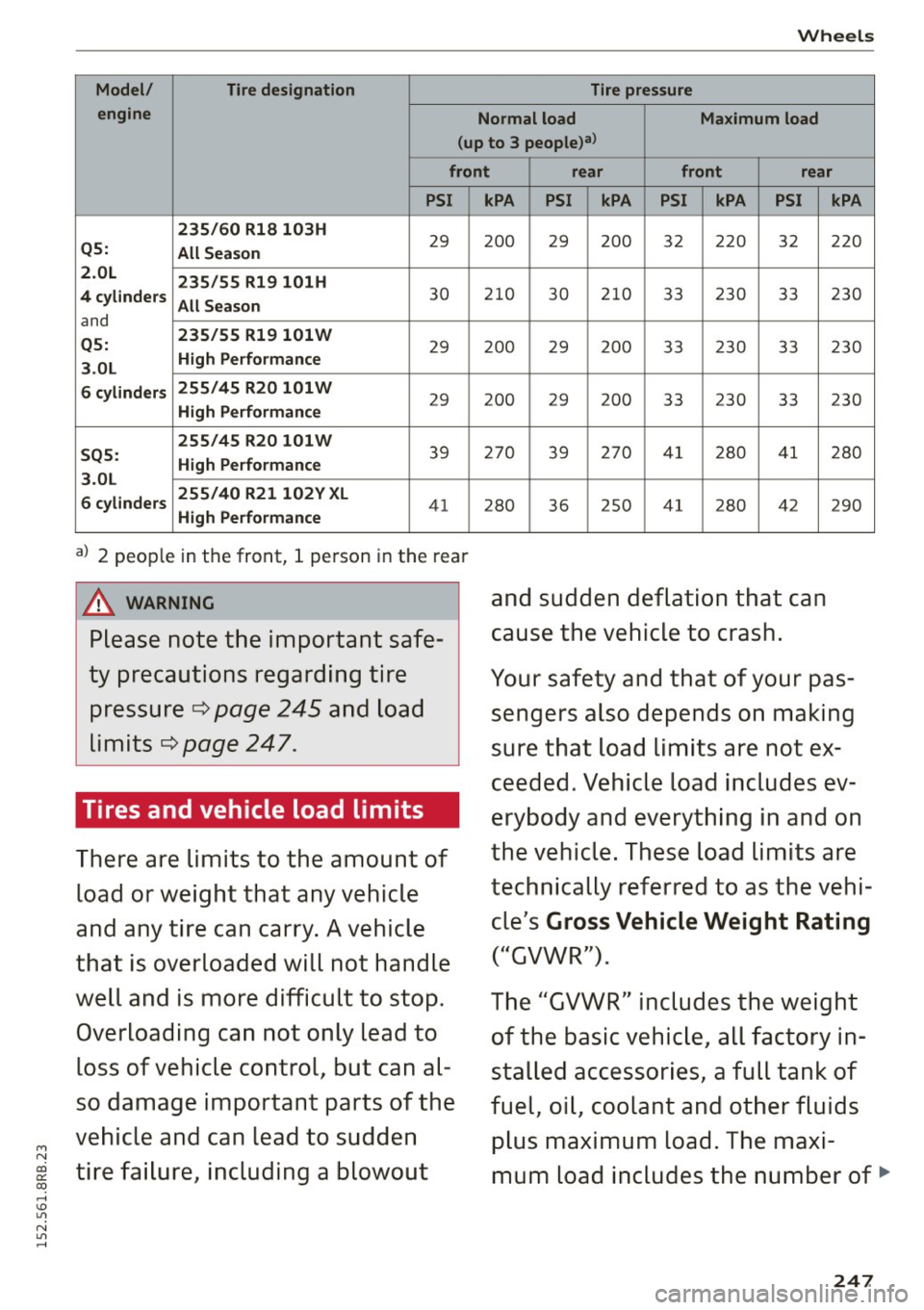
Model/ Tire designation Tire pressure
engine Normal load Maximum load
(up to 3 people)a)
front rear front rear
PSI
235/60 Rl8 103H
29 Q5: All Season
2.0L 235/55 Rl9 101H
4 cylinders All Season
30
and
Q5: 235/55 Rl9 101W 2
9 High Performance
3.0L
6 cylinders 255/45 R20 101W
29 High Performance
255/45 R20 101W
3
9 SQ5:
High Performance
3.0L
6 cylinders 255/40 R21 102Y XL
41
High Performance
a) 2 p
eopl e in th e fron t, 1 p ers on i n th e re arr
A WARNING
Please note the important safe
ty precautions regarding tire pressure
¢ page 245 and load
limits
¢ page 247 .
Tires and vehicle load limits
There are limits to the amount of
load or weight that any vehicle
and any tire can carry. A vehicle
that is overloaded will not handle
well and is more difficult to stop.
Overloading can not only lead to
lo ss of vehicle control , but can al
so damage important parts of the
vehicle and can lead to sudden
tire failure, including a blowout
kPA PSI kPA PSI kPA PSI
20 0 29 2 00 32 220 32
2 10 30 210 33 230 33
200 2 9 200
33 2
30 33
2 00 29 2 00 33 230 33
270 39 270 41 280 41
280 36 2
50 41 2 80 42
and sudden deflation that can
cause the vehicle to crash.
kPA
220
230
2 30
230
280
2 90
Your safety and that of your pas
sengers also depends on making
sure that load limits are not ex
c eeded. Vehicle load includes ev
erybody and everything in and on
the vehicle. These load limits are te chnically referred to as the vehi
cle 's
Gross Vehicle Weight Rating
("GVWR") .
The "GVWR " includes the weight
of the basic vehicle, all factory in
stalled accessories, a full tank of
fuel, oil, coolant and other fluids
plus maximum load. The maxi
mum load includes the number of""
247
Page 262 of 302
Emerg enc y ass is tance
CJ) Note
Special care is required if you are repairing the
tire on a steep incline.
@ Tips
- Do not operate the compressor for more
than 12 minutes continuously, otherwise it
can overheat . Once the compressor has
cooled, you can continue to use it.
- If sealant has spi lled out, let it dry and then
you can remove it by peeling it away like a
foil.
- Remember to obtain a new bottle of sea lant
from yo ur authorized Aud i dea ler after re
pairing a tire. After this, the functionality of
the tire repa ir set is restored.
- Obey all laws.
Replacing wheels
Before changing a wheel
Observe the following precautions for your own
and your passenger's safety when changing a
wheel.
.. After you experience a tire fa ilure, pull the car
well away from moving traffic and try to reach
l eve l ground before you stop¢_& .
.. All passengers sho uld
le ave t he car and move
to a safe location (for instance, behind the
guardrail)¢ _&.
.. Engage the
parking br ake to prevent your vehi
cle from rolling unintentionally¢_& .
.. Move
select or lever to pos itio n P ¢ &_ .
.. If you are tow ing a trailer: unhitch the trailer
from your vehicle .
.. Block the diagonally opposite wheel with the
folding chocks or other objects.
.. Take the
jack * and the in flat abl e s par e tir e*
out of the luggage compartment¢ page 255.
A WARNING
You or your passengers could be injured while
changing a wheel if you do not follow these
safety precautions:
- If you have a flat tire, move a safe distance
off the road. Turn off the engine, t urn the
260
emergency flashers on and use other warn
ing dev ices to alert other motor ists.
- Make sure that passengers wait in a safe
place away from the vehicle and well away
from the road and traffic.
- To help prevent the vehicle from moving
suddenly and possibly slipping off the jack*,
always fully set the parking brake and block
the wheel diagonally opposite the wheel be
ing changed with the folding chocks or oth
er objects. When one front wheel is lifted
off the ground, placing the Automatic Tra ns
m iss ion in P (Pa rk) w ill
not prevent the veh i
cle from moving.
- Before you change a whee l, be sure the
ground is level and firm.
If necessary, use a
sturdy board under the jack *.
- Always store the vehicle tool kit, the jack*
and the replaced tire in the luggage com
pa rtment
¢ page 140.
Changing a wheel
When you change a wheel, follow the sequence
described below step-by-step and in exactly that
order .
1. Remove the d eco rativ e wheel cover*. For
more details see also¢
page 261, Decora
tive wheel covers
or ¢ page 261, Wheels
with wheel bolt caps .
2. Loosen the wheel bolts¢ page 261 .
3. Locate the proper mounting point for the
jack* and align the jack* be low that point
¢ page 262.
4. Lift the car with the jack*¢ page 262 .
5 . Remove the
wheel with th e flat tire and then
install the
inflatable spa re ti re*
¢ page 263.
6. Tig hte n a ll whee l bolts ligh tly .
7 .
Lo we r the vehicle with the jack* .
8 . Use the wheel bolt wrench and
firml y tighten
all wheel bolts ¢
page 261.
9. Replace the decorative wheel co ve r* . ...
Page 278 of 302
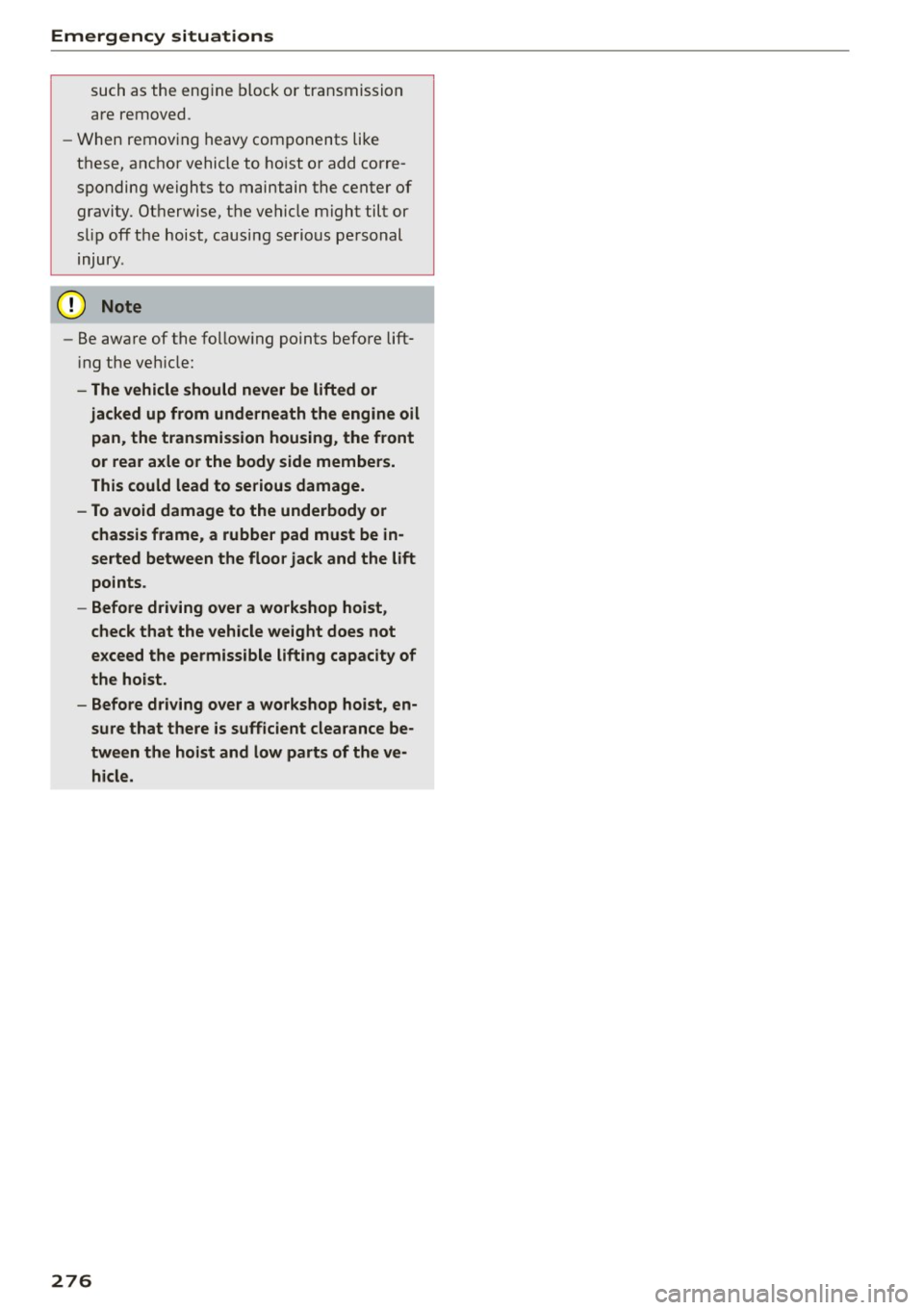
Emergency situations
such as the engine b lock or transmission
are removed .
- When remov ing heavy components like
these, anchor vehicle to ho ist or add corre
sponding weights to maintain the center of
gravity . Otherwise, t he vehicle might tilt or
slip off t he hoist, causi ng serious pe rsonal
injury .
(D Note
-Be awa re of the fo llow ing points befo re lift
ing the ve hicle:
- The vehicle should never be lifted or
jacked up from underneath the engine oil pan , the transmi ssion housing, the front
or rear axle or the body side members.
This could lead to se rious damage.
- To avoid damage to the underbody or chassis frame, a rubbe r pad must be in
serted between the floor jack and the lift
po ints .
- Before driving over a workshop hoist,
check that the vehicle weight does not
ex ceed the permissible lifting capacity of
the hoist.
- Before driving over a workshop hoist, en
sure that there is sufficient clearance be
tween the hoist and low parts of the ve
hicle .
276
Page 279 of 302

M N
co ~ co
rl I.O
"' N
"' rl
Technical data
Vehicle identification
F ig. 236 Veh icle Identificat ion Number (VlN) plate: loca·
t ion on driver 's side dash pane l
XXXXX XX -X -XXXX XXX XX
CD+ ~t :1:: xxxxxxxx xx x xxxxxxxx
T VP /fffl XXX XXX
XX XXXXXXX XX X X XX
XXX
KW XXX
®i ~:J ·f lfils~~ XXXX XXX XXX
®-+ ~ N:a=i~l xxxx ; xxxx xxx ; xx
11. • AUSS, I OPTIONS
E0A 7D5 4UB 6XM 5SG 5R W
2EH J0Z lLB l
A S lBA
3FC SMU 7Xl
FOA
9G3 0G7 0YH OJF
TL 6 3 KA
8EH UlA X98 QZ 7
lXW 803 908 824 020
7T6 CV7 7K0 4X3 2K2
3L4 4KC 3Y0 413 502
lS A
7GB 01A 4G0
XX. X XX X XX X xxxx
Fig. 237 Veh icle identificat ion label: inside the luggage
compartment
Vehicle Identification Number (VLN )
The Veh icle Iden tific ation Number is located in
d iffe rent p laces:
- under the w indshield on the dr iver's side
c::> fig . 236.
-in the radio or in the MM I*: Select: I CAR I func
t ion but ton
> Vehicle ID numb er (VIN ) or se·
Le et
I CAR I funct ion button > Car sy s tem s* con·
tro l bu tton
> Servicing & checks > VIN num
ber .
-on the vehicle identific ation label.
Technical d ata
Vehicle id entification label
T he vehicle identification label is lo cate d in the
lu ggage compartment above the compartment
for the vehicle too ls.
T he label
c::> fig . 23 7 shows the fo llow ing vehicle
da ta:
(D Vehicl e Ident ificat ion Number (VIN)
@ Vehicle type, engine o utp ut, transmission
@ Engine and transm ission code
@ Pain t number and inte rior
® Optional equipment numbers
T he information of the vehicle identification label
can a lso be found in your W arranty
& Ma inte
nance booklet.
Safety compliance sticker
T he safety complianc e sticker is your assurance
that your new vehi cle complies w ith all appli cable
F ede ra l Mo to r Vehi cle Safety Sta ndards which
were in effec t at the time the vehicle was ma nu
fact ured. Yo u can find this sticker on the door
jamb on the driver's side. It shows the month and year of product ion and the vehicle identification
number of your vehicle (perforation) as well as
t h e Gross Veh icle Weight Rating (GVWR) and the
G ross Ax le Weight Rating (GAWR).
H igh vo lt a ge warn ing lab el
The high voltage warning label is located in the
engi ne compartment next to the engine hood re·
lease. The spark ignit ion system complies with
the Canadian standard ICES-002 .
Weights
Gross Vehicle Weight Rating
The Gross Vehicle Weight Rating (GVWR), and
the Gross Axle Weight Rat ing (GAWR) for front
and rear are listed o n a sticker on the door jamb
on the dr iver's side.
The Gross Vehicle Weight Rating includes the
weight of the bas ic vehicle plus full fuel tank, oil
and coolant, plus maximum load, which includes
passenger weight (150 lbs/68 kg per designated
seat ing pos ition) and luggage we ight
c::> .&, . ..,_
277
Page 281 of 302
M N
co
a:
co
,...., \!) 1.1'1
N 1.1'1 ,....,
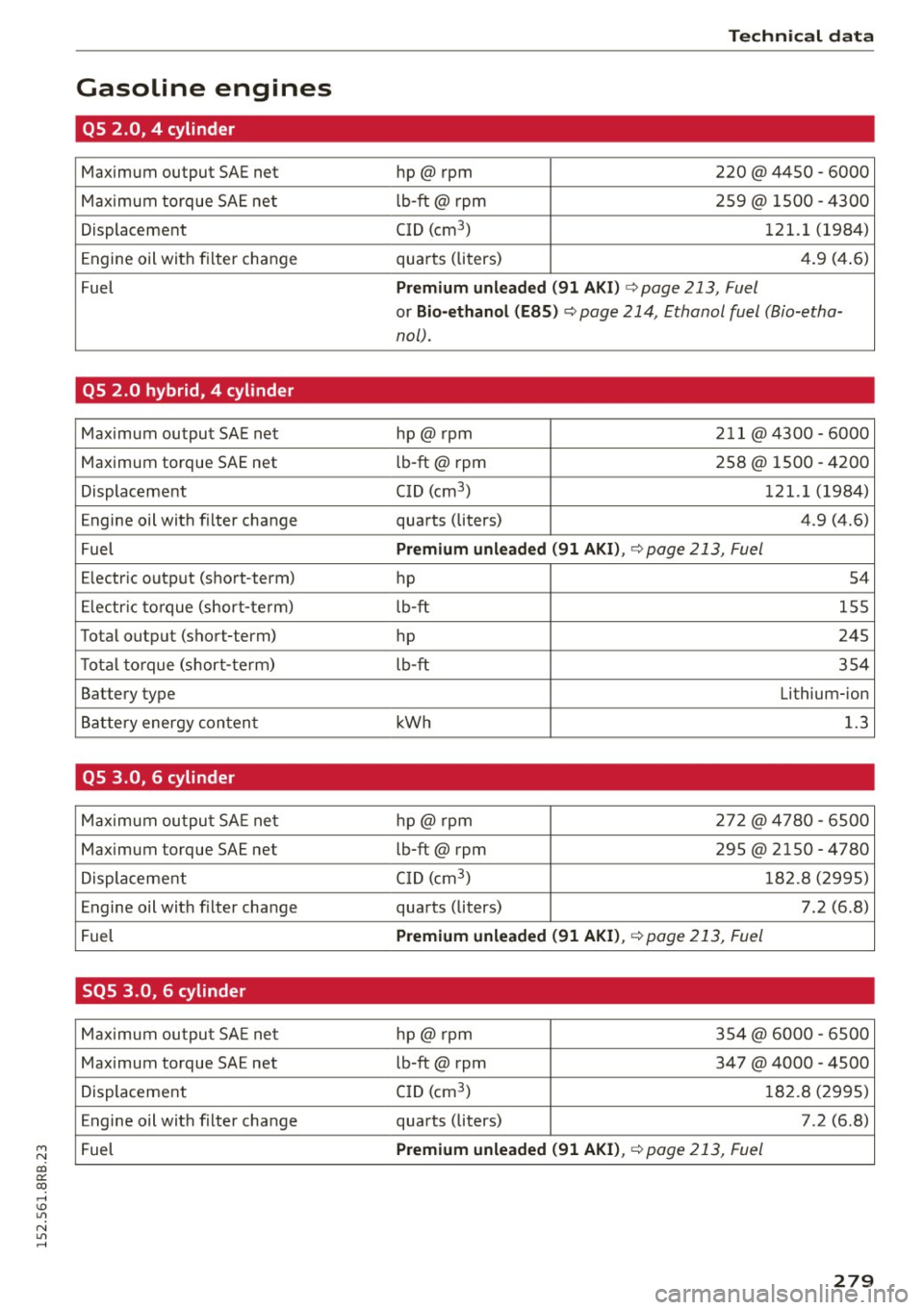
Gasoline engines
QS 2.0, 4 cylinder
Maximum output SAE net
Maximum torque SAE net
Displacement
Engine oil with filter change
Fuel
QS 2 .0 hybrid, 4 cylinder
Maximum output SAE net
Maximum torque SAE net
Displacement
Engine oil with filter change
Fuel
E lectric output (short-term)
E lectr ic torque (short-term)
Total output (short-term)
T otal torque (short-term)
Battery type
Battery energy content
QS 3.0, 6 cylinder
Maximum output SA E net
Maximum torque SAE net
Displacement
Engine oil with f ilter change
Fuel
SQS 3.0, 6 cylinder
Maximum output SA E net
Maximum torque SAE net
Displacement
Engine oil with filter change
Fuel
Techni cal d at a
hp@rpnn 220 @4450 -6000
lb -ft@ rpm 259@ 1500 -4300
CID (cm
3 ) 121.1 (1984)
quarts (liters) 4.9 (4.6)
Premium un lead ed (9 1 A KI) <=:>pag e 213, Fuel
or
Bi o-e tha no l (E B S) ¢ page 214, Ethanol fuel (Bio-etha-
no[) .
hp@rpnn 211 @4300 -6000
lb -ft@ rpm 258 @ 1500 -4200
CID (cm
3 ) 121.1 (1984)
quarts (liters) 4.9 (4.6)
Premium unl ead ed (91 AKI) , <=:>page 213, Fuel
hp 54
lb -ft 155
hp 245
lb-ft 354
Lithium-ion
kWh 1.3
hp@ rpnn 272@ 4780 -6500
lb-ft@ rpm 295@ 2150 -4780
C ID (cm
3
') 182.8 (2995)
quarts (liters) 7.2 (6.8)
Pre mi um unl ead ed (9 1 AKI) , <=:>page 213, Fuel
hp@ rpnn 354@ 6000 -6500
lb-ft@ rpm 347 @4000 -4500
C ID (cm
3
) 182.8 (2995)
quarts (liters) 7.2 (6.8)
Pre mium unlea ded (91 A KI) , <=:> page 213, Fuel
279
Page 282 of 302
Technical data
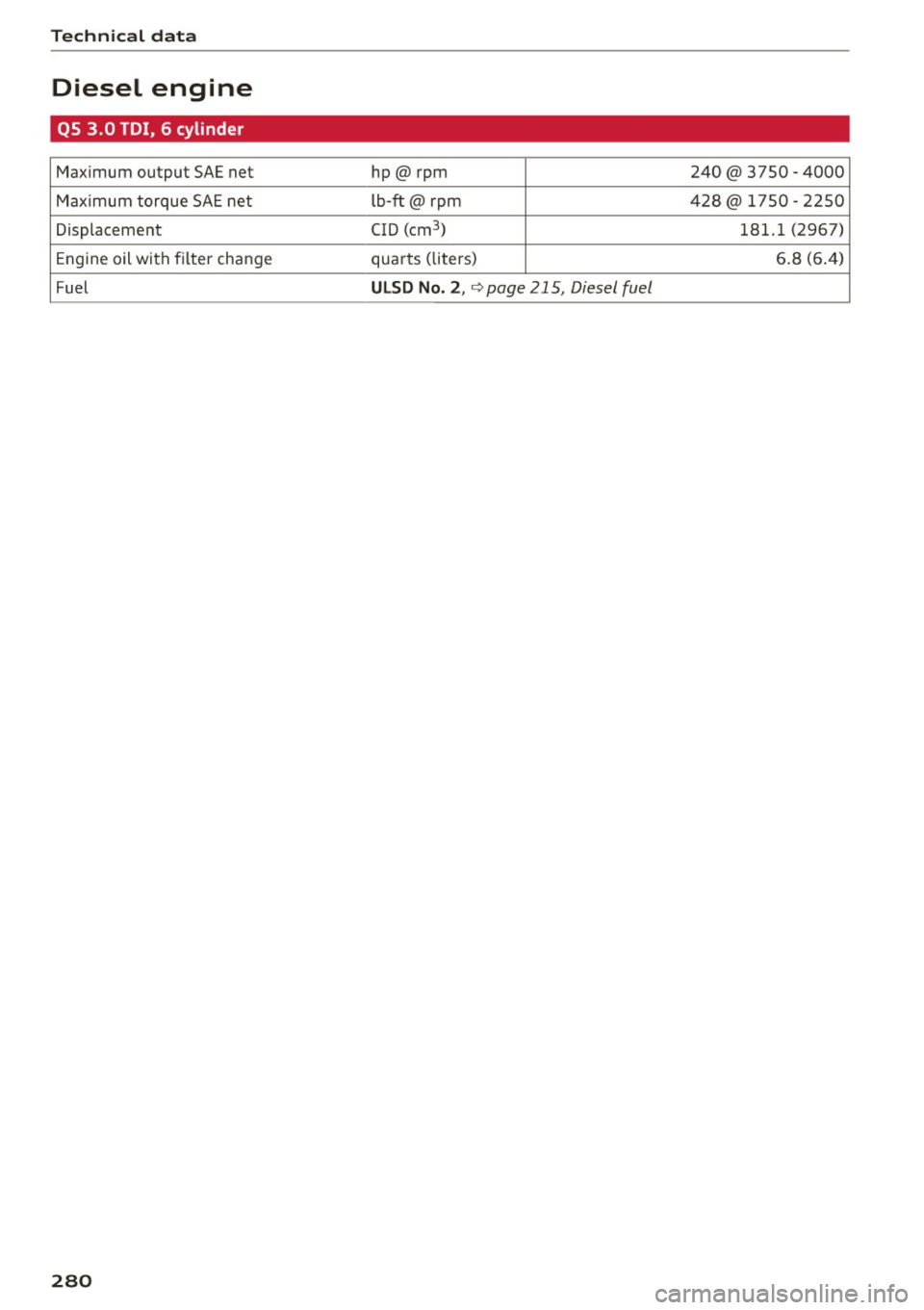
Diesel engine
QS 3.0 TDI, 6 cylinder
Maximum output SAE net hp@rpm 240@ 3750 - 4000
Maximum torque SAE net lb-ft @ rpm 428@
1750 -2250
Displacement CID (cm
3
) 181.1 (2967)
Engine oil with filter change quarts (liters)
6.8 (6.4)
Fuel
ULSD No. 2, ¢ page 215, Diesel fuel
280
Page 283 of 302
M N
co
a:
co
,...., \!) 1.1"1
N 1.1"1 ,....,
Consumer information
Warranty coverages
Your Audi is covered by the following warran
ties:
- New Vehicle Limited Warranty
- Limited Warranty Against Corrosion Perfora-
tion
- Emissions Control System Warranty
- Emissions Performance Warranty
- California Emissions Control Warranty (USA
vehicles only)
- California Emissions Performance Warranty
(USA vehicles only)
Detailed information regarding your warranties
can be found in your
Warranty & Maintenance
booklet .
Operating your vehicle
outside the U.S.A. or
Canada
Government regulations in the United States and
Canada require that automobiles meet specific
emission regulations and safety standards.
Therefore, vehicles built for the U.S.A. and Cana
da differ from vehicles sold in other countries.
If you plan to take your vehicle outside the conti
nental limits of the United States or Canada,
there is the possibility that:
- unleaded fuels for vehicles with catalytic con
verter may not be available;
- fuel may have a considerably lower octane rat
ing . Improper fuel may cause engine damage;
- serv ice may be inadequate due to lack of proper
serv ice faci lities , tools or testing equipment;
- replacement parts may not be readily available .
- Nav igat ion systems for vehicles built for the
U.S.A. and Canada will not necessar ily work in
Europe , and may not work in other countries
outside of North America.
Consumer information
(D Note
Audi cannot be responsible for mechanical
damage that could result from inadequate
fuel, service or parts availability.
Audi Service Repair
Manuals and Literature
Audi Official Factory Service Manuals and Litera
ture are published as soon as possible after mod el introduction . Service Manuals and literature
are available to order from the Audi Technical Lit
erature Ordering Center at:
www.audi.techliterature.com
Maintenance
General
Your vehicle has been designed to help keep
maintenance requirements to a minimum. How
ever, a certain amount of regular maintenance is
still necessary to assure your vehicle's safety,
economy and reliability. For detailed vehicle
maintenance consult your Warranty & Mainte
nance booklet .
Under difficult operating conditions, for exam
ple at extremely low outside temperatures, in
very dusty regions, when towing a trailer very fre
quently, etc., some serv ice work should be per
formed between the intervals specified. This ap
plies particularly to:
- oil changes, and
- cleaning or replacing the air filter .
(® For the sake of the environment
By regularly maintaining your vehicle, you
help make sure that emission standards are
maintained, thus min imizing adverse effects
on the environment.
Important considerations for you and your
vehicle
The increasing use of electronics, sophisticated
fuel injection and emission control systems, and
the generally increasing technical complexity of
lllJ,,
281