roof AUDI Q5 2015 User Guide
[x] Cancel search | Manufacturer: AUDI, Model Year: 2015, Model line: Q5, Model: AUDI Q5 2015Pages: 302, PDF Size: 75.01 MB
Page 79 of 302
M N
co ~ co
rl I.O
"' N
"' rl
.. Remove the cigarette lighter when it pops out.
The c igarette lighter should only be used as a
power source for the compressor from the i nflat
able spare tire/tire repair kit* when absolutely
necessary.
A WARNING
The cigarette lighter only works when the ig
nition is switched on. Incorrect usage can lead
to serious injuries or burns. For this reason,
children should never be left unattended in
the vehicle because this increases the risk of
injury .
12-volt sockets
Electrical accessories can be connected to every
12-volt socket.
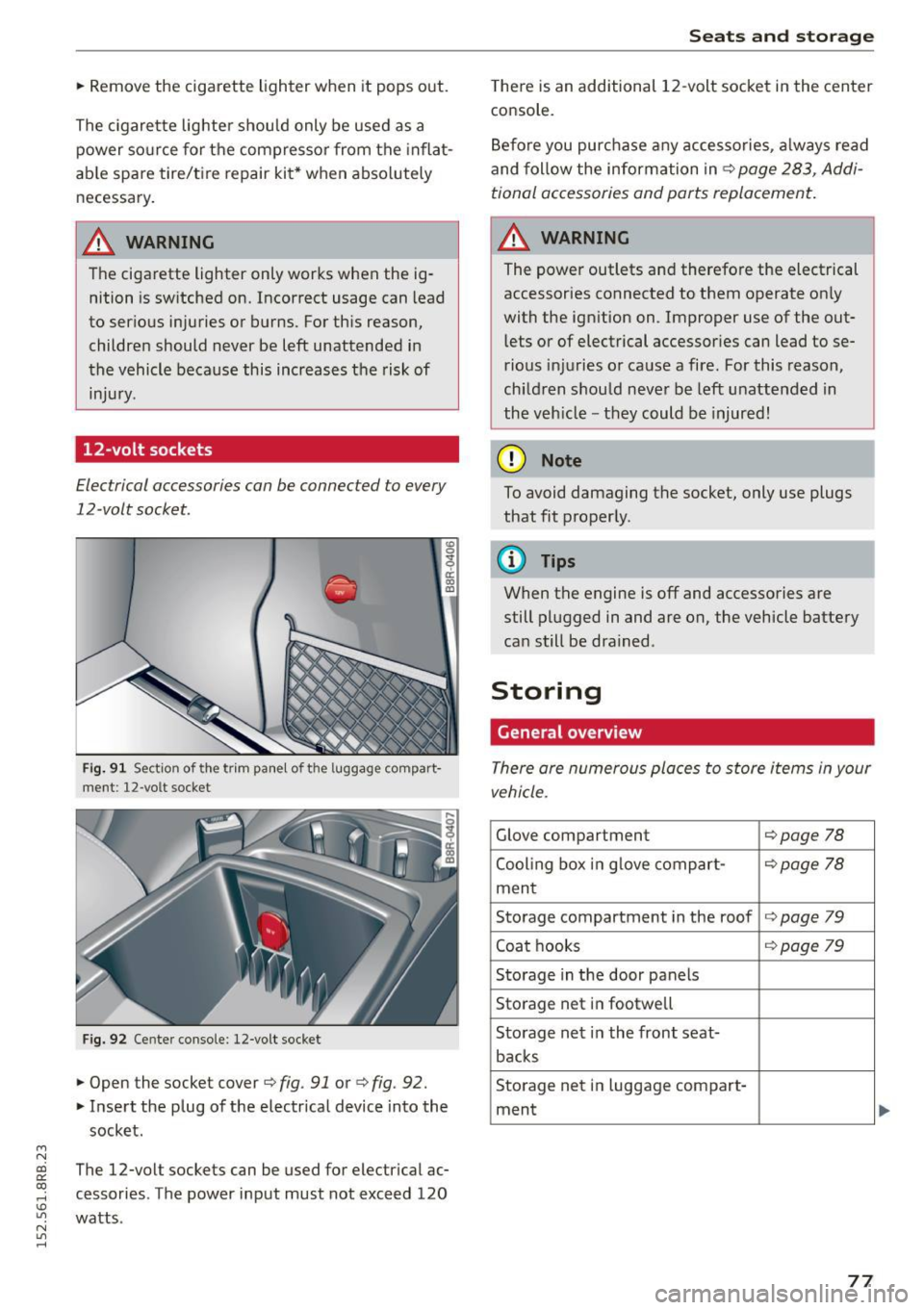
Fig . 91 Sect io n of the trim panel of t he luggage com part·
ment : 12-vo lt socket
Fig. 92 Ce nter console: 12-volt socket
.. Open the socket cover¢ fig. 91 or¢ fig. 92.
.. Insert the plug of the electrical device into the
socket.
The 12-volt sockets can be used for electrical ac
cessories . The power input must not exceed 120
watts .
Seats and storage
There is an additional 12 -volt socket in the center
console .
Before you purchase any accessories, always read
and follow the information in¢
page 283, Addi
tional accessories and parts replacement.
A WARNING
The power outlets and therefore the electrical
accessories connected to them operate only
with the ignition on . Improper use of the out
lets or of electrical accessories can lead to se
rious injuries or cause a fire . For this reason,
children should never be left unattended in
the veh icle -they could be injured!
(D Note
To avoid damaging the socket, only use plugs
that fit properly.
(D Tips
When the engine is off and accessories are
still plugged in and are on, the vehicle battery
can still be drained .
Storing
General overview
There are numerous places to store items in your
vehicle .
Glove compartment ¢page 78
Cooling box in glove compart-¢page 78
ment
Storage compartment in the roof
¢page 79
Coat hooks ¢page 79
Storage in the door panels
Storage net in footwell
Storage net in the front seat- backs
Storage net in luggage com part- ment
77
Page 81 of 302
M N
co ~ co
rl I.O
"' N
"' rl
Storage compartment in the roof
""'
11111
'~-
8 G
o . . o
~
Fig. 95 Storage pocket in the roof
.. To open the lid you have to touch the bar
Q fig. 95 (Arrow) . The lid opens automatically .
.. To close the lid, push it up until it engages .
.&, WARNING
Always keep the lid closed while driving to re
duce the risk of injury dur ing a sudden brak
ing maneuver or in the event of an accident.
Coat hook s
Fig. 96 Coat hooks at rear doors
_& WARNING
-Hang clothes in such a way that they do not
impair the driver's vision.
- The coat hooks must only be used for light
weight clothing. Do not leave any heavy or
sharp edged objects in the pockets which
may interfere with the s ide curtain airbag
deployment and can cause personal injury in
a crash.
- Do not use coat hangers for hanging cloth
ing on the coat hooks as this can interfere
Seats and storage
with proper deployment of the side curtain
airbags in an accident.
- Do not hang heavy objects on the coat
hooks, as they could cause personal injury in
a sudden stop.
79
Page 82 of 302
Warm and cold
Warm and cold Climate control system
Description
The climate control system warms, cools and
adds humidity to the air in the vehicle interior. It
is the most effective when the windows and pan
oramic sliding sunroof* are closed . If there is a
build-up of heat inside the vehicle, ventilation
can help to speed up the cooling proc ess.
In all heating mode functions except
defrost, the
blower only switches to a higher speed once the
engine coolant has reached a certain tempera
ture.
Condensation from the cooling system can drip
and form a puddle of water under the vehicle.
This is normal and does not mean there is a leak.
Pollutant filter
The pollutant filter removes pollutants such as
dust and pollen from the air.
The air pollutants filter must be changed at the
intervals specified in your Warranty & Mainte
nance booklet, so that the air conditioner can
properly work.
If you drive your vehicle in an area with high air pollution , the filter may need to be changed
more frequently than specified in your Audi War
ranty
& Maintenance booklet. If in doubt, ask
your authorized Audi Service Advisor for advice.
Key coded settings
The climate control settings are automatically
stored and assigned to the remote control key
that is in use .
.8, WARNING
Reduced visibility is dangerous and can cause
accidents.
- For safe driving it is very important that all
windows be free of ice, snow and condensa
tion.
80
- Completely familiarize yourself with the
proper use and function of the heating and
ventilation system and especially how to de
fog and defrost the windows .
- Never use the windshield wiper/washer sys
tem in freezing weather until you have
warmed the windshield first, using the heat
ing and ventilation system . The washer solu
tion may freeze on the windshield and re
duce visibility .
(D Note
-If you suspect that the air conditioner has
been damaged, switch the system off to
avoid further damage and have it inspected
by a qualified dealership.
- Repairs to the Audi air conditioner require
special technical knowledge and special
tools. Contact an authorized Audi dealer for
assistance.
@ For the sake of the environment
By reducing the amount of fuel you use, you
also reduce the amount of pollutants emitted
into the air.
(D Tips
-Keep the air intake slots (in front of the
windshield) free from ice, snow and debris
in order to maintain the proper function of
the climate control system.
- The energy management system may switch
the seat heating* or rear window defroster
off temporarily. These systems are available
again as soon as the energy balance has
been restored.
- The air flowing out of the vents and
throughout the vehicle's entire interior is
discharged at the rear of the vehicle. Make
sure that the outlet slots are not covered by clothing, etc.
Page 143 of 302
M N
co
a:
co
,...., \!) 1.1'1
N 1.1'1 ,....,
-Always put objects, for examp le, luggage or
other heavy items in the luggage c ompart
ment.
- Always secure objects in the luggage com
partment us ing the tie-down eye lets and
suitable straps.
A WARNING
Heavy loads will influence the way your vehi
cle handles. To help reduce the risk of a loss
of control leading to ser ious personal injury:
- Always keep in m ind when transporting
heavy objects, that a change in the center of
gravity can also cause changes in vehicle
hand ling:
- Always distribute the load as even ly as
possible.
- Place heavy objects as far forward in the
luggage compartment as possible.
- Never exceed the G ross Ax le Weight Rating
or the Gross Vehicle Weight Rating specified
on the safety compliance sticker on the left
doo r jamb. Exceeding permissible weight
standards can cause the vehicle to s lide and
hand le different ly.
- Please observe information on safe driving
r=>page 135.
A WARNING
To help prevent poisonous exhaust gas from
being drawn into the vehicle, always keep the
rear lid closed while driv ing.
- Never transport objects larger than those
fitt ing completely into the luggage a rea be
cause the rea r lid cannot be fully closed .
- If you absolutely must drive w ith the rear lid
open, observe the following notes to reduce
the risk of poisoning:
- Close a ll windows,
- Close the Panoramic sliding sunroof*,
- Open al l air outlets in the instrument pan-
el,
- Sw itch off the air recircu lation,
- Set the fresh ai r fan to the h ighest speed.
Dr ivin g s afet y
A WARNING
Always make sure that the doors, all windows,
the Panoramic sliding sunroof * and the rear
lid are securely closed and locked to reduce
the r is k of injury when the vehicle is not being
used.
- After closing the rear lid, always make sure
that it is p roperly closed and locked.
- Never leave your vehicle unattended espe
cially with the rea r lid left open . A child
could crawl into the ve hicle through the lug
g age compartmen t and clo se the re ar lid be
coming trapped and unable to get out. Be
ing trapped in a vehicle can lead to serious
pe rsonal injury .
- Never let children play in or around the vehi
cle.
- Never let passengers ride in the luggage
compa rtment . Vehicle occupants must al
ways be properly restrained in one of the ve
hicle's seating positions.
(D Tips
- Air circul ation helps to reduce window fog
ging . Stale ai r escapes to the outs ide
through vents in the t rim panel. Be sure to
keep these slots free and open.
- The tire pressure m ust correspond to the
load. The tire pressure is shown on the tire
pressure label. The t ire p ress ure label is lo
cated on the dr iver's side B-pillar. The tire
pressure label lists the recommended cold
t ire inflation pressures fo r the veh icle at its
maximum ca pac ity weight and the tires that
we re on your vehicle at the t ime it was man
ufac tured. For recommended tire pressures
for normal load condi tions, please see chap
ter
r=> page 246.
Tie-downs
The luggage compar tment is equipped wi th four
tie-downs to se cure luggage and other items .
Use the t ie-downs to secu re your cargo prope rly
r=> page 140, Loading the luggage compar tment. lliJ,
141
Page 157 of 302
M N
co
a:
co
,...., \!) 1.1'1
N 1.1'1 ,....,
A WARNING ,~
A child in a rearward-facing child safety seat
installed on the front passenger seat will be
seriously injured and can be killed if the front
airbag inflates - even with an Advanced Airbag
System.
- The inflating airbag will hit the child safety
seat or infant carrier with great force and
will smash the child safety seat and child
against the backrest, center armrest, door
or roof.
- Always install rear-facing child safety seats
on the rear seat.
- If you must install a rearward facing child
safety seat on the front passenger seat be
cause of exceptional circumstances and the
PASSENGER AIR BAG OFF light does not
come on and stay on, immediately install
the rear-facing child safety seat in a rear
seating position and have the airbag system inspected by your authorized Audi dealer.
- Forward-facing child safety seats installed
on the front passenger's seat may interfere
with the deployment of the airbag and cause serious personal injury to the child .
A WARNING
If, in exceptional circumstances, you must in
stall a forward-facing child restraint on the
front passenger's seat:
-Always make sure the forward-facing seat
has been designed and certified by its man
ufacturer for use on a front seat with a pas
senger front and side airbag.
- Never put the forward-facing child restraint
up against or very near the instrument pan
el.
- Always move the passenger seat into its
rearmost position in the seat's fore and aft
adjustment range, as far away from the air
bag as possible before installing the for
ward-facing child restraint. The backrest must be adjusted to an upright position.
- Make sure that the
PASSENGER AIR BAG
OFF
light comes on and stays on all the time
whenever the ignition is switched on.
Airbag system
A WARNING
To reduce the risk of serious injury, make sure
that the
PASSENGER AIR BAG OFF light will
be displayed whenever a child restraint is in
stalled on the front passenger seat and the ignition is switched on .
- If the
PASSENGER AIR BAG OFF light does
not stay on, perform the checks described
~ page 162, Monitoring the Advanced Air
bag System.
- Take the child restraint off the front passen
ger seat and install it properly at one of the
rear seat positions if the
PASSENGER AIR
BAG OFF
light does not stay on.
- Have the airbag system inspected by your
authorized Audi dealer immediately.
-Always carefully follow instructions from
child restraint manufacturers when instal
ling child restraints.
A WARNING
If, in exceptional circumstances, you must in
stall a forward or rearward-facing child re
straint on the front passenger's seat:
- Improper installation of child restraints can
reduce their effectiveness or even prevent
them from providing any protection.
- An improperly installed child restraint can
interfere with the airbag as it deploys and
seriously injure or even kill the child -even
with an Advanced Airbag System.
-Always carefully follow the manufacturer's
instructions provided with the child safety
seat or carrier.
- Never place additional items on the seat that can increase the total weight registered by the weight-sensing mat and can cause in
jury in a crash.
155
Page 160 of 302
Airbag syste m
-a small adu lt or teenager is on the front pas
senger seat
- a passenger who is not sitting upright with
their back against a non -reclined backrest with
their feet on the vehicle floor in front of the
seat is on the front passenger seat.
I f the front passenger airbag deploys, the Federal
Standard req uires the airbag to meet the " low
risk" deployment criteria to help reduce the risk
of injury through interaction with the airbag .
"Low risk" deployment occurs in those crashes
that take place at lower decelerations as defined in the electron ic control unit . ¢ page
162
Alw ays re member: Even though your vehicle is
equ ipped w ith Advanced Airbags, the safest place
for children is properly restrained on the back
seat . Please be sure to read the important infor
mat ion in the sections that follow and be sure to
heed a ll of the WARNINGS.
_& WARNING
To reduce the ris k of injury when an airbag in
fla tes, always wear safety belts proper ly.
- If you are unrestrained, leaning fo rward, s it
t ing s ideways or out of position in any way,
your risk of injury is much higher .
- You w ill also receive serious inju ries and
could even be killed if you are up against the
airbag or too close to it when it inflates -
even with an Advanced Airbag ¢page
152.
_& WARNING
A child in a rearward-facing child safety seat
installed on the front passenger seat will be
ser iously injured and can be killed if the front
airbag inflates - even w ith an Advanced Airbag
System.
- Although the Advanced Airbag System in
your vehicle is designed to turn off the front
airbag when a rearward -facing child re
straint has been installed on the front pas
senger seat, nobody can absolutely guaran
tee that deployment is impossible in al l con
ceivable s ituations that may happen dur ing
the usef ul life o f your vehicle .
- The inflating a irbag w il l hit the child safety
seat or infant carrier wi th great force and
158
w ill smash the child safety seat and child
aga inst the backrest, center armrest, door,
or roof.
- Always install rearward-facing chi ld re
straints in the back seat.
- If you must insta ll a rearward fac ing ch ild
safety seat on the front passenger seat be
cause of exceptional circumstances and the
PAS SENGER AIR BAG OFF light does not
come on and stay on, immediately install
the rear-facing child safety seat in a rear
seating position and have the airbag system
inspected by your au thorized Aud i dealer .
_& WARNING
If, in exceptiona l circumstances, you must in
stall a forwa rd-facing child restra int on the
front passenger's seat:
- Always ma ke sure the forward-facing sea t
has been des igned and certif ied by its man
ufacturer for use on a front seat with a pas
senger front and s ide a irbag .
- Never p ut the fo rward-facing child restraint
up against or very near the instrument pan
el.
-Always move the passenger seat into its
rearmost position in the seat's fore and aft
ad justment range, as far away from the a ir
bag as poss ible, before insta lling the for
ward-facing child restraint. The backrest
must be adjusted to an upr ight position .
- Make sure that the
PASSENGER AIR BAG
OFF
li ght comes on and stays on all the time
whenever the ign it ion is switched on.
Advanced Airbag System components
The front passenger seat in your vehicle has a lot
of ve ry impo rtant parts of the Advanced A irbag
System in it. These pa rts include the we ight
sensing mat, senso rs, w iring, bracke ts, and more.
The function of the system in the front passenge r
seat is checked by the e lectronic control unit
when the ignition is on. The control unit mon itors
the Advanced Airbag System and turns the airbag i ndicator light on when a malfunct io n in the sys
tem components is detected. The function of the
a irbag indicator light is described in greate r
Page 163 of 302
M N
co
a:
co
,...., \!) ..,.,
N ..,., ,....,
-and the head restraints have been p roperly ad -
justed.
Because airbags inflate in the blink of an eye w ith
great force, things you have on yo ur lap o r have
p laced on the seat cou ld become dangerous p ro
jectiles, and be pushed into yo u if the airbag in
flates.
When an a irbag deploys, fine dust is released.
This is normal and is not caused by a fire in the
vehicle. This dust is made up mostly of a powder
used to lubricate the airbags as they dep loy. It
could irr itate skin.
It is important to remember that whi le the sup
p lemental airbag system is designed to reduce
the likelihood of serious in juries, other injur ies,
for example swell ing, bruising and minor abra
sions, can also happen when a irbags inf late. Air
bags do not protect the arms or the lower parts
of the body. Front airbags o nly supplement the
three point safety belts in some frontal col lisions
i n which the veh icle deceleration is high enough
to deploy the airbags.
F ront airbags will not deploy:
- if the ign it io n is switched off when a crash oc -
curs,
- in s ide collisions,
- in rear-end collisions,
- in ro llovers,
- when the crash deceleration measured by the airbag system is less than the minimum thresh
o ld needed for airbag deployment as registered
by the electronic control un it.
Th e front pa ssenger airbag will al so not
depl oy:
-when the front passenger seat is not occupied,
- when the weight on the front passenger seat as
sensed by the Advanced Airbag System indi
cates that the front airbag on the passenger
s ide has to be turned off by the electronic con
trol unit (the
PA SSENGER AIR BAG OFF light
comes on and stays on) .
A WARNING
Sitting in the wrong position can increase the
risk of se rious injury in crashes .
Airbag syste m
- To reduce the risk of injury when the airbags
inflate, the driver and passengers must al
ways sit in an upright pos ition, must not
lean aga inst or place any part of the ir body
too close to the area where the a irbags are
located.
- Occupants who are unbelted, out of position
or too close to the airbag can be seriously
in ju red by an a irbag as it unfo lds with great
for ce in the blink ofan eye
Qpage 153.
A WARNING
A child in a rearward-fac ing ch ild safety sea t
i nsta lled on the front passenger seat w ill be
se riously inju red and can be killed if the front
a irbag inflates - even with an Advanced Airbag
System .
- The inflating airbag will hit the child safety
seat o r infant carrier with great force and
will smash the child safety seat and child
aga inst the backrest, center armrest, door
or roof.
- Always install rear-fac ing ch ild safety seats
on the rear seat.
- If you must install a rearwa rd fac ing child
safety seat on the front passenger seat be
cause of except ional circumstances and the
PASS ENG ER AIR BAG OFF light does not
come on and stay on, immediately install
the rear-facing child safety seat in a rear
seating posi tion and have the airbag system
inspected by your authori zed Audi dealer .
A WARNING
Objects between you and the airbag will in
crease the risk of injury in a crash by interfe r
ing with the way the airbag unfolds or by be
ing p ushed into you as the airbag inflates .
- Never hold things in yo ur hands or on your
lap when the vehicle is in use .
- Never transpo rt items on or in the a rea of
the front passenger seat. Objects could move into the area of the front airbags dur
ing brak ing or other sudden maneuver and
become dangerous project iles that can
cause serious persona l injury if the a irbags
inflate.
161
Page 171 of 302
M N
co ~ co
rl I.O
"' N
"' rl
-Damage (cracks, deep scratches etc .) to the
original seat covers or to the seam in the
area of the side airbag module must always
be repaired immediately by an authorized
Audi dealer .
-If children are seated improperly, their risk
of injury increases in the case of an acc ident
¢ page 172, Child safety .
-Never attempt to modify any components of
the a irbag system in any way.
- In a side collision, s ide a irbags w ill not func
tion properly if sensors cannot correctly
measu re increasing air pressure inside the
doors when air escapes through larger, un
closed openings i n the door pane l.
- Never d rive with interior door trim pane ls
removed.
- Never drive when parts have been re
moved from the inside door panel and the
openings they leave have not been proper ly closed.
- Never drive when loudspeakers in the
doors have been removed unless the
speaker holes have been properly closed.
-Always make certain that openings are covered or filled if additional speakers or
other equ ipment is installed in the inside
door panels .
- Always have work on the doors done by an
authorized Audi dealer or qualified work
shop.
Ai rb ag system
Side curtain airbags
Description of side curtain airbags
The side curtain airbag system can provide sup
plemental protection to properly restrained oc
cupants.
,ft QOD'
8i 0 ci: a, m
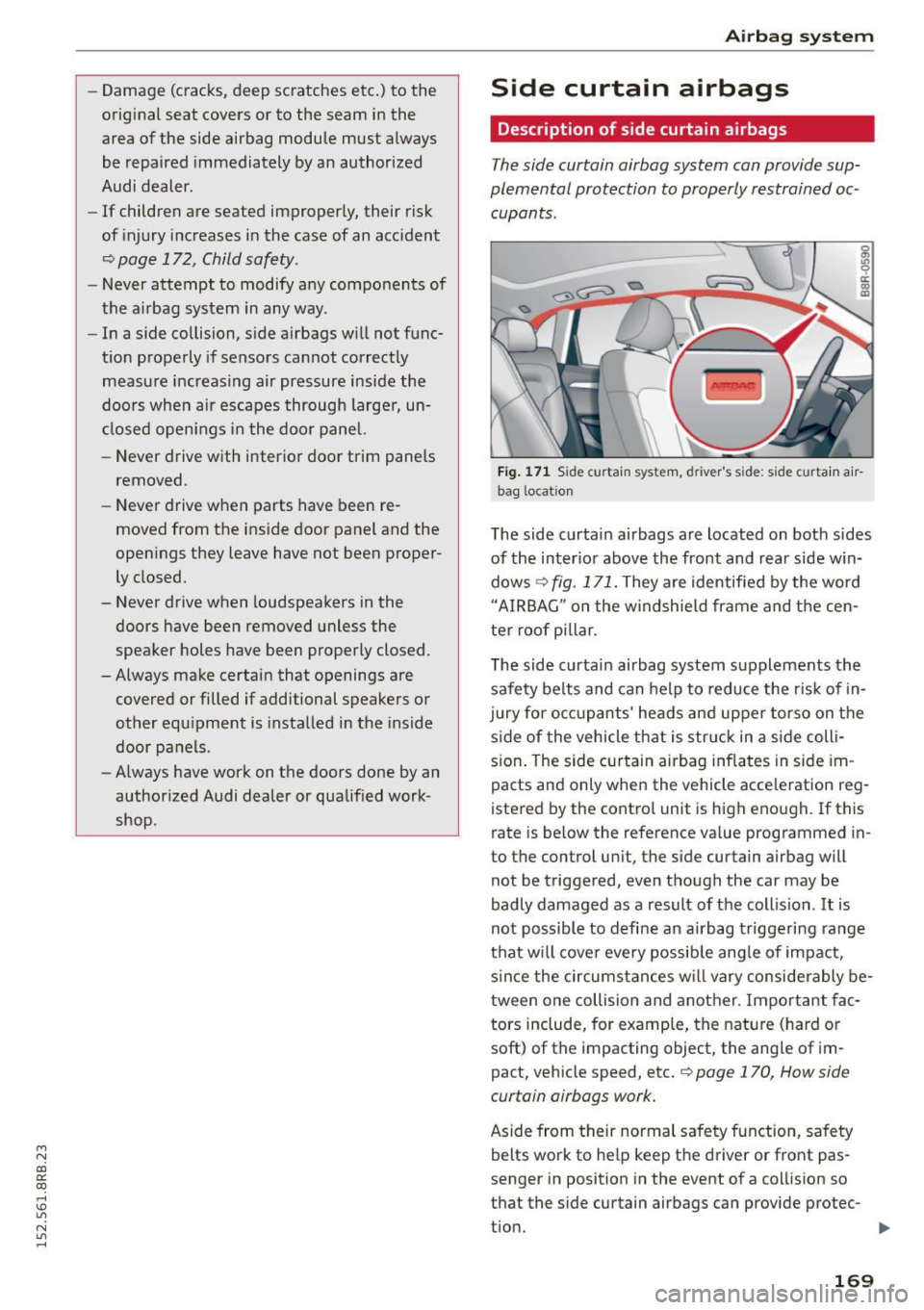
F ig . 1 7 1 Side curtain system, d river 's s ide: s ide cu rta in a ir
bag locat io n
The side curtain airbags are located on both sides
of the inter ior above the front and rear side w in
dows ¢
fig. 171. They are identified by the word
"A IRBAG" on the w indshie ld frame and the cen
ter roof pi llar.
The side c urta in airbag system supplements the
safety belts and can help to reduce the ris k of in
j u ry for occ upants' heads and upper torso on the
s ide of the vehicle that is str uck in a s ide coll i
s io n. The side c urtain airbag inflates in side im
pacts and only when the vehicle acce leration reg
istered by the contro l unit is high enough. If this
rate is below the reference va lue programmed in
to the control un it, the side curtain airbag will
not be triggered, even though the car may be
badly damaged as a result of the collis ion . It is
not possible to define an airbag triggeri ng range
that w ill cove r every possible ang le of impact,
s ince the circumstances w ill vary considerably be
tween one collision and another. Important fac
tors include, for examp le, the nat ure (hard or
soft) of the impacting object, the angle of im
pact, vehicle speed, etc.
¢ page 170, How side
curtain airbags work.
Aside from their normal safety f unction, sa fety
belts work to he lp keep the driver or front pas
senger in position in the event of a collision so
that the side curtain airbags can provide protec-
t ion. ..,.
169
Page 178 of 302
Child safet y
-When b uying a ch ild restraint, select one
that fits your child and the vehicle.
- On ly use child restraint systems that fully
contact the flat port ion of the seat cush
ion. The ch ild restra int must not tip or
lean to either s ide. Audi does not recom
mend using child safety seats that rest on
legs o r tube-like frames . They do not pro
vide adequate contact with the seat.
- Always heed all legal requirements pe r
taining to the installat ion and use of ch ild
safety seats and carefully follow the in
struc tions prov ided by the manufacturer
of the seat you are using.
- Never allow ch ildren under 57 inches
(1.45 me ters) to wear a normal sa fety belt .
They m ust always be rest rained by a proper
child restra int system. Otherwise, they
could sustain injuries to the abdomen and
neck areas during sudden braking maneu
vers or acc idents.
- Never let more than one child occupy a chi ld
safety seat.
- Never let babies or older children ride in a
vehicle while sitting on the lap of another
passenger.
- Ho ld ing a child in your arms is neve r a sub
stit ute for a child rest raint sys tem.
- The strongest person co uld not hold the
child with the fo rces that ex ist in an acci
dent. The child will s tri ke the inte rior of
the vehicle and can a lso be str uck by the
passenger.
- The ch ild and the passenger can a lso in
jure each other in an acc ident .
- Never ins tall rear-facing chi ld safety seats or
infant carriers on the front passenger seat.
A ch ild w ill be seriously injured and can be
killed when the passenger airbag inf lates -
even with an Advanced Airbag System .
- The inf lating airbag will hit the child safety
seat or infant carrier with great force and
will smash the chi ld safety seat and child
against the backrest, center armrest, door
o r roof.
-Always insta ll rear-facing child safety seats
or infant carr iers on the rear seat.
176
- Forwa rd-facing child safety seats insta lled
on the front passenger's seat can interfere
w ith the airbag when it inflates and cause
serious injury to the child. Always install fo r
ward-facing child safety seats on the rear seat .
- If except ional circumstances require the use
of a fo rward-facing child restraint on the
front passenge r's seat, the child's safety
and well-be ing require that the following
speci al precautions be taken :
- Make sure the forward-facing seat has
been designed and certified by its manu
factu rer for use on a front seat w ith a pas
senger front and side airbag .
- Always carefully follow the manufacturer's
i nst ructions provided with the child safety
seat or carrier .
- Always move the front passenger seat into
the rea rmost pos ition of the passenger
seat's fore and aft adjustment range, and
as fa r away from the a irbag as poss ible be
fo re insta lling the child rest raint.
- Always make sure that nothing p revents
the front passenge r's seat from being
moved to the rearmost posit ion in its fo re
and aft adjustment range .
- Always make sure tha t the backres t is in
the up right pos ition.
- Always buckle the child sa fety seat firmly in
place even if a ch ild is not si tting in it. A
loose child safety seat can fly around d uring
a sudden stop or in a collision.
- Always read and heed a ll WARNI NGS when
eve r us ing a child restrained in a vehicle is
be ing used
¢ page 144, Safety belts,
¢ page 152, Airbag system and
¢ page 172 , Child safety.
A WARNING
To reduce the risk of ser ious injury, make sure
that the
PASSENGER AIR BAG OFF li ght
comes on and stays on whenever a ch ild re
straint is installed on the front passenge r seat
and the ign ition is switched on . ..,.
Page 180 of 302
Child safety
seats support t he baby 's back, neck and head in a
crash
r=> fig . 174.
The airbag on the passenger side makes the fron t
seat a potentially dange rous place for a ch ild to
ride. The front seat is not the safest place for a
child in a fo rward-facing child seat. It is a very
dangerous p lace for an infant or a larger chi ld in
a rearward-facing seat .
_&. WARNING
Not using a child safety seat , using the wrong
child safety seat o r imp roperly insta lling a
child restraint inc reases the r isk of serious
personal in ju ry and death in a crash .
- Never install rea r-facing ch ild safety seats or
infant carriers on the front passenger seat -
even w ith an Advanced Ai rbag System. A
c hild will be serio us ly injured and c an be kil
led whe n the infl ating airbag hits the child
sa fe ty seat or infant carrier w ith great force
and smashes the c hild safety seat and c hild
against the bac krest, center armrest, door
or roof
r=> page 153, Child restraints on the
front seat -some important things to
know .
-Always insta ll rear-facing child safety seats
o r infant ca rr iers on the rear seat.
- Never install a rear-facing child restraint in the forward-facing direction. Such restra ints
are designed for the specia l needs of infants
and very small children and cannot protect
them prope rly if the seat is forward-fac ing .
- If you must install a rearward facing child safety seat on the front pass enge r seat be
ca use of exceptional c ircumstanc es and t he
PASSENGER AIR BAG OFF light does not
c ome on an d st ay on, immedi ate ly ins tall
t h e rear-facing c hild safety sea t in a rea r
seat ing position and have the airbag system
inspected by your Audi dealer.
- Alw ays read and hee d all WARN INGS when
ever using a child restrained in a vehicle is
being used
c::> page 144 , Safety belts,
c::> page 152, Airbag system
and
c::> page 172, Important information.
178
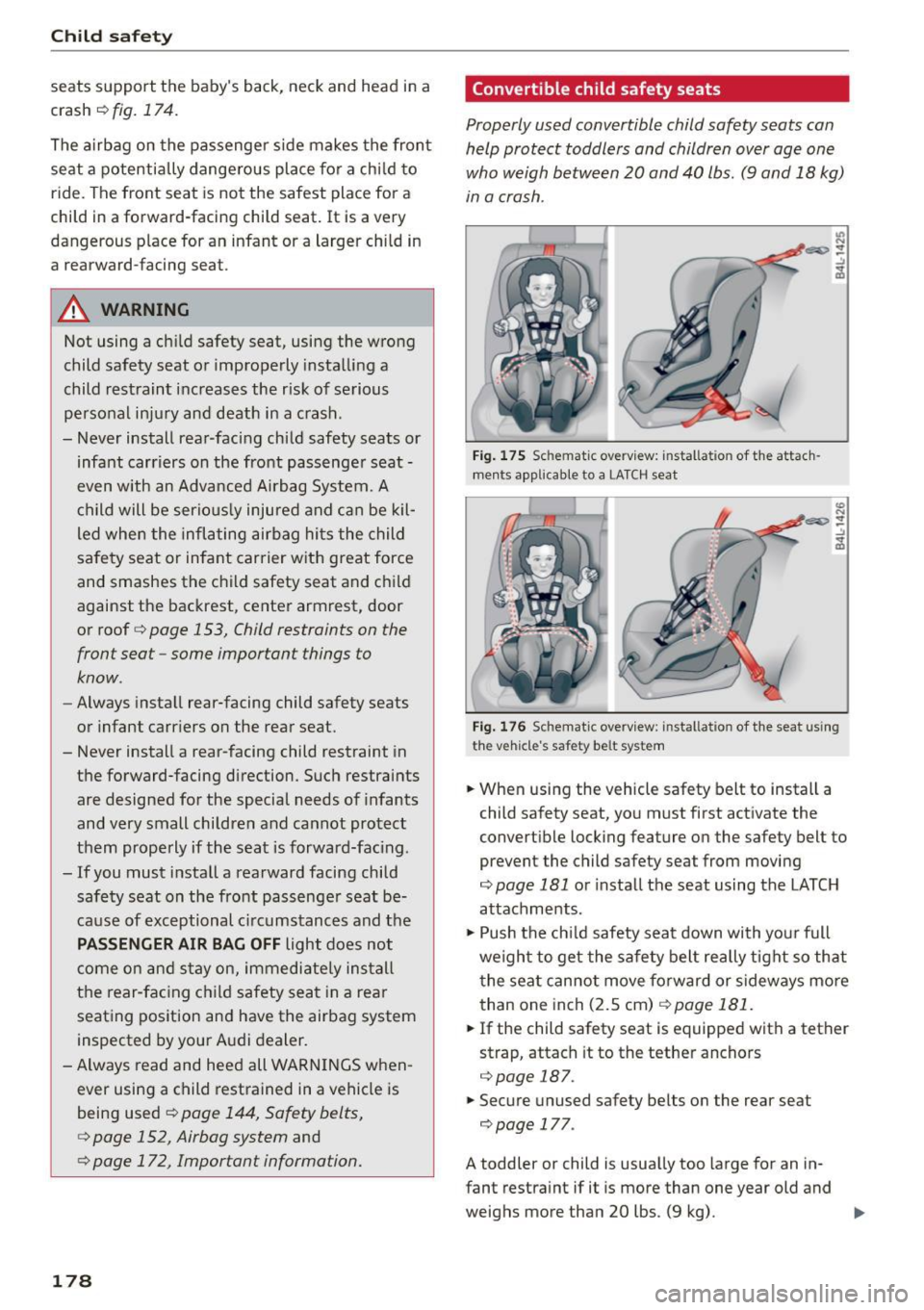
Convertible child safety seats
Properly used convertible child safety seats can
help protect toddlers and children over age one
who weigh between 20 and 40 lbs. (9 and 18 kg)
in a cra sh .
Fi g. 175 Sc hem at ic ove rv iew: instal la ti on of t he attach
m ents applicable to a LA T CH seat
Fi g. 1 76 Schemat ic ove rv iew : in stal lat io n of th e seat usin g
the v ehicl e's sa fet y bel t system
.. When using the vehicle safety belt to install a
child sa fety seat, you must first activate the
convertible locking feature on the safety belt to
prevent the child safety seat from moving
r=> page 181 or i nsta ll the seat using the LATC H
attachments.
.,. Push the ch ild safety seat down with you r full
weigh t to get the safe ty belt rea lly tight so that
t he sea t ca nnot move forward or sideways mo re
than one inch (2.5 cm)
r=> page 181.
.. If the child safety seat is equipped with a tether
strap, attach it to the tether anchors
c::> page 187.
.. Secure unused safety belts on the rear seat
r=> page 177 .
A toddler or child is usua lly too large for an in
fant restra int if it is more than one year old and
weighs more than 20 lbs . (9 kg) .
IJJ,,