roof AUDI Q5 2015 Owner's Manual
[x] Cancel search | Manufacturer: AUDI, Model Year: 2015, Model line: Q5, Model: AUDI Q5 2015Pages: 302, PDF Size: 75.01 MB
Page 181 of 302
M N
co
a:
co
,...., \!) 1.1'1
N 1.1'1 ,....,
Toddlers and children who are older than one
year up to about 4 years old and weigh more than
20 lbs. (9 kg) up to 40 lbs. (18 kg) must always
be properly restrained in a child safety seat certi
fied for their si ze and weight¢
fig. 175 and
¢fig. 176 .
The airbag on the passenger side makes the front
seat a potentially dangerous place for a child to ride . The front seat is not the safest place for a
child in a forward-facing child safety seat. It is a
very dangerous place for an infant or a larger
child in a rearward-facing seat.
.8, WARNING
Not using a child safety seat, using the wrong
child safety seat or improperly installing a
child restraint increases the risk of serious
personal injury and death in a collision or oth
er emergency situation.
- Children on the front seat of any car, even
with Advanced Airbags, can be seriously in
jured or even killed when an airbag inflates. A child in a rearward-facing child safety seat
installed on the front passenger seat will be
seriously injured and can be killed if the
front airbag inflates -even with an Ad·
vanced Airbag System .
- The inflating airbag will hit the child safety seat or infant carrier with great force and
will smash the child safety seat and child against the backrest, center armrest, door
or roof.
- Always install rear-facing child safety seats
on the rear seat.
- If you must install a rearward facing child
safety seat on the front passenger seat be
cause of exceptional circumstances and the
PASSENGER AIR BAG OFF light does not
come on and stay on, immediately install
the rear-facing child safety seat in a rear
seating position and have the airbag system inspected by your Audi dealer.
- The rear side of the child safety seat should
be positioned as close as possible to the
backrest on the vehicle seat. Adjust or re
move the rear seat head restraint if it is dif
ficult to install the child seat with the head
Child safety
restraint in place ¢page 67. Install the
head restraint again immediately once the
child seat is removed. Driving without head restraints or with head restraints that are
not properly adjusted increases the risk of
serious or fatal neck injury dramatically.
- Always read and heed all WARNINGS when
ever using a child restrained in a vehicle is
being used¢
page 144, Safety belts,
¢ page 152, Airbag system
and
¢ page 172, Important information.
.8, WARNING
If exceptional circumstances require the use
of a forward-facing child restraint on the front
passenger's seat, the child's safety and well
being require that the following special pre
cautions be taken:
- Make sure the forward-facing seat has been
designed and certified by its manufacturer
for use on a front seat with a passenger
front and side airbag .
- Always follow the manufacturer's instruc
tions provided with the child safety seat or
infant carrier.
-Always move the front passenger seat into the rearmost position of the passenger seat's fore and aft adjustment range, and as
far away from the airbag as possible before installing the child restraint.
- Always make sure that nothing prevents the
front passenger's seat from being moved to the rearmost position in its fore and aft ad
justment range.
- Always make sure the backrest is in an up
right position.
- Make sure that the
PASSENGER AIR BAG
OFF
light comes on and stays on all the time
whenever the ignition is switched on.
- If the light does not stay on, perform the
checks ¢
page 162, Monitoring the Ad
vanced Airbag System.
- Take the child restraint off the front passen
ger seat and install it properly at one of the
rear seat positions if the
PASSENGER AIR
BAG OFF
light does not stay on whenever
the ignition is switched on.
179
Page 184 of 302
Child safety
A WARNING
Improperly installed child safety seats in
crease the risk of serious personal injury and
death in a collision.
- Always make sure that the safety belt re
tractor is locked when installing a child safe
ty seat . An unlocked safety belt retractor
cannot hold the child safety seat in place
during normal driving or in a crash.
- Always buckle the child safety seat firmly in
place even if a child is not sitting in it. A
loose child safety seat can fly around during
a sudden stop or in a collision.
- Always make sure that the rear seat back
rest to which the center rear safety belt is
attached is securely latched whenever the
rear center safety belt is being used to se
cure a child restraint.
- If the backrest is not securely latched, the
child and the child restraint will be thrown
forward together with the backrest and will
strike parts of the vehicle interior. The child
can be seriously injured or killed.
- Never install rear-facing child safety seats or
infant carriers on the front passenger seat.
A child will be seriously injured and can be
killed when the passenger airbag inflates .
- The inflating airbag will hit the child safety
seat or infant carrier with great force and
will smash the child safety seat and child
against the backrest, center armrest, door
or roof.
-Always install rear-facing child safety seats
or infant carriers on the rear seat.
- Forward-facing child safety seats or infant
carriers installed on the front passenger's
seat may interfere with the deployment of
the airbag and cause serious injury to the
child.
- It is safer to install a forward-facing child
safety seat on the rear seat.
- Always read and heed all WARNINGS when
ever using a child restrained in a vehicle is
being used
~page 172. Special precautions
apply when installing a child safety seat on
the front passenger seat~
page 153, Child
182
restraints on the front seat -some impor
tant things to know.
A WARNING
Always take special precautions if you must
install a forward or rearward-facing child re
straint on the front passenger's seat in excep
tional situations:
- Whenever a forward or rearward-facing
child restraint is installed on the front pas
senger seat, the
PASSENGER AIR BAG OFF
light must come on and stay on whenever
the ignition is switched on.
- If the PASSENGER AIR BAG OFF light does
not come on and stay on, perform the
checks described
~ page 162, Monitoring
the Advanced Airbag System.
-Take the child restraint off the front passen
ger seat and install it properly at one of the
rear seat positions if the
PASSENGER AIR
BAG OFF
light does not stay on whenever
the ignition is switched on.
- Improper installation of child restraints can
reduce their effectiveness or even prevent
them from providing any protection.
- An improperly installed child restraint can
interfere with the airbag as it deploys and
seriously injure or even kill the child .
- Always carefully follow the manufacturer's
instructions provided with the child safety
seat or carrier.
- Never place additional items on the seat
that can increase the total weight registered
by the weight-sensing mat and can cause in
jury in a crash.
A WARNING
Forward-facing child restraints:
-Always make sure the forward-facing seat
has been designed and certified by its man
ufacturer for use on a front seat with a pas
senger front and side airbag.
- Never put the forward-facing child restraint
up, against or very near the instrument pan
el.
-
.__ ________________ __J ...
Page 185 of 302
M N
co
a:
co
,...., \!) 1.1'1
N 1.1'1 ,....,
-Always move the passenger seat into its
rearmost position in the seat's fore and aft
adjustment range, as far away from the air
bag as possible before installing the for
ward-facing child restraint. The backrest must be adjusted to an upright position.
- Make sure that the
PASSENGER AIR BAG
OFF
light comes on and stays on all the time
whenever the ignition is switched on.
A WARNING
Rearward-facing child restraints:
-A child in a rearward-facing child safety seat
installed on the front passenger seat will be
seriously injured and can be killed if the
front airbag inflates - even with an Ad
vanced Airbag System.
- The inflating airbag will hit the child safety
seat or infant carrier with great force and
will smash the child safety seat and child
against the backrest, center armrest, door
or roof.
- Always be especially careful if you must in
stall a rearward facing child safety seat on
the front passenger seat in exceptional cir cumstances.
- A tight tether strap on a rearward-facing
child restraint attached to the front passen
ger seat can put too much pressure on the
weight-mat in the seat and register a heavi er weight in the Advanced Airbag System.
The heavier weight registered can make the
system work as though an adult were on the
seat and deploy the Advanced Airbag when
it must be suppressed causing serious or
even fatal injury to the child.
- Make sure that the
PASSENGER AIR BAG
OFF
light comes on and stays on all the time
whenever the ignition is switched on.
- If the
PASSENGER AIR BAG OFF light does
not come on and stay on, immediately in
stall the rear-facing child safety seat in a
rear seating position and have the airbag
system inspected by your Audi dealer.
Child safety
Activating the convertible locking retractor
Use the convertible locking retractor to secure a
child restraint .
Always heed the child safety seat manufacturer's
instructions when installing a child restraint in
your vehicle . To activate the convertible locking
retractor:
.. Place the child restraint on a sea t, preferably on
the rear seat.
.. Slowly pull the belt all the way out.
.. Route it around or through the child restraint
belt path
~ . & .
.. Push the child safety seat down with your full
weight to get the safety belt really tight.
.. Insert the belt tongue into the buckle for that
seating position.
.. Guide the safety belt back into the retractor un
til the belt lies flat and snug on the child safety
seat .
.. You should hear a "clicking" noise as the belt
winds back into the inertia reel. Test the con
vertible locking retractor by pulling on the belt .
You should no longer be able to pull the belt
out of the retractor. The convertible locking re
tractor is now activated .
.. Make sure that the red release button is facing
away from the child restraint so that it can be
unbuckled quickly.
.. Pull on the belt to make sure the safety belt is
properly tight and fastened so that the seat
cannot move forward or sideways more than
one inch (2 .5 cm) .
A WARNING
Using the wrong child restraint or an improp
erly installed child restraint can cause serious
personal injury or death in a crash .
- Always make sure that the safety belt re
tractor is locked when installing a child safe
ty seat. An unlocked safety belt retractor
cannot hold the child safety seat in place
during normal driving or in a crash.
- Always buckle the child safety seat firmly in place even if a child is not sitting in it. A
loose child safety seat can fly around during
a sudden stop or in a crash. ..,.
183
Page 194 of 302
Smart Technology
wheels can spin even with these assistance
systems that cannot always help to reduce
the risk of loss of vehicle control.
@ Tips
-ABS and ASR only work correctly when all
four whee ls are equipped with identical
Switching on/off
tires . Different tire sizes can lead to a reduc
tion in engine power .
- You may hear noises when the systems de
scribed are working.
- When installing a factory-supplied roof rack
system on the roof railing, the ESC will
adapt itself to a different center of gravity.
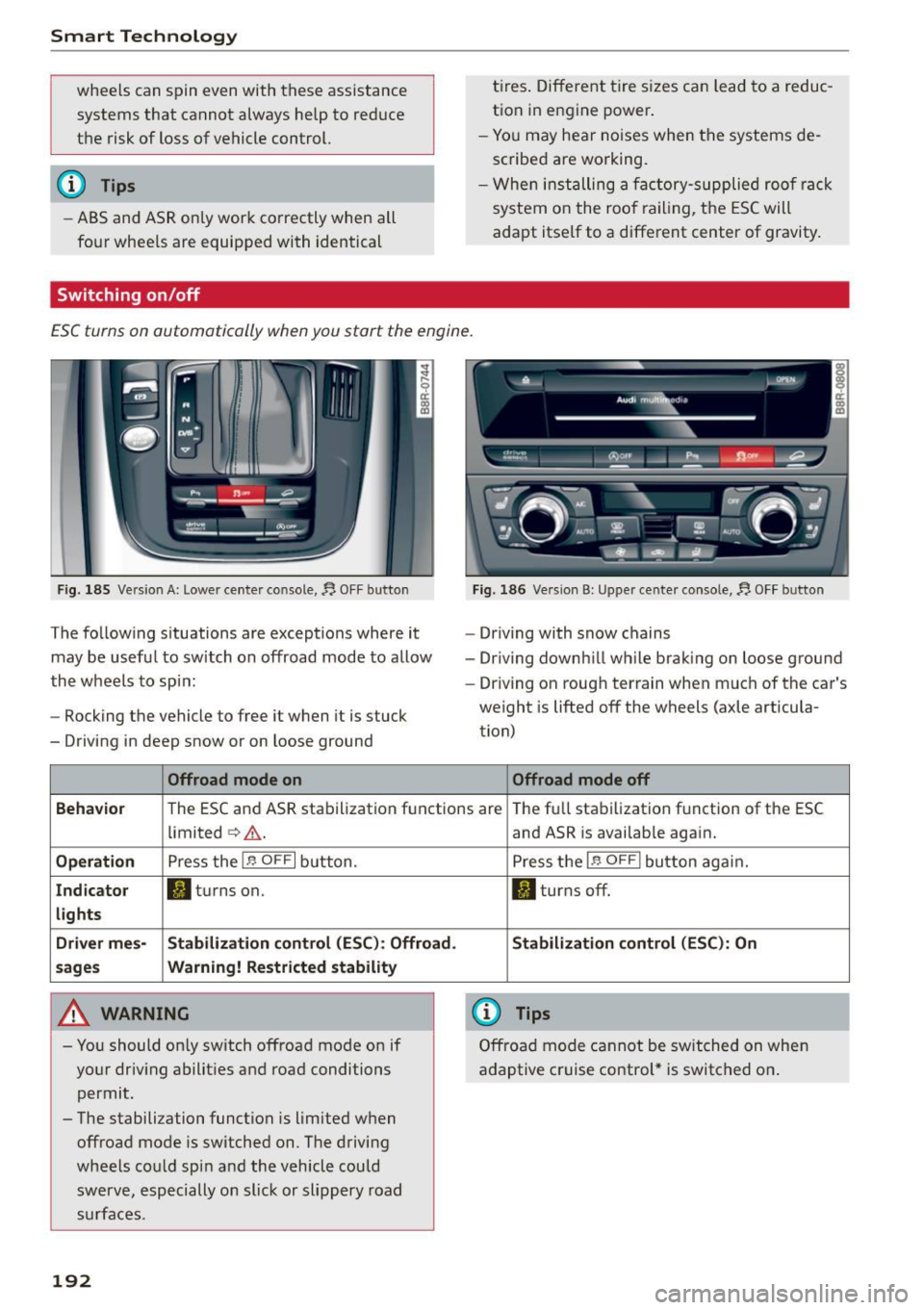
ESC turns on automatically when you start the engine.
Fig. 185 Version A: Lower center console, YJ. OFF butto n
The fo llow ing situations are exceptions where it
may be useful to sw itch on offroad mode to allow
the wheels to spin:
- Rocking the vehicle to free it when it is stuck
- Driving in deep snow or on loose ground
Offroad mode on
Fig. 186 Ve rs ion B: Upper center co nsole, YJ. O FF button
-Driving with snow chains
- Driving downhill while braking on loose ground
- Driving on rough terrain when much of the car's
weight is lifted off the wheels (axle articula
tion)
Offroad mode off
Behavior
The ESC and ASR stabilization functions are The full stabilization function of the ESC
limited
c> & .
Operation Press the l.13 OFF I button.
Indicator Ill turns on.
lights
Driver mes· Stabilization control (ESC): Offroad .
sages Warning! Restricted stability
A WARNING
- You should only switch offroad mode on if
your driving abilit ies and road conditions
permit.
- The stabilization function is limited when offroad mode is switched on. The driving
wheels cou ld spin and the vehicle could
swerve, especially on slick or slippery road
surfaces.
192
and ASR is availab le again.
Press the
1.$ OFF I button again.
II turns off.
Stabilization control (ESC): On
(D Tips
Offroad mode cannot be switched on when
adaptive cruise control" is switched on .
Page 201 of 302
M N
co
a:
co
,...., \!) 1.1'1
N 1.1'1 ,....,
-Do not apply additional undercoating or
rustproofing on or near the exhaust man i
fold, exhaust pipes, catalytic converter or heat shields. During driving, the substance
used for undercoating could overheat and
cause a fire.
Q) Note
- Be aware that just one tank filling with lead
ed
fuel will already seriously degrade the
performance of the catalytic converter .
- Do not exceed the correct engine oil level
¢page 225.
-Do not drive until the fuel tank becomes
completely empty . The engine could misfire.
Unburned fuel could also get into the ex
haust system and this could cause the cata
l ytic converter to overheat.
- Do not turn off the ignit ion while the veh icle
i s mov ing .
- Do not continue to operate your vehicle un
der these cond it ions, as otherwise fuel can
reach the catalyt ic converte r. This cou ld re
su lt in overheating of the converter, requir
i ng its replacement.
- To assure efficient operat ion of the Emission
Control System:
- Have your veh icle maintained properly and
in accordance with the service recommen
dations in your Warranty
& Maintenance
booklet.
- Lack of proper maintenance as well as im
proper use of the vehicle will impair the
function of the em ission control system
and could lead to damage.
@) For the sake of the environment
Even when the Em ission Control System is op
erating properly, the exhaust gas can have a
sulfur-like exhaust gas smell under some op
erating states. This depends on the sulfu r
content of the fuel being used. Using a differ
ent brand of fuel may help, or filling the tank
wit h lead-free super grade gasoline.
Dri ving and th e en vir onm ent
Diesel particulate filter
Applies to veh icles: w ith diesel en gine
The diese l particu late filter filters nearly all of
the soot particles out of the exhaust. The filter
cleans itself automatica lly under norma l driving
conditions. If the filter cannot clean itself (for ex
ample, because you are only driving short distan
ces), the filter becomes clogged with soot and
the
II symbol for the diese l particulate filter il
luminates
¢ page 34 .
_&. WARNING
-Do not park your veh icle over flammab le
materia ls such as grass or leaves because
the high temperature of the diesel particu
late filter could start a fire .
-
-Do not app ly an underbody protectant in the
exhaust system area or a fire cou ld start.
Avoid damaging the
vehicle
When you are driving on poor roads, or over
curbs, steep ramps, etc., make certain that low
lying parts such as spoilers and exhaust system
parts do not bottom out and get damaged.
This is especially true for vehicles with low-slung
chassis (sports chassis)* and fully loaded
vehicles.
Economical and environ
mentally-friendly driving
General
Your personal style of driving will determine the
economy of your vehicle, as well as exhaust and
noise levels.
Fuel economy, environmenta l impact, and wear
on your engine, brakes and tires largely depend
on three factors:
- your pe rsonal d riving style
- operating conditions
- technical limitat ions
If you ant icipate what you need to do next and
drive economically, you can easily cut your fuel
199
Page 210 of 302

Care and cleaning
Care and cleaning
General information
Regular, proper care he lps to maintain your vehi
cle's value.
It can also be a requirement when
submitting warranty claims for corrosion damage
and paint defects on the body.
The necessary care products can be obtained
from your authorized Audi dealer . Read and fol
low the instructions for use on the packaging.
A WARNING
-Using cleaning and care products incorrectly
can be dangerous to your health.
- Always store cleaning and care products out of reach of children to reduce the risk of poi
soning .
@ For the sake of the environment
-Preferably use environmentally-friendly
products when buying cleaning agents.
- Do not dispose of leftover cleaning and care
products with household trash .
Car washes
The longer that deposits such as insects, bird
droppings, tree sap or road sa lt remain on the ve
hicle, the more the surface can be damaged. High
temperatures such as those caused by sunlight
increase the damaging effect .
Before washing, rinse off heavy deposits with
plenty of water.
Stubborn deposits such as bird droppings or tree
sap are best removed with plenty of water and a
microfiber cloth .
Also, wash the underside of your vehicle once
road salt stops being used for the season.
Pressure washers
When washing your veh icles with a pressure
washer, always follow the operating instructions
p rovided with the pressure washer. This is espe
cially important in regard to the pressure and
spraying distance. Do not aim the spray direct ly
at seals on side windows, doors, the hood, the
208
rear lid or the sunroof* or at tires, rubber hoses,
insulating material, sensors* or camera lenses*.
Keep a distance of at least 16 inches (40 cm).
Do not remove snow and ice with a pressure
washer.
Never use rotary nozzles or high pressure noz
zles.
The water temperature must not be above 140 °F
(60 °().
Automatic car washes
Spray off the vehicle before washing.
Make sure that the windows and roof* are closed
and the windshie ld wipers are off . Follow instruc
tions from the car wash operator, especially if
there are accessories attached to your vehicle.
If possible, use car washes that do not have
brushes.
Washing by hand
Clean the veh icle starting from the top and work
i ng down using a soft sponge or cleaning b rush .
Use solvent-free cleaning products.
Washing vehicles with matte finish paint by
hand
To avoid damaging the paint when washing, first
remove dust and large particles from your vehi
cle. Insects, grease spots and fingerprints are
best removed with a special cleaner for matte
finish paint .
Apply the product using a microfiber cloth . To
avoid damaging the paint surface, do not use too
much pressure.
Rinse the vehicle thoroughly with water. Then
clean using a neutra l shampoo and a soft micro
fiber cloth .
Rinse the vehicl e thoroughly again and let it air
dry. Remove any water residue using a shammy.
A WARNING
-
- Only wash the vehicle when the ignition is
off and fo llow the instruct ions from the car
Page 236 of 302
Checking and F ill in g
management system to enable you to use the en
ergy management functions correctly after re p lacing the battery .
If i t is not poss ible to use a battery of this type,
the new battery must have the same capacity,
voltage (12 vo lts), amperage, construction and
p lug sealing .
When insta lling the ba ttery, make sure the igni
tion and all electrical consumers are t urned
off .
(D Note
- M ake sure the ven tilat ion hose on the side
of the ba tte ry is co nne cte d, o therw ise
fumes o r batte ry acid can lea k out .
- Vehicles wi th the Start-Stop-System* are
equipped with a special cycle-proof AG M
b attery. Installing a different type of bat
tery can cause prob lems in the vehicle elec
trica l system. When replacing the vehicle
battery, always install one with the same
spec ificat ions as the or iginal battery.
@ For the sake of the environment
Because of the problem of proper disposa l of
a battery, we recommend your author ized
Aud i dea ler change the battery for you. Bat
teries conta in su lfuric ac id and lead and must
always be disposed of properly in compliance
w it h all environmental reg ulations. Disposing
of vehicle batte ries imprope rly is very dange r
ous to the e nvironme nt.
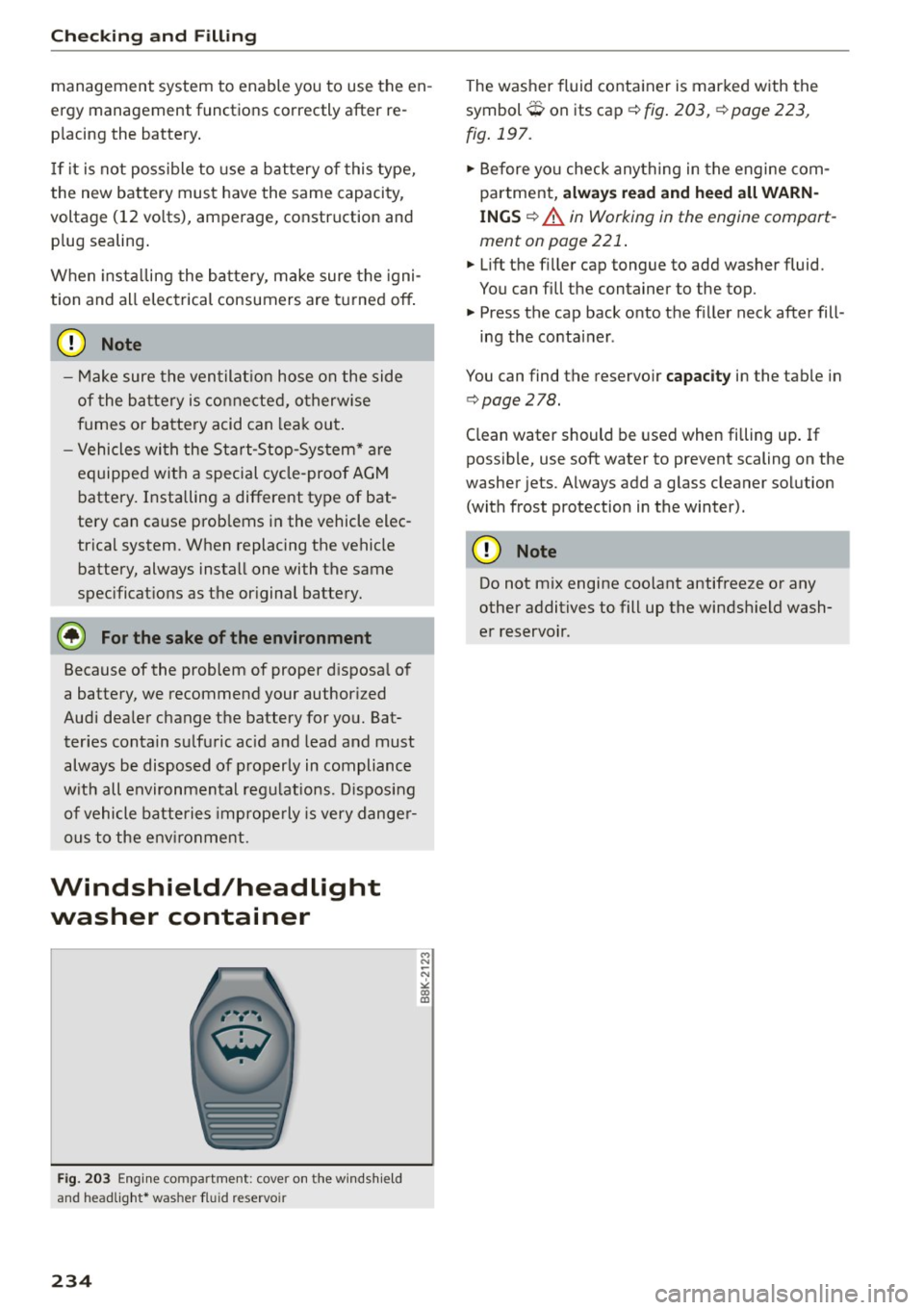
Windshield/headlight
washer container
F ig . 20 3 En gin e compart ment: cover o n the w inds hield
and headlig ht* w ash er flui d reservo ir
234
M N
-N
>< a, al
The washer fluid conta iner is mar ked w ith the
symbol
O on its cap ¢ fig . 203, ¢page 223,
fig . 197 .
.. Before yo u check any thing in the engine com
partment,
always re ad and heed all WARN
INGS ¢ A in Working in the engine compart
ment on page 221 .
.. Lift the f iller cap tongue to add washer fluid.
You can fill the container to the top.
.. Press the cap back o nto the f iller neck afte r fill -
ing the conta iner.
You can find the reservo ir
capacity in the table in
<=> page 2 78.
Clean water should be used when fi lling up . If
possib le, use soft water to prevent scaling on the
washer jets . Always add a g lass cleaner solution
(with frost protection in the winter).
(D Note
Do not mix engine coolant antifreeze o r any
other additives to fill up the winds hield wash
e r reservo ir .
Page 241 of 302
(a) Curb weight
(b) Accessory weight
(c) Vehicle capacity weight, and
(d) Product ion options weight
Maximum (permissible)
inflation pressure
means the max im um cold infla
tion pressu re to which a tire may
be inflated . Also called "ma xi
mum inflation pressure ."
Normal occupant weight
means 150 lbs . (68 kilog rams)
times the number of occupants
seated in the veh ic le up to the to
tal seating capacity of yo ur vehi
c le.
Occupant distribution
means d istr ibution of occupants
in a vehicle.
Outer diameter
means the overall diameter of an
inflated new tire .
Overall width
means the linear dis tance be
tween the exter iors of the side
walls of an inflated tire , including
elevations d ue to labe ling, deco
rations , or protective bands or
ribs .
Whee ls
Ply
means a layer of rubbe r-coated
parallel cords .
Production options weight
means the comb ined weight o f
those installed regular production
options weighing over 5 lbs . (2 .3
kg) in excess o f those s tandard
items which they re place , not pre
viously conside red in c urb weight
or accessory weight, including heavy duty brakes, ride levelers,
roof rac k, heavy d uty batte ry, and
specia l trim .
Radial ply tire
means a pneumat ic t ire in which
the ply cords that ex tend to the
beads are la id at substantially 90
degrees to the centerli ne of the
tread .
Recommended inflation
pressure
see ~ page 2 38, Cold tire infla
tion pressure .
Reinforced tire
means a tire designed to operate
at higher loads and at h igher in
flat ion pressures than the corre
spon ding standard tire . Rein
f orced tires may be identified as
239
Page 269 of 302

M N
co ~ co
rl I.O
"' N
"' rl
Left cockpit fuse assignment
Fig. 224 Left side of the cockpit: fuse panel with plastic
clip
Fuse panel @ (black )
No. Equipment
1 Dynamic steering
2 ESC control module
A/C system pressure sensor, electrome-
3 chanical park
ing brake, Homelink, auto-
matic dimming interior rearview mirror, air
quality/outside air sensor, ESC button
5 Sound
actuator/exhaust sound tuning
6 Headlight range contro l/cornering light
7 Headlight (cornering light)
Control modu les (e lectromechanical park-
8 ing brake, shock absorber, quattro Sport,
trailer hitch), DCDC converter
9
Adaptive cruise control or high voltage
battery (hybrid drive)
11 Side assist
12 Headlight range control, parking system
13 Airbag
14 Rear w iper
15 Auxi
liary fuse (instrument panel)
1 6 Auxiliary fuse terminal 15 (engine area) Fuses
and bulbs
Fuse panel @ (brown)
No . Equipment
1 Electric exhaust door
2 Brake light sensor or brake pedal
move-
ment sensor (hybr id drive)
3 Fuel pump
4 AdBlue pumps
or brake booster power
supply (hybrid dr ive)
5 Left seat heating with/without seat venti-
lation
6 ESC
7 Horn
8 Left
front door (window regulator, central
locking, mirror, switch, lighting)
9 Wiper motor
10 ESC
11 Left
rear door (window regu lator, switch,
lighting)
12 Rain and light sensor
Fu
se panel © (re d)
No . Equipment
3 Lumbar support
4 Dynamic steering
5 Climatized cupholder
6 Windshie
ld washer system, headlamp
washer system
7 Vehicle electr ical system control module 1
8 Vehicle e
lectrica l system control module 1
9 Panorama sunroof
10 Vehicle e lectrica l system control module 1
11 Sun shade (pano rama sunroof)
12 Anti-theft a
larm system
267
Page 284 of 302
Consumer information
today's automobiles, have steadily reduced the
scope of maintenance and repairs which can be
carried out by vehicle owners.
Also, safety and
environmental
concerns place very strict limits
on the nature of repairs and adjustments to en
gine and transmission parts which an owner can perform .
Maintenance, adjustments and repairs usually re
quire special tools , testing devices and other
equipment available to specially trained work
shop personnel in order to assure proper per
formance, reliability and safety of the vehicle and its many systems.
Improper maintenance, adjustments and repairs
can impair the operation and reliability of your
vehicle and even
void your vehicle warranty .
Therefore, proof of servicing in accordance with
the maintenance schedule may be a condition for
upholding a possible warranty claim made within
the warranty period .
Above all, operational safety can be adversely af
fected, creating unnecessary risks for you and
your passengers.
If in doubt about any servicing, have it done by
your authorized Audi dealer or any other properly equipped and qualified workshop. We strongly
urge you to give your authorized Audi dealer the
opportunity to perform all scheduled mainte nance and necessary repairs. Your dealer has the
facilities, original parts and trained specialists to keep your vehicle running properly.
Performing limited maintenance yourself
The following pages describe a limited number of
procedures which can be performed on your vehi
cle with ordinary tools, should the need arise and
trained personnel be unavailable. Before per
forming any of these procedures, always thor
oughly read all of the applicable text and carefully follow the instructions given . Always rigorously
observe the
WARNINGS provided.
Before you check anything in the engine com
partment, always read and heed all WARNINGS
c::> & and c::> & in Working in the engine compart
ment on page 221 .
282
A WARNING
-
-Serious personal injury may occur as a result
of improperly performed maintenance, ad
justments or repairs.
- Always be extremely careful when working
on the vehicle . Always follow commonly ac
cepted safety pract ices and general com
mon sense. Never risk personal injury.
- Do not attempt any of the maintenance,
checks or repairs described on the following
pages if you are not fully familiar with these
or other procedures with respect to the vehi
cle, or are uncertain how to proceed.
- Do not do any work without the proper tools
and equipment. Have the necessary work
done by your authorized Audi dealer or an
other properly equipped and qualified work
shop.
- The engine compartment of any motor vehi cle is a potentially hazardous area. Never
reach into the area around or touch the radi
ator fan. It is temperature controlled and
can switch on suddenly - even when the en
gine is off and the ignition key has been re
moved. The radiator fan switches on auto
mat ically when the coolant reaches a certain
temperature and will continue to run until
the coolant temperature drops.
- Always remove the ignition key before any
one gets under the vehicle.
-Always support your vehicle with safety
stands if it is necessary to work underneath
the vehicle. The jack* supplied with the vehi
cle is not adequate for this purpose and
could collapse causing serious personal in
jury.
- If you must work underneath the vehicle
with the wheels on the ground, always make
sure the vehicle is on level ground, that the
wheels are always securely blocked and that
the engine cannot be started.
- Always make sure the transmission selector
lever (automatic transmission) is in P (Park
position) and the park brake is applied.