wheel AUDI Q5 2016 Owner's Guide
[x] Cancel search | Manufacturer: AUDI, Model Year: 2016, Model line: Q5, Model: AUDI Q5 2016Pages: 300, PDF Size: 75.02 MB
Page 195 of 300
,....,
N
co
er::
co
,....,
The brakes on today 's au tomobiles a re still s ub
ject to wea r, depend ing la rgely on ope rating con
ditions and driving habits¢.&. . On vehicles that
ar e e ither driv en most ly in stop-and -go city traf
f ic or are driven ha rd, the brake pads should be
checked by your authorized Aud i dealer more of
ten than specified in the
Warranty & Mainte
n ance boo klet .
Failure to have your brake pads
inspected can resu lt in reduced brake perform
ance.
On steep slopes, you should use the braking ef
fect of the eng ine . This way, you prevent unnec
essary wear on the brake system . If you must use
your b rakes , do not ho ld the brakes down con tin
uously. Pump t he b rakes at intervals.
Operating noise
Noises may occur when braking depend ing on the
speed , braking force and outs ide cond itions such
as tempe rature and humidity .
Effect of water and road sa lt
In certain situations, for example a fter driving
t hrough water, in heavy ra in , after overnight con
densat ion or after washing your car, the braking
effect can be reduced by moisture or ice on the
b rake rotors and b rake pads . T he brakes must be
d ried first w ith a few careful b rake applica tions.
At highe r speeds and with the windsh ie ld w ipers
turned on, the bra ke pads press aga inst the brake
rotors for a short amount of time . Thi s occ urs at
r egular intervals wit hout the d river noticing and
p rovides for be tter br ak e response time u nder
wet conditions.
The eff ectiv eness of the brakes can be reduced
when the vehi cle is dr iven on a salt-covered road
and the brakes are not used. L ikewise, you clean
off acc umu la ted salt coat ing from b rake discs
and pads with a few ca utious applications of the
b rake ¢.&. .
Corrosion
There may be a tende ncy for d irt to b uild up on
the brake pads an d cor ros io n t o fo rm on the discs
if the ca r is not driven regular ly or only fo r sho rt
trips with little use of the brakes .
Intelligent Technology
If
the brakes are not used frequent ly, or i f co rro
sio n has formed on the discs , it is advisable to
clean off the pads and discs by braking firmly a
few times from a moderately high speed ¢ .&, .
Faults in the brake system
If you shou ld notice a sudden inc rease in brake
peda l travel, t hen one of t he two brake circ uits
may have fai led ¢
&..
Low brake fluid level
Malfunctions ca n occur i n the b rake system if the
br ak e fluid level is too low . T he brake f lu id leve l
is moni tored elect ronically .
Brake booster
The brake booster increases the press ure that
yo u generate with the b rake peda l.
It only oper
ates while the eng ine is r unning or w it h t he igni
tio n sw itched on (hybr id drive*) ¢.&, .
Brake lining wear status
Brake lining wear may be chec ked by visual in
spect io n of t he condition of the brake pads
t hr ough the openings in the wheel.
If necessary,
t h e wheel may be removed fo r th is i nspe ction
¢ page 259, Replacing wheels .
.&_ WARNING
--
-New brake pads don't have the bes t stop
p ing power an d m ust be " broken-in" d uring
the initial 250 miles (400 km). You can compensate for this by pressing the brake
pedal more firmly. This also applies later
when new pads are insta lled.
- You sho uld perform braking maneuvers for
the purpose of cleaning t he brake system
only if road condit io n s pe rmit . O ther road
users m ust not be put at r is k - you may
cause an accident!
- Before descending a steep g rade, reduce
speed and sh ift transmission into a lower
gea r or l ower dr iv ing ra nge. Do not r ide the
b rakes or hold the ped al down too long or
too often. This co uld cause t he b rakes to ge t
hot and dimi nish braking eff ic ien cy .
- Do no t "ride the br akes" by res ting you r foot
on the pedal when you do no t intend to ...,
193
Page 196 of 300
Intelligent Technology
brake. This may cause the brakes to over
heat, premature wear and increased stop
ping distance.
- Under certain climatic and operating condi
tions such as passing through water, driving
in heavy rain or after washing the vehicle,
the effectiveness of the brakes can be re duced . In winter, ice can accumulate on the
brake pads, linings, discs and drums. Care
fully apply brakes for a test. Brakes will dry
and ice coatings will be cleaned off after a
few careful brake applications.
- Driving for an extended period of time on
salt-covered roads without using your
brakes can also affect braking efficiency.
Clean off accumulated salt coating from
brake discs and pads with a few carefu l
brake app lications .
-If you damage the front spoiler, or if you in
stall a different spoiler, be sure the air flow
to the front brakes is not obstructed. Other
wise the brake system could overheat reduc ing the effectiveness of the entire brake sys
tem .
- Failure of one brake circuit will impair the
braking capability resulting in an increased
stopping distance. Avoid driving the vehicle and have it towed to the nearest author ized
Audi dealer or qualified workshop.
- Never let the vehicle roll to a stop with the
engine shut off.
- If the brake booster is not working, the
brake pedal must be pressed considerably
harder to make up for the lack of booster
assista nee.
Electromechanical power
assist, Dynamic steering
The electromechanical power assist helps the
driver when steering.
Power steering adapts electronically based on
the vehicle speed.
Indicator lights and messages
• Steering defective! Do not drive vehicle!
194 If
this indicator light turns on and stays on and
this message appears, the power steering may
have failed.
Stop the vehicle in a safe location as soon as pos
sible. Do
not continue driving . See your author
ized Audi dealer or other qualified repair facility
for ass istance .
'-r, ij Dynamic steering: System fault! You can
continue driving
If the indicator l ight turns on and the message
appears, the steering may be more difficult to
move or more sensitive than usual. The steering
may also be at an angle when driving straight.
Drive slowly to your authorized Audi dealer or
qualified workshop to have the malfunct ion cor
rected.
1 :r- ij Dynamic steering: Initializing
Audi drive select* : if the indicator light blinks and
the driver message appears, the dynamic steer i ng* is reinitial ized. After start ing the engine, the
steering wheel will move slightly . Re-initial iza
tion might be necessary if the steering wheel was
moved hard to the left and right while the vehicle
was not moving. The display turns off if the initi
alization was successful.
(D Tips
- If the . or 1:r- ij in dicato r light only stays on
for a short time, you may continue driving.
- T he dynamic steering* stab ility systems
¢ page 190 are not available in the event of
a system malfunction.
- For additional information on dynamic
steering*
¢page 119.
Driving with your
quattro
With all-wheel drive, all four wheels are driven .
General information
With all-wheel drive, power is distributed to all
four wheels. This happens automatically depend
ing on your driving style and the road conditions
at the time. See also
c> page 190. ..,.
Page 197 of 300
,....,
N
co
er::
co
,....,
variab ly to the front and rear axle.
It works to
gether with selective wheel torque control, which
ac tivates when driving through curves
¢page 190.
The all-wheel drive concept is designed for high
engine power. Your ve hicle is exceptionally pow
erful and has excellent driving characterist ics
both under norma l dr iving condit ions and on
snow and ice. Always read and follow safety pre
cautions ¢.&. .
Winter tires
When driving in the w inter, your vehicle with a ll
wheel drive has an advantage, even with regular
tires. In winter road conditions it may be adv isa
b le to mount w inter t ires (or all-season tires) for
i mproved driveab ility and brak ing : these tires
must be mounted on
all four wheel s. See a lso
¢ page 249, Winter tires.
Tire chains
Where tire chains are manda tory on certain
roads, this normally also applies to vehicles w ith
a ll-wheel drive¢ page 249 , Snow chains.
Replacing wheel s/tires
Veh icles with all -whee l dr ive must always have
tires of the same s ize. A lso avo id tires with differ
ent tread depths . For detai ls see page
¢ page 241, New tires or wheels.
A WARNING
Always adjust you r driving to road and t raff ic
conditions. Do not let the extra safety affo rd
ed by all-wheel drive te mpt you into tak ing
extra risks.
- Alt hough the all-whee l dr ive is very effec
t ive, always remember th at br akin g ca pac ity
is limited by tire traction. Yo u should t here
fore not d rive at excess ive speeds on icy or
slippery road surfaces.
- On wet road surfaces, be caref ul not to drive
too fast because the front wheels co uld be
gin to slide on top of the water (a quaplan
ing). If this shou ld occu r, you w ill have no
warning from a sudden increase in eng ine
speed as with a front -whee l dr ive vehicle.
Intellig ent Technology
Always d rive at speeds which are suited to
the road conditions -risk of c rash.
Energy management
Starting ability is optimized
E nergy management controls the distribution of
electrical energy and thus optimizes the availa
bility of electrical energy for starting the engine .
If a vehicle with a conventional energy system is
not dr iven fo r a long pe riod of time, the ba ttery is
discharged by id ling curre nt cons umers (e.g. im
mobili ze r). In ce rtain circumstances i t can resu lt
i n t he re being insuffi cient energy av ailabl e to
st ar t the eng ine.
Intellige nt ene rgy manageme nt in yo ur vehicle
hand les the d ist ribution of electrical e nergy.
St art ing abil ity is m arkedly improved and the life
of the ba ttery is ex tende d.
Bas ica lly, energy management co nsists of
bat
tery diagnosis , idling current management
and
dynami c energy management .
Battery diagnosis
Battery d iagnosis continuously determ ines the
state of the battery . Sensors de termine battery
vo ltage, battery curren t and batte ry tempera
tu re . This determines t he cur rent state of c harge
and the power of t he ba ttery.
Idling current management
Idli ng cur rent management reduces energy con
s u mption wh ile the vehicle is standing . With the
ignition switched off , it contro ls the energy sup
ply to the vario us elec trical componen ts. Data
fr om b attery diagnosis is co nsidere d.
Depend ing on the ba tte ry's s ta te of charge, indi
v idual consumers are gradually turned off to pre
ven t ex cess ive disc ha rge of t he battery and thus
m ain ta in starting c ap abili ty.
Dynamic energy management
While the vehicle is being driven, dynam ic e nergy
manageme nt dis trib utes the energy generated
according to the needs of the ind ividual compo-
nents.
It regula tes consu mption, so that more ..,.
195
Page 203 of 300
,....,
N
co
er::
co
,....,
conditions and off-road
General information
The operation of the Electronic Stabilization Con
trol (ESC) is expanded for operation away from paved roads. In situations where slip or a differ
ential locking fun ction is required , the offroad
mode can be activated ¢
page 190. Your Audi al
so has permanent all-wheel drive in addition .
However, your Audi is not a pure offroad vehicle.
It was not built for driving under extreme condi
tions, e.g. for tr ips that are in the nature of an
expedition .
Drive only on roads and offroad sections which
match the design of your vehicle and your abili
ties as a driver. Never take risks!
Before driving offroad
-Check the engine oi l level, tire pressure, coo l
ant level, and the fluid level in the windshield
washer reservo ir.
- Stow luggage items and other objects in the
luggage compartment, and secure them
against sliding around.
After driving offroad
-After trips offroad, remove any twigs and other
foreign objects from the gri ll, the underbody
and the wheels. Pay special attention to foreign
objects (stones) which have become lodged in
the tire tread.
- Clean the body and the vehicle underside, and
inspect the vehicle for possible damage.
- Clean dirty windows, headlamp lenses, rear
lights, and license plates.
- Perform a brake check (particularly after travel
ling through water).
A WARNING
-Drive especially attentively and plan ahead
in difficult road condit ions and when off
road. Excessive speed or incorrect maneu
vers can cause injuries and damage to the
vehicle .
Offroad driving
-Always adapt your speed and driving style to
road, offroad, traffic, and weather condi
tions. Drive especially slowly offroad when
your view is restricted.
- Please be aware that in offroad mode, par
ticularly on a smooth and slippery road, the
wheels may have an increased tendency to spin and the vehicle may break away - dan
ger of skidd ing!
- Stability is lim ited in the offroad mode .
@) For the sake of the environment
Avoid damage to the environment and re
spect nature.
(D Tips
Only drive where it is permitted and stay on
marked roads and paths.
Explanation of some technical terms
The following data refer to ideal conditions. De
pending on vehicle load and ground conditions
and the environment, the numbers may vary. It is
the driver's responsibility to decide whether ave
hicle can overcome a specific s ituation
¢ ,&. .
Gradient angle
The number of meters in altitude gained over a
distance of 109.4 yards or 100 meters (grade)
are given as a percentage or degrees. Informa
t ion about the gradient the vehicle can cl imb un
der its own power (depends in part on the road
s ur face and eng ine power). Maximum permitted
grade: 31
°
Ground clearance
The distance between the road surface and the
lowest point of the vehicle underbody. Ground
clearance 7.9 in (200 mm)
_& WARNING
-
Exceeding the stated maximum figures can
result in severe injuries or vehicle damage.
- All the information was gathered on level,
firm and non-slippery road surfaces, and un-
der dry weather conditions.
~
201
Page 204 of 300
Offroad dri ving
- Ideal conditions do not prevai l offroad . Nev
er utilize the maximum readings to their
fullest, always leave a safety reserve.
Driving tips
On poor rood ond offroad, there is always only
one motto: Plan ahead and drive slowly!
Pl ease observe the following when driv ing away
from paved roads:
.,. Drive only on roads and off road sections which
ma tch the des ign of your vehicle and yo ur abili
ties as a driver . Neve r take risks!
... Drive slowly and p lan ahead!
... Take into consideratio n the
ground clearan ce
of your veh icle.
.,. Activate the
offro ad mode Q page 190 as need
ed .
.,. Use the
hill desc ent a ssis t Q page 192 when
driv ing down steep sections on hills .
Unpaved roads and offroad
Drive s low ly on unfam iliar roads and unknown
offroad sections, and look out for unexpected ob
stacles (e .g. potholes, rocks, tree stumps, etc .) .
To prevent the veh icle from bottoming and avoid
damage to the underbody, you should d rive
stra ight across severe bumps in the ground with
only one side of the vehicle so that only two of
your wheels cross the b umps.
Drive briskly through sandy or marshy offroad
sections and do not stop , if at all possible .
Driving through water
Note the following to avoid vehicle damage when
driving throug h water, fo r example on flooded
roads:
- T he wate r must no t be any higher than the bot-
tom of the vehicle body .
- Do no t drive fas ter than wa lking spee d.
Driving on a slope
If you ever find yo urself not able to cl imb a s lope,
do not try to turn around, d rive back down in
re
verse .
Otherw ise, you run the risk of tipping over.
202 If the vehicle thre
atens to tip o ver when dr iving
across a slope, you must immediately stee r
downhill in the direction of the slope.
Do no t pa rk you r vehi cle on steep s lopes or
grades .
To reduce the risk of tipping over, drive on slopes
i n the d irect io n of the downwa rd slope (fa ll line) -
not cros swi se .
& WARNING
After driving thro ugh water, mud, slush, etc.,
the brakes may be slow to take effect beca use
of wet brake rotors and pads. Dry the brakes
f irst by braking carefu lly to restore the full
braking effect .
(D Note
- Vehicle components such as the engine,
transmiss ion, suspension or electrical sys
tem can be seve rely damaged by driving
throug h water.
-Always switch off the Start-Stop-System *
when driving through water Qpage 93.
(D Tips
-Check the de pth of the water before driving
through it.
- Do not stop the vehicle, drive in reverse or
switch the engine of f whe n driving through
water.
- Keep in mind that oncom ing vehicles may
create waves that raise the water level and
make it too deep fo r your vehicle to drive
t h roug h safe ly.
-Avoid driv ing through salt water beca use it
can cause corrosion.
Page 208 of 300
Trailer mod e
Parking on a slope
Do not park on a slope with a trailer. If it cannot
be avoided, do so only after doing the following:
When parking:
.,. Apply the foot brake .
.,. Have someone place chocks under both the ve
hicle and the trailer wheels .
.,. With chocks in p lace, slowly release the brakes
unt il the wheel chocks absorb the load .
.,. Turn the wheels towards the curb .
.,. Apply the pa rking brake .
.,. Move the selector lever to P .
When resta rting after parking:
.,. Apply the foot brake .
.,. Start the engine .
.,. Move the selector leve r to 0/5 .
.,. Release t he pa rking brake and slow ly pull out
and away from the wheel chocks.
"' Stop and have someone retrieve the wheel
chocks.
(D Tips
If you move the se lector lever of the automat
ic transmission to P before applying the park
ing brake and before blocking the wheels, you may have to use more force later to move the
lever out of the P position .
206
Page 210 of 300
Care and cleaning
& WARNING
-Only wash the vehicle when the ignition is
off and follow the instructions from the car
wash operator to reduce the risk of acci dents.
- To reduce the risk of cuts, protect yourself from sha rp metal components when wash
ing the underbody or the inside of t he wheel
hous ings.
- After was hing the vehicle, the braking effect
may be delayed due to mo isture on the
bra ke rotors o r ice i n the winte r. The bra kes
mus t be d ried first w ith a few care ful brake
applications .
@ Note
-If you wash the ve hicle in an automa tic car
wash, you m ust fold the exte rior m irrors i n
to reduce the risk of damage to the mirrors.
Power folding exterior m irrors * must on ly
be fo lded in and out using the power folding
funct ion.
- To reduce the risk of damage to the rims
and tires, compare the width between the
whee ls on your ve hicle w ith the distance be
tween the gu ide rails in the car wash. -
To red uce the risk of damage, compare the
heig ht and width of your vehicle with the
heig ht and w idth of the inside of the car
wash.
- To prevent paint damage, do not wash the
vehicle in direct sunlight.
- To reduce the risk of damage to the surface,
do not use insect removing sponges, k itchen
sponges or s imilar items.
- Matte finish painted vehicle components:
- To reduce the r isk of damage to the sur-
face, do not use polish ing agents or hard
wax.
- Never use protective wax. It can destroy
the matte finish effect.
- Do not place any stickers or magnetic signs on vehicle parts pain ted with matte
finish paint. The paint could be damaged
when the stickers or magne ts are re
moved.
@ For the sake of the environment
Only wash the veh icle in facilities spe cially de
signed for that pu rpose. This will reduce the
r isk of dirty wate r contamina ted with o il from
entering the sewer system .
Cleaning and care information
When cleaning and caring for individua l vehicle
components, refer to the following tables. The information conta ined there is s imply recom
mendations . Fo r quest ions or for components that are not
listed, consult an authorized Aud i
dealer or authorized Audi Service Fac ility. Also
fo llow the information found in c::> & .
Ex ter io r cleaning
Component S ituation Solution
Wind shield wiper
Deposits c::> page 58, Cleaning windshield wiper blades
blades
Headlights /
Deposits Soft sponge with a mild soap solution a)
Tail lights
Sen sor s/
Deposits Sensors: soft cloth with solvent-free cleaning sol utio n
camera len ses Camera lenses: soft cloth w ith alcoho l-free cleaning so lu-
tion
Snow/ice Hand brush/solvent -free de -icing spray
Wheels Road salt Water
Brake dust Acid-free special cleaning solution
208
Page 212 of 300
Care and cleaning
Component Situation Solution
Te xtil es
Deposits adhering to Vacuum cleaner
a rt ifici al le ather , the surface
Alcant ara Water-based deposits Absorben
t cloth and mild soap solutiona>
such as coffee, tea,
blood, etc.
O il-based deposits Apply a m ild soap solution a), blot away the dissolved oil or
such as oil, make-up, dye with an absorbent towel and, if necessary, treat after-
etc. ward wit h water.
Special deposits such Special stain remover, b lot with absorbent material, treat
as ink, na il polish, la- afterward with mild soap solution, if necessary a)
tex paint, shoe pol-
ish, etc.
Natural leather Fresh stains Wool cloth with a mild soap so
lutiona)
Water-based deposits Fresh sta ins : absorbent cloth
such as coffee, tea, Dried sta ins: stain remover suitable fo r leather
blood, etc.
Oil-based deposits Fresh stains: absorbent cloth and stain remover suitable
such as oil, make-up, for leather
etc. Dried sta ins : grease dissolv ing spray
Special deposits such Spot remover suitab le for leather
as ink, nai l polish, la -
tex paint, shoe pol-
ish, etc.
Ca re Regularly apply cond ition ing cream that protects from
light and penet rates into the materia l. Use specia lly-co l-
ored conditioning cream, if necessary.
Carbon parts Deposits clean the same way as plastic parts
a) Mild soap solution: maximum two tablespoons of neutral soap in 1 quart (l liter) of water
_& WARNING
The windshie ld may not be trea ted with wa
ter-repelling windshield coating agents. Un
favorable conditions s uch as wetness, dark
ness, or low sun can result in increased glare .
Wiper blade chatter is also possible.
(D Note
- Headlights/tail light s
-Never clean headlights or tail lights with a
dry cloth or sponge.
- Do not use any cleaning product that con
tains alcohol, because they could cause
cracks to form.
- Wheels
210
-
- Never use any paint polish or other abra
sive materials.
- Damage to the protect ive layer on the
rims such as stone chips or scratches must
be repaired immediately.
- Sensors /camera lenses
- Neve r use wa rm or ho t wa ter to remove
snow or ice from the camera lens . This
could cause the lens to crack .
- N eve r use ab rasive cleaning materials or
a lcohol to clea n the camera lens . This
could cause scratches and cracks .
-Doo r window s
-Remove snow and ice on windows and ex-
terior mirrors with a plast ic scraper. To
Page 220 of 300
Fuel and R efue li ng
Filling AdBlue
Applies to veh icles: w ith selective cata ly ti c reduction
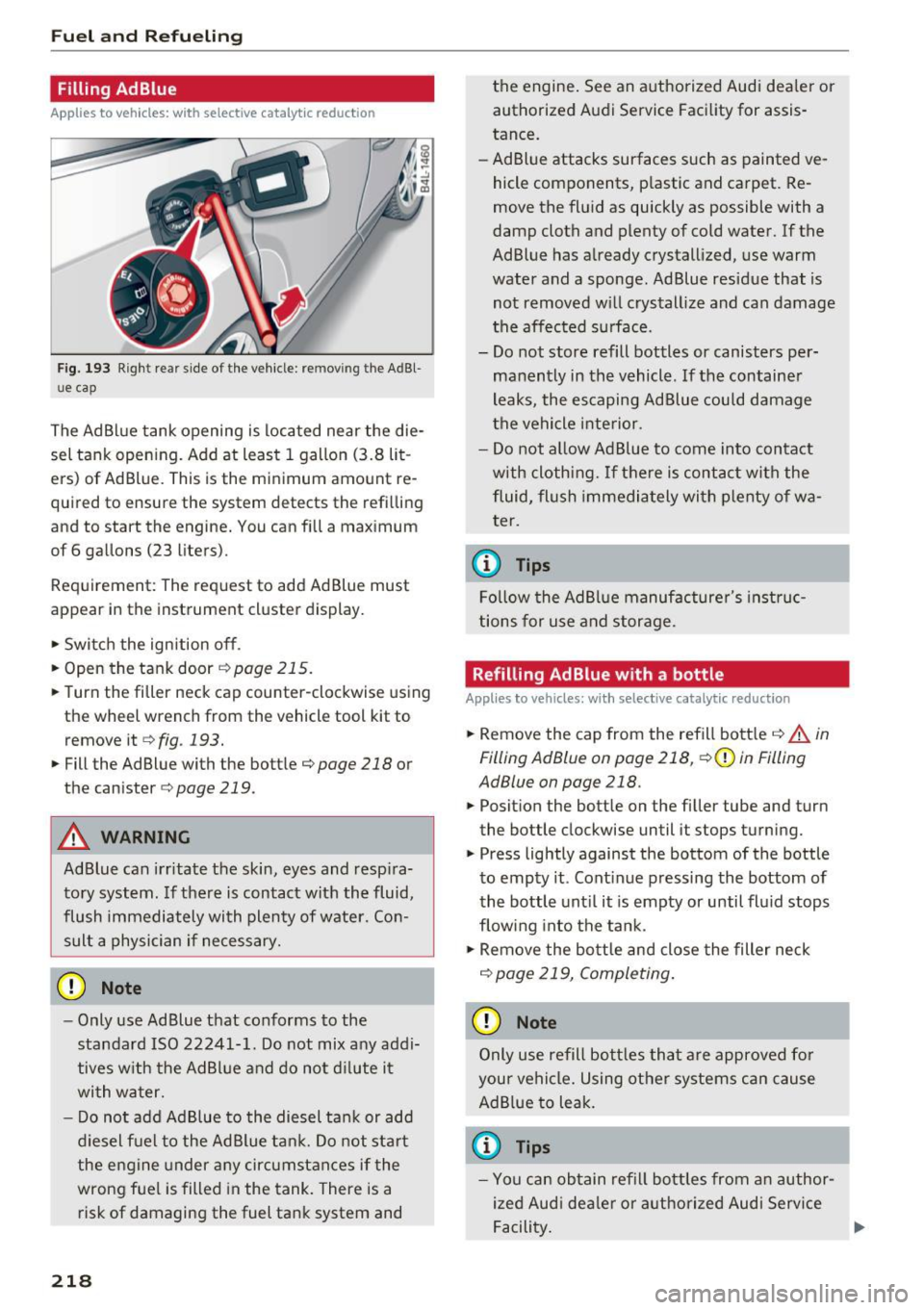
Fig. 193 Right rear side of the vehicle: removing the AdBl
ue cap
The Ad Blue tank opening is located near the die
sel tank opening. Add at least 1 gallon (3.8 lit
ers) of Ad Blue. This is the minimum amount re
quired to ensure the system detects the refilling
and to start the engine. You can fill a maximum
of 6 gallons (23 liters).
Requirement: The request to add Ad Blue must
appear in the instrument cluster display.
• Switch the ignition off.
• Open the tank door
r::!) page 215.
• Turn the filler neck cap counter-clockwise using
the wheel wrench from the vehicle tool kit to
remove it
¢ fig . 193.
• Fill the Ad Blue with the bottle¢ page 218 or
the canister ¢
page 219.
A WARNING
AdBlue can irr itate the skin, eyes and resp ira
tory system. If there is contact with the fluid,
flush immediately with plenty of water. Con sult a physician if necessary.
CD Note
- Only use Ad Blue that conforms to the
standard ISO 22241-1. Do not mix any addi
tives w ith the AdBl ue and do not d ilute it
wi th water.
- Do not add Ad Blue to the diesel ta nk or add
diesel f uel to the AdBlue tan k. Do not start
the engine under any circumstances if the
wrong fue l is filled in the tank. There is a
risk of damaging the fuel tank system and
218
the engine . See an authorized Audi dea le r or
authorized Audi Service Facility for assis
tance.
- Ad Blue attacks surfaces such as painted ve
hicle components, p lastic and carpet. Re
move the fluid as quickly as possible with a
damp cloth and plenty of cold water. If the
AdBlue has a lready crystall ized, use warm
water and a sponge. Ad Blue residue that is
not removed w ill crystall ize and can damage
t he affected s urface.
- Do not store refill bottles or canisters per
manently in the vehicle. If the container
leaks, the escaping Ad Blue could damage
the vehicle inte rior.
- Do not allow Ad Blue to come into contact
with cloth ing. If t here is contac t w ith the
fluid, flush immediately wi th plenty of wa
ter.
(0 Tips
Fo llow the AdBlue manufacture r's instruc
tions for use and storage.
Refilling Ad Blue w ith a bottle
App lies to vehicles : wi th selec tive cata lyt ic reduct ion
• Remove the cap from the refill bott le ¢ &. in
Filling AdBlue on page 218,
¢ 0 in Filling
AdBlue on page 218.
• Posit ion the bottle on the filler tube and turn
the bottle clockwise until it stops turning.
• Press lightly against the bottom of the bottle
to empty it . Cont inue pressing the bottom of
the bottle unt il it is empty or until fluid stops
flowing into the tank.
• Remove the bottle and close the filler neck
¢ page 219, Completing .
CD Note
Only use refill bott les tha t are approved for
you r vehicle. Using other systems can cause
Ad B lue to leak.
(0 Tips
- You can obtain refill bottles from an author
ized Audi dea le r or authorized Audi Service
Facility.
Page 221 of 300
-A permitted refill bott le contains approxi
mately 0.5 gallons (1.9 liters) of Ad Blue.
Refilling Ad Blue with a canister
A pp lies to vehicles: with selective ca taly tic reduc tion
®
+®
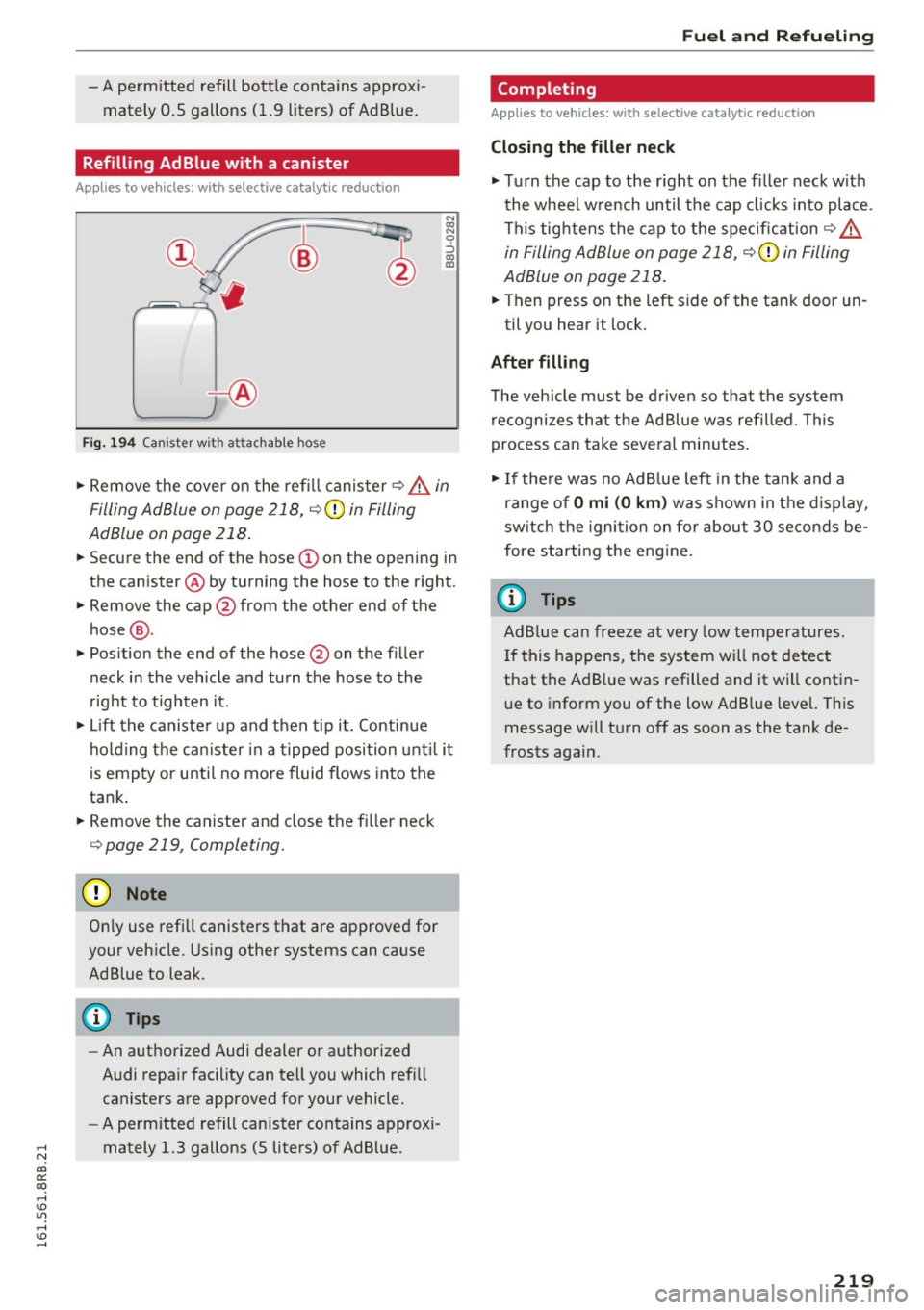
F ig . 194 Ca nister wi th att ach ab le hose
.,. Remove the cover on the refi ll canis ter ¢.&. in
Filling AdBlue on page 218, ¢(Din Filling
AdBlue on page 218 .
.. Secure the end of the hose (I) on the opening in
the can ister @ by turning the hose to the right.
.. Remove the cap @from the other end of the
hose @.
.. Pos ition the end of the hose@on the f iller
neck in the vehicle and turn the hose to the
right to tighten it.
.,. Lift the caniste r up and then tip it. Continue
holding the ca nister in a tipped position unt il it
is empty or until no more fluid flows into the
tank .
.. Remove the canister and close the f iller neck
¢ page 219, Comple ting .
(D Note
On ly use refi ll canisters t hat are approved for
your veh icle. Using other systems can cause
Ad Blue to leak.
(D Tips
- An authorized Audi dealer or authorized
Audi repa ir facility can tell you which ref ill
canisters are approved for your vehicle.
- A pe rm itted refill canister contains approxi-
~ mately 1.3 gallons (5 liters) of AdBlue.
co
er::
co
,....,
Completing
App lies to vehicles : wi th selective cata lytic re du ctio n
Closing the filler neck
.. Turn the cap to the r ight on the fille r neck w ith
the wheel w rench until the cap clicks into place .
This tighte ns the cap to the specification ¢
&,
in Filling AdBlue on page 218 , ¢@ in Filling
AdBlue on page 218 .
.. Then press on the left side of the tank door un-
til you hear it lock.
Afte r filling
T he vehicle must be driven so that the system
recogni zes that the Ad Blue was refilled. This
process can take several minutes.
.,. If the re was no AdB lue left in the tank and a
range of
O mi (0 km ) was shown in the d isplay,
sw itch the ignition on for about 30 seconds be
fore starting the engine .
(D Tips
Ad B lue can freeze at very low temperatures .
If this happens, the system will not detect
that the Ad B lue was refilled and it will contin
ue to inform you of the low AdBl ue leve l. This
message w ill turn off as soon as the tank de
frosts aga in.
219