ECU AUDI Q5 2016 Service Manual
[x] Cancel search | Manufacturer: AUDI, Model Year: 2016, Model line: Q5, Model: AUDI Q5 2016Pages: 300, PDF Size: 75.02 MB
Page 205 of 300
,....,
N
co
er::
co
,....,
General information
Your Audi was designed primarily for passenger
transportation .
If you plan to tow a trailer, please remember that
the additional load will affect durability, econo my and performance.
T railer towing not only places more stress on the
vehicle, it also calls for more concentration from
the driver.
For this reason, always follow the operating and
driving instructions provided and use common
sense.
Technical requirements
Trailer hitch
Use a weight-carrying hitch conforming to the
gross trailer weight. The hitch must be suitable
for your vehicle and trailer and must be mounted
securely on the vehicle's chassis at a technically
sound
location . Use only a trailer hitch with a re
movable ball mount . Always check with the trail
er hitch manufacturer to make sure that you are
using the correct hitch.
Do not use a bumper hitch.
The hitch must be installed in such a way that it
does not interfere with the impact -absorbing
bumper system . No modifications should be
made to the vehicle exhaust and brake systems .
From time to time, check that all hitch mounting
bo lts remain securely fastened.
When you are not towing a trailer,
remove the
tra iler hitch ball mount . This prevents the hitch
from causing damage should your vehicle be
struck from beh ind ¢
,&. .
Trailer brakes
If your trailer is equipped with a braking system,
check to be sure that it conforms to all regula
tions .
Trailer mode
The trailer hydraulic brake system must not be
directly connected to the vehicle's hydraulic
brake system ¢.&. .
Safety chains
Always use safety chains between your vehicle
and the trailer.
Trailer lights
T ra iler lights must meet all regulations . Be sure
to check with your author ized Audi dealer for cor
rect wiring, switches, and relays.
Mirrors
If you are unable to see the traffic behind you us
ing the regular outside mirrors, then you
must in
stall extended mirrors. It is important that you
always have clear vision to the rear.
,8. WARNING
-If a trailer has electrical brakes please note
that these brakes are not activated by the
factory-fitted control unit -risk of accident!
- After removing the trailer hitch, do not store it in your vehicle. In case of sudden
braking, the hitch could fly forward and in
jure you or your passengers.
- Never install a "weight distributing" or
"load equalizing" trailer hitch on your vehi
cle. The vehicle was not designed for these
kinds of trailer hitches . The hitch attach
ment can fail, causing the trailer to tear
loose from the vehicle.
- The Gross Vehicle Weight Rating for your
vehicle, found on the safety compliance la bel on the driver's side B-pillar, must never
be exceeded under any circumstances. Ex
ceeding the Gross Vehicle Weight Rating of
your vehicle is likely to damage your vehicle,
and such damage will not be covered by
your Limited New Vehicle Warranty. Exceed
ing the Gross Vehicle Weight Rating will al
so change the performance and handling
characteristics of your vehicle, which could
cause a crash resulting in serious injury or
death.
203
Page 206 of 300
Trailer mod e
Operating instructions
6"
~ 2
. 1/2 "
.(. '-I} 1-1/2"
-
F ig. 189 Pe rmi tted ball posit io n of the traile r hi tch
Tr aile r to wing weights
With a f ac tor y-inst all ed or an a ft er ma rket trailer
h itch, the maximum permissib le trailer weight is
4,400 lbs (2,000 kg) . The maximum perm iss ible
unb raked trailer weight is 1,650 lbs (750 kg) .
These spec ificat ions apply when dr iv ing on roads
hav ing an incl ine of less tha n 12%.
Perm is sible tongue load
For best vehicle handling under these changed
conditions, adjust the trailer load so that the
tongue load is at the maxim um allowable or
slightly lower. You can get an approx imation of
the tongue load w ith a bathroom scale or you can
measure the load at a tr ucking company or
weighing station.
W ith a
fa ctor y-installed or an aftermarket trailer
h itch, t he maximum permissib le load on the ball
h itch may not exceed 440 lbs (200 kg).
It is rec
ommended to use the maximum permissible
load.
Trailer load di stribution
B e su re the load in the trailer is held securely in
p lace to prevent it from s hift ing fo rwa rd, back
ward or sideways.
Nev er allo w a p assenge r to ride in a trail er c::> A
in Driving instructions on page 205.
Ball mount
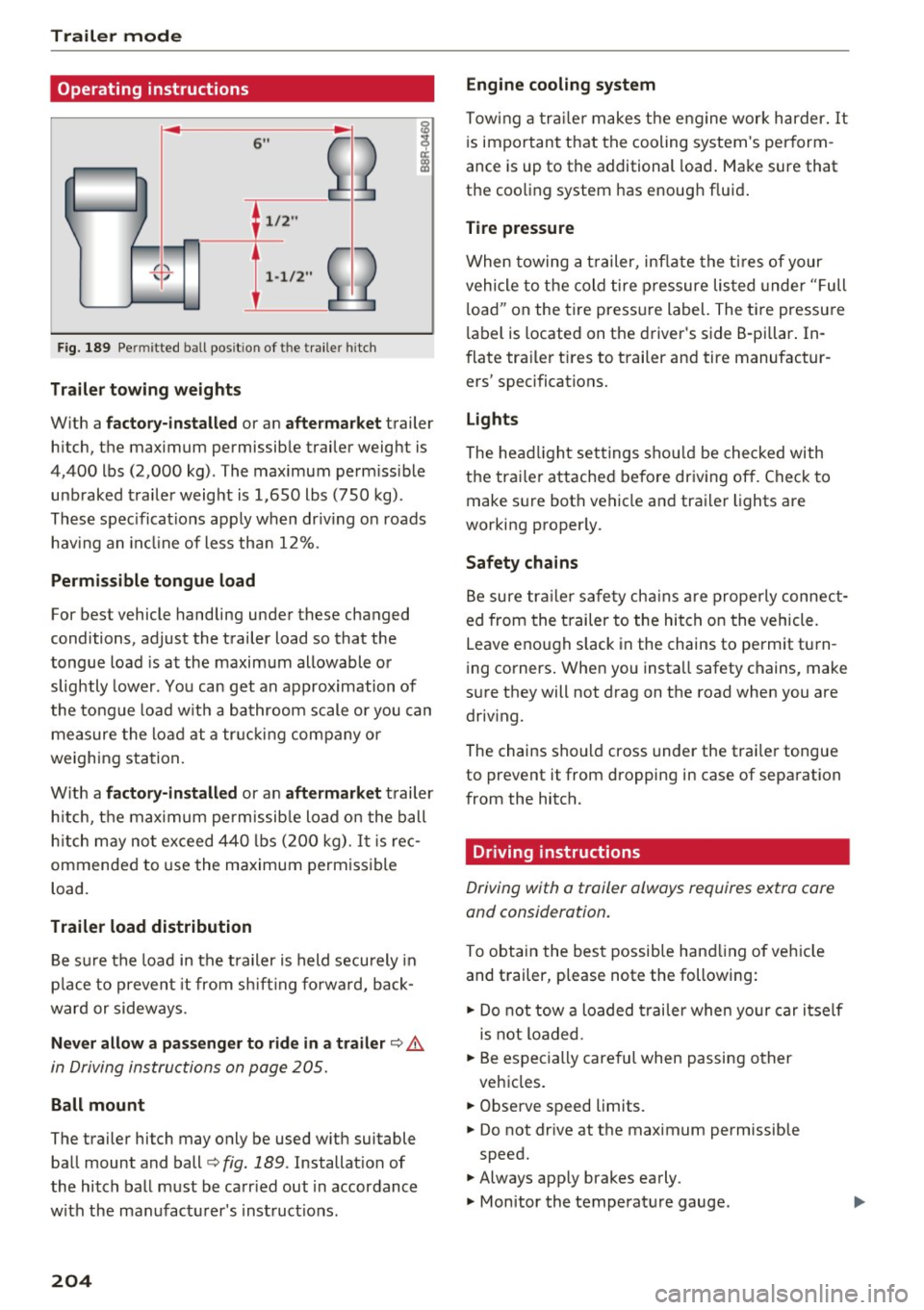
The trailer hitch may only be used w ith suitable
ball mount and ball
c::> fig. 189 . Installat ion of
the hitch ball must be carr ied out in accordance
w ith the manufacturer 's inst ruct ions.
204
Engine cooling system
Towing a tra ile r makes t he engine work harder. It
is important that the cooling system's perform
ance is up to the additional load . Make sure that
the cooling system has enough fluid .
Tire pressure
When towing a t railer, inflate the ti res of your
vehicle to the cold tire pressure listed under "Full
l oad" on the tire press ure label. The tire pressure
l abel is located on the driver 's side B-pillar . In
flate tra iler tires to trailer and tire manufactur
ers' specifications.
Lights
The head light settings shou ld be checked with
the trailer attached before driving off. Check to
make s ure both vehicle and trailer lights are
working properly.
Safety chains
Be sure tra ile r safety cha ins a re properly connect
ed from the trailer to the hitch on the vehicle.
Leave enough slack in the chains to permit tu rn
i ng corners . When you install safety chains, make
s u re they will not drag on the road when you are
driv ing.
The chains should cross under the trai ler tongue
to prevent it from dropping in case of separation
from the hitch.
Driving instructions
Driving with a trailer always requires extra care
and consideration.
To obtain the best possible handling of veh icle
and t railer, p lease note the following:
.., Do not tow a loaded trai ler when your car itself
is not loaded.
.., Be especially care ful when passing other
vehicles .
.., Observe speed limits.
.., Do not drive at the maximum permissible
speed.
.., Always app ly brakes early.
.., Monitor the temperature gauge.
Page 221 of 300
-A permitted refill bott le contains approxi
mately 0.5 gallons (1.9 liters) of Ad Blue.
Refilling Ad Blue with a canister
A pp lies to vehicles: with selective ca taly tic reduc tion
®
+®
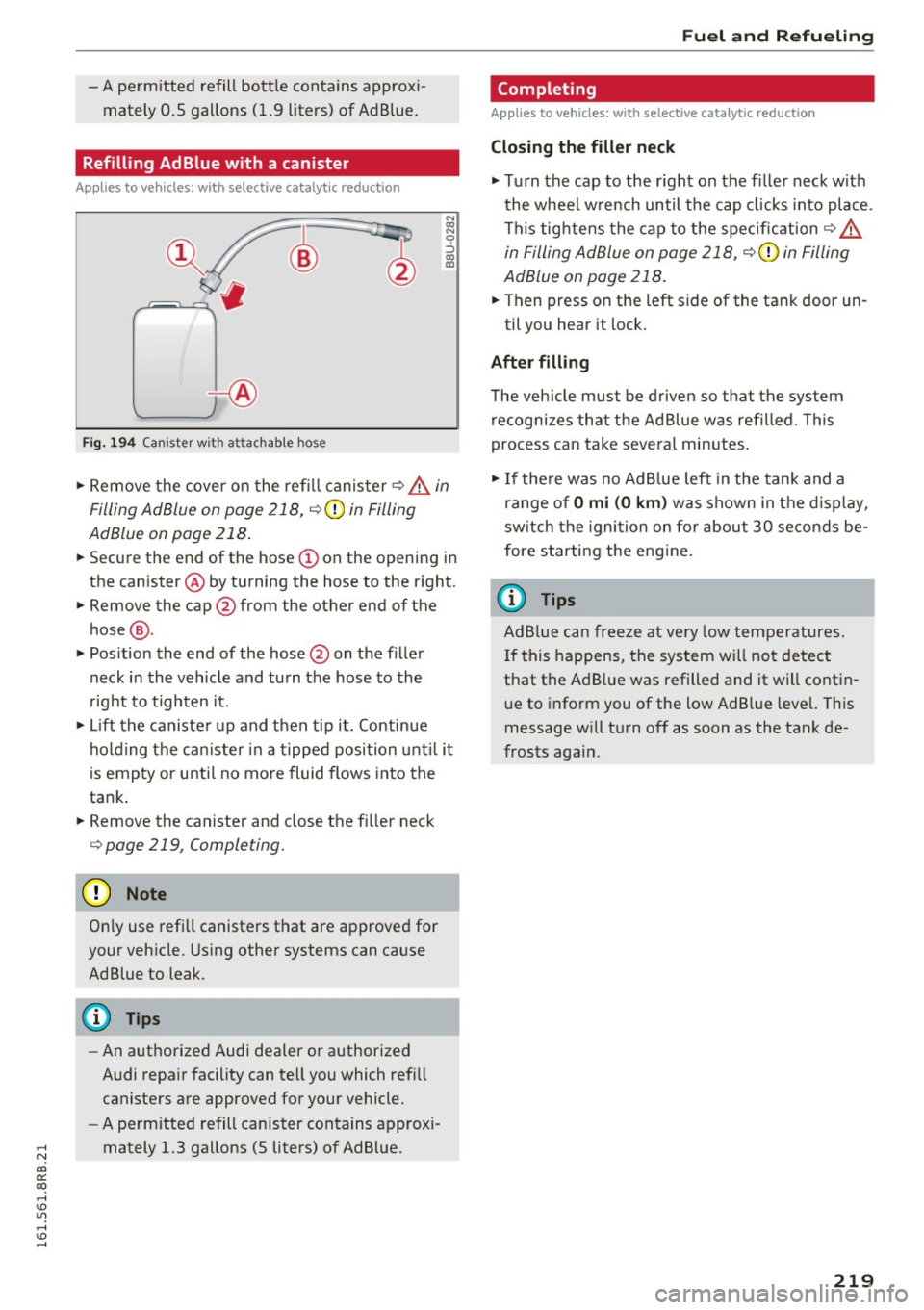
F ig . 194 Ca nister wi th att ach ab le hose
.,. Remove the cover on the refi ll canis ter ¢.&. in
Filling AdBlue on page 218, ¢(Din Filling
AdBlue on page 218 .
.. Secure the end of the hose (I) on the opening in
the can ister @ by turning the hose to the right.
.. Remove the cap @from the other end of the
hose @.
.. Pos ition the end of the hose@on the f iller
neck in the vehicle and turn the hose to the
right to tighten it.
.,. Lift the caniste r up and then tip it. Continue
holding the ca nister in a tipped position unt il it
is empty or until no more fluid flows into the
tank .
.. Remove the canister and close the f iller neck
¢ page 219, Comple ting .
(D Note
On ly use refi ll canisters t hat are approved for
your veh icle. Using other systems can cause
Ad Blue to leak.
(D Tips
- An authorized Audi dealer or authorized
Audi repa ir facility can tell you which ref ill
canisters are approved for your vehicle.
- A pe rm itted refill canister contains approxi-
~ mately 1.3 gallons (5 liters) of AdBlue.
co
er::
co
,....,
Completing
App lies to vehicles : wi th selective cata lytic re du ctio n
Closing the filler neck
.. Turn the cap to the r ight on the fille r neck w ith
the wheel w rench until the cap clicks into place .
This tighte ns the cap to the specification ¢
&,
in Filling AdBlue on page 218 , ¢@ in Filling
AdBlue on page 218 .
.. Then press on the left side of the tank door un-
til you hear it lock.
Afte r filling
T he vehicle must be driven so that the system
recogni zes that the Ad Blue was refilled. This
process can take several minutes.
.,. If the re was no AdB lue left in the tank and a
range of
O mi (0 km ) was shown in the d isplay,
sw itch the ignition on for about 30 seconds be
fore starting the engine .
(D Tips
Ad B lue can freeze at very low temperatures .
If this happens, the system will not detect
that the Ad B lue was refilled and it will contin
ue to inform you of the low AdBl ue leve l. This
message w ill turn off as soon as the tank de
frosts aga in.
219
Page 222 of 300
Checking and Filling
Checking and Filling Hood
Releasing the engine hood
The engine hood is released from inside the vehi
cle .
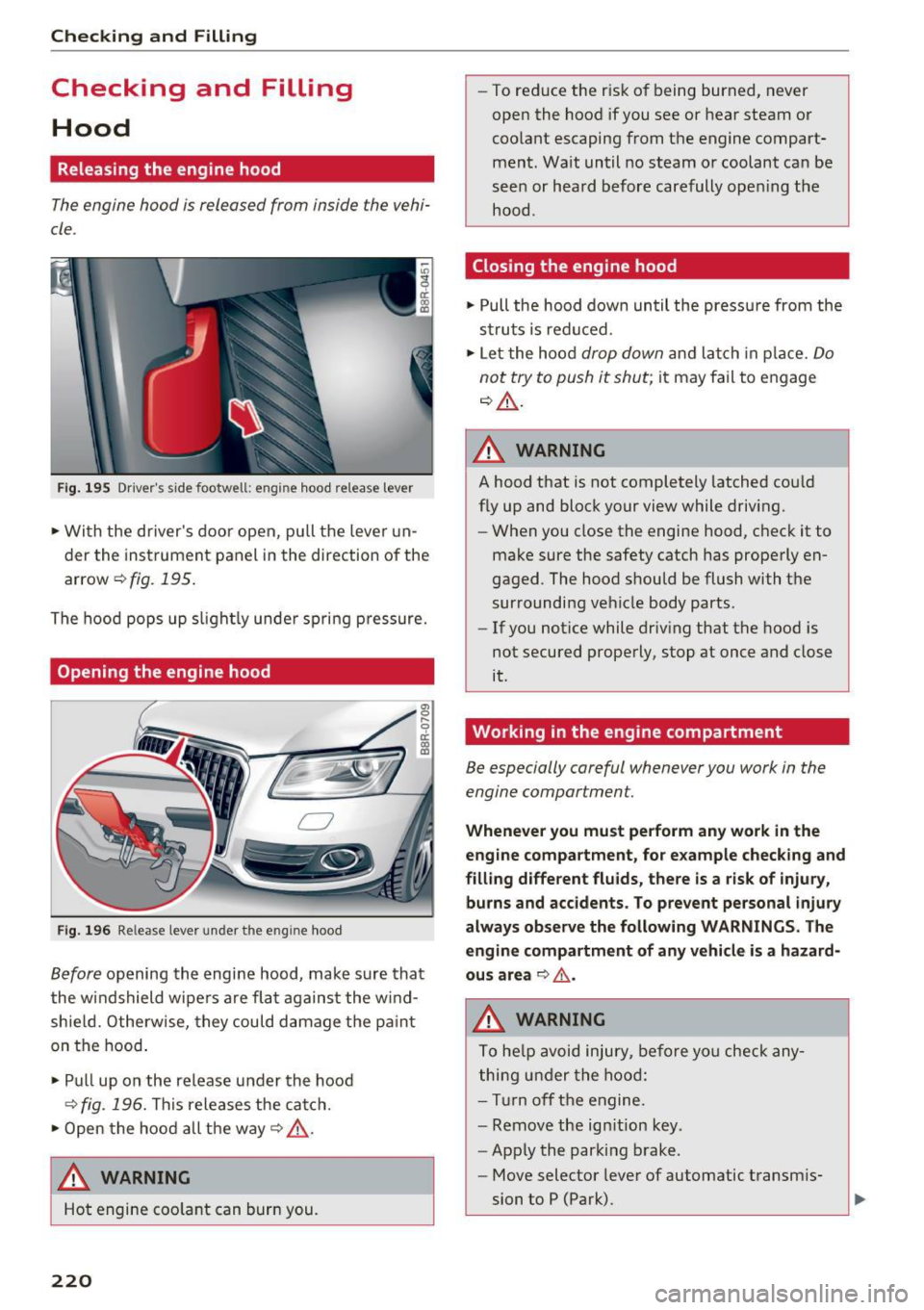
Fig. 195 Driver's side footwell : eng ine hood release lever
.. With the driver's door open, pull the lever un
der the instrument panel in the direction of the
arrow ¢
fig. 195.
The hood pops up slightly under spring pressure.
Opening the engine hood
CJ
Fig. 196 Release lever under t he e ngi ne hood
Before opening the engine hood, make sure that
the windshield wipers are flat against the w ind
shield. Otherwise, they could damage the paint
on the hood.
.,. Pull up on the release under the hood
¢
fig . 196. This releases the catch.
.,. Open the hood all the way ¢.&_ .
,& WARNING
Hot engine coo lant can burn you.
220
-To reduce the r isk of being burned, never
open the hood if you see or hear steam or
coo lant escaping from the engine compart
ment. Wait until no steam or coolant can be
seen or heard before carefully opening the
hood .
Closing the engine hood
.,. Pull the hood down until the pressu re from the
struts is reduced .
.. Let the hood
drop down and latch in place. Do
not try to push it shut;
it may fail to engage
~A -
A WARNING
A hood that is not completely latched could
fly up and block your view while driving.
- When you close the engine hood, check it to
make sure the safety catch has properly en
gaged . The hood should be flush with the
surrounding vehicle body parts .
- If you notice while driv ing that the hood is
not secured properly, stop at once and close
it .
Working in the engine compartment
Be especially careful whenever you work in the
engine compar tment.
-
Whenever you must perform any work in the
engine compartment , for example checking and
filling different fluids, there is a risk of injury,
burns and accidents. To prevent personal injury
always observe the following WARNINGS. The
engine compartment of any vehicle is a hazard
ous area ¢.&, .
A WARNING
To help avoid injury, before you check any
thing und er the hood:
- Turn off the engine.
- Remove the ign ition key .
- Apply the parking brake.
- Move selector lever of automatic transm is-
sion to P (Park).
-
Page 227 of 300
,....,
N
co
er::
co
,....,
to prevent oil from be ing sprayed on the hot
engine and exhaust system when the engine
is running -fire hazard!
- If your skin has come in contact with the en
gine oil, you must subsequently cleanse it
thoroughly .
@ Note
-Check the oil level using the radio or the
MM!*. If the message
Ple ase redu ce oil l ev
el
appears, contact your authorized Aud i
dealer or other qualified workshop to have
excess oil extracted if necessary.
- Audi do es not recommend th e use of o il
addit ive s. The y ma y damage the eng ine
and ad verse ly affect your New Vehicle
Wa rranty.
@ For the sake of the environment
- Under no circumstances can the o il come in
contact with the sewage network or the soil.
- Observe and follow legal regulations whe n
dispos ing of empty oil conta iners.
Changing the engine oil
We recommend that have your oil changed by an
authorized Audi dealer or a qualified service sta
tion.
Before you check anyth ing in the eng ine compart
ment,
alw ays read and h eed all WARNING S c:> .&.
in Working in the engine compartment on
page 220 .
The engine oil must be changed according to the
intervals specified in your Warranty
& Mainte
nance booklet . This is very important because the
l ubricat ing propert ies of o il d iminish gradually
du ring normal vehicle use.
Under some circumstances the engine o il should
be changed more frequently . Change oil more of
ten if you drive mostly short distances, operate
the veh icle in dusty areas or under predominant ly
stop-and -go traffic condit ions, or have yo ur vehi
cle whe re temperatures remain below freezing
for extended periods.
Ch eck ing and Filling
Detergent additives in the oi l will make fresh oil
look dark after the engine has been running for a
short time . This is normal and is not a reason to
change the oi l more often than recommended.
Because of the problem o f proper disposal, along
with the specia l tools and necessary expertise re
quired, we strongly recommend that yo u have
your o il changed by an authori zed
Audi dealer or
a qual ified service stat ion.
If y ou choo se to chan ge your oil your self , please
note the following important information:
A WARNING "--
To reduce the risk of persona l injury if you
must change the eng ine oil in your vehicle
yourself:
- Wear eye protection.
-
-To reduce the r isk of burns from hot engine
oil, let the engine cool down to the touch.
- When remov ing the oil drain plug w ith your
f ingers, stay as far away as possible. Always
keep your forearm parallel to the ground to
he lp prevent hot oil from running down your
arm.
- Drain the oil into a container designed for
this purpose, one large enough to hold at least the tota l amou nt of oil in your engine.
- Engine oil is poisonous. Keep it well out of
the reach of childre n.
- Continuous contact with used engine o il is
harmful to your skin. Always protect your
skin by washing oil off thoroughly with soap
and water .
«I) Note
Never mix oil additives with your engine oil.
These additives can damage your engine and
adverse ly affect yo ur Audi limited New Vehi
cle Warranty .
@ For the sake of the environment
-Before chang ing yo ur oi l, first make sure
you know where you can properly d ispose of
the used oil.
- Always dispose of used engine o il properly .
Do not dump it on ga rden soil, wooded
225
Page 256 of 300
Emerg ency assis ta nce
Emergency assistance
Vehicle jack, vehicle tool kit and collapsible spare
tire
Onboard tool kit and vehicle jack
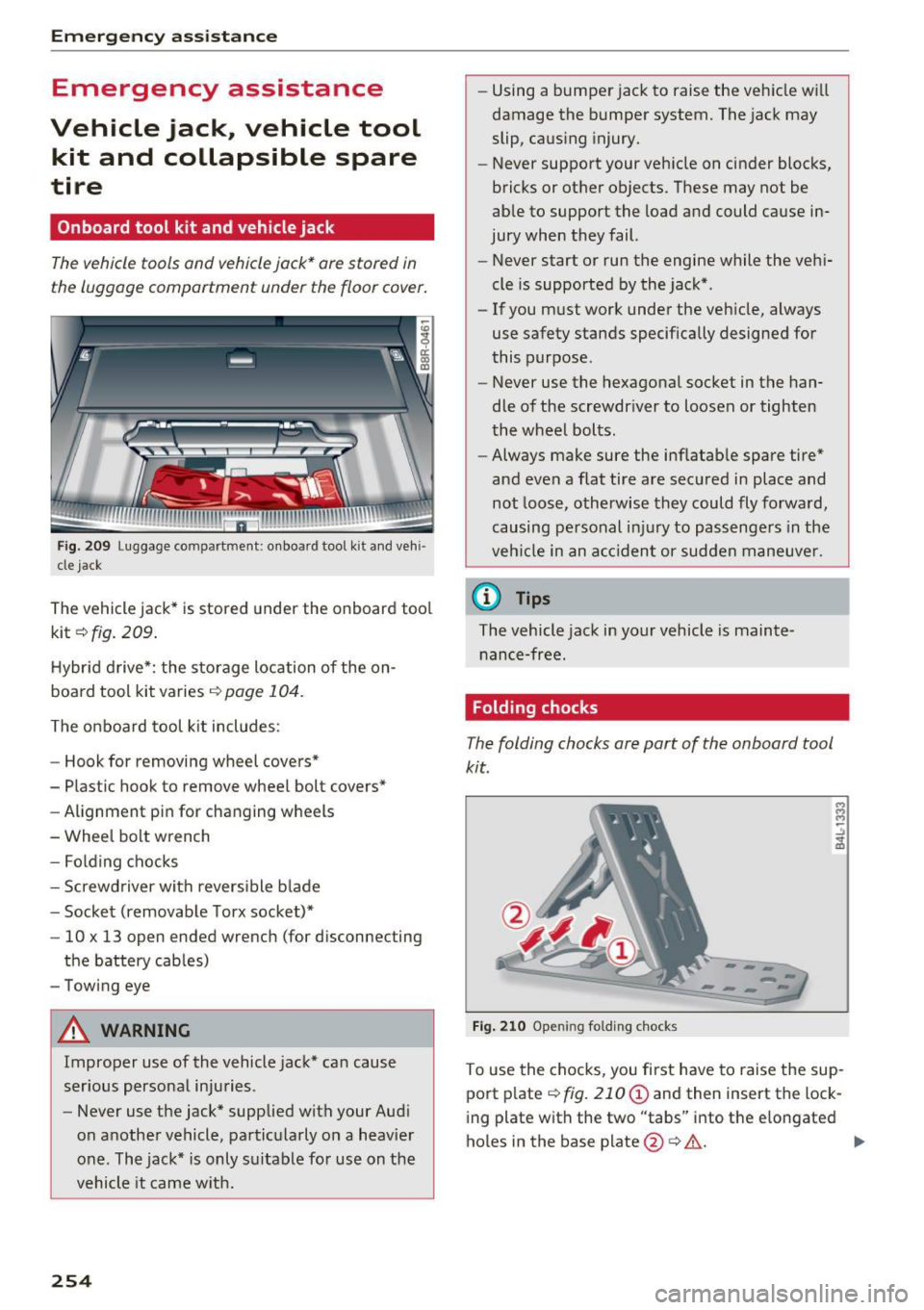
The vehicle tools and vehicle jock* ore stored in
the luggage comportment under the floor cover.
Fig. 209 Luggage compartment: on board tool kit and vehi
cle jack
The vehicle jack* is stored under the onboard tool
kit ¢ fig. 209.
Hybr id d rive*: the storage location of the on
board tool kit varies ¢ page 104.
The onboard tool k it includes:
- Hook for removing wheel covers*
- Plastic hook to
remove wheel bolt covers*
-Alignment pin for changing wheels
- Wheel bolt wrench
- Folding chocks
- Screwdriver with revers ible blade
- Socket (removable Torx socket)*
- 10 x 13 open ended wrench (for disconnecting
the battery cables)
- Towing eye
A WARNING
Improper use of the vehicle jack* can cause
ser ious personal injuries.
- Never use the jack* supplied with your Aud i
on another vehicle, particularly on a heavier
one. The jack* is only su itable for use on the
vehicle it came w ith.
254 -
Using a bumper jack to raise the vehicle will
damage the bumper system. The jack may
slip, caus ing injury.
- Never support your vehicle on cinder blocks,
bricks or other objects. These may not be
able to support the load and could cause in
jury when they fail.
- Never start or run the engine while the vehi
cle is supported by the jack* .
- If you must work under the vehicle, always
use safety stands specifically designed for
this purpose .
- Never use the hexagonal socket in the han
dle of the screwdr iver to loosen or tighten
the wheel bolts .
- Always make sure the inflatable spare tire*
and
even a flat tire are secu red in place and
not loose, otherwise they could fly forward,
causing personal inj ury to passenge rs in the
vehi cle in an a cc ident or sudden maneuve r.
@ Tips
The vehicle jack in your vehicle is mainte
nance-free.
Folding chocks
The folding chocks ore port of the on board tool
kit .
---
Fig . 210 Open ing fo lding chocks
To use the chocks, you fi rst have to raise the sup
port plate
¢ fig. 210 (D and then insert the lock
ing plate with the two "tabs" into the elongated
holes in the base plate
@ c> &.. .,,_
Page 257 of 300
..... N
co ~ CX)
..... I.Cl U"I
..... I.Cl .....
_& WARNING
-The chock cannot fulfil its function and may
lose its stability if the "tabs" on the support
plate a re not inserted correctly into the
elongated holes in the base plate. If th is
happens, the vehicle may sta rt to move
wh ile a wheel is being changed.
- Never use the fold ing chocks if they are
damaged or if they have not been assem
bled co rrectly.
Removing bass box
Appl ies to vehicles : wit h bass box
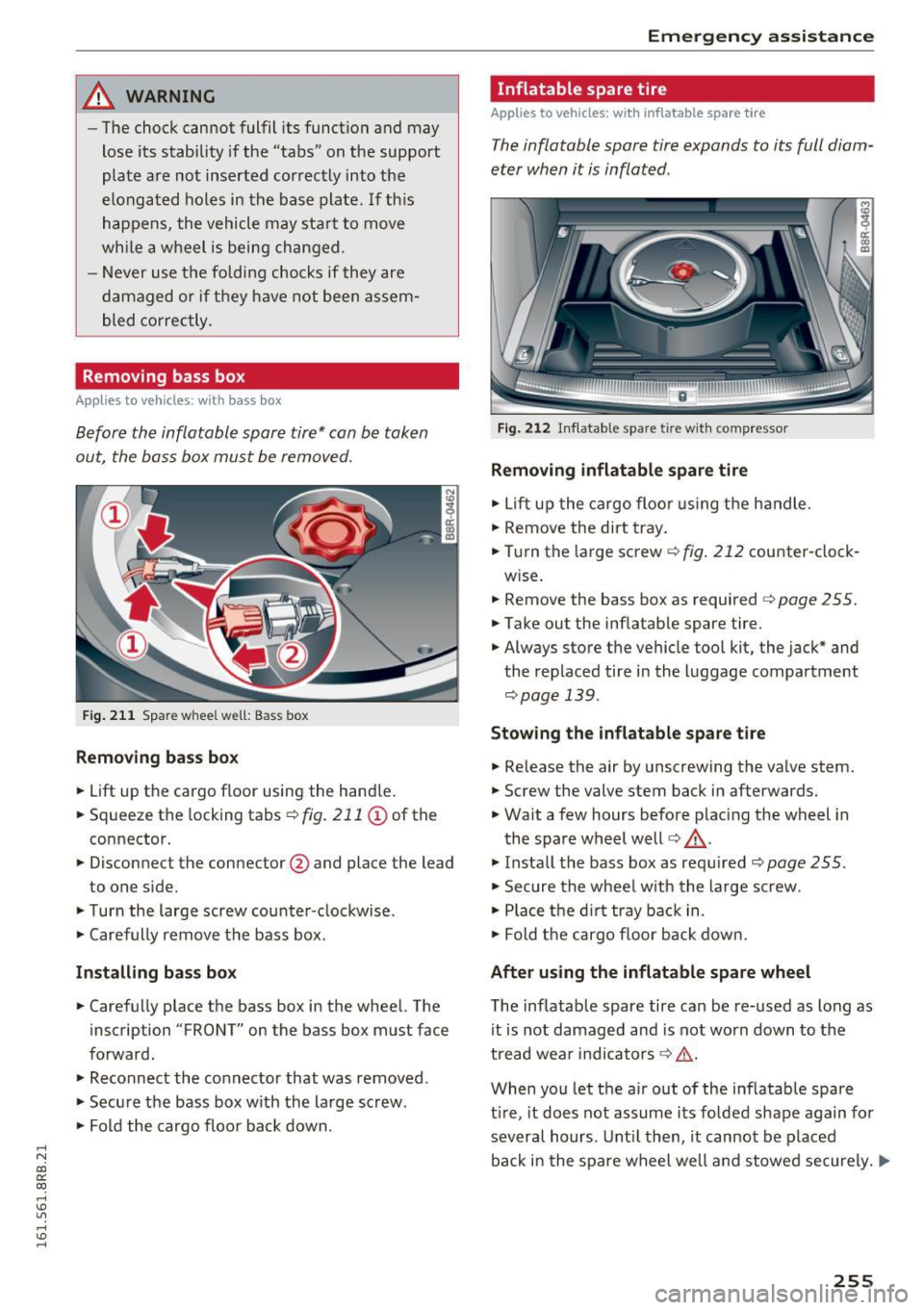
Before the inflatable spare tire* can be token
out, the bass box must be removed.
Fig . 21 1 Spare w heel well: Bass box
Removing ba ss box
"Lift up the cargo floor using the hand le .
" Squeeze the locking tabs
c:> fig . 211 (D of the
connector.
" Disconnect the connector @and place the lead
to one s ide.
"T urn the large screw counter -clockwise .
" Carefully remove t he bass box .
Installing bas s bo x
"Carefully place the bass box in the whee l. The
inscription "FRONT" on the bass box must face
forward.
" Reconnect the co nnector that was removed.
" Secu re the bass box w ith the la rge screw .
" Fold the cargo floo r bac k down.
Em ergen cy a ssis tanc e
Inflatable spare tire
Applies to vehicles: w ith inflatable spare tire
The inflatable spare tire expands to its full diam
eter when it is inflated .
Fig. 212 In flatable spare tire wit h comp ressor
Removing inflatabl e spare tire
"Lift up the cargo floo r us ing the handle.
" Remove the dirt tray .
" Turn the large screw <=:>
fig. 212 counter -clock-
w ise .
" Remove the bass box as required<=:>
page 255.
"Take out the inflatab le spare tire.
" Always store the vehicle too l kit, the jack* and
the replaced tire in the luggage compartment
<=:> page 139.
Stowing the inflatable spare t ire
.. Release the air by unscrewing the valve stem.
" Screw the valve stem back in afterwards.
" Wa it a few hours before plac ing the wheel in
the spare wheel well<=:>,& .
" Insta ll the bass box as required <=:>
page 255 .
" Secure the whee l w ith the la rge sc rew.
" Place t he d irt tray back in .
" Fold t he c argo floor back down .
After using the inflatable spare wheel
The inflatable spare tire can be re-used as long as
it is not damaged and is not worn down to the
tread wea r indicators
c:> .&, .
When you let the a ir out of the inf latab le spare
t ir e, it does not assume its folded shape again for
severa l hours . Unt il then, it cannot be placed
back i n the spare wheel well and stowed securely.
IJI>
255
Page 264 of 300
Emergency assistance
-Position the jack* only at the designated
lifting points and align the jack *. Other
wise, the jack* could slip and cause an in
jury if it does not have sufficient hold on
the vehicle .
- A soft or unstable surface under the jack*
may cause the vehicle to slip off the jack*.
Always provide a firm base for the jack* on
the ground. If necessary, use a sturdy
board under the jack*.
- On hard, s lippery surface (such as tiles)
use a rubber mat or similar to prevent the
jack* from slipping.
- To help pre vent injury to you rself and yo ur
passenge rs:
- Do not raise the vehicle until you are sure
the jack * is securely engaged.
- Passengers must not remain in the vehicle
when it is jacked up.
- Make sure that passengers wait in a safe
place away from the vehicle and well away
from the road and traffic.
- Make sure jack position is correct, adjust
as necessary and then continue to raise
the jack *.
(D Note
Do not lift the vehicle by the sill. Position the
jack * only at the designated lifting points on
the sill. Otherwise, your vehicle will be dam
aged.
262
Taking the wheel off/installing the inflatable spare tire
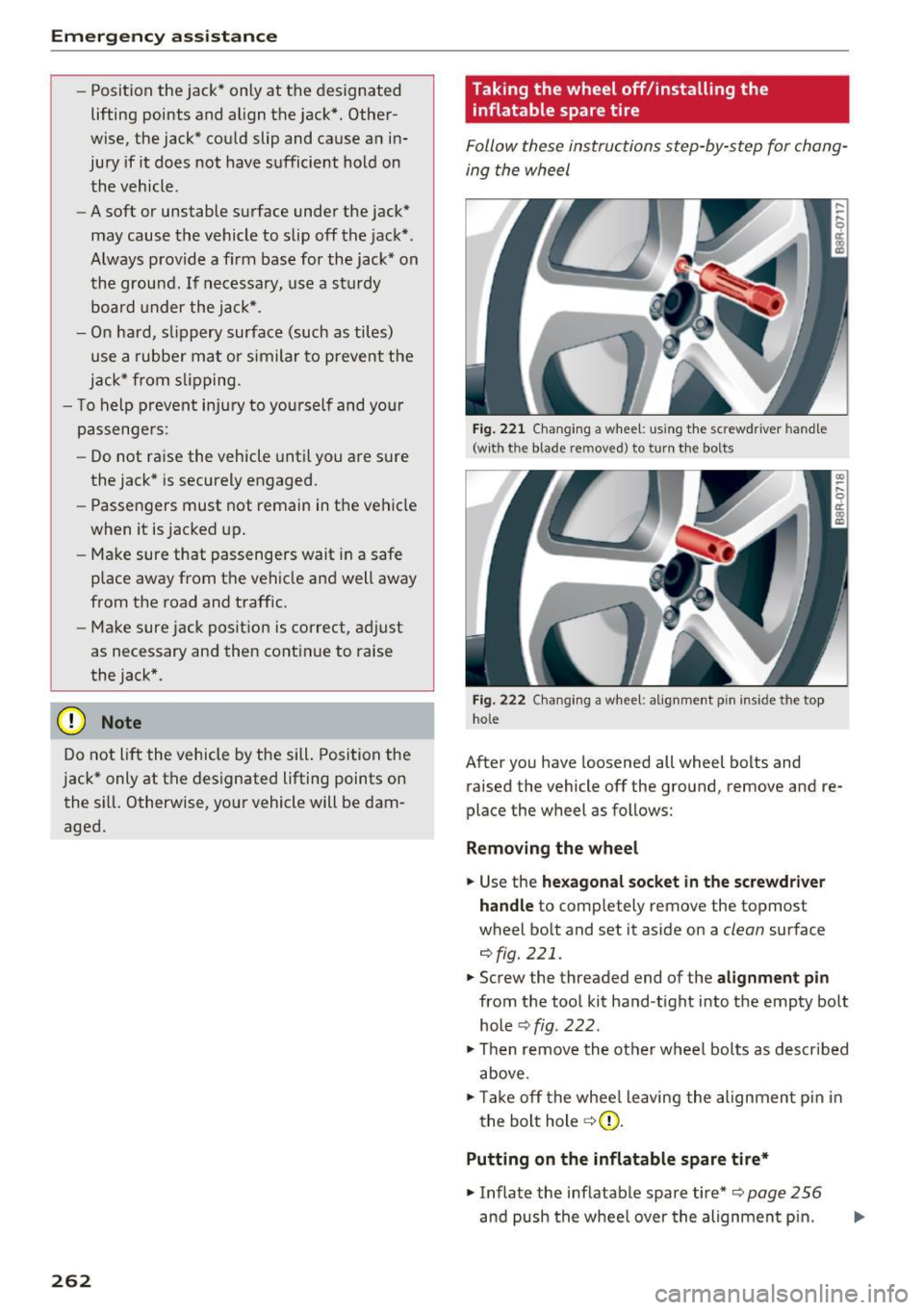
Follow these instructions step-by-step for chang
ing the wheel
Fig. 221 Changing a wheel: usin g the screwdriver handle
(w ith the blade removed) to turn the bolts
Fig. 222 Changi ng a w heel: alignment pin inside the top
h ole
After you have loosened all wheel bolts and
raised the vehicle off the ground, remove and re
place the wheel as follows:
Removing the wheel
.,. Use the hexagonal socket in the screwdriver
handle
to comp letely remove the topmost
wheel bolt and set it aside on a
clean surface
qfig. 221 .
.. Screw the threaded end of the alignment pin
from the tool kit hand-tight into the empty bolt
hole
q fig. 222 .
.,. Then remove the other wheel bolts as described
above .
.,. Take off the whee l leaving the alignment p in in
the bolt hole
q(D.
Putting on the inflatable spare tire*
.,. Inflate the inflatable spare tire* q page 256
and push the whee l over the alignmen t pin.
Page 266 of 300
Emergency assistance
-Always make sure the damaged wheel or
even a flat tire and the jack* and tool kit are
properly secured in the luggage compart
ment and are not loose in the passenger
compartment.
- In an accident or sudden maneuver they
could fly forward, injuring anyone in the ve
hicle.
- Always store damaged wheel, jack* and
tools securely in the luggage compartment .
Otherwise, in an accident or sudden maneu
ver they could fly forward, causing injury to
passengers in the vehicle .
264
Page 274 of 300
Emergency situations
-When connecting jumper cables, make sure
that they cannot get caught in any moving
parts in the engine compartment.
- Do not bend over the batteries -danger of
chemical burns!
- The battery cell locking screws must be
tightened securely.
- Before you check anything in the engine
compartment, always read and heed all
WARNINGS
c> page 220.
(D Note
Improper hook-up of jumper cables can ruin
the generator .
- Always connect POSITIVE(+) to POSITIVE
(+), and NEGATIVE(-) to NEGATIVE(-)
ground post of the battery manager control
unit.
- Check that all screw p lugs on the battery
cells are screwed in firmly. If not, tighten
plugs prior to connect ing clamp on negative
battery terminal.
- Please note that the procedure for connect
i ng a jumper cable as described above ap
plies specifically to the case of your vehicle
being jump started . When you are giving a
ju mp start to another vehicle , do
not con
nect the negative (-) cable to the negative
(-) terminal on the discharged batte ry @
c> fig. 228. Instead, securely connect the
negative( -) cab le to either a solid metal
component that is firm ly bolted to the en
gine block or to the engine block itself. If
the battery that is being charged does not
vent to the outside, escap ing battery gas
could ignite and explode !
Towing with a tow truck
General hints
Your Audi requires special handling for towing.
The following information is to be used by com
mercial tow truck operators who know how to op
erate the ir equipment safely.
-Never tow your Audi, towing will cause dam
age to the engine and transmission.
272
-Never wrap the safety chains or winch cables
around the brake lines .
- To prevent unnecessary damage, your Audi
must be transported with a flat bed truck .
- To load the vehicle on to the flat bed, use the
towing loop found in the vehicle tools and at
tach to the front or rear anchorage
i:>pag e 272 and i:> page 273.
A WARNING
A vehicle being towed is not safe for passen
gers . Never allow anyone to ride in a vehicle
being towed, for any reason.
Front towing loop
Do not install the front towing loop until it is
needed.
Fig. 229 Front bumper : remov ing the cover cap
Fig. 230 Front bumper: s crew ing in t he towing loop
The towing loop fits into the threaded hole locat
ed on the right side o f the front bumper and cov
ered by a cover when not in use.
.,. Remove the towing loop from the vehicle tool
kit
c> page 254 .
.,. Carefully remove the cove r c> fig. 229.
.,. Screw the towing loop tightly into the threaded
hole as far as it will go
c> fig. 230. Ill>