brake AUDI Q5 2016 Repair Manual
[x] Cancel search | Manufacturer: AUDI, Model Year: 2016, Model line: Q5, Model: AUDI Q5 2016Pages: 300, PDF Size: 75.02 MB
Page 224 of 300
Checking and Filling
Engine compartment
Engine compartment
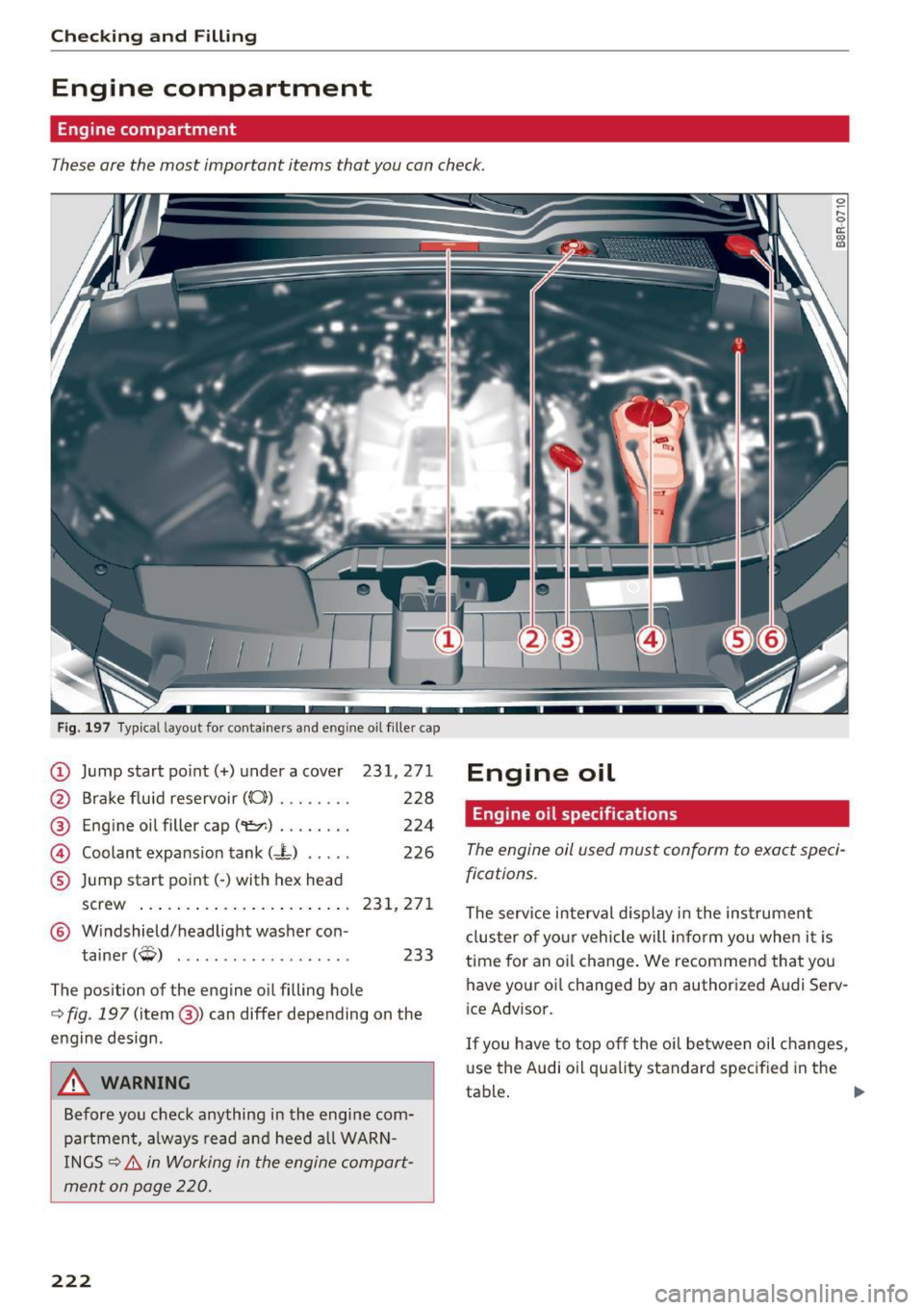
These are the most important items that you can check.
Fig. 197 Typical layout for con tainers and eng ine oil filler cap
® Eng ine oil filler cap ("1::7':) ........ 224
© Coolant expansion tank (- L) ..... 226
® Jump start point(-) with hex head
screw
. .. .. .... .............. 231,271
® Windshield/headlight washer con-
tainer
(Q) ................... 233
The position of the engine oil filling hole
¢ fig. 197 (item @) can differ depending on the
engine design .
A WARNING
Before you check anything in the engine com
partment, always read and heed all WARN
INGS ¢.&.
in Working in the engine compart
ment on page 220.
222
Engine oil
Engine oil specifications
~ r--0 d::
"' t0
The engine oil used must conform to exact speci
fications.
The serv ice interval display in the instrument
cluster of your vehicle will inform you when it is
time for an oi l chang e. We recommend that you
have your oi l changed by an authorized Audi Serv
i ce Advisor.
If you have to top off the oil between oil changes,
us e the Audi oil quality standard specified in the
ta ble.
~
Page 230 of 300
Checking and Filling
-To avoid bein g burned, do not spill anti
f reeze or coolant on the exhaust system or
hot engine parts. Under certain condi
tions, the ethylene glycol in engine cool ant can catch fire.
- Antifreeze is poisonous . Always store anti
freeze in its original container and well out
of the reach of children .
- If you dra in the coolant, it must be ca ught
and safely stored in a proper conta iner
clearly marked "poison".
(D Note
- Do not add coolant if the expansion tank is
empty . Air cou ld enter the cooling system
and damage the eng ine .
If this is the case,
do not continue dr iving . Seek professional
ass istance.
- Coolant pollutes the e nvironment a nd could
cause an eng ine fire. Excess coolant will be
fo rced o ut through the pressu re relief valve
i n the cap when the eng ine be comes hot .
- If, in an emergency, o nly wate r can be add
ed, the co rrect ratio between water and an
tifree ze ~
page 226 mus t be resto red as
soon as possib le .
@) For the sake of the environment
Drained cool ant sho uld not be reused. Always
dispose of used coo lant w hile obse rving all
environmenta l regulatio ns.
Radiator fan
The radiator fan switches on automatically by it
self.
The radiator fan is dr iven by the eng ine v ia the V
be lt . The visco us cl utch regula tes the speed of
the fan acco rding to the tempera ture of t he cool
ant.
An aux iliary ele ct ric radiator fan* swit ches on and
off depending on coolant tempera tu re and o ther
ve hicl e operat ing cond itions .
After you switch the engine off , the auxiliary fan
can cont inue runn ing fo r up to 10 minutes - even
228
with the ignition off . It can even switch o n aga in
l ater by itself~.&. , if
- the tempera ture of the engine coolant rises d ue
to the hea t build- up from the engine in the en
gine compartment, or
- the engine compa rtme nt heats up bec ause the
veh icle is parked in intense s unlight.
A WARNING
- To reduce the r isk of personal injury never
touch the radiator fan.
- The a uxiliary e lectric fan is temperat ure
controlled and can switch on suddenly even
when the engine is not runn ing .
-
-The a uxiliary radiator fan switches on a uto
mat ically when the eng ine coolant reaches a
certain temperature and will continue to r un
until the coo lant temperature drops.
Brake fluid
Checking brake fluid level
The broke fluid level con be checked with o quick
glance .
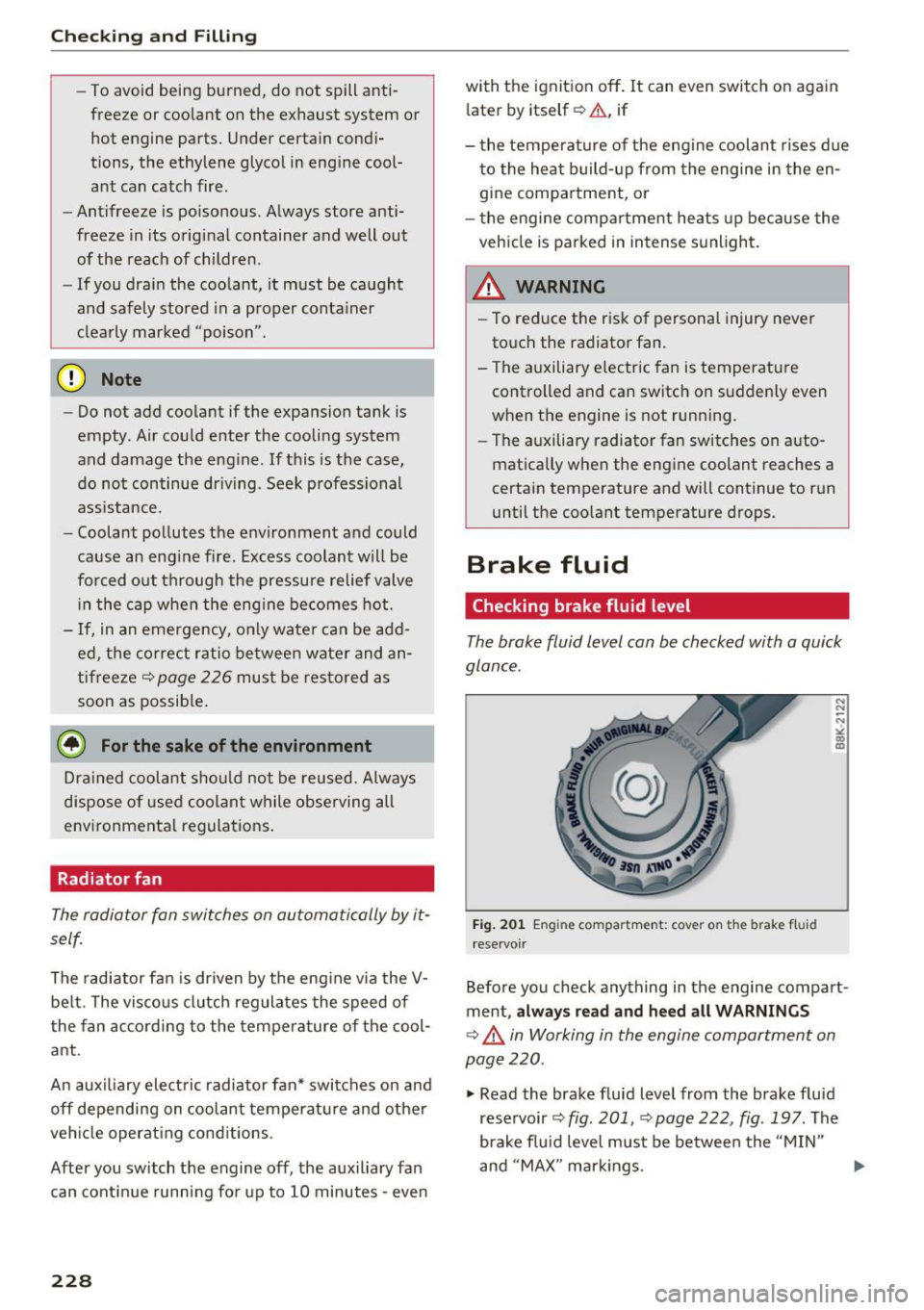
Fig. 20 1 En g in e com par tmen t: cov er on t he br ak e fluid
r e servo ir
N
N
-N
"' CIO a,
Befo re you check anything in the engine compart
ment,
always read and heed all WARNINGS
~ .&, in Working in the engine comportment on
page 220 .
.,. Read the brake fluid level from the bra ke f luid
rese rvoir ~
fig. 201, <> page 222, fig . 197. The
brake fl uid leve l must be between the "M IN"
and "MAX " mark ings .
Page 231 of 300
,....,
N
co
er::
co
,....,
partition of the engine compartment on the left
side ¢
page 222.
The fl uid level may drop slightly after some time
due to the automatic adjustment of the brake
pads . This is not cause for alarm.
I f the b rake fl uid level fa lls
considerably be low
the "MIN" mark, the brake wa rning/ind icator
light (U .S. mode ls:
1111 , Canadian models:.)
will come on¢
page 18 and ¢ page 28 . Do not
continue to operate the vehicle. The complete brake system should be thoroughly checked by an
author ized Audi dealer or qualified workshop and
the cause corrected . If the brake fluid level is too
low, the brake warning/ind icator light will illumi
nate. Contact an authorized Audi dealer
immedi
a te ly.
Changing brake fluid
Have the brake fluid changed by an experienced technician.
Brake fluid absorbs mo isture from the air. If the
water conte nt in the brake fluid is too h igh, cor
ros ion in the brake system may resu lt after ape
riod of time. The boiling poi nt of the brake flu id
will also dec rease cons iderably and decrease
braking pe rformance.
Therefore, the b rake fluid must be changed
e ve ry
two year s.
Always use new b rake fluid wh ich con
forms to Fede ral Motor Veh icle St andard "FMVSS
116 DOT 4".
The brake fluid reservoir can be diff icult to reach,
therefore, we re commend that yo u have the
b rake fl uid changed by yo ur autho rized
Audi
deal er.
Your dealer has the cor rect too ls, the
right brake fluid and the know -how to do this for
you.
A WARNING
- Brake fluid is poisonous. It must be stored
only in the closed original container out of
the reach of chi ldren!
- B rake failure can resu lt from old or inappro
pr iate brake flu id. Observe these precau
t io ns:
Ch eck ing and Filling
-Use only brake fluid that meets SAE speci
ficat ion
J 1703 and conforms to Federal
Motor Vehicle Standard 116. Always check
with your authorized Aud i dealer to make
sure you are us ing the correct brake fluid .
The co rrect type of brake flu id is also i ndi
cated on the b rake fluid reservoir.
- The brake flu id must be new. Heavy use of
the b rakes can cause a vapo r lock if the
bra ke fluid is left in the system too long.
T his can se riously affe ct the efficiency of
t h e b rakes as we ll as you r safety . This
could resu lt in an accident.
(D Note
B rake flu id will damage the paint of your ve h i
cle.
@) For the sake of the environment
Because of the p roblem of proper d isposa l of
brake fluid as well as the spec ial too ls re
q uire d and the necessary expertise, we rec
ommend that yo u have the bra ke fluid
c hanged by yo ur authorize d Au di dealer.
Battery
General information
Under normal ope rat ing condit ions, the batte ry
in you r A udi does not need any mainte nance.
Wi th
high o utside temperatures or long daily
drives we recommend that yo u have the elec tro
lyte level checked by an authorized A udi dealer or
qualified workshop . The electro lyte level should
also be checked each time the battery is charged
~ page 231.
Have the batte ry checked when you take your ve
hicle in for service. You are we ll advised to re
place a battery that is older than S years.
Wi th certain types of airbag deployment, the
battery is d isconnected from the veh icle electri
ca l system for safety reasons¢.&.
in Repair, care
and disposal of the airbags on page 164.
Hyb rid dr ive *: yo u can find impo rtant informat ion
about the high voltage battery under ¢
page 97. .,.
229
Page 238 of 300
Wheels
be happy to provide more infor
mation.
® Mud and snow capability
"M/S" or "M+S" indicates the tire
has characteristics that make it
suitab le for driving on mud and
snow.
& indicates a winter t ire.
@ Compos ition of the tire cord
and materials
The number of plies indicates the
number of rubberized fabric lay
ers in the tire . In general: the
more layers, the more weight a
tire can carry. Tire manufacturers must also specify the materia ls
used in the tire. These include
steel, nylon, polyester and other
materials .
@ Maximum permitted load
This number indicates the maxi
mum load in k ilograms and
pounds that the tire can carry.
@ Uniform tire quality grade
standards for treadwear,
traction and temperature
resistance
Tread wear, t raction and temper
ature ranges
¢ page 251 .
@ Running direction
The arrows indicate the running
direction of unidirec tiona l tires.
23 6
You must a lways follow the speci
fied runn ing direction
¢ page 263.
@ Maximum permitted
inflation pressure
This number indicates the maxi
mum pressure to which a tire can be inflated unde r normal operat
ing condit ions .
Glossary of tire and loading
terminology
Accessory weight
means the comb ined we ight (in
excess of those standard items
which may be replaced) o f auto
matic tra nsmission , power steer
ing , power brakes , power wi n
dows, power seats , radio , and
heater, to the extent that these
items a re available as facto ry-in
stalled equipment (whet her in
stalled or not).
Aspect ratio
means the rat io of the height to
the width o f the tire in pe rcent.
Numbe rs of 55 or lower indicate a
low sidewa ll for imp roved steer
ing response and better overa ll
handling on dry pavement .
...
Page 240 of 300
Wheels
(a) Curb weight
(b) Accessory weight
(c) Vehicle capacity weight, and
(d) Production options weight
Maximum (permissible )
inflation pressure
means the maximum cold infla
tion pressure to which a tire may be inflated. Also called "maxi
mum inflation pressure ."
Normal occupant weight
means 150 lbs . (68 kilograms)
times the number of occupants
seated in the vehicle up to the to
ta l seating capacity of your vehi
c le .
Occupant distribution
means distribut ion of occupan ts
in a vehic le .
Outer diameter
means the overall diamete r of an
inflated new tire.
Overall width
means the l inear distance be
tween the exter iors of the side
walls of an infla ted tire , including
elevations due to labeling , deco
rations, or protective bands or
r ibs.
23 8
Ply
means a layer of rubber -coated
pa rallel cords.
Production options weight
means t he comb ined we ight of
those insta lled regular production
options weighing over 5 lbs . (2 .3
kg) in excess of those standard
items which they replace , not pre
viously considered in curb weight or accessory weight, inc luding
heavy duty brakes, ride levelers,
roof rack, heavy duty battery, and
special trim.
Radial ply tire
means a pneumatic tire in which
the ply co rds that extend to the
beads are laid at subs tantially 90
deg rees to the centerline o f the
tread .
Recommended inflation
pressure
see~ page 23 7, Cold tire infla
tion pressure.
Reinforced tire
means a tire designed to operate
at highe r loads and at h igher in
flat ion pressures than t he corre
spond ing standa rd tire . R ein
forced tires may be identified as .,.
Page 244 of 300
Wheels
different tire speeds. For this rea
son, in case of emergency, only
use a spare tire* that is the same
circumference as the regular
tires.
,&. WARNING -
-Only use tire/rim combina tions and suitable wheel bolts
that have been approved by
Audi. Otherwise, damage to
the vehicle and an accident could result.
-For technical reasons, it is not possible to use tires from oth
er vehicles - in some cases,
you cannot even use tires from the same vehicle model.
-Make sure that the tires you select have enough clearance
to the vehicle . Replacement
tires should not be chosen simply based on the nominal
size, because t ires with a dif
ferent construction can differ
greatly even if they are the
same size. If there is not
enough clearance, the tires or
the vehicle can be damaged and this can reduce driving
safety and increase the risk of
an accident.
242
-Only use tires that are more
than 6 years old when abso
lutely necessary and drive
carefully when doing so .
-Do not use run-flat tires on your vehicle. Using them when not permitted can Lead to ve
hicle damage or accidents.
- If you install wheel covers on
the vehicle, make sure they al
low enough air circulation to
cool the brake system. If they
do not, this could increase the
risk of an accident.
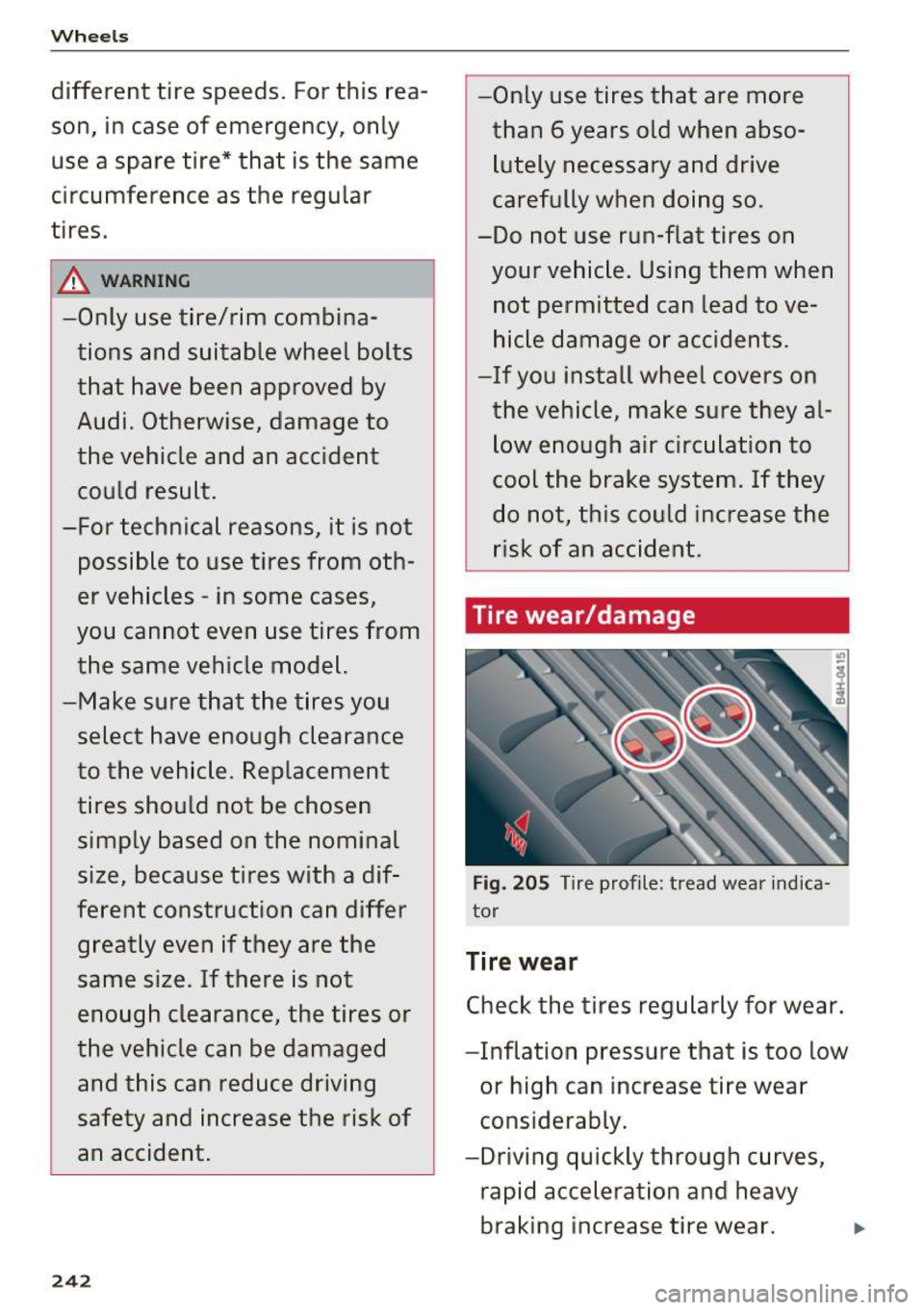
Tire wear/damage
Fig. 205 Tire profile: tread wear ind ica
tor
Tire wear
Check the tires regularly for wear.
- Inflation pressure that is too Low
or high can increase tire wear
considerably.
-Driving quickly through curves, rapid acceleration and heavy
braking increase tire wear. ..
Page 249 of 300
plus maximum load. The maxi
mum load includes the number of
passengers that the vehicle is in
tended to carry ("seating capaci
ty") with an assumed weight of
150 lbs. (68 kg) for each passen
ger at a designated seating posi
tion and the total weight of any luggage in the vehicle . If you tow
a trailer, the weight of the trailer
hitch and the tongue weight of
the loaded trailer must be includ
ed as part of the vehicle load .
The
Gross A xle Weight Rating
("GAWR") is the maximum load
that can be appl ied at each of the
vehicle's two axles.
The fact that there is an upper
limit to your vehicle's Gross Vehi
c le Weight Rating means that the
total weight of whatever is being
carried in the vehicle (including
the weight of a tra iler hitch and
the tongue weight of the loaded
trailer) is limited. The more pas
sengers in the vehicle or passen
gers who are heavier than the
standard weights assumed mean
that less weight can be carried as luggage.
The Gross Vehicle We ight Rating
and the Gross Axle Weight Rating
Wheels
are listed on the safety compli
ance sticker label located on the
driver's side B -pillar
¢ page 244,
fig . 206.
_& WAR NING
Overloading a vehicle can cause
loss of vehicle control, a crash
or other accident, serious per
sonal in jury, and even death.
-Carrying more weight than
your vehicle was designed to carry will prevent the vehicle
from handling properly and increase the risk of the loss of
vehicle control.
- The brakes on a vehicle that
has been overloaded may not
be able to stop the vehicle
within a safe distance.
-Tires on a vehicle that has
been overloaded can fail sud
denly, including a blowout and
sudden deflation, causing loss
of control and a crash.
-Always make sure that the to
tal load being transported -
including the weight of a trail
er hitch and the tongue
weight of a loaded trailer - does not make the vehicle
heavier than the vehicle's
Gross Vehicle Weight Rating .
247
Page 260 of 300
Emergency assistance
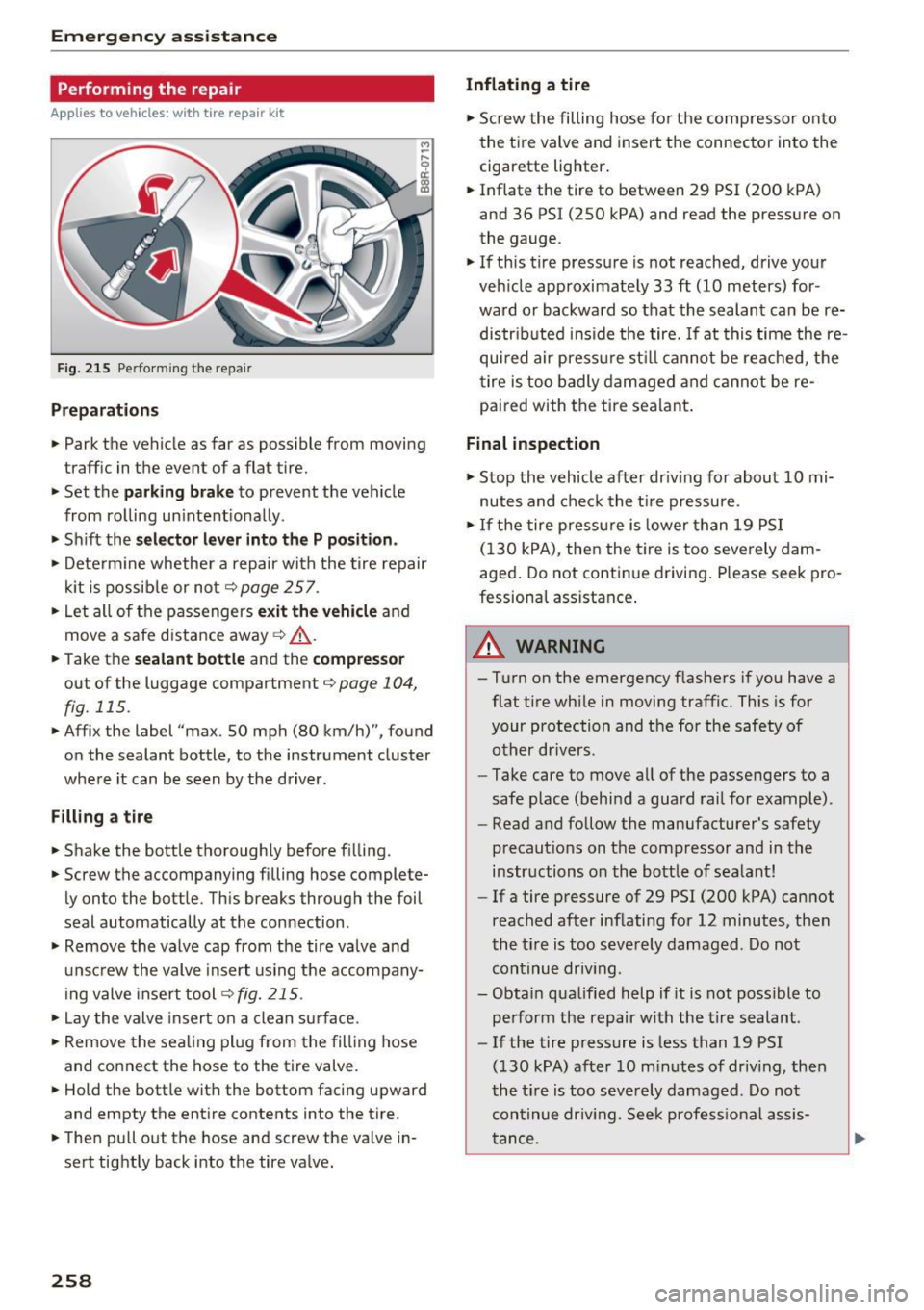
Performing the repair
Applies to vehicles: w ith tire repair k it
Fig. 215 Performing the repair
Preparations
.,. Park the vehicle as far as possible from moving
traffic in the event of a flat tire.
.,. Set the
parking brake to prevent the vehicle
from rolling unintentionally.
.,. Shift the
selector lever into the P position.
.,. Determine whether a repair with the tire repair
kit is possible or not¢
page 257.
.,. Let all of the passengers
exit the vehicle and
move a safe distance away¢_&. .
.,. Take the
sealant bottle and the compressor
out of the luggage compartment ¢ page 104,
fig. 115.
.,. Affix the label "max. 50 mph (80 km/h)", found
on the sealant bottle, to the instrument cluster
where it can be seen by the driver.
Filling a tire
.,. Shake the bottle thoroughly before filling.
.,. Screw the accompanying filling hose complete
ly onto the bottle. This breaks through the foil
seal automatically at the connection .
.,. Remove the valve cap from the tire valve and
unscrew the valve insert using the accompany
ing valve insert tool
~fig. 215.
.,. Lay the valve insert on a clean surface .
.,. Remove the sealing plug from the filling hose
and connect the hose to the tire valve .
.,. Hold the bottle with the bottom facing upward
and empty the entire contents into the tire .
.,. Then pull out the hose and screw the valve in
sert tightly back into the tire valve.
258 Inflating a tire
.,.
Screw the filling hose for the compressor onto
the tire valve and insert the connector into the
cigarette lighter.
.. Inflate the tire to between 29 PSI (200 kPA)
and 36 PSI (250 kPA) and read the pressure on
the gauge .
.,. If this tire pressure is not reached, drive your
vehicle approximately 33
ft (10 meters) for
ward or backward so that the sealant can be re
distributed inside the tire. If at this time the re
quired air pressure still cannot be reached, the
tire is too badly damaged and cannot be re
paired with the tire sealant.
Final inspection
.,. Stop the vehicle after driving for about 10 mi
nutes and check the tire pressure.
.,. If the tire pressure is lower than 19 PSI
(130 kPA), then the tire is too severely dam
aged. Do not continue driving. Please seek pro
fessional assistance .
&_ WARNING
- Turn on the emergency flashers if you have a
flat tire while in moving traffic. This is for
your protection and the for the safety of
other drivers.
- Take care to move all of the passengers to a
safe place (behind a guard rail for example) .
- Read and follow the manufacturer's safety
precautions on the compressor and in the instructions on the bottle of sealant!
- If a tire pressure of 29 PSI (200 kPA) cannot
reached after inflating for 12 minutes, then
the tire is too severely damaged. Do not
continue driving.
- Obtain qualified help if it is not possible to
perform the repair with the tire sealant .
- If the tire pressure is less than 19 PSI
(130 kPA) after 10 minutes of driving, then
the tire is too severely damaged . Do not
continue driving. Seek professional assis
tance .
Page 261 of 300
,....,
N
co
er::
co
,....,
Special care is required if you are repairing
the tire on a steep incline.
@ Tips
- Do not operate the compressor for more
than 12 minutes continuously, otherwise it
can overheat. Once the compressor has
cooled, you can continue to use it.
- If sealant has spi lled out, let it dry and then
you can remove it by peeling it away like a
foil.
- Remember to obtain a new bott le of sealant
from your authorized Audi dealer after re
pair ing a tire. After this, the functionality of
the tire repair set is restored .
- Obey all laws.
Replacing wheels
Before changing a wheel
Observe the following precautions for your own
and your passenger's safety when changing a
wheel.
""After you experience a tire failure, pull the car
well away from moving traff ic and try to reach
level ground before you stop¢_& .
.. All passengers sho uld
leave the car and move
to a safe location (fo r instance, behind the
guardrai l) ¢ .&_ .
.. Engage the
par king b rake to prevent yo ur vehi
cle from roll ing unintentionally ¢&_ .
.. Move
selecto r le ver to po sitio n P ¢ &_ .
"" If you are towing a trailer: unh itch the trailer
from your veh icle.
"" Block the diagonally opposite wheel with the
folding chocks o r other objects .
""T ake the
jac k* and the inflatable spa re tir e*
out of the luggage compartment ¢ page 254 .
A WARNING
You or your passengers cou ld be inj ured while
changing a wheel if you do not follow these
safety precautions:
- If you have a flat tire, move a safe distance
off the road. Turn off the engine, turn the
Em ergenc y ass is tanc e
emergency flashers on and use other wa rn
ing dev ices to alert other motorists.
- Make sure that passengers wait in a safe
place away from the vehicle and well away
from the road and traff ic.
- To help prevent the veh icle from moving
suddenly and possib ly slipping off the jack*,
always fully set the parking brake and block
the wheel diagonally opposite the wheel be i n g changed with the fold ing c hocks or oth
er objects . When one front whee l is lifted
off the ground, placing the Automatic
Transmission in P (Park) w ill
not prevent the
veh icle from moving.
- Before you change a wheel, be sure the
gro und is leve l and firm.
If necessary, use a
sturdy board under the jack*.
- Always s tore the vehicle too l kit, the jack*
and the replaced tire in the lugg age com
partment
¢ page 139.
Changing a wheel
When you change a wheel, follow the sequence
described below s tep-by -step and in exactly that
order.
1. Remove the de corative wheel cover* . For
more detai ls see also¢
page 260, Decaro-
tive wheel covers
o r¢ page 260, Wheels
with wheel bolt cops .
2. Loosen the w
heel bolt s ¢ page 260.
3 . Locate the proper mounting point for the
jack* and align the jack* below that point
¢ page 261.
4. Li ft the car with the jack*¢ page 261 .
s. Remove the wheel with th e flat tire and then
insta ll the
inflatable spar e tir e *
¢ page 262.
6. Tighte n all whee l bolts lightly.
7 .
Lo wer the vehicle wi th the jack *.
8 . Use the whee
l bolt wrench and
firml y tighten
all wheel bo lts ¢
page 260 .
9. Replace the decorat ive wheel co ver* .
259
...
Page 263 of 300
..... N
co ~ CX)
..... I.Cl U"I
..... I.Cl .....
.. Take t ight hold of the end of the wrench handle
and turn the wheel bolts
c o un ter-cloc kwi se
about one single tu rn in the d irection of arrow
r=> fig . 218.
T igh tening
.. Install the wheel b olt w renc h over the wheel
bolt and push it down as far as it will go .
.. Take tight hold of the
end of the wrench handle
and turn each wheel bolt
cl oc kwise until it is
seated.
_& WARNING
- Do not use force or hurry when changing a
wheel - you can cause the vehicle to slip off
the jack* and cause ser ious personal inju
ries.
- Do not loosen the wheel bolts more than
one turn
before you raise the vehicle with
the jac k*. -Yo u ris k an injury.
@ Tips
If a wheel bolt is very tight, you may find it
easier to loosen by carefu lly pushing down on
the end of the wheel bo lt wrench with
one
foot only.
As you do so, hold on to the car to
keep your balance and take care not to slip.
Raising the vehicle
The vehicle must be li~ed with the jack* first be
fore the wheel can be removed .
Fig . 219 Sill pane ls: markin gs
Em ergen cy a ssis tanc e
Fig . 220 Sill: pos ition ing the jack
.. Engage the parking brake to prevent your vehi
cle from rolling unintentionally
.. Move the
sel ecto r le ver to po sitio n P.
.. Find the mark ing (imprint) on the sill that is
nearest the wheel that will be changed
r=> fig . 219 . Behind the marking, there is a lift
ing point on t he sill fo r the jack* .
"" Turn the
ja ck * located under the lifting point
on the sill to raise the jack until its arm @
r=> fig. 220 is located under the designated plas
tic mo unt
r=> A r=> (j) .
.. Align the jack* so that its arm @ r=> fig. 220 en
gages in the designated lifting point in the door
sill and the movable base @ lies flat on the
ground. The base @ must be
vertical under the
lifting point @.
"" Wind the jack* up furthe r unt il the flat tire
comes off the g round
r=> _&. .
Pos ition the jack* onl y under the designated lift
ing points on the s ill
r=> fig . 219. There is exactly
one location for each wheel. The jack* must not
be pos itioned at any othe r loca tion
r=> & r=> @.
An un stable surf ace under the jack* can cause
the vehicle to slip off the jack* . Always prov ide a
firm base for the jack* on the ground .
If necessa
r y place a s turdy board or similar support unde r
t h e jack*. O n
hard, slipp ery surfa ce s (such as
t il es) use a r ubber mat or sim ilar to prevent the
jac k* from slipp ing
r=> .&. .
_& WARNING
-
-You or your passengers could be i njured
while changing a wheel if you do not follow these safety precautions :
261