towing AUDI Q5 2017 User Guide
[x] Cancel search | Manufacturer: AUDI, Model Year: 2017, Model line: Q5, Model: AUDI Q5 2017Pages: 296, PDF Size: 74.43 MB
Page 204 of 296
Trailer towing
Sp eed
The higher the speed, the more d ifficult it be
comes for the driver to contro l the rig. Do not
dr ive at the maximum permissible speed. Reduce
your speed even more if load, w eather or wind
conditions are unfavorable -particularly when
going downhill.
Red uce vehicle speed
immediatel y if the trai le r
shows the s lightest sign of swaying .
Do not try
to stop the swayin g by ac cele rating.
Observe speed limits . In some areas, speeds for
vehicles towing trailers are lower than for reg ular
ve hicles.
A lways apply b rakes early . When dr iving down
hi ll, shi ft into a lower gear to use the engine
braking effect to slow the vehicle. Use of the
brakes a lone can cause them to overheat and fail.
Coolant temperature
The coolant temperatu re gauge ¢ page 8 must
be observed ca refully . If the needle moves close
to the upper end of the scale, reduce speed im
mediately and/or turn off the air conditioner .
I f t he coolan t temperature warn ing light i n the
instr ument cluster s tarts flashing ., pull off
the road, stop and let the engine
idle for about
two minutes to prevent heat bu ild-up .
A WARNING
Anyone not properly restrained in a moving
vehicle is at a much greater risk in an acci
dent . Never let anyone ride in your car who is
not properly wearing the restraints provided
by Audi .
Trailer towing
information
Important to know
Your veh icle hand les different ly when tow ing a
tra iler because of the additional weight and dif
fe rent weight d istr ibut ion . Safety, performance
and economy w ill great ly depend on how careful
ly you load you r trailer and operate your rig .
202
Before you actually tow your trailer, practice
turning, stopping and backing up in an area away
from traffic . Keep pract icing unt il yo u h ave be
come comp lete ly familiar w ith the way your vehi
cle-tra iler combination behaves and responds.
Backing up is difficult and requires practice .
Backing up w ith a trailer generally req uires steer
i ng action opposite to that when backing up your
vehicle without a trailer.
Maintain a greater distance between your vehicle
and the one in front of you . You will need more
room to stop. To compensate for the trailer, you
will need a larger than normal turning radius.
When passing, remember that you cannot accel erate as fast as you normally wou ld because of
the added load. Make sure you have enough room
to pass. After passing, allow p lenty of room for
your trailer before changing lanes again.
Avo id jerky starts, sharp turns or rapid lane
changes.
(D Tips
- Do not tow a trailer during the break-in peri
od of your veh icle.
- If you tow a trai ler, your Audi may requi re
more frequent maintenance due to the ex
tra load ¢
page 2 76.
' Parking on a slope
Do not park on a slope with a trailer. If it cannot
be avoided, do so only after doing the following:
When parking:
.,. App ly the foot bra ke .
.,. Have someone place cho cks under bot h the ve
hicle and the trailer wheels .
.,. With choc ks in place, slowly release the brakes
until the wheel chocks absorb the load.
.,. Turn the wheels towards the curb .
.,. App ly the parking brake .
.,. Move the selector lever to P .
When restarting after parking :
.,. App ly the foot brake .
.,. Start the eng ine .
.,. Move the se lector lever to D/S.
Page 205 of 296

CD
CD
.... N ,-... N ..... 0 0 C<'. 00
~ Release the parking brake and slowly pull out
and away from the whee l chocks.
~ Stop and have someone retrieve t he whee l
chocks .
(D Tips
If you move the selector lever of the a utomat
ic transm ission to P before applying the park
ing brake and before block ing the wheels, you
may have to use more force later to move the
lever out of the P position .
Trailer towing
203
Page 246 of 296
Wheels
Determining correct load
limit
Use the example below to calcu
late the total weight of the pas
sengers and luggage or other
things that you plan to transport so that you can make sure that
your vehicle will not be overload ed .
Steps for Determining Correct
Load Limit
1 . Locate the statement "THE
COMBINED WEIGHT OF OCCU PANTS AND CARGO SHOULD
NEVER EXCEED XXX KG OR XXX
LBS"on your vehicle 's placard
(tire inflation pre ssure label)
c:::> page 240, fig. 204.
2. Determine the combined
weight of the driver and pas
sengers that will be riding in
your vehicle.
3 . Subtra ct the combined weight
of the driver and passengers
from
"XXX" kilograms or " XXX"
pounds shown on the sticker
c:::> page 240 , fig. 204 .
4. The re sulting figure equals the
available amount of cargo and luggage load capacity. For ex
ample, if the
"XXX" amount
equals 1400 lbs. and there will
244
be five 150 lbs. passengers in
your vehicle, the amount of available cargo and luggage load capacity is 650 lb s.
(1400-750 (5 X 150) = 650
lb s.)
5. Determine the combined weight of luggage and cargo
being loaded on the vehicle.
That weight may not safely ex
ceed the available cargo and luggage load capacity calculat
ed in Step 4 .
6. If your vehicle will be towing a trailer, load from your trailer
will be transferred to your ve
hicle. Con sult this manual to
determine how this reduces
the available cargo and lug gage load capacity of your vehi
cle .
~check the tire sidewall
(¢ page 230, fig. 202) to deter
mine the designated load rating
for a specific tire.
· Wheel bolts and rims
Wheel bolts
W heel bolts mus t be clean and loose n/tighten
eas ily .
Rims
Rims with a bo lted r im ring * or with bo lted wheel
covers" co nsist of mult ip le p ieces . T h ese compo-
n ents were bolted togethe r usin g s pec ial bolts ..,.
Page 252 of 296
Emerg ency assis ta nce
Emergency assistance
Vehicle jack, vehicle tool kit and collapsible spare
tire
Onboard tool kit and vehicle jack
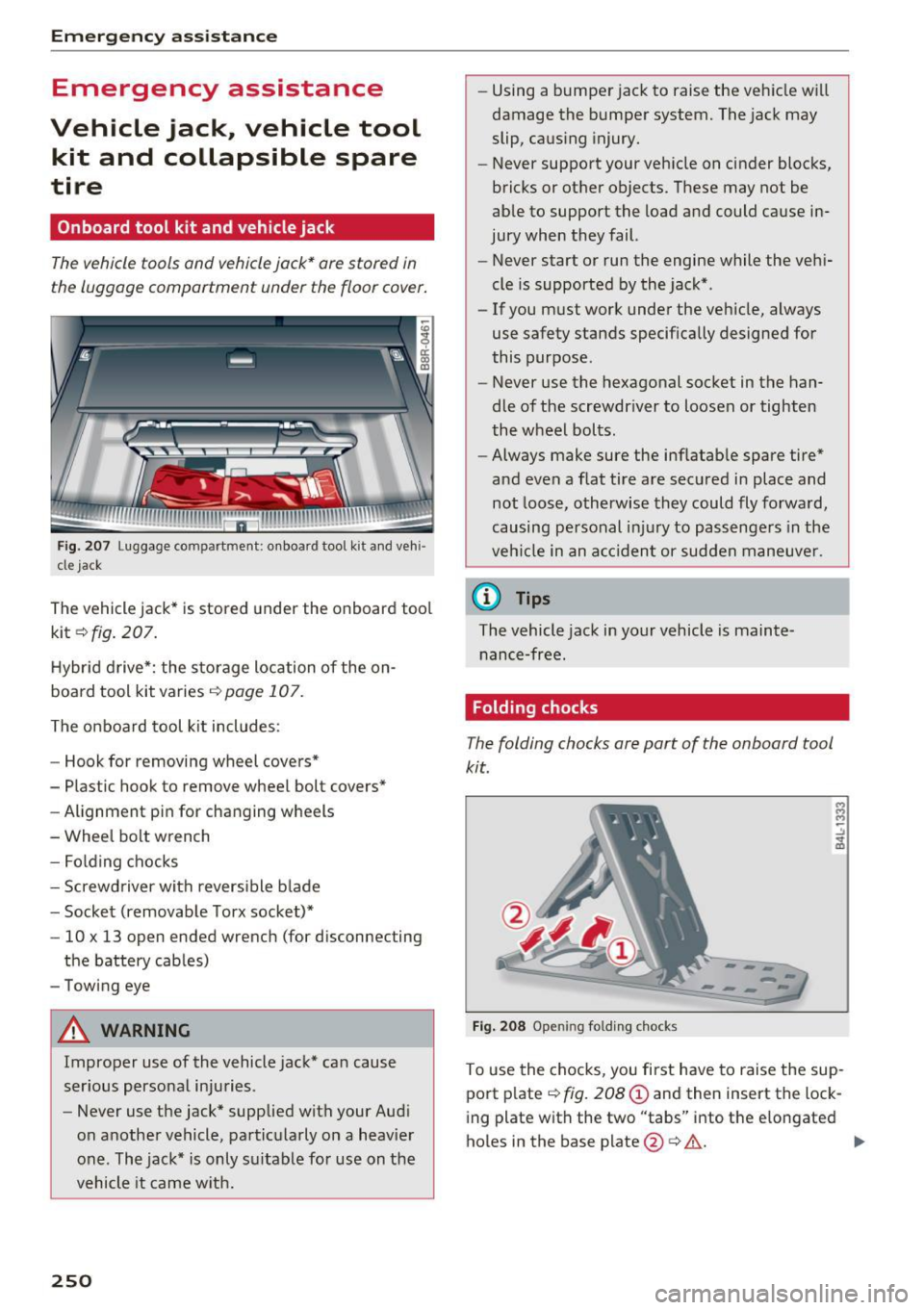
The vehicle tools and vehicle jock* ore stored in
the luggage comportment under the floor cover.
Fig. 207 Luggage compartment: on board tool kit and vehi
cle jack
The vehicle jack* is stored under the onboard tool
kit ¢ fig. 207.
Hybr id d rive*: the storage location of the on
board tool kit varies
r:!) page 107.
The onboard tool k it includes:
- Hook for removing wheel covers*
- Plastic hook to remove wheel bolt covers*
- Alignment pin for changing wheels
- Wheel bolt wrench
- Folding chocks
- Screwdriver with revers ible blade
- Socket (removable Torx socket)*
- 10 x 13 open ended wrench (for disconnecting
the battery cables)
- Towing eye
A WARNING
Improper use of the vehicle jack* can cause
ser ious personal injuries.
- Never use the jack* supplied with your Aud i
on another vehicle, particularly on a heavier
one. The jack* is only su itable for use on the
vehicle it came w ith.
250
- Using a bumper jack to raise the vehicle will
damage the bumper system. The jack may
slip, caus ing injury.
- Never support your vehicle on cinder blocks,
bricks or other objects. These may not be
able to support the load and could cause in
jury when they fail.
- Never start or run the engine while the vehi
cle is supported by the jack* .
- If you must work under the vehicle, always
use safety stands specifically designed for
this purpose.
- Never use the hexagonal socket in the han
dle of the screwdr iver to loosen or tighten
the wheel bolts .
- Always make sure the inflatab le spare tire*
and even a flat tire are secured in place and
not loose, otherwise they could fly forward,
causing personal inj ury to passenge rs in the
vehi cle in an a cc ident or sudden maneuve r.
@ Tips
The vehicle jack in your vehicle is mainte
nance-free.
Folding chocks
The folding chocks ore port of the on board tool
kit .
---
Fig . 208 Open ing fo lding chocks
To use the chocks, you fi rst have to raise the sup
port plate
¢ fig. 208 (D and then insert the lock
ing plate with the two "tabs" into the elongated
holes in the base plate
@ c> &.. .,,_
Page 253 of 296
a,
a,
..... N
" ('I ..... 0 0
0:
co
_& WARNING
-The chock cannot fulfil its function and may
lose its stability if the "tabs" on the support
plate a re not inserted correctly into the
elongated holes in the base plate. If th is
happens, the vehicle may sta rt to move
wh ile a wheel is being changed.
- Never use the fold ing chocks if they are
damaged or if they have not been assem
bled co rrectly.
Removing bass box
Appl ies to: vehicles wit h bass box
Before the inflatable spare tire* can be token
out, the bass box must be removed.
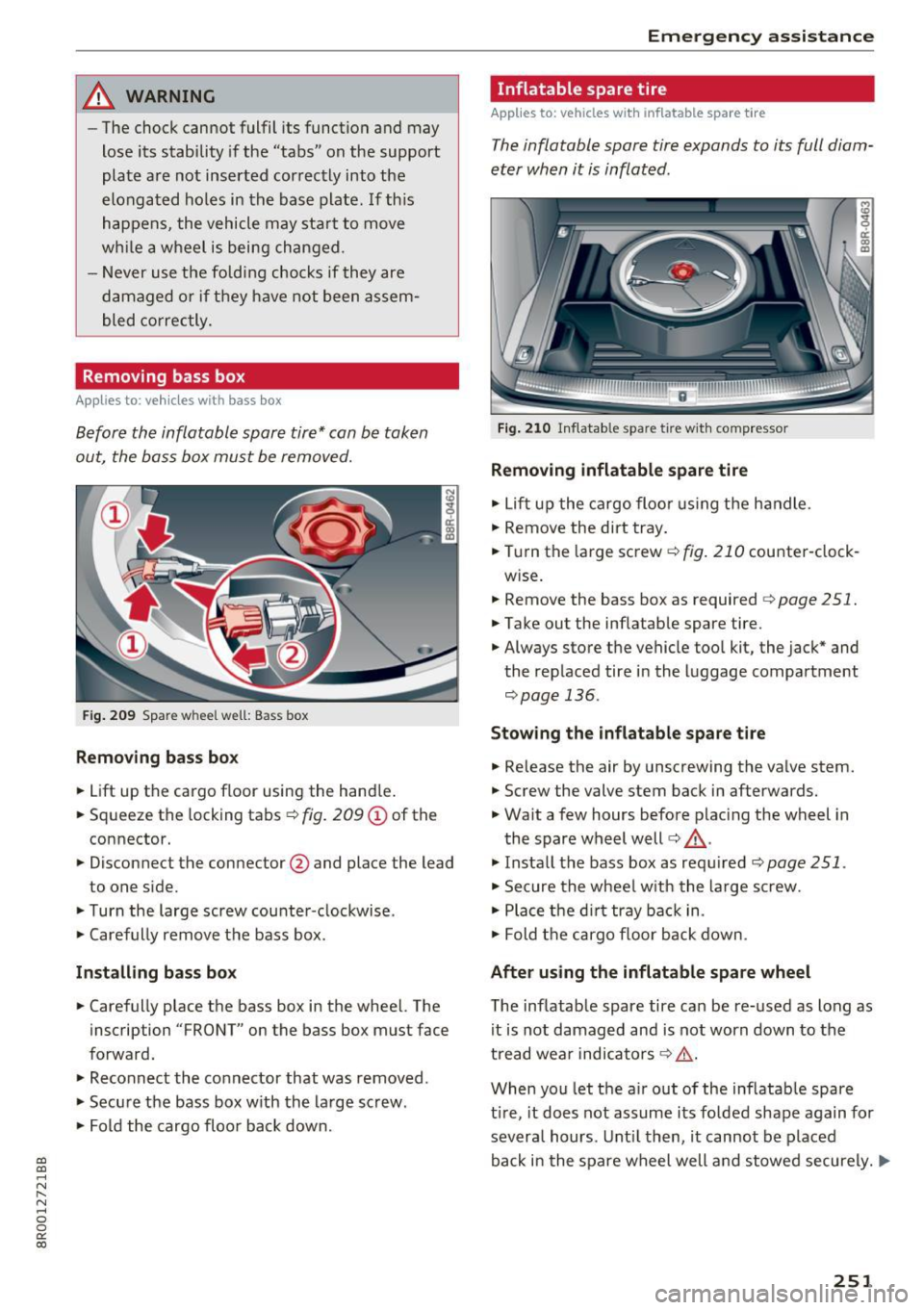
Fig . 20 9 Spare w heel well: Bass box
Removing ba ss box
"Lift up the cargo floor using the hand le .
" Squeeze the locking tabs¢
fig. 209 © of the
connector.
" Disconnect the connector @and place the lead
to one s ide.
"T urn the large screw counter -clockwise .
" Carefully remove t he bass box .
Installing bas s bo x
"Carefully place the bass box in the whee l. The
inscription "FRONT" on the bass box must face
forward.
" Reconnect the co nnector that was removed.
" Secu re the bass box w ith the la rge screw .
" Fold the cargo floo r bac k down.
Em ergen cy a ssis tanc e
Inflatable spare tire
Applies to: vehicles w ith inflatable spare tire
The inflatable spare tire expands to its full diam
eter when it is inflated .
Fig. 210 In flatable spare tire wit h comp ressor
Removing inflatabl e spare tire
"Lift up the cargo floo r us ing the handle.
" Remove the dirt tr ay .
" Turn the large sc rew ¢ fig .
210 counter -clock-
w ise .
" Remove the bass box as required¢
page 251.
"Take out the inflatab le spare tire.
" Always store the vehicle too l kit, the jack* and
the replaced tire in the luggage compartment
¢ page 136.
Stowing the inflatable spare tire
.. Release the air by unscrewing the valve stem.
" Screw the valve stem back in afterwards.
" Wa it a few hours before plac ing the wheel in
the spare wheel well¢,& .
" Insta ll the bass box as requ ired ¢
page 251 .
" Secure the whee l w ith the la rge sc rew.
" Place t he d irt tray back in .
" Fold t he c argo floor back down .
After using the inflatable spare wheel
The inflatable spare tire can be re-used as long as
it is not damaged and is not worn down to the
tread wea r indicators ¢.&, .
When you let the a ir out of the inf latab le spare
t ir e, it does not assume its folded shape again for
severa l hours . Unt il then, it cannot be placed
back i n the spare wheel well and stowed securely.
IJI>
251
Page 257 of 296
CD
CD
.... N ,-... N ..... 0 0 C<'. 00
(D Note
Special care is required if you are repairing
the tire on a steep incline.
@ Tips
- Do not operate the compressor for more
than 12 minutes continuously, otherwise it
can overheat. Once the compressor has
cooled, you can continue to use it.
- If sealant has spi lled out, let it dry and then
you can remove it by peeling it away like a
foil.
- Remember to obtain a new bott le of sealant
from your authorized Audi dealer after re
pair ing a tire. After this, the functionality of
the tire repair set is restored .
- Obey all laws.
Replacing wheels
Before changing a wheel
Observe the following precautions for your own
and your passenger's safety when changing a
wheel.
"" After you experience a tire failure, pull the car
well away from moving traff ic and try to reach
level ground before you stop¢_& .
.. All passengers sho uld
leave the car and move
to a safe location (fo r instance, behind the
guardrai l) ¢ .&_ .
.. Engage the
par king b rake to prevent yo ur vehi
cle from roll ing unintentionally ¢&_ .
.. Move
selecto r le ver to po sitio n P ¢ &_ .
"" If you are towing a trailer: unh itch the trailer
from your veh icle.
"" Block the diagonally opposite wheel with the
folding chocks o r other objects .
""T ake the
jac k* and the inflatable spa re tir e*
out of the luggage compartment¢ page 250 .
A WARNING
You or your passengers cou ld be inj ured while
changing a wheel if you do not follow these
safety precautions:
- If you have a flat tire, move a safe distance
off the road. Turn off the engine, turn the
Em ergenc y ass is tanc e
emergency flashers on and use other wa rn
ing dev ices to alert other motorists.
- Make sure that passengers wait in a safe
place away from the vehicle and well away
from the road and traff ic.
- To help prevent the veh icle from moving
suddenly and possib ly slipping off the jack*,
always fully set the parking brake and block
the wheel diagonally opposite the wheel be i n g changed with the fold ing c hocks or oth
er objects . When one front whee l is lifted
off the ground, placing the Automatic
Transmission in P (Park) w ill
not prevent the
veh icle from moving.
- Before you change a wheel, be sure the
gro und is leve l and firm.
If necessary, use a
sturdy board under the jack*.
- Always s tore the vehicle too l kit, the jack*
and the replaced tire in the lugg age com
partment
¢ page 136.
Changing a wheel
When you change a wheel, follow the sequence
described below s tep-by -step and in exactly that
order.
1. Remove the de corative wheel cover* . For
more detai ls see also
¢page 256, Decaro-
tive wheel covers
o r r::!> poge 256, Wheels
with wheel bolt cops .
2. Loosen the w
heel bolts¢ page 256 .
3. Locate the proper mounting point for the
jack* and align the jack* below that point
¢ page 257.
4. Li ft the car with the jack*¢ page 257.
s. Remove the wheel with th e flat tire and then
insta ll the
inflatable spar e tire*
¢ page 258.
6. Tighte n all whee l bolts lightly.
7 .
Lo wer the vehicle wi th the jack *.
8 . Use the whee
l bolt wrench and
firml y tighten
all wheel bo lts
r::!> poge 256 .
9. Replace the decorat ive wheel co ver* .
255
...
Page 268 of 296
Emergency situations
Emergency situations
General
This chapter is intended for trained emergency crews and working personnel who have the nec
essary tools and equipment to perform these
operations.
Starting by pushing or
towing
(D Note
Vehicles with an automatic transmission
cannot be started by pushing or towing.
Starting with jumper
cables
If necessary, the engine con be started by con
necting it to the battery of another vehicle.
If the engine should fail to start because of a dis
charged or weak battery, the battery can be con
nected to the battery of
another vehicle, using a
pair of jumper cables to start the engine.
Jumper cables
Use only jumper cables of sufficiently large cross
section
to carry the starter current safely. Refer
to the manufacturer's specifications.
Use only jumper cables with
insulated terminal
clamps which are distinctly marked :
plus(+) cable in most cases colored red
minus(-) cable
in most cases colored black.
A WARNING
Batteries contain electricity, acid, and gas.
Any of these can cause very serious or fatal in
jury. Follow the instructions below for
safe
handling of your vehicle's battery.
-Always shield your eyes and avoid leaning
over the battery whenever possible.
-A dead battery can freeze at temperatures
around 32 °F (0 °C) . If the vehicle battery is
frozen, you must thaw it before connecting
the jump start cables.
If you do not, this in-
266
creases the risk of an explosion and chemi
cal burns. After jump starting the vehicle,
drive to an authorized Audi dealer or author
ized Audi Service Facility immediately to
have the vehicle battery checked.
- Do not allow battery acid to contact eyes or
skin . Flush any contacted area with water
immediately.
- Improper use of a booster battery to start a
vehicle may cause an explosion .
- Vehicle batteries generate explosive gases.
Keep sparks, flame and lighted cigarettes
away from batteries.
- Do not try to jump start any vehicle with a
low acid level in the battery.
- The voltage of the booster battery must also
have a 12-Volt rating. The capacity (Ah) of
the booster battery should not be lower
than that of the discharged battery. Use of
batteries of different voltage or substantial
ly different "Ah" rating may cause an explo
sion and personal injury.
- Never charge a frozen battery. Gas trapped
in the ice may cause an explosion.
- Never charge or use a battery that has been
frozen. The battery case may have be weak
ened.
- Use of batteries of different voltage or sub
stantially different capacity (Ah) rating may
cause an explosion and injury. The capacity (Ah) of the booster battery should not be
lower than that of the discharged battery.
- Before you check anything in the engine
compartment, always read and heed all
WARNINGS
r=:> poge 217.
([) Note
-Applying a higher voltage booster battery
will cause expensive damage to sensitive electronic components, such as control
units, relays, radio, etc.
- There must be no electrical contact between
the vehicles as otherwise current could al
ready start to flow as soon as the positive
(+) terminals are connected.
Page 270 of 296
Emerg enc y s it uati ons
& WARNING
To avoid serious personal injury and damage
to the vehicle, heed all warn ings and instruc
tions of the jumper cab le manufacturer . If in
doubt, call for road service .
- Jumper cables must be long enough so that
the vehicles do not touch.
- When connecting jumper cables, make sure
that they cannot get caught in any mov ing
parts in the engine compartment .
- Do not bend over the batteries -danger of
chemical burns!
- The battery cell lock ing screws must be
t ightened securely .
- Before you check anything in the engine
compartment, always read and heed all
WARNINGS ¢page 217.
(D Note
Improper hook-up of jumper cables can ru in
the generator.
- Always connect POSITIVE(+) to POSITIVE
(+), and NEGATIVE( -) to NEGATIVE( -)
ground post of the battery manager control unit.
- Check that all screw p lugs on the battery
cells are screwed in firmly. If not, t ighten
plugs prior to connect ing clamp on negat ive
battery terminal.
- Please note that the procedure for connect
ing a jumper cable as desc ribed above ap
pl ies specifica lly to the case of yo ur vehicle
being jump s tarted. When you are giv ing a
j u mp sta rt to another vehicle , do not con
nect the negative( -) cab le to the negative
( - ) terminal on the discharged battery @
¢ fig. 226 . Instead, securely connect the
negative ( -) cable to either a solid metal
component that is f irm ly bolted to the en
gine block or to the engine block itself . If
the battery that is bei ng charged does not
vent to the outside, escap ing battery gas
could ignite and exp lode!
268
Towing with a tow truck
' General hints
Your Audi requires special handling for towing .
T he following info rmation is to be used by com
merc ial tow truck operators who know how to op
erate their equipment safely.
- Never tow your Audi , tow ing will cause dam
a ge to t he engine and t ran sm ission.
- Ne ver wrap the safety chains or winch cable s
around the brake l ines .
- To prevent un necessary damage , your Audi
must be t ran sported with a flat bed truck.
- To load the vehicle on to the fl at bed , use the
towing loop found in the vehicle tools and at
t ac h to the front o r rear ancho rage
¢ page 269 and ¢page 269.
& WARNING
A vehicle being towed is not safe for passen
gers . Never allow a nyone to ride in a vehicle
be ing towed, for any reason .
Page 271 of 296
a,
a,
..... N r-N ..... 0 0
0:
co
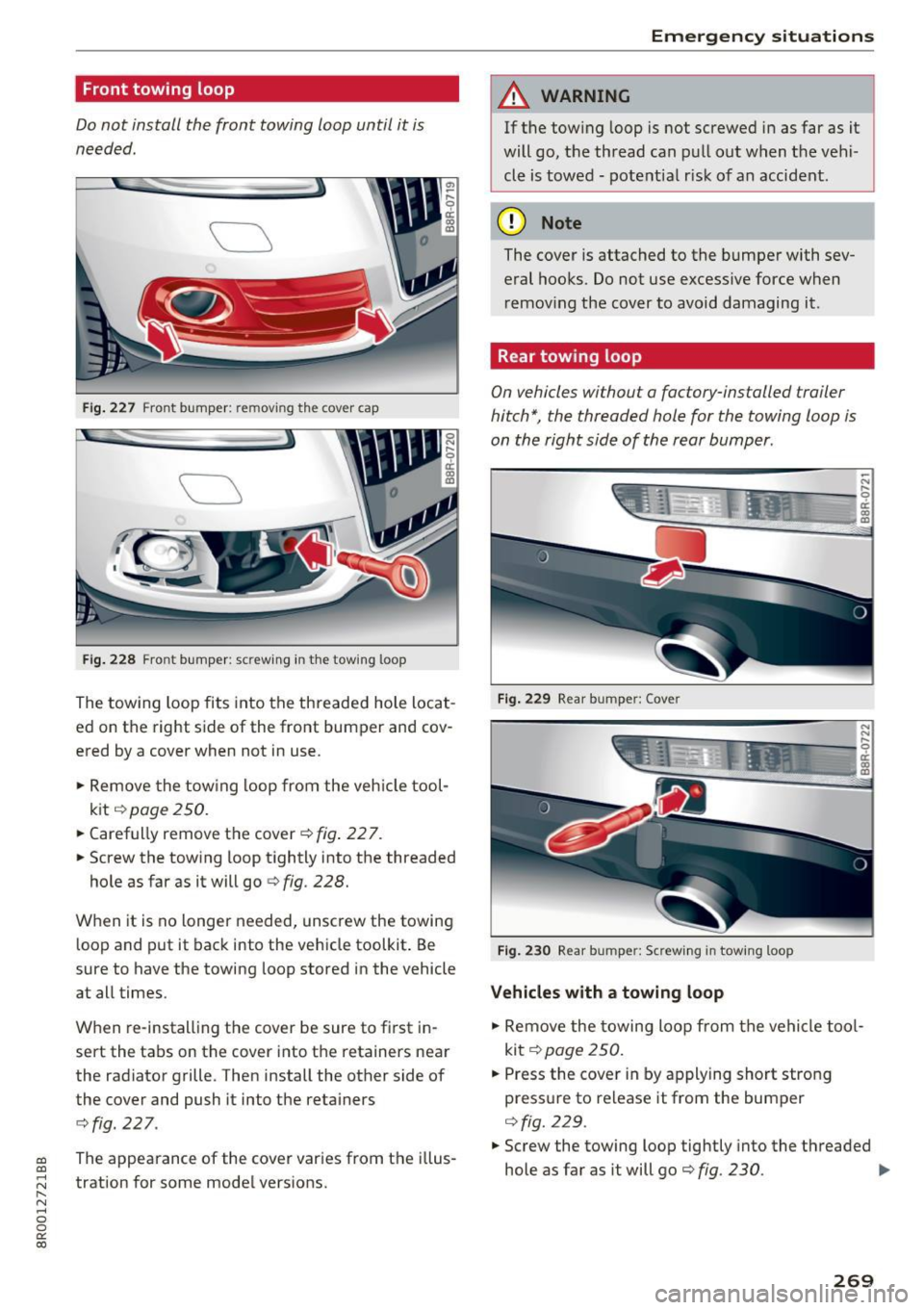
Front towing loop
Do not install the front towing loop until it is
needed.
Fig. 227 Fro nt bumper: remov ing the cover cap
:'CT ..,, -
-·
Fig. 228 F ro nt bumper : sc rewing in the towing loop
The towing loop fits into the threaded hole locat
ed on the right side of the front bumper and cov
ered by a cover when not in use .
.,. Remove the towing loop from the vehicle tool
kit ¢
page 250 .
.,. Carefully remove the cover ¢fig . 227 .
.,. Screw the towing loop tightly into the threaded
hole as far as it will go ¢
fig. 228.
When it is no longer needed, unscrew the towing
loop and put it back into the vehicle toolkit . Be
sure to have the towing loop stored in the vehicle
at all times.
When re-installing the cover be sure to first in
sert the tabs on the cover into the retainers near
the radiator grille . Then install the other side of
the cover and push it into the reta iners
¢ fig. 227 .
The appearance of the cover varies from the illus
tration for some model versions.
Emergency situations
A WARNING
-If the towing loop is not screwed in as far as it
will go, the thread can pull out when the vehi
cle is towed -potential risk of an accident.
(D Note
The cover is attached to the bumper with sev
eral hooks. Do not use excessive force when
removing the cover to avoid damaging it .
Rear towing loop
On vehicles without a factory-installed trailer
hit ch*, the threaded hole for the towing loop is
on the right side of the rear bumper .
Fig. 229 Rear bumper: Cove r
Fig. 230 Rear bumper: Sc rewing in towing loop
Vehicles with a towing loop
.,. Remove the towing loop from the vehicle tool
kit
¢ page 250.
.,. Press the cover in by applying short strong
pressure to release it from the bumper
¢ fig. 229 .
.,. Screw the towing loop tightly into the threaded
hole as far as it will go¢
fig. 230 . ..,_
269
Page 272 of 296
Emergency situations
Vehicles with a trailer hitch*
.. Install the trai ler hitch.
.. Attach the tow ing bar or the towing cable to
the trailer hitch.
Unscrew the towing loop again after use and in
stall the cover in the bumper. Return the towing
loop to the vehicle toolkit. Be sure to have the
towing loop stored in the vehicle at all times.
A WARNING
-If the towing loop is not screwed in as far as
it will go, the thread can pull out when the
vehicle is towed -potential risk of an acci
dent.
- If your veh icle has a
trailer hitch* only use a
special towing bar to prevent damaging the
ball hitch . These towing bars have been spe
cially designed for t railer towing h itches.
- If your veh icle has a
trailer hitch* use only
special tow ing cab les.
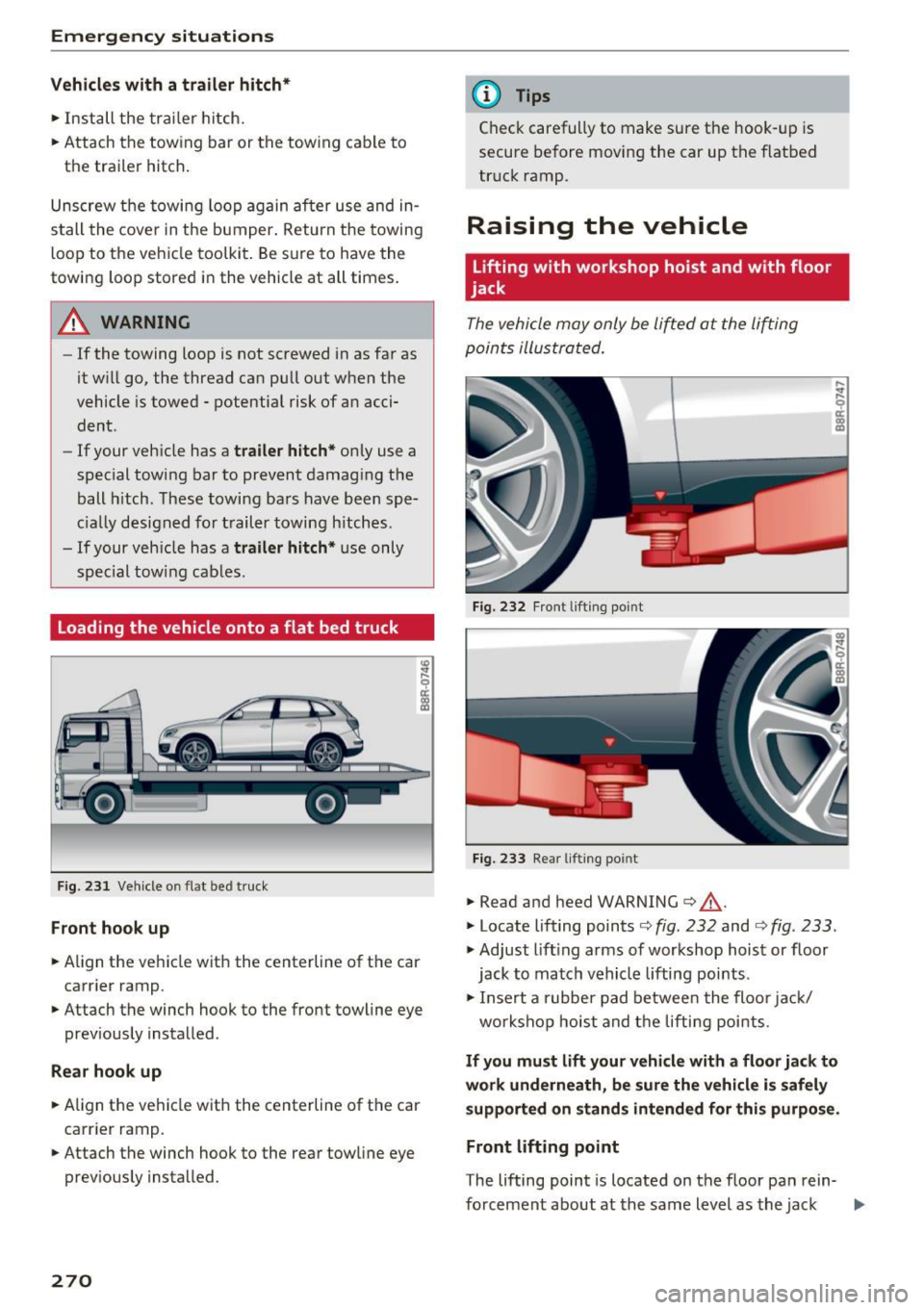
Loading the vehicle onto a flat bed truck
Fig . 231 Vehicle o n flat bed tr uck
Front hook up
.. Align the vehicle with the centerline of th e car
carr ier ramp .
.. Attach the winch hook to the front towline eye
previously installed.
Rear hook up
.. Align the vehicle with the centerline of the car
carrier ramp.
.. Attach the winch hook to the rear towline eye
previously installed.
270
@ Tips
Check carefully to make sure the hook-up is
secure before moving the car up the flatbed
truck ramp .
Raising the vehicle
Lifting with workshop hoist and with floor
jack
The vehicle may only be Lifted at the lifting
points illustrated.
Fig. 232 F ront lif ting point
Fig. 233 Rear lif ting point
.,. Read and heed WARNING c> ,& .
.. Locate lifting points c> fig. 232 and c> fig . 233 .
.,. Adjust l ift ing arms of workshop hoist or floor
jack to match vehicle lifting points .
.. Insert a rubber pad between the floor jack/
wo rkshop hoist and the lifting points .
If you must lift your vehicle with a floor jack to
work underneath, be sure the vehicle i s safely
supported on stands intended for this purpose.
Front lifting point
The lifting point is located on the floor pan rein-
forcement about at the same level as the jack ..,.