instrument cluster AUDI Q5 2017 Owner's Guide
[x] Cancel search | Manufacturer: AUDI, Model Year: 2017, Model line: Q5, Model: AUDI Q5 2017Pages: 296, PDF Size: 74.43 MB
Page 250 of 296
Wheels
check your tires as soon as possible, and inflate
them to the proper pressure. Driving on a signifi
cantly under-inflated tire causes the tire to overheat and can lead to tire failure. Under-inflation
also reduces fuel efficiency and tire tread life,
and may affect the vehicle's handling and stop
ping ability.
Please note that the TPMS is not a substitute for
proper tire maintenance, and it is the driver's re
sponsibility to maintain correct tire pressure,
even if under-inflation has not reached the level
to trigger illumination of the TPMS low tire pres
sure telltale.
Your vehicle has also been equipped with a TPMS malfunction indicator to indicate when the sys
tem is not operating properly. The TPMS mal
function indicator is combined with the low tire pressure telltale. When the system detects a
malfunction, the telltale will flash for approxi
mately one minute and then remain continuously
illuminated. This sequence will continue upon
subsequent vehicle start-ups as long as the mal
function exists .
When the malfunction indicator is illuminated,
the system may not be able to detect or signal low tire pressure as intended . TPMS malfunctions
may occur for a variety of reasons, including the
installation of replacement or alternate tires or
wheels on the vehicle that prevent the TPMS from functioning properly . Always check the
TPMS malfunction telltale after replacing one or
more tires or wheels on your vehicle to ensure
that the replacement or alternate tires and
wheels allow the TPMS to continue to function
properly.
248
· If the Tire Pressure Monitoring System
indicator appears
Applies to: vehicles with Tire Pressure Monitoring System
The tire pressure indicator in the instrument
cluster informs you if the tire pressure is too low
or if there is a system malfunction.
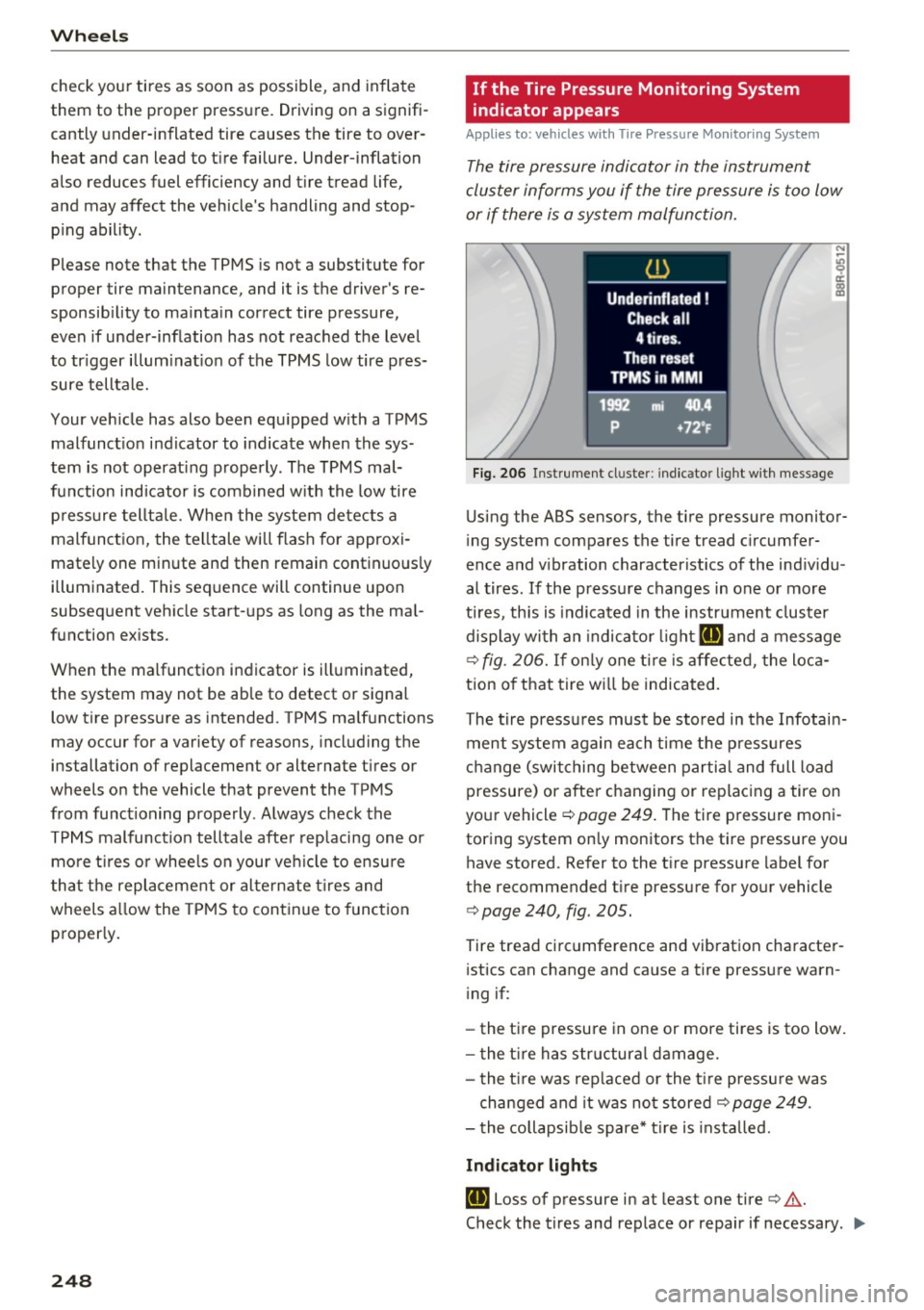
Fig. 206 Instrument cl uster: i ndic ator ligh t with message
Using the ABS sensors, the tire pressure monitor
ing system compares the tire tread circumfer
ence and vibration characteristics of the individu
al tires . If the pressure changes in one or more
tires , this is indicated in the instrument cluster
display with an indicator light
IE and a message
c>fig. 206. If only one tire is affected, the loca
tion of that tire will be indicated.
The tire pressures must be stored in the Infotain
ment system again each time the pressures
change (switching between partial and full load
pressure) or after changing or replacing a tire on
your vehicle
c> page 249. The tire pressure moni
toring system only monitors the tire pressure you have stored. Refer to the tire pressure label for
the recommended tire pressure for your vehicle
c> page 240, fig . 205.
Tire tread circumference and vibration character
istics can change and cause a tire pressure warn
ing if:
- the tire pressure in one or more tires is too low.
- the tire has structural damage.
- the tire was replaced or the tire pressure was
changed and it was not stored
c> page 249 .
-the collapsible spare* tire is installed.
Indicator lights
IE Loss of pressure in at least one tire c> &.
Check the tires and replace or repair if necessary . .,.
Page 256 of 296
Emergency assistance
Performing the repair
Applies to: vehicles w ith tire repair k it
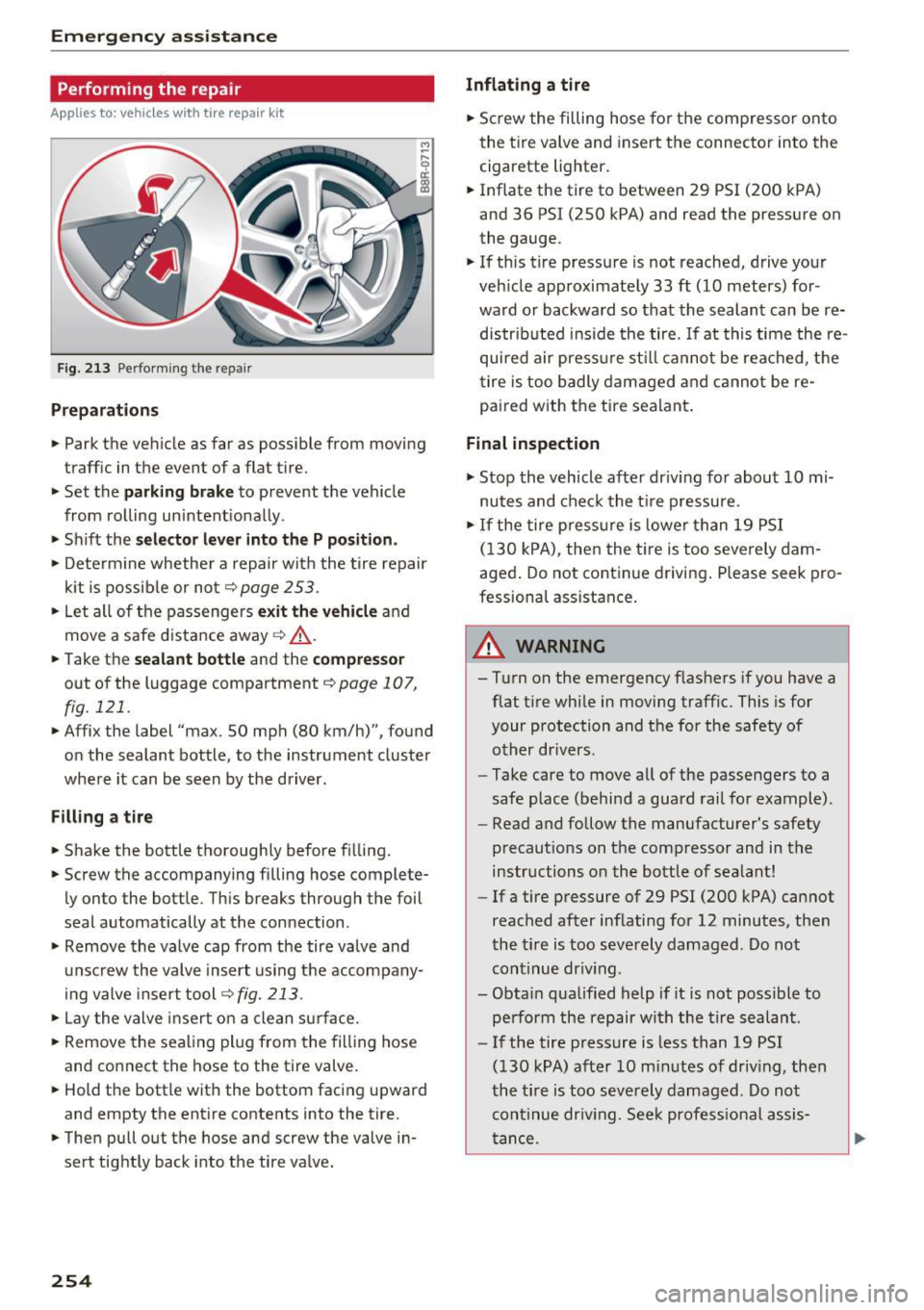
Fig. 213 Performing the repair
Preparations
.,. Park the vehicle as far as possible from moving
traffic in the event of a flat tire.
.,. Set the
parking brake to prevent the vehicle
from ro lling un intent ionally.
.,. Sh ift the
selector lever into the P po sition .
.,. Determ ine whether a repair with the tire repair
kit is possible or not¢
page 253.
.,. Let all of the passengers
exit the vehicle and
move a safe distance away¢_&. .
.,. Take the
sealant bottle and the compressor
out of the luggage compartment ¢ page 107,
fig. 121.
.,. Affix the label "max. 50 mph (80 km/h)", found
on the sealant bottle, to the instrument cluster
where it can be seen by the driver.
Filling a tire
.,. Shake the bottle thoroughly before fi lling.
.,. Screw the accompanying filling hose complete
ly onto the bottle. This breaks through the foil
seal automatically at the connection .
.,. Remove the valve cap from the tire valve and
unscrew the valve insert using the accompany
ing valve insert tool
~fig. 213 .
.,. Lay the valve insert on a clean surface .
.,. Remove the sealing plug from the filling hose
and connect the hose to the tire valve .
.,. Hold the bottle with the bottom facing upward
and empty the entire contents into the tire .
.,. Then pull out the hose and screw the valve in
sert tightly back into the tire valve.
254
Inflating a tire
.,. Screw the filling hose for the compressor onto
the tire valve and insert the connector into the
cigarette lighter.
.. Inflate the tire to between 29 PSI (200 kPA)
and 36 PSI (250 kPA) and read the pressure on
the gauge .
.,. If this tire pressure is not reached, drive your
veh icle approximately 33
ft (10 meters) for
ward or backward so that the sealant can be re
distr ibuted inside the tire. If at this time the re
qui red air press ure st ill cannot be reached, the
tire is too badly damaged and cannot be re
pa ired with the tire sealant .
Final inspection
.,. Stop the vehicle after dr iv ing for about 10 mi
nutes and check the tire pressure.
.,. If the tire pressure is lower than 19 PSI
(130 kPA), then the t ire is too severely dam
aged . Do not continue driving . Please seek pro
fessional ass istance .
&_ WARNING
- Turn on the emergency flashers if you have a
flat tire while in moving traffic. This is for
your protection and the for the safety of
other drivers.
- Take care to move all of the passengers to a
safe place (behind a guard rail for example) .
- Read and follow the manufacturer's safety
precaut ions on the compressor and in the
instructions on the bottle of sealant!
- If a tire pressure of 29 PSI (200 kPA) cannot
reached after inflating for 12 minutes, then
the tir e is too severely damaged. Do not
continue driving.
- Obta in qualified help if it is not possible to
pe rform the repair with the tire sealant .
- If the tire pressure is less than 19 PSI
(130 kPA) after 10 minu tes of driv ing, then
the tire is too severely damaged . Do not
con tinue driv ing. Seek profess ional assis
ta nce.
Page 265 of 296
a,
a,
..... N r-N ..... 0 0
0:
co
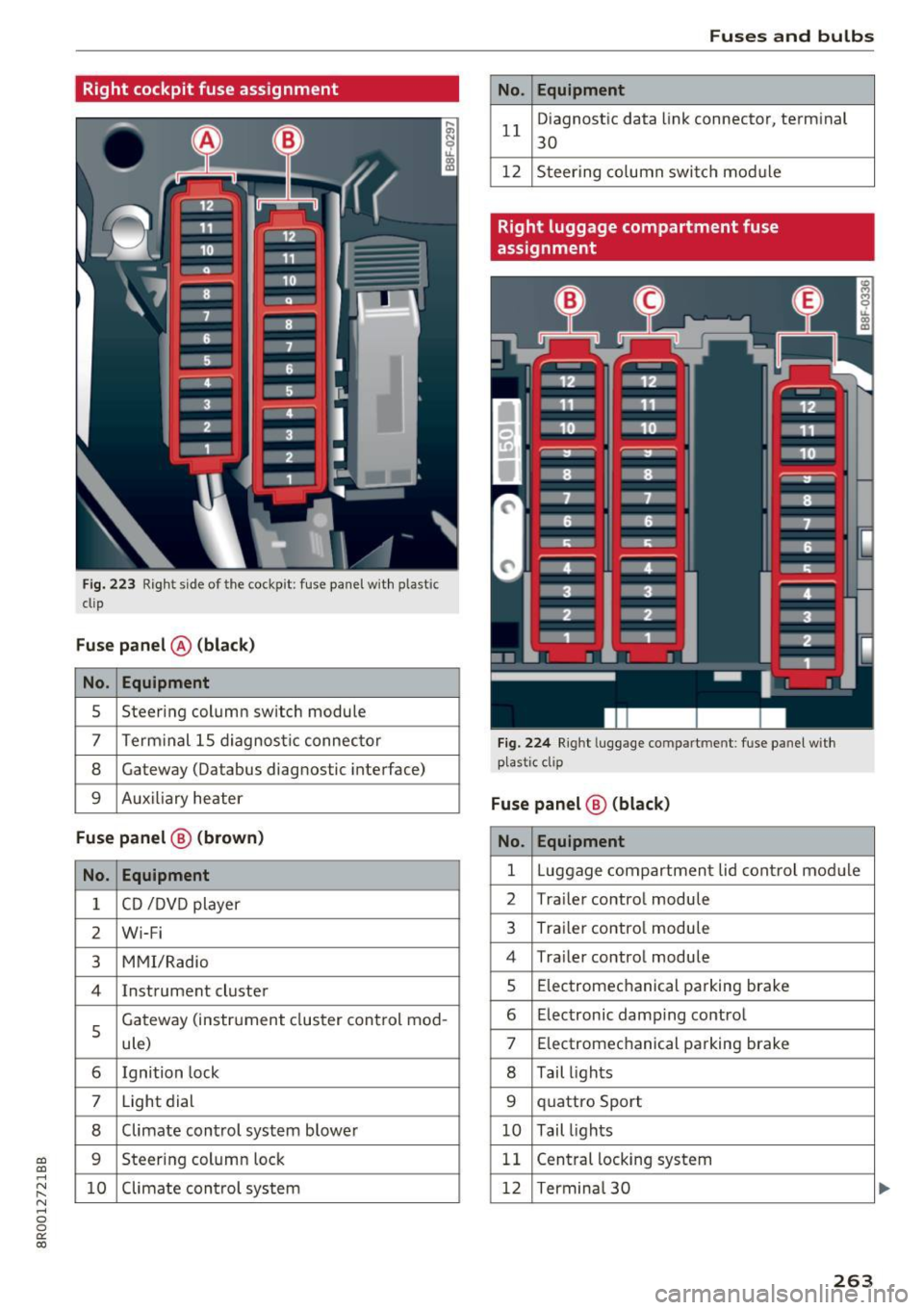
Right cockpit fuse assignment
Fig. 223 Right side of the cockpit: fuse panel wit h plastic
clip
Fuse panel @ (black)
No . Equipment
5 Steering column switch module
7 Terminal 15 diagnostic connector
8 Gateway (Databus diagnostic interface)
9 Auxil iary heater
Fuse panel @ (brown)
No. Equipment
1 CD /DVD player
2 Wi-Fi
3 MMI/Radio
4 Instrument cluster
5
Gateway (instrument cluster control mod-
ule)
6 Ignition lock
7 Light dial
8 Climate control system blower
9 Steering column lock
1 0 Climate control system
Fuses and bulbs
No . Equipment
11 Diagnostic data
link connector, terminal
30
12 Steering column switch module
Right luggage compartment fuse
assignment
Fig. 224 Right luggage compartment: fuse panel with
pla stic dip
Fuse panel @ (black)
No. Equipment
1 Luggage compartment lid control module
2 Trailer control module
3 Traile r control module
4 Tra iler control module
5 Electromechanical parking brake
6 Electronic damping control
7 Electromechanical parking brake
8 Tail lights
9 quattro Sport
10 Tail lights
11 Central locking system
12 Termina l 30
263
Page 288 of 296
Index
How safety belt pretensioners work ..... .
Hybrid drive .. .. .. ................ ... .
12 volt batteries .. ........... .... .. . 146
100
107
Consumption display . . . . . . . . . . . . . . . . . 107
Efficient drive mode . . . . . . . . . . . . . . . . . . 104
Energy flow display . . . . . . . . . . . . . . . . . . 106
EV mode . . . . . . . . . . . . . . . . . . . . . . . . . . . 103
High voltage battery . . . . . . . . . . . . . 100, 107
High voltage system . . . . . . . . . . . . . . . . . 100
Operating modes . . . . . . . . . . . . . . . . . . . . 103
Power meter . . . . . . . . . . . . . . . . . . . . . . . . 101
Starting the vehicle . . . . . . . . . . . . . . . . . . 101
Transport 108
I
Ignition
Switching on/off . . . . . . . . . . . . . . . . . . . . . 81
Ignition key Emergency unlocking . . . . . . . . . . . . . . . . . . 35
I gnition lock . . . . . . . . . . . . . . . . . . . . . . . . . . 81
Malfunction .... ................ .. 27, 31
Imbalance (wheels) . . . . . . . . . . . . . . . . . . . 238
Important things to do before driving . . . . 131
I mproperly worn safety belts . . . . . . . . . . . 146
Indicator lights . . . . . . . . . . . . . . . . . . . . 11, 102
Airbag system . . . . . . . . . . . . . . . . . . . . . . 159
PASSENGER AIR BAG OFF . . . . . . . . . . . . . 159
Infant seats . . . . . . . . . . . . . . . . . . . . . . . . . 17 4
I nflatable spare tire . . . . . . . . . . . . . . . . . . . 251
I nflating . . . . . . . . . . . . . . . . . . . . . . . . . . . 252
Inflation pressure (tires) . . . . . . . . . . . . . . . 240
Installing the upper tether strap on the an
chorage . . . . . . . . . . . . . . . . . . . . . . . . . . . . . 184
I nstrument cluster . . . . . . . . . . . . . . . . . . . . 101
Indicator lights . . . . . . . . . . . . . . . . . . . . . . 11
Messages . . . . . . . . . . . . . . . . . . . . . . . . . . . 11
I nstrument illum inat ion . . . . . . . . . . . . . . . . 53
Instruments . . . . . . . . . . . . . . . . . . . . . . . . . . . 8
I nstruments and controls
General illustration . . . . . . . . . . . . . . . . . . . . 6
I nterior lights
Front . . . . . . . . . . . . . . . . . . . . . . . . . . . . . . . 52
Rear . . . . . . . . . . . . . . . . . . . . . . . . . . . . . . . 52
Interval wiping . . . . . . . . . . . . . . . . . . . . . . . . 54
Rain sensor . . . . . . . . . . . . . . . . . . . . . . . . . . 54
286
J
Jump-starting 266
Jumper cables . . . . . . . . . . . . . . . . . . . . . . . . 267
Jump starting 107
K
Key...........
... .. .. ................ 33
Battery replacement . . . . . . . . . . . . . . . . . . 34
Check light . . . . . . . . . . . . . . . . . . . . . . . . . . 34
Emergency key . . . . . . . . . . . . . . . . . . . . . . . 83
lg n ition/ engine on/ off . . . . . . . . . . . . . . . . 81
Key replacement . . . . . . . . . . . . . . . . . . . . . 33
Master key with remote control . . . . . . . . . 33
Mechanica l key . . . . . . . . . . . . . . . . . . . . . . . 34
Removing . . . . . . . . . . . . . . . . . . . . . . . . . . . 83
Kick-down tiptronic . . . . . . . . . . . . . . . . . . . . . . . . . . . . 98
L
Lane Change Assistant
refer to Side assist . . . . . . . . . . . . . . . . . . . 118
LATCH . . . . . . . . . . . . . . . . . . . . . . . . . . . . . . 181
Description . . . . . . . . . . . . . . . . . . . . . . . . . 182
Installing a child restraint . . . . . . . . . . . . . 182
Location . . . . . . . . . . . . . . . . . . . . . . . . . . . 181
Mounting and releasing the anchorage
hook . . . . . . . . . . . . . . . . . . . . . . . . . . . . . . 182
Lateral angle . . . . . . . . . . . . . . . . . . . . . . . . . 198
Leather care/cleaning . . . . . . . . . . . . . . . . . 207
Lefthand drive .. .. .. .. ............. ... 51
Lifting jack . . . . . . . . . . . . . . . . . . . . . . . . . . 257
Light Coming home . . . . . . . . . . . . . . . . . . . . . . . . 50
Dayt ime runn ing lights . . . . . . . . . . . . . . . . 50
Driving light control. . . . . . . . . . . . . . . . . . . 49
Emergency flashers . . . . . . . . . . . . . . . . . . . 51
Exterior lighting . . . . . . . . . . . . . . . . . . . . . . 50
High beam . . . . . . . . . . . . . . . . . . . . . . . . . . 52
High beam warning/indicator light. . . . . . . 14
Leaving home . . . . . . . . . . . . . . . . . . . . . . . . 50
Sensor .. .. .. .. .. .. .. ...... .... ... .. . 49
Sensor defective . . . . . . . . . . . . . . . . . . . . . . 29
Switching on and off . . . . . . . . . . . . . . . . . . 49
Travel mode . . . . . . . . . . . . . . . . . . . . . . . . . 51
Turn signals . . . . . . . . . . . . . . . . . . . . . . . . . 52