wing AUDI Q5 2017 Repair Manual
[x] Cancel search | Manufacturer: AUDI, Model Year: 2017, Model line: Q5, Model: AUDI Q5 2017Pages: 296, PDF Size: 74.43 MB
Page 214 of 296
Fuel and R efue li ng
_& WARNING
Under normal operating conditions, never car
ry additional fuel containers in you r car. Gas
canisters and other containers used to trans
port fuel can be dangerous . Such containers,
full or empty, may leak and could cause a fire
in a collision. If you must transport fuel to
use for your lawn mower, snow blower, etc.,
be very careful and a lways observe local and
state laws regarding the use, transportation
and sto rage of such fue l conta iners. Make cer
tain the container meets industry standards (ANSI/ASTM F852 -86) .
(D Note
Never drive you r vehicle unt il the fuel tank is
comp letely empty. The irregular supply of
fue l can cause m isfiring. Gasoline cou ld enter
the exhaust system and damage the catalytic
converter.
Refuelling
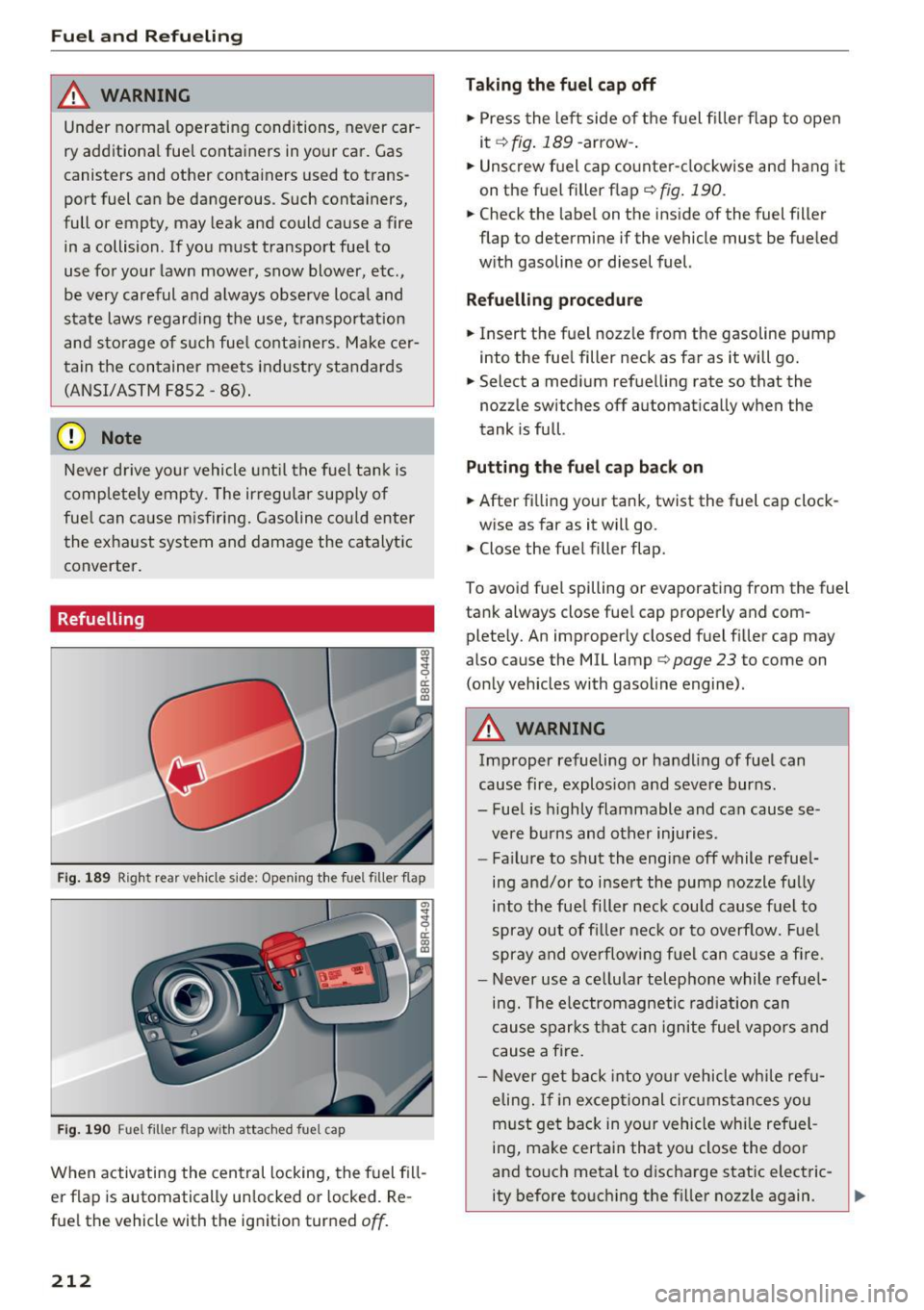
Fig. 189 Right rear veh icle side: Opening the fuel filler flap
Fig. 190 Fuel filler flap wit h attac hed fuel cap
When activating the central locking, the fuel f ill
er flap is automatically unlocked o r locked. Re
fuel the vehicle with the ignition turned
off.
212
Taking th e fue l cap off
.. Press the left side of the fuel fi ller flap to open
it
¢ fig. 189 -ar row-.
.. Unscrew fuel cap counter-clockwise and hang it
on the fuel filler flap¢
fig. 190 .
.. Check the label on the inside of the fuel filler
flap to determine if the vehicle must be fueled
w ith gasoline or diesel fuel.
Refuelling procedur e
.. Insert the fuel nozzle from the gasoline pump
into the fuel filler neck as far as it will go.
.. Select a medium refuelling rate so that the
nozzle switches off automatically when the
tank is full.
Putting th e fu el c ap b ack o n
.. After filling your tank, twist the fuel cap clock-
wise as far as it will go.
.. Close the fuel filler flap.
To avoid fuel spilling or evaporating from the fuel
tank always close fuel cap properly and com
plete ly. An improperly closed fuel filler cap may
also cause the MIL lamp¢
page 23 to come on
(only vehicles with gasoline engine).
_& WARNING
Improper refueling or handling of fuel can
cause fire, explos ion and severe burns.
- Fuel is highly flammable and can cause se
vere burns and other injuries.
-
- Fa ilure to shut the engine off while refuel
ing and/or to insert the pump nozzle fully into the fue l filler neck could cause fuel to
spray out of fi ller neck or to overflow. Fue l
spray and ove rflowing f uel can ca use a fire .
- Never use a ce llular telephone while refuel
ing. The electromagnetic radiation can
cause sparks t hat can ignite fuel vapors and
cause a fire.
- Never get back into your vehicle whi le refu
eling. If in exceptional circumstances you
must get back in your vehicle wh ile refuel
ing, make certain that you close the door
and touch metal to discharge static electric-
ity before touching t he f iller nozzle again. .,_
Page 216 of 296
Fuel and Refueling
"'Loosen the strap from its bracket and pu ll on it
¢
fig. 191 . Now you can open the fuel filler flap
as usual.
Selective catalytic reduction (AdBlue/DEF)
General information
Applies to: veh icles w ith selective catalyt ic reduction
In vehicles with selective catalytic reduction, a
urea solution (Ad B lue/DEF) is injected into the
exhaust system before a nitrogen oxide catalytic
converter to reduce nitrogen emissions. The urea
solution is known as Ad Blue or DEF (Diesel Ex
haust Fluid) . AdBlue is used in the following.
The AdBlue is carried in a separate tank in the ve
hicle. The Ad Blue usage accounts for approxi mately 0 .5% to 2.5% of the diesel fuel that is
used.
When a message about refilling the Ad Blue ap
pears in the instrument cluster display, you must
refill the Ad Blue yourself or have it refilled by an
authorized Audi dealer or authorized Audi Service
Facility ¢ page 215.
(D} Tips
-The display indicates the distance remaining
that can be driven¢
page 214. If the Ad Bl
ue tank is completely empty, the engine will
not start again after the ignition is switched
off.
-Ad Blue is required by law to operate this ve
hicle.
Messages in the instrument cluster display
Applies to: vehicles with selective catalytic reduction
The display indicates if the Ad Blue level is low or
if there is a system malfunction.
AdBlue level low
You will be informed if the Ad Blue in the tank
drops below a certain level.
Ad Blue /9 Refill Ad Blue. See owner's manual
214
This message appears when there is only enough
Ad Blue left to drive the distance indicated in the
i nstrument cluster. Fill the Ad Blue.
AdBlue /9 Refill Ad Blue! No restart in x mi
(x km)! See owner's manual
This message appears when there is only enough
Ad Blue left to dr ive the distance indicated in the
i nst rument cluster. Fill the Ad Blue. Otherw ise
the engine will not start again if you stop it once
the distance indicated has been driven.
Refill Ad Blue! No restart! See own
er's manual
This message appears when the Ad Blue tank is
empty . Fill the Ad Blue. Otherwise you will not be
able to start the engine again once you stop it.
The Ad Blue must be refilled when the amount in
the tank has reached the minimum leve l
¢ page 215, Filling AdBlue .
Incorrect filling/system malfunction
A message appears if the Ad Blue tank was filled
with a flu id other than Ad Blue and the system
has detected that the tank was filled incorrectly,
or if there is a system malfunction .
Ad Blue -I' AdBlue: Fault! No restart in x mi
(x km)! See owner's manual
This message appears when it is on ly possible to
drive the distance indicated in the instrument
cluster. Drive to the nearest authorized Audi
dealer or authorized Audi Service Facility to have
the malfunct ion corrected. Otherw ise the eng ine
will not start again if you stop it once the dis
tance indicated has been driven.
AdBlue: System fault No restart!
See owner's manual
This message appears if the system has detected
that the tank was filled incorrectly or that there
is a malfunction . Drive immediately to the near
est authorized Audi dealer or authorized Audi
Service Facility to have the malfunction correct
ed . Otherwise you will not be able to star t the en
gine again once you stop it.
Page 219 of 296
Checking and Filling Hood
Releasing the engine hood
The engine hood is released from inside the vehi
cle .
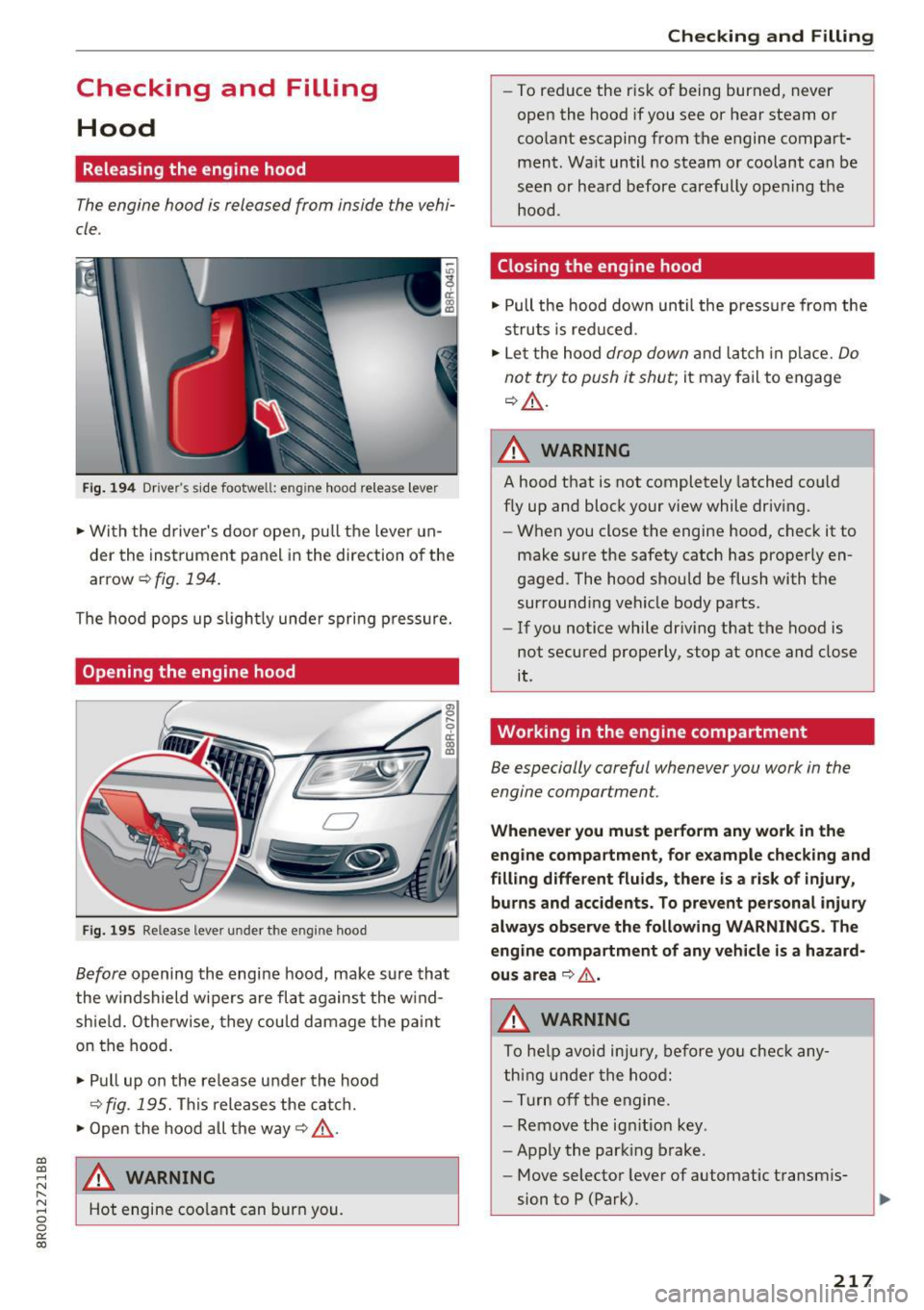
Fig. 194 Drive r's side footwell: e ng ine hood re lease lever
"' Wi th the driver's door open, pu ll th e leve r un
der the instrument panel in the direction of the
arrow ¢fig.194 .
The hood pops up s light ly unde r spri ng p ressure.
Opening the engine hood
Fi g. 19 5 Release lever under t he eng ine hood
Before opening the engine hood, make sure tha t
the w indshield wipe rs are fla t against the w ind
shie ld. Otherwise, they could d amage t he paint
on the hood .
"' Pull up on the release under the hood
~fig . 195. Th is releases the cat ch.
"' Open the hood all the way¢&,, .
a,
~ ,&. WARNING
r--
~ Hot engine coo lant can burn you. 0 0
0:
co
Checking and Filling
- To reduce the r isk of being burned, never
open the hood if you see or hear steam or
coo lant escaping from the engine compart
ment. Wa it until no steam or coolant can be
seen or hea rd before carefully ope ning t he
hood.
Closing the engine hood
"' Pull the hood down until the press ure from the
s truts is red uced.
"' Le t the hood
drop down and latch in p lace. Do
not try to push it shut ;
it may fail to engage
¢ &,, .
A WARNING
- -
A hood that is not completely latched co uld
f ly up and block your view while dr iv ing.
- When you close the engine hood, c heck it to
make sure the safety catch has prope rly en
gaged . The hood should be flush with the
sur rounding vehicle body parts .
- If you notice while driv ing that the hood is
not secured prope rly , stop at once and close
it .
Working in the engine compartment
Be especially careful whenever you work in the
engine compartment.
Whenever you must pe rfo rm any work in the
eng ine compa rtment , for e xample check ing and
fill ing diffe rent fluids, the re is a ris k of injury,
burns and acciden ts. To pre vent personal injur y
always ob serve the fo llowing WARNINGS . The
eng ine compartment of any vehicle is a hazard
ou s area
~ .&, .
A WARNING
To he lp avoid injury, befo re yo u check any
t h ing u nder the hood:
- Tur n off the engine.
- Remove the ig nitio n key .
- Apply the parking brake.
-
- Move selector lever of automatic t ransm is-
sion to P (Park).
217
Page 222 of 296
Check ing and F illing
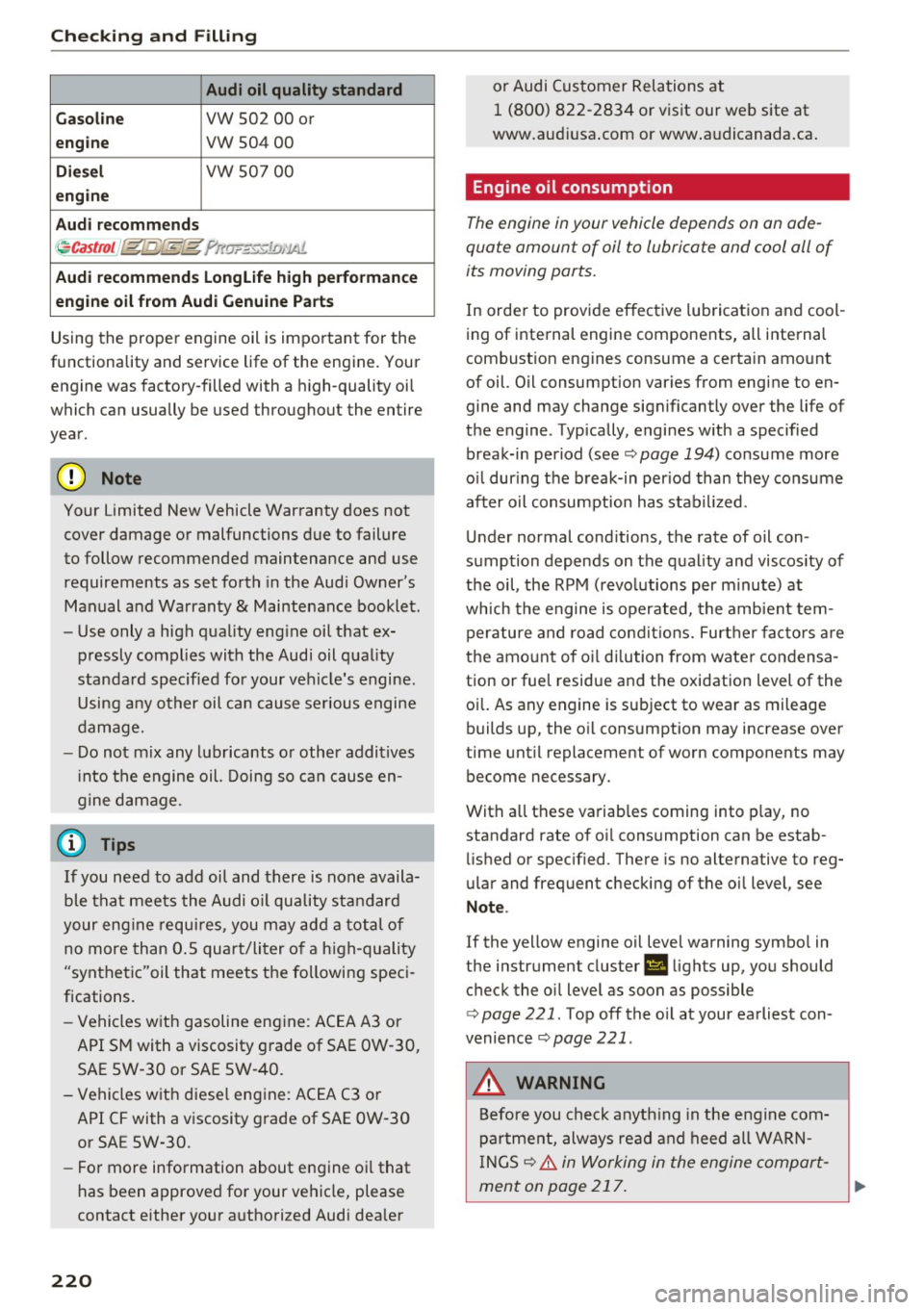
Audi oil quality standard
Gas olin e
VW 502 00 or
engi ne vw 50400
Di esel vw 50 7 00
eng in e
Au di r ecomm ends
~ castroL //gJB,'flt@t Frti:rr.:;-...1"JDl'1Al.
Au di r ecommend s Longlif e high perf ormance
engi ne oil from A udi Genuine Part s
Using the proper engine oil is important for the
functionality and service life of the eng ine. Your
engine was factory-filled with a high-quality oil
which can usually be used throughout the entire
year.
{tD Note
Your Limited New Vehicle Warranty does not
cover damage or malfunctions due to failure
to follow recommended maintenance and use
requirements as set forth in the Audi Owner's
Manual and Warranty
& Maintenance booklet.
- Use only a high quality eng ine oil that ex-
pressly complies wi th the Audi oil quality
standard specified for your vehicle's engine.
Using any other oil can cause serious engine
damage.
- Do not mix any lub ricants or other additives
i nto the engine oil. Doing so can cause en
g ine damage.
@ Tips
If you need to add oil and there is none availa
ble tha t meets the Audi o il quality standard
your eng ine requi res, you may add a tota l of
no more than 0 .5 quart/li ter of a h igh-quality
"synthetic"oil that meets the fo llowing speci
fications.
- Vehicles with gasoline eng ine: ACEA A3 or
API SM with a viscosity grade of SAE OW-30,
SAE 5W-30 or SAE 5W-40.
- Vehicles w it h diese l engine: ACEA C3 o r
API CF with a viscosity grade of SAE OW-30
or SAE 5W-30.
- For more information about engine oi l that
has been approved for your ve hicle, please
contact either your authorized Audi dea ler
220
or Audi Customer Relations at
1 (800) 822-2834 or visit our web site at
www.aud iusa .com or www .a udicanada .ca.
Engine oil consumption
The engine in your vehicle depends on an ade
quate amount of oil to lubricate and cool all of
its moving parts.
In order to provide effective lub rication and cool
ing of internal engine components, all internal
combust ion engines consume a certa in amount
of oil. Oil consumption var ies from engine to en
gine and may change significantly over the life of
the engine . Typically, engines w ith a specified
break-in period (see
c::;,page 194) consume more
o il dur ing the break-in per iod than they consume
after o il consumption has stabi lized .
Under normal cond itions, the rate of oil con
sumption depends on t he quality and viscos ity of
the oil, the RPM (revolutions per m inute) at
wh ich the engine is operated, the ambient tem
perature and road condit ions. Furthe r facto rs a re
t h e amount of o il d ilution from water condensa
tion or fue l residue and the oxidation level of the
oi l. As any engine is subject to wear as mileage
builds up, the oil consumption may increase over
time unt il replacement of worn components may
become necessary.
With a ll these variab les coming into p lay, no
standard rate of oi l consumption can be estab
li shed or spec ified . There is no alternative to reg
ular and frequent checking of the oi l level, see
Note .
If the yellow engine oil level warning symbo l in
the instrument cluster
Ill lights up, you should
check the o il level as soon as possible
<=:> page 221 . Top off the o il at your earliest con
venience
c::;, page 221 .
&. WARNING
Before you check anything in the engine com
partment, always read and heed all WARN
I NGS
<=:> .&. in Wor king in the engine compart-
ment on page 217. ..,
Page 228 of 296
Check ing and F illing
in the luggage compartment, re ad and heed all
W ARNING S~
A .
Hybr id d rive*: you can find important information
about the h igh vo ltage bat tery unde r
c;>poge 100.
Always heed the s afet y warning s, when working
on the vehicle battery or the vehicle electrical
system to prevent injury .
The following WARNINGS are very important
when working on the battery:
A lway s heed the following WARNING SYM-
BOLS and saf ety pr ecautions when working on
the battery.
®
A lway s wear ey e protection .
A
Batter y acid conta ins sulfu ric acid. Al -
w ays wear glo ves and eye p rotection .
.
@
No
- spa rks
- flame s
- smoking.
~
When a battery is charg ed, it produc es
hydrogen gas whi ch is ex pl osi ve and
c o uld cause p ers ona l injury.
®
Alwa ys keep the ba ttery we ll out of rea ch
of child ren.
A WARNING
Whenever work ing on the battery or on the
elect rical system, there is the risk of inju ry,
accident and even fire. Read and heed the fol
lowing WARN INGS:
- Always we ar eye pro tection. Do not let bat
tery acid or any lead particles get on your
skin or clothing. Shield your eyes . Explosive
gases can cause blindness or other injury .
- Battery acid con tains su lfu ric acid . Sulfur ic
acid can cause blindness and severe b urns.
- Always wear gloves and eye protection. Do
not tilt the battery because acid could leak
out of the ventilat ion open ings.
- If you get battery ac id in your eyes or on
your skin, immediately rinse with cold wa
ter for several minutes and get medical at
tention .
226
-If you should ingest any batte ry acid, seek
medical attention immediate ly.
- Do not expose the battery to an open flame,
electric sparks or an open light.
- Do not smoke.
- Do not interchange t he positive and nega -
tive cables .
- When working on t he ba ttery, be sure not to
short -circuit the termina ls with tools or o th
er metal objects. This would cause the bat
tery to heat up very quickly, which could lead to damage or exp losion and personal
injury .
- When a battery is charged, it produces hy
drogen gas which is explosive and could
cause persona l injury.
- Always keep the battery well out of the
reach of children.
- Before wo rk is done on the electrical sys
tem, disconnect the negative ground cable.
- Before performing any work on the e lectri
cal system, sw itch off the engine and ign i
tion as well as any electrical equ ipment. The
negat ive cab le on the battery must be dis
connected . If you a re just going to replace a
light bulb, then it is enough to switch off
the l ights.
- Before d isconnecting the battery, switch off
the anti-theft alarm system ! Otherwise you
will set off the alarm.
- When disconnecting the battery, first dis
connect the negative cable and then the
positive cable.
- Before reconnect ing the battery, make sure
all electr ica l cons umers a re switched off.
Reconnect the positive cable firs t and then
the negative cable . Never in terchange the
cables -this could start a fire !
- Never cha rge a fro zen or a t hawe d-ou t bat
tery . It co uld explode! If a ba tte ry has fro
ze n, then it must be replaced. A discharged
battery can freeze over at 32°F (0°() .
- Ma ke sure the vent hose is always attached
to the opening on the side of the battery .
- Never use bat teries which a re damaged.
There is the danger of an exp losion! Always
replace a damaged battery .
Page 243 of 296
a,
a,
-N r-N
-0 0 0: a:,
and follow the important safe
ty precautions inc:::>
page 242,
Tires and vehicle load limits .
-The tire must flex more if the
tire pressure is too low or if
the vehicle speed or load are
too high . This heats the tire up
too much. This increases the risk of an accident because it
can cause the tire to burst and result in loss of vehicle con
trol.
- Incorrect tire pressure in
creases tire wear and has a negative effect on driving and
Tire pressure table
Please note that the information
contained in the following table
was correct at the time of print ing, and the information is sub
ject to change . If there are differ
ences between this information
and the tire pressures specified
on the label on the driver's side B
pillar, always follow the specifica
tion on the B-pillar label
c:::> page 240, fig. 204.
Wheels
braking behavior, which in
creases the risk of an accident.
Replace lost valve caps to re
duce the risk of damage to the
tire valves.
Tire pressure that is too low in creases fuel consumption.
Audi recommends using the
tire pressure specified for a
normal load
c:::> table on
page 242
or for a full load
when the vehicle is partially
loaded .
Make sure that the tire designa
tion on your tire matches the des
ignation on the tire pressure label
and the tire pressure table .
The following table lists recom
mended tire pressures in cold
tires according to the load and
the size of the tires installed .
241
Page 246 of 296
Wheels
Determining correct load
limit
Use the example below to calcu
late the total weight of the pas
sengers and luggage or other
things that you plan to transport so that you can make sure that
your vehicle will not be overload ed .
Steps for Determining Correct
Load Limit
1 . Locate the statement "THE
COMBINED WEIGHT OF OCCU PANTS AND CARGO SHOULD
NEVER EXCEED XXX KG OR XXX
LBS"on your vehicle 's placard
(tire inflation pre ssure label)
c:::> page 240, fig. 204.
2. Determine the combined
weight of the driver and pas
sengers that will be riding in
your vehicle.
3 . Subtra ct the combined weight
of the driver and passengers
from
"XXX" kilograms or " XXX"
pounds shown on the sticker
c:::> page 240 , fig. 204 .
4. The re sulting figure equals the
available amount of cargo and luggage load capacity. For ex
ample, if the
"XXX" amount
equals 1400 lbs. and there will
244
be five 150 lbs. passengers in
your vehicle, the amount of available cargo and luggage load capacity is 650 lb s.
(1400-750 (5 X 150) = 650
lb s.)
5. Determine the combined weight of luggage and cargo
being loaded on the vehicle.
That weight may not safely ex
ceed the available cargo and luggage load capacity calculat
ed in Step 4 .
6. If your vehicle will be towing a trailer, load from your trailer
will be transferred to your ve
hicle. Con sult this manual to
determine how this reduces
the available cargo and lug gage load capacity of your vehi
cle .
~check the tire sidewall
(¢ page 230, fig. 202) to deter
mine the designated load rating
for a specific tire.
· Wheel bolts and rims
Wheel bolts
W heel bolts mus t be clean and loose n/tighten
eas ily .
Rims
Rims with a bo lted r im ring * or with bo lted wheel
covers" co nsist of mult ip le p ieces . T h ese compo-
n ents were bolted togethe r usin g s pec ial bolts ..,.
Page 248 of 296
Wheels
damage the ti res, and the chains w ill quickly be
destroyed .
A WARNING
Using incorrect snow chains or insta lling snow
chains incorrectly can result in loss of vehicle
control, which increases the risk of an acc i
dent .
(D Note
Snow chains can damage the rims/wheel cov
ers * if the chains come into d irect contact
w ith them. Remove the wheel covers* first .
Use coated snow chains.
(D Tips
When using snow cha ins, it may be useful to
sw itch the off road mode on ¢
page 187.
Low aspect ratio tires
Your Audi is factory -equipped with low aspect ra
tio tires. These t ires have been tho roughly tested
a nd been se lected specifically fo r yo ur model fo r
thei r supe rb per fo rman ce , road feel and handling
un der a va riety of d riving conditions . As k yo ur au
thor ized Audi dealer for mo re details .
T he low aspect ratio of these t ires is in dicated by
a nume ral of
55 or less in the tire's size desig na
tion . The numera l rep resents the rat io o f th e
tire's sidewall he ight in relat ion to its tread width
expressed in pe rcentage. Conventional tires have
a height/w idt h rat io o f 60 o r more .
The performance of low-aspect -ra tio tires i s par
ticularly sensitive to improper inflation pres
sure . It is therefore important that low aspect
ratio tires are inflated to the specified pressure
and that the inflation pressure is regularly
checked and maintained . Tire pressures should
be checked at least once a month and always
before a long trip ¢
page 240.
What you can do to avoid tire and rim
damage
Low aspect rat io tires can be damaged more easi
ly by impact with potholes, cu rbs, gullies or
246
ridges on the road, particularly if the tire is un
derinflated.
I n orde r to mi nimize the occur rence o f imp act
dam age to the tires o f yo ur vehicle, we recom
mend that you observe the following preca u
tions:
- Always m aintain reco mmende d in fla tion pres
sures. Check yo ur tir e pressure eve ry 2,0 00
m iles (3,00 0 km) and add air if necessary .
- Dr ive c arefully on ro ads w ith potholes, deep
gu llies o r ridges . The impact from dr iving
through or over such obstacles can damage
your tires. Impact with a curb may a lso ca use
damage to your t ires.
- After any impact, immediate ly inspect you r
tires or have them inspected by the nearest au
thorized Aud i dealer. Replace a damaged tire as
soon as possible.
- Inspect your tires every 2,000 m iles (3,000 km)
for damage and wear . Damage is not always
easy to see . Damage can lead to loss of a ir and
unde rinflation, w hich could event ua lly cause
tire fa ilure . If you believe that a tire may have
be en damaged, replace the tire as soon as pos
sible .
- These tires may wear mo re quickly than o thers .
- Please also remember that, while these tires delive r responsive hand ling, they may ride less
comfortab ly and make mo re noise than o ther
choi ces.
Reduced performance in winter/cold season
conditions
A ll tires are des igned for certain purposes. The
l ow aspect ratio, ultra h igh performance tires
o rigin ally ins talle d on your veh icle are inten ded
for m aximum dry and wet road per forma nce and
handling . They a re not suitable for co ld, snowy or
i cy weather conditions . If you drive under those
c ir cumstances, you should equip yo ur vehicle
with all-season o r winter tires, which offer better
tract ion under t hose conditions. We suggest you
u se the recommended s now or all-season tires
spec ified for your vehicle, o r the ir equiva lent .
Refer to¢
page 245 for more detailed informa
tion regard ing winter tires.
Page 252 of 296
Emerg ency assis ta nce
Emergency assistance
Vehicle jack, vehicle tool kit and collapsible spare
tire
Onboard tool kit and vehicle jack
The vehicle tools and vehicle jock* ore stored in
the luggage comportment under the floor cover.
Fig. 207 Luggage compartment: on board tool kit and vehi
cle jack
The vehicle jack* is stored under the onboard tool
kit ¢ fig. 207.
Hybr id d rive*: the storage location of the on
board tool kit varies
r:!) page 107.
The onboard tool k it includes:
- Hook for removing wheel covers*
- Plastic hook to remove wheel bolt covers*
- Alignment pin for changing wheels
- Wheel bolt wrench
- Folding chocks
- Screwdriver with revers ible blade
- Socket (removable Torx socket)*
- 10 x 13 open ended wrench (for disconnecting
the battery cables)
- Towing eye
A WARNING
Improper use of the vehicle jack* can cause
ser ious personal injuries.
- Never use the jack* supplied with your Aud i
on another vehicle, particularly on a heavier
one. The jack* is only su itable for use on the
vehicle it came w ith.
250
- Using a bumper jack to raise the vehicle will
damage the bumper system. The jack may
slip, caus ing injury.
- Never support your vehicle on cinder blocks,
bricks or other objects. These may not be
able to support the load and could cause in
jury when they fail.
- Never start or run the engine while the vehi
cle is supported by the jack* .
- If you must work under the vehicle, always
use safety stands specifically designed for
this purpose.
- Never use the hexagonal socket in the han
dle of the screwdr iver to loosen or tighten
the wheel bolts .
- Always make sure the inflatab le spare tire*
and even a flat tire are secured in place and
not loose, otherwise they could fly forward,
causing personal inj ury to passenge rs in the
vehi cle in an a cc ident or sudden maneuve r.
@ Tips
The vehicle jack in your vehicle is mainte
nance-free.
Folding chocks
The folding chocks ore port of the on board tool
kit .
---
Fig . 208 Open ing fo lding chocks
To use the chocks, you fi rst have to raise the sup
port plate
¢ fig. 208 (D and then insert the lock
ing plate with the two "tabs" into the elongated
holes in the base plate
@ c> &.. .,,_
Page 253 of 296
a,
a,
..... N
" ('I ..... 0 0
0:
co
_& WARNING
-The chock cannot fulfil its function and may
lose its stability if the "tabs" on the support
plate a re not inserted correctly into the
elongated holes in the base plate. If th is
happens, the vehicle may sta rt to move
wh ile a wheel is being changed.
- Never use the fold ing chocks if they are
damaged or if they have not been assem
bled co rrectly.
Removing bass box
Appl ies to: vehicles wit h bass box
Before the inflatable spare tire* can be token
out, the bass box must be removed.
Fig . 20 9 Spare w heel well: Bass box
Removing ba ss box
"Lift up the cargo floor using the hand le .
" Squeeze the locking tabs¢
fig. 209 © of the
connector.
" Disconnect the connector @and place the lead
to one s ide.
"T urn the large screw counter -clockwise .
" Carefully remove t he bass box .
Installing bas s bo x
"Carefully place the bass box in the whee l. The
inscription "FRONT" on the bass box must face
forward.
" Reconnect the co nnector that was removed.
" Secu re the bass box w ith the la rge screw .
" Fold the cargo floo r bac k down.
Em ergen cy a ssis tanc e
Inflatable spare tire
Applies to: vehicles w ith inflatable spare tire
The inflatable spare tire expands to its full diam
eter when it is inflated .
Fig. 210 In flatable spare tire wit h comp ressor
Removing inflatabl e spare tire
"Lift up the cargo floo r us ing the handle.
" Remove the dirt tr ay .
" Turn the large sc rew ¢ fig .
210 counter -clock-
w ise .
" Remove the bass box as required¢
page 251.
"Take out the inflatab le spare tire.
" Always store the vehicle too l kit, the jack* and
the replaced tire in the luggage compartment
¢ page 136.
Stowing the inflatable spare tire
.. Release the air by unscrewing the valve stem.
" Screw the valve stem back in afterwards.
" Wa it a few hours before plac ing the wheel in
the spare wheel well¢,& .
" Insta ll the bass box as requ ired ¢
page 251 .
" Secure the whee l w ith the la rge sc rew.
" Place t he d irt tray back in .
" Fold t he c argo floor back down .
After using the inflatable spare wheel
The inflatable spare tire can be re-used as long as
it is not damaged and is not worn down to the
tread wea r indicators ¢.&, .
When you let the a ir out of the inf latab le spare
t ir e, it does not assume its folded shape again for
severa l hours . Unt il then, it cannot be placed
back i n the spare wheel well and stowed securely.
IJI>
251