engine AUDI Q5 2017 Manual Online
[x] Cancel search | Manufacturer: AUDI, Model Year: 2017, Model line: Q5, Model: AUDI Q5 2017Pages: 296, PDF Size: 74.43 MB
Page 225 of 296
CD
CD
.... N ,-... N ..... 0 0 C<'. 00
Cooling system
Coolant
The engine cooling system is filled with a mixture
of purified water and coolant additive at the fac
tory. This coo lant must not be not changed.
The coolant level is monitored through the. in
dicator light
¢page 26. However , we do recom
mend occasionally check ing the coo lant level
manually.
If you must add coolant, use a mixture of water
and coolant addit ive. Mixing the coolant additive
with distilled water is recommended.
Coolant additive
The coolant additive is made of anti-freez ing and
corros ion protection agents. Only use the follow
ing coolant addit ives . These additives may be
mixed with each other.
Coolant additive Specification
G13
TL 774 J
G12++ TL 774 G
The amount of coo lant add itive that needs to be
mixed with water depends on the climate where
the vehicle will be operated.
If the coolant addi
tive percentage is too low, the coolant can freeze
and damage the engine.
Coolant Freeze protec-
additive tion
Warm min. 40% m in. -13 °F
regions max. 45% (-25 °C)
Cold min. 50% max
. -40 °F
regions max. 55% (-40 °C)
(D Note
-Before the start of winter, have your author
ized Audi dealer or authorized Audi Service
Facility check if the coolant additive in your
vehicle matches the percentage appropriate
for the climate . Th is is especially important
when driving in colder climates.
- If the appropriate coolant additive is not
available in an emergency, do not add any
other additive . You could damage the en-
Checking and Filling
gine. If this happens, only use water and re
store the correct mixture ratio with the
specified coolant add it ive as soon as possi
ble.
- Only refill with new coolant .
- Radiator sealant must not be mixed with
the coolant.
Adding coolant
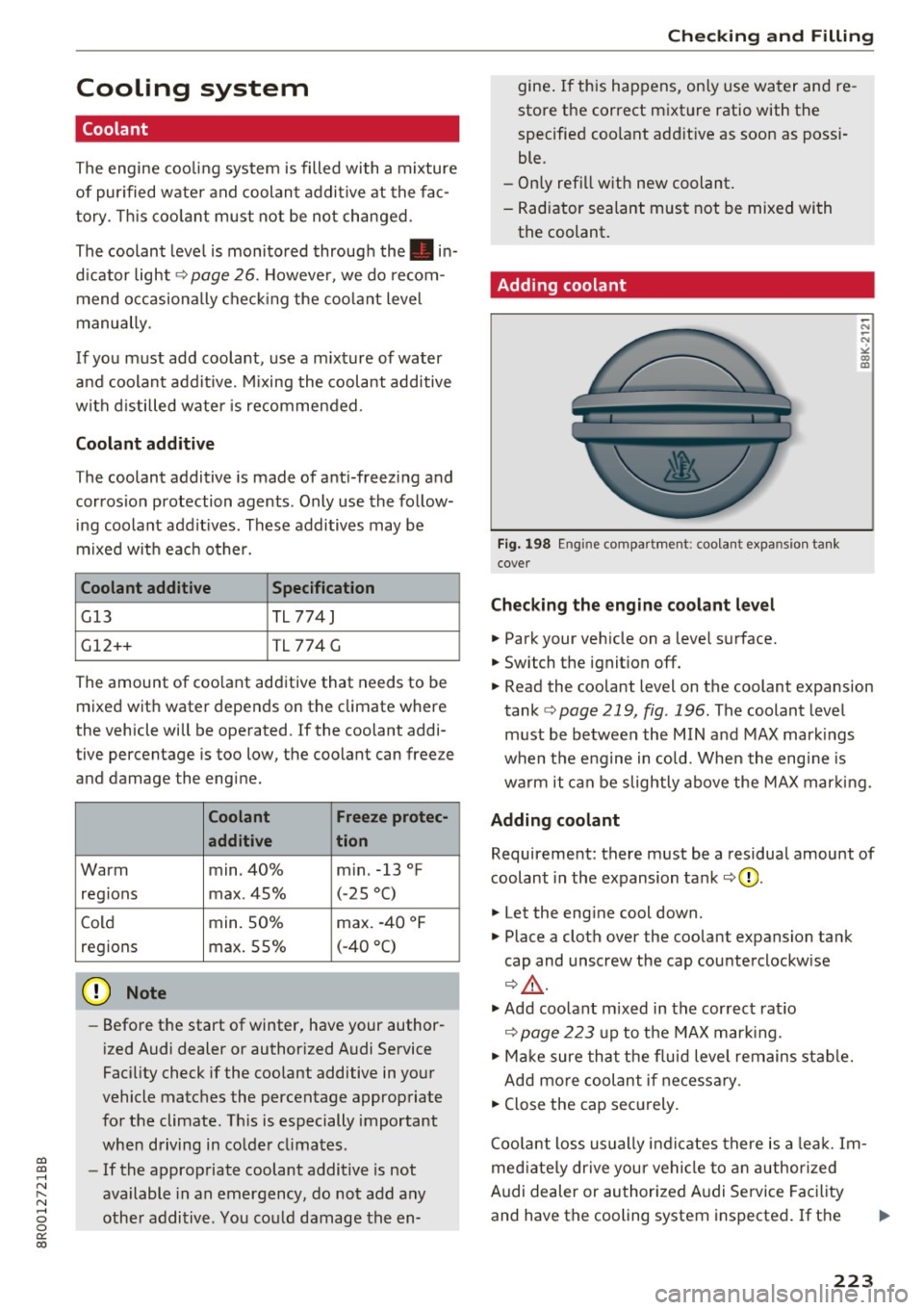
Fig. 198 Engine compartment: coolant expansio n ta nk
cover
Checking the engine coolant level
.,. Park your vehicle on a level surface.
.,. Switch the ignit ion off.
-N
-N
"" CD co
.,. Read the coolant level on the coolant expansion
tank
¢ page 219, fig . 196. The coolant level
must be between the MIN and MAX mark ings
when the engine in cold. When the engine is
warm it can be slightly above the MAX marking.
Adding coolant
Requirement: there must be a residual amount of
coolant in the expansion tank
¢(D .
.,. Let the engine cool down.
.,. Place a cloth over the coolant expansion tank
cap and unscrew the cap counterclockw ise
¢ _& .
.,. Add coo lant mixed in the correct rat io
¢ page 223 up to the MAX marking .
.,. Make sure that the fluid level remains stable.
Add more coolant if necessary .
.,. Close the cap securely.
Coolant loss usually indicates there is a lea k. Im
mediately drive your vehicle to an authorized
Audi dealer or authorized Audi Service Facility
and have the cooling system inspected.
If the
223
Page 226 of 296
Checking and Filling
cooling system is not leakin g, a loss can come
from t he coolant boiling through overheat ing
an d be ing pushed out o f the coo ling system .
A WARNING
-
-The cooling system is under pressure. Do
not open t he coolant expansion tank ca p
when the eng ine is hot. This inc reases the
risk of bu rns .
- The coolant add itive and the coolant can be
dangerous to your health. For this reason,
keep the coolant in the o rigina l container
and away from children. There is a risk of
po isoning .
- When working in the eng ine compartmen t,
r emembe r that the rad iator fan ca n switch
on even if the ign ition is swi tc h ed off, which
in creases the risk of in jury.
(D Note
Do not add coolant if the expansion tank is
empty. Air could enter the cooling system and
damage the engine. If this is the case , do no t
cont inue driv ing. See an authorized Audi deal
er or author ized Audi Se rvice Facility for assis
tance .
Brake fluid
Checking brake fluid level
The brake fluid level can be checked with a quick
glance.
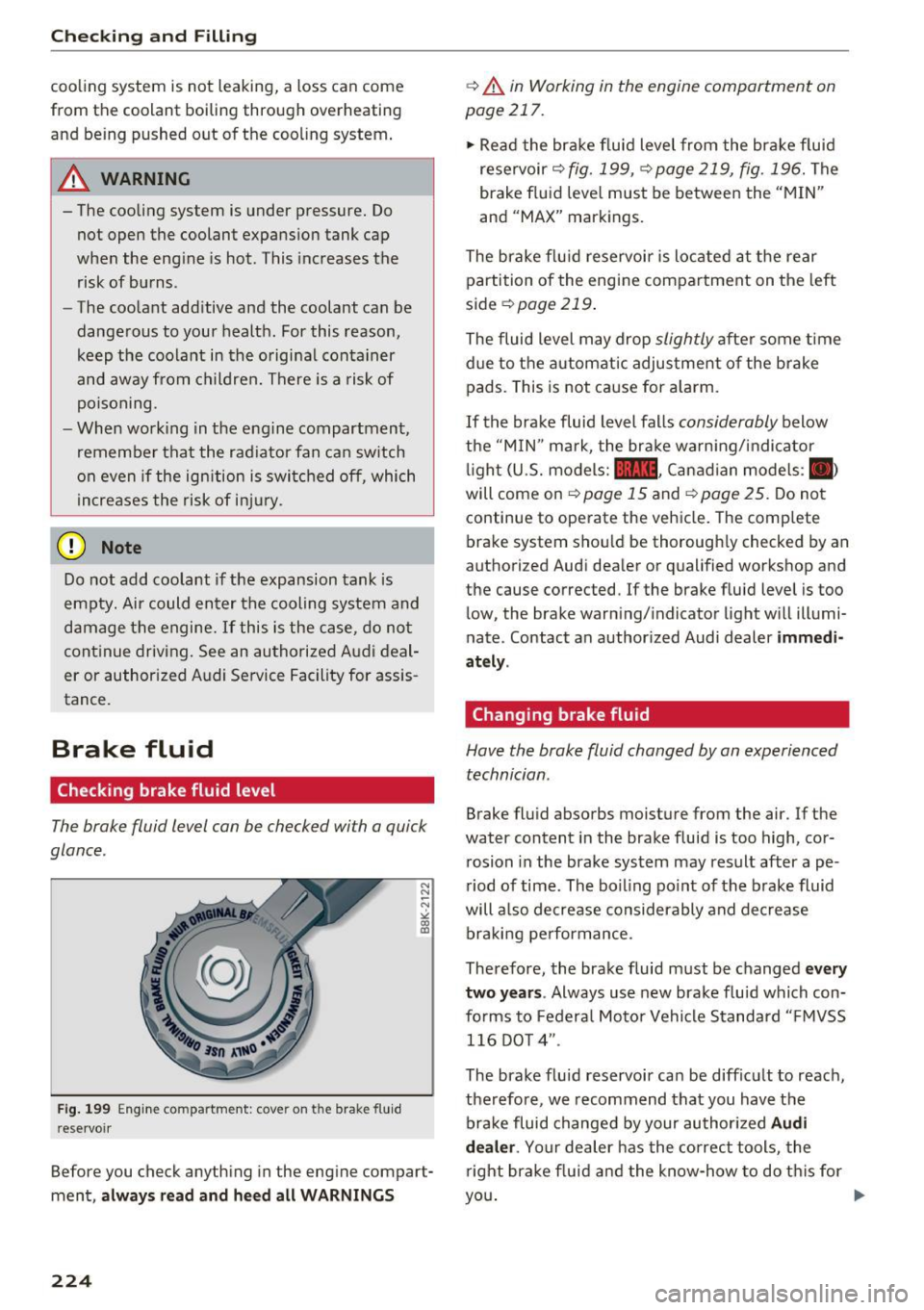
F ig. 19 9 En gi ne co mpa rtme nt: cove r on the brak e fluid
r ese rvoi r
N N
-N
" "' IX)
Before you check anyth ing in the eng ine compart
ment,
a lways read and h eed all WARNING S
224
¢.&. in Working in the engine compartment on
page 217.
.,. Read the bra ke fluid level from the brake f lu id
reservoir ¢
fig. 199, ~ page 219, fig. 196. The
brake fluid leve l must be between the "M IN"
and "MAX" markings.
The brake flu id reservoir is located a t the rear
partition of the engine compartment on the left
side
¢ page 219.
The fluid level may drop slightly afte r some t ime
due to t he automatic adjustme nt of the brake
pads. This is not ca use for a larm.
If the brake fluid level falls considerably below
the
" M IN " mark, the bra ke warn ing/ indica tor
li gh t (U.S. models:
11111 . Canadian models: .
will come on ¢
page 15 and¢ page 25. Do not
continue to ope rate the veh icle. The comp lete
brake system shou ld be thoroughly checked by an
a uthor ized Audi dealer or qualified workshop and
the cause corrected. If the brake fluid level is too l ow, the brake warn ing/ indicator light w ill illumi
nate. Contact a n author ized Audi dealer
immedi
ately .
Chang ing brake fluid
Have the brake fluid changed by an experienced
technician .
Brake fluid absorbs moisture from the air. If the
water content in the brake fluid is too high, cor
rosion in the brake system may result after ape
riod of time . The boiling po int of the brake fluid
will a lso decrease considerably and decrease
bra king pe rformance.
Therefore, the brake fluid must be changed
every
two years .
Always use new brake f lu id which con
fo rms to Federa l Moto r Vehicle S tandard " FMVSS
116 DO T 4".
The brake fluid reservoir can be diff icult to reach,
therefore, we recommend that you have the
brake fluid changed by your author ized
Audi
dealer .
Your dealer has the correct tools, the
right brake fluid a nd the know -how to do t his for
you . ..,.
Page 228 of 296
Check ing and F illing
in the luggage compartment, re ad and heed all
W ARNING S~
A .
Hybr id d rive*: you can find important information
about the h igh vo ltage bat tery unde r
c;>poge 100.
Always heed the s afet y warning s, when working
on the vehicle battery or the vehicle electrical
system to prevent injury .
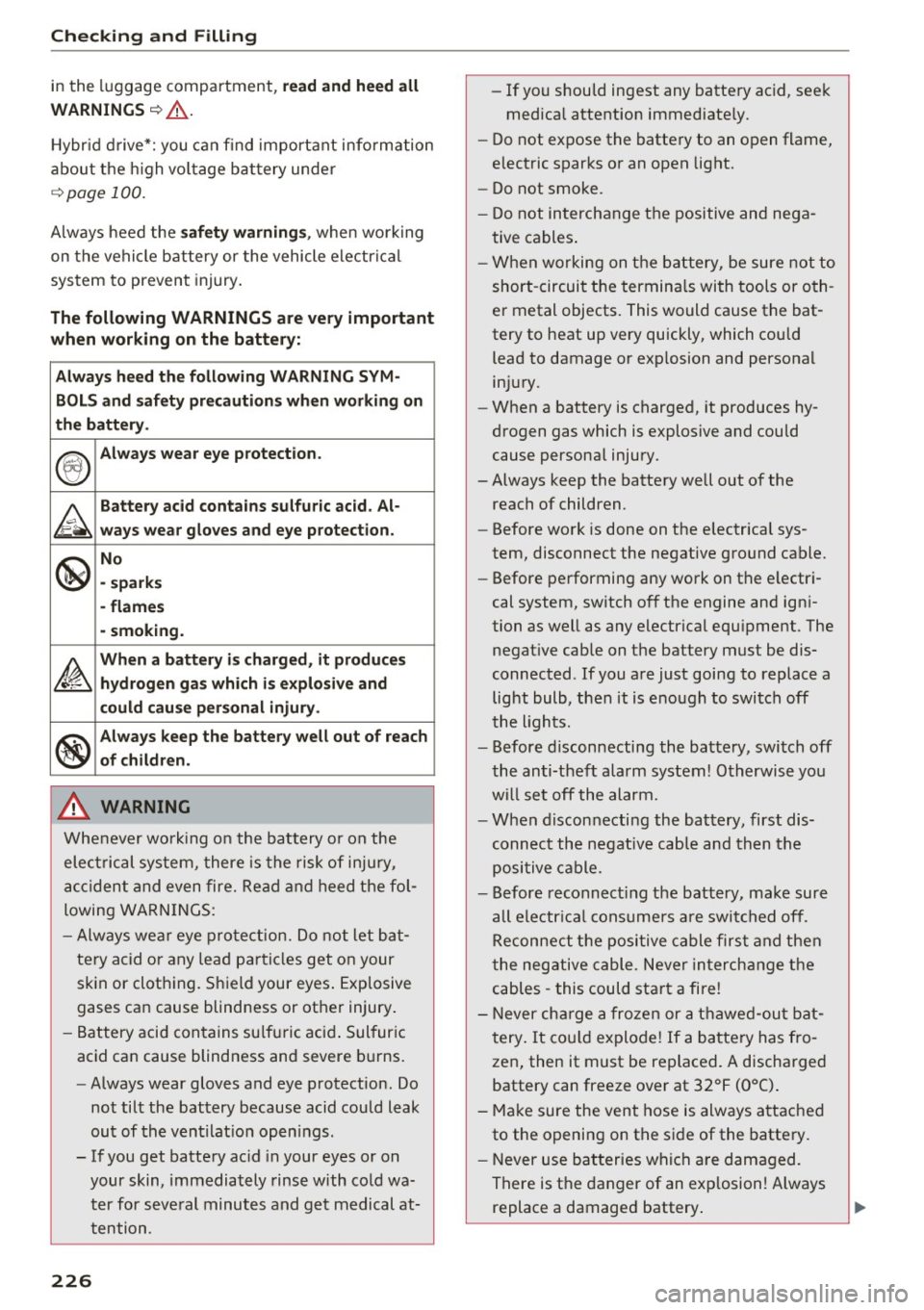
The following WARNINGS are very important
when working on the battery:
A lway s heed the following WARNING SYM-
BOLS and saf ety pr ecautions when working on
the battery.
®
A lway s wear ey e protection .
A
Batter y acid conta ins sulfu ric acid. Al -
w ays wear glo ves and eye p rotection .
.
@
No
- spa rks
- flame s
- smoking.
~
When a battery is charg ed, it produc es
hydrogen gas whi ch is ex pl osi ve and
c o uld cause p ers ona l injury.
®
Alwa ys keep the ba ttery we ll out of rea ch
of child ren.
A WARNING
Whenever work ing on the battery or on the
elect rical system, there is the risk of inju ry,
accident and even fire. Read and heed the fol
lowing WARN INGS:
- Always we ar eye pro tection. Do not let bat
tery acid or any lead particles get on your
skin or clothing. Shield your eyes . Explosive
gases can cause blindness or other injury .
- Battery acid con tains su lfu ric acid . Sulfur ic
acid can cause blindness and severe b urns.
- Always wear gloves and eye protection. Do
not tilt the battery because acid could leak
out of the ventilat ion open ings.
- If you get battery ac id in your eyes or on
your skin, immediately rinse with cold wa
ter for several minutes and get medical at
tention .
226
-If you should ingest any batte ry acid, seek
medical attention immediate ly.
- Do not expose the battery to an open flame,
electric sparks or an open light.
- Do not smoke.
- Do not interchange t he positive and nega -
tive cables .
- When working on t he ba ttery, be sure not to
short -circuit the termina ls with tools or o th
er metal objects. This would cause the bat
tery to heat up very quickly, which could lead to damage or exp losion and personal
injury .
- When a battery is charged, it produces hy
drogen gas which is explosive and could
cause persona l injury.
- Always keep the battery well out of the
reach of children.
- Before wo rk is done on the electrical sys
tem, disconnect the negative ground cable.
- Before performing any work on the e lectri
cal system, sw itch off the engine and ign i
tion as well as any electrical equ ipment. The
negat ive cab le on the battery must be dis
connected . If you a re just going to replace a
light bulb, then it is enough to switch off
the l ights.
- Before d isconnecting the battery, switch off
the anti-theft alarm system ! Otherwise you
will set off the alarm.
- When disconnecting the battery, first dis
connect the negative cable and then the
positive cable.
- Before reconnect ing the battery, make sure
all electr ica l cons umers a re switched off.
Reconnect the positive cable firs t and then
the negative cable . Never in terchange the
cables -this could start a fire !
- Never cha rge a fro zen or a t hawe d-ou t bat
tery . It co uld explode! If a ba tte ry has fro
ze n, then it must be replaced. A discharged
battery can freeze over at 32°F (0°() .
- Ma ke sure the vent hose is always attached
to the opening on the side of the battery .
- Never use bat teries which a re damaged.
There is the danger of an exp losion! Always
replace a damaged battery .
Page 229 of 296
a,
a,
..... N
" ('I ..... 0 0
0:
co
,&_ WARNING
California P roposition 65 Warn ing :
- B attery posts, termi na ls and re lated acces
sories contain lead and lead compounds,
chemicals known to the State of California
to cause cancer and reproductive problems.
Wash hands after handling.
(D Note
- Do no t disconnect the ve hicle bat tery when
t h e ignit ion is switched on or when the en
gine is runni ng, otherwise, you w ill damage
electron ic components in the e lectr ica l sys
tem.
- If your vehicle is going to stan d for a long
period of time without be ing driven, protect
the battery from "freez ing", otherwise it
will be damaged a nd will then have to be re
placed .
Battery charging
Starting the engine requires a well charged bat
tery .
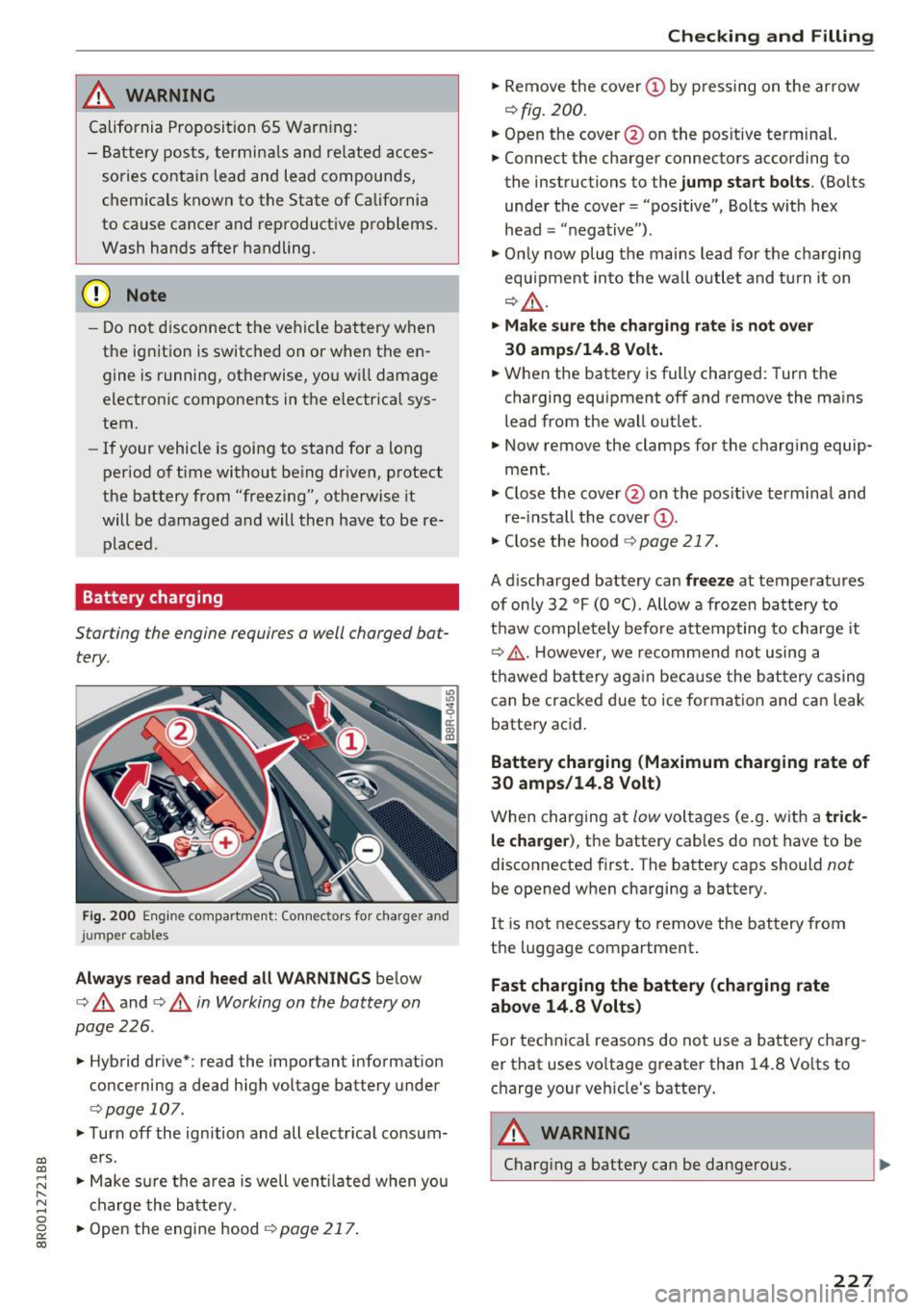
Fig. 200 Engin e co mpartme nt: Co nnectors for charger and
j um per ca bles
Always read and heed all WARNINGS below
c> & and <=> & in Working on the battery on
page 226 .
.. Hybrid dr ive*: read the important i nformation
co ncerning a dead high voltage battery under
<=> page 107.
.. Turn off the ignition and all e lectr ica l consum
ers.
.. Make s ure the a rea is well vent ilated w hen you
c harge the b attery.
.. Open the engine hood
c> page 217 .
Checking and Filling
.. Remove the cover@ by pressing on the arrow
<=>fig . 200.
.. Open the cover @on the pos itive terminal.
.. Connect the charger connecto rs according to
the instructions to the
jump start bolts . (Bolts
under the cover = "positive" , Bolts w ith hex
head = "n egative ").
.,. Onl y now plug the mains lead for the cha rgi ng
equ ipme nt in to the wa ll ou tlet and turn it on
<=> & .
.. Make sure the charging rate i s not over
30 amps/14.8 Volt.
.. When the battery is fully charged: Turn the
charging equ ipment off and remove the ma ins
lead from the wall out let .
.,. Now remove the clamps for the charg ing equip
ment .
.,. Close the cover @on the pos it ive termina l and
re- insta ll the cover
(D .
.,. Close the hood c> page 217.
A d ischarged battery can freeze at temperat ures
of on ly 32 °F (0 °C). Allow a frozen batte ry to
t h aw comple tely before attempting to charge it
c> .&, . However, we recommend not using a
t h awe d batt ery ag ain be ca use the bat tery ca sing
can be cracked due to ice formation and ca n leak
batte ry ac id.
Battery charging (Maximum charging rate of
30 amps/14.8 Volt)
W hen charging a t low voltages (e.g . w ith a trick
le charger ),
th e battery cables do not have to be
disconnected first. The battery caps should
not
be opened when cha rging a battery.
It is no t necessary to remove the bat tery from
the luggage compartment .
Fast charging the battery (charging rate
above 14 .8 Volts)
F or technical rea sons do not use a batte ry charg
er that uses vo ltage greater than 14.8 Vo lts to
c h arge your veh icle's battery .
A WARNING
-Charging a battery can be dangerous.
227
Page 230 of 296
Checking and Filling
-Always follow the operating instructions
provided by the battery charger manufactur
er when charging your battery.
- Never charge a frozen battery . It may ex
plode because of gas trapped in the ice. Al
low a frozen battery to thaw out first.
- Do not reuse batteries which were frozen .
The battery housing may have cracked and
weakened when the battery froze .
- Charge the battery in a well ventilated area.
Keep away from open flame or electrical
spark . Do not smoke. Hydrogen gas generat
ed by the battery is explosive .
- To reduce the danger of explosion, never
connect or disconnect charger cables while
the charger is operating .
- Fast charging a battery is dangerous and should only be attempted by a competent
technician with the proper equipment .
- Battery acid that may spill during charging should be washed off with a solution of
warm water and baking soda to neutralize
the acid.
(D Note
Never use a fast charger as a booster to start
the engine. This will seriously damage sensi
tive electronic components, such as control
units , relays , radio, etc., as well as the battery
charger.
Battery replacement
The new battery must have the same specifica
tions and dimensions as the original equipment
battery.
Intelligent energy management in your vehicle is
responsible for distributing the electrical energy
throughout your vehicle
~ page 192. The intelli
gent energy management system will keep the
engine battery charged better then vehicles with
out this system. To mak e sure the additional
electrical energy is available once again after you
have changed the battery, we recommend that
you install batteries of the same type and manu facture only (the same as those installed at the
time your vehicle was delivered) . Specifications
228
are listed on the battery housing. Your author
ized dealer must cod e the battery in the energy
management system to enable you to use the en
ergy management functions correctly after re
placing the battery.
If it is not possible to use a battery of this type,
the new battery must have the same capacity,
voltage (12 volts), amperage, construction and plug sealing.
When installing the battery, make sure the igni
tion and all electrical consumers are turned off.
([) Note
- Make sure the ventilation hose on the side
of the battery is connected, otherwise
fumes or battery acid can leak out.
- Vehicles with the Start-Stop-System* are
equipped with a special cycle-proof AGM
battery. Installing a different type of bat
tery can cause problems in the vehicle elec
trical system. When replacing the vehicle battery, always install one with the same
specifications as the original battery.
@ For the sake of the environment
Because of the problem of proper disposal of
a battery, we recommend your authorized
Audi dealer change the battery for you. Bat
teries contain sulfuric acid and lead and must
always be disposed of properly in compliance
with all environmental regulations. Disposing
of vehicle batteries improperly is
very danger
ous to the environment.
Page 231 of 296
a,
a,
.... N r-N .... 0 0
0:
co
Windshield/headlight washer container
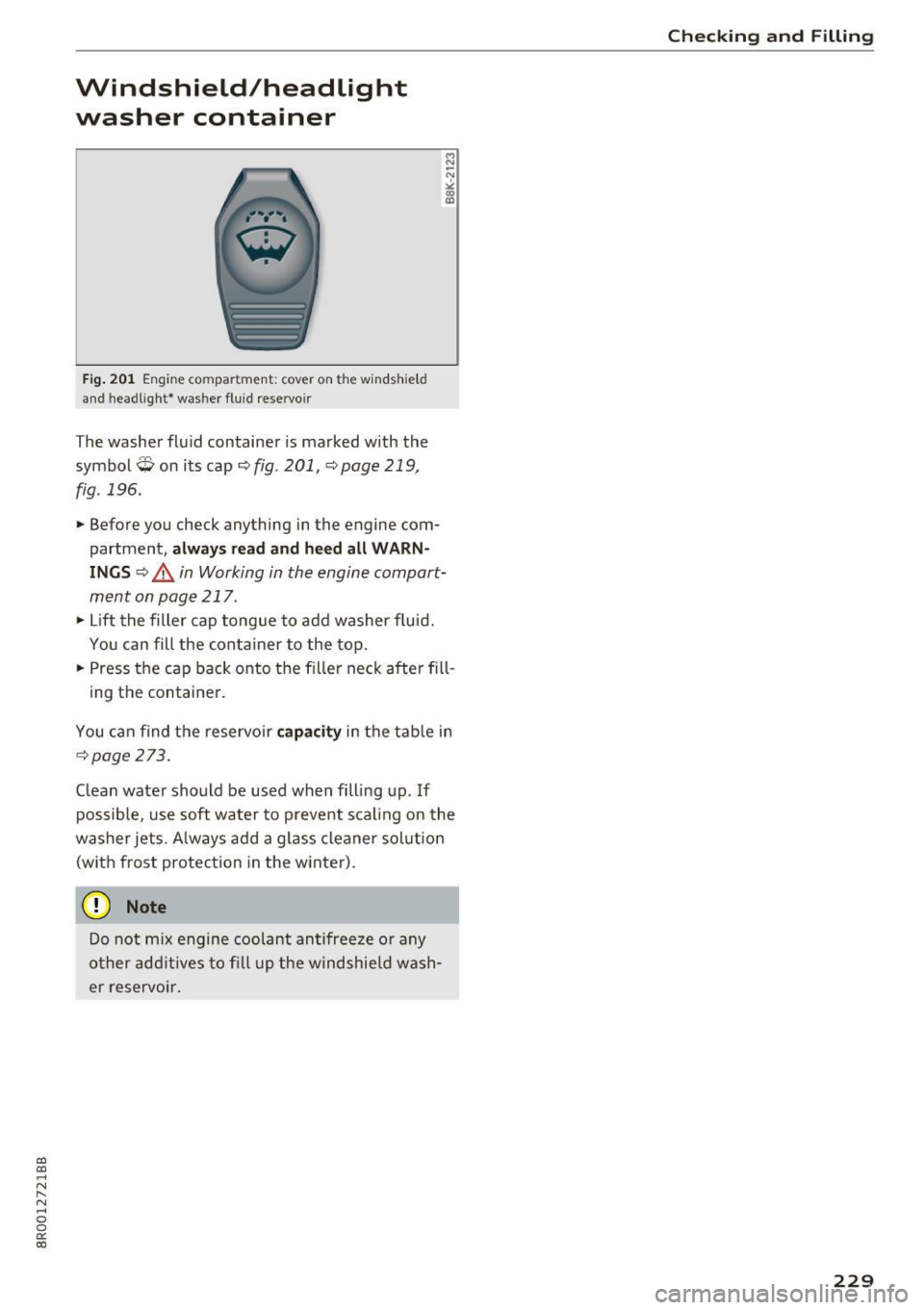
Fig. 201 Engine co mpartment: cover on t he windshie ld
an d h eadligh t* was her fluid reservo ir
The washer fluid container is marked with the
symbol
Q on its cap ¢ fig. 201, ¢ page 219,
fig . 196.
M N
-N ~ a, a,
• Before you check anything in the engine com
partment ,
always read and heed all WARN
INGS ~&, in Working in the engine compart
ment on page 217.
• Lift the filler cap tongue to add washer fluid.
You can fill the container to the top.
• Press the cap back onto the filler neck after fill -
ing the container.
You can find the reservoir
capacity in the table in
¢page 273.
Clean water should be used when filling up. If
possible, use soft water to prevent scaling on the
washer jets . Always add a glass cleaner solution
(with frost protection in the winter).
(D Note
Do not mix engine coolant antifreeze or any
other additives to fill up the windshield wash
er reservoir.
Checking and Filling
229
Page 244 of 296
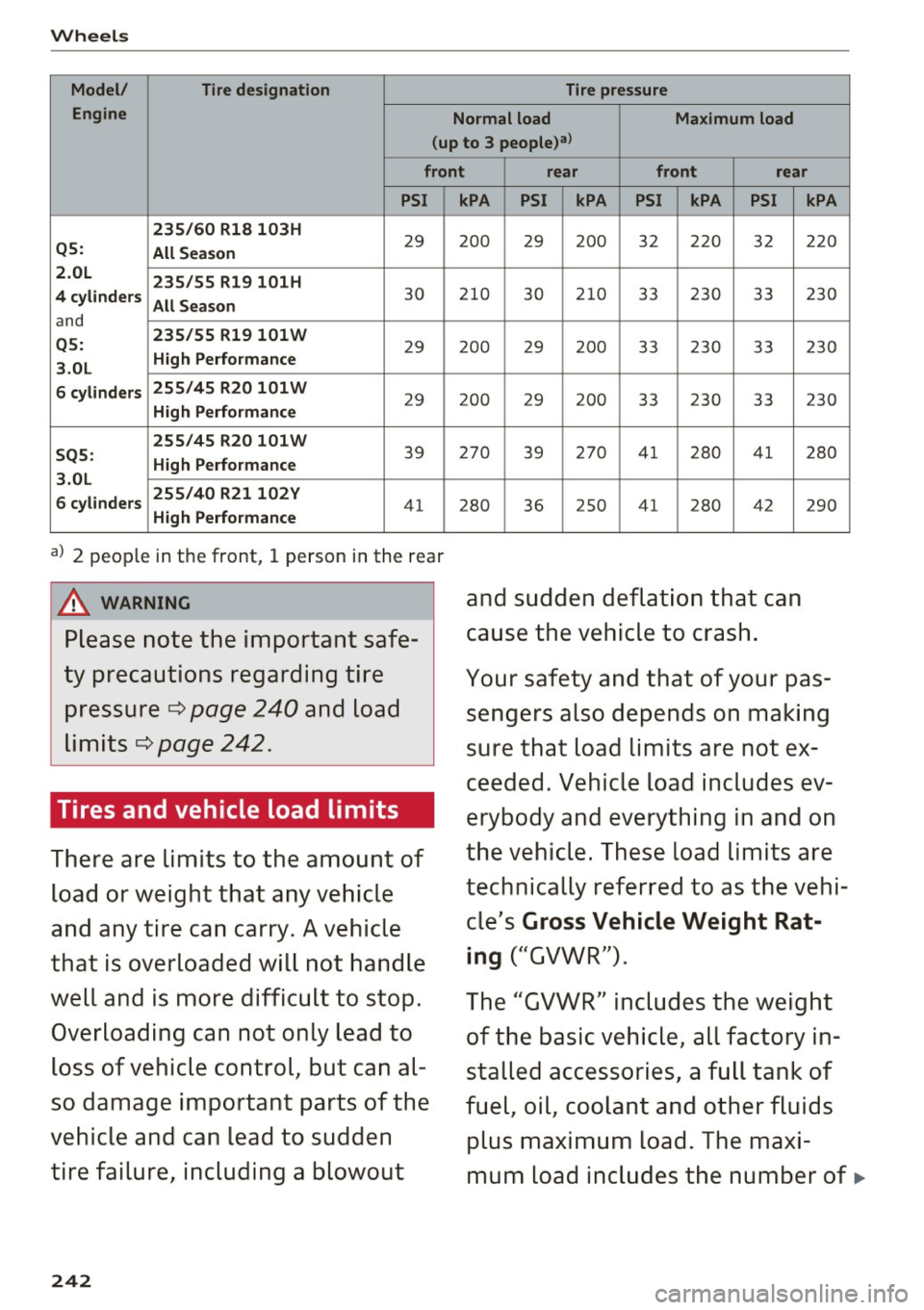
Wheels
Model/ Tire designation Tire pressure
Engine Normal load
Maximum load
(up to
3 people)a)
front rear front rear
PSI
235/60 Rl8 103H
29 Q5:
All Season
2.0L 235/55 Rl9 101H
4 cylinders
All Season
30
and
Q5: 235/55 Rl9
101 W 29 High Performance
3.0L
6 cylinders 255/45 R20 101W
29 High Performance
255/45R20101W
39 SQ5:
High Performance
3.0L
6 cylinders 255/40
R21102Y
41 High Performance
a) 2 people in the front, 1 perso n in the r ear
A WARNING
Please note the important safe
ty precautions regarding tire pressure ¢
page 240 and load
limits ¢
page 242.
Tires and vehicle load limits
There are limits to the amount of
load or weight that any vehicle
and any tire can carry . A vehicle
that is overloaded will not handle
well and is more difficult to stop.
Overloading can not only lead to
loss of vehicle control, but can al
so damage important parts of the
vehicle and can lead to sudden
tire failure, including a blowout
242
kPA PSI kPA PSI kPA PSI
200 29 2 00 32 220 32
210 30 210 33 230 33
200 29 200 33 230 33
2 00 29 2 00 3 3 230 33
270 39 270 41 280 41
2 80
36 2
50 41
28 0 42
and sudden deflation
that can
cause the vehicle to crash.
kPA
220
230
230
230
280
2 9 0
Your safety and that of your pas
sengers also depends on making
sure that load limits are not ex
ceeded. Vehicle load includes ev
erybody and everything in and on
the vehicle. These load limits are
technically referred to as the vehi
cle's
Gross Vehicle Weight Rat
ing
("GVWR") .
The "GVWR" includes the weight
of the basic vehicle, all factory in
stalled accessories , a full tank of
fuel, oil, coolant and other fluids
plus maximum load. The maxi
mum load includes the number of
11-
Page 252 of 296
Emerg ency assis ta nce
Emergency assistance
Vehicle jack, vehicle tool kit and collapsible spare
tire
Onboard tool kit and vehicle jack
The vehicle tools and vehicle jock* ore stored in
the luggage comportment under the floor cover.
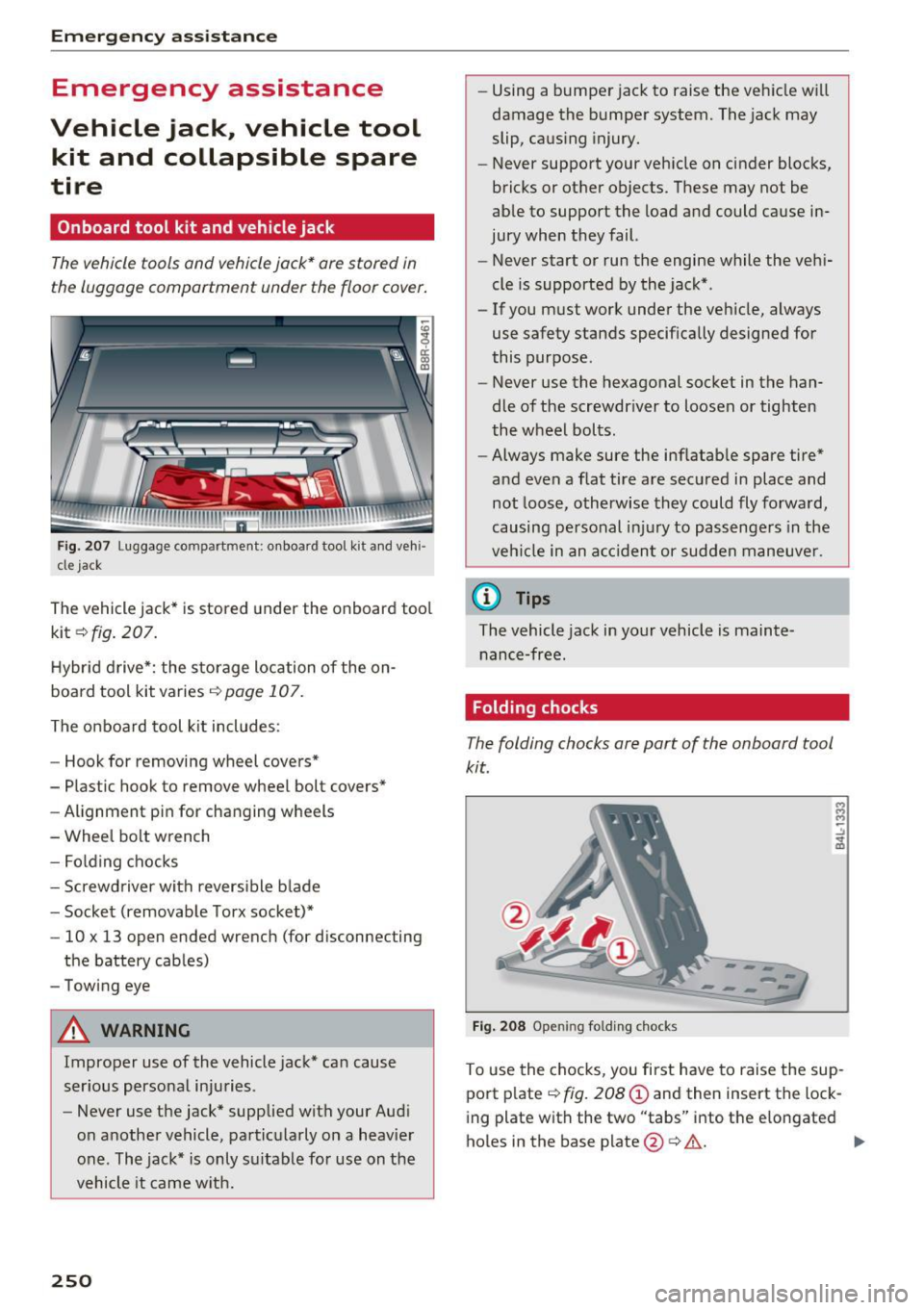
Fig. 207 Luggage compartment: on board tool kit and vehi
cle jack
The vehicle jack* is stored under the onboard tool
kit ¢ fig. 207.
Hybr id d rive*: the storage location of the on
board tool kit varies
r:!) page 107.
The onboard tool k it includes:
- Hook for removing wheel covers*
- Plastic hook to remove wheel bolt covers*
- Alignment pin for changing wheels
- Wheel bolt wrench
- Folding chocks
- Screwdriver with revers ible blade
- Socket (removable Torx socket)*
- 10 x 13 open ended wrench (for disconnecting
the battery cables)
- Towing eye
A WARNING
Improper use of the vehicle jack* can cause
ser ious personal injuries.
- Never use the jack* supplied with your Aud i
on another vehicle, particularly on a heavier
one. The jack* is only su itable for use on the
vehicle it came w ith.
250
- Using a bumper jack to raise the vehicle will
damage the bumper system. The jack may
slip, caus ing injury.
- Never support your vehicle on cinder blocks,
bricks or other objects. These may not be
able to support the load and could cause in
jury when they fail.
- Never start or run the engine while the vehi
cle is supported by the jack* .
- If you must work under the vehicle, always
use safety stands specifically designed for
this purpose.
- Never use the hexagonal socket in the han
dle of the screwdr iver to loosen or tighten
the wheel bolts .
- Always make sure the inflatab le spare tire*
and even a flat tire are secured in place and
not loose, otherwise they could fly forward,
causing personal inj ury to passenge rs in the
vehi cle in an a cc ident or sudden maneuve r.
@ Tips
The vehicle jack in your vehicle is mainte
nance-free.
Folding chocks
The folding chocks ore port of the on board tool
kit .
---
Fig . 208 Open ing fo lding chocks
To use the chocks, you fi rst have to raise the sup
port plate
¢ fig. 208 (D and then insert the lock
ing plate with the two "tabs" into the elongated
holes in the base plate
@ c> &.. .,,_
Page 257 of 296
CD
CD
.... N ,-... N ..... 0 0 C<'. 00
(D Note
Special care is required if you are repairing
the tire on a steep incline.
@ Tips
- Do not operate the compressor for more
than 12 minutes continuously, otherwise it
can overheat. Once the compressor has
cooled, you can continue to use it.
- If sealant has spi lled out, let it dry and then
you can remove it by peeling it away like a
foil.
- Remember to obtain a new bott le of sealant
from your authorized Audi dealer after re
pair ing a tire. After this, the functionality of
the tire repair set is restored .
- Obey all laws.
Replacing wheels
Before changing a wheel
Observe the following precautions for your own
and your passenger's safety when changing a
wheel.
"" After you experience a tire failure, pull the car
well away from moving traff ic and try to reach
level ground before you stop¢_& .
.. All passengers sho uld
leave the car and move
to a safe location (fo r instance, behind the
guardrai l) ¢ .&_ .
.. Engage the
par king b rake to prevent yo ur vehi
cle from roll ing unintentionally ¢&_ .
.. Move
selecto r le ver to po sitio n P ¢ &_ .
"" If you are towing a trailer: unh itch the trailer
from your veh icle.
"" Block the diagonally opposite wheel with the
folding chocks o r other objects .
""T ake the
jac k* and the inflatable spa re tir e*
out of the luggage compartment¢ page 250 .
A WARNING
You or your passengers cou ld be inj ured while
changing a wheel if you do not follow these
safety precautions:
- If you have a flat tire, move a safe distance
off the road. Turn off the engine, turn the
Em ergenc y ass is tanc e
emergency flashers on and use other wa rn
ing dev ices to alert other motorists.
- Make sure that passengers wait in a safe
place away from the vehicle and well away
from the road and traff ic.
- To help prevent the veh icle from moving
suddenly and possib ly slipping off the jack*,
always fully set the parking brake and block
the wheel diagonally opposite the wheel be i n g changed with the fold ing c hocks or oth
er objects . When one front whee l is lifted
off the ground, placing the Automatic
Transmission in P (Park) w ill
not prevent the
veh icle from moving.
- Before you change a wheel, be sure the
gro und is leve l and firm.
If necessary, use a
sturdy board under the jack*.
- Always s tore the vehicle too l kit, the jack*
and the replaced tire in the lugg age com
partment
¢ page 136.
Changing a wheel
When you change a wheel, follow the sequence
described below s tep-by -step and in exactly that
order.
1. Remove the de corative wheel cover* . For
more detai ls see also
¢page 256, Decaro-
tive wheel covers
o r r::!> poge 256, Wheels
with wheel bolt cops .
2. Loosen the w
heel bolts¢ page 256 .
3. Locate the proper mounting point for the
jack* and align the jack* below that point
¢ page 257.
4. Li ft the car with the jack*¢ page 257.
s. Remove the wheel with th e flat tire and then
insta ll the
inflatable spar e tire*
¢ page 258.
6. Tighte n all whee l bolts lightly.
7 .
Lo wer the vehicle wi th the jack *.
8 . Use the whee
l bolt wrench and
firml y tighten
all wheel bo lts
r::!> poge 256 .
9. Replace the decorat ive wheel co ver* .
255
...
Page 264 of 296
Fuses and bulbs
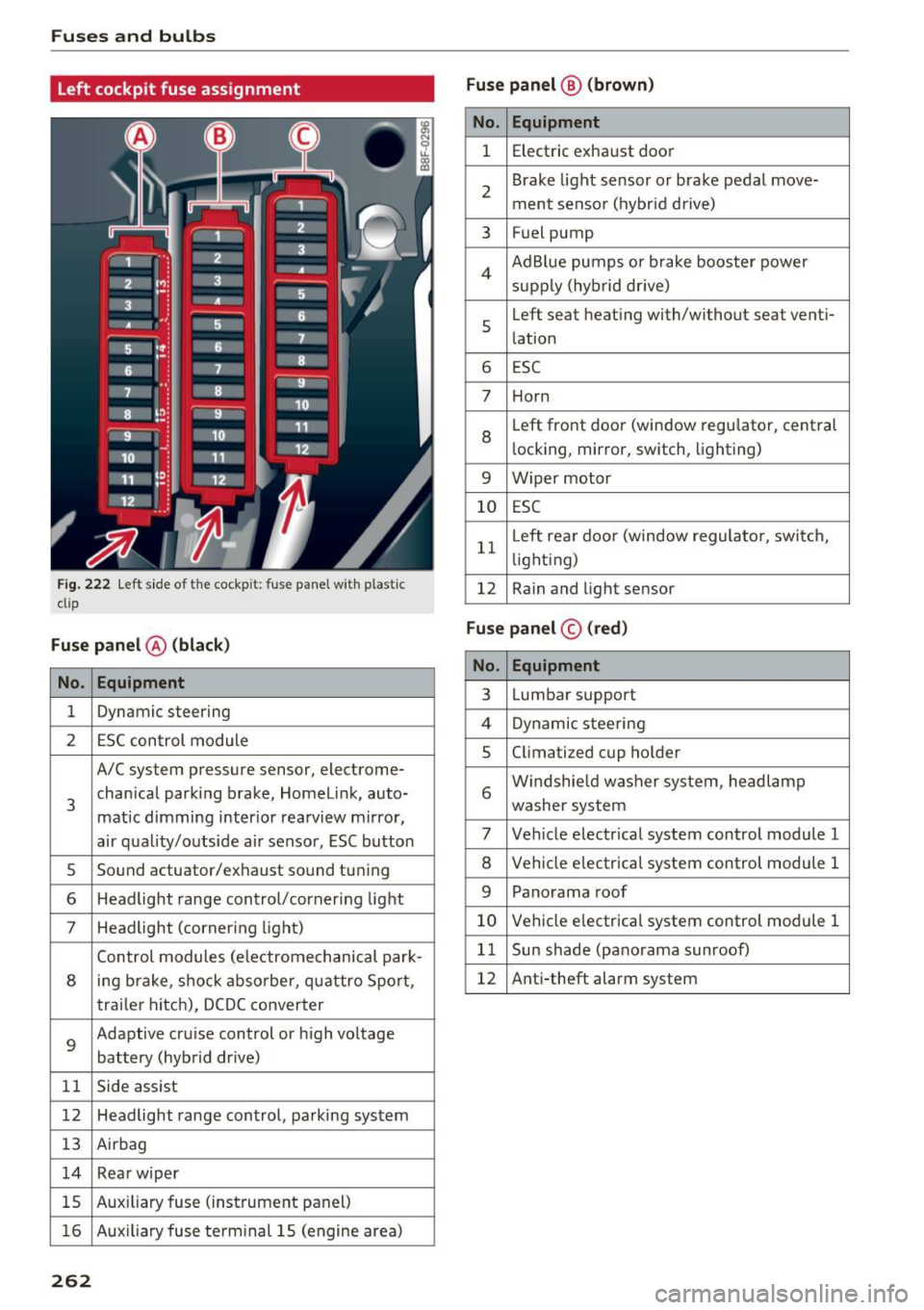
Left cockpit fuse assignment
Fig. 222 Left side of the cockp it: fuse panel with p lastic
clip
Fuse panel @ (black)
No . Equipment
1 Dynamic steering
2 ESC control module
A/C system pressure sensor, electrome-
3 chanical parking
brake, Homelink, auto-
matic dimming interior rearview mirror,
air quality/outside air sensor, ESC button
s Sound actuator/exhaust sound tuning
6 Headlight range control/corner ing light
7 Headlight (cornering light)
Control modules (electromechanical park-
8 ing brake, shock absorber, quattro Sport,
trailer hitch), DCDC converter
9
Adaptive cruise control or high voltage
battery (hybrid dr ive)
11 Side assist
12 Headlight range control, parking system
13 Airbag
14 Rear wiper
15 Auxiliary
fuse (instrument panel)
16 Auxiliary fuse te rm inal 15 (engine area)
262
Fuse panel ® (brown)
No. Equipment
1 Electric exhaust door
2 Brake
light sensor or brake pedal move-
ment sensor (hybrid drive)
3 Fuel pump
4 Ad
Blue pumps or brake booster power
supply (hybrid dr ive)
s
Left seat heating with/without seat venti-
lation
6 ESC
7 Horn
8
Left front doo r (window regulator, central
locking, mirror, switch, lighting)
9 Wiper motor
10 ESC
11 L
eft rear doo r (window regulator, switch,
li ght ing)
12 Rain and light sensor
Fuse panel
© (red)
No. Equipment
3 Lumbar support
4 Dynamic steering
5 Climatized cup holder
6 Windshie
ld washer system, headlamp
washer system
7 Vehicle electrical system control module 1
8 Vehicle electrical system control module 1
9 Panorama roof
10 Vehicle electrical system control module 1
11 Sun shade (panorama sunroof)
12 Anti-theft alarm system