engine AUDI Q5 2017 Workshop Manual
[x] Cancel search | Manufacturer: AUDI, Model Year: 2017, Model line: Q5, Model: AUDI Q5 2017Pages: 296, PDF Size: 74.43 MB
Page 124 of 296
Audi drive select
Audi drive select
Drive settings
Introduction
Applies to: vehicles with Audi drive select
Drive select provides the possibility to experience
d ifferent types of vehicle settings in one veh icle.
F or instance, using the three
Comfort, Auto and
Dynamic modes, the driver can switch from a
sporty to a comfortable driving mode with the
press of a button.
Addit ionally, in vehicles with MM I*, the vehicle
setup for Individual* mode can be customized by
you. This makes it possible to combine settings such as a sporty engine tuning with comfortable
steering .
A WARNING
-
Improper use of the drive select can cause
collisions, other accidents and serious person
al injury .
Description
Applies to: vehicles with Audi drive select
The vehicle setup in each mode depends on the
veh icle's features . However, the engine, auto
mat ic transmission and steering are a lways in
volved.
Engine and automatic transmission
Depending on the mode, the engine and the au
tomatic transmission respond quicker or in a
more balanced manner to accelerator pedal
movements . In the sporty dynamic mode, the au
tomatic transmission shifts at higher RPMs.
Steering
The steering adapts in terms of steering effort
and steering ratios. Indirect steer ing that moves
easi ly, like the steering in comfort mode, is best
suited to long drives on a highway. In contrast,
dynamic mode provides sporty, direct steering.
The follow ing applies to vehicles with dynam ic
steer ing*: the stee ring rat io changes based on
veh icle speed in order to ma inta in optim um
steer ing effort for the driver at all times. This
122
sets the steering to be less sensitive at higher
speeds in order to provide improved vehicle con
tro l. At reduced speeds, however, steering is
more direct in order to keep the steering effort as
minimal as possible when the driver is maneuver
ing the vehicle . At low and average speeds, dy
nam ic steering addit ionally prov ides more re
spons ive steering performance .
Adaptive dampers*
The adaptive dampers* use sensors to record in
formation regarding steering movements, brak ing and acceleration operations by the driver,
road surface, driving speed, and load . This makes
i t possible to adapt damp ing to the driving situa
tion virtually in real time . Drive select also makes
i t possible to sat isfy the desire for sporty suspen
sion (Dynamic) and comfortable suspension
(Comfort) without giving up balanced tuning (Au
to).
Engine sound*
The sound of the eng ine is adapted to the select
ed mode and ranges from subtle to sporty.
Adaptive cruise control*
The behavior whe n accelerating can be adjusted
from comfortable to sporty, depending on the
drive select mode. Adaptive cruise control also
r esponds to the driv ing behavior of the vehicle
ahead in a more conservative or sporty manner .
(D Tips
- In some models, the maximum vehicle
speed can only be reached in the
Auto and
Dynamic modes.
- Selecting the
Dynamic mode results in spo r
ty shifting characteristics. The S gear posi
tion engages automatically.
- In veh icles that have dynamic steering*, op
erating noise is heard when starting or stop
ping the engine. This does not indicate a
prob lem.
Page 125 of 296
a,
a,
..... N r-N ..... 0 0
0:
co
Selecting the driving mode
App lies to: vehicles wit h Audi drive select
You con choose between Comfort, Auto, Dynam
ic and Individual* modes .
«>
~ 9
c:=====::::;: ~ a,
drive I I r.,. select _ - ~
Fig. 138 Center conso le: Co ntrol for drive se lect
Fig. 139 MMI*: Audi drive select
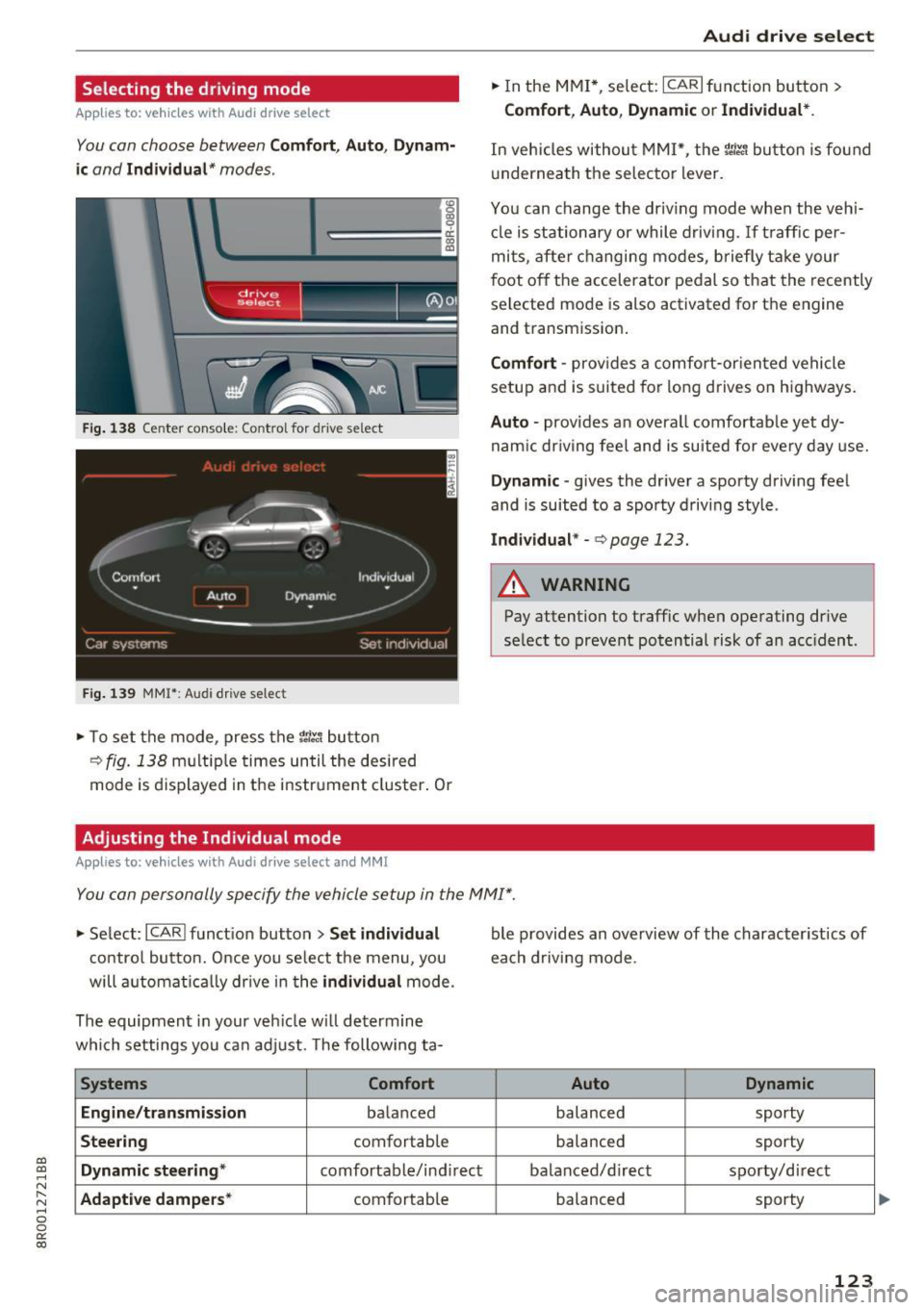
... To set the mode, press the r:i~ button
c>fig. 138 multip le times until the desired
mode is displayed in the instrument cluster. Or
Adjusting the Individual mode
Applies to: vehicles with Audi drive select and MMI
Audi drive select
... In the MMI*, select: ICARlfunction button>
Comfort , Auto , Dynamic or Individual*.
In vehicles without MMI*, the rn~, button is found
underneath the selector lever.
You can change the driving mode when the veh i
cle is stationary or while driving.
If traff ic per
mits, after changing modes, briefly take your
foot off the accelerator pedal so that the recently
selected mode is also activated for the engine
and transmission .
Comfort -provides a comfort-or iented vehicle
setup and is suited for long drives on highways.
Auto -provides a n overal l comfortab le yet dy
namic driving feel and is suited for every day use.
Dynamic -gives the driver a sporty driving feel
and is suited to a spo rty driving style .
Individual* -c> poge 123.
A WARNING
-Pay attention to traffic when operating drive
se lect to prevent potential risk of an acc ident.
You can personally specify the vehicle setup in the MMI" .
... Se lect: I CARI function button > Set individual
control button. Once you se lect the menu, you
will automatically drive in the
individual mode .
The equipment in your vehicle will determine
which settings you can adjust. The following ta-
Systems Comfort
Engine/transmission
ba lanced
Steering comfortab le
Dynamic steering* comfortable/ind irect
Adaptive dampers * comfortable ble
provides an overview of the character istics of
each driving mode.
Auto Dynamic
balanced sporty
balanced sporty
balanced/d irect sporty/direct
balanced sporty
123
Page 126 of 296

Audi drive select
Systems Comfort
Engine sound*
subtle
Adaptive cruise control* comfortable
•> Subtle i n th e dr iv ing position D and spo rty in th e driving posit ion S .
(D Tips
Your Individual mode settings are automati
cally stored and assigned to the remote con
trol key being used.
124
Auto Dynamic
subtle/sportyal sporty
balanced sporty
Page 188 of 296
Intelligent Technology
Intelligent Technology
Electronic Stabilization
Control (ESC)
Description
The Electronic Stabilization Control (ESC) reinfor
ces driver safety . It reduces the risk of slipping
and improves driving stability. ESC detects crit i
cal s ituations such as the vehicle oversteering
and understeering or the wheels sp inning. The
veh icle is stab ilized by applying the brakes or re
ducing engine torque . Once t he ESC is active, the
indicator light
Ji) blinks in t he instrument clus
ter.
The fo llow ing systems are integrated in the ESC :
Ant i-loc k brake system (ABS)
ABS preve nts the wheels from locking up when
braking. The veh icle can still be steered even dur
ing hard brak ing. Apply steady pressure to the
brake pedal. Do not pump t he pedal. A pulsing in
the brake pedal indicates that the system is help
i n g you to brake the vehicle .
Br ake assist system
The brake assist system can decrease brak ing dis
tance . It increases braking power when the driver
presses the brake pedal quick ly in emergency sit
uations . You must press and hold the b rake pedal
until the situa tion is over. In vehicles w it h adap
tive c ruise contro l* , the brake assist system is
mo re sensit ive if the di stance de te cte d to the ve
h icle ahead is too small.
Anti -slip regulation (ASR)
ASR reduces eng ine power when the drive wheels
begin to spin and adapts t he force to the road
conditions . This makes it easie r to sta rt, acceler
ate and dr ive up h ills.
Electronic differential lock (EDL )
The EDL brakes w heels that a re spinning and
transfers the drive power to the other whee ls .
This f unction is not avai lab le at higher speeds.
In extreme cases, EDL automatically switches off
to help keep the brake on the braked wheel from
186
overheating . EDL will sw itch on again automati
ca lly when conditions have returned to normal.
Steering recommendation
The ESC he lps to s tabilize the vehicle by chang ing
t h e s teer ing torque.
On vehicles with dynam ic steeri ng*, ESC helps
stab ilize the steer ing in crit ica l sit uat io ns.
Selective wheel torque control
Se lective wheel torque cont rol is used when driv
i ng on curves. The front whee l on the inside of
the curve or both wheels on the inside of the cu rve are braked se lectively as needed. This al
l ows mo re precise dr iving in c urves . The applica
ble system may not ac tiv ate when d riving in wet
o r snowy cond it ions.
_&. WARNING
- The ESC and i ts in teg ra ted systems can not
overcome the laws of physics . This is espe
cially important on slippery or wet roads. If
the systems begin act ing to stab ilize your
veh icle, you should immediately change
your speed to match the road and traffic conditions. Do not let the increased safety
provided by t hese systems tempt yo u to
take risks. Doing so will i ncrease the r isk of
a loss of vehicle con trol, collisi on and se ri
ous person al injur ies.
- Always a dapt your speed to road, traffic and
weather condi tions. The risk of los ing c on
t rol of the vehicle in creases w hen driving
too fast, es pecially through curves and on
slippe ry or wet roads, and when driving too
close to ve hicles up ahead. The ESC and its
integ rated systems cannot always prevent
col lisions - there is still a risk of accidents!
- Always accelerate w ith special care on even,
smooth su rfaces s uch as those that are wet
or covered wit h ice and snow. The drive
wheels can spin even w it h these assistance
sys tems t hat cannot a lways help to reduce
t he risk of loss of vehicle co ntro l.
Page 189 of 296
a,
a,
..... (',J r-(',J ..... 0 0
0:
co
@ Tips
-ABS and AS R on ly work correctly when a ll
fo ur whee ls are e quipped w ith identical
tires. Different tire sizes can lead to a reduc
tion in eng ine power.
Switching on/off
Intelligent Technology
- You may hear noises when the sy stems de
scribed a re worki ng .
- Whe n in st alling a factory -s up plied roo f ra ck
system o n the roof ra iling, the ESC wi ll
adapt itself to a different center of grav ity .
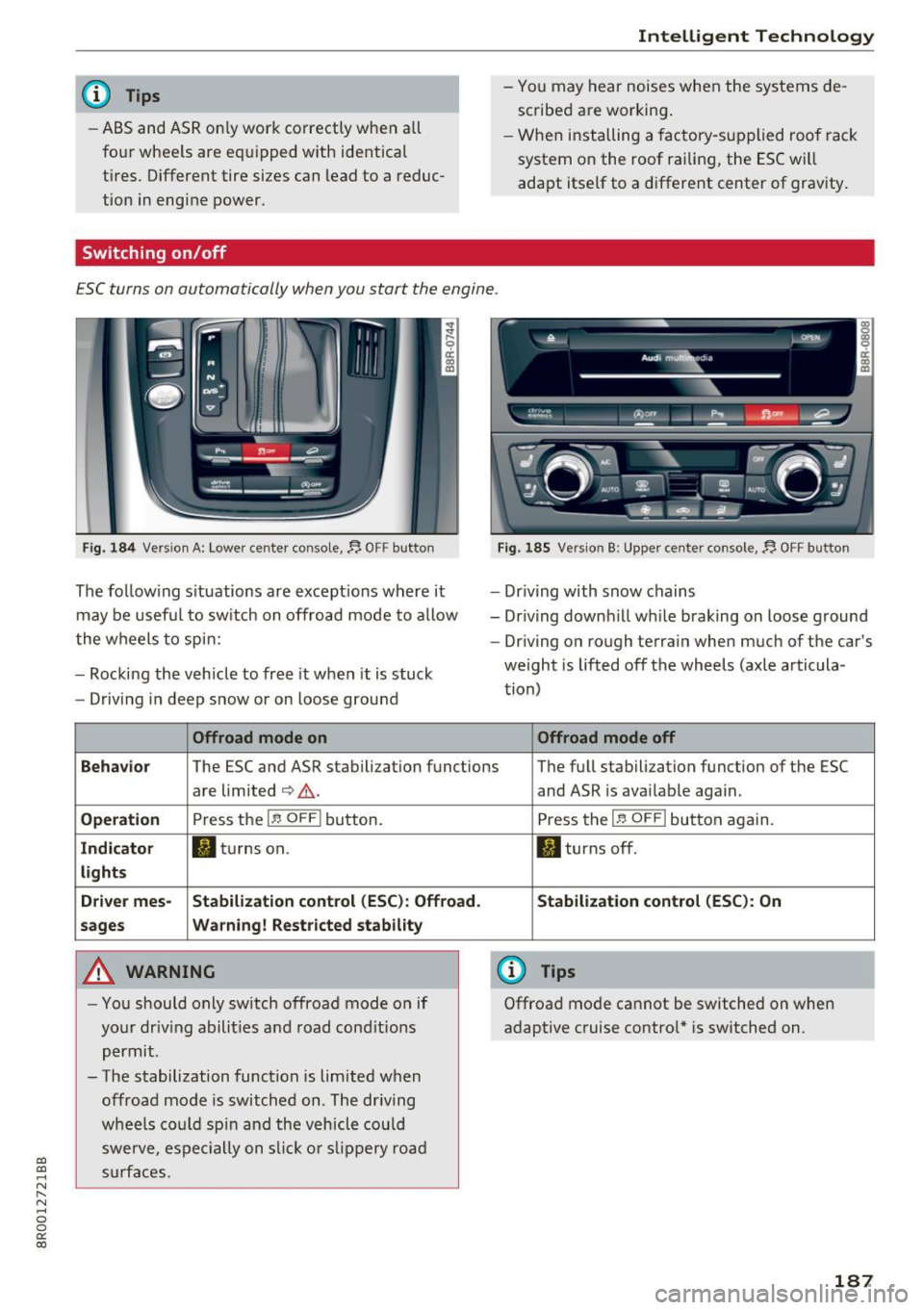
ESC turns on automatically when you start the engine.
Fig . 184 Versio n A: Lower cente r console,~ OFF button
The follow ing s ituations ar e except ions where i t
may be usef ul to sw itch on offroad mode to allow
the w heels to sp in:
- Rocking the vehicle to free it when it is stuck
- Driv ing i n deep snow or on loose ground
Offroad mode on
Fig. 185 Version B : Upper center console,~ OFF butto n
-Dr iv ing with snow chains
- Dr iv ing down hill while braking on loose g round
- Dr iving on rough terra in when much of t he car's
weight is lifted off the wheels (axle artic ula
t ion)
Offroad mode off
Behavior
The ESC and ASR stabilization functions The fu ll stabilization function of the ESC
are limited
¢ ,&. .
Operation Press the 1.$ OFF I button.
Indicator Ii) tu rns on.
lights
Driver mes- St abilization control (ESC ): Offroad.
sages Warning! Restricted stability
A WARNING
- Yo u should only sw itch offroad mode o n if
yo ur dr iv ing abilit ies a nd road cond it io ns
permit.
- The stabilization function is limited when
offroad mo de is switched on. The dr iving
w he els co uld s pin and the v eh icle cou ld
swe rve, es peci ally on s lick or slipp ery roa d
s ur fac es. and ASR
is ava ilable again.
P ress the
I!.! OFFI but ton again.
II turns off.
Stabilization control (ESC ): On
(D Tips
Offroad mode cannot be switched on whe n
adaptive c ruise contro l* is switched on.
187
Page 191 of 296
CD
CD
.... N ,-... N ..... 0 0 C<'. 00
situations, such as an a irbag dep loyment or hit
ting a road obstacle, data that wi ll assist in un
derstanding how a vehicle 's systems performed.
The EDR is designed to record da ta rela ted to ve
hicle dynamics and safety systems for a short pe
riod of time, typically 30 seconds or less . The
E DR in th is veh icle is des igned to record such da
ta as:
- How various systems in your vehicle were oper
at ing;
- Whether o r not the driver and passenger safety
belts were buckled/fastened;
- How far ( if at all) the dr iver was depressing the
acce lerator and/or brake peda l; and,
- How fast the vehicle was trave ling.
These da ta ca n he lp provide a better understand
ing of the ci rcumstances in which crashes and in
juries occur. NO TE: EDR data are reco rded by your
vehicle only if a non-triv ia l crash situation occurs ;
no data are recorded by the EDR under normal
driving conditions and no personal data (e.g., name, gender, age, and crash location) are re
corded . H owever, other parties, such as law en
forcement, could combine the EDR data w ith the
type of personally identify ing dat a routine ly ac
q uir ed dur ing a crash invest iga tion.
To read data reco rded by an EDR, specia l equip
ment is req uired, a nd access to t he veh icle or the
E DR is needed. I n add it io n t o the veh icle ma nu
facture r, ot he r p arties, s uch as law enfor cement,
that have the specia l equipment, can read the in
formation if they have access to the vehicle or the
EDR.
Some state l aws restrict the retr ieval or down
loading of data stored by EDRs insta lled in a vehi
cle for the express purpose of retrieving data af
ter an accident or crash event without the own
er's consent.
Aud i will not access the EDR and/or s imilar data
or give it to others -
- u nless the veh icle owner (or lessee if t he vehi
cl e h as bee n leased) agrees; or
- u pon the officia l request by the po lice; o r
- upon the order of a court of law or a govern-
ment agency; o r
Intelligent Technology
- for the defense of a lawsuit thro ugh the jud ic ia l
discovery process.
- Aud i may a lso use the data for resea rch about
vehicle operation and safety performance or
provide the data to a third party for research
purposes witho ut identify ing the specif ic veh i
cle or information about the ident ity of its own
er or lessee and only after the recorded veh icle
data has been accessed .
Vehicle control modules
You r vehicle is also eq uipped w ith a number of
electronic control modules for various vehicle
systems, such as engine management, emiss ion
contro l, airbags, and safety be lts .
These elect ronic contro l modu les record data
during norma l vehicle operation that may be
needed by trained techn ic ians for diagnostic and
repa ir purposes . The recording capab ility of these
modules is lim ited to data (no sound is record
ed) . Only a sma ll amount of data is actua lly re
corded over a very lim ited period of time, or stor
ed whe n a system fault is de tected by a contro l
module . Some of the da ta s tored may rela te to
vehicle speed, direction, or braking, as well as re
straint system use and performance in the event
of a crash . Stored data can also only be read and
downloaded wit h specia l equipment that is di
rectly connected to the vehicle.
{!) Tips
Your vehicle may be equipped w ith Aud i con
nect. Your use of certain Aud i connect fea
tures requires wire less serv ices that are pro
v ided by a third party wireless telecommuni
cations provider . Fo r details regarding how in
fo rmation ob tained throug h Au di connec t is
colle cted, p ro cessed, tra nsmitted, used, and
s hare d, ple ase see yo ur contra ct with t he
wireless tele commun ications provider and the
"About A udi connect" tab in your vehicle's
MMI:
I MENU ! button > Audi connect > About
Audi connect .
189
Page 193 of 296
CD
CD
.... N ,-... N ..... 0 0 C<'. 00
-Before descending a steep grade , reduce
speed and shift transm iss ion into a lower
gear or lower driving range. Do not ride the
brakes or hold the pedal down too long or
too often . This could cause the brakes to get
hot and d iminish brak ing efficiency .
- Do not "r ide the brakes" by resting your foot
on the pedal when you do not intend to
bra ke. This may cause the bra kes to over
heat , premat ure wea r and increased stop
ping distance.
- Under certa in climat ic and operating condi
tions su ch as p assing thro ugh w ater, dr iving
in heavy ra in or after washing the vehicle,
the ef fectiveness of the brakes can be re
duced. In winter, ice can acc umulate on the
brake pads, linings, discs and drums . Care
fully apply b rakes for a test. Brakes wi ll dry
and ice coatings wi ll be cleaned off after a
few careful brake applications .
- Driv ing for an extended period of time on
salt-covered roads without using your
bra kes can also affect bra king efficiency .
Clean off accumulated sa lt coating from
bra ke discs and pads with a few caref ul
bra ke appl ic a tion s.
- If you damage the front spoiler, or if yo u in
sta ll a differen t spoi le r, be sure the air flow
to the front br akes is not o bstru cte d. O the r
wise the br ake system could over heat reduc
ing the e ffec tiveness of the entire brake sys
tem.
- Failure of one brake circuit will imp air the
brak ing capability resulting in an increased
stopping distance . Avoid driving the vehicle
and have it towed to the nearest a uthorized
Audi dealer or qualif ied workshop.
- Never let the vehicle roll to a stop with the
engine shut off .
- If the brake booster is not wor king, the
brake pedal m ust be pressed considerably
harder to make up for the lack of booster
assistance .
Intelligent Technology
Electromechanical power
assist, Dynamic steering
The electromechanical power assist helps the
driver when steering .
Power steering adap ts elec tronically based on
the vehicle speed .
Indicator lights and message s
• Steering defecti ve! Do not drive vehicle!
If this indi ca to r li ght tur ns on and st ays on and
t hi s message appea rs, the powe r steering may
have failed.
Stop t he vehi cle in a safe location as soon as pos
s ible. Do
not cont inue drivi ng. See yo ur author
ized Audi dea ler or o ther qualif ied repa ir facility
for assistance .
l;rij Dynamic steering : Sy stem fault! You can
continue driving
If the indicator light turns on and the message
appea rs , the steer ing may be more diffic ult to
move o r more sensitive than usu a l. Th e steering
m ay also be at an angle when dr iving st raig ht.
D rive slowly to your a uthorized Aud i dea le r or
qualified wo rksh op to have t he malfunct io n cor
rec ted .
'Iij Dynamic steering: Initializing
Aud i drive select* : if the indicato r light blinks and
the driver message appears, the dynamic steer
ing* is re init ia liz ed . After sta rting the engine , the
steering wheel will move slig htly . Re -initializa
t io n m ight be necessary if the steer ing whee l was
moved hard to t he left and r ight wh ile the veh icle
was not mov ing. The display turns off if the initi
aliza tion was successful.
(D Tips
- If the . or l~ij indicato r light only stays on
for a shor t time, you m ay cont inue drivi ng.
- The dynam ic stee ring* sta bility systems
r=;, page 186 are no t ava ilable in the event of
a system mal func tio n.
- For add itiona l information on dy namic
steering*
r=;, page 122 .
191
Page 194 of 296
Intelligent Technology
Driving with your
quattro
With all-wheel drive, all four wh eels are driven.
G eneral information
With all-whee l drive, power is distributed to all
four wheels. This happens automatically depend
ing on you r driv ing style and the road condit ions
at the time. See also¢
page 186 .
A center differentia l distrib utes the driving power
variably to the front and rear axle. It works to
gether with selective wheel torque control, which
activates when driving t hrough curves
~ page 186.
The all-wheel drive concept is designed for high
engine power. Your vehicle is exceptionally pow
erful and has excellent driving characterist ics
both under normal dr iv ing condit ions and on
snow and ice . Always read and fo llow safety pre
cautions ~
/1..
Winter tires
When driving in the winter, your vehicle with all
wheel drive has an advantage, even with regular tires. In winter road conditions it may be adv isa
b le to mount wi nte r tires (or all-season tires) for
improve d driveab ility and bra king: these tires
m ust be mounted on
all four wheel s. See also
¢ page 245, Winter tires.
Tire cha ins
Where tire chains are mandatory on certain
roads, this norma lly also applies to vehi cles w ith
all-whee l d rive ~
page 245, Snow chains.
Replacing wheels /tires
Veh icles with all-whee l dr ive must always have
tires of the same s ize. A lso avo id tires with d iffer
ent t read depths. For details see page
~ page 237, New tires or wheels.
.&, WARNING
Always adjust yo ur drivi ng to road and traff ic
c ondi tions . Do not let the extra safety afford
ed by all -wheel drive tempt you into ta king
extra risks .
192
-Although the all-wheel d rive is very e ffec
tive, always remember that braking capacity
is limited by tire tract ion. You shou ld there
fore not drive at excessive speeds on icy or
slippery road s urfaces.
- On wet road surfaces, be careful not to dr ive
too fast because the front wheels could be
gi n to slide on top of t he water (aquapla n
ing). If th is should occur, you will h ave no
warn ing from a s udden increase i n engine
spee d as wi th a front-wheel d rive vehicle.
Always d rive at speeds which are suited to
the road conditions -risk of crash.
Energy management
· Starting ability is optimized
Energy management controls the distribution of
electrical energy and thus optimizes the availa
bility of electrical energy for starting the engine .
If a vehicle with a conventional energy system is
not dr iven for a long period of time, the batte ry is
discharged by id ling current consumers (e.g. im
mobilizer) . In certain c ircumstances it can resu lt
i n the re being insuffic ient energy ava ilable to
start the eng ine.
Intelligent energy management in your vehicle
handles the d istribution of elec trical energy .
Start ing ability is markedly improved and the life
of the batte ry is ex tended.
Bas ically, energy management consists of
bat
tery diagnosis , idling current man agement
and
dynamic ene rgy management .
Battery diagnos is
Battery d iagnosis continuously determines the
state of the battery. Sensors determine battery
vo ltage , battery current and battery tempera
ture . This determines the current state o f charge
and the power of the battery .
Idling current management
Idling cur rent management reduces energy con
sumption while the vehicle is standing. With the ..,.
Page 195 of 296
CD
CD
.... N ,-... N ..... 0 0 C<'. 00
ignition switched off, it controls the energy sup
ply to the various electrical components . Data
from battery diagnosis is considered.
Depending on the battery 's state of charge, ind i
vid ual consumers are gradually turned off to pre
ve nt excessive discharge of the battery and thus
maintain starting capability.
Dynamic en ergy management
Wh ile the veh icle is being driven , dynamic energy
management dist ributes the energy ge nerated
according to the needs of the individua l compo
nents . It regulates consumption, so that more
e lectrical energy is not being used than is being
generated and ensures an optimal state of
charge for the battery.
- But even energy management cannot neg
ate the limits of physics. Consider that the power and life of a battery are limited.
- If starting ability is threatened, the indica
tor light (•] appears
¢ page 30 .
What you should know
The highest priority is given to maintaining start
ing capability .
The battery is severely taxed in short-distance
driving, in city traffic and during the co ld time of
year. Abundant electrical energy is required, but only a little is generated . It is also crit ica l if the
engine is not runn ing and electrical components
are turned on . In this instance energy is being
consumed but none is being generated .
It is in precisely these situations that you will no
tice energy management actively regulat ing the
d istr ibution of energy .
Vehicle stands for an extended p eriod
If you do not drive your vehicle over a period of
several days or weeks, electrical components are
gradually cut back or sw itched off. This reduces
energy consumption and ma inta ins starting ca
pability over a longer pe riod . Some of the con
ve nience funct ions may not operate, suc h as the
inte rior ligh ts or the powe r seat adjustment. The
Intellig ent Technology
convenience functions will be availab le aga in
when you switch on the ignition and sta rt the en
gine.
With the engine turn ed off
If you listen to the rad io, for examp le, with the
engi ne turned off or use other
MM I* functions,
the battery is being discharged .
If s tarting capab ility is jeopardized due to energy
consumption, a message appears in the rad io or
MM I* disp lay. The message indica tes that the
system will be switched off automatically in a
moment . If you wish to continue using the func
t ions, you have to start the engine.
With the engine running
Although e lectr ic al energy is generated when t he
vehicle is being driven, the batte ry can become
discharged. This happens mostly when litt le en
ergy is being generated and a great dea l con
sumed and the battery's state of charge is not
optimal.
To bring the energy balance back into equilibr i
um, consumers whic h require especia lly large
amounts of energy are temporari ly cut back or
switched off. Heating systems in particular re
quire a great deal of energy. If you notice, for ex
ample, that the heated seats* or the heated rear
window a re not heati ng, they have bee n tempo
rarily cut bac k or switched off . T hese systems will
be available again as soon as the ene rgy balance
has been restored.
You w ill also notice that engine idle speed has
been increased s light ly. This is no rma l and not a
ca use for concern. By increas ing engine idle
speed the additional energy required is genera t
ed and the battery is charged.
193
Page 196 of 296
Driving and th e en vironm ent
Driving and the
environment
Breaking in
New engine
The engine needs to be run-in during the first
1,000 miles (1,500 km).
For the first 600 miles (1 ,000 kilometer s):
.,. Do not use full throttle .
.,. Do not drive at engine speeds that are more
than 2/3 of the max imum permitted RPM .
From 600 to 1,000 miles (1 ,000 to 1 ,500
kilometers ):
.,. Speeds ca n gradually be increased to the maxi
mum perm iss ib le road or eng ine speed .
During and after break-in pe riod
.,. Do not rev the engine up to high speeds when it
is cold. This applies whether the transmission is
in N (Neutral) or in gear .
After the break- in period
.,. Do not exceed maximum engine speed under
any circumstances.
.,. Upshift into the next higher gear
before reach
ing t he red area at the end of the tachometer
sca le
¢page 8.
During the first few hours of driving, the eng ine's
internal friction is higher than later whe n all the
mov ing parts have been broken in. How well this
break- in process is done depends to a considera
b le exte nt on the way the vehicle is d rive n during
the firs t 1,000 miles (1,500 kilometers).
{[) Note
Extremely high eng ine speeds a re au tomati
cally reduced . However, these rpm lim its are
progr ammed for an e ng ine well run -in, not a
new engine.
@ For the sake of the environment
Do not dr ive with u nne cessarily high eng ine
spee ds -upshi fting ea rly saves fuel, reduces
noise and protec ts the enviro nment .
194
· New tires
If your veh icle is runni ng on new tires, d rive very
c ar efu lly fo r the fi rs t 350 miles (500 kilometers)
a fter fi tting.
_& WARNING
New tires tend to be slippe ry and must a lso
be "broken-in". Be sure to remember this dur
ing the first 350 m iles (500 kilometers) .
Brake gent ly. Avoid following closely behind
other ve hicles or ot her situations that might
require sudden, hard braking.
Catalytic converter
App lies to : vehicles wi th gaso line e ngi ne
-
It is very important that your emission control
system (catalytic converter) is functioning prop
erly to ensure that your vehicle is running in an
environmen tally sound manner .
.,. Always use lead-free gasoline¢ page 209,
Gasoline .
.,. Never r un the tank down all the w ay to emp ty.
.,. Never put too much mo to r o il in yo ur engi ne
¢ page 221, Adding engine oil 9::r..
.,. Never try to push- or tow-start your vehicle .
The cata lyt ic converter is an efficie nt "clea n-up"
device b uilt into the exhaus t sys tem o f the ve hi
cle . Th e catalytic converter b urns many of the
po llutants in the exhaust gas before they are re
l eased into the atmosphere.
The exclusive use of un le ad ed fuel is critically im
portan t fo r the life o f the cataly tic converte r and
proper functio ning of the engine .
A WARNING
The temperature o f the exhaust system is
h igh, both when driv ing and after stopp ing
the eng ine.
-
- Never touch the exhaust tail pipes once they
have become hot. This could resu lt in burns.
- Do not park or operate the vehicle in a reas
where the hot exhaust system may come in
contact with dry grass, b rush, fuel sp ill or
other mate rial which can cause a fire.