page 4 AUDI Q5 2018 Owners Manual
[x] Cancel search | Manufacturer: AUDI, Model Year: 2018, Model line: Q5, Model: AUDI Q5 2018Pages: 392, PDF Size: 60.56 MB
Page 325 of 392
u co ..... N r-N .....
~ 0 co
Charging the vehicle battery
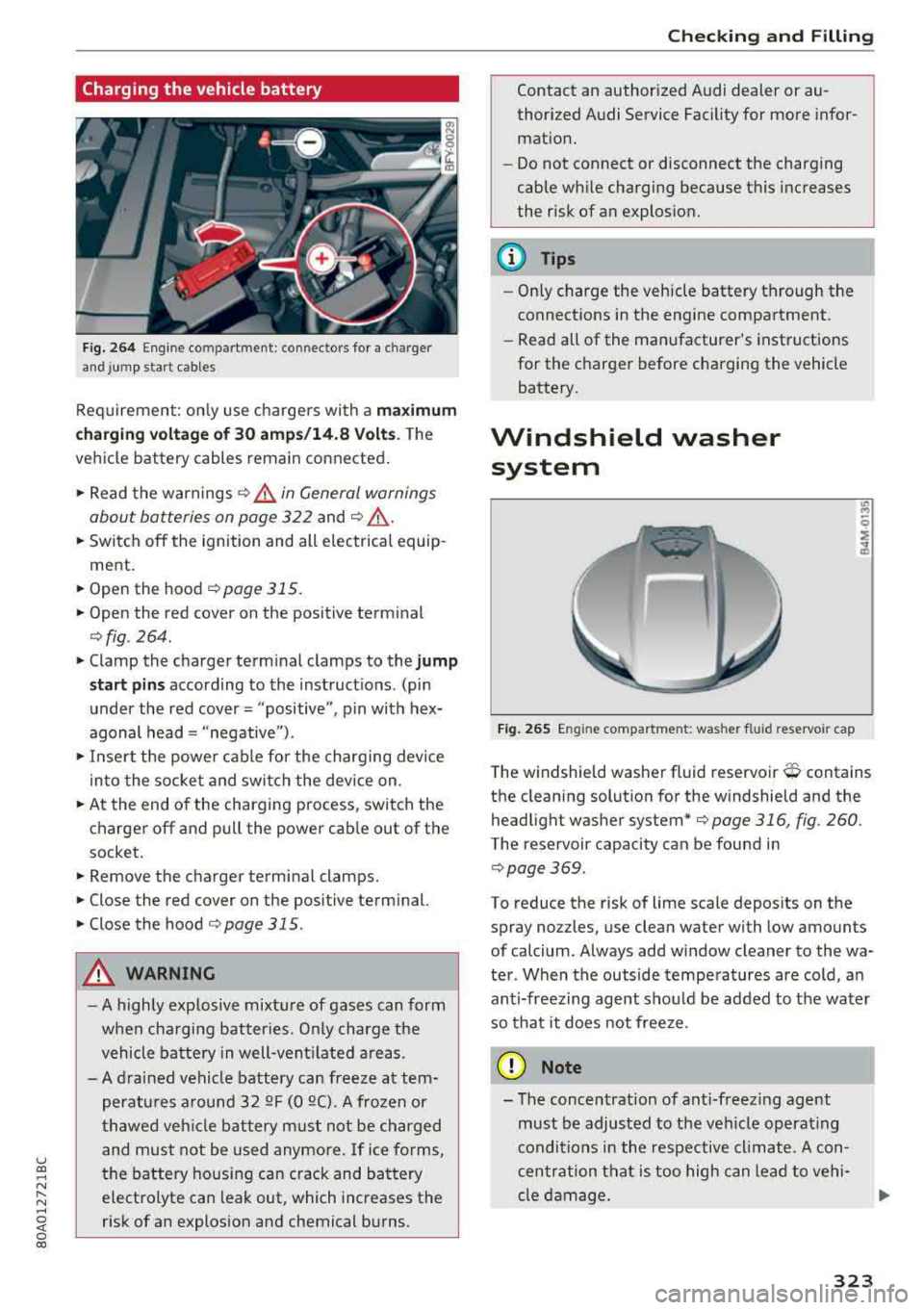
Fig. 264 Engine co mpartment : connec tor s fo r a charg er
and jump s ta rt cab les
Req uirement: on ly use charge rs with a maximum
c harging voltage of 30 amp s/14 .8 Volt s.
T he
vehicle battery cables remain connected .
.,. Read the warnings ¢ & in General warnings
about batteries on page 322
and ¢ ,& .
.,. Switch off the ignition and all e lectrical equip
ment .
.,. Open the hood ¢ page 315 .
.,. Open the red cover on the positive term inal
¢ fig . 264 .
.,. Clamp the charger term inal clamps to the jump
s tart pins
according to the instruct ions . (pin
under the red cover = "positive", p in with hex
agonal head= "negative ") .
.,. In se rt the powe r cable for the charging device
in to the socket and swi tch the device on .
.,. At the end of the charging process, switch the
charger off and pull the power cab le out of the
socket.
.,. Remove the charger terminal clamps .
.,. Close the red cover on the positive term inal.
.,. Close the hood ¢ page 315 .
A WARNING
-A highly explosive mixtu re of gases can form
whe n cha rging batter ies. O nly charge the
vehicle ba tte ry in well-ven tilated are as.
- A dra ined vehicle battery can freeze at tem
peratu res a round 3 2
QF (0 QC). A frozen or
t hawed veh icle bat tery m ust not be charged
and must not be used anymore. If ice forms,
the battery housing can crack and battery electrolyte can leak out, which increases the
risk of an explosion and chemical b urns .
Chec king and Filling
Contact an author ized Audi dealer or au
thorized Audi Service Facility for more infor
mat ion.
- Do not connect or disconnect the charging
cable wh ile charging because this increases
the risk of an explos ion.
(D Tips
- Only charge the veh icle battery through the
connect ions in the engine compartment .
- Read all of the manufacturer's instructions
for the charger before charging the vehicle battery.
Windshield washer system
F ig. 265 Engine compar tmen t: was her fluid reservo ir ca p
T he windshield washer fluid reservoir O contains
the clean ing solut ion for the w indshield and the
headlight washer system*
¢page 316, fig. 260 .
The reservoir capacity can be found in
¢page 369 .
To reduce the risk of lime scale deposits on the
spray no zzles, use clean water with low amounts
of calcium . Always add w indow cleaner to the wa
ter . When the outside tempe ratures are cold, an
anti-freez ing agent sho uld be added to t he water
so that it does not free ze.
@ Note
- The concentration of ant i-freez ing agent
must be adjusted to the ve hicle operat ing
conditio ns in the respective cl imate . A con
c en tration that is too high can lead to vehi
cle d am age .
323
Page 328 of 392
Wheels
Tire designations
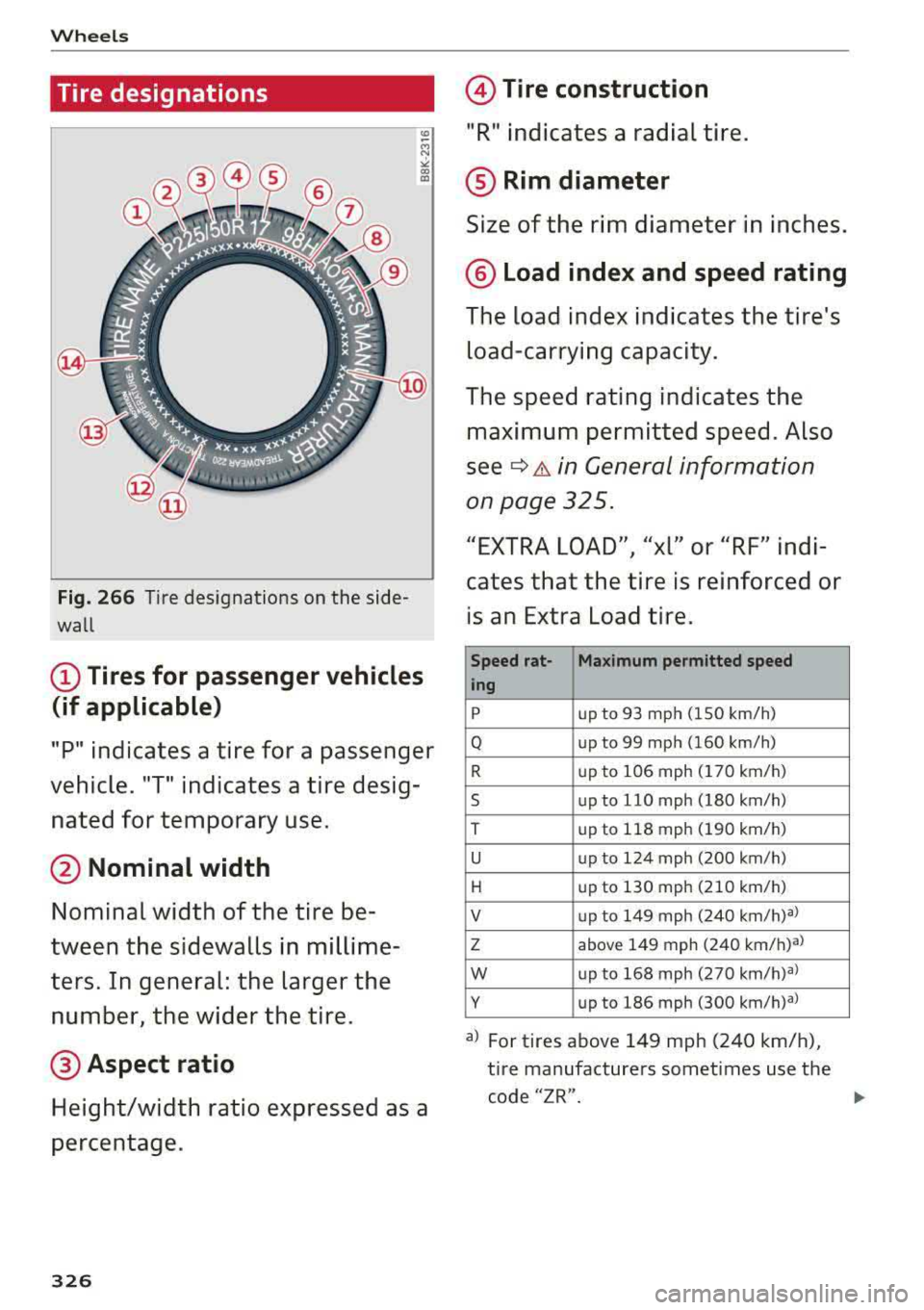
Fig. 266 Tire designations on the side
wall
(D Tires for passenger vehicles
(if applicable)
"P" indicates a tire for a passenger
vehicle. "T" indicates a tire desig
nated for temporary use.
@ Nominal width
Nominal width of the tire be
tween the sidewalls in millime
ters. In general: the larger the
number, the wider the tire.
@ Aspect ratio
Height/width ratio expressed as a
percentage.
326
@ Tire construction
"R" indicates a radial tire.
® Rim diameter
Size of the rim diameter in inches.
® Load index and speed rating
The load index indicates the tire's
load-carrying capacity.
The speed rating indicates the maximum permitted speed. Also
see
¢ A in General information
on page 325.
"EXTRA LOAD", "xl" or "RF" indi
cates that the tire is reinforced or
is an Extra Load tire.
Speed rat-
Maximum permitted speed
ing
p
up to 93 mph (150 km/h )
Q up to 99 m ph (1 60 km/h)
R up to 106 mph (170 km /h)
5 up to 11 0 mph (180 km/h)
T up to 118 mph (190 km/h)
u up to 124 mph (200 km /h)
H up to 130 mph (210 km/h)
V up to 149 mph (240 km /h)al
z a bov e 149 mph (240 km/h) al
w up to 168 mph (270 km /h) al
y up to 186 mph (300 km /h) al
a ) For tires above 149 mph (240 km/h),
tire manufacturers sometimes use the
code "ZR" .
Page 329 of 392
u a, .... N r-N ....
~ a,
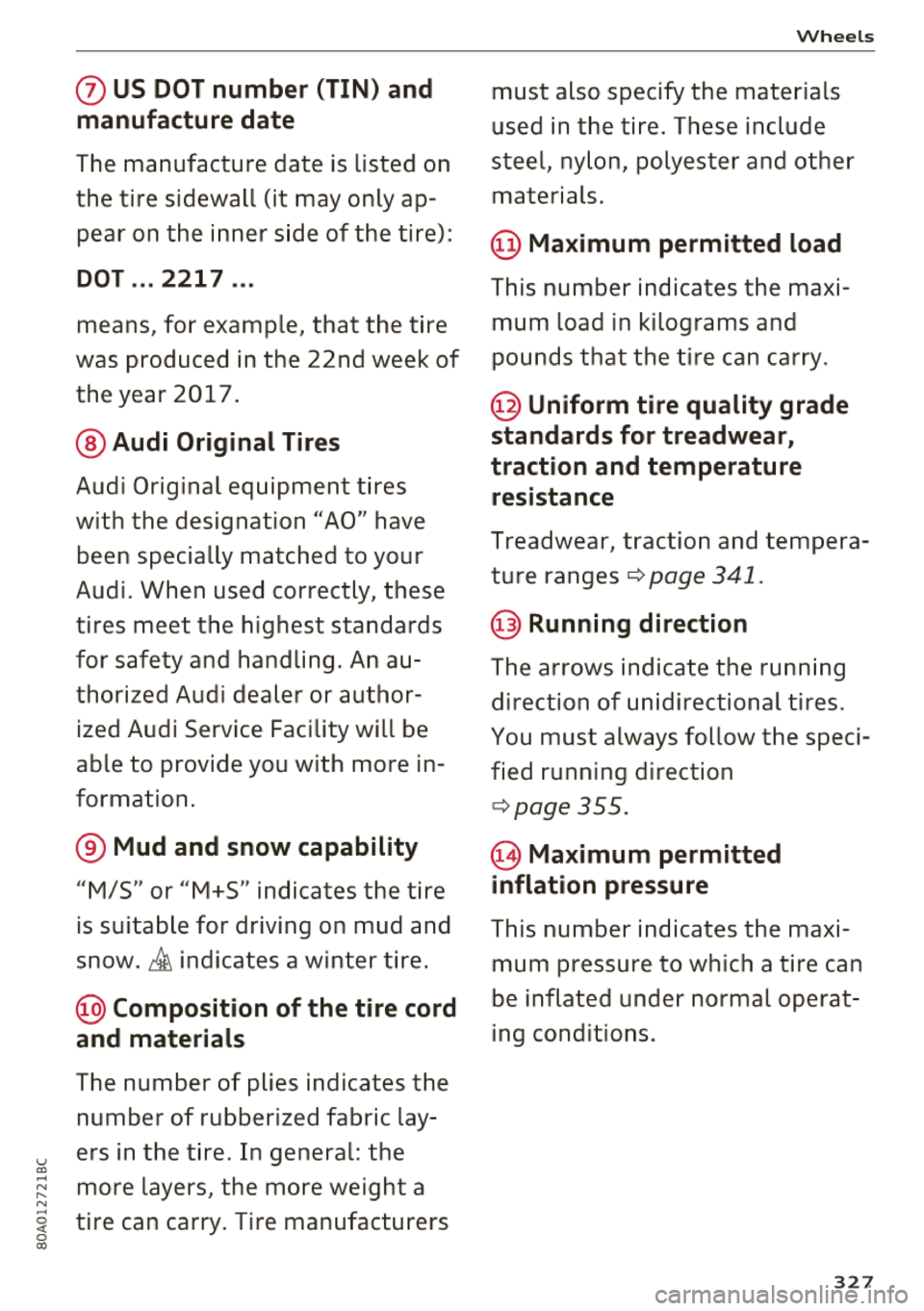
(J) US DOT number (TIN) and
manufacture date
T he manufacture date is listed on
the tire sidewall (it may only ap
pear on the inner s ide of the tire):
DOT .. . 2217 .. .
means , for example, that the tire
was produced in the 22nd week of
the year 2017 .
@ Audi Original Tires
Audi Original equipment tires
with the designation
"AO" have
been specially matched to your
Audi . When used correct ly , these
tires meet the highest standards
for safety and handling . An au
thorized Audi dealer or author
ized Audi Service Facility will be
able to provide you with more in
formation .
® Mud and snow capability
"M/5 " or "M+S" indicates the tire
is suitable for driving on mud and
snow .
& indicates a winter tire .
@ Composition of the tire cord
and materials
The number of plies indicates the
number of rubberized fabric lay
ers in the tire. In general : the
more layers, the more weight a
tire can carry . Tire manufacturers
Wh eel s
must also specify the materials
used in the tire . These include
steel, nylon, polyester and other
materials.
@ Ma ximum permitted load
This number indicates the maxi
mum load in kilograms and
pounds that the tire can carry .
@ Uniform tire qual ity grade
standards for treadwear,
traction and temperature resistance
Treadwear , tract ion and tempera
ture ranges
r=:>page 341 .
@ Running direction
The arrows indicate the runn ing
direction of unidirectional tires .
You must always follow the speci
fied running direction
Q page 355.
@ Ma ximum permitted
inflation pressure
This number indicates the maxi
mum pressure to which a tire can
be inflated under normal operat
ing cond itions .
327
Page 332 of 392
Wheels
Production options we igh t
means the combined weight of
those installed regular production
options weighing over 5 lbs.
(2.3 kg) in excess of those stand
ard items which they replace, not previously considered in curb
weight or accessory weight, in
cluding heavy duty brakes, ride levelers, roof rack, heavy duty
battery, and special trim.
Radial pl y tir e
means a pneumatic tire in which
the ply cords that extend to the beads are laid at substantially
90 degrees to the centerline of
the tread.
R ecomm ended in flation
pressure
see¢ page 328 , Cold tire infla
tion pressure.
R einforced tire
means a tire designed to operate
at higher loads and at higher in
flation pressures than the corre
sponding standard tire . Rein
forced tires may be identified as
"XL" "xl" "EXTRA LOAD" or "RF" , , ,
on the sidewall.
330
Rim
means a metal support for a tire
or a tire and tube assembly upon
which the tire beads are seated.
Rim diam eter
means nominal diameter of the
bead seat . If you change your
wheel size, you will have to pur
chase new tires to match the new rim diameter .
Rim size designation
means rim diameter and width.
Rim width
means nomina l distance between
r im
flanges .
Sidewall
means that portion of a tire be
tween the tread and bead .
Speed rating (letter code )
means the speed at which a tire is
designed to be driven for extend
ed periods of time. The ratings range from 93 mph (150 km/h)
to
186 mph (298 km/h) ¢ table
on page 326 .
You may not find
this information on all tires be
cause it is not required by law .
The speed rating letter code,
where applicable, is molded on
the tire sidewall and indicates the
...
Page 333 of 392
u a, .... N r-N ....
~ a,
maximum permissible road
speeds. See
also ¢.& in General
information on page 325.
Tire pre ssure mon itoring
system
means a system that detects
when one or more of a vehicle's
tires are underinflated and illumi
nates a low tire pressure warning
telltale.
Tread
means that portion of a tire that
comes into contact with the road .
Tread separation
means pulling away of the tread
from the tire carcass.
Treadwea r indicators (TWI )
means the projections within the
principal grooves designed to give
a visual indication of the degrees
of wear of the tread. See
¢ page 334, Treadwear indicator
for more information on measur
ing tire wear .
Uniform Tire Quality Grading
is a tire information system devel
oped by the United States Nation
al Highway Traffic Safety Admin
istration (NHTSA) that is designed
to help buyers make relat ive com-
Wheels
parisons among tires . The U TQG
is not a safety rating and not a
guarantee that a tire will last for
a prescribed number of miles
(kilometers) or perform in acer
tain way . It simply gives tire buy
ers additional information to
combine with other considera
tions, such as price, brand loyalty and dealer recommendatio ns. Un
der UTQG, tires are graded by the
tire manufacturers in three areas :
treadwear, tract ion, and tempera
ture resistance. The UTQG infor
mation on the tires, molded into
the sidewalls.
U.S. DOT Tire Identification
Number (TIN)
T his is the tire's "se ria l number" .
It begins with the letters "DO T"
and indicates that the tire meets all federal standards. The next
two numbers or letters indicate
the plant whe re it was manufac
tured, and the last four numbers
represent the week and year of
manufactu re . For example,
DOT .. . 2217 ...
means that the tire was produced
in the 22nd week of 2017 . The
other numbers are marketing co des that may or may not be used
.,.
33 1
Page 334 of 392
Wheels
by the tire manufacturer. This in
formation is used to contact con sumers if a tire defect requires a
recall.
Vehicle capacity weight
means the rated cargo and lug
gage load plus 150 lbs. (68 kilo
grams) times the vehicle's desig nated seating capacity .
Vehicle maximum load on the
tire
means that load on an individual
tire that is determined by distrib
uting to each axle its share of the
maximum loaded vehic le weight
and dividing by two.
Vehicle normal load on the tire
means that load on an individual
tire that is determined by distrib
uting to each axle its share of the
curb weight, accessory weight,
and normal occupant weight (dis
tr ibuted in accordance
with¢ ta
ble on page 33 7)
and d ividing by
two .
Occupant loading and distri
bution for vehicle normal load
for various designated seating capacities
Re fer to the tire inflation pres
sure
label¢ page 335, fig. 269
332
for the n umbe r of seating posi
tions. Refer to the
table ¢ table
on page 337
for the number of
people tha t correspond to the ve
hicle normal load.
New tires or wheels
Audi recommends having all work
on t ires or wheels performed by
an authorized Audi dealer or au
thorized Audi Service Facility.
These facilities have the proper
know ledge and are eq uipped with
the required too ls and rep lace
ment parts.
... New t ires do not yet have the
optim um gripping properties.
Drive carefully and at moderate
speeds for the first 35 0 m iles
(500 km) with new tires .
... Only use tires with the same de
sign, size ( rolling circumfer
ence) , and as close to t he same
tread pattern as possible on a ll
four wheels .
...
Do not replace tires individually.
At least replace bo th tires on the
same axle at the same time .
... Audi recommends that you use
Audi O riginal Tires. If you would
like to use di fferent tires, please
note that the tires may perform
...
Page 337 of 392
u
"' ... N
" N ....
~ 0 (X)
on the front axle and vice versa.
This will allow the tires to have approximately the same length of
service life.
For unidirectional tires, make
sure the tires are installed accord ing to the running direction indi
cated on the tire sidewall
¢ page 355.
Hidden damage
Damage to tires and rims can of
ten occur in locations that are
hidden. Unusual vibrations in the
vehicle or pulling to one side may indicate that there is tire damage.
Reduce your speed immediately.
Check the tires for damage. If no
damage is visible from the out
side, drive slowly and carefully to
the nearest authorized Audi deal er or authorized Audi Service Fa
cility to have the vehicle inspect
ed.
A WARNING
Tread that has worn too low or
different tread depths on the
tires can reduce driving safety.
This can increase the risk of an
accident because it has a nega
tive effect on handling, driving
through curves, and braking, and because it increases the
Wheels
risk of hydroplaning when driv
ing through deep puddles.
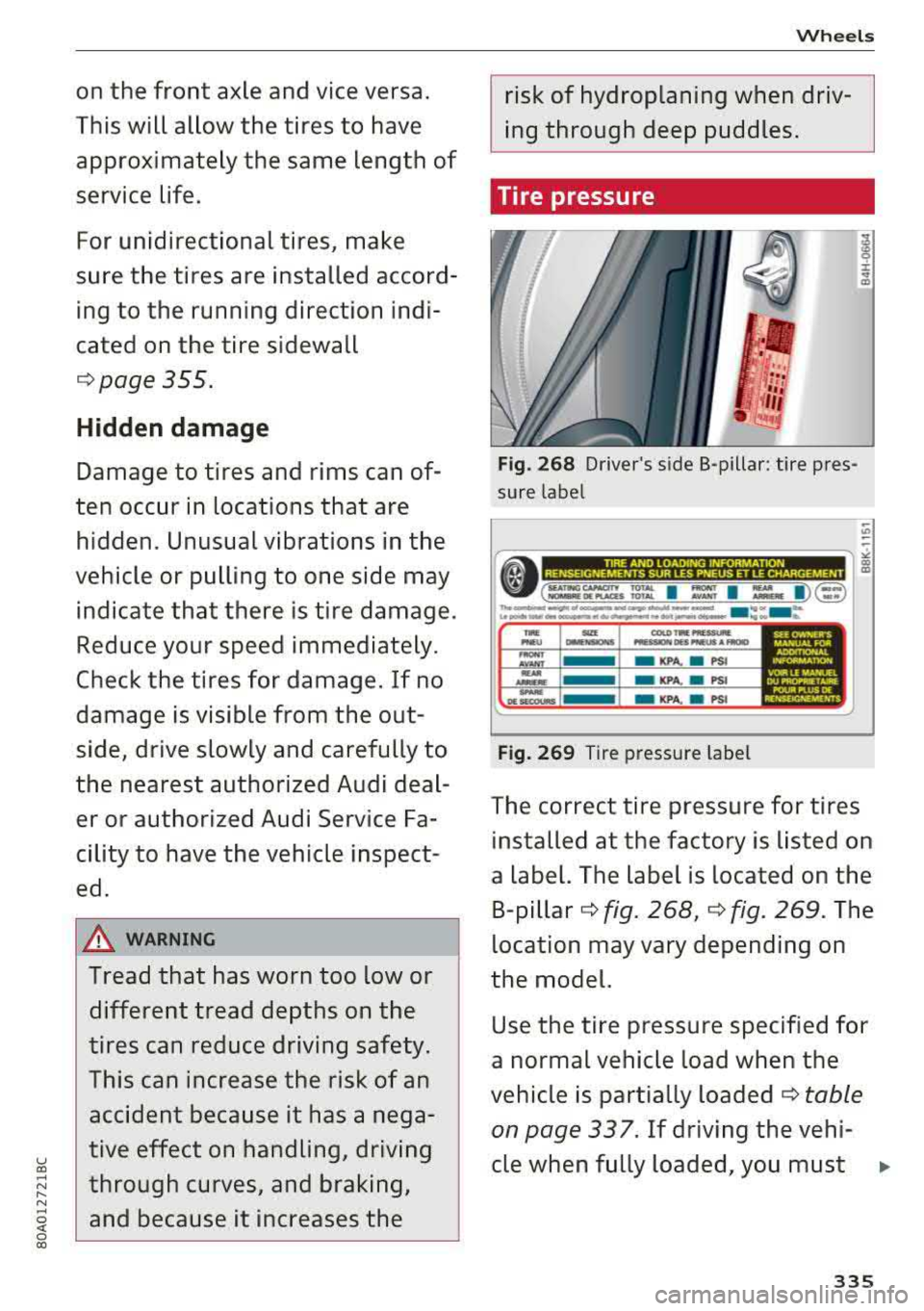
Ti re pressure
Fig. 268 Driver's side 8-pillar : tire pres
sure label
I i .. a,
-"' -
r ~. --c =-- TINQ- ~-- ~-- - .-::""'- - - .- =--- •>-~-=:- ~ l ~
. ...... __..___. .... _.,. ...... _.._. . ... _ ... ............ __. ... ___.._ ... ~ ..... __,. .... ....
-.... P'ICU CIII I I >NI
-AVAHT -KPA. • PSI
-
Fig. 269 Tire pressure label
The correct tire pressure for tires
installed at the factory is listed on
a label. The label is located on the
B-pillar
¢ fig. 268, ¢ fig. 269. The
location may vary depending on
the model.
Use the tire pressure specified for
a normal vehicle load when the
vehicle is partially
loaded ¢ table
on page 337.
If driving the vehi-
cle when fully loaded, you must
""
335
Page 338 of 392
Wheels
increase the tire pressure to the
maximum specified
pressure ¢.&. -
Checking/correcting tire
pressure
~check the tire pressure at least
once per month and also check it
before every long drive .
~Always check the tire pressure
when the tires are
cold. Do not
reduce the pressure if it increas
es when the tires are warm.
~check the label¢ fig . 269 for
the correct tire pressure based
on vehicle load.
~correct the tire pressure if nec
essary .
~store the new tire pressure in
the Infotainment system
¢ page 343.
_&. WARNING
Always adapt the tire pressure
to your driving style and vehicle
load .
-Overloading can lead to loss of
vehicle control and increase
Tire pressure table
Please note that the information
contained in the following table
was correct at the time of print ing, and the information is sub
ject to change . If there are differ-
336
the risk of an accident. Read
and follow the important safe
ty precautions in
¢ page 337,
Tires and vehicle load limits.
-The tire must flex more if the tire pressure is too low or if
the vehicle speed or load are
too high. This heats the tire up
too much. This increases the risk of an accident because it
can cause the tire to burst and
result in loss of vehicle con
trol.
- Incorrect tire pressure in
creases tire wear and has a
negative effect on driving and
braking behavior, which in
creases the risk of an accident.
@ Note
Replace lost valve caps to re
duce the risk of damage to the
tire valves.
@ For the sake of the environment
Tire pressure that is too low in
creases fuel consumption.
ences between this information
and the tire pressures specified
Page 339 of 392
u co .... N r--N .... 0 <( 0 00
on the label on the driver's side B
pillar, always follow the specifica
tion on the B-pillar label
c:::> page 335, fig. 268.
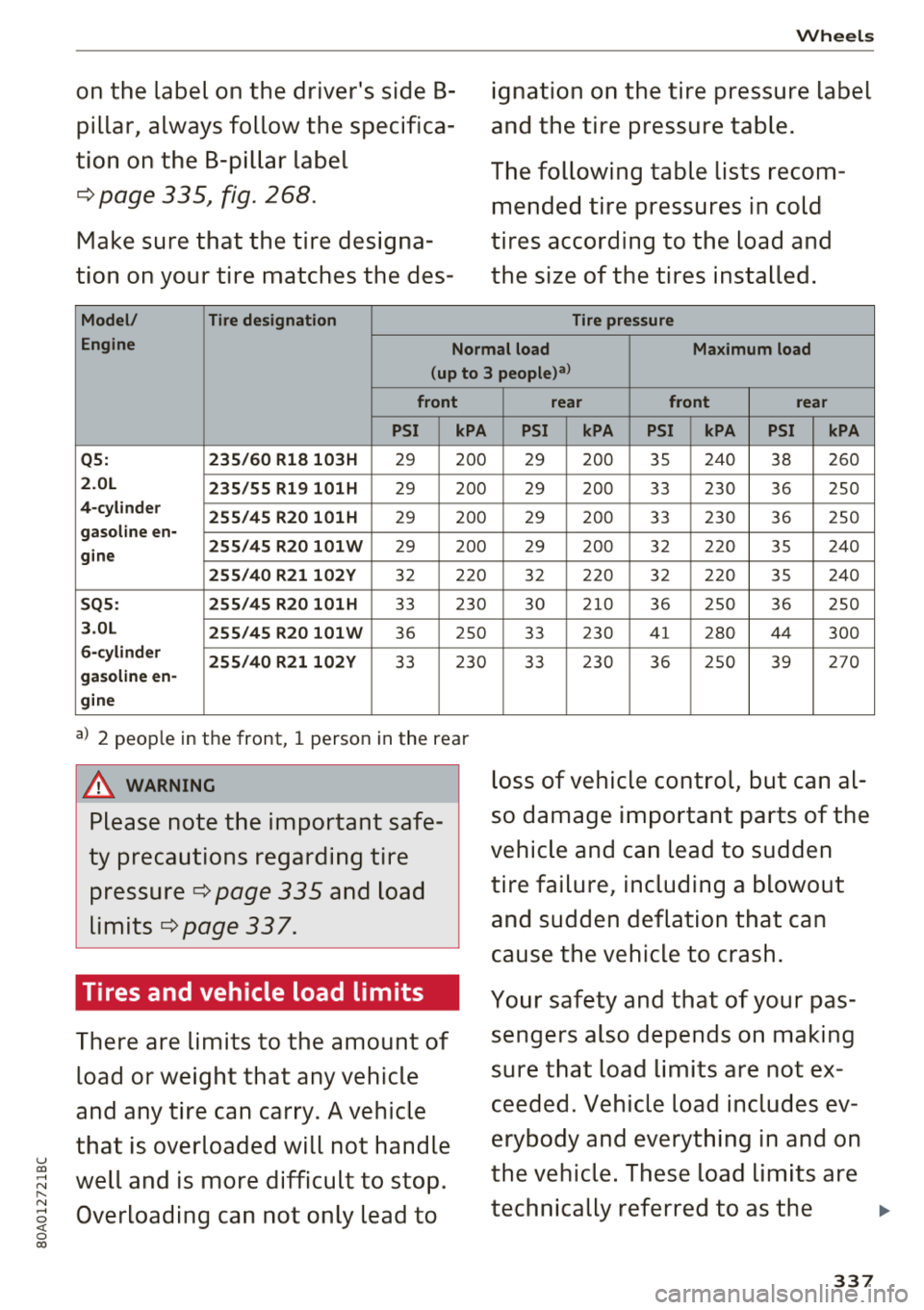
Make sure that the tire designa
tion on your tire matches the des-
Model/ Tire designation
Wheels
ignation on the tire pressure label
and the tire pressure table.
The following table lists recom mended tire pressures in cold
tires according to the load and
the size of the tires installed.
Tire pressure
Engine Normal load Maximum load
(up to 3
people)a)
front
PSI kPA
Q5: 235/60 R18 103H 29 200
2.0L
235/55 R19 101H 29 200
4-cylinder
255/45 R20 101H 29 200
gasoline en-
255/45 R20 101W
29 200 gine
255/40 R21102Y
32 220
SQ5: 255/45 R20 101H 33 230
3.0L
255/45 R20 101W 36 250
6-cylinder
gasoline en- 255/40 R21102Y 33 230
gine
a
) 2 people in the front, 1 person in the rear
A WARNING
Please note the important safe
ty precautions regarding tire
pressure
c:::> page 335 and load
limits
c:::> page 337.
Tires and vehicle load limits
There are limits to the amount of
load or weight that any vehicle
and any tire can carry. A vehicle
that is overloaded will not handle
well and is more difficult to stop .
Overloading can not only lead to
rear front rear
PSI kPA PSI kPA PSI kPA
29 200 35 240 38 260
29 200 33 230 36 250
29 200 33 230 36 250
29 200 32 220 35 240
32 220 32 220 35 240
30 210 36 250 36 2 50
33 230 4
1
280 44
300
33 230 36 250 39 270
loss of vehicle control, but can al
so damage important parts of the
vehicle and can lead to sudden
tire failure, including a blowout
and sudden deflation that can
cause the vehicle to crash.
Your safety and that of your pas
sengers also depends on making
sure that load limits are not ex
ceeded. Vehicle load includes ev
erybody and everything in and on
the vehicle . These load limits are
technically referred to as the
..,
337
Page 341 of 392
u a, .... N r-N ....
~ a,
including the weight of a trail
er hitch and the tongue
weight of a loaded trailer -
does not make the vehicle heavier than the vehicle's
Gross Vehicle Weight Rating .
Determining correct load
limit
Use the example below to calcu
late the total weight of the pas
sengers and luggage or other
things that you plan to transport
so that you can make sure that
your vehic le w ill not be over load
ed .
Steps for Determining Correct
Load Limit
1. L ocate the statement "TH E
COMBINED WEIGH T OF OCCU
PANTS AND CARGO SHOULD
NEVER EXCEED XXX KG OR XXX
L BS" on your vehicle's placard
(tire inflation pressure label)
¢ page 335, fig . 269 .
2. Determine the combined
weight of the driver and pas
sengers that w ill be riding in
your vehic le .
3. Subt ract the combined weight
of the driver and passengers
from "XXX" kilograms or "XXX"
Wheels
pounds shown on the stick
er ¢ page 335, fig. 269 .
4. The resulting figure equals the
available amount of cargo and
luggage load capacity . For ex
ample , if the
"XXX" amount
equa ls
1400 lbs . and there will
be five
150 l bs . passengers in
your vehicle, the amount of
available cargo and luggage
load capacity is
650 lbs .
(1 400- 750 (5 X 1 50) = 650
lbs .)
5. Determine the comb ined
weight of luggage and cargo
being loaded on the vehicle .
T hat weight may not safely ex
ceed the availab le cargo and
luggage load capacity calculat
ed in Step 4 .
6 . If your vehicle will be towing a
tra iler, load from your tra iler
w ill be transferred to your ve
hicle. Consult this manual to
determine how this reduces
the availab le cargo and lug
gage load capacity of your veh i
c le .
.,. Check the tire sidewall
(¢ page 326, fig . 266) to deter
mine the designated load rat ing
for a specific t ire .
339