seats AUDI Q5 2018 Workshop Manual
[x] Cancel search | Manufacturer: AUDI, Model Year: 2018, Model line: Q5, Model: AUDI Q5 2018Pages: 392, PDF Size: 60.56 MB
Page 303 of 392
Booster seats and safety belts
Properly used booster seats can help protect
children weighing between about 40 lbs. and
80 lbs . (18 kg and 36 kg) who are less than 4
ft.
9 in. (57 inches/1.45 meters) tall.
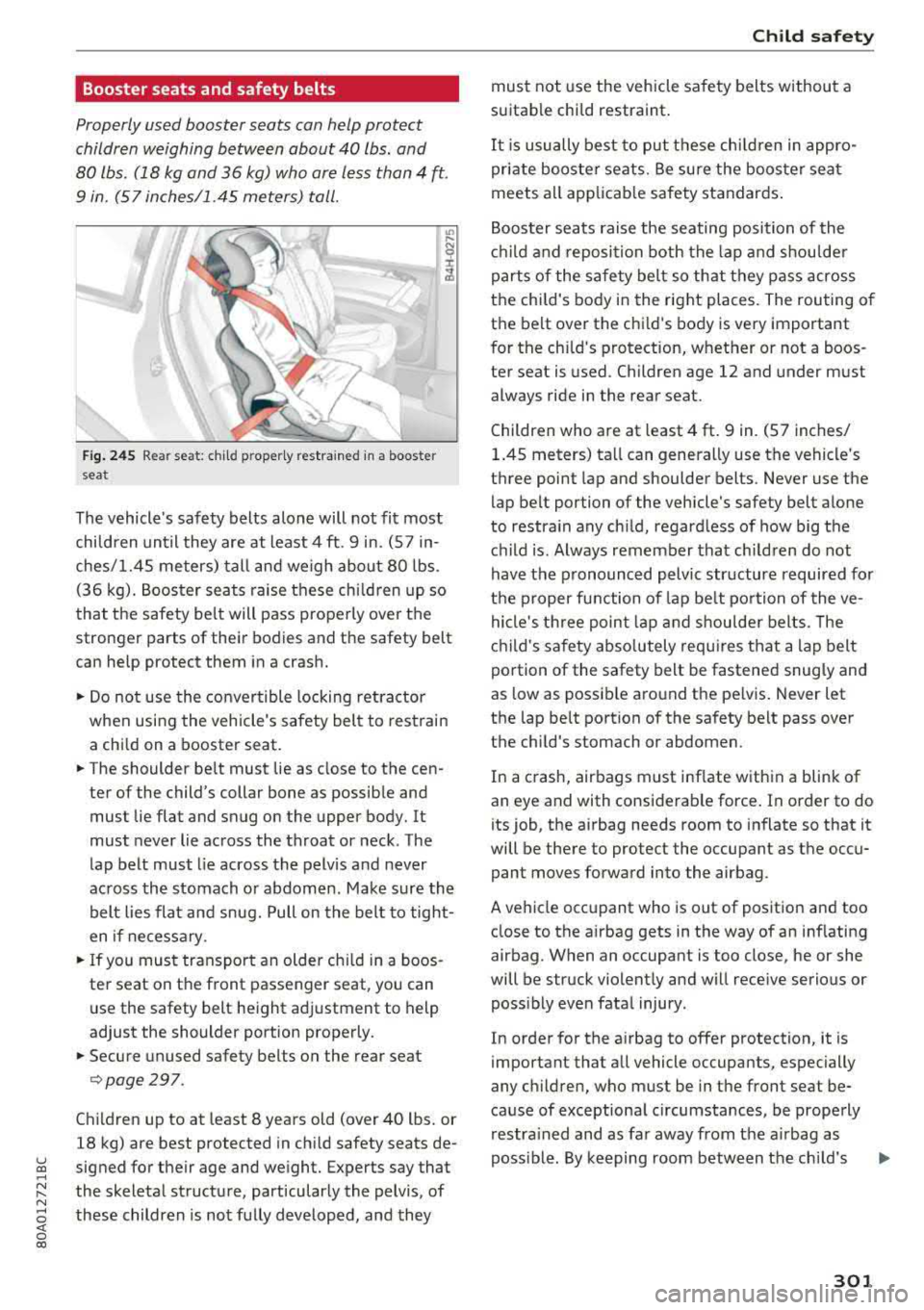
Fig . 245 Rea r seat: chi ld p roper ly restrained in a booster
sea t
The vehicle's safety belts alone will not fit most
children until they are at least 4
ft. 9 in. (57 in
ches/1.45 meters) tall and weigh about 80 lbs.
(36 kg). Booster seats raise these children up so
that the safety belt will pass properly over the
stronger parts of their bodies and the safety belt
can help protect them in a crash.
.,. Do not use the convertible locking retractor
when using the vehicle's safety belt to restrain
a chi ld on a booster seat .
.. The shoulder belt must lie as close to the cen
ter of the child's collar bone as possib le and
must lie fla t and snug on the upper body. It
must never lie across the throat or neck. The
lap belt must lie across the pelvis and never
across the stomach or abdomen . Make sure the
belt lies flat and snug. Pull on the belt to tight
en if necessary .
.,. If you must transport an older child in a boos
ter seat on the front passenger seat, you can
use the safety belt height adjustment to help
adjust the shoulder portion properly .
.. Secure unused safety belts on the rear seat
¢page 297.
Children up to at least 8 years old (over 40 lbs. or
18 kg) are best protected in chi ld safety seats de-
~ signed for their age and we ight. Experts say that .....
~ the skeletal structure, particularly the pelvis , of N
~ these children is not fully developed, and they
0 co
Child safety
must not use the vehicle safety belts without a
suitable child restraint .
It is usually best to put these children in appro
priate booster seats. Be sure the booster seat
meets all applicab le safety standards .
Booster seats raise the seating position of the
child and reposition both the lap and shoulder
parts of the safety belt so that they pass across
the chi ld's body in the right places. The routing of
the be lt over the chi ld's body is very important
for the ch ild's protection, whether or not a boos
ter seat is used. Children age 12 and under must
always ride in the rear seat.
Children who are at least 4
ft. 9 in. (57 inches/
1.45 meters) tall can generally use the vehicle 's
three point lap and shoulder belts. Never use the
lap belt portion of the vehicle 's safety belt alone
to restrain any ch ild, regard less of how big the
ch ild is. Always remember that child ren do not
have the pronounced pelvic structure required for
the proper function of lap belt portion of the ve
hicle's three point lap and shoulde r belts. The
child's safety absolutely requires that a lap belt
portion of the safety belt be fastened snugly and
as low as possible around the pe lvis . Never let
the lap belt portion of the safety belt pass over
the child 's stomach or abdomen .
In a crash, airbags must inflate within a blink of
an eye and with considerab le force. In order to do
its job, the airbag needs room to inflate so that it
will be there to protect the occupant as the occu pan t moves forward into the airbag .
A vehicle occ upant who is out of position and too
close to the a irbag gets in the way of an inf lating
airbag. When an occupant is too close , he or she
will be struck violent ly and w ill rece ive serious or
poss ibly even fata l injury .
In order for the airbag to offer protection, it is
important that all vehicle occupants, especially
any ch ildren, who must be in the front seat be
cause of exceptiona l circumstances, be properly
restrained and as far away from the airbag as
poss ible. By keeping room between the child's
..,_
301
Page 304 of 392
Child sa fety
body and the front of the passenger compart
ment, the air bag can inflate comp lete ly and pro
vide supp lemental protect ion in certain fronta l
coll is ions.
A WARNING
Not using a booster seat, us ing the booster
seat improperly, incorrectly installing a boos
ter seat or using the vehicle safety belt im
properly increases the risk of ser ious personal
injury and death in a collision or other eme r
gency sit uat ion. To help red uce the risk of se
rious persona l injury and/or death:
- The shoulder be lt mus t lie as close to the
center of the child's collar bone as possib le
and must lie flat and snug on the upper
body. It must never lie across the throat or
neck . The lap be lt must lie across the pelvis
and never across the stomach or abdomen.
Make sure the belt lies flat and snug. Pull on
the belt to tighten if necessary.
- Failure to proper ly route safety belts over a
child's body will cause severe injuries in an
acc ident or other emergency situation
¢ page 261.
- The rear side of the child safety seat should
be pos itioned as close as possible to the
backrest on the vehicle seat. Adjust or re
move the rear seat head restraint if it is d if
ficult to install the child seat with the he ad
restra int in place¢
page 58. Ins tall the
head restraint again immediately once the
child seat is removed . Driving without head
restra ints or w ith head rest raints that are
not properly adjusted increases the risk of
serious or fatal neck injury dramatically.
- Never let a child put the sho ulder belt under
the arm or beh ind the back, because it cou ld
cause severe injur ies in a crash.
- Children on the front seat of any car, even with Advanced Airbags, can be seriously in
jured or even killed when an airbag inflates .
- Never let a child stand or knee l on any seat,
for example the front seat.
- Never let a child ride in the ca rgo area o f
you r vehicle.
- Always remember that a child leaning for
ward, s itting sideways or out of position in
302
-
any way du ring an accident can be struck by
a deploying airbag. Th is w ill result in serious
personal injury or death.
- If you must install a booster seat on the
front passenger seat because of exceptiona l
circumstances the
PASSENGER AIR BAG
OFF
'1; light must come on and stay on,
wheneve r the ign it ion is swi tched on.
- If the
PASSENGER AIR BAG OFF '1; light
does not come on and stay on, perform the
checks desc ribed ¢
page 281, Monitoring
the Advanced Airbag System.
- Take the child res tra int off the front passen
ge r seat and install it prope rly at one of the
rear sea t positions if the
PASSENGER AIR
BAG OFF
'1; light does not st ay on whenever
the ignition is switched on .
- Always read and heed all WARNINGS when
eve r us ing a child restrained in a vehicle is
be ing used ¢
page 261, Safety belts,
¢ page 269, Airbag system and
¢ page 291 , Important information .
Securing child safety
seats
Securing a child safety seat using a safety belt
Safety belts for the rear seats and the front pas
senger can be locked with the convertible locking
retractor to properly secure child safety seats .
The safety belts for the rea r seats and for the
front passenge r's seat have a conve rtible locking
r etractor for child safety seats. The safety belt
must be locked so that be lt webb ing cannot un
r eel. The retractor can be act ivated to lock the
safety belt and prevent the safety belt webbing
from loosening up dur ing norma l dr iving . A ch ild
safety seat can o nly be prope rly installed when
t h e safety be lt is locked so that the c hild and
c hi ld s afety seat will stay in place.
Always remember : Even though your veh icle is
equipped with an Advanced Airbag system, all
c hi ld re n, especially those 12 yea rs and you nger,
sho uld always ride in t he b ack seat p roperly re-
strained for their age and s ize.
II>-
Page 305 of 392
u co ..... N r--N ..... 0 <( 0 00
A WARNING
-
Improperly in stalled chi ld safety seats in
crease the risk of serious personal injury and
death in a collision.
- Always make sure that the safety belt re
tractor is locked when installing a child safety seat. An unlocked safety belt retrac
tor cannot hold the child safety seat in place dur ing normal driving or in a crash.
- Always buckle the child safety seat firmly in
place even if a child is not sitting in it. A
loose child safety seat can fly around during
a sudden stop or in a collision.
- Always make sure that the rear seat back
rest to wh ich the center rear safety belt* is
attached is secure ly latched whenever the
rea r cente r safety belt is being used to se
cur e a ch ild rest raint.
- If the backrest is not securely latched, the
child and the child restraint will be thrown
forwar d toge ther w it h the backrest and will
st rike parts of the vehicle interior. The ch ild
can be se riously in jured or killed .
- Never ins tall rear-f acing chi ld safety sea ts
or infant carriers on the front passen ger
seat . A child will be serious ly inju red and
can be killed when the passenger airbag in
flates.
- The inflating airbag will hit the child safety
seat or infant carrier with great force and
will smash the ch ild safety seat and chi ld
against the backrest, center armrest, door
or roof .
- Always install rear-facing child safety seats
o r infant carriers on the rear seat.
- Forward-fac ing ch ild safety seats or infant
carriers installed on the front passenger's
seat may interfere with the deployment of
the a irbag and cause serious injury to the
child.
- It is safe r to install a forward-fac ing ch ild
safety seat on the rear seat.
- Always read and heed all WARNINGS when
ever using a child res trained in a veh icle is
being
used~ page 291 . Specia l precaut ions
apply when installing a child safety seat on
t h e fron t passenger
sea t~ page 2 70, Child
Ch ild saf ety
restraints on the front seat -some impor
tant things to know.
A WARNING
--
A lways take special precautions if you must
i nstall a forward or rearward-facing child re
stra int on the front passenger's seat in excep
tional s ituations:
- Whenever a forward or rearward-fac ing
child restraint is installed on the front pas
senger sea t, the
PASSENGER AIR BAG OFF
~; lig ht must come on and stay on whenev
er the ign ition is swi tched on.
- I f the
PASSENGER AIR BAG OFF ~; light
does not come on and stay on, perform the
checks desc ribe d
~ page 281, Monito ring
t he Advanced Airbag System.
- T ake the child res tra int off the front passen
ge r seat and inst all it prope rly at one of the
rear sea t positions i f the
PASSENGER AIR
BAG
OFF ~; light does not stay on whenever
the ignition is switched on .
- Imp roper installat ion of child restra ints can
reduce the ir effectiveness or even prevent
them from providing any protect ion .
- An imprope rly installed child restra int can
interfere with the airbag as it deploys and
serio usly injure or even kill the chi ld.
- Always carefully follow the manufacturer's
instr uctions provided with the child sa fety
seat or ca rr ie r.
- After checking to make su re that the child
rest raint is proper ly installed, make ce rtain
that the child restraint is co rrectly recog
n ized by the capacitive passenger detection
system in the front passenger seat and that
the
PASSENGER AIR BAG OFF ~; light sig
na ls the correct front passenger fronta l air
b ag sta tus.
A WARNING
F orw ard-facing child restra int s:
- Always make sure the forward-facing sea t
has been des igned and certified by its man
ufa cturer for use on a fron t sea t with a pa s
senger front and side air bag.
303
Page 307 of 392
u co ..... N ,..._
N ..... 0 <( 0 00
-Always make sure the seat backrest to w hich
t h e ch ild restraint is installed is in an up
rig ht position and securely latched into
place a nd ca nnot f old forward. Otherwise,
t h e sea tback with the ch ild safe ty s eat at
tach ed to it could fly forward in the event of
an acc ident or o ther emergency situation.
- Always read and heed all WARNINGS when
ever using a child restrained in a veh icle is
being
used¢ page 291. Spec ia l pre caut ions
apply when ins talling a child s afety seat on
the front passenger
seat¢ page 2 70, Child
restraints on the front seat -some impor
tant things to know.
Deactivating the convertible locking
retractor
The convertible locking retractor for child re
straints will be deactivated automatically when
the belt is wound all the way back into the re
tractor .
~ Press the red button on the safety be lt b uck le.
The belt tongue w ill pop out of the buckle.
~ Gu ide the safety be lt all the way back into its
stowed pos ition .
Always let the safety belt retract complete ly into
its stowed position. The safety belt can now be
used as an ordinary safety belt without the con
vert ible lock ing retractor for child restra ints .
If the convert ible lock ing retractor should be ac
tivated inadve rtently, the safety belt must be un
fastened and guided completely back into its
stowed position to deact ivate this feature .
If the
convert ib le lock ing re tractor is not deact ivated,
the safety belt w ill gradually become tighte r and
u ncomfo rtable to we ar.
_& WARNING
-
Improperly ins talled chi ld safety seats in
crease the risk of serio us personal injury and
death in a collision.
- Never unfasten the sa fe ty belt to deactivate
the conve rt ible locking retractor for child re
straints while the ve hicle is moving . You
Ch ild saf ety
wou ld not be rest rained and could be seri
ously injured in an accident.
- Always read and heed all WARNINGS when
ever using a child restrained in a vehicle is
be ing
used¢ page 291. Special p recautions
apply when install ing a child safety seat on
the front passenge r seat
¢ page 2 70, Child
restraints on the front seat -some impor
tant things to know.
LATCH system (lower
anchorages and tethers
for children)
Child Restraint System anchors and how
are they related to child safety
T o p rovide a simp ler and more practicab le way to
attach the ch ild rest raint on the vehicle seat,
Federal regulations require spec ia l lower ancho
rages in vehicles and devices o n new c hild re
straints to attach to the vehicle anc horages .
In the United States, the combination of the
tethe r anchorages and the lower anchorages is
now generally called t he LATCH system for
" Lower Anchorages and Tethers for Childre n". In
Canada, the terms "top tether" with "lower un i
versa l anchorages" (o r "lowe r universa l anchor
age bars") a re used to descr ibe the system .
In other co untries the term "ISOFIX" is used to
desc ribe the lower anchorages .
Forward-facing chi ld restraints manufactured af
ter September 1, 1999, are requ ired by U.S . fed
era l regulations to comply with new child head
movement pe rformance requ iremen ts. These
new pe rformance req uir ements make a tether
necessary on most new ch ild seats.
Installing a c hild restraint t hat requires a top
tethe r withou t one can se riously impa ir the per
fo rmance of the ch ild rest rai nt and its ab ility to
pro tect the ch ild in a co llision. I nstalling a ch ild
r estr aint tha t requi res a top tether wi tho ut the
top tether may be a vio lat ion o f state law.
Child restra int manufactu rers offe r LATCH lowe r
an chorages on t heir child sea ts w it h hook-on or
..,
305
Page 308 of 392
Child safety
push-on connectors attached to adjustable
straps.
I n addition to the LATCH lower anchorages , these
child restraint systems usually require the use of
tether straps to help keep the child restraint
firmly in place.
A WARNING
Improper installation of child restraints will
increase the risk of injury and death in a
crash.
- Always follow the instructions provided by
the manufacturer of the child restraint you intend to install in your vehicle.
- Never install a child restraint without a
properly attached top tether strap if the
child restraint manufacturer's instructions
require the top tether strap to be used.
- Improper use of child restraint LATCH lower
anchorage points can lead to injury in a colli
sion . The LATCH lower anchorage points are
designed to withstand only those loads im
posed by correctly fitted child restraints.
- Never mount two child restraint systems on
one LATCH lower anchorage point.
- Never secure or attach any luggage or other
item to the LATCH lower anchorages.
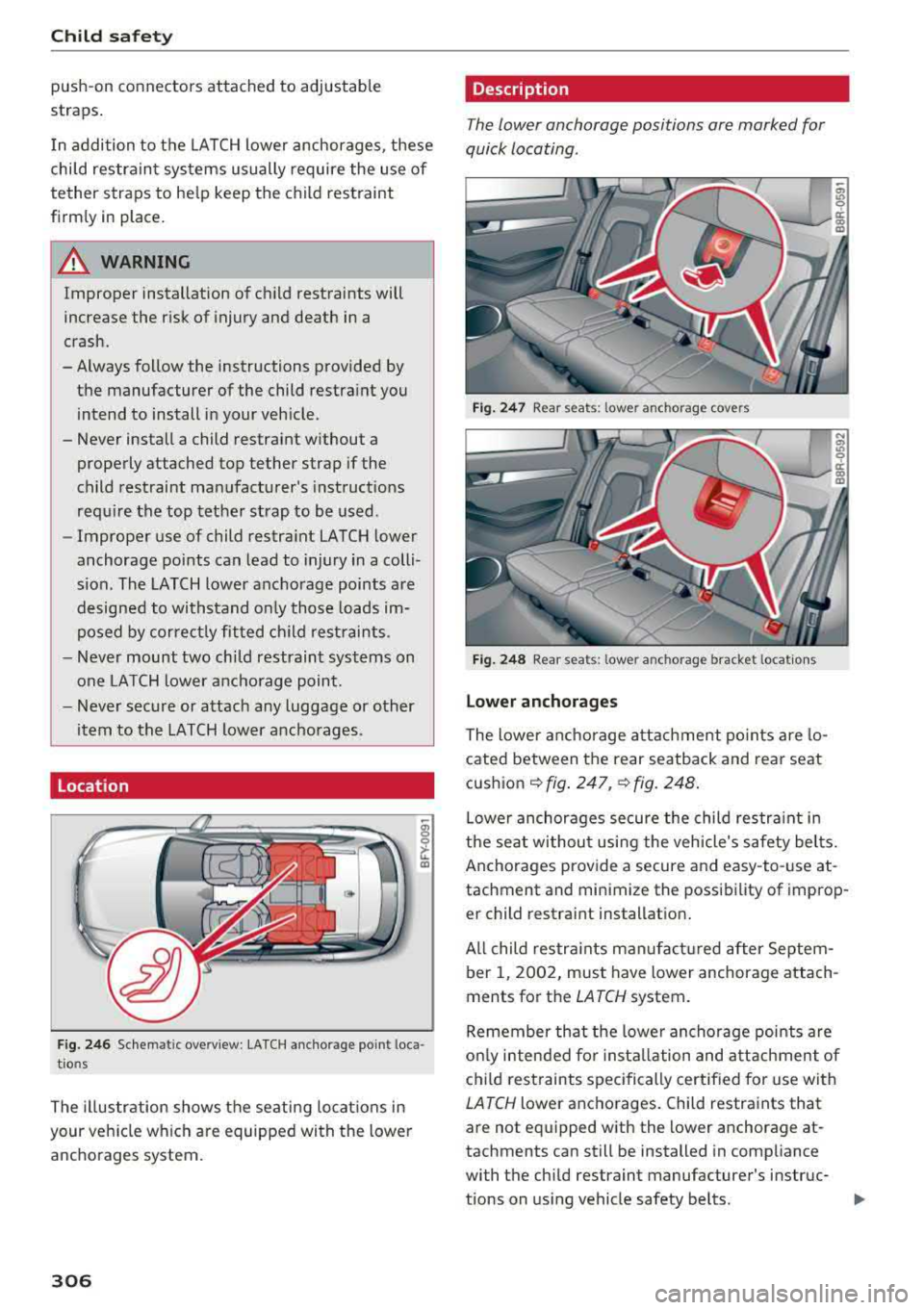
Location
Fig. 246 Schem atic overv iew : LATCH an cho rag e point loca
tio ns
The illustration shows the seating locations in
your vehicle which are equipped with the lower
anchorages system.
306
Description
The lower anchorage positions are marked for
quick locating .
Fig. 247 Rear seats: lowe r anchorag e cove rs
Fig. 248 Rear seat s: lowe r anchorage bra cket loca tions
Lower anchorages
The lower anchorage attachment points are lo
cated between the rear seatback and rear seat
cushion
~ fig. 247, ~fig. 248.
Lower anchorages secure the child restraint in
the seat without using the vehicle's safety belts.
Anchorages provide a secure and easy-to-use at
tachment and minimize the possibility of improp
er child restraint installation.
All child restraints manufactured after Septem
ber 1, 2002, must have lower anchorage attach
ments for the
LATCH system.
Remember that the lower anchorage points are
only intended for installation and attachment of
child restraints specifically certified for use with
LATCH lower anchorages. Child restraints that
are not equipped with the lower anchorage at
tachments can still be installed in compliance
wi th the child restraint manufacturer 's instruc-
tions on using vehicle safety belts.
IJ.
Page 309 of 392
u co ..... N r-N .....
~ 0 co
A WARNING
Improper use of LATCH lower anchorages can
cause serious personal injury in an accident.
- Always carefu lly follow the child restra ints
manufacturer's instructions for proper in
sta llation of the child restraint and proper
use of the lower anchorages or safety belts
in your vehicle.
- Never secure or attach any luggage or other
items to the
LATCH lower anchorages .
- Always read and heed the important infor
mation about child restraints in this chapter
and
WARNINGS ¢ page 291, Child safety.
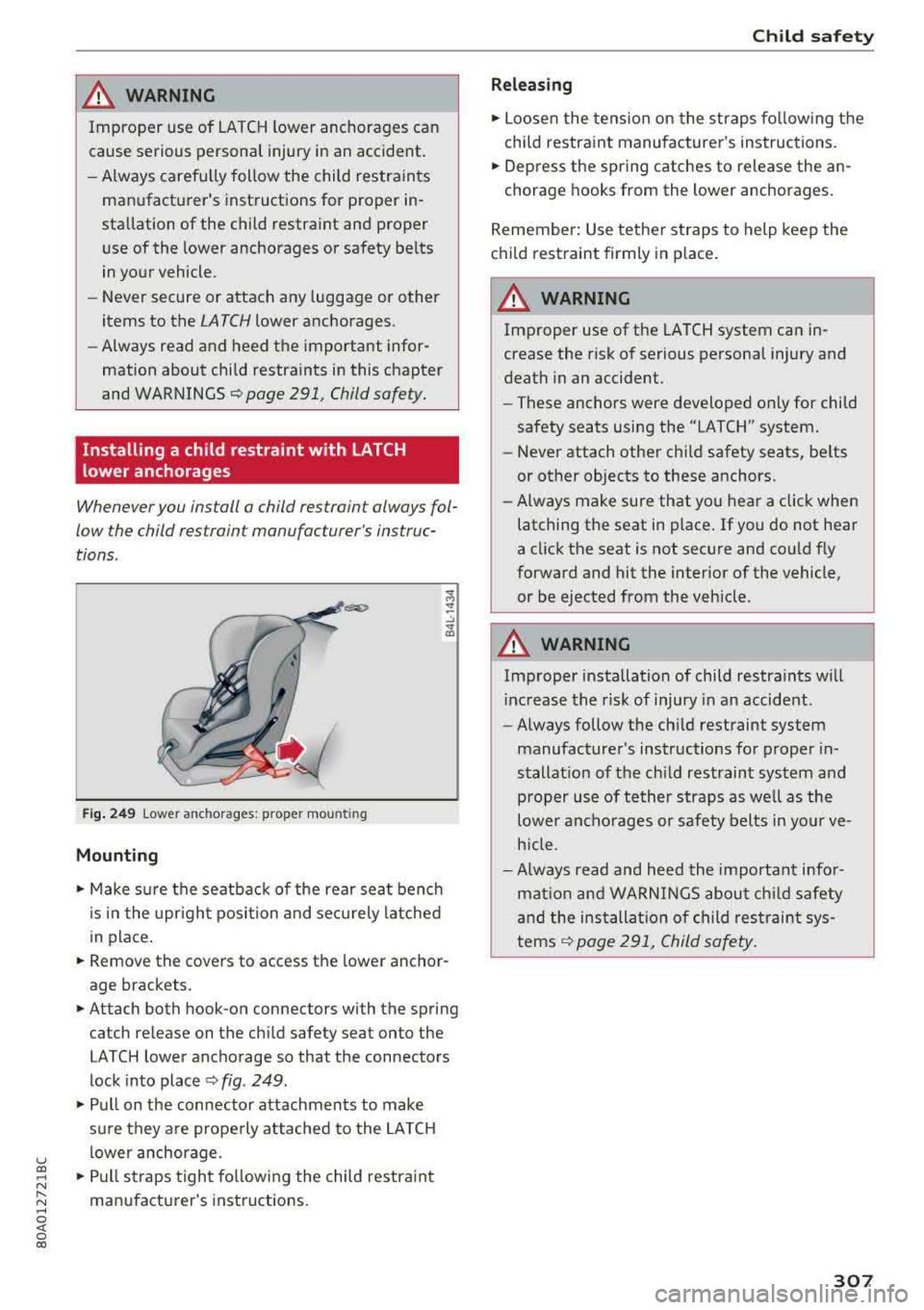
Installing a child restraint with LATCH
lower anchorages
Whenever you install a child restraint always fol
low the child restraint manufacturer's instruc
tions .
Fig . 2 4 9 Lower anchorages: p roper mount ing
Mounting
.,. Make sure the seatback of the rear seat bench
i s in the upr igh t position and securely latched
in place .
.,. Remove the covers to access the lower anchor
age brackets .
.,. Attach both hook -on connectors with the spring
catch release on the ch ild safety seat onto the
LATCH lower anchorage so that the connectors
lock into place
¢ fig . 249 .
.,. Pull on the connector attachments to make
s ur e they a re prope rly attached to the LA TC H
lower anchorage.
.,. Pull straps tight fo llowing the child restra int
manufacturer's instructions.
Ch ild s afe ty
Re leas ing
.,. Loosen the tension on the straps fo llow ing the
child restraint manufacturer's instructions.
.,. Depress the spring catches to release the an
chorage hooks from the lower anchorages.
Remember: Use tethe r straps to help keep the
child restraint firmly in p lace .
A WARNING
-
Improper use of the LATCH system can in
crease the risk of serious personal injury and
death in an accident.
- These anchors were developed only for child
safety seats using the "LATCH" system.
- Never attach other child safety seats, be lts
or other objects to these anchors.
- Always make sure that you hear a click when
latching the seat in place. If you do not hear
a cl ick the seat is not secure and co uld f ly
forward and hit the interior of the vehicle,
or be ejected from the vehicle .
A WARNING
Improper installation of child restraints wi ll
i ncrease the risk of injury in an accident.
- Always follow the child restraint system
manufacturer's instructions for proper in
stallat ion of the chi ld restraint system and
proper use of tether straps as well as the
lowe r ancho rages or safety belts in yo ur ve
h icle.
- Always read and heed the important info r
mat ion a nd WARN INGS abou t ch ild safety
a nd the ins tallat ion of ch ild restraint sys
tems ~ page 291 , Child safety.
307
Page 310 of 392
Child sa fet y
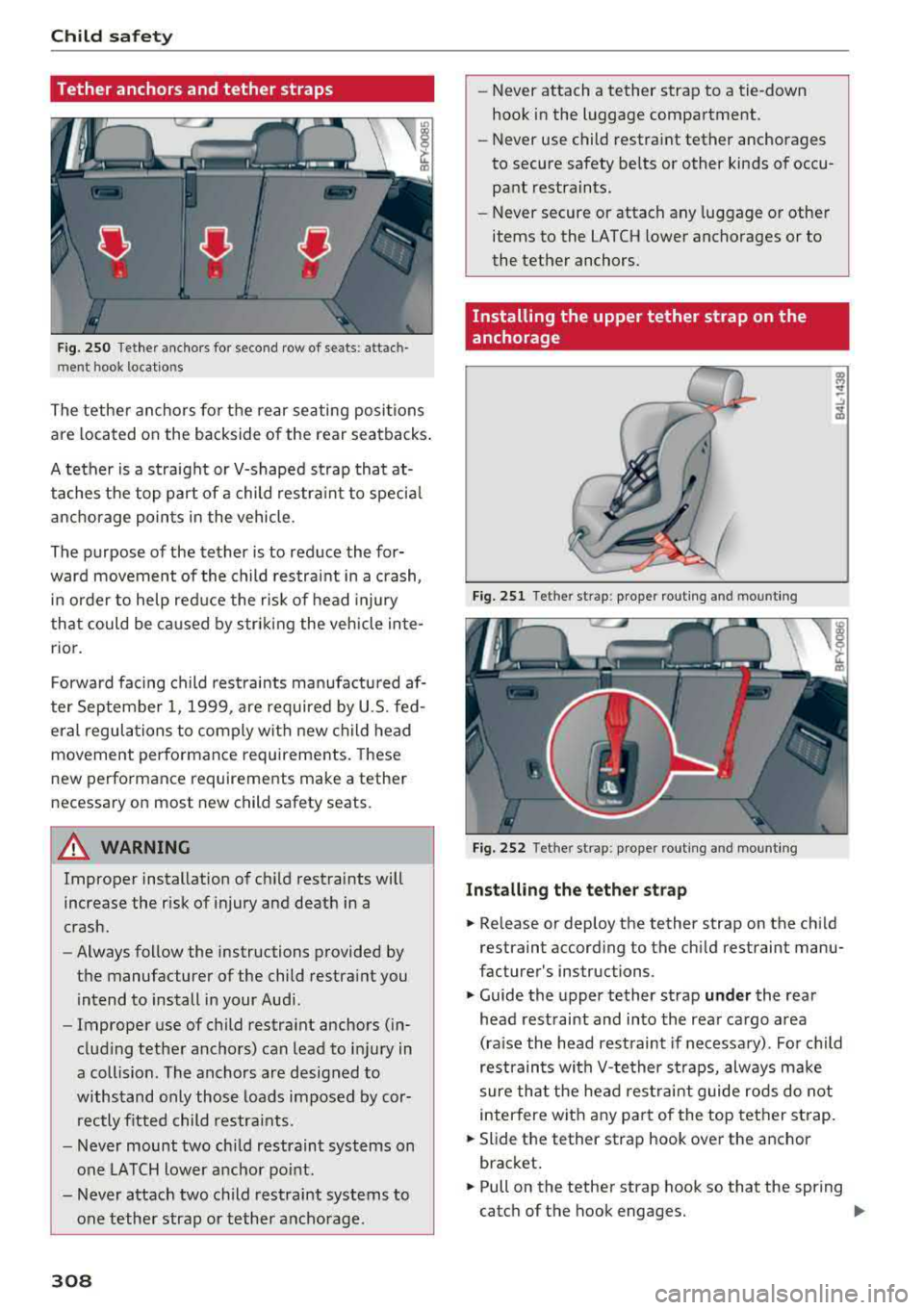
Tether anchors and tether straps
Fig. 250 Tether ancho rs for second row of seats: a tt a ch ·
m ent hook locat io ns
The tether an chors fo r the rear seating posi tions
are located on the backside of the rear sea tbacks .
A tether is a straight or V-shaped s trap that at·
t a ches the top part of a child restra int to spec ia l
ancho rage poin ts in the vehicle .
The purpose of the tether is to red uce the for
ward movement of the child res traint in a crash,
i n order to help red uce the risk of head injury
tha t could be c aused by str iki ng the vehicle inte
rior .
Forward fac ing ch ild rest rai nts manufactured af
ter September 1, 1999, are required by U .S. fed
eral regula tions to comply with new child head
movement performance requirements. These
new perfo rmance requirements make a tethe r
necessary on most new child safety seats.
A WARNING
Improper installation of c hild restraints will
increase the risk of injury and death in a
crash .
- Always follow the instructions provided by
the manufacturer of the child restra int you
intend to install in your Audi .
- Improper use of child restra int anchors (in
clud ing tether anchors) can lead to i njury in
a collision . The anchors are designed to
withs tand only those loads imposed by cor
r ectly fitted child restra ints.
- Never mount two chi ld restraint systems on
one LATC H lower anc ho r poi nt.
- Never attach two child restraint systems to
one tether strap or tether anchorage.
308
-
- Never attach a tether strap to a tie -down
hook in the luggage compartment .
- Never use child restraint tether anchorages
to secure safety be lts or other kinds o f occu
pant restraints.
- Never secure or attach any luggage or other
items to the LATCH lower ancho rages or to
the tether anchors.
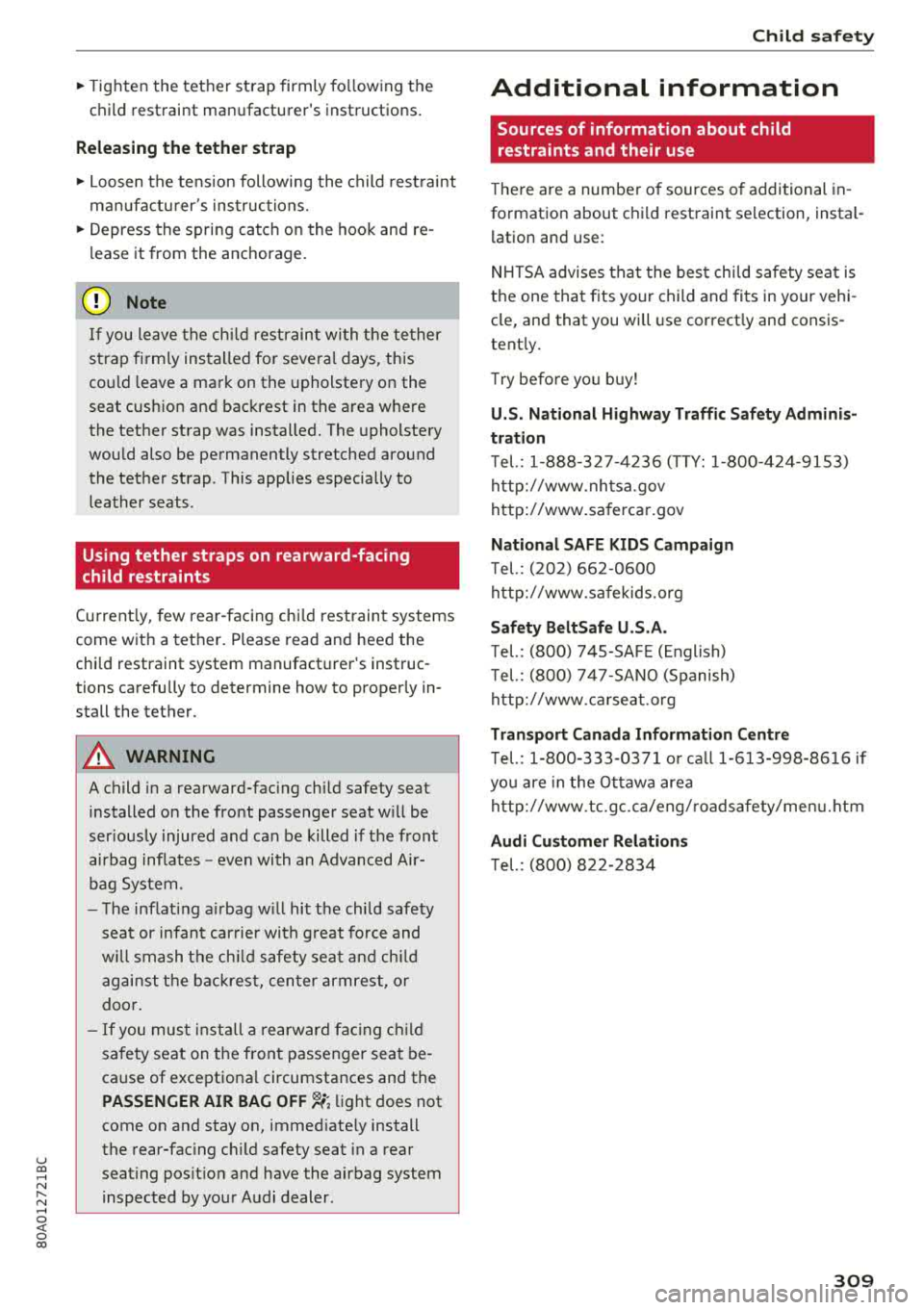
Installing the upper tether strap on the
anchorage
F ig. 2 51 Tet her st ra p: pro per r out ing and m oun ting
Fi g. 2 52 Tet her st rap: prope r rou ting and m oun ting
Installing the tether st rap
.,. Re lease or deploy the tethe r strap on the chi ld
restraint accord ing to the ch ild restraint manu
fac turer's ins tructions.
.,. Guide the upper tether strap under the rear
head restraint and into the rear cargo area (ra ise the head restraint if necessa ry) . Fo r ch ild
restrain ts with V- te ther st ra ps, alw ays ma ke
sure that the hea d rest rain t guide rods do not
interfere with any part of the top tether strap.
.,. Slide the tether strap hook ove r the anchor
bracket.
.,. Pull on the tether strap hook so that the spring
catc h of the hook engages.
..,_
Page 311 of 392
u co ..... N ,..._
N ..... 0 <( 0 00
~ Tighten the tether strap firmly fo llowing t he
child restraint manufacturer's instructions .
Releasing the tether strap
~ Loosen the tens ion following the ch ild rest rai nt
man ufacturer's instructions.
~ Depress the spring catch on the hook and re
l ease it from the anchorage.
(LlJ) Note
I f you leave the ch ild rest rain t with t he tether
s trap firm ly installed for severa l days, this
cou ld leave a mark on the upholstery on the
seat cushion and backrest in the area where
the tether strap was installed. The upholstery
wou ld also be permanently stretched around
the tether strap . This applies especially to
leather seats .
Using tether straps on rearward-facing
child restraints
Current ly, few rear-facing chi ld restraint systems
come wit h a tether. Please read and heed the
chi ld restraint system manufacturer's instruc
tions carefully to determine how to properly in
stall the tether.
A WARNING
A child in a rearward-facing chi ld safety seat
installed on the front passenger seat w ill be
ser iously injured and can be killed if the front
airbag inflates -even with an Advanced Air
bag System .
- T he inflat ing a irbag w ill hit the child safety
seat or infant car rie r with g reat fo rce and
w ill smash the ch ild safety seat a nd ch ild
agai nst t he bac kres t, cen ter armrest, o r
door .
-If you mus t install a rearw ard fac ing c hild
sa fety seat on t he front passenger seat be
cause of exceptiona l circumstances and the
PASSENGER AIR BAG OFF ~; light does not
come on and stay on, immed iate ly install
the rear-fac ing c hild safety seat in a rear
seating pos it ion and have the airbag system
inspected by your A udi dealer .
Child saf ety
Additional information
Sources of information about child
restraints and their use
T here are a number of sources o f additional in
formation about child restraint selection, instal
l ation and use :
N HT SA advises that the best ch ild safety seat is
the one that fits your child and fits in your vehi
cle, and that you wi ll use correct ly and consis
tent ly.
T ry befo re yo u buy!
U.S . N ational High way Traffic S afet y A dmini s
tration
T el. : 1-888-3 27- 42 36 ( TTY: 1-800 -424-91S3)
http:/ /www.nhtsa.gov
http:/ /www.sa ferca r.gov
Nati onal SAFE KIDS Camp aig n
Tel. : (202) 662-0600
http:/ /www.safekids .org
S afety BeltSaf e U.S .A.
Tel. : (800) 745-SAF E (E nglish)
T el. : (800) 747-SANO (Spanish)
http://www.ca rsea t.o rg
Tran sport C anada Information Centre
T el. : 1-800-333-0371 o r ca ll 1 -613-998-86 16 if
yo u are in the Ottawa area
http://www.tc.gc.ca/ eng/ roadsafety/men u. h tm
Audi Cu stomer Relation s
Tel.: (800) 822-2834
309
Page 330 of 392
Wheel s
Glossary of tire and loading
terminology
Accessory weight
means the combined weight (in
excess of those standard items
which may be replaced) of auto matic transmission, power steer
ing , power brakes , power win
dows , power seats, radio, and
heater, to the extent that these
items are available as factory-in
stalled equipment (whether in
stalled or not).
Aspect ratio
means the ratio of the height to
the width of the tire in percent. Numbers of 55 or lower indicate a
low sidewall for improved steer
ing response and better overall
handling on dry pavement .
Bead
means the part of the tire that is
made of steel wires, wrapped or
reinforced by ply cords and that is
shaped to fit the rim.
Bead separation
means a breakdown of the bond
between components in the bead.
328
Cord
means the strands forming the
plies in the tire.
Cold tire inflation pressure
means the t ire pressure recom
mended by the vehicle manufac
turer for a tire of a designated
size that has not been driven for
more than a couple of miles (kilo
meters) at low speeds in the
three hour period before the tire pressure is measured or adjusted.
Curb weight
means the weight of a motor ve
hicle w ith standard equipment in
cluding the maximum capacity of
fuel, oil, and coolant, ai r condi
tioning and additional weight of
optional equipment.
E x tra load ti re
means a tire designed to operate
at higher loads and at higher in
flation pressures than the corre
sponding standard tire. Extra load
tires may be identified as "X L",
"
l" "EXTRA LOAD" or "RF" on X I I
the sidewall. .,.
Page 378 of 392
Index
Audio player Bluetooth audio player . . . . . . . . . . . . . . . 228
Wi-Fi audio player . . . . . . . . . . . . . . . . . . . 229
Aud io track . . . . . . . . . . . . . . . . . . . . . . . . . . 237
Aud i pre sense . . . . . . . . . . . . . . . . . . . . . . . 112
Messages . . . . . . . . . . . . . . . . . . . . . . . . . . 116
Sett ings . . . . . . . . . . . . . . . . . . . . . . . . . . . 116
Audi Service Repair Manuals and Literature 371
Aud i side assist . . . . . . . . . . . . . . . . . . . . . . . 120
Rear cross-traffic assist . . . . . . . . . . . . . . . 124
Audi smartphone interface . . . . . . . . . 243, 247
Audi virtua l cockpit
refer to Instrument cluster . . . . . . . . . . . . . 10
AUTO Automatic headlights . . . . . . . . . . . . . . . . . 45
Auto Lock (central locking system) . . . . . . . . 30
Automatic belt retractor . . . . . . . . . . . . . . . 264
Automatic climate control . . . . . . . . . . . . . . . 69
Operation . . . . . . . . . . . . . . . . . . . . . . . . . . . 70
Automatic climate control system Audi drive select . . . . . . . . . . . . . . . . . . . . . 125
Setup . . . . . . . . . . . . . . . . . . . . . . . . . . . . . . 72
Automatic transmission . . . . . . . . . . . . . . . . . 84
Emergency program . . . . . . . . . . . . . . . . . . 89
Hill descent control . . . . . . . . . . . . . . . . . . . 87
Kick-down . . . . . . . . . . . . . . . . . . . . . . . . . . . 88
La unch control program . . . . . . . . . . . . . . . 89
Manual shiftin g . . . . . . . . . . . . . . . . . . . . . . 88
Parking lock emergency re lease . . . . . . . . . 90
Selector lever positions . . . . . . . . . . . . . . . . 85
Automatic wipe/wash system . . . . . . . . . . . . 51
Auto Safety Hotline . . . . . . . . . . . . . . . . . . . 259
AUTO (button) Automatic climate control system . . . . . . . 71
Auxiliary heater (automatic climate control) 72
AUX input . . . . . . . . . . . . . . . . . . . . . . . . . . . 232
Average consumption . . . . . . . . . . . . . . . . . . . 16
Average speed . . . . . . . . . . . . . . . . . . . . . . . . 16
B
BACK button 147
Balance (sound) . . . . . . . . . . . . . . . . . . . . . . 249
Bass (sound) . . . . . . . . . . . . . . . . . . . . . . . . . 249
Battery Jump starting . . . . . . . . . . . . . . . . . . . . . . . 363
also refer to Vehicle battery . . . . . . . . . . . 321
376 Before
driving . . . . . . . . . . . . . . . . . . . . . . . . 252
Belt tensioners . . . . . . . . . . . . . . . . . . . . . . . 267
Blended gasoline . . . . . . . . . . . . . . . . . . . . . 310
Blower (automat ic climate control system) . 71
Bluetooth Audio player . . . . . . . . . . . . . . . . . . . . . . . . 228
Connecting a cell phone . . . . . . . . . . . . . . 17 4
Settings . . . . . . . . . . . . . . . . . . . . . . . . . . . 248
Boost...... .. .. .. .. .. ............. ... 17
Booster seats . . . . . . . . . . . . . . . . . . . . . . . . 301
Boost pressure indicator . . . . . . . . . . . . . . . . 17
Brake fluid Checking the brake fluid level . . . . . . . . . . 321
Brakes . . . . . . . . . . . . . . . . . . . . . . . . . . . . . . 142
Brake assist . . . . . . . . . . . . . . . . . . . . . . . . 140
Brake fluid . . . . . . . . . . . . . . . . . . . . . . . . . 321
E lectromechanical parking brake . . . . . . . . 80
Emergency braking function . . . . . . . . . . . . 81
New brake pads . . . . . . . . . . . . . . . . . . . . . 142
Worn brake pads . . . . . . . . . . . . . . . . . . . . . 26
Break-in security feature . . . . . . . . . . . . . . . . 36
Breaking in
New brake pads . . . . . . . . . . . . . . . . . . . . . 142
New engine . . . . . . . . . . . . . . . . . . . . . . . . . 73
New tires . . . . . . . . . . . . . . . . . . . . . . . . . . 332
Browser
refer to Media center . . . . . . . . . . . . . . . . . 235
Bulbs . . . . . . . . . . . . . . . . . . . . . . . . . . . . . . . 362
Buttons Control panel (MMI) . . . . . . . . . . . . . . . . . 148
Multifunction steering wheel . . . . . . . . 12, 15
Switching the Infotainment system display
on/off . . . . . . . . . . . . . . . . . . . . . . . . . . . . . 148
C
Cable (USB adapter/ AUX connector cable) 231
California Proposition 65 Warning . . . . . . . 315
Battery specific . . . . . . . . . . . . . . . . . . . . . 322
Call list . . . . . . . . . . . . . . . . . . . . . . . . . . . . . 177
Call options . . . . . . . . . . . . . . . . . . . . . . . . . . 185
Capacities Fuel tank. . . . . . . . . . . . . . . . . . . . . . . . . . . 369
Washer fluid reservoir . . . . . . . . . . . . . . . . 369
Cargo area
refer to Loading the luggage compart-
ment..... .... .. .. .. ............. .. 257