engine AUDI Q5 2018 Repair Manual
[x] Cancel search | Manufacturer: AUDI, Model Year: 2018, Model line: Q5, Model: AUDI Q5 2018Pages: 392, PDF Size: 60.56 MB
Page 321 of 392
u co ..... N r--N ..... 0 <( 0 00
-Pay attention to legal requirements when
disposing of empty oi l containers .
Changing the engine oil
We recommend that have your oil changed by an
authorized Audi dealer or a qualified service sta
tion .
Before you check anyt hing in the eng ine compart
ment,
alwa ys read and heed all WARNING S¢.&.
in Working in the engine comportment on
page 314.
The engine oil must be changed accord ing to the
intervals specified in your Warranty
& Mainte
nance booklet . This is very important because the
lubricat ing propert ies of oil diminish gradually
during normal vehicle use.
Under some circumstances the engine oi l should
be changed more frequently. Change oil more of
ten if you drive most ly short distances, operate
the vehicle in dusty areas or under predominant ly
stop-and-go traffic condit ions, or have your vehi
cle where temperatures remain below freezing
for extended periods.
Detergent additives in the oil will make fresh oil
look dark after the engine has been running for a
short time. Th is is normal and is not a reason to
change the oil more often than recommended.
Because of the problem of proper disposal, along
with the special tools and necessary expertise re
qu ired, we strongly recommend that you have
your oil c hanged by an authorized
A udi de aler or
a qualified service station .
If you choos e to change your o il y our self , please
note the following important information:
A WARNING
T o red uce the r isk of pe rsonal injury if yo u
must change the engine oil in your ve hicle
yourse lf:
-Wear eye p rotection.
-To reduce the risk of burns from hot engine
o il, let the eng ine cool down to the touch.
-
-Whe n removing the o il drain plug with your
fingers, stay as far away as poss ible. A lways
Ch eck ing and F illing
keep your forearm pa rallel to the ground to
he lp prevent hot oil from running down your
arm.
-Drain the oil into a container designed for
this purpose, one la rge enough to hold at
least the tota l amount of oil in your engine.
-Engine oil is poisonous. Keep it well out of
the reach of children.
-Continuous contact with used engine o il is
harmful to your skin. Always protect your
skin by washing oil off thoroughly with soap
a nd water.
@ Note
Never mix oil additives with yo ur engine oil.
These additives can damage your engine and
adverse ly affect your Audi limited New Vehi
cle Warranty.
@) For the sake of the environment
-Before chang ing your oi l, first ma ke sure
you know where you can properly d ispose of
the used oil.
-Always dispose of used engine o il properly.
Do not dump it on garden so il, wooded
areas, into open streams o r down sewage
dra ins.
-Recycle used eng ine o il by tak ing it to a used
eng ine oi l collec tion fac ility in yo ur area, or
contact a se rvice station.
Cooling system
Coolant
The eng ine cooling system is fi lled w ith a mixture
of purified water and coolant additive at the fac
tory. This coolant must not be not changed.
T he coo lant level is monitored through
the . in
dicator light
¢page 23. However, we do recom
mend occasionally checking the coolant leve l
manual ly.
If you must add coo lant, use a mixture of water
and coolant additive. Mixing the coolant add itive
with dist illed water is recommended.
IIJ>-
319
Page 322 of 392
Checking and Filling
Coolant addit ive
The coolan t additive is made of anti-freezi ng and
corrosion protection agents. Only use the fo llow
ing coolant additives . These additives may be
mixed w ith each other.
Coolant additive Specification
G 12e vo
TL 774 L
G12 ++ TL 774 G
G13 TL 774)
The amount of coolant additive that needs to be
mixed with water depends on the climate where
the vehicle will be operated. If the coolant addi
tive percentage is too low, the coolant can freeze
and damage the engine.
Coolant Freeze protec-
tion
additive
Warm min . 40% m in . -13 °F
reg ions (-25
°C)
max . 45%
Cold min. 50% max.
-40 °F
reg ions (-40 °C)
max. 55%
(D Note
- Before the start of winter, have an author
i zed Audi dealer or authorized Audi Service
Fac ility check if the coolant additive in your
vehicle matches the percentage appropriate
fo r the climate. This is especially important
when driving in co lde r climates.
- If the appropriate coolant additive is not
available in an emergency, do no t add any
othe r addi tive. You cou ld d amage the en
gine. If this happens, only use water and re
store the correct mixture ra tio with the
specified coolant additive as soon as possi
ble.
- Only refill with new coo lant.
- Radia tor sealan t must no t be m ixed w it h
the coo lant .
320
Adding coolant
(l!J .. ,
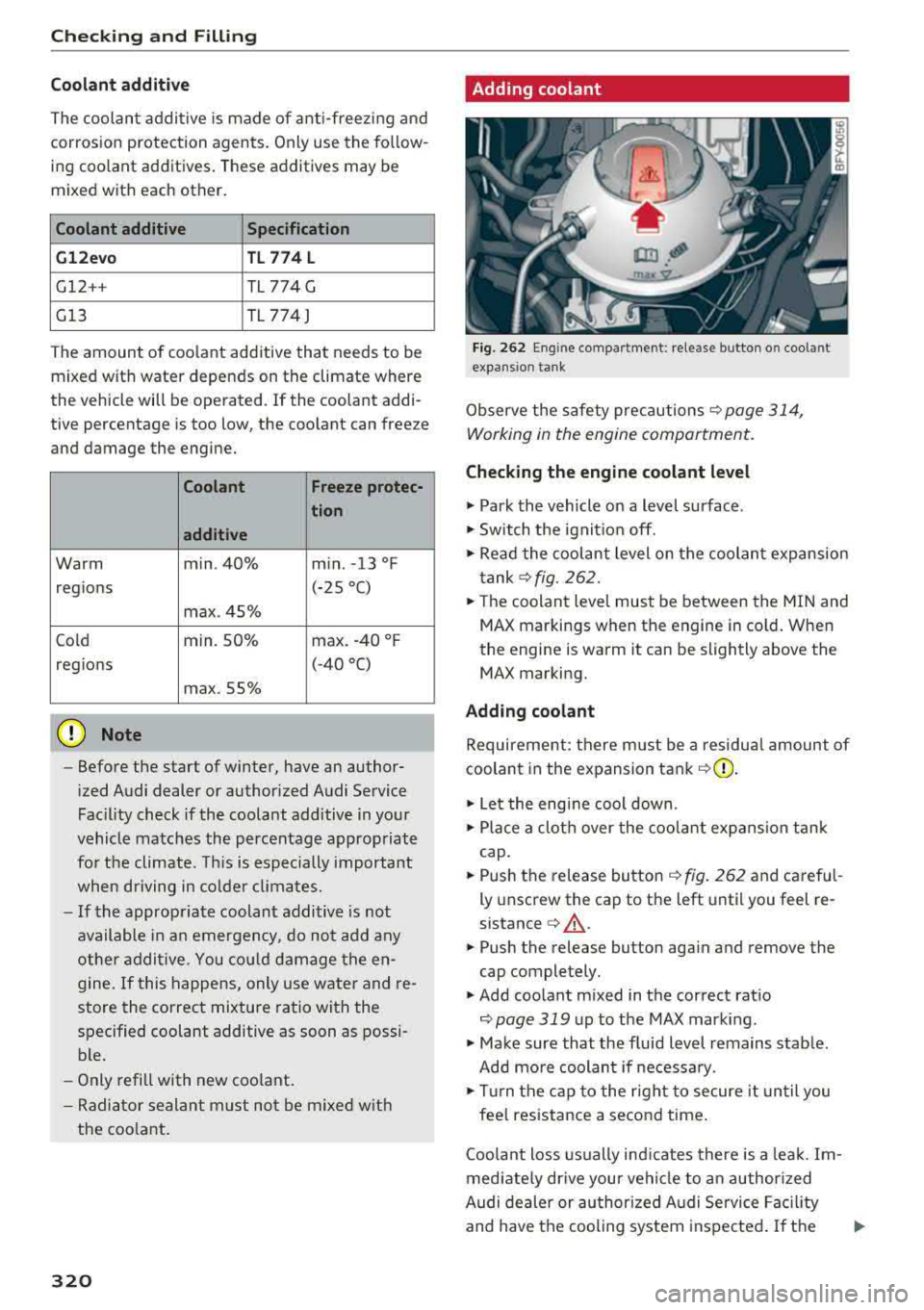
Fig. 262 En g in e compartment: release butto n on coola nt
expansio n tank
Observe the safety precautions ¢ page 314,
Working in the engine compartment.
Checking the engine coolant level
" Park the vehicle on a level surface.
11> Switch the igni tion off.
" Read the coolant level on the coolan t expansion
t ank
¢ fig. 262.
"T he coolant level must be between the MIN and
MAX marki ngs when the engine in cold . When
the engine is warm it can be slightly above the
MAX marking.
Adding coolant
Requireme nt: there m ust be a residual amount of
coolant in the expansion tank
¢ (D.
"Le t the engi ne cool down.
" Place a clot h over the coo lant exp ansion tank
cap.
" Push the release button ¢ fig. 262 and carefu l
ly unscrew the cap to the left unti l you feel re
sistance ¢ _A.
"Push the release button aga in and remove the
cap completely.
" Add coo la nt m ixed in the correct rat io
r:=;, page 319 up to the MAX mark ing .
" Ma ke sure that the f luid level remains stab le .
Add mo re coolan t if ne cessa ry .
" Tur n the cap to the r ight to secure it until you
fee l resista nce a second time .
Coo la nt loss us ually ind icates there is a lea k. Im
med iate ly dr ive you r veh icle to a n author ized
Audi dealer or au thor ized Audi Servi ce Fac ility
and have the cooling system ins pected .
If the
Page 323 of 392
u co ..... N r-N .....
~ 0 co
cooli ng system is not le aking, a loss can come
from the coolant boili ng through overheating
and being pushed out of the cooling system.
.&_ WARNING
-The cooling system is under pressure. Do
not open the coolant expansion tank cap
when the eng ine is hot. This inc reases the
risk of burns.
- The coo lant add itive and the coolant can be
dangerous to you r healt h. For this reason,
keep t he coolant i n the o rigi nal container
and away from children. There is a risk of
poiso ning.
- When working in the engine compartment,
remember t hat the radiator fan can sw itch
o n even if the ign ition is swi tched off, which
increases the risk of i njury.
@ Note
Do not add coo lant if the expansion tank is
empty. There may be a ir in the coo ling sys
t em, wh ich increases t he risk of engi ne dam
age . If this is the case, do not continue driv
ing . See an authorized Aud i dea le r or a uthor
ize d Aud i Service Fac ility for assistance .
Brake fluid
-
N N ~ N
""
CX) IXl
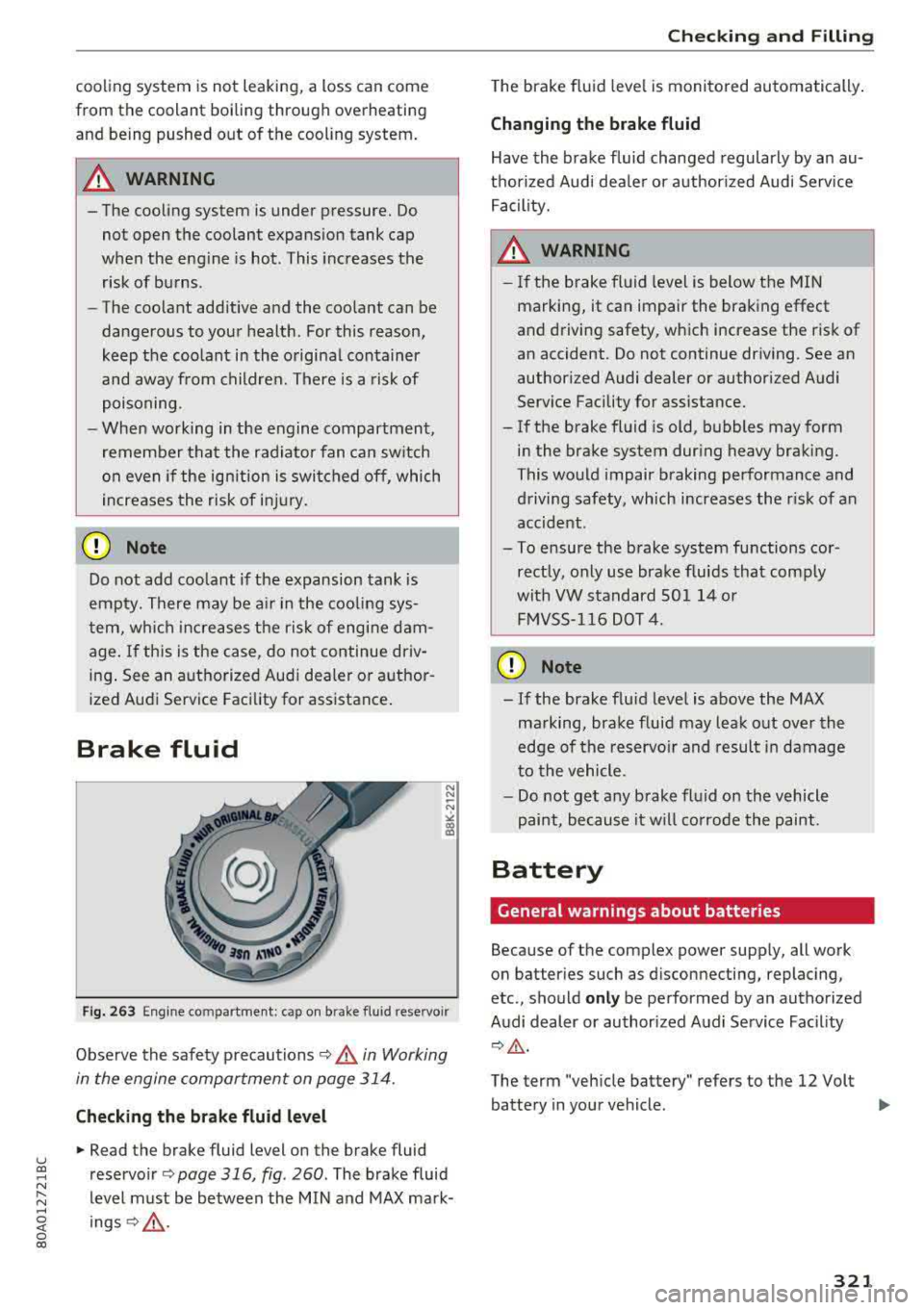
Fig . 2 63 Engi ne compartme nt: cap o n brake fluid reservoir
Observe the safety p recautions 9 &. in Working
in the engine comportment on page 31 4.
Checking the brake fluid level
"' Read the brake fluid level on the brake fluid
reservoir ¢
page 316, fig . 260. The brake fluid
level must be between the MI N and MAX mark
ings ¢,&. .
Chec king and Filling
The brake f lu id leve l is moni to red automatically .
Changing the brake fluid
Have the brake fluid changed regularly by an au
t h ori zed Audi dea le r or a uthor ized Audi Service
F ac ility.
A WARNING
-
- I f the b rake fl uid level is below t he MIN
marking, it can impair the brak ing effect
and d riving safety, which increase the risk of
an accident. Do not continue dr iving. See an
author ized Audi dealer or author ized Audi
Serv ice Facility for assistance.
- If the b rake fl uid is old, b ubbles may form
in the brake system dur ing heavy bra king.
This wo uld impair braking performance and
driving safety, which increases the r isk of an
accident.
- To ensure the brake system functions cor rectly, only use brake f luids tha t comply
wit h VW standard S0 l 14 o r
F M VSS -116 DOT 4 .
(D Note
-If the brake flu id leve l is above the MAX
ma rking, bra ke f luid may leak o ut over the
edge of the reservo ir and resul t in damage
t o the vehicle.
- Do not ge t any brake fl uid on the vehicle
pai nt, because it w ill corrode the paint.
Battery
General warnings about batteries
Because of the complex power supply, all work
on batter ies such as d isconnecting, replacing,
etc., sho uld
only be performed by an authorized
Audi dealer or author ized A udi Se rvice Facility
¢ &_ .
The term "veh icle battery" refers to the 12 Volt
batte ry in your vehicle.
..,.
321
Page 324 of 392
Checking and Filling
Detailed warnings for the vehicle battery:
~
Always wea r eye protection.
~
Battery acid is highly corrosive. Always
wea r protect ive g loves and eye pro tect io n .
.
®
Fire, sparks, open flame and smok ing are
forb idden .
~
A highly explosive mixture of gases can
form when charging batteries.
®
Always keep childre n far away from bat-
tery electrolyte and the batte ry .
~
Always follow the instructions in the oper-
ating manual.
A WARNING
All wo rk on the batte ry o r electrical system in
yo ur vehicle can result in inju ries, chemical
burns, accidents or burns. Because of this, all
wor k must be performed
only by an author
ized Audi dealer or authorized Audi Service
Facility.
A WARNING
California Proposition 65 Warning:
- Battery posts, terminals and re lated acces
sories contain lead and lead compounds,
chemica ls known to the State of California
to cause cancer and reproductive problems.
Wash hands after handling .
@ Note
-If the vehicle will be parked for long periods
of time, protect it against the cold so that it
will not be destroyed by "freezing"
<=>page 323.
-There are electrical components under the
cargo floor behind a trim pane l that warm
up during operation. To reduce the risk of
the components overheat ing, do not store
objects such as blankets under the cargo
floor . If they overheat, the components wi ll
switc h off temporarily. This will be ind icat ed
by a message in the instrument cluster, un
til the temperature returns to normal.
322
@ For the sake of the environment
i Batteries contain polluting substances such
as sulfur ic acid and lead. Contact an author
i zed Audi dealer or authorized Audi Service
Fac ility for more informat ion.
Vehicle battery
The term "vehicle battery" refers to the 12 Volt
battery in your vehicle.
Not running the vehicle for long periods of
time
If you do not drive your vehicle for severa l days or
weeks, electrical equ ipment is gradually sca led
back or switched off. This reduces energy use and
ensures the vehicle will be able to start after long
periods of
time<=> page 145 . Some convenience
funct ions, such as interior lighting or power seat
adjustment, may not be available under certain
circumstances . These convenience functions will
be available again once you switch t he ignition on
and start the engine .
Even when electrical equipment is switched off,
the equipm ent can still drain the vehicle battery
if the vehicl e is not driven for long periods of
time. Deep draining results in a chemical reaction
that destroys the inside of the vehicle battery.
The vehicle battery must be charged every month
to reduce the risk of this happening
<=> page 323.
Contact an authorized Aud i dealer or authorized
Audi Service Fac il ity for more information.
Winter operation
Cold weather places higher demands on the vehi
cle battery. This results in reduced starting abili
ty. Have the vehicle battery checked by an au
thorized Audi dealer or authorized Audi Service
Fac il ity before the cold time of year .
Page 325 of 392
u co ..... N r-N .....
~ 0 co
Charging the vehicle battery
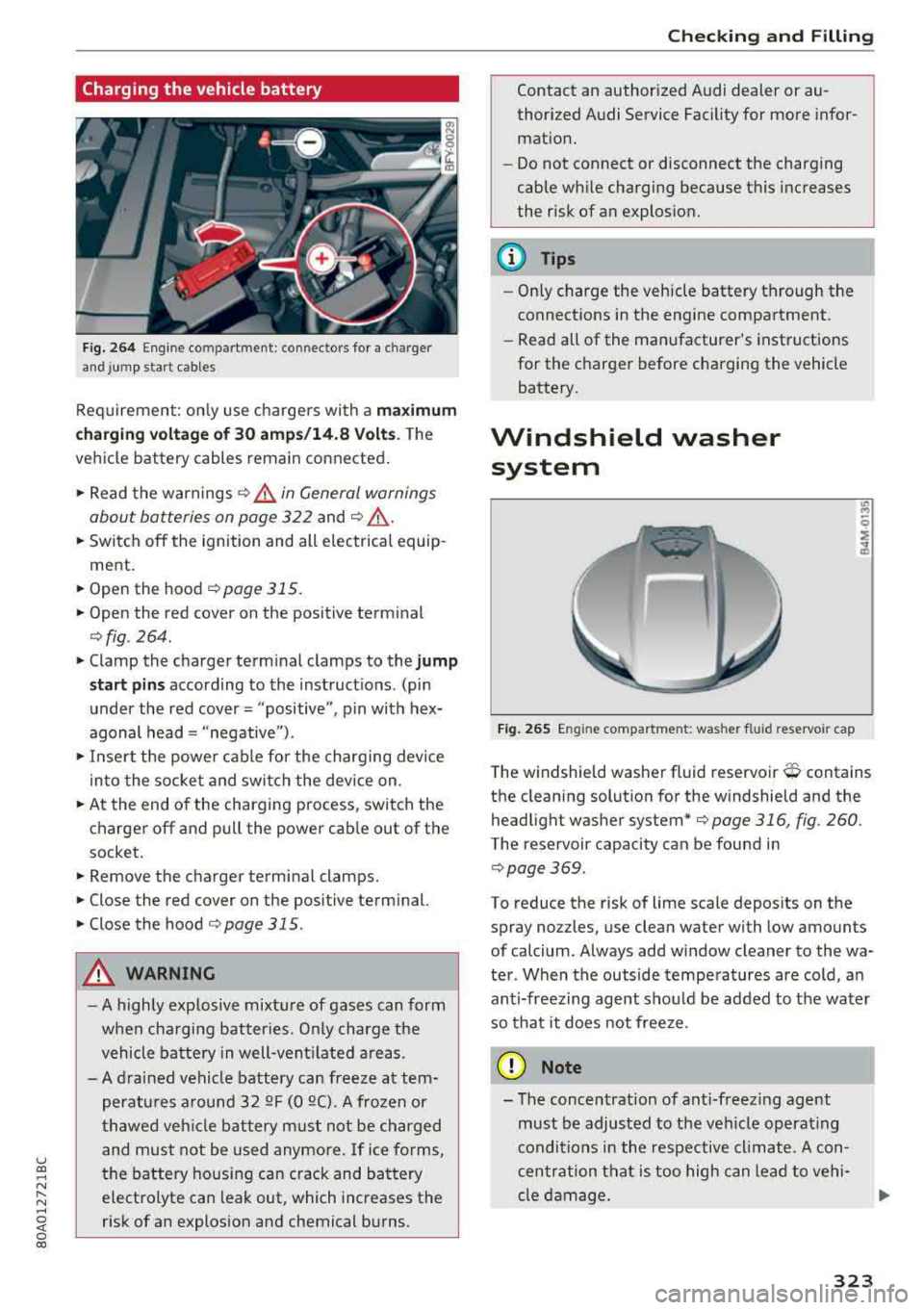
Fig. 264 Engine co mpartment : connec tor s fo r a charg er
and jump s ta rt cab les
Req uirement: on ly use charge rs with a maximum
c harging voltage of 30 amp s/14 .8 Volt s.
T he
vehicle battery cables remain connected .
.,. Read the warnings ¢ & in General warnings
about batteries on page 322
and ¢ ,& .
.,. Switch off the ignition and all e lectrical equip
ment .
.,. Open the hood ¢ page 315 .
.,. Open the red cover on the positive term inal
¢ fig . 264 .
.,. Clamp the charger term inal clamps to the jump
s tart pins
according to the instruct ions . (pin
under the red cover = "positive", p in with hex
agonal head= "negative ") .
.,. In se rt the powe r cable for the charging device
in to the socket and swi tch the device on .
.,. At the end of the charging process, switch the
charger off and pull the power cab le out of the
socket.
.,. Remove the charger terminal clamps .
.,. Close the red cover on the positive term inal.
.,. Close the hood ¢ page 315 .
A WARNING
-A highly explosive mixtu re of gases can form
whe n cha rging batter ies. O nly charge the
vehicle ba tte ry in well-ven tilated are as.
- A dra ined vehicle battery can freeze at tem
peratu res a round 3 2
QF (0 QC). A frozen or
t hawed veh icle bat tery m ust not be charged
and must not be used anymore. If ice forms,
the battery housing can crack and battery electrolyte can leak out, which increases the
risk of an explosion and chemical b urns .
Chec king and Filling
Contact an author ized Audi dealer or au
thorized Audi Service Facility for more infor
mat ion.
- Do not connect or disconnect the charging
cable wh ile charging because this increases
the risk of an explos ion.
(D Tips
- Only charge the veh icle battery through the
connect ions in the engine compartment .
- Read all of the manufacturer's instructions
for the charger before charging the vehicle battery.
Windshield washer system
F ig. 265 Engine compar tmen t: was her fluid reservo ir ca p
T he windshield washer fluid reservoir O contains
the clean ing solut ion for the w indshield and the
headlight washer system*
¢page 316, fig. 260 .
The reservoir capacity can be found in
¢page 369 .
To reduce the risk of lime scale deposits on the
spray no zzles, use clean water with low amounts
of calcium . Always add w indow cleaner to the wa
ter . When the outside tempe ratures are cold, an
anti-freez ing agent sho uld be added to t he water
so that it does not free ze.
@ Note
- The concentration of ant i-freez ing agent
must be adjusted to the ve hicle operat ing
conditio ns in the respective cl imate . A con
c en tration that is too high can lead to vehi
cle d am age .
323
Page 326 of 392
Checking and Filling
-Never add radiator anti-freeze or other addi
tives to the washer fluid.
-Do not use a glass cleaner that contains
paint solvents, because this could damage
the paint .
Service interval display
The service interval display detects when your ve
hicle is due for service.
Checking service intervals
You can check the remaining distance or time un
til the next oil c hange or next inspection in the
Infotainment system .
.,. Select in the Infot ainment system: the I MENU I
button > Vehicle > left contro l button > Service
& checks > Service intervals.
Resetting the indicator
An author ized Audi dealer or authorized Audi
Service Facility will reset the service interval dis
p la y after performing serv ice.
If you have changed the oil yourself, you must re
set the oil c hange interva l.
.,. Select in the Infotainment system: the lMENUI
button
> Vehicle > left control button > Service
& checks > Service intervals > Reset oil change
interval.
If an oil change or inspection is due, you can ac
cess it in the Infotainment system . The display
works in two stages:
-Service reminder: after a certain distance is
driven, a message appears in the instrument
cluster display every time the ign ition is switch
ed on. The remaining distance and t ime is dis
played br iefly.
-Service due : if your vehicle has reached a serv
ice interval, a message appears briefly after
switching the ignition on.
0 Note
-Only reset the oil change indicator if the oil
was c hanged.
-Following the service inter vals is critical to
maintain ing the service life and value of
324
your vehicle, especially the engine . Even if
the mileage on the ve hicle is low, do not ex
ceed t he time for the next service .
Page 339 of 392
u co .... N r--N .... 0 <( 0 00
on the label on the driver's side B
pillar, always follow the specifica
tion on the B-pillar label
c:::> page 335, fig. 268.
Make sure that the tire designa
tion on your tire matches the des-
Model/ Tire designation
Wheels
ignation on the tire pressure label
and the tire pressure table.
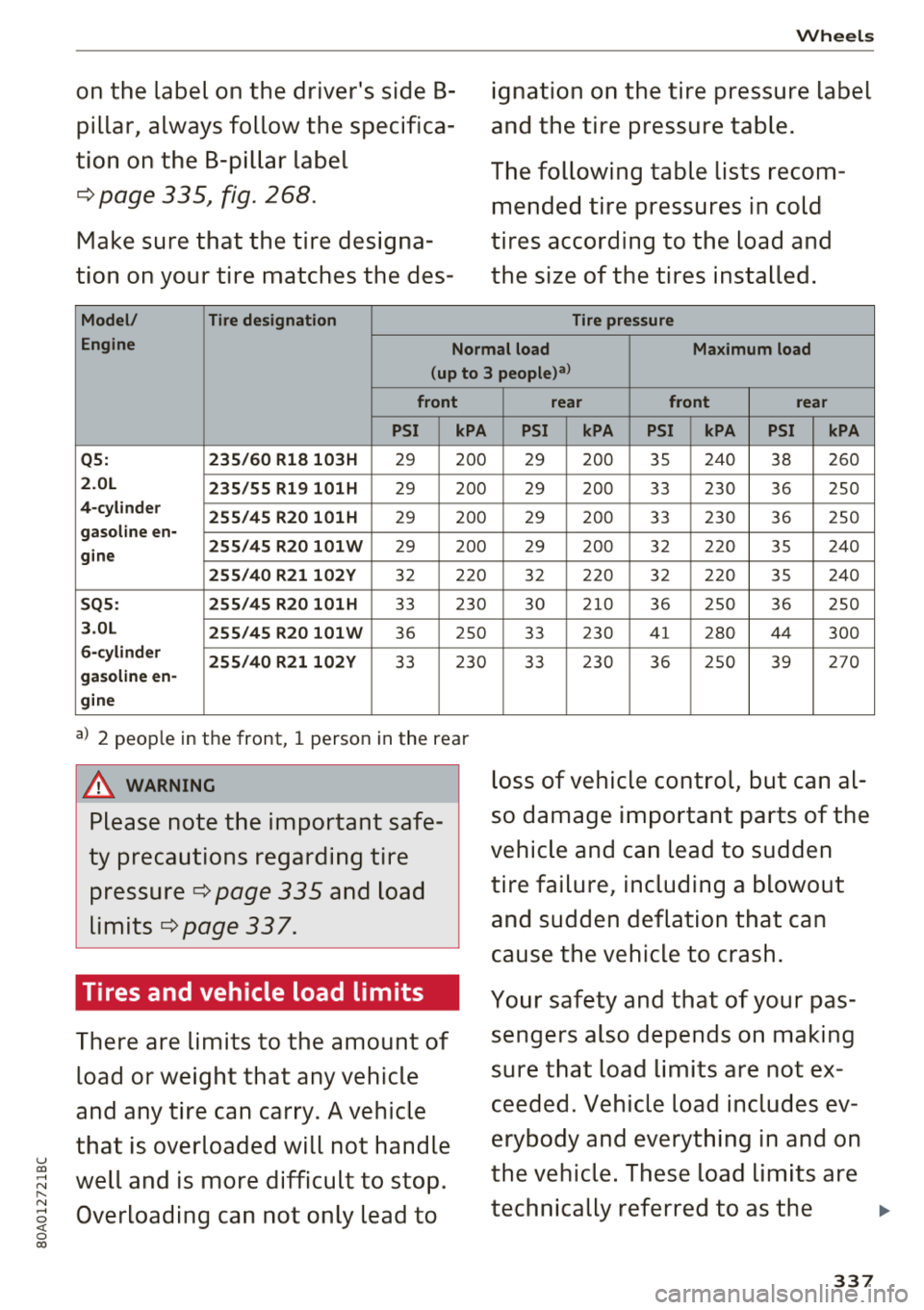
The following table lists recom mended tire pressures in cold
tires according to the load and
the size of the tires installed.
Tire pressure
Engine Normal load Maximum load
(up to 3
people)a)
front
PSI kPA
Q5: 235/60 R18 103H 29 200
2.0L
235/55 R19 101H 29 200
4-cylinder
255/45 R20 101H 29 200
gasoline en-
255/45 R20 101W
29 200 gine
255/40 R21102Y
32 220
SQ5: 255/45 R20 101H 33 230
3.0L
255/45 R20 101W 36 250
6-cylinder
gasoline en- 255/40 R21102Y 33 230
gine
a
) 2 people in the front, 1 person in the rear
A WARNING
Please note the important safe
ty precautions regarding tire
pressure
c:::> page 335 and load
limits
c:::> page 337.
Tires and vehicle load limits
There are limits to the amount of
load or weight that any vehicle
and any tire can carry. A vehicle
that is overloaded will not handle
well and is more difficult to stop .
Overloading can not only lead to
rear front rear
PSI kPA PSI kPA PSI kPA
29 200 35 240 38 260
29 200 33 230 36 250
29 200 33 230 36 250
29 200 32 220 35 240
32 220 32 220 35 240
30 210 36 250 36 2 50
33 230 4
1
280 44
300
33 230 36 250 39 270
loss of vehicle control, but can al
so damage important parts of the
vehicle and can lead to sudden
tire failure, including a blowout
and sudden deflation that can
cause the vehicle to crash.
Your safety and that of your pas
sengers also depends on making
sure that load limits are not ex
ceeded. Vehicle load includes ev
erybody and everything in and on
the vehicle . These load limits are
technically referred to as the
..,
337
Page 352 of 392
Emergency assistance
Emergency assistance
General information
.,. Park the vehicle as far as possible from moving
traffic in the event of a breakdown. In the event
of a flat tire, park the vehicle on a level surface .
It you are on a steep hill, be especially careful.
.,. Set the parking brake .
.,. Switch the emergency flashers on .
.,. Have the passengers exit the vehicle . They
should move to a safe place, for example
be
hind a guard rail.
.&, WARNING
Follow the steps given above . This is for your
protection and the for the safety of other driv
ers.
Equipment
Vehicle tool kit/tire mobility kit/vehicle
jack
Applies to: vehicles with the vehicle tool kit, tire mobility kit
and veh icle jack
Fig. 270 Luggage co mpartment: ve hicle too l kit, veh icle
j ack, tir e m ob ility k it and comp ressor
The vehicle tool kit, vehicle jack, tire mobility kit
and compressor are stored in the luggage com·
pa rtm ent under the cargo floor cover. Lift the
cargo floor using the handle .
.&, WARNING
Improper use of the vehicle jack can cause se
rious persona l injuries.
-Never use the screw driver hex head to
tighten wheel bolts, since the bolts cannot
attain the necessary tightening torque if you
350
use the hex head, potentially causing an ac
cident.
-The factory-supplied jack is intended only
for your vehicle model. Under no circum stances should it be used to lift heavy
vehicles or other loads; you risk injuring
yourself.
-Never start the engine when the vehicle is
raised, which could cause an accident .
-Support the vehicle securely with appropri·
ate stands if work is to be performed under·
neath the vehicle; otherwise, there is a
po ·
tential risk for injury .
-Never use the jack supplied with your Audi
on another vehicle, particularly on a heavier
one . The jack is only su itable for use on the
vehicle it came with.
(i) Tips
The vehicle jack in your vehicle is mainte· nance-free .
Tire mobility kit
Preparation
Applies to: vehicles with tire mob ility kit
.,. Read and follow the important safety precau-
tions
c::> page 350 .
.,. Set the parking brake .
.,. Select the "P" selector lever position .
.,. Check if a repair with the tire mob ility kit is pos ·
sible
c::> page 350 .
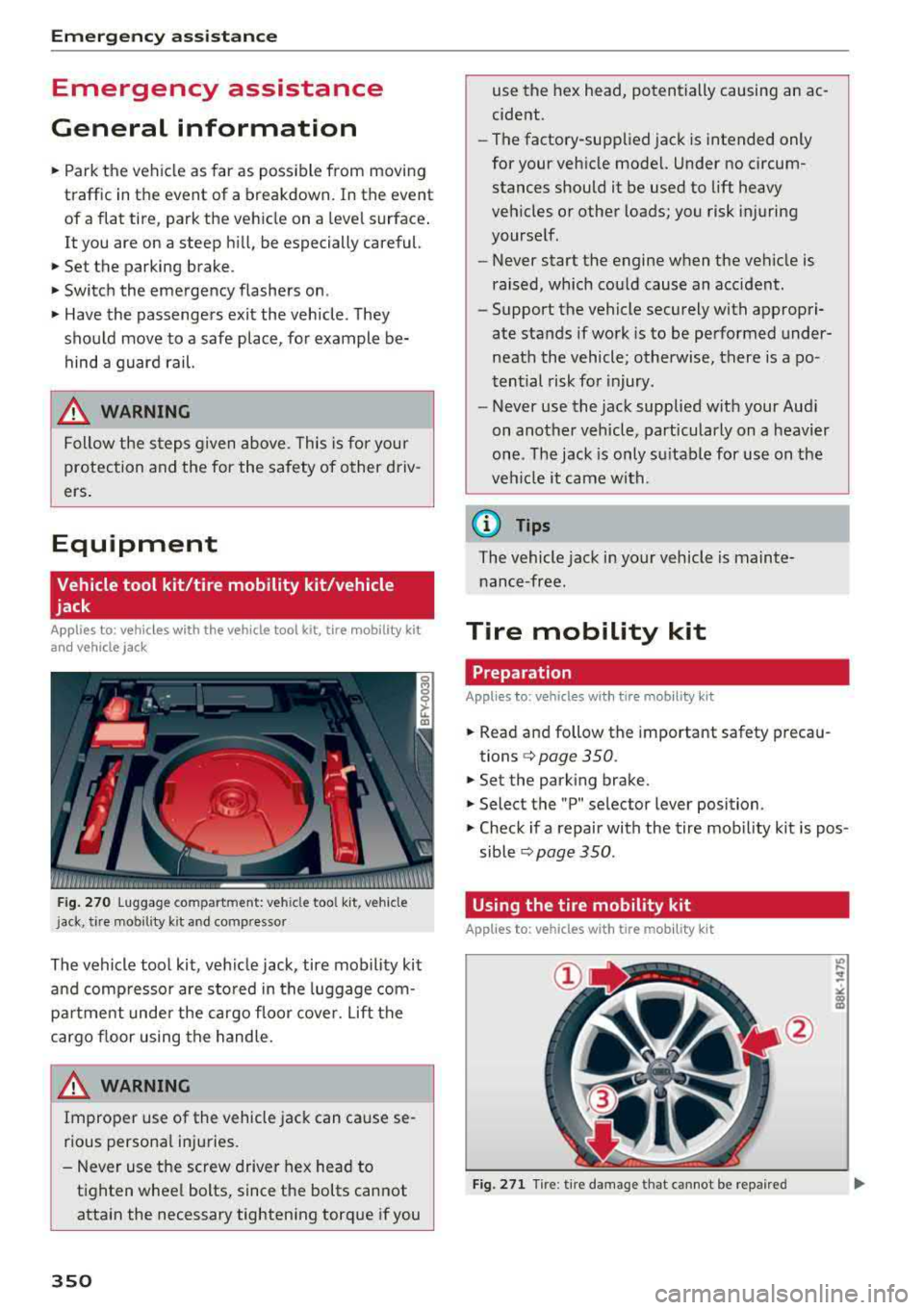
Using the tire mobility kit
Applies to: vehicles with tire mob ility kit
Fig. 271 Tir e : tire damage that cannot be repaired
Page 355 of 392
u co ..... N r-N .....
~ 0 co
-If you have a flat tire, move a safe distance off the road. Turn off the engine, turn the
emergency flashers on and use other warn
ing devices to alert other motorists.
-Make sure that passengers wait in a safe
place away from the vehicle and well away
from the road and traffic.
-To help prevent the vehicle from moving
suddenly and possibly slipping off the jack*,
always fully set the parking brake and block
the front and back of the wheel diagonally opposite the wheel being changed. When
one front wheel is lifted off the ground,
placing the Automatic Transmission in P
(Park) will
not prevent the vehicle from
moving .
-Before you change a wheel, be sure the
ground is level and firm. If necessary, use a
sturdy board under the jack*.
-Always store the vehicle tool kit, the jack*
and the replaced tire in the luggage com
partment ¢ page 2 5 7.
(D Tips
-Obey all laws.
-Before changing the wheel, you must acti-
vate the jacking mode*, so that the auto
matic controls for the air suspension* do
not make it more difficult to lift the vehicle
with the jack*
c::> page 354.
Removing the caps
Fig . 274 Wheel: wheel bolts with caps
.. Slide the plastic clip (from the vehicle tool kit)
onto the cap until it engages
¢ fig. 274.
.. Remove the cap with the plastic clip.
Emergency assistance
Loosening the wheel bolts
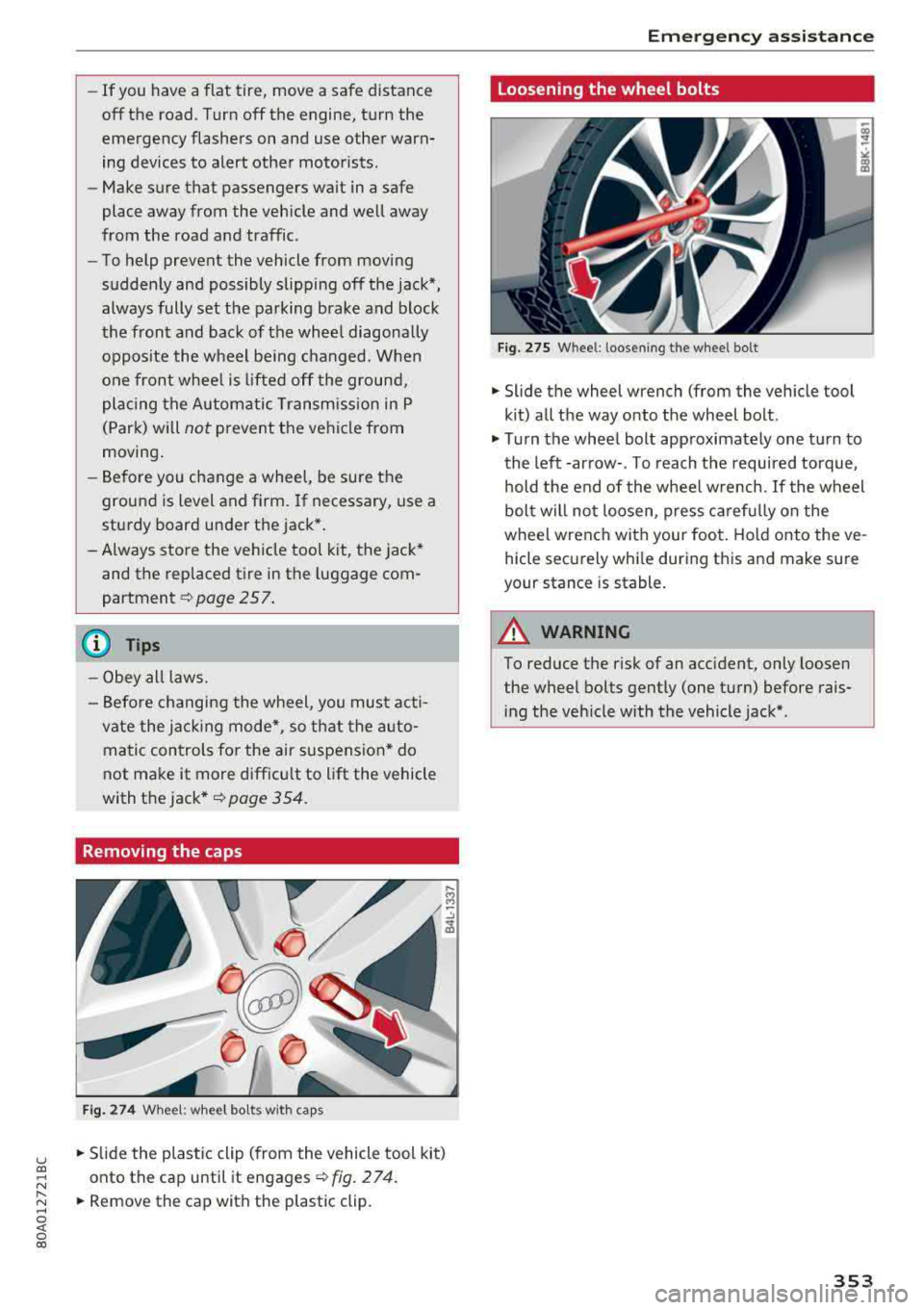
Fig. 275 W hee l: l oosen ing t he wheel bolt
.. Slide the wheel wrench (from the vehicle tool
kit) all the way onto the wheel bolt .
.. Turn the wheel bolt approximately one turn to
the left -arrow-. To reach the required torque,
hold the end of the wheel wrench. If the wheel
bolt will not loosen, press carefully on the
wheel wrench with your foot. Hold onto the ve
hicle securely while during this and make sure
your stance is stable.
A WARNING
--To reduce the risk of an accident, only loosen
the wheel bolts gently (one turn) before rais
ing the vehicle with the vehicle jack* .
353
Page 356 of 392

Emergency assistance
Raising the vehicle
Fig. 276 Sill p ane ls : mar kin gs
Fig. 277 Sill: pos itio nin g th e ve hicle jack
"' Place the vehicle jack* (vehicle tool kit) on a
firm surface . Use a flat , stable support if neces
sary . On a slippery surface such as tile, you
shou ld use a non-slip pad (such as a rubber
mat) ¢,&. .
"'Find the mark ing on the sill that is closest to
the tire that will be changed
¢ fig. 2 76 . Behind
the marking, there is a lifting point on the side
sill for the vehicle jack*.
"'Turn the handwheel to raise the vehicle jack*
under the lifting point on the side sill until the
bracket on the jack @completely covers the
notch on your vehicle .
"' Align the vehicle jack* so the bracket @covers
the notch and the base @ is flat on the ground .
T he base @ mus t be direct ly unde r the lifting
po int @ .
"'Mount the crank on the vehicle jack*: insert the
crank into the opening on the handwheel. Turn
the crank to the left or right to secure it.
"'Continue raising the vehicle jack* with the
crank until the wheel lifts off the ground slight
ly .
354
A WARNING
,-
- Make sure the vehicle jack* is stable . There
is a risk of injury when the ground is slick or
soft, because the vehicle jack* could slide or
sink .
- Only raise your vehicle with the vehicle jack*
provided by the factory. If you use a veh icle
jack designed for another vehicle, your vehi
cle can slide and cause injury.
- Position the vehicle jack* only at the desig
nated mounting points on the side sill and
align the jack. Otherwise, the vehicle jack*
could slip and cause an injury if it does not
have sufficient hold on the vehicle.
- Vehicles with air suspension*: changes in
temperature or load can affect the height of
the stopped vehicle .
- To reduce the risk of an accident,
neve r start
the engine when the vehicle is raised.
- To reduce the risk of injury, support the
ve
hicle securely with suitable stands if work is
to be performed underneath the vehicle .
- To help prevent injury to yourself and your
passengers:
- Do not raise the veh icle until you are sure
the jack* is securely engaged.
- Passengers must not remain in the vehicle
when it is jacked up .
- Make sure that passengers wait in a safe
place away from the vehicle and well away
from the road and traffic .
- Make sure jack position is correct, adjust
as necessary and then continue to ra ise
the jack*.
- If work has to be done under the vehicle,
ensure that it is safely supported on suita
ble stands -risk of injury!
- Never start the engine when the vehicle is
on the jack* - risk of accident!
(D Note
Do not lift the vehicle by the sill. Position the
vehicle jack* only at the designated mounting
po ints on the side sill. Otherw ise, your vehicle
will be damaged .
..,.