lock AUDI Q7 2009 Owner´s Manual
[x] Cancel search | Manufacturer: AUDI, Model Year: 2009, Model line: Q7, Model: AUDI Q7 2009Pages: 426, PDF Size: 97.13 MB
Page 378 of 426
lllftl.,___W_ h_ a _ t_d_ o_ l _d _o_ n_ o_ vv_ ? ______________________________________________ _
Loosening and tightening the wheel bolts
The wheel bolts must be loosened before raising the
vehicle.
Loosening
Fig . 303 Changing a
wheel: loosening the
wheel bolts
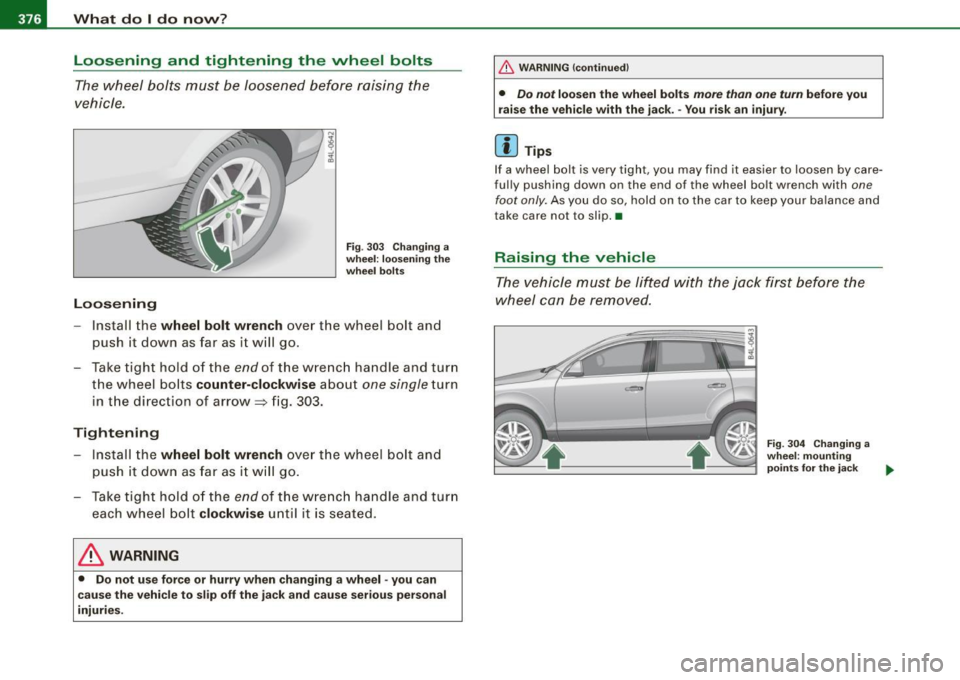
- Install the wheel bolt wrench over the wheel bolt and
push it down as far as it will go.
- Take tight hold of the
end of the wrench handle and turn
the wheel bolts counter-clockwise about
one single turn
in the direction of arrow::::, fig. 303.
Tightening
- Install the wheel bolt wrench over the wheel bolt and
push it down as far as it will go.
- Take tight hold of the
end of the wrench handle and turn
each wheel bolt clockwise until it is seated.
& WARNING
• Do not use force or hurry when changing a wheel -you can
cause the vehicle to slip off the jack and cause serious personal
injuries.
& WARNING (continued)
• Do not loosen the wheel bolts more than one turn before you
raise the vehicle with the jack. -You risk an injury.
[ i] Tips
If a wheel bolt is very tight, you may find it easier to loosen by care
fully pushing down on the end of the wheel bolt wrench with
one
foot only.
As you do so, hold on to the car to keep your balance and
take care not to slip. •
Raising the vehicle
The vehicle must be lifted with the jack first before the
wheel can be removed.
Fig. 304 Changing a
wheel: mounting
points for the jack ..
Page 380 of 426

lllftl.___W_ h_ a_ t_ d_o_ l_ d_ o _ n_ o_w _ ? ____________________________________________ _
Taking the wheel off/installing the inflatable
spare tire
Follow these instructions step -by-step for changing the
wheel
Fig. 306 C han ging a
w heel : align ment pin
insid e the to p ho le
After you have loosened all wheel bolts and raised the
vehicle off the ground, remove and replace the w heel as
follows :
Removing the wh eel
- Remove the topmost wheel bolt complete ly and set it
aside on a clean surface.
- Screw the t hreaded end of the alignment pin from the
tool kit hand-tight into the empty bo lt hole ~ page 378,
fig. 306.
T hen remove the other wheel bolts as descr ibed above.
- Take off the wheel leaving t he alignment pin in the bolt
hole .
Putting on the inflatable spare tire
-Inflate the inflatable spare tire~ page 378 and push the
wheel over the alignment pin . - Sc
rew in and tighte n all wheel bolts slightly.
- Remove the a lignment pin and insert and tighten the
remaining wheel bolt slig htly like the rest.
- Tu rn the jack handle counter -c lockwise to lower the
veh icle until the jack is fully released.
Use the wheel bolt w rench to tighten a ll wheel bolts
firmly ~ page 376. Tighten them crosswise, from one
bolt to the (approximately) opposite one, to keep the
wheel centered .
[ i ] Tip s
• When mounting tires with un idi rect io n al t rea d de sign make sure
the tread pattern is pointed the right way =>
page 379.
• The whee l bolts should be clean and easy to turn. Check for dirt
and corrosion on the mating surfaces of both the wheel and the
hub . Remove a ll dirt from these surfaces before remounting the
wheel. •
Inflating inflatab le spare tire
- Remove the compressor from the luggage compartment
~ page 372, fig. 300.
- Unscrew the va lve stem f rom t he spare tire.
- Screw the ti re fi lier hose f rom the compress or firmly o nto
the valve of t he spare tire.
- Insert the plug from the comp ressor into a socket of the
veh icle ~ page 118.
- Sw itch the compressor on .
Page 384 of 426
lllftl.,___F_ u_ s_ e_s _ a_n _ d_ b_ u_lb _ s _______________________________________________ _
[ i J Tips
You are well advised to keep a supply of spare fuses in your vehicle .
Fuses with the proper ampere ratings are available at your autho
rized Audi dealer. •
Fuse Location, Instrument Panel left
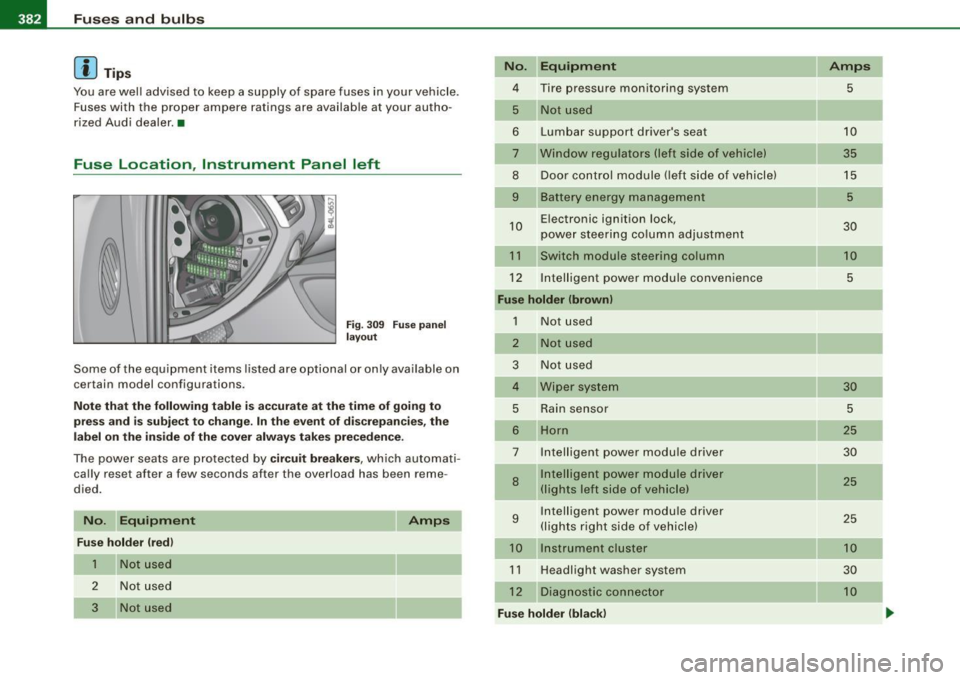
Fig . 309 Fuse panel
layout
Some of the equipment items listed are optional or only available on
certain model configurations .
Note that the following table is accurate at the time of going to
press and is subject to change. In the event of discrepancies, the
label on the inside of the cover always takes precedence.
The power seats are protected by circuit breakers, which automati
cally reset after a few seconds after the overload has been reme
died.
No.
Equipment
Fuse holder (red)
1
2
3
Not used
Not used
Not used
Amps
No. Equipment
4 Tire pressure monitoring system
5 Not used
6 Lumbar support driver's seat
7 Window regulators (left side of vehicle)
8 Door control module (left side of vehicle)
9 Battery energy management
10 Electronic ignition lock,
power steering column adjustment
11 Switch module steering column
12 Intelligent
power module convenience
Fuse holder (brown)
1
2
Not used
Not used
3 Not used
4 Wiper system
5 Rain sensor
6 Horn
7
8
9
Intelligent power module driver
Intelligent power module driver
(lights left side of vehicle)
Intelligent power module driver
(lights right side of vehicle)
10 Instrument cluster
11 Headlight washer system
12 Diagnostic connector
Fuse holder (black) Amps
5
10
35 15
5
30
10 5
30
5
25
30
25 25
10
30
10
-
Page 391 of 426
________________________________________________ E _m_ e_r.:g :;,. e_ n_c ...: y:.- s_ i_ t _u _a_ t_ i_ o _ n_ s __ lfflll
•
Conn ect POSITIVE (+ ) to PO SITIVE (+ ) (r ed )
- Open the red cover on the pos itive pole => page 388,
fig. 312.
1. Connect one end of the positive cable (red) on the
jump
start bolt=>
page 388, fig. 3 13 G) (Bo lts under red cover
= "positive") of the vehicle to be started @.
2. Connect the other end to the positive terminal@ of the
booster battery ®·
Conn ect NEGATIVE (- ) to NEGATIVE (-) (black )
3. Connect one end to the negat ive termi nal 0 of t he
boos ter battery ®·
4 . Connect the other end of the negative cable (black) to the
jump sta rt bolt 0 (Bolts with hex head = "n egative") of
the vehicle to be s tarted @.
Startin g th e e ngin e
-Start the engine of the veh icle w ith the booster battery .
Run t he engine at a moderate speed .
- Start engine with discharged ve hicle battery in the usual
ma nner.
- If the engine fails to s tart: do not keep the star ter
cranking for longer than 10 seconds. Wait f or about
30 seconds and then try again.
- With engine running, remove jumper cables from both
vehicles in the exact reverse order.
- Close the red cover on the positive pole.
The battery is vented to the outside to prevent gases from entering
the vehic le interior . Make sure that the jumper clamps are well connected with their
metal parts in full contact with the battery
t erminals .
& WARNING
To avoid seriou s per sonal in jur y a nd d amage to the vehicle , heed
a ll wa rning s and in stru ction s o f th e jum per ca ble man ufa cturer . If
in doubt , call for ro ad serv ice.
• Jump er c able s must b e lo ng eno ugh s o that the vehi cle s do not
touch .
• When conne cting jumpe r cable s, ma ke sure th at the y cannot
g et caught in an y mo ving p arts i n the engine comp art m ent .
• Before you che ck anyth ing in the en gin e com partm ent , a lwa ys
r ea d and h eed all W ARNIN GS~ pag e 32 4, "E ngine compa rtm ent ".
0 Note
Improper hook -up of jumper cables can ruin the generato r.
• Always connect POSITIVE(+) to POS ITIVE( +), and NEGATIVE( -) to
NEGATIVE( -) ground post of the battery manager control unit.
• Check that al l screw p lugs on the battery ce lls are screwed in
firm ly . If not, tighten plugs prior to connecting clamp on negative
battery termi nal.
• Please note that the procedure for connecting a jumper cab le as
described above applies specifical ly to the case of your vehicle
being jump started. When you are giving a jump start to another
vehicle, do not connect the negative(-) cable to the negative (-1
terminal on the discharged battery©~ page 388, fig. 313. Instead,
securely connect the negative ( -1 cable to either a solid metal
component that is firmly bolted to the engine b lock or to the engine
block itself . If the battery that is being charged does not vent to the
outside, escap ing battery gas could ignite and exp lode! •
Do-it-yourself service
Page 395 of 426
________________________________________________ E _m_ e_r.:g :;,. e_ n_c ...: y:.- s_ i_ t _u _a_ t_ i_ o _ n_ s __ lllll
•
- Inse rt a rubbe r pad betwee n th e floo r ja ck/work shop
h oi st an d the lift ing p oin ts.
If you must lift your vehicle with a floor jack to wo rk underneath , be
sure the veh icle is safely supported on stands intended for this
purpose .
Front lifting point
T he lift ing p oint i s located o n th e flo or pan rei nforce men t about at
the same l eve l as th e jac k m ounting point=> page
392 , fig. 3 19 . Do
not lift the vehicle at the vertical sill reinforcement.
Rear lifting point
The li fti ng poi nt is located on the ve rt ical re in forceme nt of t he low er
sill for the on board jack=> page
392 , fig. 320.
Lifting with vehi cle ja ck
R efer to => page
376 .
& WARNING
• To reduce the risk of serious injury and vehicle damage.
-Always l ift the vehicle only at the special workshop hoist and
floor jack lift points illustrated => page
392 , fig. 319 and
=> page
392 , fig. 320.
- Failure to lift the vehicle at these points could cause the
vehicle to tilt or fall from a lift if there is a change in vehicle
weight distribution and balance . This might happen , for
e x ample , when heavy components such as the engine block or
transmission are removed .
• When remo ving heavy components like these, anchor vehicle
to hoist or add correspond ing we ights to maintain the center of
gravity. Otherwise , the vehicle might tilt or slip off the hoi st,
c ausing serious personal injury .
0 Note
• Be awar e of the fo llow ing po ints before l ifting t he ve hicle:
- The vehicle should never be lifted or jacked up from unde r
neath the engine oil pan , the transmission housing , the front or
rear a xle or the body side members. This could lead to serious
damage.
- To avoid damage to the underbody or chassis frame, a rubber
pad must be in serted between the floor jack and the lift po ints .
- Before driving over a workshop ho ist, check that the vehicle
weight does not exceed the permissible lifting capacity of the hoist.
- Before driving over a workshop hoist , ensure that there is
sufficient clearance between the hoist and low parts of the
vehicle. •
Do-it-yourself service
Page 399 of 426
_________________________________________________ G_ e_ n_ e_r _a _l_ i_n _f_o _ r_ m_ a_ t _i _o _ n __ ll'II
v e hic le identificatio n number of your vehic le (p erforation) as well as
th e G ro ss V ehic le We ight Rat ing (GVWR) an d the Gro ss A xle We ig ht
R ating (GAWRl .
The high voltage warning label is located on the lock carrier.
The spark ignition system complies with the Canadian standard ICES-002 . •
Displaying Vehicle Identification
Number in the MMI
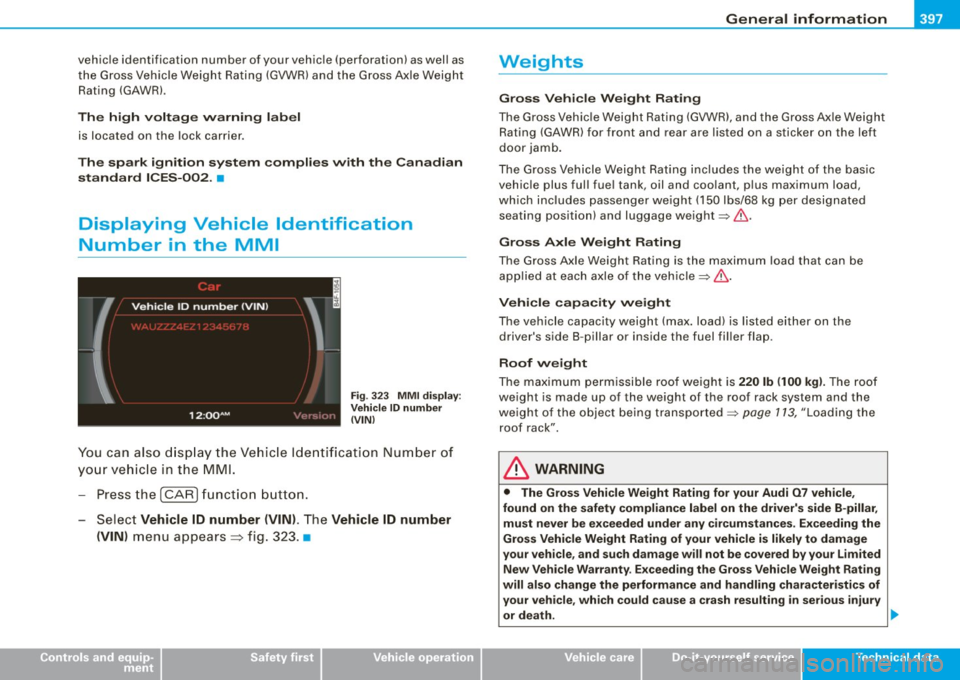
Fig . 323 MMI di splay :
Vehicle ID number
(VIN)
Y ou can also display t he Vehi cle Id ent ifi catio n Num ber of
y o ur vehi cle in the MM I.
- Pre ss th e
(CA RI fun ctio n bu tton.
- Selec t
Vehicle ID number (VIN) . The Vehicle ID number
(VIN)
m enu appea rs=> fig. 3 23 . •
Controls and equip
ment Safety first Vehicle operation
Weights
Gross Vehicle Weight Rating
The G ross Ve hicle We ight Rating (GVWR), a nd the Gross A xle Weight
R ating (GAW R) for front and rear are l isted on a stic ker on the left
doo r jamb .
T he G ross Ve hicle We igh t R ating includes t he weight o f the bas ic
vehic le plus full fue l tank , oil and coo lant, p lus maximum load,
w hi ch includes passe nger we ight (1 50 lbs/68 kg per des ignat ed
seat ing position) and luggage weight:::::,&.
Gross Axle Weight Rating
The Gross Axle Weight Rating is the maximum load that can be
ap plied at each axl e of the vehicle:::::, .&,.
Vehicle capacity weight
The vehic le capacity weig ht (max. load) is list ed e ither on the
driver's side B -pillar or ins ide the fuel fi ller flap.
Roof weight
The maxi mum pe rm is s ible roof we ig ht i s 220 lb (100 kg ). The ro of
we ight is made up of th e wei ght of t he roof rack system an d the
we igh t of t he o bjec t being tra nspo rted :::::, page 1 13, "Lo adi ng the
roo f rack".
& WARNING
• The Gross Vehi cle Weight Rating for your Audi 07 vehi cle ,
found on the safety compliance label on the driver's side B -pillar ,
must never be exceeded under any circumstances . Exceeding the
Gross Vehicle Weight Rating of your vehicle is likely to damage
your vehicle , and such damage will not be covered by your Limited
New Vehicle Warranty . Exceeding the Gross Vehicle Weight Rating
will also change the performance and handling characteristics of
your veh icle , which could cause a crash resulting in serious injury
or death. .,_
Vehicle care Do-it-yourself service Tec hn ica l da ta
Page 405 of 426
__________________________________________________ C_o_ n _ s_u_ m_ e ___ r_l_ n _f_ o_ r _m...:....:.. a:.;..:. ti .... o:.. n ........ _llll
& WA RNIN G (continu ed )
• The engine compartment of any motor vehi cle i s a potentially
h az ardou s area. N ev er re ach into the are a arou nd or to uch the
r a di ator fan . It is temperature co ntrolled and can swi tc h o n
s uddenly -even wh en the engine i s off and the ignition key h as
been removed . The r adiator f an switches on autom atic all y w hen
the coolant reache s a certain temperature and will continue to run
until the coo lant t emper ature drop s.
• Alway s remov e th e ignition key befo re anyone get s under the
v ehi cle .
• Alway s s upport your vehi cle with safety sta nd s if it i s ne ces
sa ry to wor k unde rne ath the veh icle . The ja ck suppl ied with the
v ehic le i s not adequ ate for thi s purpo se and could coll ap se
c au sin g s eriou s per son al in jury .
• If you m ust w ork under neath the vehi cle with the wheel s on
the ground , alwa ys m ake sure the veh icle i s on l eve l ground , that
the wheels ar e always securely blocked and that the engine
ca nn ot be sta rted .
• Alway s mak e sure the tran sm iss ion selecto r leve r (automatic
tr ansmi ssion ) is in "P " (P a rk po sition ) and the park brake is firml y
applied .
c£> For the sake of the environment
• Changing the engine settings w ill adverse ly affect emission
levels . This is detrimenta l to the environment and increases fuel
consumption.
• Always observe environmenta l regu lations when disposing of
old engine oil, used brake fluid, dirty engine coolant, spent batteries
or worn out tires.
• Undeployed airbag modules and pretens ioners might be classi
fied as Perchlorate Material -specia l handling may apply, see
www .dtsc .ca .gov/hazardouswaste/perchlorate. When the vehicle or
parts of the restraint system including airbag modules safety belts
with pretens ioners are scrapped, all applicable laws and regu la-
Controls and equip
ment Safety first Vehicle operation
tions must be observed. Your authorized Audi dealer is familiar with
these requirements and we rec
ommend that you have your dea ler
perform this service for you .•
Additional accessories ,
modifications and parts replacement
Addition al a ccessori es and parts
replacement
Always c onsul t an authorized Audi dealer before
purchasing accessories.
Your vehicle incorporates the latest safety design features ensuring a high standard of act ive and passive safe ty .
This safety could be compromised by non -approved changes to the
vehic le . F or this reason, if par ts have to be replaced, please observe
the following points when insta lling additiona l accessories:
Approved Audi accessories and genuine Audi parts are avai lable
from authorized Audi dealers.
These dealers also have the necessary facilities, tools and trained specialis ts to install the parts and accessories prope rly.
& WARNING
Using the wrong spare part s or u sing non-approved acce ssorie s
can c ause seri ous persona l injur y.
• Use onl y acc essorie s ex pres sly approved by Audi and g enuine
Audi spare p art s
• The se p art s and acce ssorie s have been spe cia lly de signed to
be used on you r vehi cle .
• Nev er in stall acc ess orie s s uch a s telep hone cra d le s or
be ver age holder s on airb ag cover s or within th e airbag deploy-
Vehicle care Do-it-yourself service Tec hn ica l da ta
Page 411 of 426

______________________________________________ A_ l_,_ p _h_ a_ b_e _t_ic _ a _ l _in _ d_e _ x __ lll
Important things to know . ... .. .... 241
Indi cator light ...... .. .... ... ..... 252
Monitoring ... .... .... ..... .. .... 252
PASSENGER AIR BAG OFF light ... .. 253
Repairs .. .... .... .... ... .... .... 255
Safety instructions ... .... ..... .. . 254
Side airbags ... .. .... .... ...... .. 257
Side curtain airbags ... .. .... .... . 260
Weight -sensing mat .... ........ .. 264
When must the system be inspected? ..
252
All Wheel Drive .. .... ....... ...... .. 294
Alloy wheels ... .. .... .... ..... .. .... 318
All-whee l drive
Winter tires .... .. .... ...... ... .. . 363
Alternator Malfunction . .... .... ........ ..... 32
Anti-freeze
See Engine coo lant system .. ...... . 337
Anti-glare inside day-night mirror .... 86, 87
Anti -lock brake system
How the ABS system works . .... ... 292
Warning/indicator lights .. .... .... .. 22
Anti-Slip Regulation System (ASR)
How the system works ........ .... 290
Anti-theft systems
Anti-theft alarm system ... ......... 63
Elec tronic immobilizer .. ... .... .... 51
Approach/departure angle ............ 302
Ashtray Front .. .... ... .. .... .... ...... .. 116
R ear .... ... .. .... .... ........... 116
Controls and equip
ment Safety first
ASR
How the Anti-Slip Regulation System
works ...... ............. ...... 290
Asterisk What does it mean when something is
marked with an asterisk? .. ....... .. 6
Audi braking guard ....... .... ... .... 168
Error messages ....... .... ... .... 170
Settings ........... ... .... .... ... 169
Status messages .......... .... ... 170
Switching on and off .. .... .... .... 169
Audi Service Repair Manuals and Literature
401
AUTO mode AC climate contro ls ..... ...... .... 126
Auto Safety Hotline ..... ... ... .. .... . 229
Auto -Check Control ...... ..... ... .... . 30
Automatic belt retractor ... .. .... .... . 235
Automatic car wash
See Washing ............... .... .. 313
Au tomatic mode
Four -zone automatic comfort air
conditioning .... ...... ...... ... 132
Automatic Shif t Lock (ASU ...... ... ... 186
Automatic transmission
6 -speed automatic transmission .... 184
Automatic Shift Lock (ASU ...... .. . 186
Driving ...... ....... ...... .... ... 1 84
Dynamic shift program .... ........ 187
Emergency release for selector lever 189
F ail-safe mode ...... ... .. .... ... . 189
Ignition key safety lock ..... .. .... . 143 Manua
l sh ift program .. .. ....... .. 188
Selector lever .................... 185
Shift buttons ...... .... .... ...... . 189
Steering wheel with tiptronic® ..... 189
Average speed ....................... 40
Avo id damaging the vehicle ... .... .... 299
B
Background lighting
Lighting profiles . ......... ......... 79
Bass box ........... ... .. .... ...... . 371
Battery ...... .... ... .... .... .... ... 342
Battery location .......... .... .... 343
Charging ........................ 344
Important warnings when working on the
battery ...... ....... .... ...... . 343
Jump starting ................ .... 387
Low ...... ........... ....... .. .. 295
Replacing the battery ............ . 346
State of charge ................... 295
Voltage ........... ...... .... .... . 36
Winter operation ............ ... .. 342
Working on the battery ... ....... .. 343
Before driving ... .... .... ...... .... . 221
Blended gasoline .................... 325
Body cavity sealing .. .... .... .... ... . 318
Booster seats ...... ... .. .... .... .... 271
How do I properly insta ll a booster seat in
my vehic le? . .... .... .... ... .... 271
Safety instructions .... .......... .. 271
Brake assistant .......... .... .... ... 293
K ick -down .... .... ...... ...... ... 187 Brake booster ....................... 292
Vehicle operation Vehicle care Do-it-yourself service Technical data
Page 412 of 426
___ A_l.:,. p _h_ a_ b_e _t _ic _ a_l _in _ d_e _x ____________________________________________ _
Brake fluid
Changing the brake fluid ... ... ... .
341
Checking the brake fluid level . . . . . . 341
Reservoir ...... .. .... .... ....... 341
What is the correct brake f luid level? 341
What should I do if the brake fluid warning
light comes on? ........ .... ....
341
Brake light
Defective . . . . . . . . . . . . . . . . . . . . . . . .
27
Brake system ....................... 341
Anti-lock brake system . . . . . . . . . . . . . 22
Brake fluid . . . . . . . . . . . . . . . . . . . . . . 341
Brake f luid specifications for refill and
replacement ...... ...... ...... .
341
Brake pads ..................... . 298
General information . . . . . . . . . . . . . . 291
How does moisture or road salt affect the
brakes? ..... .... ....... .... ...
291
Malfunction ........ ... .. .... .... . 32
Park ing brake . . . . . . . . . . . . . . . . . . . . 147
Warning/indicator lights ... ...... .. 23
Worn brake pads symbol . . . . . . . . . . . 37
Braking guard
See Audi braking guard ... ... .... . 168
Break-in period . . . . . . . . . . . . . . . . . . . . . 297
Brake pads .... .................. 298
Tires .... ... .. .... .... ......... . 297
Breakover angle . . . . . . . . . . . . . . . . . . . . 302
Bulbs ..... ....... .. .... .... ...... . 385
Bumper cover
Caution when parking near a parking bar -
rier or curb .. ... ..... ........ ..
147
C
Ca lifornia Proposition 65 Warning 332
Battery specific .... .... .... .... .. 344
Capac,t,es ... .............. ...... .. 399
Car -Systems
Background lighting . ...... .... ....
79
Lighting profiles . . . . . . . . . . . . . . . . . . 79
Car care ........................... 312
Interior .... .... .... .... ....... .. 319
Plastic and vinyl ........... ... ... 316
Weatherstrips ... .. .... .... ...... 317
Care of exterior ..................... 312
Cargo area
See Loading the luggage compartment . .
227
Cargo floor ......... .... ........ ... 109
Cargo net . . . . . . . . . . . . . . . . . . . . . . . . . .
107
Catalytic converter .. ....... ........ . 298
Center conso le in rear
Central locking 103
Emergency locking ............ .... 57
Panoramic s liding sunroof ...... .... 69
Certification . . . . . . . . . . . . . . . . . . . . . . . . 404
Changing a flat tire .... .... ....... ... 373
Changing a wheel ................... 373
Changing engine oil ... ........ ...... 336
Chassis
Undercoating ... .. .... .... .... ...
318
See also Adaptive Air Suspension . .. 206
CHECK button . . . . . . . . . . . . . . . . . . . . . . . 16
Checking
Engine coolant level
338
Checking tire pressure ............. .. 353
Child restraints
Danger of using ch ild restra ints in the
front seat . . . . . . . . . . . . . . . . . . . . . .
243
What types of child restraint anchors are
available? ... ......... ......... .
276
Where can I get additional information
about child restraints? .... .... .. .
277
Child safety .................... 263, 268
Additional information .. ... .... ... 282
Booster seats . . . . . . . . . . . . . . . . . . . . 271
Convertible child safety seats ... ... 269
Convertible locking retractor .... ... 273
Guidance fixtures for lower anchorages ..
279
Important safety instructions for using
chi ld safety seats ...............
266
Important things to know when driving
with children .. .... ... ..... .....
263
Infant seats ......... ........ .... 268
Install ing a child restraint using the
LATCH system .. ...... ....... ...
281
Lower anchorages ... .. .... .... ... 278
Mounting and releasing the anchorage
hook ..... ........ .... ....... ..
282
Older children and safety belts 272
Safety belts and older children ..... 272
Tether anchors .. ...... .... ...... 282
Tether strap ... .... .... ...... .... 283
Which restraint system should my older
chi ld wear? ... ....... .... .... ..
272
Page 413 of 426

______________________________________________ A_ l_,_ p _h_ a_ b_e _t_ic _ a _ l _in _ d_e _ x __ _
Child safety lock
rear doors (powe r) .. ... .. ... ... .... 61
Child safety seats . ................. . 268
Convertible locking retractor .... ... 273
Danger of using child restraints in the front seat ...... .... .... ...... .. 243
How do I properly install a child safety
s e at in my vehicle? .. .... ... .... . 266
Installing .. .. .... ... ..... ...... .. 273
LATCH system ...... .. ... .. .. ... . 281
Safety instructions .. ... ....... ... 266
Cigar ette light er ... ... ... .. ... .... .. 117
Cleaning Alcantara (synthetic suede) ... .. ... 323
Engine compartment .. ...... .... . 324
Fabrics and fabric coverings ....... 319
Ins trument pane l ...... ........... 320
Int erior ... ....... .... .... ... .... 319
L eather .... .... ......... ........ 322
MMI display ..... .. ... ... .... .... 319
MMI terminal ...... ....... .... ... 319
Plastic and vinyl ......... .... ..... 316
Plas tic parts .. .. .... .... ... .. ... . 320
Safety belts .. .... ....... .... .... 323
Trim strips ... .... .... ... .... .... 315
trim strips .. ...... .... ..... ...... 316
Cleaning and pro tection .. .... ... ... .. 312
Climate control ..... .... .... ....... . 123
Synchronizing .. ...... ...... ..... 125
Warm and cold .. .... .... .... .... . 123
Climate controls Air distribution ... .... .... .... .... 127
Air outlets .... ... .... .... .... .... 130
Air outlets (rear) .... ........... ... 130
Controls and equip
ment Safety first
Air recirculation
...... .... .... .... 128 Starting engine ....... .. .. ... .... 144
AUTO (standard set ting) .. .... ..... 126 STOP button .. .. ... ... .... ..... .. 145
Basic settings .... .... ... .... ..... 134 Switching engine off ... ... ... ... .. 145
Blower ...... ... .... .... .... ..... 128 Switching on ignition ... .. .... .... 144
Controls . .... .... .... .... ... .... 125 Unlocking vehicle ...... ... .... .... . 62
Defrosting/defogging ...... ....... 127
Convertible child seats
Description .. ...... ... .... .... ... 123
How do I properly install a convertib le
ECON mode .... . .. .. ..... ... .... 126 child seat in my vehic le? ...... ... 269
ECON operation ........... ....... 134 Safety instructions ........ ........ 269
Energy manageme int .. .... .... .... 123
Convertible locking retractor
Heated seats, fron t .... ... ..... ... 136
Activating ........ .... ... .... .... 275
Key coded setting ........ ........ 123
Deactivating ... ... .... .... .... ... 276
Recirculation mode (automatic) ... .. 134
Using to secure a chi ld safety seat . 273,
Recommended settings .. ... .... .. 123 275
Residual heat ................... . 126
Coolant system ....... ... ........... 337
Setting the temper .ature .. ... ... .. . 127
Cooling box in glove compartment .... . 120
SETUP ...... ... .. .... .... .... ... 134
Synchronization ... .... .... .... ... 135 Cooling System
Expansion tank ... ..... .. .... .... . 338
Turning on and off ......... ... .... 126
Using climate control economically . 131 Cornering
light ....................... 76
Cruise control
Clock ......... .... . ...... ........ ... 14
Changing speed ............ .. .... 150
Closing Presetting your speed ........ ..... 150
Panoramic sliding sunroof .......... 68
Switching off ..... ... .... .... .... 150
Coat hooks ... .. .... .... ........ .... 121
Switching on ... .... ... ..... ... ... 149
Cold tire inflation pressur e ..... ... ... 351
Warning/indicator lights ........ .... 22
Compass mirror ........... ......... .. 89
See also Adaptive Cruise Control . ... 152
Compliance ......... ...... ... .. .... 404 Cruising range ......... ....... .. ..... 40
Consumer Information ........... 229, 401 Cupholder ........... ....... 103,114,115
Contacting NHTSA ... .... ... .... .... 229
Convenience key ..... ...... .... ... ... 61
D
Driver messages ... ... .... .. .. ... 146
Locking vehicle ... .... .... .... ..... 63
START button .................... 144 Damping
See Adaptive Air
Suspension .... ... 206
Vehicle operation Vehicle care Do-it-yourself service Technical data