lock AUDI Q7 2009 Owner´s Manual
[x] Cancel search | Manufacturer: AUDI, Model Year: 2009, Model line: Q7, Model: AUDI Q7 2009Pages: 426, PDF Size: 97.13 MB
Page 224 of 426
-Driving Safely
Pll:1------=---------------
Proper occupant seating positi ·ons
Proper seating position for the driver
The proper driver seating position is important for safe,
relaxed driving.
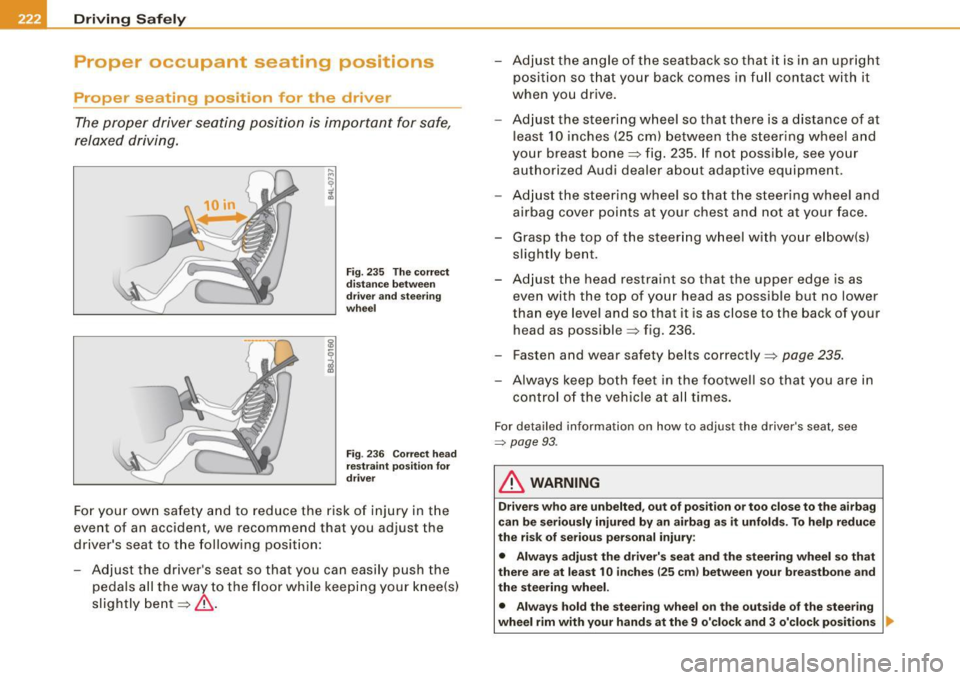
Fig. 235 The correct
distance between
driver and steering
wheel
Fig. 236 Correct head
restraint position for
driver
For your own safety and to reduce the risk of injury in the
event of an accident, we recommend that you adjust the
driver's seat to the following position:
- Adjust the driver's seat so that you can easily push the
pedals all the way to the floor while keeping your knee(s)
slightly bent=:>& . - Adjust the angle of the seatback so that
it is in an upright
position so that your back comes in full contact with it
when you drive.
- Adjust the steering wheel so that there is a distance of at
least 10 inches (25 cm) between the steering wheel and
your breast bone=:> fig. 235. If not possible, see your
authorized Audi dealer about adaptive equipment.
- Adjust the steering wheel so that the steering wheel and
airbag cover points at your chest and not at your face.
- Grasp the top of the steering wheel with your elbow(s)
slightly bent.
- Adjust the head restraint so that the upper edge is as
even with the top of your head as possible but no lower
than eye level and so that it is as close to the back of your
head as possible =:> fig . 236.
- Fasten and wear safety belts correctly=:>
page 235.
-Always keep both feet in the footwell so that you are in
control of the vehicle at all times.
For detailed information on how to adjust the driver's seat, see
=> page 93 .
& WARNING
Drivers who are unbelted, out of position or too close to the airbag
can be seriously injured by an airbag as it unfolds. To help reduce
the risk of serious personal injury:
• Always adjust the driver's seat and the steering wheel so that
there are at least 10 inches
125 cm) between your breastbone and
the steering wheel.
• Always hold the steering wheel on the outside of the steering
wheel rim with your hands at the 9 o'clock and 3 o'clock positions ..
Page 225 of 426

Driving Safely -
----------------
& WARNING (continued)
to help reduce the risk of personal injury if the driver's airbag
inflates.
• Never hold the steering wheel at the 12 o'clock position or with
your hands at other positions inside the steering wheel rim or on
the steering wheel hub . Holding the steering wheel the wrong way
can cause serious injuries to the hands, arms and head if the
driver's airbag deploys .
• Pointing the steering wheel toward your face decreases the
ability of the supplemental driver's airbag to protect you in a colli
sion.
• Always sit in an upright position and never lean against or
place any part of your body too close to the area where the airbags
are located .
• Before driving, always adjust the front seats and head
restraints properly and make sure that all passengers are properly
restrained.
• Never adjust the seats while the vehicle is moving. Your seat
may move unexpectedly and you could lose control of the vehicle.
• Never drive with the backrest reclined or tilted far back! The
farther the backrests are tilted back, the greater the risk of injury
due to incorrect positioning of the safety belt and improper
seating position.
• Children must always ride in child safety seats
=> page 263.
Special precautions apply when installing a child safety seat on
the front passenger seat
=> page 241 . •
Controls and equip
ment Safety first
Vehicle operation
Proper seating position for the front
passenger
The proper front passenger seating position is important
for safe, relaxed driving.
For your own safety and to reduce the risk of injury in the
event of an accident, we recommend that you adjust the
seat for the front passenger to the following pos ition:
- Move the front passenger seat back as far as possible.
There must be a minimum of 10 inches (25 cm) between
the breastbone and the instrument panel =>
&.
- Adjust the angle of the seatback so that it is in an upright
position and your back comes in full contact with it
whenever the vehicle is moving.
- Adjust the head restraint so that the upper edge is as
even with the top of your head as possible but not lower
than eye level and so that it is as close to the back of your
head as possible =>
page 225.
-Keep both feet flat on the floor in front of the front
passenger seat.
- Fasten and wear safety belts correctly=:>
page 235.
For detailed information on how to adjust the front passenger's
seat, see
=> page 92.
& WARNING
Front seat passengers who are unbelted, out of position or too
close to the airbag can be seriously injured or killed by the airbag
as it unfolds. To help reduce the risk of serious personal injury : .,
Vehicle care Do-it-yourself service Technical data
Page 230 of 426
lllffl..,___D_ r_iv _i_ n""' g::;._ S_ a_f _e _ly =---------------------------------------------------
& WARNING
Improperly stored luggage or other items can fly through the
vehicle causing serious personal injury in the event of hard braking or an accident. To help reduce the risk of serious personal injury:
• Always put objects, for example, luggage or other heavy items
in the luggage compartment.
• Always secure objects in the luggage compartment using the
tie-down eyelets and suitable straps.
& WARNING
Heavy loads will influence the way your vehicle handles. To help
reduce the risk of a loss of control leading to serious personal
injury :
• Always keep in mind when transporting heavy objects, that a
change in the center of gravity can also cause changes in vehicle
handling:
-Always distribute the load as evenly as possible.
- Place heavy objects as far forward in the luggage compart-
ment as possible.
• Never exceed the Gross Axle Weight Rating or the Gross
Vehicle Weight Rating specified on the safety compliance sticker on the left door jamb. Exceeding permissible weight standards
can cause the vehicle to slide and handle differently.
• Please observe information on safe driving
~ page 220.
& WARNING
To help prevent poisonous exhaust gas from being drawn into the
vehicle, always keep the rear lid closed while driving.
• Never transport objects larger than those fitting completely
into the luggage area because the rear lid cannot be fully closed.
& WARNING (continued)
• If you absolutely must drive with the rear lid open, observe the
following notes to reduce the risk of poisoning :
- Close all windows,
- Close the Panoramic sliding sunroof*,
- Open all air outlets in the instrument panel,
- Switch off the air recirculation,
- Set the fresh air fan to the highest speed.
& WARNING
Always make sure that the doors, all windows, the Panoramic
sliding sunroof* and the rear lid are securely closed and locked to
reduce the risk of injury when the vehicle is not being used.
• After closing the rear lid, always make sure that it is properly
closed and locked .
• Never leave your vehicle unattended especially with the rear lid
left open. A child could crawl into the vehicle through the luggage
compartment and close the rear lid becoming trapped and unable
to get out . Being trapped in a vehicle can lead to serious personal
injury.
• Never let children play in or around the vehicle.
• Never let passengers ride in the luggage compartment . Vehicle
occupants must always be properly restrained in one of the
vehicle's seating positions.
[ i] Tips
• Air circulation helps to reduce window fogging. Stale air escapes
to the outside through vents in the trim panel. Be sure to keep these
slots free and open.
• The tire pressure must correspond to the load. The tire pressure
is shown on the tire pressure label. On USA vehicles, the tire pres- .,_
Page 238 of 426
___ S_a_ f_ e_ t-= y_ b_e_ l_ t _s _______________________________________________ _
-Insert the tongue into the correct buckle of your seat
until you hear it latch securely~ fig. 245.
Pull on the belt to make sure that it is securely latched in
the buckle.
Automatic safety belt retractors
Every safety belt is equipped with an automatic belt retractor on the
shoulder belt. This feature locks the belt when the belt is pulled out
fast, during hard braking and in an accident. The belt may also lock
when you drive up or down a steep hill or through a sharp curve. During normal driving the belt lets you move freely.
Safety belt pretensioners
The safety belts are equipped with a belt pretensioner that helps to
tighten the safety belt and remove slack when the pretensioner is
activated. The function of the pretensioner is monitored by a
warning light=>
page 19.
Switchable locking feature
Every safety belt except the one on the driver seat is equipped with
a switchable locking feature that
must be used when the safety belt
is used to attach a child safety seat. Be sure to read the important
information about this feature=>
page 273.
& WARNING
Improperly positioned safety belts can cause serious injury in an
accident =>
page 236, "Safety belt position".
• Safety belts offer optimum protection only when the seat back
is upright and belts are properly positioned on the body.
• Always make sure that the rear seat backrest to which the
center rear safety belt is attached is securely latched whenever
the rear center safety belt is being used. If the backrest is not
securely latched, the passenger will move forward with the back
rest during sudden braking, in a sudden maneuver and especially
in a crash.
& WARNING (continued)
• Never attach the safety belt to the buckle for another seat.
Attaching the belt to the wrong buckle will reduce safety belt
effectiveness and can cause serious personal injury.
• A passenger who is not properly restrained can be seriously
injured by the safety belt itself when it moves from the stronger
parts of the body into critical areas like the abdomen.
• Always lock the convertible locking retractor when you are
securing a child safety seat in the vehicle
=> page 275. •
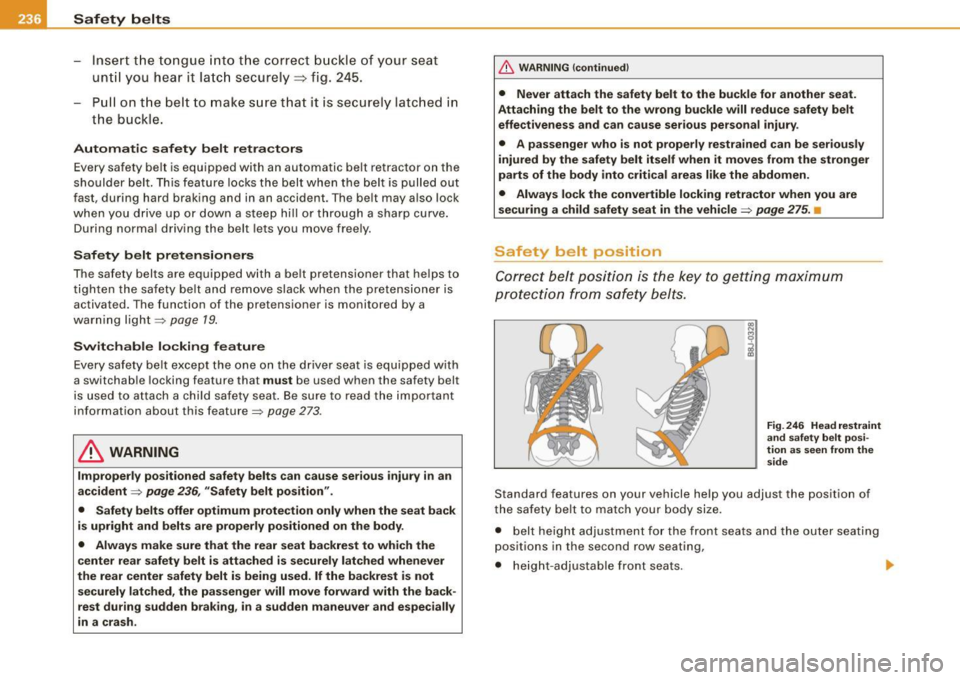
Safety belt position
Correct belt position is the key to getting maximum
protection from safety belts.
Fig. 246 Head restraint
and safety belt posi
tion as seen from the
side
Standard features on your vehicle help you adjust the position of
the safety belt to match your body size .
• belt height adjustment for the front seats and the outer seating
positions in the second row seating,
• height-adjustable front seats. .,
Page 255 of 426

Airbag syst em -----------------=~-
& WARN ING (co ntinued)
po ssib le th at the airb ag will inf late wh en it is not suppo sed to , or
will not inflate when it should.
• Hav e the air bag sy stem in spe cted immedi ate ly by y our autho
ri zed Audi de aler. •
PASSENGER AIR BAG OFF light
Fig. 253 S ecti on from
t he in strum ent pan el:
PA SS ENGER A IR B AG
OFF light
The PA SS ENGER AIR BA G OFF light is located in the center o f the
instrument pane l
~ fig. 253.
The
PA SSENGER AIR BAG OFF light wil l come on and stay on to tel l
you when the front Advanced Airbag on the passenger side has
been turned off by the electronic control unit. Each time you turn on
the ignition, the
PA SS ENGER AIR B AG OFF light wi ll flash for a few
seconds and:
• will stay on if the front passenger seat is not occupied
• will stay on if there is a small child or chi ld restraint on the front
passenger seat
• will go out if the front passenger seat is occupied by an adult as
registered by the weight-sensing mat
T he
PAS SENGER AIR BAG OFF light mu st co me on and sta y on if the
ign ition is on and
Controls and equip
ment Safety first
Vehicle operation
• a car bed has been installed on the front seat. or
• a rearward-facing chi ld restraint has been insta lled on the front
passenger seat, or
• a forward-facing child restraint has been insta lled on the front
passenger seat, or
• the weight registered on the front passenger seat is equal to or
less than the combined weight of a typica l 1 year -old restrained in
one of the rear-fac ing or forward -facing in fant restraints listed in
Federal Motor Vehicle Safety Standard 208 with which the Advanced
Airbag System in your vehicle was certified .
I f the front passenger seat is not occupied, the front airbag will not
deploy, and the
PA SS ENGER AIR BAG OFF light wi ll stay on. Never
install a rearward-facing child restraint on the front passenger seat,
the safest place for a child in any kind of child restraint is at one of
the seating positions on the rear seat~
page 243, "Child restraints
on the front seat -some important things to know" and~
page 263,
"Chi ld Safety".
If the PAS SEN GER AIR BAG OFF light come s on when one of the
conditions lis ted above is me t, be sure to check the ligh t regu lar ly
to make certain that the
PA SS ENGER AIR BA G OFF light stays on
continuously whenever the ignition is on. If the
PASSENGER AIR
BAG OFF
light does not appear on and does not stay on all the time,
stop as soon as i t is safe to do so and
• react ivate the system by turning the ignition of f and then turning
it on again;
• remove and reinstall the child restraint. Make sure that the ch ild
restraint is properly installed and that the safety belt for the front
passenger seat has been correctly routed through the chi ld restra int
as described in the child restraint manufacturer's instructions;
• make sure that the convertible locking feature on the safety belt
for the front passenger seat has been activated and that the safety
belt has been pulled tight. The belt must not be loose or have loops
of slack so that the sensor be low the safety belt latch on the seat can
do its job~
page 273. •
Vehicle care Do-it-yourself service Technical data
Page 256 of 426
IIIIIL..__:A:....:..:.; ir:....: b=-= a~g !....:: s:.!y :....:s:..: t:..: e:..: m:...:....:... ________________________________________________ _
• make sur e th at th ings that ma y increase th e weigh t of th e child
a nd child saf ety sea t are not b eing tran spo rted on the fr ont
passen ger seat;
• m ake su re t hat th e sa fet y belt ten sio n se ns or is not block ed.
Sha ke the safety belt latch on th e front pass enger seat bac k and
fo rth;
• If a stra p or tether is being used to t ie the chi ld safety seat to the
fr ont passe ng er se at, m ake sure th at it i s not s o tigh t th at it causes
the weig ht-sensing mat to measure more weight than is actual ly on
th e seat .
If the PASSENGER AIR BAG OFF light still does not come on and does
not stay on continuous ly (when the ignition is switched on),
• t ake the child r estr aint off the fr ont passe ng er seat a nd ins ta ll it
properly at one of the r ear seat pos it ions . Have th e airbag syst em
ins pect ed by y our au thorized Audi d ea ler im med iatel y.
• move the chi ld to a rear seat position and make sure that the
c hild is pro pe rly r estrai ned in a c hild restrai nt th at i s app rop riat e fo r
its size and age .
The
PASSENGER AIR BAG OFF l igh t sho uld NOT co me o n whe n the
ignition is on and an adult is sitt ing in a proper seating position on
t h e front pa ssenge r seat . If the
PASSENGER AIR BAG OFF light
co me s on and stays o n or fl ash es for about 5 seco nds whi le d riving,
under these ci rcumstances, make sure that:
• the adult on the front pass enger s eat i s pro perly s eate d o n the
center of the seat cushion with his or her back up against the back
r e st and the backrest is not rec lined => page
222, "Prope r occup ant
seating positions",
• t he ad ult i s not t aki ng w eight off t he seat b y ho ldi ng on to the
passenger assist hand le above the front passenger door or
s up porting their w eigh t on the arm res t,
• the safety be lt is be ing proper ly worn and that there is not a lot
o f sla c k in th e sa fet y belt webbin g,
• accessory seat covers or cushions or other things that ma y cause
an incorr ect rea ding o r impressi on on the w eig ht-s en sing mat under the upho
lstery of the seat have been removed from the front
p assenge r sea t,
• a safety belt extende r has not been left in the safety belt latch for
th e fro nt passenger s eat.
I n addition to the
PASSENGER AIR BAG OFF light in the center of the
instr ument pane l, the message
PASSENGER AIR BAG OFF or
PASSENGER AIR BAG ON will briefly appear in the inst rument c luster
display . Thi s is to info rm the driver of t he cur rent front passenge r
airbag status. •
Important safety instructions on monitoring
the Advanced Airbag System
& WARNING
An airbag system that is not functioning properly cannot provide
supplemental protection in a frontal crash.
• If the airbag indicator light comes on , it means that there may
be something wrong with the Advanced Airbag System. It is
possible that the airbag will inflate when it is not supposed to , or
will not inflate when it should.
• Have the airbag system inspected immediately by your autho
rized Audi dealer.
& WARNING
If the front airbag inflates, a child without a child restraint, or in a
rearward-facing child safety seat , or in a forward-facing child
restraint that has not been properly installed will be seriously
injured and can be killed.
• Even though your vehicle is equipped with an Advanced Airbag
System , make certain that all children, especially 12 years and
younger , always ride on the back seat properly restrained for their
age and size. .,,_
Page 268 of 426
___ C_h_ i_ ld _ S_ a_ f_ e_ t_y ____________________________________________ _
C. Forward-facing convertible child restraint systems,
manufactured on or after September 1, 2004:
• Britax Roundabout 161
• Britax Expressway
• Century Encore 4612
• Century STE 1000 4416
• Cosco Olympian 02803
• Cosco Touriva 02519
• Evenflo Horizon V 425
• Evenflo Medallion 254
• Safety First Comfort Ride 22-400
& WARNING
To reduce the risk of serious injury, make sure that the PASSENGER
AIR BAG OFF light comes on and stays on whenever a child
restraint is installed on the front passenger seat and the ignition
is switched on.
• Take the child restraint off the front passenger seat and install
it properly at one of the rear seat positions if the PASSENGER AIR
BAG OFF light does not stay on.
• Have the airbag system inspected by your authorized Audi
dealer immediately.
[ i] Tips
The child seats listed in categories A to C have been tested by Audi
only for the Advanced Airbag function. •
Important safety instructions for using child
safety seats
Correct use of child safety seats substantially reduces the
risk of injury in an accident!
As the driver, you are responsible for the safety of every
body in the vehicle, especially children:
- Always use the right child safety seat for each child and
always use it properly ::::>
page 268.
-Always carefully follow the child safety seat manufac
turer's instructions on how to route the safety belt prop
erly through the child safety seat.
- When using the vehicle safety belt to install a child safety
seat, you must first activate the convertible locking
retractor on the safety belt to prevent the child safety
seat from moving ::::>
page 273.
-Push the child safety seat down with your full weight to
get the safety belt really tight so that the seat cannot
move forward or sideways more than one inch (2.5 cm).
- If a strap or tether is being used to tie the child safety
seat to the front passenger seat, make sure that it is not
so tight that it causes the weight-sensing mat to
measure more weight than is actually on the seat.
Always remember: Even though your vehicle is equipped with an
Advanced Airbag system, all children, especially those 12 years and
younger, should always ride in the back seat properly restrained for
their age and size. _,,
Page 270 of 426
___ C_h_ i_ld _ S_ a_ f_ e_ t-= y'------------------------------------------------
& WARNING (continued)
-Always move the front passenger seat into the rearmost
position of the passenger seat's fore and aft adjustment range,
and as far away from the airbag as possible before installing
the child restraint.
- Always make sure that nothing prevents the front
passenger's seat from being moved to the rearmost position in
its fore and aft adjustment range .
- Always make sure that the backrest is in the upright posi
tion.
• Always buckle the child safety seat firmly in place even if a
child is not sitting in it. A loose child safety seat can fly around
during a sudden stop or in a collision.
• Always read and heed all WARNINGS whenever using a child
restrained in a vehicle is being used=>
page 231, "Safety belts",
=>
page 241, "Airbag system" and=> page 263, "Child Safety".
& WARNING
To reduce the risk of serious injury, make sure that the PASSENGER
AIR BAG OFF light comes on and stays on whenever a child
restraint is installed on the front passenger seat and the ignition
is switched on.
• Take the child restraint off the front passenger seat and install
it properly at one of the rear seat positions if the PASSENGER AIR
BAG OFF light does not stay on.
• Have the airbag system inspected by your authorized Audi
dealer immediately. •
Child safety seats
Infant seats
Babies and infants up to about one year old and 22 lbs or
10 kg need special rearward-facing child restraints that
support the back, neck and head in a crash.
Fig . 258 Rearward
facing infant seat,
properly installed on
the rear seat
-When using the vehicle safety belt to install a child safety
seat, you must first activate the convertible locking
retractor on the safety belt to prevent the child safety
seat from moving~
page 273 or install the seat using
the LATCH attachments.
- Push the child safety seat down with your full weight to
get the safety belt really tight so that the seat cannot
move forward or sideways more than one inch (2.5 cm).
Infants up to about one year (22 lbs. or 10 kg) are best protected in
special infant carriers and child safety seats designed for their age
group. Many experts believe that infants and small children should
ride only in special restraints in which the child faces the back of the
vehicle. These infant seats support the baby's back, neck and head
in a crash . These child safety seats must never be used in the front
seat because of the risk of serious injury or death should the airbag
deploy in a crash=> fig. 258. ..
Page 271 of 426

& WARNING
Not using a child safety seat, using the wrong child safety seat or
improperly installing a child restraint increases the risk of serious
personal injury and death in a cr ash .
• Never install rear-facing child safety seats or infant carriers on
the front passenger seat -even with an Advanced Airbag System .
A child will be seriously injured and can be killed when the
inflating airbag hits the child safety seat or infant carrier with
great force and smashes the child safety seat and child against the
backrest , center arm rest, or door=>
page 243, "Child restraints on
the front seat -some important things to know" .
• Always install rear-facing child safety seats or infant carriers on
the rear seat.
• Never install a rear-facing child restraint in the forward-facing
direction. Such restraints are designed for the special needs of
infants and very small children and cannot protect them properly
if the seat is forward-facing.
• If you must install a rearward facing child safety seat on the
front passenger seat because of exceptional circumstances and
the PASSENGER AIR BAG OFF light does not come on and stay on,
immediately install the rear-facing child safety seat in a rear
seating position and have the airbag system inspected by your
authorized Audi dealer.
• Always read and heed all WARNINGS whenever using a child
restrained in a vehicle is being used=>
page 231, "Safety belts",
=> page 241, "Airbag system" and=> page 263, "Important things
to know". •
Safety first
Child Safety
Convertible child safety seats
Properly used convertible child safety seats can help
protect toddlers and children over age one who weigh between 20 and 40 lbs. (10 and 20 kg) in a crash.
Fig . 259 Rear seat:
smaller child in a prop
erly installed forward
facing convertible child safety seat
-When using the vehicle safety belt to install a child safety
seat, you must first activate the convertible locking
feature on the safety belt to prevent the child safety seat
from moving :::;,
page 273 or install the seat using the
LATCH attachment.
- Push the child safety seat down with your full weight to
get the safety belt really tight so that the seat cannot
move forward or sideways more than one inch (2.5 cm)
:::;, page 273.
- If the child safety seat is equipped with a tether strap,
attach it to the tether anchors :::;,
page 282.
A toddler or child is usually too large for an infant restraint if it is
more than one year old and weighs more than 22 lbs. (10 kgl.
Toddlers and children who are older than one year up to about 4
years old and weigh more than 22 lbs (10 kg) up to 40 lbs . (18 kg)
should be properly restrained in a child safety seat certified for their
size and weight=> fig. 259. .,
•
•
Vehicle care I I Technical data
Page 273 of 426
Booster seats
Properly used booster seats can help protect children
weighing between about 40 lbs. and 80 lbs. (18 kg and 36
kg) who are less than
4 ft. 9 in. tall.
Fig. 260 Rear seat :
child properly
restrained in a booster
seat
The vehicle's safety belts alone will not fit most children
until they are at least 4 ft. 9 in. tall and weigh about 80 lbs.
(36 kg). Booster seats raise these children up so that the
safety belt will pass properly over the stronger parts of their
bodies and the safety belt can help protect them in a crash.
- Do not use the convertible locking retractor when using
the vehicle's safety belt to restrain a child on a booster
seat.
- Always position the shoulder portion of the safety belt
midway over the child's shoulder.
- Always make sure that the shoulder portion of the safety
belt never rests against or across the child's neck.
- Always make sure that the child can properly wear the
lap portion of the belt low across the thighs or pelvis and
never over the stomach or abdomen.
Safety first
Child Safety
Children up to about 40 lbs (18 kg) are best protected in child safety
seats designed for their age and weight. Experts say that the skel
etal structure, particularly the pelvis, of these children is not fully
developed, and they should not use the vehicle safety belts
=> page 271, fig. 260.
Children who weigh more than 40 lbs. (18 kg) may generally use the
available three point combination lap and shoulder belts when they
sit on an appropriate booster seat . Be sure the booster seat meets
all applicable safety standards.
Booster seats raise the seating position of the child and reposition
both the lap and shoulder parts of the safety belt so that they pass
across the child's body in the right places. The routing of the belt
over the child's body is very important for the child's protection.
This applies whenever a child uses the vehicle's safety belts, even
when the child is big enough to use them without a booster seat.
Children age 12 and under should
always ride in the rear seat .
Children should not ride in the front seat unless no other seating
position is available because crash statistics show that children are
better protected in the rear seat.
In a crash, airbags must inflate within a blink of an eye and with
considerable force . In order to do its job, the airbag needs room to
inflate so that it will be there to protect the occupant as the occu
pant moves forward into the airbag.
A vehicle occupant including a child who is out of position and too
close to the airbag gets in the way of an inflating airbag. When an
occupant is too close, he or she will be struck violently and will
receive serious or possibly even fatal injury.
In order for the airbag to offer protection, it is important that all
vehicle occupants, especially any children, who must be in the front
seat in exceptional circumstances, be properly restrained and as far
away from the airbag as possible. By keeping room between the
child's or other occupant's body and the front of the passenger
compartment, the airbag can inflate fully and completely and
provide supplemental protection in certain frontal crashes. _.,
Vehicle care I I irechnical data