lock AUDI Q7 2009 Owner´s Manual
[x] Cancel search | Manufacturer: AUDI, Model Year: 2009, Model line: Q7, Model: AUDI Q7 2009Pages: 426, PDF Size: 97.13 MB
Page 298 of 426
llffl __ ln_ t _e_ ll-'"ig ...,_ e_ n_t _t_ e_ c_ h _ n_o _ l_o _,.g= y,_ __________________________________________ _
Vehicle stands for an extended period
If you do not drive your vehicle over a period of several days or
weeks, electrical components are gradually cut back or switched off.
This reduces energy consumption and maintains starting capability
over a longer period.
Take into consideration that when you unlock your vehicle, some
convenience functions, such as the remote key or power seat
adjustment, may not be available. The convenience functions will be
available again when you turn on the ignition and start the engine.
With the engine turned off
If you listen to the radio, for example, with the engine turned off or
use other MMI functions, the battery is being discharged.
If starting capability is jeopardized due to energy consumption, the
following warning appears in the MMI display:
Please start engine, otherwise system will switch off in
3 minutes.
The warning indicates that the system will be turned off automati
cally after 3 minutes. If you wish to continue using the functions,
you have to start the engine.
With the engine running
Although electrical energy is generated when the vehicle is being
driven, the battery can become discharged. This happens mostly
when little energy is being generated and a great deal consumed and the battery's state of charge is not optimal.
To bring the energy balance back into equilibrium, consumers
which require especially large amounts of energy are temporarily
cut back or switched off. Heating systems in particular require a
great deal of energy. If you notice, for example, that the heated
seats* or the heated rear window are not heating, they have been
temporarily cut back or switched off. These systems will be available
again as soon as the energy balance has been restored.
You will also notice that engine idle speed has been increased
slightly. This is normal and not a cause for concern. By increasing engine idle speed the additional energy required is generated and
the battery is charged. •
Driver notification in the instrument cluster
display
If battery power drops into the range where it can limit the ability of
the engine to start, this is shown in the instrument cluster display
with the following driver message:
C Low battery charge: battery will be charged while driving
This notification reminds you that the starting capability of the
engine may be limited. As soon as you start driving again, the
battery will be recharged and the notification will go out.
Driver notification appears and goes out again
If this driver notification appears after the ignition is turned on or
while driving and it goes out again after a while, the battery has
been adequately recharged.
Driver notification appears and does not go out again
If this driver notification appears after the ignition is turned on or
while driving and does not go out again, the battery's state of
charge is not in the optimal range. Starting ability is restricted. Have
the battery checked as soon as possible by an authorized Audi dealer or qualified workshop. •
Page 304 of 426

llffl!I Driving off road __ _...,______;, _____________________________ _
Driving off road
Driving in difficult road conditions
and offroad
General information
The operat ion o f the Elect ronic Stab ilizat ion Prog ram ( ESP) is
e x panded for operation away from paved roads . In situations where
s lip o r a di fferential lockin g function is required, the ESP o ffroad
mode can be activated~
page 288. Hill descent contro l is also avai l
able in the ESP off road m ode, w hich a utomat ical ly bra kes t he
vehicle and thereby keeps speed constant when different whee l
speeds are de tected whe n descend ing a hill ~
page 289 . You r Audi
a lso has permanent all -wheel drive in add ition .
Howeve r, your Audi is not a pure offroad vehicle . It was n ot bu ilt fo r
dr ivin g und er ex tre me cond itions, e.g . for tr ips t hat ar e in t he n atu re
of an expedition.
Drive only on roads and offroad sections which match the design of
your vehicle and your abilitie s as a driver . Never take r isks!
Before driving offr oad
• Check the engine oil level, tire pressure, coolant level, and the
fl uid level in t he windshie ld wash er r eservo ir.
• Stow luggage items and other objects in the luggage compart
ment, and secure the m aga inst sl iding around .
After driving offroad • After trips offroad, remove any twigs and other forei gn ob jects
from the gri ll, the underbody and the whee ls. Pay special attention
t o foreig n objects (stones) which have become lodged in t he tire
tread.
• Clean the body and the vehicle underside, and inspect the
veh ic le for possible damage. •
Clean dirty windows, headlamp lenses, rea r lights, and license
plates.
• Perform a bra ke check (particularly af ter travel ling through
wa ter).
& WARNING
• Drive especially attentively and plan ahead in difficult road
c onditions and when offroad . Excessive speed or in correct maneu
vers can cause injuries and damage to the vehicle.
• Alway s adapt your speed and d riv ing style to road , offroad,
traffic, and weather conditions. Drive especially slowly offroad
when your v iew is restri cted .
• Please be aware that in ESP offroad mode , particularly on a
smooth and slippery road , the wheels may have an in creased
tendency to spin and the vehicle may break away -danger of skid
ding !
• Stability is limited in the ESP offroad mode.
[ i ] Tips
On ly dr ive where it is perm itted and s tay on marked roads a nd
paths.
Explanation of some technical terms
T he fol lowing data refer to idea l conditions. Depending on vehic le
lo ad and g round cond itions and the environ ment, t he num ber s may ...
Page 310 of 426
ll'I __ T_ r _a_ il_e _r_ t_ o_ vv_ in__... g,_ __________________________________________________ _
& WARNING
Anyone not properly restrained in a moving vehicle is at a much
greater risk
in an accident. Never let anyone ride in your car who
is not properly wearing the restraints provided by Audi .
c:
Trailer towing tips
Important to know
Your vehicle handles differently when towing a trailer because of
the additional weight and different weight distribution. Safety,
performance and economy will greatly depend on how carefully you
load your trailer and operate your rig.
Before you actually tow your trailer, practice turning, stopping and
backing up in an area away from traffic. Keep practicing until you
have become completely familiar with the way your vehicle -trailer
combination behaves and responds.
Backing up is difficult and requires practice. Backing up with a
trailer generally requires steering action opposite to that when
backing up your vehicle without a trailer.
Maintain a greater distance between your vehicle and the one in
front of you. You will need more room to stop. To compensate for
the trailer, you will need a larger than normal turning radius.
When passing, remember that you cannot accelerate as fast as you normally would because of the added load. Make sure you have
enough room to pass. After passing, allow plenty of room for your
trailer before changing lanes again.
Avoid jerky starts, sharp turns or rapid lane changes.
[ i] Tips
• Do not tow a trailer during the break-in period of your vehicle. • If you tow
a trailer, your Audi may require more frequent mainte
nance due to the extra load~
page 401. •
Parking on a s1ope
Do not park on a slope with a trailer. If it cannot be
avoided , do so only after doing the following:
When parking:
-Apply the foot brake.
- Have someone place chocks under both the vehicle and
the trailer wheels.
- With chocks in place, slowly release the brakes until the
wheel chocks absorb the load.
- Turn the wheels towards the curb.
- Apply the parking brake.
- Move the selector lever to
P.
When restarting after parking:
- Apply the foot brake.
- Start the engine.
- Move the selector lever to
D.
-Release the parking brake and slowly pull out and away
from the wheel chocks.
- Stop and have someone retrieve the wheel chocks.
[ i] Tips
I f you move the selector lever of the automatic transmission to P
before applying the parking brake and before blocking the wheels, II-
Page 316 of 426
-~_C_ le_ a _ n_i_n ...::g ::....- a_ n_ d_,__ P_r _o _t _e _c_ t_ i_o _n ___________________________________________ _
Use a separate sponge for cleaning the wheels, door sills and other
regions exposed t o road dirt. In this way, you wil l n o t sc ratch the
paint with coarse particles imbedded in the sponge the next time
you wash the car.
& WARNING
• Do not clean the underside of the cha ssis, fender s, wheel
c overs , or other h ard to rea ch part s without prote cting your h and s
and ar ms. You ma y cut your self on sharp -edged met al part s.
• Alw ays re ad and heed all WARNINGS and other inform atio n
=> pa ge 312 .
0 Note
• Never try to remove d irt, mud or dus t if the surface of the vehicle
is dry. Never use a dry cloth o r sponge, since this cou ld scratch your
vehic le's paint or windows .
• Never wash your car in bright sunl ight. Drops of water act as
magnifying lenses and may damage your pain t.
• When you wash your car in the winter: if you rinse your vehic le
with a hose, be careful not to aim the stream of water directly at locks, or at door or hatch openings -they can freeze shut.
• Never use sponges designed to remove insects, or any k itchen
scouring sponges or similar products. They can damage your paint
fi nish.
• Never use a dry cloth or sponge to c lean the head lights. Only use
wet cloths or sponges to preven t scratches . It is best to use soapy
water .
washed in spec ia l wash bays .•
Washing your vehicle with a power washer
Cle aning the exterior of you r ca r with a high- pressure
power washer is safe as long as you observe a few simple rules .
-Before us ing the powe r washer, make su re you have read
and unders tood the WAR NINGS~
& in "General infor
mation" o n
page 312.
Always follow the operat ing instructions fo r th e power
washer.
Make sure t hat the jet o n th e sp ray hose p ro d uces a "fa n
sha ped sp ray".
D o
not hold t he spray n ozzle too close to s oft ma te rials .
When cleani ng the vehicle with a power washer always follow the
operating instructions . T his applies particularly to the operating
pressure and the spraying distance. Maintai n a sufficient distance
to soft materia ls such as rubber hoses and sound/vibration dead
ening materia ls (pa rt icularly on the underside of the engine hood).
Do not use a jet which sprays water in a direct stream or one that
has a rotating jet.
Water temperature shou ld not exceed 140 °F (60 °C).
& WARNING
Never wash tires with a jet that sp ray s water in a direct stream .
Thi s could cause invisible damage to th e tires and weaken them ,
even if the spray i s from a re lat ively long distan ce and for a short
time . Damaged and weakened t ires can f ail and cause accidents
and person al injury .
~
Page 321 of 426
_____________________________________________ C_ l_ e _a_ n_ in_ g_a _ n_d_ p_ r_ o_ t _e_ c_t _io _ n __ lftlll
•
Any damage to the undercoating caused by road hazards should be
repa ired promptly.
& WARNING
Too mu ch undercoating in the wro ng pl ace s can cause a fir e.
• Do not appl y ad ditional und ercoating or ru stproofing on or
n ea r the e xhaus t man ifold , ex haust pipe s, catalyt ic c onverter or
heat shields . While d riving , the s ub stan ce used for undercoating
c ould overheat and cau se a fire.
• Alw ays read and heed all WARNINGS and other informat ion
=> pag e 312 . •
Care of interior
MMI display
- C lean the M MI display with a soft c lean cloth and an LCD
cleaner.
The MM I display can be cleaned with a professional ly available "LCD
cleaner". The clot h should be s lightly dampened with the c leaning
fluid to clean the display.
0 Note
T o avoid scratching the MMI display, you should never c lean it dry. •
MMI terminal
- First clean the MMI terminal with a brush to remove dust
from the housing . T
hen w ipe the MM I terminal wit h a clean, so ft, s light ly
dam p cloth.
The M MI termina l shou ld be c leaned w ith a brush first so that no
dirt is trapped between the buttons and the housing. We recom
mend giving the MMI terminal a fina l w ipe with a c loth moistened
with water and dish washing detergent.
0 Note
To prevent damage, make sure that no fluid ever gets into the MMI
terminal. •
Aluminum trim
Use only neutral -pH produc ts to remove spots and deposits from
aluminum surfaces. Chrome care products and alkaline cleaners
wi ll attack aluminum surfaces and can damage them over time.
& WARNING
Al way s read and h eed all WARNINGS and oth er information
=> page 31 2. •
Fabrics and fabric coverings
Fabrics and fabric coverings (e.g . seats, door trim panels, etc.)
shou ld be c leaned at regular inte rvals with a vacuum cleaner . This
removes surface dirt particles which could become embedded in
the fabric th rough use. Steam cleaners shou ld not be used, because
the steam tends to push the dirt deeper into the fabric and lock it
there .
~
Vehicle care I t •
Page 323 of 426
Cleaning and protection IJI
----------------=-----=------
•
Applie s to vehicles: with natural leather
Natural leather
Audi makes great efforts to maintain the properties,
natural look and feel of interior leather.
General
We offer many different types of leather on our vehicles. Most are
different types of nappa leather, which has a smooth surface and
comes in various colors.
The intensity of the color determines the visua l characteristics and
appearance. If the surface of the leather has a typica l natural look,
then the leather is a nappa leather that has been left in a re latively
natural condition. This leather offers particular ly good comfort and
breathes well. Fine veins, closed grains, insect bites, skin folds, and
subtle variations in color remain visible. These characteristics
demonstrate that the material is natural.
Natura l nappa leather is not covered by a color finish. It is therefore
more sensitive to soiling and wear, which is something you need to
consider if children, animals or other factors might prove to be
particularly hard on the leather .
By contrast, leather types that are covered by a colored finish layer
are more durable. This has a positive effect on the leather's resis
tance to wear and soiling in daily use . On the other hand, the typical
characteristics of natural leather are barely or not apparent.
However, this does not mean that the leather itself is of inferior
quality.
Care and handling
Because of the exclusive nature of the types of leather that Audi
uses and their unique properties (such as sensitivity to oils, grease,
soiling, etc.l, you will need to be somewhat careful with these
leathers, and a certain type of care is required. For example, dark
clothing materials can discolor leather seats (especial ly if such
clothing is damp and was not dyed correctly) . Dust and dirt particles in pores, folds, and seams can have an abrasive effect and can
damage the leather surface as well as weaken seams
.
The leather should be cleaned regularly as needed . After having
been used for a relatively long time, your leather seats will acquire
a rich aged finish. This is a characteristic of natural leather and a
sign of true quality.
In order to maintain the value of this natural product over the life of
your vehicle, you should follow the recommendations below:
0 Note
• To keep your leather from bleaching out, do not allow it to be
exposed to bright sun light for long periods of time. If you have to
leave the vehicle parked outside for long periods, cover the leather
to protect it from direct exposure to sunlight.
• Sharp objects on clothing, such as zippers, rivets or sharp pieces
on belts can leave permanent scratches or scrape marks on the
surface of the leather.
[ i ] Tips
• After each time you clean the leather and at regular intervals, use
a leather preservative creme that contains UV -blockers and that
works into the leather . This creme wil l nourish and moisturize the
leather, helping it to breathe and stay supple. It also helps to build
up a protective coating on the surface .
• Clean the leather every 2 -3 months, and clean any areas that get
soiled.
• Remove fresh marks made by ballpoint pens, ink, lipstick, shoe
polish, etc. as soon as possible .
• Preserve the color of the leather as needed by using a special
colored leather care creme to touch up areas of uneven color. •
Vehicle care I t •
Page 326 of 426
lll'ft __ C_ le_ a _ n_i_n ~g _ a_ n_ d __ p_r _o _t _e _c_ t_ i_o _n ___________________________________________ _
Engine compartment
Be especially careful when cle aning the engine compart
ment.
Alw ays sw itch off the ignition before cle aning the en gine ~ &.
Ple num p anel
Remove leaves from the p lenum pane l in front of the windshield
under the engine hood. This prevents the water drain ho les from
becoming blocked, and it prevents debris from entering the vehicle
inter ior through the hea ting and ventilation ducts .
Corrosion protection
The engine compartment and transmission have been corrosion
protected at the factory .
Good anti-corros ion treatment is very important, particularly in the
winter. If the vehicle is frequently driven on salt treated roads, the
en tire engine compartment and plenum pa nel sh ould be tho r
oughly c leaned at the end of winter and retreated to prevent salt
damage. A t the same time, the underside o f the vehicle shou ld be
washed as well.
If the engine compartment is cleaned at any t ime with grease
removin g solutions
3
l, or if you have the eng ine washed, the anti
corrosion treatment is almost a lways removed as well. It is therefore
essential to have a long -lasting corrosion protection reapplied to all
surfaces, seams, joints and components in the engine compart
ment .
& WARNING
Be awa re: The engi ne compa rtment of any moto r vehicle i s a
potenti ally ha zardou s area .
• Before workin g in the eng ine compartment , be sure to read the
inform ation
~ page 324 .
31 Use on ly the correct cleaning solutions. Never use gasoline or diesel fuel.
& WARN ING (continued )
• Before reaching into the front plenum panel , always remove the
ignition key . Otherw ise, the windshield wiper system could unin
tentionally be swit ched on , po ssibl y causing personal injury from
the moving wiper link age .
• Never re ach into the are a a round or touch the radiator fan . The
au xilia ry fan i s temper ature cont rolled and can swit ch on suddenly
- even when the ignition is off .
• Do not w ash, w ax or dry the engine with the engine run ning.
Moving or hot parts could injure you .
• Do not clean the underside of the cha ssis , fenders , wheel
cover s, or other hard to rea ch parts without protecting your hands
and arm s. You ma y cut your self on sh a rp -edged metal part s.
• Always read and heed all WARNINGS and other inform ation
~ poge312. •
Page 328 of 426

Fuel supply and filling your fuel tank
Blend of gasoline and ethanol (grain alcohol or ethyl alcohol}
• Anti-knock index must be 87 AKI or higher.
• Blend must not contain more than 10% ethanol.
Blend of gasoline and MTBE
• Anti-knock index must be 87 AKI or higher.
• Blend must contain not more than 15% MTBE.
Seasonally adjusted gasoline
Many gasoline grades are blended to perform especially well for
winter or summer driving. During seasonal change -over, we suggest
that you fill up at busy gas stations where the seasonal adjustment
is more likely to be made in time.
0 Note
• Methanol fuels which do not meet these requirements may
cause corrosion and damage to plastic and rubber components in
the fuel system.
• Do not use fuels that fail to meet the specified criteria in this
chapter.
• If you are unable to determine whether or not a particular fuel
blend meets the specifications, ask your service station or its fuel
supplier.
• Do not use fuel for which the contents cannot be identified.
• Fuel system damage and performance problems resulting from
the use of fuels different from those specified are not the responsi
bility of Audi and are not covered under the New Vehicle or the
Emission Control System Warranties.
• If you experience a loss of fuel economy or driveability and
performance problems due to the use of one of these fuel blends,
we recommend that you switch to unblended fuel. •
Gasoline additives
A major concern among many auto manufacturers is carbon
deposit build-up caused by the type of gasoline you use.
Although gasoline grades differ from one manufacturer to another,
they have certain things in common. All gasoline grades contain
substances that can cause deposits to collect on vital engine parts,
such as fuel injectors and intake valves. Although most gasoline
brands include additives to keep engine and fuel systems clean,
they are not equally effective.
Audi recommends using TOP TIER Detergent Gasoline. For more
information on TOP TIER Detergent Gasoline, please go to the offi
cial website (www.toptiergas.com).
After an extended period of using inadequate fuels, carbon deposit
build-ups can rob your engine of peak performance.
(D Note
Damage or malfunction due to poor fuel quality is not covered by
the Audi New Vehicle Limited Warranty. •
Fuel tank
Fuel filler neck
The fuel filler neck is located on the right rear side panel behind the
fuel filler flap.
If the power locking system should fail, you can still open the flap
manually - for detailed instructions see=>
page 329.
You can find the fuel tank capacity of your vehicle in Technical Data
=> page 399. .,_
Page 329 of 426
_____________________________________ F_ u_ e _ l _s _u -= p_ p '--' ly=--- a_ n_ d _ f_ i_ll _in -= g_y=-- o_u _ r_ f_ u_ e_l _t _a _n _ k _ ____._
The labe l on the inside of the fuel filler flap tel ls you the correct fuel
fo r your vehicle . For mo re information about fuel specifications, see
=> page 325.
Your vehicle fuel tank has an on -board refuelling vapor recovery
sys tem. Th is feature helps to prevent fue l vapors from escapin g
from the tank and polluting the environment wh ile you refue l your
veh ic le . I n order to fill the tank properly while protecti ng the envi
ronment, please follow this refuel ing procedure carefully .
& WARNING
Under normal operating conditions , never carry additional fuel
c ontainers in your car . Ga s canister s and other containers used to
transport fuel can be dangerous . Such conta iners , full or empty,
may leak and could cause a fire in a collision . If you mu st transport
fuel to use for your lawn mower , snow blower , etc. , be very c areful
and always ob serve local and state laws regarding the u se , tran s
port ation and storage of su ch fuel containers . Make certain the
c ontainer meets industry standard s (ANSI/ASTM F852 · 86 1.
0 Note
Neve r d rive your vehicle until the fuel tank is completely emp ty . The
irregular supp ly of fuel can cause misfiring . Gasoline could enter
t he e xhaus t system and damage the cataly tic converter. •
Refuelling
Fig. 27 7 Dri ver 's do or :
Unlo cking fuel filler
flap
Fig . 2 78 Right re ar
v ehi cle sid e: Open ing
the fuel filler flap
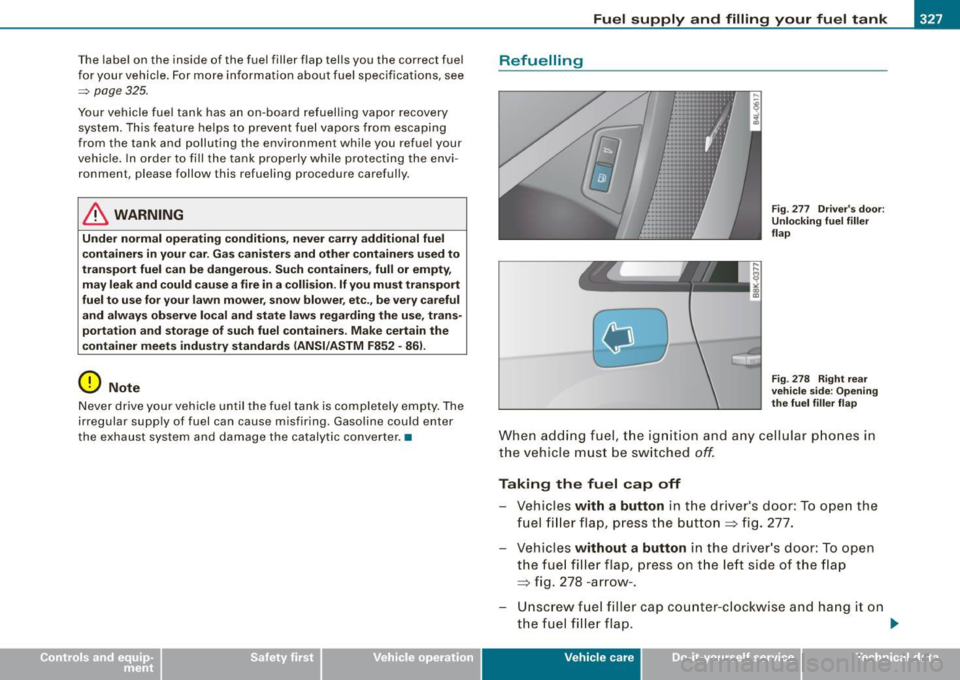
Wh en a ddin g fu el, th e i gni tion and any cellul ar ph ones in
t h e v ehicl e mus t be sw itch ed
off.
Taking the fuel cap off
Vehicles with a button in t he driver's doo r: To o pen the
f u el fill er fla p, p ress t he b utto n
~ fig. 277 .
Vehicles
without a button in the driver 's door: To open
the fue l fi lle r flap, press on t he le ft side of the flap
~ fig. 278 -arrow -.
Unsc rew f uel filler cap co unter-c lockwise and hang it on
t h e fue l fi ller flap. .,._
Vehicle care I I irechnical data
Page 330 of 426
Fuel supply and filling your fuel tank Refuelling procedure
- Insert the fuel nozzle from the gasoline pump into the
fuel filler neck as far as it will go.
- Select a medium refuelling rate so that the nozzle switches off automatically when the tank is full.
Putting the fuel cap back on
- After filling your tank, twist the fuel filler cap clockwise as
far as it will go.
Close the fuel filler flap.
To avoid fuel spilling or evaporating from the fuel tank always close
fuel filler cap properly and completely. An improperly closed fuel
filler cap may also cause the MIL lamp=>
page 29 to come on.
& WARNING
Improper refueling or handling of fuel can cause fire, explosion
and severe burns.
• Fuel is highly flammable and can cause severe burns and other
injuries.
• Failure to shut the engine off while refueling and/or to insert
the pump nozzle fully into the fuel filler neck could cause fuel to spray out of filler neck or to overflow. Fuel spray and overflowing
fuel can cause a fire.
• Never use a cellular telephone while refueling . The electromag
netic radiation can cause sparks that can ignite fuel vapors and
cause a fire.
• Never get back into your vehicle while refueling. If in excep
tional circumstances you must get back in your vehicle while refu
eling, make certain that you close the door and touch metal to
discharge static electricity before touching the filler nozzle again.
Static electricity can cause sparks that can ignite fuel vapors
released during refueling .
& WARNING (continued)
• Never smoke or have an open flame anywhere in or near your
vehicle when refueling or filling a portable fuel container.
• For your safety, we strongly recommend that you do not travel
with a portable fuel container in your vehicle. The container, full or
empty may leak and could cause a fire, especially in a crash.
• If, under exceptional circumstances, you must transport a
portable fuel container, please observe the following:
-Never fill a portable fuel container while it is anywhere in or
on the vehicle (for example, in the luggage compartment, or on
the trunk). Static electricity can build up while filling and can
ignite fuel vapors causing a fire.
- Always place a portable fuel container on the ground before
filling.
- Always keep the filler nozzle completely inside the portable
container before and during filling.
- If filling a portable container made of metal, the filler nozzle
must always be in contact with the container. This will help
prevent static electricity from discharging and cause a fire.
- Never spill fuel inside the vehicle or luggage compartment. Fuel vapors are highly flammable .
- Always observe local and state/provincial laws regarding the
use, storage and transportation of fuel containers.
- Make certain the fuel container meets industry standards
(ANSI / ASTM F852-86l.
0 Note
If any fuel has spilled onto the car, it should be removed immedi -
ately to prevent damage to the paint. _.,