towing AUDI Q7 2009 Owner´s Manual
[x] Cancel search | Manufacturer: AUDI, Model Year: 2009, Model line: Q7, Model: AUDI Q7 2009Pages: 426, PDF Size: 97.13 MB
Page 203 of 426
____________________________________________ A_d_ v_ a_n_ c_ e_d _ P_a_ r_ k_ i_ n ..::g==-- S_ y=- s_t _e _m __ lJII
& WARNING (continued)
• Maintain plenty of distance from an obstacle, so that your
outside mirror or a corner of your vehicle does not collide with any
obstacles -danger of accident!
• The Audi parking system is not a substitute for being careful
and alert when backing up. Be especially careful during parking
and similar maneuvers. Always watch where you are driving and
make sure that nothing is in the way.
• When maneuvering or parking , do not only use the MMI Display
for orientation. Certain objects -depending on the screen resolu
tion -may not, or not entirely, be displayed; for example trailer
hitches , chains, narrow posts, or fences . •
Appl ies to vehic les : with Audi Pa rk ing System and factory insta lled tow ing h itch
Towing hitch
For vehicles with a factory installed towing hitch, or a trailer hitch
installed according to factory specifications , the rear acoustic
parking sensors are not activated when the vehicle is put in reverse
gear while an electrical connection to the trailer socket* is estab
lished. No distance alert occurs in the rear =:>
page 191. The rear
view camera picture=:>
page 194 is displayed without orientation
lines and without blue surfaces. •
Controls and equip
ment
Settings in the MMI
A pplies to v ehicles: with A dvanc ed Park ing System with rear view camera
Adjusting the chimes -option 1
The volume and the pitch (frequency) of the chimes can
be adjusted in the MM!.
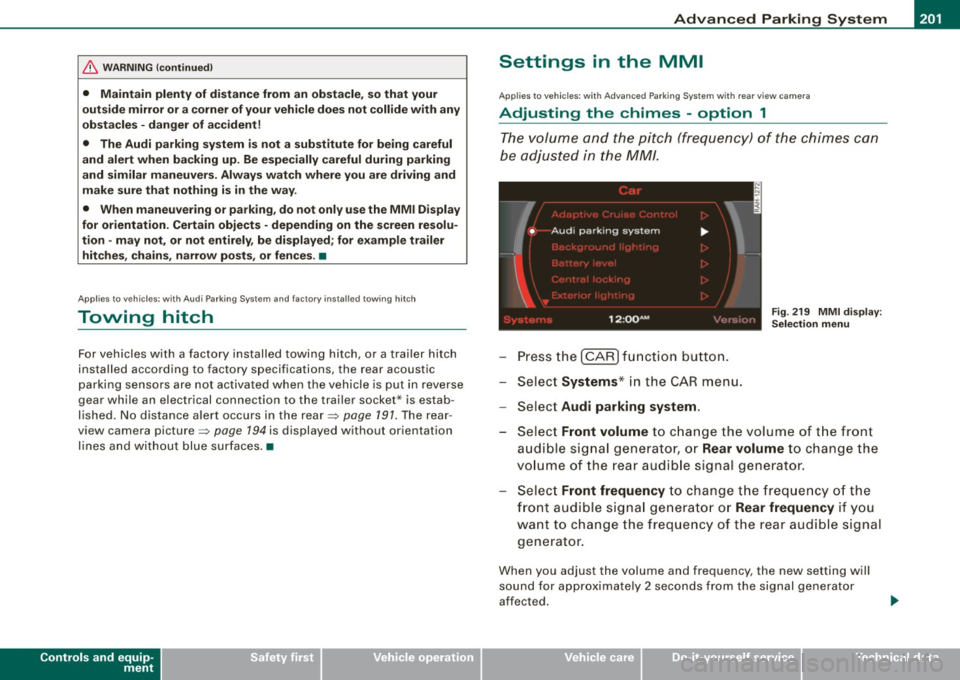
Press the [CAR] function button.
Select
Systems* in the CAR menu.
- Select
Audi parking system .
Fig. 219 MMI display :
Selection menu
- Select Front volume to change the volume of the front
audible signal generator, or
Rear volume to change the
volume of the rear audible signal generator.
Select
Front frequency to change the frequency of the
front audible signal generator or
Rear frequency if you
want to change the frequency of the rear audible signal
generator.
When you adjust the volume and frequency, the new setting will
sound for approximately 2 seconds from the signal generator
affected.
I • •
Page 213 of 426
___________________________________________ ___:A~d~ a~p~t~iv~ e=-.:A~ir~ S~u~ s ~p~ e~n~ s~io~n ~_ffllll
Applies to vehicles : w it h towi ng h itch and Adapt ive Air Su spens io n
Towing a trailer
Automatic lowering is not desirable when towing a trailer.
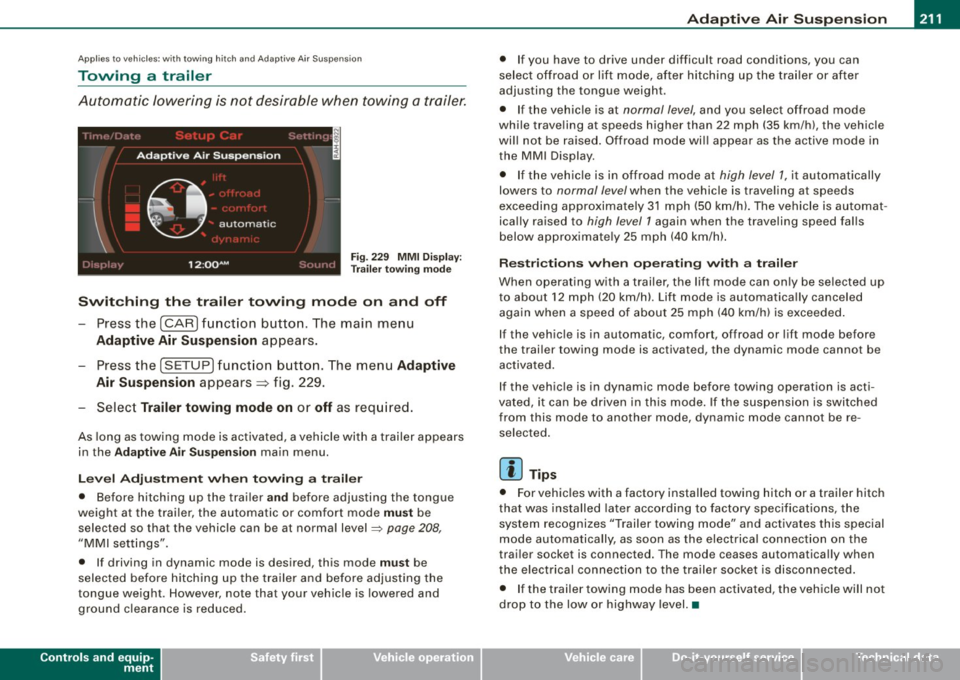
Fig . 22 9 MMI D isplay:
T rai le r t ow ing mode
Swi tching th e trail er towing mode on and off
Press the (CARI function button. The main menu
Adaptive Air Su spension appears .
-Press the (SETUP I funct ion button. The menu Adaptiv e
Air Susp ension
appears~ fig. 229.
- Select
Trailer towing mod e on or off as req uired .
As long as towing mode is activated, a vehicle with a trailer appears
in the
Ad apti ve Air Sus pension main menu.
Le ve l Ad jus tm ent w hen t owing a tra ile r
• Before hitching up the trai ler a nd before adjusting the tongue
weight at the trai ler, the automatic or comfort mode
mu st be
selected so that the vehicle can be at normal level
=> page 208 ,
"MMI settings".
• If driving in dynamic mode is desired, this mode
mus t be
selected before hitching up the trailer and before adjusting the
tongue weight . However , note that your vehicle is lowered and
ground clearance is reduced.
Controls and equip
ment
• If you have to drive under difficult road conditions, you can
se lect offroad or lift mode, af ter hitching up the trai ler or after
adjusting the tongue weigh t.
• If the vehic le is at
normal level, and you select offroad mode
while trave ling a t speeds higher than 22 mph (35 km /h) , t he vehicle
wi ll not be raised . Offroad mode wi ll appear as the active mode in
the MMI Display .
• If the vehic le is in offroad mode at
high level 1 , it automatically
lowers to
normal level when the vehicle is trave ling a t speeds
exceeding approxima tely 31 mph (50 km/h). The vehicle is automat
ica lly raised to
high level 1 again when the t raveling speed falls
below approximate ly 25 mph (40 km/h).
R es tric tions when ope ra ti ng w ith a tra iler
When opera ting with a trailer, the lift mode can on ly be se lected up
to about 12 mph (20 km/h). Lift mode is au tomatica lly canceled
again when a speed of about 25 mph (40 km/h) is exceeded .
If the vehicle is in automatic, comfort, offroad or lift mode before
the trai ler towing mode is act iv a te d , the dynamic mod e cannot b e
activated.
If the vehicle is in dynamic mode before tow ing operation is acti
vated, it can be driven in this mode. If the suspension is switched
from this mode to another mode , dynamic mode canno t be re
selected .
[ i ] Tips
• For vehicles with a factory installed towing hitch or a trailer hitch
that was installed later acco rding to factory specificat ions , the
system recognizes "Trailer towing mode" and activates this special
mode automatically, as soon as the electrica l connection on the
trai le r sock et is connected. The mode c eases au tomat ica lly wh en
the electrical connection to the trailer socket is disconnected.
• I f the trailer tow ing mode has been activated, the vehicle w ill not
drop to the low or highway level. •
I • •
Page 229 of 426
Use only floor mats that leave the pedal a rea unobstructed and that
are firmly secured so that they cannot slip out of position. You can
ob tain sui table floor mats from your au thorized Audi dealer.
Floor mat fasteners are installed in your Audi.
Floor mats used in your vehicle must be attached to these fasteners .
Properly securing the floor mats will prevent them from sliding into
positions that could interfere with the pedals or impair safe opera
tion of your vehicle in other ways .
& WARNING
Pedals that cannot move freely can result in a loss of vehicle
control and increase the risk of serious personal injury.
• Always make sure that floor mats are properly secured.
• Never place or install floor mats or other floor coverings in the
vehicle that cannot be properly secured in place to prevent them
from slipping and interfering with the pedals or the ability to
control the vehicle .
• Never place or install floor mats or other floor coverings on top
of already installed floor mats. Additional floor mats and other
coverings will reduce the size of the pedal area and interfere with
the pedals.
• Always properly reinstall and secure floor mats that have been
taken out for cleaning.
• Always make sure that objects cannot fall into the driver foot·
well while the vehicle is moving. Objects can become trapped
under the brake pedal and accelerator pedal causing a loss of
vehicle control. •
Safety first
Driving Safely
Stowing luggage
Loading the luggage compartment
All luggage and other objects must be properly stowed
and secured in the luggage compartment.
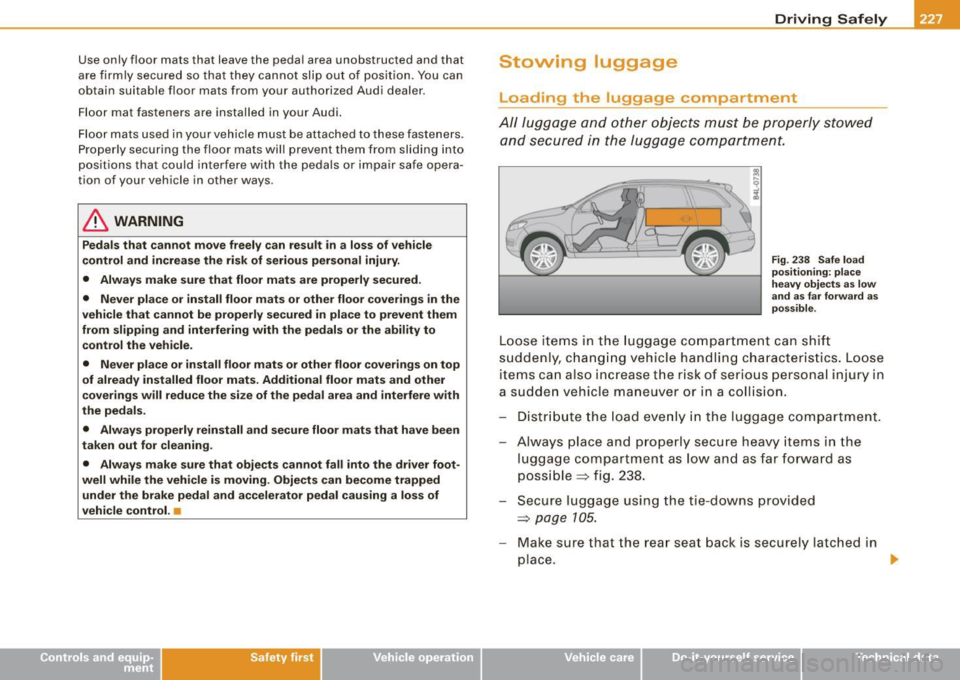
Fig. 238 Safe load
positioning: place
heavy objects as low
and as far forward as
possible .
Loose items in the luggage compartment can shift
suddenly, changing vehicle handling characteristics. Loose
items can also increase the risk of serious personal injury in
a sudden vehicle maneuver or in a collision.
- Distribute the load evenly in the luggage compartment.
- Always place and properly secure heavy items in the
luggage compartment as low and as far forward as
possible :::::> fig. 238.
- Secure luggage using the tie -downs provided
:::::>
page 105 .
-Make sure that the rear seat back is securely latched in
place.
ti,
Vehicle care I I irechnical data
Page 294 of 426
___ ln_ t _e_ ll-'"ig ...,_ e_ n_t _t_ e_ c_ h _ n_o _ l_o _,.g= y,_ __________________________________________ _
& WARNING
• You should perform braking maneu vers for the purpose of
cleaning the brake system only if road conditions permit . Other
road u sers mu st not be put at r isk -you may cause an a ccident!
• Before des cending a steep grade, reduce speed and shift trans
mission into a lower gear or lower dr iving range . Do not ride the
brakes or hold the pedal down too long or too often. This could
cause the brake s to get hot and diminish braking effi ciency .
• Do not "ride the brakes " by resting your foot on the pedal when
you do not intend to b rake. This may cause the br ake s to ove rheat ,
premature wear and increased stopping distance.
• Under ce rtain climat ic and operating condit ions such as
passing through water , driving in heavy rain or after washing the
vehi cle , the effectiveness of the brakes can be reduced . In winter ,
ice can a ccumulate on the brake pads , linings , discs and drums .
Carefully apply bra kes fo r a test . Brakes will dry and ice coatings
will be cleaned off after a few careful brake appli cations .
• Driving for an extended period of time on salt -co vered roads
without using your brakes can also affect braking effic iency. Clean
off accumulated salt coating from brake dis cs and pads with a few
c areful brake applications .
• If you damage the front spoile r, or if you install a different
spoiler, be sure the air flow to the front brakes is not ob structed.
Otherw ise the brake sy stem could overheat reducing the effective
ness of the entire brake system .
• Failure of one bra ke cir cuit will impair the braking capability
resulting in an increased stopping distance. Avoid driving the
vehicle and ha ve it towed to the nearest authorized Audi dealer or
qualified workshop . •
Brake booster
T he b rake boost er ad ds extra b ra kin g powe r.
The brake booster works with vacuum pressure which is created
o nly w he n t he e ngine is ru nnin g=> & .
& WARNING
• Never let the vehicle roll to a stop with the engine shut off.
• If the brake booster is not working, for example when towing
your vehicle, or because the brake boo ster has somehow been
damaged , the brake pedal must be pressed considerably harder to
make up for the lack of booster assistance . •
Functioning of A!"lt"-Lock Brake System (ABS)
ABS p revents the wheels from locking up unde r brakin g.
Th e ABS co ntribu tes effect ively to vehicle cont ro l since it preve nts
the whee ls from
locking when the brakes are app lied. This means
t h at the ve hicle rema ins steerable and is less l ikely to s kid.
With ABS you do not need to pump the brake . Just hold the brake
pedal down .
However, do not expec t the A BS to s hor ten bra king d istance u nder
all circumstances. When driving o n grave l or on newly fallen snow
o n t op o f icy sur faces, brak ing d istance may be ev en lon ger, the re
fore, under these c ircumstances, it is especially important that you
driv e slow ly an d with gre at ca re.
How the ABS system works
An a utomatic c heck is m ade w hen a speed of about 1 2 mph (2 0
km/h) is reached. When this happens, a pumping noise can be
h ea rd.
Page 307 of 426

Trailer towing
Driving with a trailer
Genera l information
Your Audi was designed primarily for passenger transpor
ta tion.
If you plan to tow a trailer, please remember that the add itional load
wi ll affect durability, economy and performance.
Trai ler towing no t only places more s tress on the vehicle, it a lso ca lls
for more concentration from the driver.
F or this reaso n, always fol low the operating and driving instructions
prov ided and use common sense.
(D Note
If you are going to tow a tra iler, you must activate the trailer opera
tion mode =>
page 211, "Towing a trailer".
Technical requirements
Trailer hitch
Use a we ight-carry ing hitch conforming to the gross tra iler weig ht.
T he hitch must be suitable for your vehic le and trailer and must be
m ounted secure ly on the veh icle's chassis at a
technically sound
location. Use only a trailer hitch with a removable ball mount.
Always check with the trai ler hitch ma nufacturer to make sure that
you are using the correct hitch .
Do not use a bumper hitch.
The hitch must be instal led in such a way that it does not in terfere
with the impact-absorbing bumper system. No modifications shou ld be made to the vehicle exhaust and b rake systems . Fro m
Controls and equip
ment Safety first Vehicle operation
Tr
aile r t owing
time to time, check that all hitch mounting bolts remain securely
fastened .
When you are not towing a trai ler, rem ove the t railer hi tch bal l
mount. This prevents the hitch from causing damage should your
vehicle be struck from behind =>
&.
Trailer bra kes
If your trai ler is equipped with a b raking system, check to be sure
that it conforms to all regulations.
The tra iler hydraul ic bra ke system must not be directly co nnecte d to
the veh icle's hydrau lic brake system=> &.
Safety chains
Always use safety chains between your vehicle and the trailer.
Trail er lights
Trai ler lights must meet a ll regulations. Be sure to check with your
au thorized Audi dea ler for correct wiring, switches, an d relays.
Mirrors
If you are unab le to see the traff ic behind you using the regular
outside mirrors, then you
must instal l extended mirrors. It is impor
t ant that you
always have clear v isi on to the rear.
& WARNING
• If a trailer has electrical brake s please note that the se brakes
are not act ivated by the fa ctory-fitted control unit -ris k of acci
dent!
• After removing the trailer hitch , do not store it in your vehicle.
In case of sudden braking , the hitch could fly forward and injure
you or your passengers .
Vehicle care Do-it-yourself service Technical data
Page 308 of 426
llffl!I Trailer towing
------=---------------------------------
& W ARN ING (continued )
• The Gros s Vehicle Weight Rating for your Audi 07 vehicle ,
found on the safety compliance l abel on the driver's side B -pillar ,
must never be ex ceeded under any cir cumstances . E xceeding the
Gross Vehi cle Weight Rating of your vehicle is likely to damage
your vehicle , and such damage w ill not be covered by your Limited
New Vehicle Warranty. Exceeding the Gro ss Vehicle Weight Rating
will also change the performan ce and handling characteristics of
your vehicle , which could cause a crash resulting in serious injury
or death .
• The Gros s Vehicle Weight Rating for your Audi 0 7 would be
e xc eeded if your veh icle is simultaneously equipped with
Panoramic sliding sunroof ; third -row seating ; trailer towing equip
ment (factory or dealer -installed) , and running boards (dealer
installedl. UNDER NO CIRCUMSTANCES MAY ALL SUCH ITEMS BE
INSTALLED ON THE SAME VEHICLE .
a
Operating instructions
---------~--~-------
MAX 6.9"
MAX 175mm
Trailer towing weights
Fi g. 2 76 P erm itted ball
po sition of the trailer
hitch
With a factory-installed trai ler hitch, the maximum permissible
trai ler weight is 6,615 lbs (3,000 kg). The maximum permissible
unbraked trailer weight is 1,650 lbs (750 kgl. With an
aftermarket
tr ailer h itch , the maxi mum pe rm iss ib le tra iler weigh t is 5,51 2 lb s (2,500
kg). These specifications apply when driv ing on roads having
an in cli ne of less t han 12% .
Permissible tongue load
Fo r best v ehicle ha ndling under th es e changed con ditio ns, a dju st
the trai ler load so that the tongue load is at the maximum allowable
or s lightly lower. Y ou ca n ge t an ap proxi mati on of the tong ue load
with a bathroom sca le or you can measure the load at a trucking
company or weig hing s tati on.
Wtih a
factory -installed trailer hi tch, the max imum perm issib le load
on the ball hitch may not exceed 66 2 lbs (300 kg) . With an
after
market
t ra iler hitc h, the max imum pe rmi ssible loa d on the ball h itch
may not exceed 55 1 lbs (250 kg). It is recommended to use the
m aximum p ermi ssi ble l oad.
Trailer load distribution B e sure the load in the trai ler is he ld securel y in place to prevent it
from shifting forward, backward or sideways.
Never allow a passenger to ride in a trailer=> & in "D riving ins truc
tions" on page 307.
Ball mount
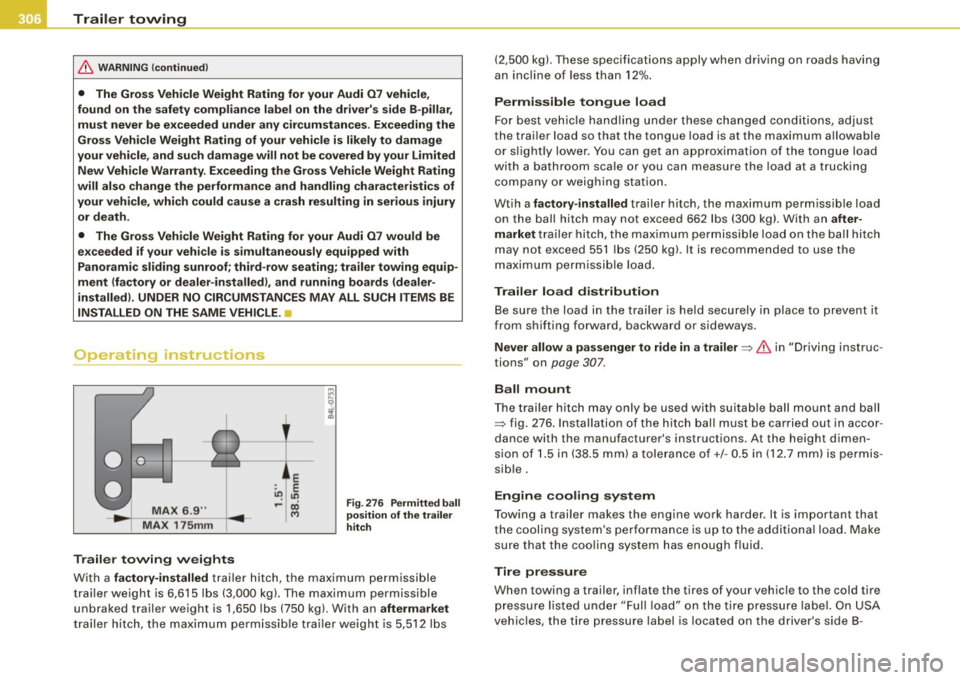
T he trai ler hitch may only be used with suitab le ball mount and ball
=> fig. 276 . In sta llati on of t he hitch ball must be ca rr ie d o ut i n a ccor
dance with the manufacturer's instructions. At the height dimen
s io n of 1 .5 in (38 .5 mm) a tole ran ce o f+/- 0 .5 in (12 .7 mm) is pe rmis
sib le.
Engine cooling system
T owing a trai ler makes the engine work harder. It is important that
th e c ooli ng system 's per forman ce is u p to the a ddi tiona l loa d. Ma ke
sure that the coo ling s ystem has enough f luid.
Tire pressure
When towing a trailer, inflate the tires of your vehic le to the cold tire
p re ssure l is ted unde r "Full load" on th e tire press ure l abe l. On USA
vehic les, the tire pressure label is located on the driver's side 8 -
Page 309 of 426
pillar. On Canada vehicles, the tire pressure label is located either on
t he driver's side 8 -pillar or inside the fuel fil ler flap. Inflate trailer
tires to trailer and tire manufacturers' specifications.
L ight s
The head light settings should be checked with the trailer attached
before driving off . Check to make sure both vehicle and trai ler lights
are working properly.
Sa fety c hain s
Be sure trailer safety chains are properly connected from the trailer
to the hitch on the vehicle . Leave enough slack in the chains to
permit turning corners. When you insta ll safety chains, make sure
they will not drag on the road when you are driving .
The chains should cross under the tra iler tongue to prevent it from
dropping in case of separation from the hitch.
0 Note
If you are going to tow a traile r, you must activate the trailer opera
tion mode =>
page 211, "Towing a trailer" .
Driving instructions
Driving with a trailer always requires extra care and
consideration.
To obtain the best possible handling of vehicle and trailer,
please note the fo llow ing:
- Do not tow a loaded trailer when your car i tse lf is not
loaded .
- Be especia lly careful when passing other vehicles .
- Observe speed l imits.
- Do not drive at the maximum permiss ible speed .
Controls and equip
ment Safety first Vehicle operation
Tr
aile r t owing
Always apply brakes early .
- Monitor the temperature gauge .
Weigh t dis tr ibution
Towing a loaded trailer wi th an empty car results in a highly
unstable dis tribution of weight . If this cannot be avoided , drive at
very low speeds only to avoid the risk of losing steering control.
A "balanced" rig is easier to operate and control. This means that
the tow vehicle should be loaded to the extent possible and permis
sib le, while keeping the trailer as light as possib le under the circum
stances . Whenever possible, transfer some cargo to the luggage
compartment of the tow vehicle whi le observing tongue load
requirements and vehicle loading considerations .
Speed
The higher th e speed, the more difficu lt it becomes for the driver to
control the rig . Do not drive at t he maximum pe rmissible speed.
Reduce your speed even more
if load, weather or wind conditions
a re unfavorable -particularly when going downhil l.
Reduce vehicle speed
i mmedi ate ly if the trailer shows the slightest
sign of swaying.
Do not tr y to s top the swaying by accelerating .
Observe speed limits . In some areas, speeds for vehicles towing
trailers are lower than for regular vehicles .
Always apply brakes early. When driving downhill, shift into a lower gear to use the engine braking effect to slow the vehicle. Use of the
brakes alone can cause them to overheat and fa il.
Coo lant t emperatu re
The coolant temperature gauge=> page 13 must be obse rved care
ful ly. If the need le moves close to the upper end of the sca le , reduce
speed immediately and/or turn off the air conditioner .
If the coolant temperature warning light in the instrument cluster
starts f lashing
- f- , pul l off the road, stop and let the engine idle for
about two minutes t o prevent heat build -up.
Vehicle care Do-it-yourself service Technical data
Page 310 of 426
ll'I __ T_ r _a_ il_e _r_ t_ o_ vv_ in__... g,_ __________________________________________________ _
& WARNING
Anyone not properly restrained in a moving vehicle is at a much
greater risk
in an accident. Never let anyone ride in your car who
is not properly wearing the restraints provided by Audi .
c:
Trailer towing tips
Important to know
Your vehicle handles differently when towing a trailer because of
the additional weight and different weight distribution. Safety,
performance and economy will greatly depend on how carefully you
load your trailer and operate your rig.
Before you actually tow your trailer, practice turning, stopping and
backing up in an area away from traffic. Keep practicing until you
have become completely familiar with the way your vehicle -trailer
combination behaves and responds.
Backing up is difficult and requires practice. Backing up with a
trailer generally requires steering action opposite to that when
backing up your vehicle without a trailer.
Maintain a greater distance between your vehicle and the one in
front of you. You will need more room to stop. To compensate for
the trailer, you will need a larger than normal turning radius.
When passing, remember that you cannot accelerate as fast as you normally would because of the added load. Make sure you have
enough room to pass. After passing, allow plenty of room for your
trailer before changing lanes again.
Avoid jerky starts, sharp turns or rapid lane changes.
[ i] Tips
• Do not tow a trailer during the break-in period of your vehicle. • If you tow
a trailer, your Audi may require more frequent mainte
nance due to the extra load~
page 401. •
Parking on a s1ope
Do not park on a slope with a trailer. If it cannot be
avoided , do so only after doing the following:
When parking:
-Apply the foot brake.
- Have someone place chocks under both the vehicle and
the trailer wheels.
- With chocks in place, slowly release the brakes until the
wheel chocks absorb the load.
- Turn the wheels towards the curb.
- Apply the parking brake.
- Move the selector lever to
P.
When restarting after parking:
- Apply the foot brake.
- Start the engine.
- Move the selector lever to
D.
-Release the parking brake and slowly pull out and away
from the wheel chocks.
- Stop and have someone retrieve the wheel chocks.
[ i] Tips
I f you move the selector lever of the automatic transmission to P
before applying the parking brake and before blocking the wheels, II-
Page 311 of 426

you may have to use more force later to move the lever out of the P
position .•
Controls and equip
ment Safety first Vehicle operation
Trailer towing
Vehicle care Do-it-yourself service
Technical data
Page 359 of 426
3. Subtract the combined weight of the driver and passengers from
"XXX" kilo
grams or
"XXX" pounds shown on the
sticker=>
page 351, fig. 291.
4. The resulting figure equals the available amount of cargo and luggage load capacity. For example, if the
"XXX"
amount equals 1400 lbs. and there will
be five 150 lbs. passengers in your
vehicle, the amount of available cargo and luggage load capacity is 650 lbs. (1400-750 (5
X 150) = 650 lbs.)
5. Determine the combined weight of luggage and cargo being loaded on the
vehicle. That weight may not safely exceed the available cargo and luggage
load capacity calculated in Step 4.
6. If your vehicle will be towing a trailer, load from your trailer will be transferred
to your vehicle. Consult this manual to determine how this reduces the avail
able cargo and luggage load capacity of
your vehicle.
Tires and wheels -
-Check the tire sidewall (=> page 359,
fig. 295) to determine the designated
load rating for a specific ti re. •
Tire service life
The service life of tires depends on a lot of different things
including proper installation and balancing, correct tire
pressure and driving style.
--
~-----------~
Tread Wear Indicator (TWI)
Fig. 293 Tire tread:
tread wear indicators
(TWI)
Fig. 294 Rotating tires
for more even wear
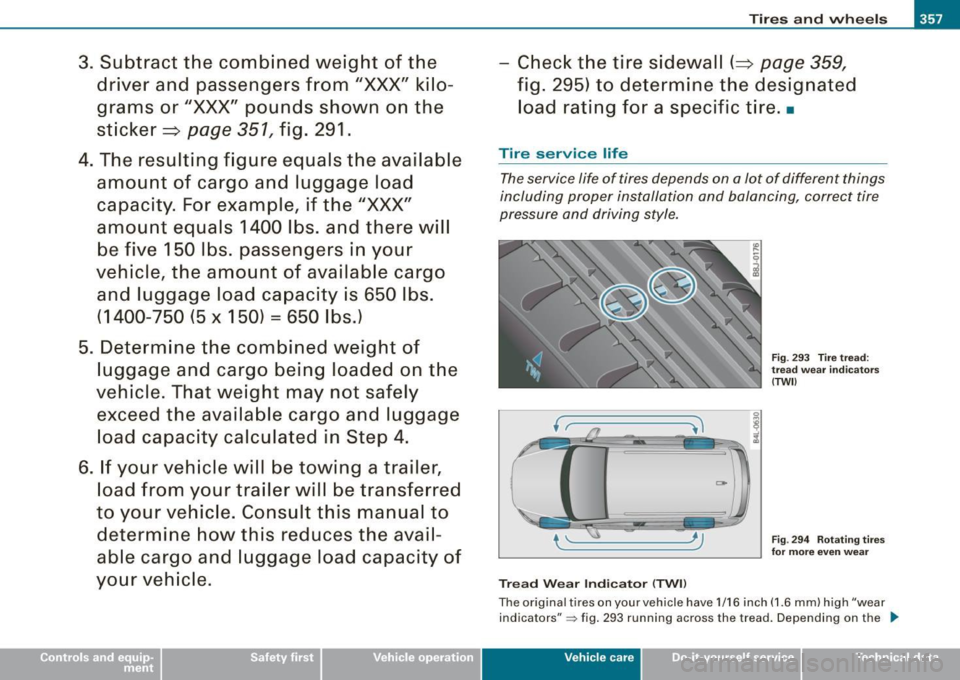
The original tires on your vehicle have 1 /16 inch (1.6 mm) high "wear
indicators" => fig. 293 running across the tread. Depending on the ._
Vehicle care I I irechnical data