warning AUDI Q7 2009 Owner´s Manual
[x] Cancel search | Manufacturer: AUDI, Model Year: 2009, Model line: Q7, Model: AUDI Q7 2009Pages: 426, PDF Size: 97.13 MB
Page 321 of 426
_____________________________________________ C_ l_ e _a_ n_ in_ g_a _ n_d_ p_ r_ o_ t _e_ c_t _io _ n __ lftlll
•
Any damage to the undercoating caused by road hazards should be
repa ired promptly.
& WARNING
Too mu ch undercoating in the wro ng pl ace s can cause a fir e.
• Do not appl y ad ditional und ercoating or ru stproofing on or
n ea r the e xhaus t man ifold , ex haust pipe s, catalyt ic c onverter or
heat shields . While d riving , the s ub stan ce used for undercoating
c ould overheat and cau se a fire.
• Alw ays read and heed all WARNINGS and other informat ion
=> pag e 312 . •
Care of interior
MMI display
- C lean the M MI display with a soft c lean cloth and an LCD
cleaner.
The MM I display can be cleaned with a professional ly available "LCD
cleaner". The clot h should be s lightly dampened with the c leaning
fluid to clean the display.
0 Note
T o avoid scratching the MMI display, you should never c lean it dry. •
MMI terminal
- First clean the MMI terminal with a brush to remove dust
from the housing . T
hen w ipe the MM I terminal wit h a clean, so ft, s light ly
dam p cloth.
The M MI termina l shou ld be c leaned w ith a brush first so that no
dirt is trapped between the buttons and the housing. We recom
mend giving the MMI terminal a fina l w ipe with a c loth moistened
with water and dish washing detergent.
0 Note
To prevent damage, make sure that no fluid ever gets into the MMI
terminal. •
Aluminum trim
Use only neutral -pH produc ts to remove spots and deposits from
aluminum surfaces. Chrome care products and alkaline cleaners
wi ll attack aluminum surfaces and can damage them over time.
& WARNING
Al way s read and h eed all WARNINGS and oth er information
=> page 31 2. •
Fabrics and fabric coverings
Fabrics and fabric coverings (e.g . seats, door trim panels, etc.)
shou ld be c leaned at regular inte rvals with a vacuum cleaner . This
removes surface dirt particles which could become embedded in
the fabric th rough use. Steam cleaners shou ld not be used, because
the steam tends to push the dirt deeper into the fabric and lock it
there .
~
Vehicle care I t •
Page 322 of 426
___ C_ le_ a _ n_i_n ~g _ a_ n_ d __ p_r _o _t _e _c_ t_ i_o _n ___________________________________________ _
Normal c lea ning
Genera lly, we recommend using a sof t sponge or a lint -free
microfiber cloth to the c lean fabric. Brushes should only be used for
carpets and floor mats, since other fabric surfaces cou ld be harmed
by brushes .
Normal surface stains can be cleaned using a commercially avail
able foam cleaner . Spread the foam on the surface of the fabric with
a soft sponge and work it in g ent ly. Do not saturat e the fabric. Then
pat the foam d ry using abs orbent, dry cl oths (e .g . micro fiber c loth)
and vacuum it after it has dried completely .
Cleaning stains
Stains caused by beverages (e.g. coffee , fruit juice, etc.) can be
treated w ith a mild detergent so luti on. Apply the detergent so lu tion
with a sponge . In the case of stubborn stains , a d etergent paste can
be applied di rectly t o the sta in and worked into the fabric . After
wards , use copious amounts of clean water to remove the
remaining detergen t. Apply the wa ter w ith a damp cloth or sponge
and pat the fabric dry with an absorbent, dry c loth.
Stains from chocolate or makeup should have detergent paste (e .g.
ox -ga ll soap) rubbed into them . Afterwards, remove the soap w ith
water (damp sponge).
A lcohol can be used to treat stains from grease, oil, lipstick o r a ba ll
point pen. Melted grease or dye must be patted off using absorbent material. It may be necessary to retreat the areas with detergent
paste and water.
In the case of genera l soiling of the upholstery and cover material,
we recommend hiring a specialist that has the eq uipment to c lean
the seat covers and other fabric surfaces by shampooing and spray
extraction .
& WARNING
Always read and heed all WARNINGS and th e information
=> page 31 2.
[ i ] T ips
Open Ve lcro fasteners on your clothing can damage the seat cover.
Please make su re that Ve lcro fasteners are c losed .•
Plastic parts and instrument panel
Always use a clean cloth moistened in clea r water to clean these
areas . For persistent dir t use an Audi approved
solvent -free plastic
cleaner/protecta nt.
& WARNING
Solvent s can change the propertie s of some plastics and make it
ha rder for the airbag to deploy .
• Never clean the instrument panel or the surface of airbag
module s with cleaning pr oduct s that contain so lvents .
• Product s containing solvent s w ill make the surface of this part
porou s.
• Seriou s injuries can result if pla stic parts come loo se when the
ai rbag is deployed .
• Alway s read and heed all WARNING S and other info rm ation
=> page 312 .
0 Note
Cleaning agents containing solvents wil l attack the material and can
change the way it behaves .•
Page 324 of 426
-Cleaning and prot ection
Pt'l:I-~--------------
Applies to vehicles : with na tura l leather
Cleaning and caring for leather upholstery
and trim
N atural leather requires special care and attention.
Normal cleaning
C lean s oiled areas wi th a s lig htly mo istened cotton o r
w oole n cloth.
Mor e stubborn dirt
- More stubborn dirt can be removed using a cloth satu
rated with a mild soap solution (2 tablespoons m ild
liquid soap) .
- Neve r allow the soap solution to saturate the leathe r, and
make certain that no water soaks into the seams.
Wipe off the soap solution with a soft, dry clot h.
Cleaning spots
-Remove fresh water-based spots (su ch as coffee, tea,
juices, b lo od) with an a bsorbent c loth or paper towel.
- Remove fresh grease or oil-based spots (such as butter,
mayonnaise, choco late) with an absorbent c loth o r paper
towel, or use the cleaner from the leather care k it if t he
spot has not yet penetrated into the su rface of the
l eather.
- Use an oil/grease dissolving spray, if oil/grease spots
have dried on .
- Remove specific kinds of spots (ballpoint pen , fe lt
marker, fingernai l po lish, water -based paint, shoe polish ,
etc.) with a spot remover specifically formulated for lea ther .
Leather car e
-Every half year use a n approved leather care product
(availa ble from your author ized Audi deale r) to care for
t h e lea ther.
- Apply the produc t very spar ingly.
- Wipe i t off wit h a damp cloth.
If you have any questions about c leaning and caring fo r the lea ther
in your vehicle, i t is best to contact your authorized Audi dealer , who
wi ll be glad to help you a nd tell you about our ful l range of leather
care products, such as:
• Le ather cle aning and care kit
• Creams to care for co lored leather
• Spot r emovers for ba llpoint pens, shoe polish, etc .
• Oil/grease disso lving spray
• New and upcoming products .
& WARNING
Always read and heed all WARNINGS and other info rmation
~ page 312 .
0 Note
• Never use ch em ical solvents (e .g . lighter flu id, turpentine),
waxes, shoe po lish or simi lar products on the leather surfaces in
your Aud i.
• To avoid damage , have s tubbo rn stains removed by a commer
cia l cleaning spec ial ist .•
Page 325 of 426
--------------------------------------------~C ~ l~ e ~ a~ n~ in~ g~ a~n ~d~ p~ r ~o~ te~ c~t ~io ~ n~_IIIII
•
A pp lies to vehicles : w it h A lcantara up holste ry
Cleaning Alcantara ® (synthetic suede)
Removing dust and dirt
- Moisten a cloth, squeeze out excess water and wipe down
the seat surfaces.
Removing stains
- Moisten a cloth with lukewarm water or with diluted
ethyl (rubbing) alcohol.
Dab at the stain. Start at the outside and work inwards.
- Once the stain is no longer visible, use a soft dry cloth or
tissue to soak up the moisture.
Do not use leather cleaning products on Alcantara.
You may use a suitable shampoo for removing dust and dirt. Dust and grit in the pores and seams can scratch and damage th e
surface. If the car is left standing in the sun for long periods, the
Alcantara should be protected against direct sunlight to prevent it
from fading. Slight color variations will develop in normal use and
are not an indication of material deterioration.
0 Note
• Never use chemical solvents (e .g. lighte r fluid , tu rpen tine) ,
waxes, shoe polish or s imilar products on Alcantara ® surfaces.
• To avoid damage , have stubborn stains removed by a commer
cial cleaning specialist.
• Do no t use brushes, stif f spong es or similarly abras ive cleaning
aids. •
Safety belts
Only well-maintained safety belts work reliably when
needed.
Keep belts clean .
- For cleaning, use a mild soap and water solution. Let
belts dry thoroughly and away from direct sunl ight.
- Do not allow inertia reel safety belts to retract before
they are completely dry.
- Check the condition of your safety belts
regularly.
Heavily soiled safety belts may not retract properly.
& WARNING
Damaged safety belts can break in a crash.
• Anything that might damage your safety belts could mean that
you and your passengers would not be adequately protected in an
accident.
• Safety belt performance depends on correct installation. Never
remove belts from the vehicle to clean them.
• Do not use chemical cleaning agents, bleach or dyes. They have
corrosive properties which weaken the webbing.
• When cleaning your safety belts, inspect them for damage.
If
you discover damage, see your authorized Audi dealer.
• Always read and heed all WARNINGS and other information
~ page312. •
Vehicle care I t •
Page 326 of 426
lll'ft __ C_ le_ a _ n_i_n ~g _ a_ n_ d __ p_r _o _t _e _c_ t_ i_o _n ___________________________________________ _
Engine compartment
Be especially careful when cle aning the engine compart
ment.
Alw ays sw itch off the ignition before cle aning the en gine ~ &.
Ple num p anel
Remove leaves from the p lenum pane l in front of the windshield
under the engine hood. This prevents the water drain ho les from
becoming blocked, and it prevents debris from entering the vehicle
inter ior through the hea ting and ventilation ducts .
Corrosion protection
The engine compartment and transmission have been corrosion
protected at the factory .
Good anti-corros ion treatment is very important, particularly in the
winter. If the vehicle is frequently driven on salt treated roads, the
en tire engine compartment and plenum pa nel sh ould be tho r
oughly c leaned at the end of winter and retreated to prevent salt
damage. A t the same time, the underside o f the vehicle shou ld be
washed as well.
If the engine compartment is cleaned at any t ime with grease
removin g solutions
3
l, or if you have the eng ine washed, the anti
corrosion treatment is almost a lways removed as well. It is therefore
essential to have a long -lasting corrosion protection reapplied to all
surfaces, seams, joints and components in the engine compart
ment .
& WARNING
Be awa re: The engi ne compa rtment of any moto r vehicle i s a
potenti ally ha zardou s area .
• Before workin g in the eng ine compartment , be sure to read the
inform ation
~ page 324 .
31 Use on ly the correct cleaning solutions. Never use gasoline or diesel fuel.
& WARN ING (continued )
• Before reaching into the front plenum panel , always remove the
ignition key . Otherw ise, the windshield wiper system could unin
tentionally be swit ched on , po ssibl y causing personal injury from
the moving wiper link age .
• Never re ach into the are a a round or touch the radiator fan . The
au xilia ry fan i s temper ature cont rolled and can swit ch on suddenly
- even when the ignition is off .
• Do not w ash, w ax or dry the engine with the engine run ning.
Moving or hot parts could injure you .
• Do not clean the underside of the cha ssis , fenders , wheel
cover s, or other hard to rea ch parts without protecting your hands
and arm s. You ma y cut your self on sh a rp -edged metal part s.
• Always read and heed all WARNINGS and other inform ation
~ poge312. •
Page 329 of 426
_____________________________________ F_ u_ e _ l _s _u -= p_ p '--' ly=--- a_ n_ d _ f_ i_ll _in -= g_y=-- o_u _ r_ f_ u_ e_l _t _a _n _ k _ ____._
The labe l on the inside of the fuel filler flap tel ls you the correct fuel
fo r your vehicle . For mo re information about fuel specifications, see
=> page 325.
Your vehicle fuel tank has an on -board refuelling vapor recovery
sys tem. Th is feature helps to prevent fue l vapors from escapin g
from the tank and polluting the environment wh ile you refue l your
veh ic le . I n order to fill the tank properly while protecti ng the envi
ronment, please follow this refuel ing procedure carefully .
& WARNING
Under normal operating conditions , never carry additional fuel
c ontainers in your car . Ga s canister s and other containers used to
transport fuel can be dangerous . Such conta iners , full or empty,
may leak and could cause a fire in a collision . If you mu st transport
fuel to use for your lawn mower , snow blower , etc. , be very c areful
and always ob serve local and state laws regarding the u se , tran s
port ation and storage of su ch fuel containers . Make certain the
c ontainer meets industry standard s (ANSI/ASTM F852 · 86 1.
0 Note
Neve r d rive your vehicle until the fuel tank is completely emp ty . The
irregular supp ly of fuel can cause misfiring . Gasoline could enter
t he e xhaus t system and damage the cataly tic converter. •
Refuelling
Fig. 27 7 Dri ver 's do or :
Unlo cking fuel filler
flap
Fig . 2 78 Right re ar
v ehi cle sid e: Open ing
the fuel filler flap
Wh en a ddin g fu el, th e i gni tion and any cellul ar ph ones in
t h e v ehicl e mus t be sw itch ed
off.
Taking the fuel cap off
Vehicles with a button in t he driver's doo r: To o pen the
f u el fill er fla p, p ress t he b utto n
~ fig. 277 .
Vehicles
without a button in the driver 's door: To open
the fue l fi lle r flap, press on t he le ft side of the flap
~ fig. 278 -arrow -.
Unsc rew f uel filler cap co unter-c lockwise and hang it on
t h e fue l fi ller flap. .,._
Vehicle care I I irechnical data
Page 330 of 426
Fuel supply and filling your fuel tank Refuelling procedure
- Insert the fuel nozzle from the gasoline pump into the
fuel filler neck as far as it will go.
- Select a medium refuelling rate so that the nozzle switches off automatically when the tank is full.
Putting the fuel cap back on
- After filling your tank, twist the fuel filler cap clockwise as
far as it will go.
Close the fuel filler flap.
To avoid fuel spilling or evaporating from the fuel tank always close
fuel filler cap properly and completely. An improperly closed fuel
filler cap may also cause the MIL lamp=>
page 29 to come on.
& WARNING
Improper refueling or handling of fuel can cause fire, explosion
and severe burns.
• Fuel is highly flammable and can cause severe burns and other
injuries.
• Failure to shut the engine off while refueling and/or to insert
the pump nozzle fully into the fuel filler neck could cause fuel to spray out of filler neck or to overflow. Fuel spray and overflowing
fuel can cause a fire.
• Never use a cellular telephone while refueling . The electromag
netic radiation can cause sparks that can ignite fuel vapors and
cause a fire.
• Never get back into your vehicle while refueling. If in excep
tional circumstances you must get back in your vehicle while refu
eling, make certain that you close the door and touch metal to
discharge static electricity before touching the filler nozzle again.
Static electricity can cause sparks that can ignite fuel vapors
released during refueling .
& WARNING (continued)
• Never smoke or have an open flame anywhere in or near your
vehicle when refueling or filling a portable fuel container.
• For your safety, we strongly recommend that you do not travel
with a portable fuel container in your vehicle. The container, full or
empty may leak and could cause a fire, especially in a crash.
• If, under exceptional circumstances, you must transport a
portable fuel container, please observe the following:
-Never fill a portable fuel container while it is anywhere in or
on the vehicle (for example, in the luggage compartment, or on
the trunk). Static electricity can build up while filling and can
ignite fuel vapors causing a fire.
- Always place a portable fuel container on the ground before
filling.
- Always keep the filler nozzle completely inside the portable
container before and during filling.
- If filling a portable container made of metal, the filler nozzle
must always be in contact with the container. This will help
prevent static electricity from discharging and cause a fire.
- Never spill fuel inside the vehicle or luggage compartment. Fuel vapors are highly flammable .
- Always observe local and state/provincial laws regarding the
use, storage and transportation of fuel containers.
- Make certain the fuel container meets industry standards
(ANSI / ASTM F852-86l.
0 Note
If any fuel has spilled onto the car, it should be removed immedi -
ately to prevent damage to the paint. _.,
Page 332 of 426
___ C_h_ e_ c_k _in --== g'-- a_n _d_ f_il _li _n ..:::g:::..- ___________________________________________ _
Checking and filling
Engine hood
Releasing the engine hood
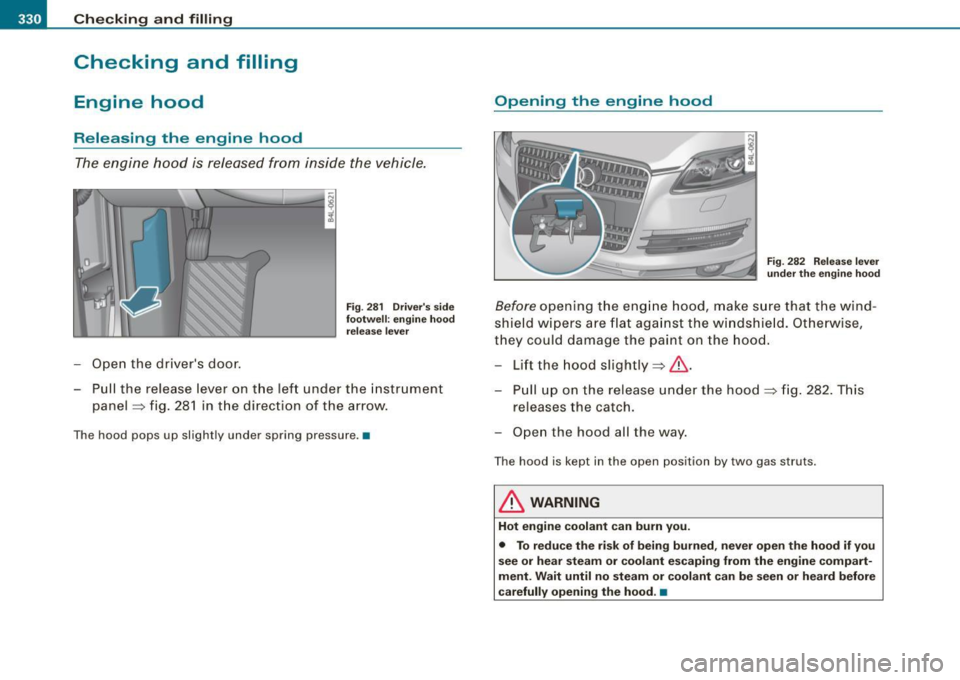
The engine hood is released from inside the vehicle.
-Open the driver's door.
Fig . 281 Driver's side
footwell: engine hood
release lever
-Pull the release lever on the left under the instrument
panel
=> fig. 281 in the direction of the arrow.
The hood pops up slightly under spring pressure. •
Opening the engine hood
Fig. 282 Release lever
under the engine hood
Before opening the engine hood, make sure that the wind
shield wipers are flat against the windshield. Otherwise,
they could damage the paint on the hood.
Lift the hood slightly =>&, .
- Pull up on the release under the hood => fig. 282. This
releases the catch.
- Open the hood all the way.
The hood is kept in the open position by two gas struts.
& WARNING
Hot engine coolant can burn you.
• To reduce the risk of being burned, never open the hood if you
see or hear steam or coolant escaping from the engine compart
ment. Wait until no steam or coolant can be seen or heard before
carefully opening the hood. •
Page 333 of 426
_____________________________________________ C_ h_ e .=....= c..:..k :..:.in :....:..:= g:.....= a..:..n .:....:d::......:. f.:..:il .:..:li ..:..n ::.:g:!....- __
•
Closing the engine hood
- Pull the hood down until the pressure from the struts is
reduced .
- Let the hood
drop down and latch in place. Do not try to
push it shut;
it may fail to engage => &.
& WARNING
A hood that is not completely latched could fly up and block your
view while driving.
• When you close the engine hood, check it to make sure the
safety catch has properly engaged. The hood should be flush with
the surrounding vehicle body parts.
• If you notice while driving that the hood is not secured prop
erly, stop at once and close it. •
Working in the engine compartment
Be especially careful whenever you work in the engine
compartment.
Whenever you must perform any work in the engine compartment,
for example checking and filling different fluids, there is a risk of injury, burns and accidents. To prevent personal injury always
observe the following WARNINGS. The engine compartment of any
vehicle is a hazardous area
~ & .
& WARNING
To help avoid injury, before you check anything under the hood :
• Turn off the engine.
• Remove the ignition key.
• Apply the parking brake .
& WARNING (continued)
• Move selector lever to "P" (Park).
• Always let the engine cool down. Hot components will burn
skin on contact.
• To reduce the risk of being burned, never open the hood if you
see or hear steam or coolant escaping from the engine compart
ment. Wait until no steam or coolant can be seen or heard before
carefully opening the hood.
• Keep children away from the engine compartment .
• Never spill fluids on hot engine components. They can cause a
fire.
• Never touch the radiator fan. The auxiliary electric fan is
temperature controlled and can switch on suddenly.
• Never open the coolant reservoir cap when the engine is still
warm . The coolant system is pressurized and hot coolant could
spray out.
• Protect your face, hands and arm from steam or hot engine
coolant by placing a thick rag over the cap when you open the
coolant reservoir.
• If work on the fuel system or the electrical system is necessary :
- Always disconnect the battery.
- Never smoke or work near heaters or open flames . Fluids in
the engine compartment could start a fire.
- Keep an approved fire extinguisher immediately available.
• To avoid electrical shock and personal injury while the engine
is running or being started, never touch:
- Ignition cables
- Other components of the high voltage electronic ignition system.
• If you must perform a check or repair with the engine running: -First, fully apply the parking brake, move selector lever to "P"
(Park). .,
Vehicle care
I t •
Page 334 of 426
-Checking and filling PW---=---------------
& WARNING (continued )
-Always u se extreme caution to prevent cloth ing , jewelry, or
long hair from getting caught in the radiator fan , V-belt s or
other moving parts , or from contacting hot parts . Tie back hair
before starting , and do not wear clothing that will hang or
droop into the engine .
• Minimize exposure to emis sion and chemical hazards
::::> & .
& WARNING
California Proposition 65 W arn ing :
• Engine exhaust , some of its constituents , and certain vehicle
c omponents cont ain or emit chemicals known to the State of Cali
fornia to cause cancer and birth defects and reproductive harm. In addition , certain fluids contained in vehi cles and certa in products
of component wear contain or emit chemicals known to the State
of California to cause cancer and birth defect s or other reprodu c
tive harm.
• Battery posts , terminals and related ac cessories conta in lead
and lead compounds , chemicals known to the State of California
to cause cancer and reproductive harms. Wash hands after
handling.
0 Note
When adding f luids, always make sure that they are poured into the
proper container or filler ope ning, otherwise serious damage to
vehic le systems wi ll occur.
ci> For the sake of the environment
To detect leaks in time, inspect the vehicle floor pan from under
n eath regu larly. If you see spots fro m oil o r o th e r v eh icle flu ids, hav e
your vehicle inspected by an author ized Audi dea ler. •
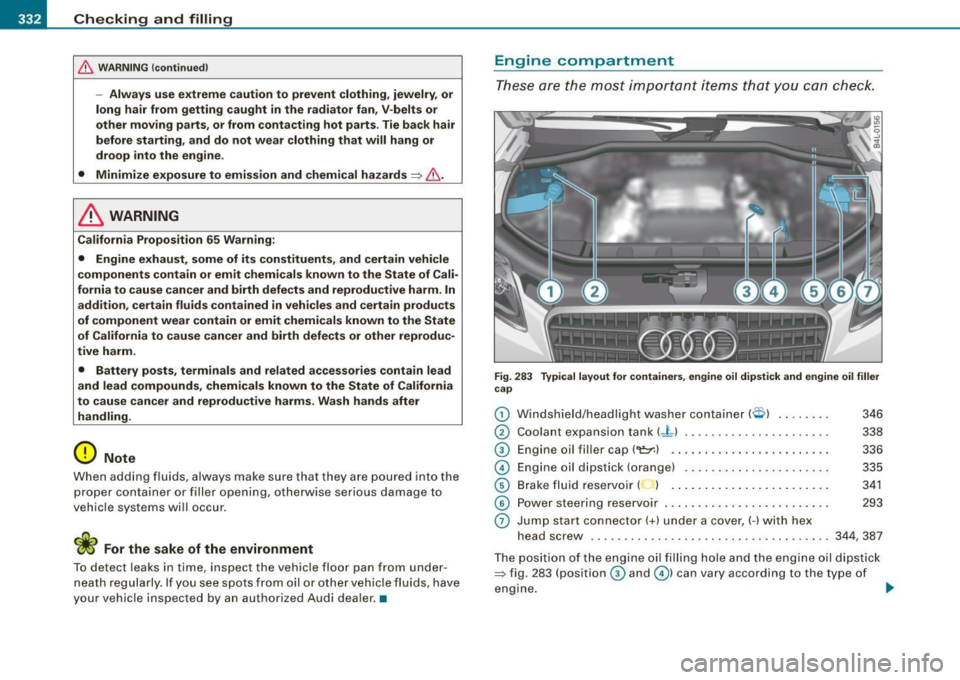
Engine compartment
These are th e m ost im porta nt items th at you can ch ec k.
Fig. 283 Typical layout for containe rs, engine oi l d ipstick and engine oil filler
cap
0 W indsh ield/headligh t was her conta iner ( 9 ) . . . . . . . . 346
0 Coolant e xpansion tank (- L l . . . . . . . . . . . . . . . . . . . . . . 338
G) Engin e oil fi ller cap ("l::r.) . . . . • . . . . . . • • • • . . . • . . • . . 336
© Engine oil d ips tick (orange) . . . . . . . . . . . . . . . . . . . . . . 335
© Brake fluid reservo ir ( ) . . . . . . . . . . . . . . . . . . . . . . . . 341
© Pow er steer ing r eser voir . . . . . . . . . . . . . . . . . . . . . . . . . 2 93
0 Jump sta rt connector( +) u nder a cover,( -) w ith hex
head screw .... ... ..... .... ... .... ... ..... .... . 344 , 387
The positi on of t he e ngin e oil fi lling hole and t he engine oil dipstick
=> fig . 283 (position G) and ©l can vary according to the type of
eng ine. .,_