warning AUDI Q7 2009 Owner´s Manual
[x] Cancel search | Manufacturer: AUDI, Model Year: 2009, Model line: Q7, Model: AUDI Q7 2009Pages: 426, PDF Size: 97.13 MB
Page 378 of 426
lllftl.,___W_ h_ a _ t_d_ o_ l _d _o_ n_ o_ vv_ ? ______________________________________________ _
Loosening and tightening the wheel bolts
The wheel bolts must be loosened before raising the
vehicle.
Loosening
Fig . 303 Changing a
wheel: loosening the
wheel bolts
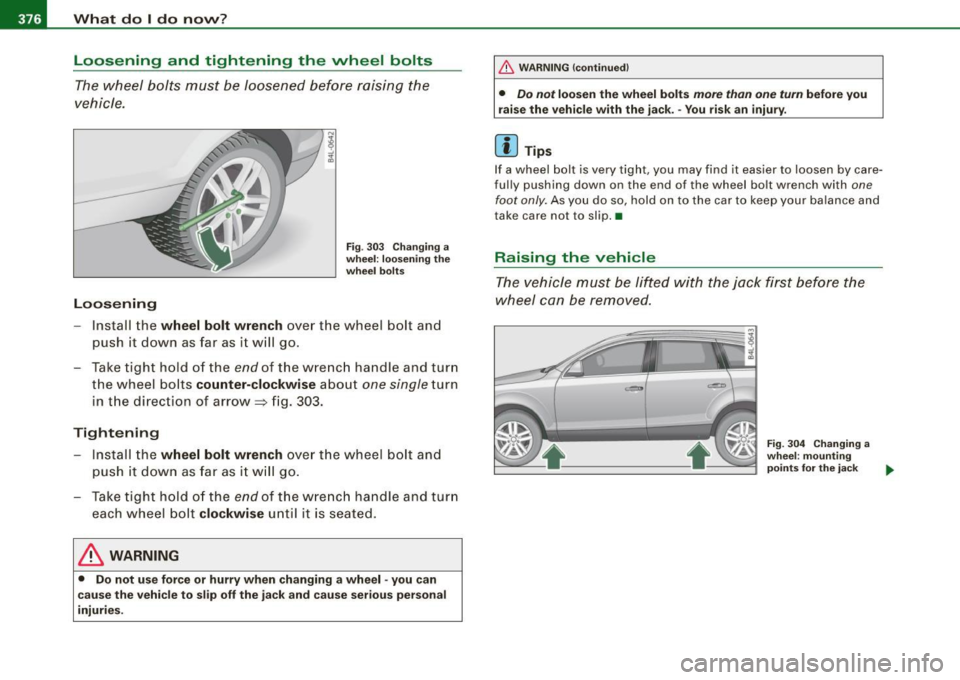
- Install the wheel bolt wrench over the wheel bolt and
push it down as far as it will go.
- Take tight hold of the
end of the wrench handle and turn
the wheel bolts counter-clockwise about
one single turn
in the direction of arrow::::, fig. 303.
Tightening
- Install the wheel bolt wrench over the wheel bolt and
push it down as far as it will go.
- Take tight hold of the
end of the wrench handle and turn
each wheel bolt clockwise until it is seated.
& WARNING
• Do not use force or hurry when changing a wheel -you can
cause the vehicle to slip off the jack and cause serious personal
injuries.
& WARNING (continued)
• Do not loosen the wheel bolts more than one turn before you
raise the vehicle with the jack. -You risk an injury.
[ i] Tips
If a wheel bolt is very tight, you may find it easier to loosen by care
fully pushing down on the end of the wheel bolt wrench with
one
foot only.
As you do so, hold on to the car to keep your balance and
take care not to slip. •
Raising the vehicle
The vehicle must be lifted with the jack first before the
wheel can be removed.
Fig. 304 Changing a
wheel: mounting
points for the jack ..
Page 379 of 426
_____________________________________________ W_ h_ a_t _d_ o_l _ d_o _ n_o_ w_ ? _ __._
Fig. 30 5 Close- up:
prope r po sit io ning of
jack
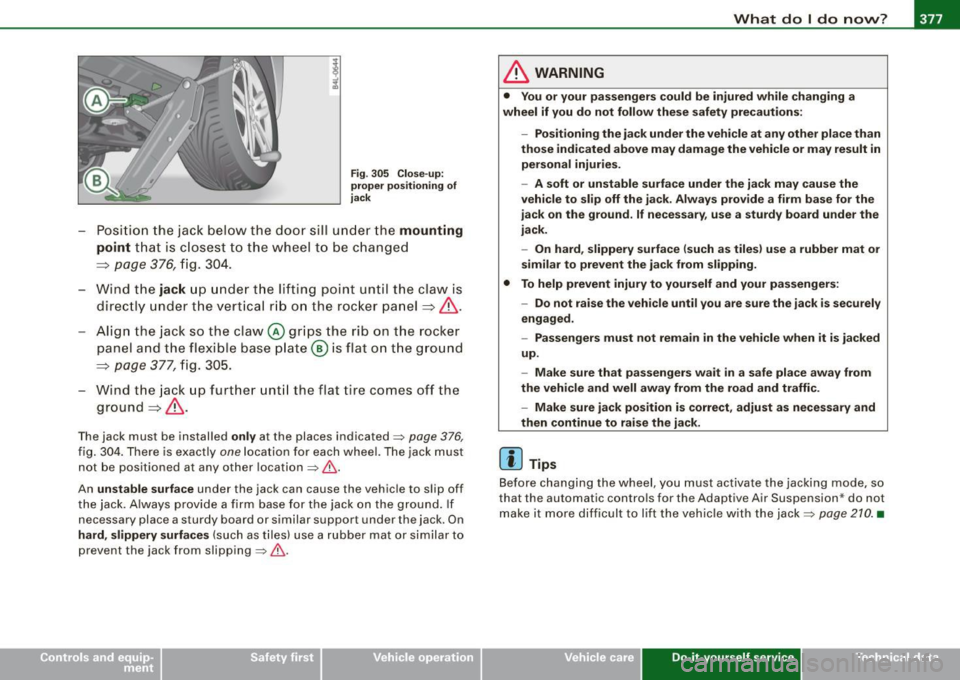
- Posi tion the jack b elow the doo r sill u nder t he mounting
point
t ha t is clos est to the w hee l to be cha nged
==> p age 376, fi g. 30 4.
- Wind the jack up un der the liftin g p oint un til the c law is
d ir ect ly un der t he ver tical rib on th e ro cke r pane l==:> & .
- Align t he jack so the claw@ grip s the rib on th e rocke r
pane l and th e fl exible base plate @ is flat o n the gr oun d
==> page 3 77, fig. 30 5.
- Wind t he jack up furt her u ntil the flat ti re come s off the
g roun d==:> & .
The jack must be instal led only at the places indicated=> pa ge 376,
fi g. 30 4. T here is e xactl y on e loca tion for each w heel. The jack must
not be positioned at any oth er location =:>& .
A n
unstable surface under the jack can cause the vehic le to s lip off
the ja c k. Al ways pro vid e a firm base for the jack on t he grou nd. If
necessary place a sturd y board or s imilar sup port under the jack. On
hard , slippery surface s {such as tile s) us e a rub ber mat or s imi lar to
p revent the jack from slipping =:>& .
& WARNING
• You or your passengers could be injured wh ile changing a
wheel if you do not follow these safety precautions:
-Positioning the jack under the vehicle at any othe r place than
those indicated above may damage the vehicle or may result in personal injuries.
- A soft or unstable surface under the jack may cause the
vehicle to slip off the jack . Always provide a firm base for the
jack on the ground. If necessary, use a sturdy board under the
jack.
- On hard, slippery surface (such as tiles ) use a rubber mat or
similar to prevent the jack from slipping .
• To help prevent injury to yourself and your passengers:
-Do not raise the vehicle until you are sure the jack is securely
engaged.
- Passengers must not remain in the vehicle when it is jacked
up.
- Make sure that passengers wait
in a safe place away from
the vehicle and well away from the road and traffic.
- Make sure jack position is correct, adjust as necessary and
then continue to rai se the jack.
[ i ] Tips
B efore c hang in g the whee l, you must activate the jac king mode, so
that the au tomatic con trols for the Adaptive Air Suspension * do not
m ak e it mo re diff icu lt to lif t the v ehic le wi th t he jack =:>
page 210. •
Vehicle care Do-it-yourself service irechnical data
Page 381 of 426
_______________________________________________ W_ h_ a_t _ d_ o_ l _d _o_ n_ o _ w_ ? __ IIIII
•
- Let the compressor run until it has reached 50 PSI (3.5
bar). Switch the compressor off after running for 8
minutes at the most -danger of overheating!
& WARNING
The compressor and the tire filler hose can become extremely hot
while they are running -danger of burns!
0 Note
Switch the compressor off after running for 8 minutes at the most -
danger of overheating! Allow the compressor to cool down for a few
minutes before you use it again.
[ i] Tips
The compressor must not be connected to the cigarette lighter
socket, as this socket does not provide the required power .•
Tires with unidirectional tread design
Tires with unidirectional tread design must be mounted
with their tread pattern pointed in the right direction.
Using a spare tire with a tread pattern intended for use
in a specific direction
When using a spare tire with a tread pattern intended for use in a
specific direction, please note the following:
• The direction of rotation is marked by an arrow on the side of the
tire.
• If the spare tire has to be installed in the incorrect direction, use
the spare tire only temporarily since the tire will not be able to
achieve its optimum performance characteristics with regard to
aquaplaning, noise and wear. •
We recommend that you pay particular attention to this fact
during wet weather and that you adjust your speed to match road
conditions.
• Replace the flat tire with a new one and have it installed on your
vehicle as soon as possible to restore the handling advantages of a
unidirectional tire. •
Notes on wheel changing
Please read the information => page 359, "New tires and replacing
tires and wheels " if you are going to use a spare tire which is
different from the tires on your vehicle.
After you change a tire :
• Check the tire pressure on the spare immediately after installa
tion.
• Have the wheel bolt tightening torque checked with a torque
wrench as soon as possible by your authorized Audi dealer or a
qualified workshop.
• With steel and alloy wheel rims, the wheel bolts are correctly
tightened at a torque of 120 ft lb (160 Nm).
• If you notice that the wheel bolts are corroded and difficult to
turn while changing a tire, they should be replaced before you check
the tightening torque.
• Replace the flat tire with a new one and have it installed on your
vehicle as soon as possible. Remount the wheel cover.
Until then, drive with extra care and at reduced speeds .
& WARNING
• If you are going to equip your vehicle with tires or rims which
differ from those which were factory installed, then be sure to read
the information
=> page 359, "New tires and replacing tires and
wheels". ..
Do-it -yourself service
Page 383 of 426

_________________________________________________ F_ u_ s_ e_s _ a_n _d_ b_ u _ lb_ s _ __._
Fuses and bulbs
Fuses
Replacing a fuse
A problem in the electrical system may be caused by a
blown fuse.
Fig . 307 Ins trument
pa nel left: Face c over
F ig . 308 I nst rume nt
pa nel left: Co ntent
F ac e cover
- Locate the fuse which belongs to the component which
failed.
- Switch off the ignition and the e lectr ica l component
affected. - Carefully p
ry t he face cover off the instr umen t pane l
using the ignition key or a screwdriver~ fig. 307.
- Rem ove the plastic clip @ from i ts retainer in the face
cove r~ fig. 308, p lace i t over the questionable fuse and
remove the fuse.
- Replace a blown fuse (recognizable by the melted metal
str ip inside) wi th a f use of the
same amperage.
The individual circuits are protected by fuses. T he fuse panels with
the fuses are located on the left and right front faces of the instru
ment pane l behind a cover and in the right storage area in the
luggage compartment.
There is a plastic clip @ in the cover on the lef t side of the instru
ment pane l, which can be used to remove the fuses . The crank © is
used for emergency operation of the Panoramic sliding sun roof *.
You w ill also find a label on both covers in the instrument panel with
the fuse layout © for the corresponding fuse panel.
& WARNING
Nev er replac e a fuse with one that ha s a high er amperag e rati ng.
• A fu se w ith a to o high ampe rage could damage the ele ctr ical
pa rt a nd cause a fire .
0 Note
• On no account should fuses be repaired (e .g. patched up wi th tin
foil or wire) as this may cause serious damage elsewhere in the e lec
trica l circuit o r cause fire.
• If a fuse blows repeatedly, do not keep replacing it. Instead , have
the cause of the repea ted short circuit or overload located and fixed.
ti>
Vehicle care Do-it-yourself service Technical data
Page 388 of 426
11111.___F_ u_ s _ e_s _ a_n _ d_ b_ u_lb _ s _______________________________________________ _
& WARNING
Contact with high -voltage components of the ele ctrical system
and improper replacement of gas discharge (Xenon ) headlight
bulbs can cause ser ious personal injury and death .
• Xenon bulbs are pressurized and can explode when being
changed .
• Changing Xenon lamp s requires the special training, instruc
tions and equipment .
• Only an authorized Audi dealer or other qualified work shop
should change the bulbs in gas discharge lamps .
& WARNING
There are parts with sharp edges on the openings and on the bulb
holder s that can cause serious cuts.
• If you are uncertain about what to do , have the work performed
by an authorized Audi dealer or other qualified workshop . Serious
personal injury may result from improperly performed work.
[ i ] Tips
• If you must re place the light bulb s yourself, always remember
that the engine compartment of any ve hicle is a hazardous area to
work in . Always read and heed al l WARNI NGS ~
page 324, "Engine
compart ment"~
&-
• It is best to ask your autho rized Audi dea ler whenever you need
to change a bulb .•
Page 389 of 426
________________________________________________ E _m_ e_r.:g :;,. e_ n_c ...: y:.- s_ i_ t _u _a_ t_ i_ o _ n_ s __ lll
•
Emergency situations
General
This chapter is intended for trained emergency crews and working
pe rsonnel who have the necessary tools and equ ipment to perform
these operations. •
Starting by pushing or towing
(D Note
You r ve hicle is eq uipped w ith an automatic trans missi on. C o nse
quent ly, the engine cannot be started by pushing or towing .•
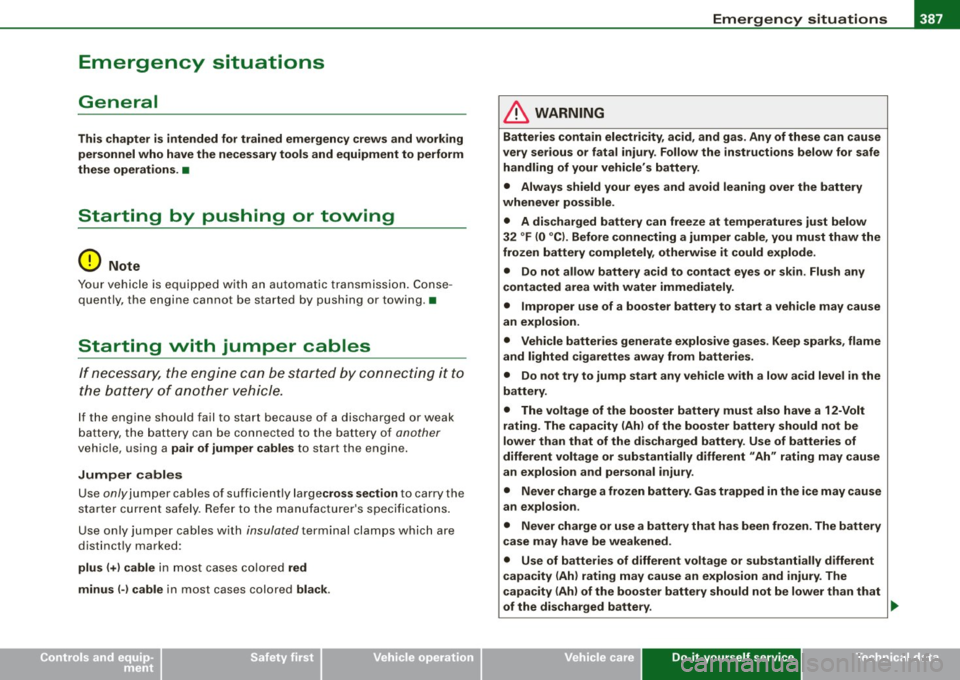
Starting with jumper cables
If necess ary, the en gine can b e sta rted by conn ectin g it to
the battery of anothe r vehicle.
If th e engine should fail to start because of a discharged or weak
b at te ry, the batt ery ca n be co nnected t o the ba ttery of
another
vehicle, using a pair of jumper cables to start the engine .
Jumper cables
Use
only jumper cables of sufficiently large cross section to carry the
s tarte r curre nt safely. Refer t o the manu fac tu rer 's specif ica tions.
Use only ju mper cabl es with
insulated terminal clamps whic h are
distinct ly marked:
plus (+l cable in mo st cas es c olored red
minus
(- 1 cable in most cases colored black.
& WARNING
Batteries contain electricity, acid , and gas. Any of the se can cause
very ser ious or fatal injury . Follow the instructions below for safe
handling of your vehicle 's battery .
• Always shield your eyes and avoid leaning over the battery
whenever possible .
• A discharged battery can freeze at temperatures just below
32 °F (0 °C l. Before connecting a jumper cable , you must thaw the
frozen battery completely , otherwise it could explode .
• Do not allow battery acid to conta ct eyes or skin. Flush any
contacted area with water immediately.
• Improper use of a booster battery to start a vehicle may cause
an explosion.
• Vehicle batteries generate explosive gases . Keep sparks , flame
and lighted c igarettes away from batteries.
• Do not try to jump start any vehicle with a low acid level in the
battery.
• The voltage of the booster battery must also have a 12-Volt
rating. The capacity (Ah l of the booster battery should not be
lower than that of the discharged battery . Use of batteries of
different voltage or substantially different "Ah" rating may cause
an explosion and personal injury .
• Never charge a frozen battery. Gas trapped in the ice may cause
an explosion.
• Never charge or use a battery that has been frozen . The battery
c ase may have be weakened .
• Use of batter ies of different voltage or substantially different
c apacity (Ah l rating may cause an explosion and injury . The
capacity (Ahl of the booster batte ry should not be lower than that
of the discharged battery. _..
Do-it -yourself service
Page 391 of 426
________________________________________________ E _m_ e_r.:g :;,. e_ n_c ...: y:.- s_ i_ t _u _a_ t_ i_ o _ n_ s __ lfflll
•
Conn ect POSITIVE (+ ) to PO SITIVE (+ ) (r ed )
- Open the red cover on the pos itive pole => page 388,
fig. 312.
1. Connect one end of the positive cable (red) on the
jump
start bolt=>
page 388, fig. 3 13 G) (Bo lts under red cover
= "positive") of the vehicle to be started @.
2. Connect the other end to the positive terminal@ of the
booster battery ®·
Conn ect NEGATIVE (- ) to NEGATIVE (-) (black )
3. Connect one end to the negat ive termi nal 0 of t he
boos ter battery ®·
4 . Connect the other end of the negative cable (black) to the
jump sta rt bolt 0 (Bolts with hex head = "n egative") of
the vehicle to be s tarted @.
Startin g th e e ngin e
-Start the engine of the veh icle w ith the booster battery .
Run t he engine at a moderate speed .
- Start engine with discharged ve hicle battery in the usual
ma nner.
- If the engine fails to s tart: do not keep the star ter
cranking for longer than 10 seconds. Wait f or about
30 seconds and then try again.
- With engine running, remove jumper cables from both
vehicles in the exact reverse order.
- Close the red cover on the positive pole.
The battery is vented to the outside to prevent gases from entering
the vehic le interior . Make sure that the jumper clamps are well connected with their
metal parts in full contact with the battery
t erminals .
& WARNING
To avoid seriou s per sonal in jur y a nd d amage to the vehicle , heed
a ll wa rning s and in stru ction s o f th e jum per ca ble man ufa cturer . If
in doubt , call for ro ad serv ice.
• Jump er c able s must b e lo ng eno ugh s o that the vehi cle s do not
touch .
• When conne cting jumpe r cable s, ma ke sure th at the y cannot
g et caught in an y mo ving p arts i n the engine comp art m ent .
• Before you che ck anyth ing in the en gin e com partm ent , a lwa ys
r ea d and h eed all W ARNIN GS~ pag e 32 4, "E ngine compa rtm ent ".
0 Note
Improper hook -up of jumper cables can ruin the generato r.
• Always connect POSITIVE(+) to POS ITIVE( +), and NEGATIVE( -) to
NEGATIVE( -) ground post of the battery manager control unit.
• Check that al l screw p lugs on the battery ce lls are screwed in
firm ly . If not, tighten plugs prior to connecting clamp on negative
battery termi nal.
• Please note that the procedure for connecting a jumper cab le as
described above applies specifical ly to the case of your vehicle
being jump started. When you are giving a jump start to another
vehicle, do not connect the negative(-) cable to the negative (-1
terminal on the discharged battery©~ page 388, fig. 313. Instead,
securely connect the negative ( -1 cable to either a solid metal
component that is firmly bolted to the engine b lock or to the engine
block itself . If the battery that is being charged does not vent to the
outside, escap ing battery gas could ignite and exp lode! •
Do-it-yourself service
Page 392 of 426
lllffll.,___E_ m _ e _r.;:g '-e_ n_ c-=y _ s_ i_t _u _a _t_ i_o _n_ s _______________________________________________ _
Emergency towing with commercial
tow truck
General hints
Your Audi requires special handling for towing.
The following information is to be used by commercial tow truck
operators who know how to operate their equipment safely.
• Never tow your Audi, towing will cause damage to the engine
and transmission.
• Never wrap the safety chains or winch cables around the brake
lines.
• To prevent unnecessary damage, your Audi must be transported
with a flat bed truck.
• To load the vehicle on to the flat bed, use the towing loop found
in the vehicle tools and attach to the front or rear anchorage
~ page 390 and~ page 391.
& WARNING
A vehicle being towed is not safe for passengers. Never allow
anyone to ride in a vehicle being towed, for any reason. •
Front towing loop
Do not install the front towing loop until it is needed.
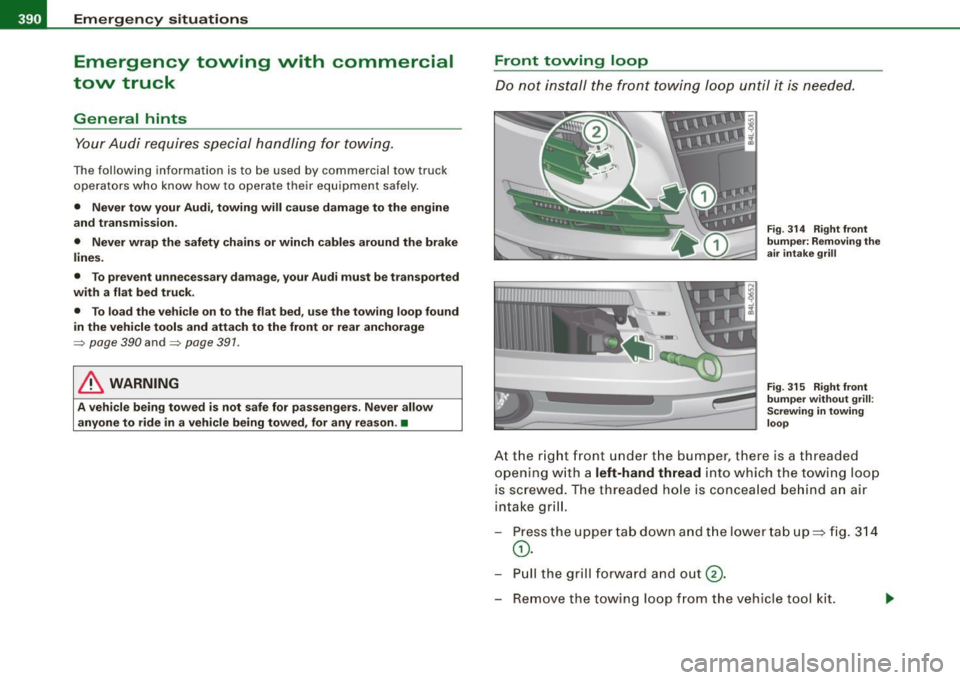
Fig. 314 Right front
bumper: Removing the
air intake grill
Fig . 315 Right front
bumper without grill:
Screwing in towing
loop
At the right front under the bumper, there is a threaded
opening with a
left-hand thread into which the towing loop
is screwed. The threaded hole is concealed behind an air
intake grill.
- Press the upper tab down and the lower tab up~ fig. 314
(i).
- Pull the grill forward and out 0-
- Remove the towing loop from the vehicle tool kit.
Page 393 of 426
________________________________________________ E_ m ___ e_r .::g :...e_ n _ c_,!y:._ s_ i_t _u _a_ t_ i_o _n_ s _--J_
- Screw the towing loop t ightly into the threaded hole as
far as it will go::::>
page 390, fig. 315.
When it is no longer needed, unscrew the towing loop and put it
back into the vehicle toolkit. Be sure to have the towing loop stored
in the vehicle at all times.
When installing the grill for the air duct, be sure that the tabs on the
gril l are first inserted into their guides on the vehicle above the
fog lamp. Then position the opposite side of the grill
=> page 390,
fig. 314 ® and push it firmly into its guide.
& WARNING
If the towing loop is not screwed in as far as it will go, the thread
can pull out when the vehicle is towed -potential risk of an
accident. •
Rear towing loop
Do not install the rear towing loop until it is needed.
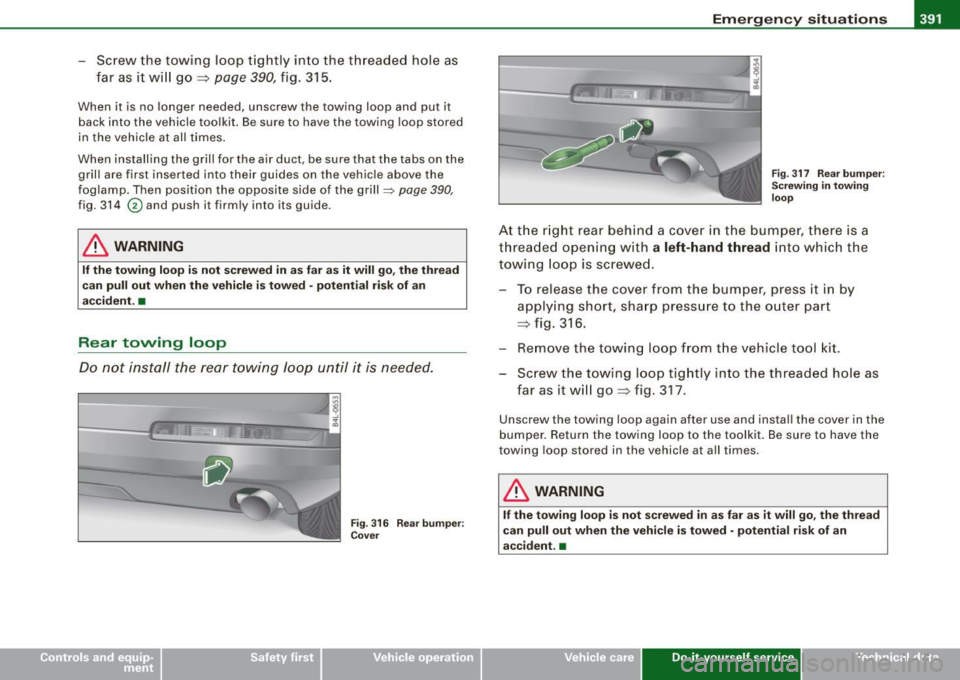
Fig. 316 Rear bumper:
Cover Fig
. 317 Rear bumper:
Screwing in towing
loop
At the right rear behind a cover in the bumper, there is a
threaded opening with
a left-hand thread into which the
towing loop is screwed.
- To release the cover from the bumper, press it in by
applying short, sharp pressure to the outer part
==> fig. 316.
- Remove the towing loop from th e vehicle tool kit.
- Screw the towing loop tightly into the threaded hole as
far as it will go ::::> fig. 317.
Unscrew the towing loop again after use and instal l the cover in the
bumper. Return the towing loop to the toolkit. Be sure to have the
towing loop stored in the vehicle at all times .
& WARNING
If the towing loop is not screwed in as far as it will go, the thread
can pull out when the vehicle is towed -potential risk of an
accident. •
Vehicle care Do-it-yourself service irechnical data
Page 394 of 426
lll9.,___E_ m_ e_ r -'g==-- e_n _ c_ y=--- s_ i_ t _u _a _ t_ i_o _n _ s _____________________________________________ _
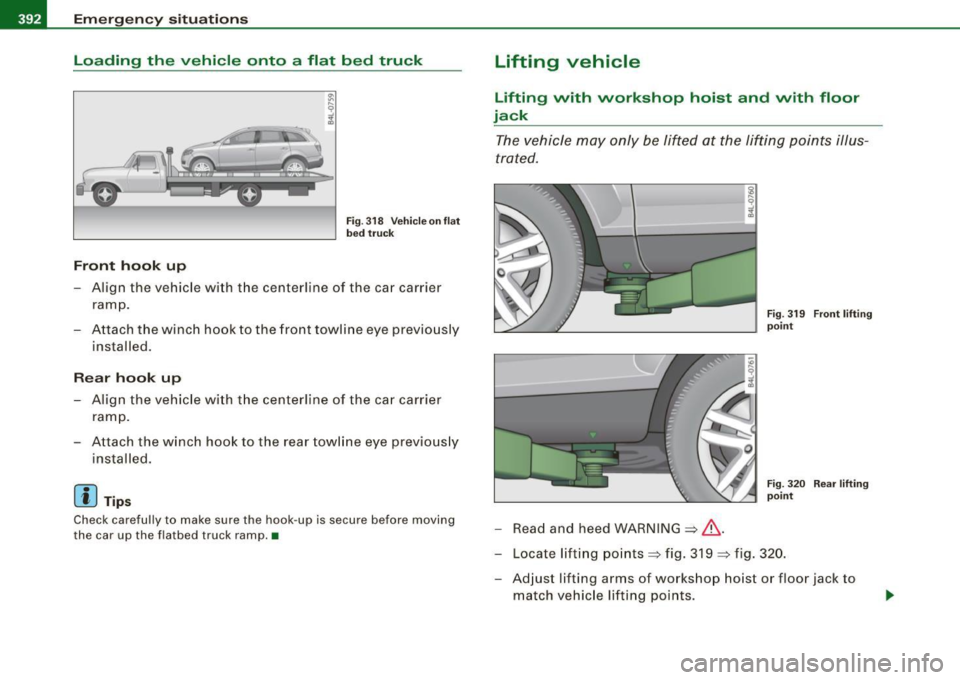
Loading the vehicle onto a flat bed truck
Front hook up
Fig. 318 Vehicle on flat
bed truck
- Align the vehicle w ith the centerline of the car carrier
ramp.
- Attach the winch hook to the front towline eye p reviously
installed.
Rear hook up
- Align the vehicle with the centerline of the car carrier
ramp.
- Attach the winch hook to the rear towline eye prev iously
i nstalled.
[ i ) Tips
Check carefully to make sure the hook -up is secure before moving
the car up the fla tbed truck ramp. •
Lifting vehicle
Lifting with workshop hoist and with floor
jack
The vehicle may only be lifted at the lifting points illus
trated.
- Read and heed WARNING=>& .
Fig. 319 Front lifting
point
Fig. 320 Rear lifting
point
- Locate lifting points=> fig. 319 => fig. 320.
- Adjust lifting arms of workshop hoist or floor jack to
match vehicle lifting points.