warning AUDI Q7 2009 Owner´s Manual
[x] Cancel search | Manufacturer: AUDI, Model Year: 2009, Model line: Q7, Model: AUDI Q7 2009Pages: 426, PDF Size: 97.13 MB
Page 346 of 426
•---=C:.:h..:. e=-= c..:.k :..:.in :..:.:= g:.....= a..:.n :.:d::....:. f.:.:il .:.:li ..:.n :..::g~ --------------------------------------------
& WARNING (continued )
battery to heat up very quickly, wh ich could lead to damage or
explosion and personal injury .
• When a battery is charged , it produces h ydrogen gas which i s
explosive and could cau se personal injury .
• Always keep the battery well out of the reach of children.
• Before work is done on the electrical system , disconnect the
negative ground cable .
• Before performing any work on the ele ctri cal system , switch off
the engine and ignition as well as any electrical equipment. The negative cable on the battery m ust be disconnected . If you are ju st
going to replace a light bulb , then it is enough to switch off the
lights .
• Before disconnecting the battery , switch off the anti -theft
alarm system! Otherwise you will set off the alarm .
• When disconne cting the battery , first disconnect the negative
c able and then the positive cable .
• Before reconnecting the battery , make sure all electrical
c onsumers are swit ched off . Reconnect the positive cable first and
then the negative cable. Never interchange the cables - this could start a fire !
• Never charge a frozen or a thawed -out battery. It could
explode! If a battery has frozen , then it must be replaced . A
discharged battery can freeze over at 32 °F (0 °Cl.
• Make sure the vent hose is always attached to the opening on
the side of the battery.
• Never use batteries whi ch are damaged . There is the danger of
an explosion! Always replace a damaged battery.
& WARNING
Californ ia Proposition 65 W arning :
& WARNING (continued )
• Battery posts, terminals and related accessories contain lead
and lead compounds, chemicals known to the State of California
to cause can cer and reproductive problems . Wash hands after
handling .
0 Note
• Do not disconnect t he veh icle battery w he n th e ign itio n is
switched on or when the engine is running , otherwise, you will
damage e le ctronic co mponents in the elec trical sys tem.
• I f your vehicle i s going to stand for a long period of time without
b ei ng dr iven, prot ec t the batte ry from "fr ee zing", otherwise it will
be damaged and will then have to be rep laced. •
Battery charging
Sta rti ng th e e ngin e req uires a well c harged ba tte ry.
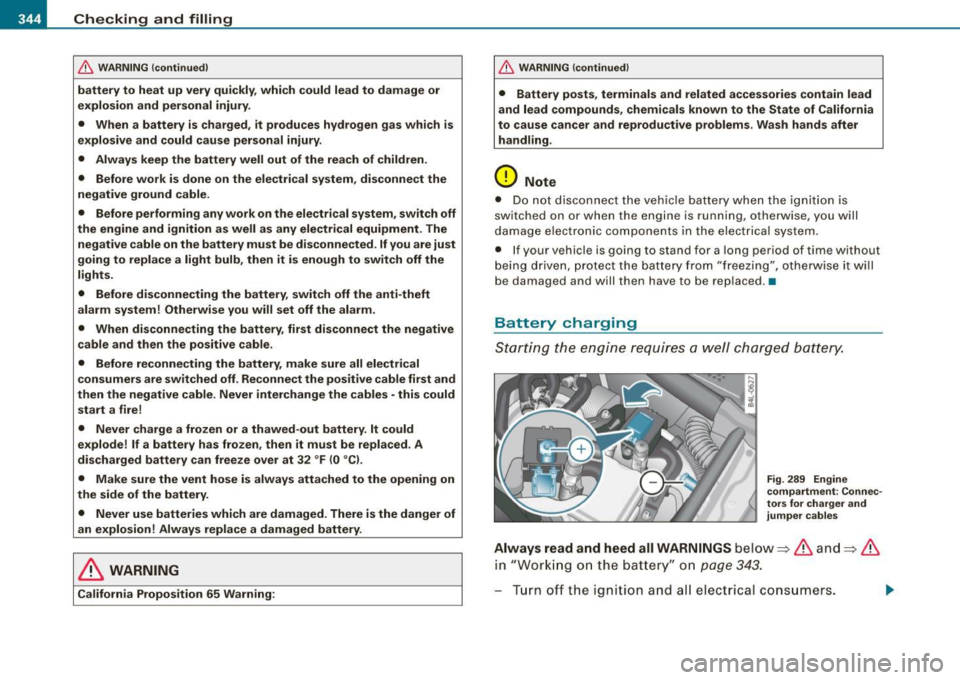
F ig . 289 Engine
compartment : Conne c
tors fo r charge r and
jumper cable s
Always read and heed all WARNINGS be low ~ & and::::} &
in "W orkin g on the b atte ry" on pa ge 34 3.
- Tur n off the ig ni tio n a nd a ll elec tric al co nsum ers.
Page 347 of 426
___________________________________________ C_ h_e _c_ k_ i_n _g _ a_n _d_ f_il _li _n _g __ _
•
-Make sure the area is well ventilated when you charge
the battery.
- Open the hood
::::> page 330.
-Open the red cover on the positive pole ::::> fig. 289.
- Connect the charger connectors according to the instruc-
tions to the
jump start bolts. (Bolts under the red cover=
"positive", Bolts with hex head = "negative").
- Only now plug the mains lead for the charging equip
ment into the wall outlet and turn it on
::::> &.
- Make sure the charging rate is not over 30 amps/14.8
Volt.
- When the battery is fully charged: Turn the charging
equipment off and remove the mains lead from the wall
outlet.
- Now remove the clamps for the charging equipment.
- Close the red cover on the positive pole.
- Close the hood=>
page 331.
A discharged battery can freeze at temperatures of only O °C. Allow
a frozen battery to thaw completely before attempting to charge it
~ & .However, we recommend not using a thawed battery again
because the battery casing can be cracked due to ice formation and
can leak battery acid.
Battery charging (Maximum charging rate of 30
amps/14.8 Volt)
When charging at /ow voltages (e.g. with a trickle charger), the
battery cables do not have to be disconnected first. The battery caps
should
not be opened when charging a battery.
It is not necessary to remove the battery from the luggage compart
ment.
Fast charging the battery (charging rate above 14 .8
Volts)
For technical reasons do not use a battery charger that uses voltage
greater than 14.8 Volts to charge your vehicle's battery.
& WARNING
Charging a battery can be dangerous.
• Always follow the operating instructions provided by the
battery charger manufacturer when charging your battery.
• Never charge a frozen battery. It may explode because of gas
trapped in the ice. Allow a frozen battery to thaw out first.
• Do not reuse batteries which were frozen. The battery housing
may have cracked and weakened when the battery froze.
• Charge the battery in a well ventilated area. Keep away from
open flame or electrical spark . Do not smoke. Hydrogen gas gener
ated by the battery is explosive.
• To reduce the danger of explosion, never connect or disconnect
charger cables while the charger is operating.
• Fast charging a battery is dangerous and should only be
attempted by a competent technician with the proper equipment.
• Battery acid that may spill during charging should be washed
off with a solution of warm water and baking soda to neutralize
the acid .
0 Note
Never use a fast charger as a booster to start the engine. This will
seriously damage sensitive electronic components, such as control
units, relays, radio, etc ., as well as the battery charger. •
Vehicle care I t •
Page 348 of 426
llftl __ C _h_ e_ c_k _in --== g'-- a_n _d_ f_il _li _n ..:::g:::..- ___________________________________________ _
Battery replacement
The new battery must have the same specffications and
dimensi ons as the original equipment battery.
Intel ligen t energy management in your vehicle is responsible for
distributing the e lectrica l ene rgy throughout your vehicle
::} page 295. The intelligent energy management system will keep
the engine battery charged bette r then vehicles wi thou t this system .
To make sure the additional electrical energy is available once again
after you have changed the batte ry, we recommend that you install
batteries of the same type and manufacture only (the same as those
installed at the time your vehicle was delivered). Specifications are
listed on the battery housing . Your authorized Audi dealer will then
code the battery management cont rol unit .
If i t is no t possib le to use a ba ttery o f this type, the new battery m ust
have the same capacity, vo ltage (12 volts), amperage, construction
and plug seal ing.
When installing the battery, make sure the ignition and all electrica l
consumers are turned off .
0 Note
Make sure the ventilation hose on the side of the bat tery is
connected, otherwise fumes or battery acid can leak out .
W For the sake of the environment
Because of the problem of proper d isposal of a battery , we recom
mend your authorized Aud i dea ler change the battery for you .
Ba tteries contain sulfuric acid a nd lead and must always be
disposed of properly in compliance with all environmental regula
tions. D isposi ng o f vehicle ba tteries i mproper ly is very dangerous to
the environment .•
Windshield/headlight washer
container
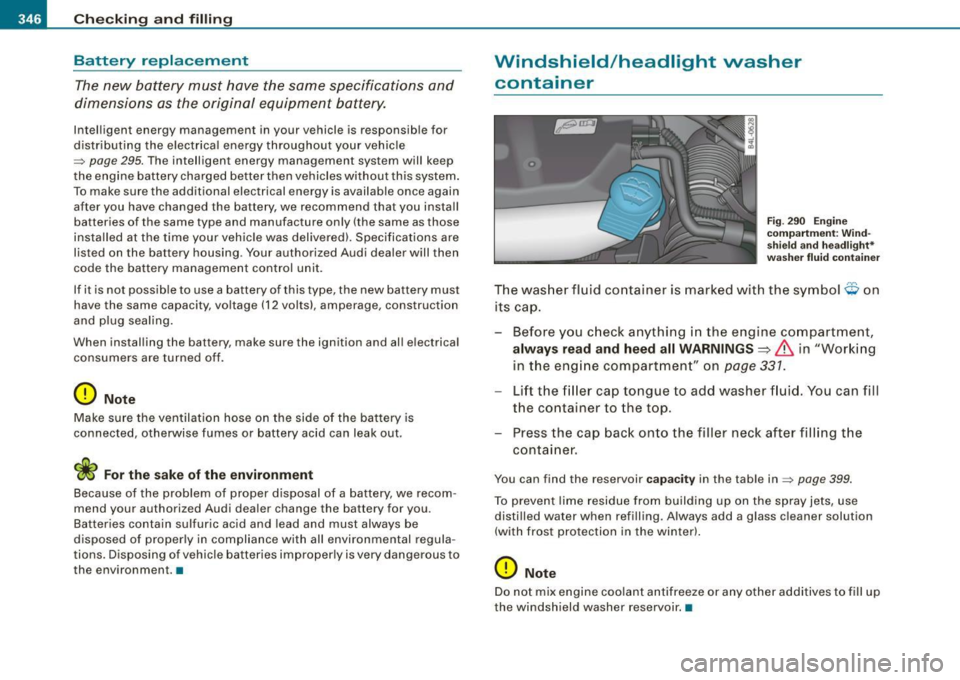
Fi g. 290 Engine
co mpartment : Wind
s hield and h eadli ght *
washer fluid container
T he w as her fluid co ntainer is m arke d with the sy mbol ¢' on
its cap .
- Before you c heck anything in the engine compartment,
always read and heed all WARNINGS~
& in "Wor kin g
in t he en gine comp artmen t" on
page 33 7.
- Lift the fi ller cap tongue to add washer fluid. You can fill
the containe r to the top.
- Press the cap bac k on to the filler neck after fi lling t he
contai ner .
You can find the reservoir capa city in the tab le in ::} page 399.
To prevent lim e residue from building up on the sp ray je ts, use
distilled water when refilling . Always add a glass cleaner solution
(with fr ost protection in the winter).
0 Note
Do no t mix engine coo lant antifreeze or any o ther additives to fill up
the windshield washer reservoir. •
Page 349 of 426
________________________________________________ T_ i _r_e _s_ a_n_ d_ w_ h_ e_e _ l_s __ PII
•
Tires and wheels
Tires
General notes
Tires may be the least appreciated and most abused parts
of a motor vehicle.
Tires may be the least appreciated and most abused parts of a
motor vehicle. Tires are, however, one of the most important parts
of a vehicle, particularly considering the comparative ly sma ll patch
of rubber on each tire that assures that all- important contact
between you, your vehicle and the road .
Maintaining the correct tire pressure, making sure that your vehicle
and its tires do not have to carry more weight than they can safely
handle, avoiding damage from road hazards and regu lar ly
inspecting tires for damage inc luding cuts , slashes irregular wear
and overa ll condition are the most important things that you can do
to help avoid sudden tire failure including tread separation and
b lowouts .
Avoiding dama ge
If you have to drive over a curb or similar obstacle, drive very slow ly
and as close as possible at a right angle to the curb.
A lways keep chemica ls includ ing grease, oil, gasoline and brake
f luid off the tires.
I nspec t the tires regularly for damage (cuts, cracks or blis ters, etc.l.
Remove any foreign bodies embedded in the treads.
Storing tires
Mark tires when you remove them to indicate the direction of rota
tion . This ensu res you to be ab le to mount them correctly when you
reinstal l them. When removed, the wheels or tires shou
ld be stored in a coo l, dry
and preferably dark place.
St ore t ires in a vertical posit ion if they a re not mounted on rims, in
a horizontal position if they are mounted on rims.
New tire s
New tires have to be broken in~&.
The tread dep th of new tires may va ry, according to the type and
make of tire and the tread pattern.
Hidden d ama ge
Damage to tires and rims is often not readily visible. If you notice
unusua l vibration or the vehicle pul ls to one side, this may indicate
that one of the tires has been damaged . The tires must be checked
immed iately by an authorized Audi dealer or qualified workshop .
Unidire ction al tir es
A unidirectio nal tire can be iden tif ied by arrows on the s idewa ll, that
point in the direction the tire is designed to rotate. You must follow
the specified direction of ro tation . This is necessary so that these
tires can deve lop their optimum characteristics regarding grip, road
noise, wear and hydroplaning resistance . For more information
~ page 379.
in. WARNING
Ne w tire s or tire s that are old , worn or damaged cann ot pro vide
m aximum cont rol and braking ability.
• New tire s tend to be slippe ry and m ust be broken in . To redu ce
the risk of losing control, a colli sion and seriou s per sonal injurie s,
drive with speci al care for t he fi rst 350 m ile s ( 560 km l.
• Driving with worn or damaged t ire s can lead to lo ss of co ntrol ,
s udd en tire failure , in clu ding a blowout a nd sudden deflation , .,,_
Vehicle care
I t •
Page 350 of 426
-~_T_ ir_e_ s_ a_ n_d _ w_ h_ e_e _l_s _________________________________________________ _
& WARNING (continued)
crashes and serious personal injuries . Have worn or damaged tires
replaced immediately.
• Tires age even if they are not being used and can fail suddenly,
especially at high speeds. Tires that are more than 6 years old can
only be used in an emergency and then with special care and at
low speed.
Glossary of tire and loading terminology
Accessory weight
means the combined weight (in excess of those standard items
which may be replaced) of automatic transmission, power steering,
power brakes, power windows, power seats, radio, and heater, to
the extent that these items are available as factory-installed equip
ment (whether installed or not).
Aspect ratio means the ratio of the height to the width of the tire in percent.
Numb ers of 55 or lower indicate a low sidewall for improved
steering response and better overall handling on dry pavement.
Bead
means the part of the tire that is made of steel wires, wrapped or reinforced by ply cords and that is shaped to fit the rim.
Bead separation means a breakdown of the bond between components in the bead.
Cord
means the strands forming the plies in the tire.
& WARNING (continued)
• Never mount used tires on your vehicle if you are not sure of
their "previous history." Old used tires may have been damaged
even though the damage cannot be seen that can lead to sudden
tire failure and loss of vehicle control.
• If you notice unusual vibration or if the vehicle pulls to one side
when driving, always stop as soon as it is safe to do so and check
the wheels and tires for damage . •
Cold tire inflation pressure
means the tire pressure recommended by the vehicle manufacturer
for a tire of a designated size that has not been driven for more than
a couple of miles (kilometers) at low speeds in the three hour period
before the tire pressure is measured or adjusted.
Curb weight means the weight of a motor vehicle with standard equipment
including the maximum capacity of fuel, oil, and coolant, air condi
tioning and additional weight of optional equipment.
Extra load tire
means a tire design to operate at higher loads and at higher infla
tion pressures than the corresponding standard tire. Extra load tires
may be identified as "XL",
"xi", "EXTRA LOAD", or "RF" on the side
wall.
Gross Axle Weight Rating ("GAWR")
means the load-carrying capacity of a single axle system, measured
at the tire -ground interfaces.
Gross Vehicle Weight Rating ("GVWR"l
means the maximum total loaded weight of the vehicle.
Page 352 of 426
_L_T~ ir~e :..:s~ a~n~ d~ w~ h ~e~e~ l~ s '.,_ ______________________________________________ _
Sidewall
means that portion of a tire between the tread and bead.
Speed rating
extended periods of time. The ratings range from 93 mph (150 km/h)
to 186 mph (298 km/h)=>
page 360. You may not find this informa
tion on a ll tires because it is not required by law.
The speed rating letter code, where applicable, is molded on the tire sidewa ll and indicates the maximum perm issible road speeds=>
&
in "Winter tires" on page 363.
Tire pressure monitoring system
means a system that detects when one or more of a vehicle 's tires
are under inflated and illuminates a low tire pressure warning te ll
tale.
Tread
means that portion of a tire that comes into contact with the road.
Tread separation
means pu lling away of the tread from the tire carcass.
Treadwear indicators (TWI)
means the projections within the principa l grooves designed to give
a visual indication of the degrees of wear of the tread . See
=>
page 357, "Tread Wear Indicator (TWI)" for more information on
measuring tire wear.
Uniform Tire Quality Grading
is a tire information system developed by the United States National
Highway Traffic Safety Adm inistration (NHTSA) that is designed to
help buyers make relative comparisons among tires. The UTQG is
not a safety rati ng and not a guarantee that a tire will last for a
prescribed number of miles (kilometers) or perform in a certain way.
It simply gives tire buyers additional informat ion to combine with
other considerations, such as price, brand loyalty and dealer recom-mendations. Under UTQG, tires are graded by the tire manufac
t urers in three areas: treadwear, traction, and temperature resis
tance . The UTQG information on the tires, molded into the
sidewalls.
U .S. DOT Tire Identification Number (TIN }
This is the tire's "seria l number" It begins with the letters "DOT" and
indicates that the tire meets a ll federa l standards . The next two
numbers or letters indicate the plant where it was manufactured,
and the last four numbers represent the week and year of manufac
ture. For example,
DOT ... 2208 ...
means that the tire was produced in the 22th week of 2008 . T he
other numbers are marketing codes that may or may not be used by
the tire manufacturer . This information is used to contact
consumers if a tire defect requires a reca ll.
Vehicle capacity weight
means the rated cargo and luggage load plus 150 lbs. (68 kilograms)
times the vehicle's tota l seating capacity as listed on the label
located either on the driver's side 8-pillar or on the inside of the fuel
filler flap.
Vehicle maximum load on the tire
means that load on an individual tire that is determined by distrib
uting to each axle its share of the maximum loaded vehicle weight
and dividing by two.
Vehicle normal load on the tire
means that load on an individual tire that is determined by distrib
uting to each axle its share of the curb weight, accessory weight,
and normal occupant weight (distributed in accordance with table
below =>
page 351) and dividing by two. _..
Page 355 of 426
Tires a nd wh eels -
----------------
•
Because technical changes may be made to vehicle equipment
during the mode l year, always compa re the tire size designation on
the tire pressure label on your vehic le with the tires on your vehicle.
Make sure that the tire size information on the vehicle labe l is the
same as the size of the tires on the vehicle . This is especially impor
tant if the vehicle belongs to someone else or you bought the
veh ic le with different rims/tires or you bought the vehicle as a previ
ously owned vehicle.
Remember, your safety and that of your passengers also depends
on making sure that load limits are not exceeded. Vehicle load
includes everybody and everything in and on the vehicle . These load
limits are technically referred to as the vehicle's Gross Vehicle
Weight Rating ("GVWR"l. The Gross Axle Weight Rating ("GAWR"l is
the maximum load that can be applied at each o f the vehicle's two
ax les . The Gross Vehic le Weight Rating and the Gross Ax le Weight
Rating are l isted on the safety compl iance sticker labe l located
either on the driver's side 8 -pillar or on the inside of the fuel fi ller
flap. The ti re pressure labe l on your Audi lists the maximum
combined we ight of a ll of the occupants and luggage or other cargo
t hat the vehic le can carry. For the location of the tire pressure la bel
=>
page 357, fig . 291.
& WARNING
O verload ing a vehi cle can c ause loss of vehi cle co ntrol , a cra sh or
other a ccid ent , s eriou s per sonal injury , and even death.
• Carrying more weight than your vehicle wa s de signed to carry
w ill p revent the vehicle from h andling properly and incre ase the
ri sk of a l oss of vehi cle control .
• The brake s on a vehicle that ha s been o verloaded m ay not be
a ble to stop the vehicle with in a safe distance .
• Tires on a v ehi cle that ha s been o verlo aded can fail suddenl y
c au sin g loss o f control a nd a cra sh .
• Alwa ys ma ke sure that the total l oad being tr ansp o rted -
including th e wei ght of a trailer hit ch and the tongu e weight of a
& W AR N IN G (c ontinued )
loaded trailer -does not m ake the vehi cle heavier than the
v ehicle' s Gro ss Vehicle W eight Rating.
& WARNING
• Incor re ct t ire pre ssures a nd/o r underi nfl ation can le ad to a
s erious or fatal a ccident.
• Incorre ct t ire pre ssure s and/or u nderinfla tion ca use in crea sed
tire w ear and can affect th e handling of the vehicle.
• Incorre ct t ire p ressu res and /or underinfl ation c an als o lead to
s udden tire failure , including a blowout and sudden deflation ,
c au sin g lo ss of vehi cle co ntr ol. •
Checking tire pressure
The correct tire pressure for the tires originally installed
o n your vehicle is listed on the tire pressure label located
either on driver's side 8 -pil/ar or inside the fuel filler flap .
The recommended tire pressures are on the tire pressure label and
in the table=>
page 351, "Cold tire inflation pressure" .This means
that the pressure must be checked and adjusted when the tire has
not been driven for more than a couple of mi les (kilomete rs} at low
speeds during the previous three hours. Air in the tires expands
when the tire heats up as a result of internal fric tion as i t flexes in
use. The tire pressure is higher when the tire has warmed up than
when it is "cold ."
It is the inflation pressure in a "cold" tire that counts. Therefore, you
should never let air out of a warm tire to match "Co ld tire inflation
pressure" recommendations=>
page 351 . The tires wou ld then be
underinflated and could fail suddenly.
The tire pressure label on your Audi lists the recomme nded cold tire
inflation pressures at maximum capacity for the new, origina l equip -.,.
Vehicle care I t •
Page 356 of 426
-~_T_ ir_e_ s_ a_ n_d _ w_ h_ e_e _l_s _________________________________________________ _
ment tires that were on your vehicle at the time it was manufac
tured. For the location of the labe l =>
page 351, fig. 291 .
Most tires lose air natural ly over time. They can also lose some air if
you drive over a pothole or hit a curb while parking. It is usually not
possible to see whether the radial tires used today are underinflated
just by looking at them.
Therefore, be sure to check tire pressures at least once a month and
always before going on a long trip. Make sure to take the number of
people and the amount of luggage into account when adjusting tire
pressure for a trip - even one that you wou ld not consider to be
"long." See=>
page 355, "Tires and vehicle load limits" for more
important informat ion .
Always use an accurate tire pressure gauge when checking and adjusting inflation pressures. Check a ll of the tires and be sure not
to forget the spare tire . If the pressure in any tire is too high when
the tire is "cold," let air out of the tire slowly with the edge of the tire
gauge and keep checking the pressure until you reach the pressure
that is correct for the load (passengers and luggage) and kind of
driving you p lan to do.
If the pressure in any tire is too low, note the difference between the
pressure in the cold t ire and the pressure you need and add the air
that you need to reach the correct pressure for the vehicle load
(passengers and luggage) for the tires on your vehic le as listed on
the on your vehicle and in this manual and the kind of driving you
plan to do .
Nev er e xceed th e m ax imum inf lation p ressu re li sted on the tir e
s id ew all for any re ason .
Remember that the veh icle manufacturer, not the tire manufacturer,
determines the correct tire pressure for the tires on your vehicle .
It is important to check the ti re pressure when the tires are cold.
• Read the required tire pressure from the tire pressure label. On
USA vehicles, the tire pressure label is located on the driver's side
B-pillar. On Canada vehicles, the tire pressure label is located either
on the driver's s ide 8 -pillar or inside the fue l fil ler flap . The tire pres -sure labe
l lists the recommended co ld tire inflation pressures for
t he vehicle at its maximum capaci ty weight and the tires that were
on your vehicle at the time it was manufactured. For recommended
tire p ressures for normal load conditions, please see chapter
=>
page 351 .
• Turn the va lve stem cap counter -clockwise to remove it from the
tire valve.
• Place the air pressure gauge on the valve.
• T he tire pressures should only be checked and adjusted when
the tires are cold . The s lightly raised pressures of war m tires must
not be reduced.
• Adjust the tire pressure to the load you are carrying .
• Reinstal l the valve stem cap on the valve.
Wh en sh o uld I ch eck th e tir e pr es su re?
The correct tire pressure is especially important at high speeds. The
pressure should therefore be checked at least once a month and
always before starti ng a journey . Do not forget to check the tire pres
sure for the spare wheel.
When should I adjust the tire pre ssures ?
Adjust the tire pressure to the load you are carrying . After changing
a whee l
or replacing whee ls you have to adjust the tire pressures on
all wheels. In addition, you must then initialize the new tire pres
sures in the tire pressure monito ring system =>
page 42.
& WARNING
Incorrect tire pre ssure s and /or underinflation can lead sudden tire
fa ilure , loss o f control , colli sion , seriou s per so nal inj ury or e ven
death.
• When the warning symbo l
r appe ars in th e instr ument
clu ste r, sto p and in spect the tire s.
Page 357 of 426
Tires and wheels -_____________ .:.....::...=..____:__:_:_:_=-=----
•
& WARNING (continu ed )
• Incorrect tire pressure and /or under inflation can cause
in creased tire wear and can affect the handling of the vehicle and
stopping ability .
• Incorrect t ire pressures and /o r underinflat ion can also lead to
sudden tire failure, including a blowout and sudden deflation,
causing lo ss of vehicle control .
• The driver is respon sible for the correct tire pressures for all
tires on the vehicle. The applicable pre ssure values are located on
a sticker on the driver 's side 8-pillar or on the inside of the fuel
filler flap .
• Only when all tires on the vehicle are filled to the correct pres
sure , the tire pressure monitoring sy stem can work correctly .
• The use of incorrect tire pressure values can lead to accidents
or other damage . Therefore it is essential that the driver observe
the specified tire pressure value s for the tires and the correct pres
sures for the function of the tire pressure monitoring system.
• Always inflate tires to the re commended and correct tire pres
sure before driving off .
• Driving with underinflated tires bend more , letting them get
too hot resulting in tread separation , sudden tire failure and loss
of control.
• Ex cessive speed and /overloading can cause heat build-up ,
s udden tire failure and lo ss of control .
• If the tire pres sure is too low or too high , the t ires will wear
prematurely and the vehicle will not handle well .
• If the tire is not flat and you do not have to change a wheel
immediately , drive at reduced speed to the nearest service station
to check the t ire pressure and add air as required.
0 Note
Dr iving wi thout valve stem caps ca n cause damage to t he tire
valves. To prevent this, always make sure that factory instal led va lve
stem caps o n all wheels are sec urely mou nted on the va lve .
c£> For the sake of the environment
Underi nflate d tir es w ill a lso inc rease the fue l consu mptio n.•
Tires and vehicle load limits
There are li m its to the a mou nt o f load or weig ht th at any ve hic le and
any tire can carry . A vehicle that is overloaded wil l not handle wel l
and is more diff icu lt to stop . Overload ing ca n no t only lead to loss
of vehic le control, but can also damage important parts of the
ve hicle a nd can lead to sud den tire failu re, i nclu di ng a bl owou t and
sudden deflat ion that can cause the vehic le to crash.
Your safety an d that of your passengers also depends on ma kin g
su re tha t load l imits are not exceeded . Vehicle load includes eve ry
body and everything in and on the vehic le. These load limits are
t echnica lly re ferred to as the ve hicle's
Gross Vehicle Weight Rating
("GVWR"l.
The "GVWR" in clu de s th e we ig ht of t he basi c ve hicle, all fac tory
insta lled accessories, a ful l tank of fuel, oil, coolant and other fluids
plus m aximu m load. The maxi mum l oad inc lude s the n umber of
passen gers that the vehicle is intended to carry !"seating capacity")
with an assumed weight of 150 lbs (68 kg) fo r each passenger at a
designated seating position and the total weight of any lugga ge in
the vehicle. If you tow a trailer, the weight of the trailer hitch and the
to ngue we ig ht of th e loaded tra iler must b e included as par t of th e
vehic le load.
The
Gross Axle Weight Rating ("GAWR") is the m aximum loa d th at
can be applied at each of the vehicle's two ax les. _,,,
Vehicle care I t •
Page 358 of 426
-~_T_ ir_e _s_ a_n_ d_ w_ h _e_e_ l_ s _______________________________________________ _
The Gross Veh icl e We ight Rating and the Gross Axle Weight Rating
ar e l isted on th e safe ty comp lia nce st icker labe l located ei ther on
the driver's side 8 -p illar or on the inside of the fue l filler flap. Your
Audi has 5 seating positi ons, 2 in the fron t and 3 in the rea r for total
seating capacity of 5 . On vehicles with s ix seats*, your ve hicle has
two front seats, two seats in the second row seating an d two sea ts
i n t he t hir d row seating. On ve hic les w ith seven seats*, your ve hicle
has two front seats, three seats in the second row seating and two
seats in the th ir d row sea tin g. Eac h seat ing pos it ion has a seat belt
=>
page 231, " S afety belts".
T he fact that there is a n upper l imit to your ve hicle's Gro ss Vehic le
Weight Rating means that the total we ight of whatever is bein g
carried in the vehic le ( including the we ig ht of a t rai le r h itc h a nd the
t on gue wei ght o f the load ed trai ler) is lim ited. The more passen ge rs
in the ve hicle o r passe nger s w ho are heavier t han the s tanda rd
we ights assumed mea n th at l ess wei ght ca n be ca rri ed as lu gg age .
Th e tire pressure labe l on your Audi also lists the maximum
co mbi ned we igh t of all o f th e occ upa nts a nd luggage o r othe r ca rgo
that the vehicle can carry. For the location of the label=>
page 351,
fig . 291 .
LJ}. WARNING
Overloading a vehicle can cause loss of vehicle control , a crash or
other accident , serious personal injury , and even death .
• Carrying more weight than your vehicle was designed to carry
will prevent the vehicle from handl ing properly and increase the
ri sk of the loss of vehicle control.
• The brakes on a vehicle that has been overloaded may not be
able to stop the vehicle within a safe distance.
• Tires on a vehicle that has been overloaded can fail suddenly ,
including a blowout and sudden deflation , causing loss of control
and a crash .
• Always make sure that the total load being transported -
including the weight of a trailer hitch and the tongue weight of a
& WARNING (continued)
loaded trailer -does not make the vehicle heavier than the
vehicle's Gross Vehicle Weight Rating .•
Determining correct load limit
Use the example below to calculate the
total weight of the passengers and
luggage or other things that you plan to
transport so that you can make sure that
your vehicle will not be overloaded.
Steps for Determining Correct
Load Limit
1. Locate the statement "THE COMBINED WEIGHT OF OCCUPANTS AND CARGO SHOULD NEVER EXCEED XXX KG OR XXX LBS"on your vehicle's placard (tire infla
tion pressure label)=>
page 351, fig. 291.
2. Determine the combined weight of the driver and passengers that will be riding
in your vehicle.
~