brake AUDI Q7 2009 Owner´s Manual
[x] Cancel search | Manufacturer: AUDI, Model Year: 2009, Model line: Q7, Model: AUDI Q7 2009Pages: 426, PDF Size: 97.13 MB
Page 148 of 426

• .___O_ n_ t_h _e _ r_o _a_ d __________________________________________________ _
& WARNING
• Never turn off the engine until the vehicle has come to a
complete stop.
• The brake booster and servotronic only work when the engine
is running. With the ignition turned off, you have to apply more
force when steering or braking. Since you cannot steer and stop
normally, this can lead to accidents and serious injuries.
• For safety reasons, you should always park your vehicle with
the selector lever in P. Otherwise, the vehicle could inadvertently roll away.
• After the engine has been switched off, the radiator fan can
continue to run for up to 10 minutes -even with the ignition
switched off. It can also switch on again after some time if the
coolant temperature rises as the result of a heat buildup or if the
engine is hot and the engine compartment is additionally heated
by the sun's rays.
0 Note
If the engine has been under heavy load for an extended period,
heat builds up in the engine compartment after the engine is
switched off -there is a risk of damaging the engine. Allow the
engine to run at idle for about 2 minutes before switching it off. •
Applies to vehicles: w ith Conven ience key
Driver messages in the instrument cluster
display
If a function is not present, a driver message appears.
No key identified
This message appears when the [STAR T) button is pressed if there
is no master key inside the vehicle or if the system does not recog
nize it . For example, the master key cannot be recognized if it is
covered by an object (e.g. aluminum brief case) which
screens the radio signal. Electronic devices such as cell phones can also inter
fere with the radio signal.
Press brake pedal to start engine
This message appears if you press the [ START) button to start the
engine and do not depress the brake pedal. The engine can only be
started if the brake pedal is depressed.
Engage N or P to start engine
This message appears when the engine is started if the selector
lever for the automatic transmission is not in the P or N position.
The engine can only be started with the selector in these positions.
? Key not in vehicle
This message appears along with the symbol if the master key is
removed from the vehicle with the engine running. It is intended to
remind you (e.g. when changing drivers) not to continue the journey
without the master key.
If the master key is no longer in the vehicle, you cannot switch off
the ignition after stopping the engine and you also cannot start the engine again. Moreover, you cannot lock the vehicle from the
outside with the key.
Shift to P, otherwise vehicle can roll away. Doors do not lock if lever
is not in
P.
This message appears for safety reasons along with a warning
buzzer if the selector lever for the automatic transmission is not in
the P position when the ignition is switched off with the
[STOP)
button and the driver's door is opened. Move the selector lever to
the P position, otherwise the vehicle is not secured against rolling
away. You also cannot lock the vehicle using the locking button on
the door handle or using the remote key.
To engage steering lock, press and hold STOP button
This message appears for safety reasons if the engine and the igni
tion have been switched off by pressing the [
STOP) button once, .,,_
Page 149 of 426
_________________________________________________ O_ n_ t_h _e _ ro_ a_d _ __._
and then the driver's door is opened. In this instance, the steering is
not locked . The steering is locked :
• If you press the
I STOP ] button aga in for more than 1 second.
• If you c lose the driver's door and lock your vehicle from the
outside .•
Parking brake
Operation
The parking brake replaces the handbrake.
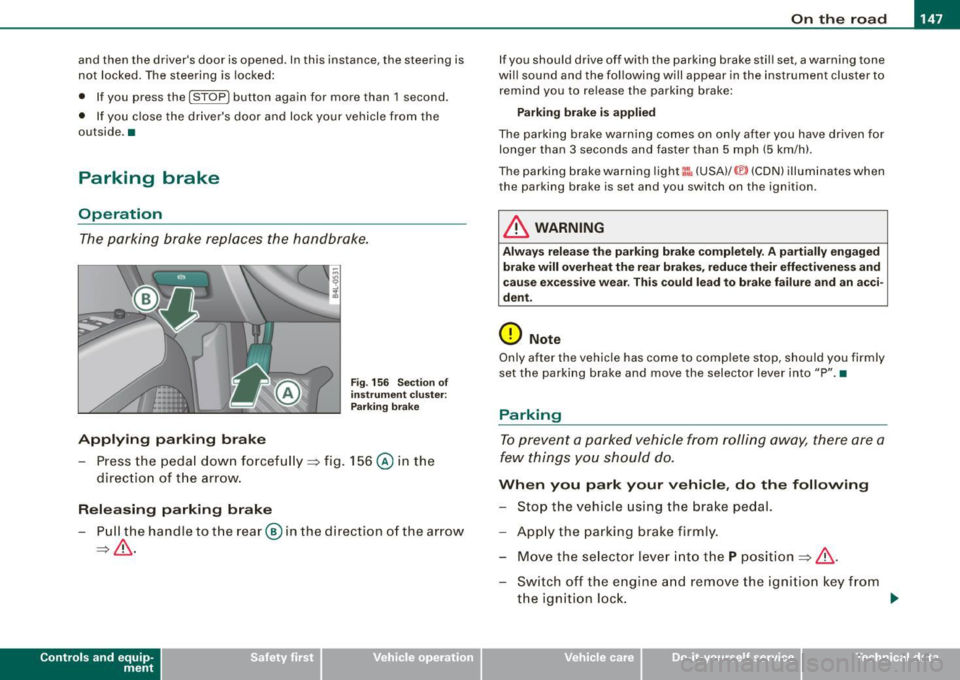
Applying parking brake
F ig . 156 Sec tion of
in strum ent clu ster:
P ark in g brake
- Press the peda l down forcefu lly ~ fig. 156 @ in the
direc tio n of the arrow.
Releasing parking brake
- Pull the handle to t he rear @ in the direction of the a rrow
~ & .
Con tro ls and eq uip
ment
I f you should drive off with the parking brake stil l set, a warning tone
wi ll sound and the following will appear in the instrument cluster to
remind you to release the parking brake:
Parking bra ke i s applied
The parking brake warning comes on on ly after you have driven for
longer than 3 seconds and faster than 5 mph (5 km/h).
The pa rking brake warning light
I:: , (USA) /© (CDN) illum inates when
the parking brake is set and you switch on the ignition .
& WARNING
Always relea se t he parking brake completely. A p artially engaged
brake will overh eat th e rea r brake s, reduce their effe ctiven ess and
ca use e xcessive w ear. Thi s co uld lead to brake failure and an a cci
dent .
(D Note
Only after the vehicle has come to comp lete stop, should you firmly
set the parking bra ke and move the selector lever into "P ". •
Parking
To prevent a parked vehicle from roll ing away, there are a
few things yo u should do.
Wh en you park your vehicle , do the following
- Stop the vehicle using the brake pedal.
- App ly the parking brake firmly.
- Mov e the se lector l ev er in to th e
P pos ition ~ & .
- Switch off the engine a nd remove the ig nitio n key from
the ignition loc k. ..,_
Vehicle care I I irechnical data
Page 150 of 426
• .___O_ n_ t_h _e _ r_o _a_ d __________________________________________________ _
When you park your vehicle on hills , do the
following
- Sto p th e vehicle usi ng the brake pe dal.
- App ly the parkin g brake firml y.
- If you ar e park ing head ed
downhill , turn the fr ont w heels
t o wa rd the curb.
- I f yo u are parkin g hea ded
uphill , turn the fro nt wh ee ls
a way fro m t he c urb.
M ove t he selecto r leve r into the
P p osition .
- Swi tch off the e ngine a nd re move th e igni tio n k ey fro m
t he ignition loc k.
& WARNING
This is how you can reduce the risk of injury when leaving your
vehicle.
• Never park the vehicle where it can come in contact with dry
grass, spilled fuel or any other flammable materials.
• When parking on hills , always turn the wheels so that the front
wheels will first roll into the curb, if the vehicle should start to roll .
• Never allow anyone -especially small children -to remain in the
vehicle when it is locked. Locked doors make it more difficult for
rescuers to access the passenger compartment in the event of an
emergency. Danger to life!
• Never leave children unsupervised in the vehicle. Children
could release the parking brake or move the gearsh ift lever out of
gear . The vehicle could start to roll away and cause an acc ident.
• No matter what the season is, the temperature in a parked
vehicle can reach dangerous levels .
0 Note
• Please e xercise care whe n you pa rk your ve hicle i n par king areas
with parking barrie rs or curbs . Parking barriers and curbs vary in
hei ght a nd could damage you r bum per a nd rela ted componen ts as
the front of your vehicle moves over a barrier or curb that is too
high , as you park o r as y ou bac k out o f a par king s pot. In o rde r to b e
sure that no such damage can occur, you may wish to stop short of
h av ing the fr ont tir es of you r car touch th e parkin g bar rier or cu rb.
• Pl ease a lso exercise exceptional care when you drive up o r down
s tee p ra mp s or drive over curbs o r other ob stacl es, for wh ich th e
vehic le is not designed, because com ponents of the vehicle c lose to
th e gr oun d, suc h as bump er cove rs, s poile rs and suspens io n an d
e x haust syst em compon ents, may become damaged. •
Starting on hills
Hill hold assist ma kes it eas ier to start on hil ls.
T he system is activated when the b ra ke peda l is depressed
for a few
seconds .
Fo r thi s, the veh icle must be stand ing in uphill d riv in g
di rection.
A ft er r elea sin g the bra ke ped al, t he br ake po wer i s held f or a
brief
moment to prevent the vehicle from rolling back when startin g. At
t hi s t ime, yo u ca n ea sily begi n to move yo ur vehicle.
& WARNING
• If you did not begin moving immediately after relea sing the
brake pedal , under certain c ircumstances , the vehicle would begin
to roll backward . Depress the brake pedal immediately or engage
the parking brake .
• Should the engine stall , depress the brake pedal immediately
or engage the parking brake . .,_
Page 151 of 426

___________________________________________________ O_ n_ t_h _e_ r_o _a_ d _ ___.BIII
& WARNING !continued )
• In order to prevent the vehicle from rolling back unintentionally
when starting in stop -and -go traffic , keep the brake pedal
depressed for a few se conds before driving off .
• When you leave the vehicle -eve n if only briefly -, switch off the
ignition and make sure to remove the ignition key. Also engage the
parking brake to prevent your vehicle from rolling unintentionally .
This particularly applies if ch ildren are left in the vehicle -danger
of accident! •
Cruise control
Switching the system on
The cr uise c ontro l syst em makes i t possible to drive a t a
c o ns tan t spee d star ting at 20 mph (30 km /h).
A ---....,;;
Con tro ls and eq uip
ment
-
Fi g. 15 7 Control lever
with set button
Fig . 158 D ispl ay:
Selected speed
P ull t he lev er t o po siti on G) => fig. 1 57 to sw itch the
sy stem on.
D riv e at th e s peed yo u wish to set .
P ress b utton
© to set th at speed.
T he display => fig. 158 wi ll show the set speed. The display may vary
d epend ing on the type o f dis play i n yo ur vehicle. The indi cator lig ht
CRUISE (US model)/ 0" (Canadian model) will a lso light up in the
instr ument clus te r.
& WARNING
• Always pay attention to traffic even when the cruise control is
switched on . You are always responsible for your speed and the
distance between your vehicle and other vehicles.
• For safety reasons, the cruise control should not be used in the
city, in stop -and -go traffic, on twisting roads and when road condi
tions are poor (such as ice , fog , gravel , heavy rain and hydro
planing ) -risk of accident.
• Turn off the cruise control temporar ily when entering turn
lanes, highway exit lanes or in constru ction zones.
• Please note that inadvertently "rest ing " your foot on the accel
erator pedal cau ses the cruise control not to brake . This is because
the cruise control is overridden by the driver's acceleration . ..
Vehicle care
I I irechnical data
Page 152 of 426
• .___O_ n_ t_ h_ e_ r_ o_ a_d ____________________________________________________ _
& WARNING (continued)
• Never use the cruise control when driving off-road or on
unpaved roads. The Cruise control is intended for use only when
the vehicle is being operated on paved roads , and is not suitable
for use off -road or on unpaved roads .
[ i J Tips
The cruise control cannot maintain a constant speed when driving
downhill. The vehicle will accelerate under its own weight. Down
shift to a lower gear or use the brakes to slow down. •
Changing speed
-Press lever in the 0 or O direction ~ page 149, fig. 157
to increase or decrease your speed.
- Release the lever to save that speed.
Change speed in increments of 1 mph (1 km/h) by lightly pressing
the lever . If you keep the lever pressed down, you will alter your
speed in 5 mph (10 km/h) increments.
You can also press the accelerator pedal down to increase your
speed, e.g. if you want to pass someone. The speed you saved
earlier will resume as soon as you release the accelerator pedal.
If, however, you exceed your saved speed by 5 mph (10 km/h) for
longer than 5 minutes, the cruise control will turn off temporarily.
The symbol will go out but the saved speed will be retained. •
Presetting your speed
You can preset your desired speed while the vehicle is not
moving.
- Turn on the ignition.
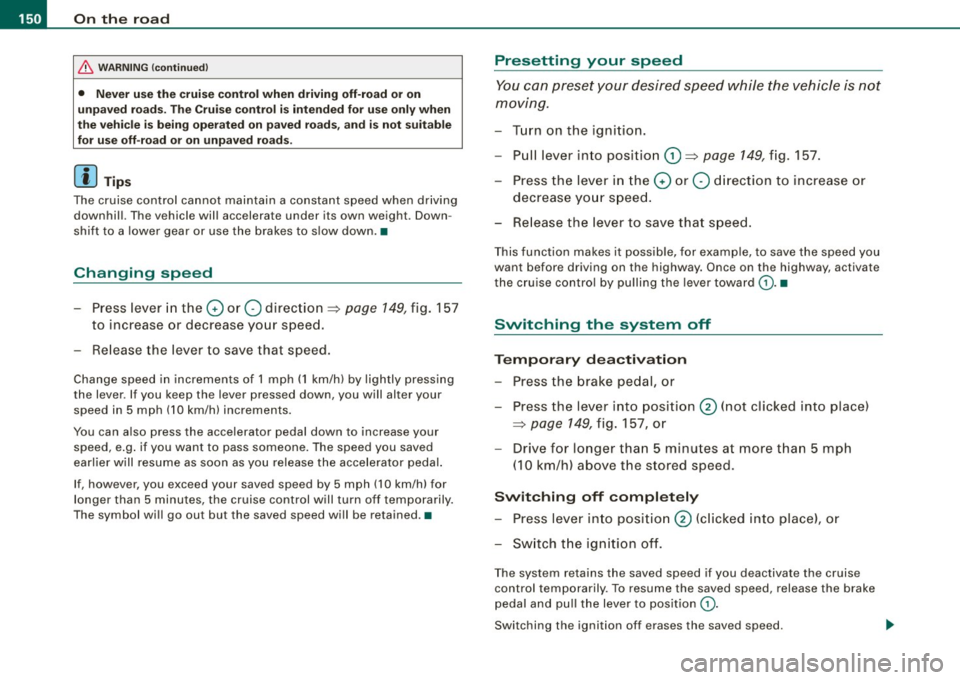
- Pull lever into position
G) ~ page 149, fig. 157.
- Press the lever in the
0 or O direction to increase or
decrease your speed.
- Release the lever to save that speed.
This function makes it possible, for example, to save the speed you
want before driving on the highway. Once on the highway, activate
the cruise control by pulling the lever toward
G). •
Swit ching th e syst em off
Temporary deactivation
- Press the brake pedal, or
- Press the lever into posit ion
0 (not clicked into place)
~ page 149, fig. 157, or
- Drive for longer than 5 minutes at more than 5 mph
(10 km/h) above the stored speed .
Switching off completely
- Press lever into position
0 (clicked into place), or
- Switch the ignition off.
The system retains the saved speed if you deactivate the cruise
control temporarily . To resume the saved speed, release the brake
pedal and pull the lever to position
G).
Switching the ignition off erases the saved speed.
Page 155 of 426
___________________________________________ A ;__d_ a.....!.,. p_t _iv _e_ C_ ru_ is_e_ C_ o_ n_t _ro _ l __ lllll
& W ARNING (continu ed )
the veh icle safely when you follow another vehicle too closely .
Always remember that the Adaptive Crui se Control has a braking
power th at is only about 30 % of the vehicle 's maximum braking
ability . The automatic braking function cannot bring the vehicle to
a sudden or emergen cy stop . Always be prepared to bra ke and
take evasive action to avoid collisions and other accident situa
tions .
• Never allow the closing speed between you and other vehicles
to be so high that the Adaptive Cruise Control may not be able to
slow your vehicle safely . If closing speed is too high , you must
apply the brakes yourself to reduce the ri sk of a rear -end crash .
• Never rest your foot on the accelerator pedal , especially when
the Adapt ive Cruise Control is being used . Pressure on the a cceler
ator will override the ACC braking function and prevent the brakes
from being appl ied when ACC detects a situation when the brakes
must be applied.
• Never use Adapt ive Cruise Control when you cannot drive
safely at a steady speed , including on city streets , on winding
roads or when road conditions are poor (for example , on ice,
gravel, in fog , heavy r ain or on wet roads that increase the risk of
hydroplaning
I.
• The radar sensor's vision can be reduced by rain , snow and
heavy road spray . These and similar conditions can prevent vehi
cles up ahead from being accurately detected and in some cases
they may not be detected at all . Do not use ACC when the radar
sensors cannot accurately detect veh icles moving ahead of you in
traffic.
• Always turn off Adaptive Cruise Control when entering turn
lanes , exit lanes and construction zones or in similar situations
because the vehicle will automati cally accelerate to the stored
speed when the road ahead is clear.
• To prevent unintended operation , always switch ACC off when
it is not be ing used .
Controls and equip
ment
[ i ] Tips
• For sa fety reasons , the sto red speed is de leted w he n th e ig nit ion
is turned off.
• The E lectronic Stabilization Program (ESP) and the Anti -Slip
R egu lation (ASR) cannot be deacti vated when the Adaptive Cruise
Co ntrol is sw itc hed on . If the ESP and the Anti-Slip Regula tion (AS R)
has been deactivated and you then switch on the Adaptive C rui se
Contro l, t he ESP func tion w ill also be act iva ted automat ica lly .
• Damage caused by accidents an d so me mino r co llisions can
affect t he radar sensor sett ings and cause the sys tem to ma lfun c
tion or switch off completely.
• The radar sensor cover is heated. In winter conditions, you
should stil l check before driving to make sure it is free of ice and
s n ow. If necessary, clean the area near t he radar sensor carefully
~ page 15 2, fig. 159 .
• To ensure that the radar sensor is not blocked, foreign objects
(e .g. stickers, la rger l icense plate mount s, add -on pa rts) must not
cove r th e area near t he radar sensor~ page 152, fig. 159. The area
nea r the rada r sensor must not be painted, either .
• For Dec laration of Comp liance to United States FCC and Industry
Canada regulations ~ page
404. •
I • •
Page 156 of 426
• .___A_ d_a_ p:- t_i v_ e_ C_ r_u _is _ e_C_ o_ n_ t_ r_ o_ l --------------------------------------------
Ap plies to vehi cles : wi th Ad aptive Cruise Co nt rol
How does Adaptive Cruise Control work?
Vehicles traveling ahead are detected with the aid of a
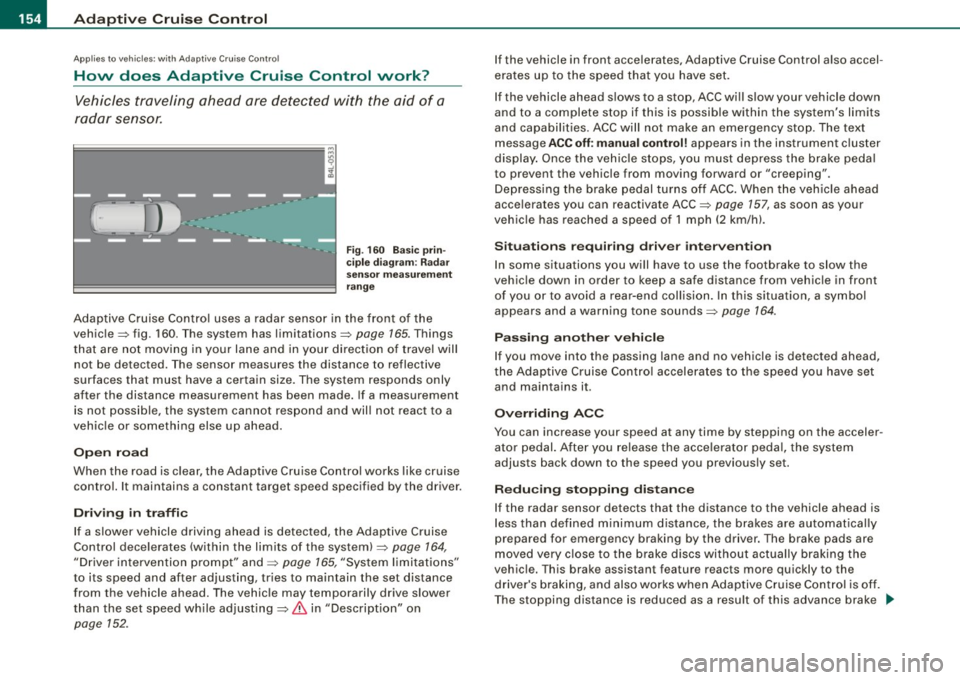
radar sens or.
Fig. 160 Bas ic p rin
ci pl e diagra m: R adar
s en sor measur eme nt
ra nge
Adaptive Cruise Contro l uses a radar sensor in the fron t of the
vehic le=> fig. 160. The system has limitations=>
page 165. Things
t hat are not moving in your lane and in your direction of travel will
not be detected. The sensor measures the distance to reflective
surfaces that must have a certain size. The system responds only
after the distance measurement has been made. If a measurement
is not possible, the system cannot respond and wil l not react to a
vehic le or something else up ahead.
Op en ro ad
When the road is clear, the Adaptive Cruise Contro l works like cruise
control. It maintains a constant target speed specified by the driver.
D rivi ng in t raffi c
If a slower vehicle driving ahead is detected, the Adaptive Cruise
Control dece lerates (within the limits of the system)=>
page 164,
"Driver intervention prompt" and=> page 165, "System l imitations"
to its speed and after adjusting, tries to maintain the set distance
from the vehicle ahead. The vehicle may temporarily drive slower
than the set speed wh ile adjusting=>
& in "Description" on
page 752 .
If the vehicle in front acce lerates, Adaptive Cruise Control a lso accel
era tes up to the speed that you have set .
If the vehicle ahead s lows to a stop, ACC wi ll slow your vehicle down
and to a complete stop if this is possible within the system's limits
and capabil ities . ACC will not make an emergency stop. The text
message
ACC off : manu al c ontro l! appears in the instrument c luster
display . Once the veh ic le stops, you must depress the brake peda l
to prevent the vehicle from moving forward or "creeping" .
Depressing the brake pedal turns off ACC. When the veh ic le ahead
acce lerates you can reactivate ACC =>
page 157, as soon as your
vehic le has reached a speed of 1 mph (2 km/h).
S ituati ons re quir in g dri ver int erve ntion
In some situations you will have to use the footbrake to slow the
vehic le down in order to keep a safe distance from vehic le in front
of you or to avoid a rear-end collision. In this situation, a symbol
appears and a warning tone sounds=>
page 164.
Passing anoth er v ehicl e
If you move into the passing lane and no vehicle is detected ahead,
the Adap tive Cruise Contro l accelerates to the speed you have set
and maintains it.
Ov erriding A CC
You can increase your speed at any time by stepping on the acceler
ator pedal. After you re lease the accelerator peda l, the system
adjusts back down to the speed you previously set.
Redu cin g stopping di stan ce
If the radar sensor detects that the distance to the vehicle ahead is
less than defined minimum d istance, the brakes are automat ically
prepared for emergency braking by the driver. The brake pads are
moved very c lose to the brake discs without actually braking the
vehic le. This brake assis tant feature reacts more quickly to the
driver's braking, and also works when Adap tive Cruise Contro l is off.
The stopping distance is reduced as a result of this advance brake .,_
Page 157 of 426
Adaptive Cruise Control -
---------------=-------'
preparation. This function does not perform any emergency braking
m aneuv ers by i tse lf ; t he driver m ust alw ays app ly the b rake s.
& WARNING
If ACC initiates a braking maneuver, the brake pedal will be
retracted . Interference with the brake pedal can prevent ACC from
slowing the vehicle down and cause a crash and serious personal
injury .
• Never put anything in the driver 's footwell or let anything fall
into it . An object in the driver 's footwell can interfere with the
pedals and prevent the accelerator from being used to override
ACC or prevent ACC from being swit ched off when the brake pedal
is depressed and also prevent the vehicle from being slowed down
or stopped .
• Only u se floor mats that keep the area around the pedals free
and that can be securely fastened to the footwell.
• Never drive with your foot underneath the brake pedal.
• Always read and heed the information and WARNINGS=>
& in
" Description " on
page 152.
& WARNING
• Never rely on the distance control feature of ACC alone to
prevent rear -end collisions. Always be prepared to brake and take
evasive action to avoid collisions and other accident situations .
• Never allow the closing speed between you and other vehicles
to be so high that the Adapt ive Cruise Control may not be able to
slow your vehicle safely .
If closing speed is too high , you must
apply the brakes yourself to reduce the risk of a rear -end cra sh.
[ i ] Tips
Please note that the amount of acceleration the Adaptive Cruise
Control uses depends on the Distance setting selected. DISTA NCE 1
gives you accel erati on that is dy na mi c a nd sporty. DISTA NCE
4, on
Con tro ls and eq uip
ment
the other hand , gives more moderate acceleration . For more infor
m ati on about th e tim e in te rvals =>
page 758, "How i s the d istance
(time interval) set?" .
• Please not e th at if th e Ada ptive Cru ise Control has begun bra king
the vehicle and the driver chooses to brake th e vehicle additionally,
t he brakes may fe e l "har d". Th is is simply due t o th e pr essu re build
up of the initial braking .
• Adap tiv e Crui se Co ntrol is switc hed off aft er pr essing th e foot
brake. The speed saved up this point can be resumed . T o resume the
saved spee d, rel ease the brake pedal a nd pull t he control le ve r
toward you=>
page 757, " Turning Adaptive Cru ise Contro l off
t empo ra rily" .•
A pplies to veh ic les: with Adaptive C ru ise Contro l
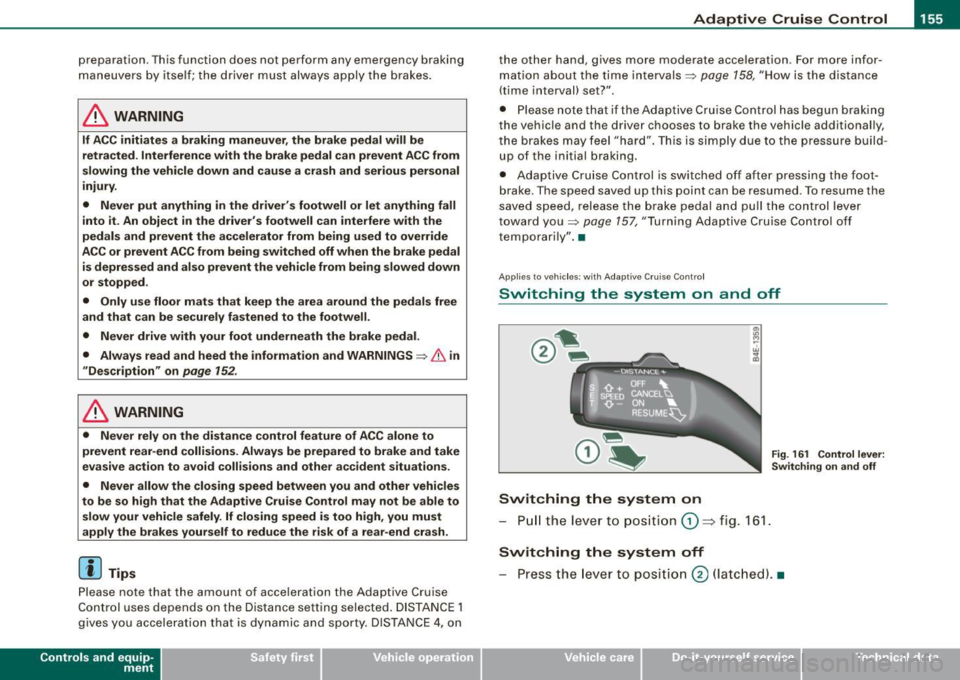
Switching the system on and off
Fig. 161 Control lever:
S w itc hing on and off
Switching the system on
- Pull t he leve r to p ositi on G) => fig . 1 61.
Switching the system off
- Press the lev er to posi tion 0 (la tc h ed). •
Vehicle care I I irechnical data
Page 158 of 426
-L.....:.A:::::: d:.::a:1 Pt:.::. ti:...:v :...: e::::....: C:::..:,_ ru::.:.: is::,: e::::....: C::..:: o::n..:. t:.: r..: o :..: I:__ __________________________________________ _
Applies to ve hicles : w it h Ad aptive Crui se Co nt rol
How is the speed stored?
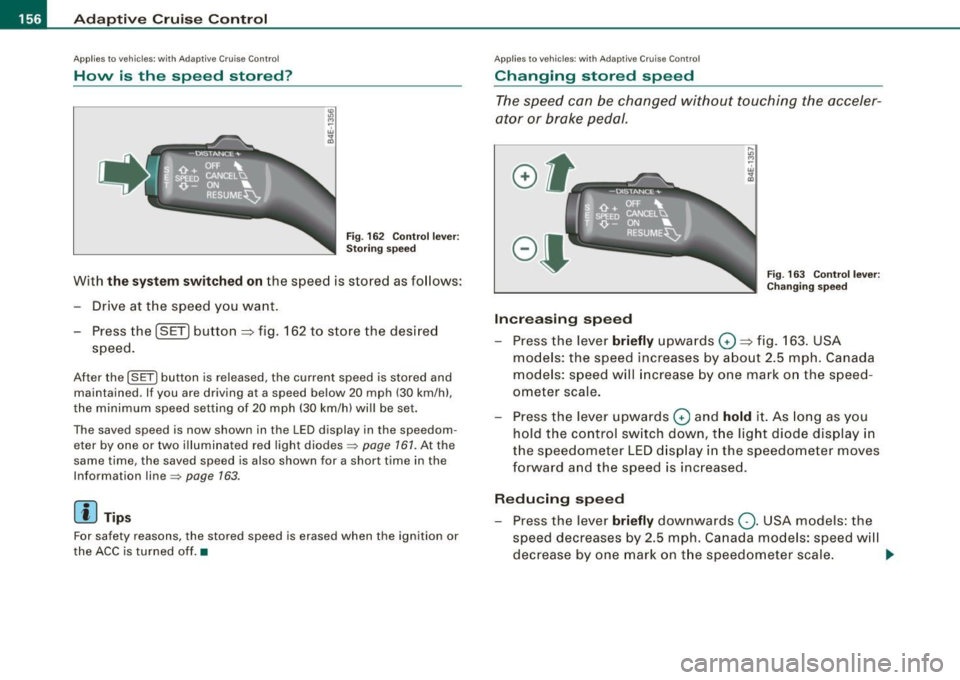
Fig. 162 Control lever:
Storing speed
With the system switched on the speed is stored as follows :
- Drive at the speed you want.
Press the ( SET] button
::::> fig. 162 to store the desired
speed.
After the I SET I button is released, the current speed is stored and
maintained . If you are driving at a speed below 20 mph (30 km/h) ,
the minimum speed setting of 20 mph (30 km/h) will be set.
The saved speed is now shown in the LED display in the speedom eter by one or two illuminated red light diodes~
page 161. At the
same time , the saved speed is also shown for a short time in the
Information line~
page 163.
[ i J Tips
For safety reasons, the stored speed is erased when the ignition or
the ACC is turned off. •
Applies to vehi cles: with Ad aptive Crui se Contro l
Changing stored speed
The speed can be changed without touching the acceler
ator or brake pedal.
Increasing speed
....
"' M ~ w .,
"'
Fig . 163 Control lever:
Changing speed
Press the lever briefly upwards Q ::::> fig. 163. USA
models: the speed increases by about 2.5 mph. Canada
models: speed will increase by one mark on the speed
ometer scale.
- Press the lever upwards
Q and hold it. As long as you
hold the control switch down, the light diode display in
the speedometer LED display in the speedometer moves
forward and the speed is increased.
Reducing speed
- Press the lever briefly downwards Q. USA models: the
speed decreases by 2.5 mph. Canada models: speed will
decrease by one mark on the speedometer scale. _,,.
Page 159 of 426
_____________________________________________ A_ d..:.a....! p..:. t _i_ v _ e_;_ C.:...._ ru.:...._ is..:.e_;_ C.:...: o..:.n..:.. t:.; r..:. o ..:. I_---J_
- Press the lever downwards Q and hold it. As long as you
hold the control switch down, the light diode display in
the speedometer LED display moves backward and the speed is reduced.
After releasing the control switch, the system regulates the speed to
the value just set .
After each adjustment, the newly -set speed is shown for a short
time in the Information line=> page
163.
& WARNING
Improper use of the Adaptive Cruise Control features and inatten
tion can lead to an accident causing serious personal injury.
• It is dangerous to use the "RESUME" feature when the previ
ously set speed is too high for existing road, traffic or weather
conditions.
• Always read and heed the information and WARNINGS =>
& in
"Description" on
page 152.
[ i] Tips
You can increase your speed at any time by stepping on the acceler
ator pedal. After you release the accelerator pedal, the system
adjusts back down to the speed you previously set . A new desired
speed can be stored at any time by pressing the [SET ] button
=> page
756 , fig. 162. •
Con tro ls and eq uip
ment
A pp lies to veh icles: with Ad aptive Crui se Co ntro l
Turning Adaptive Cruise Control off
temporarily
In some situations it makes sense to turn Adaptive Cruise
Control off temporarily.
Turning control off temporarily
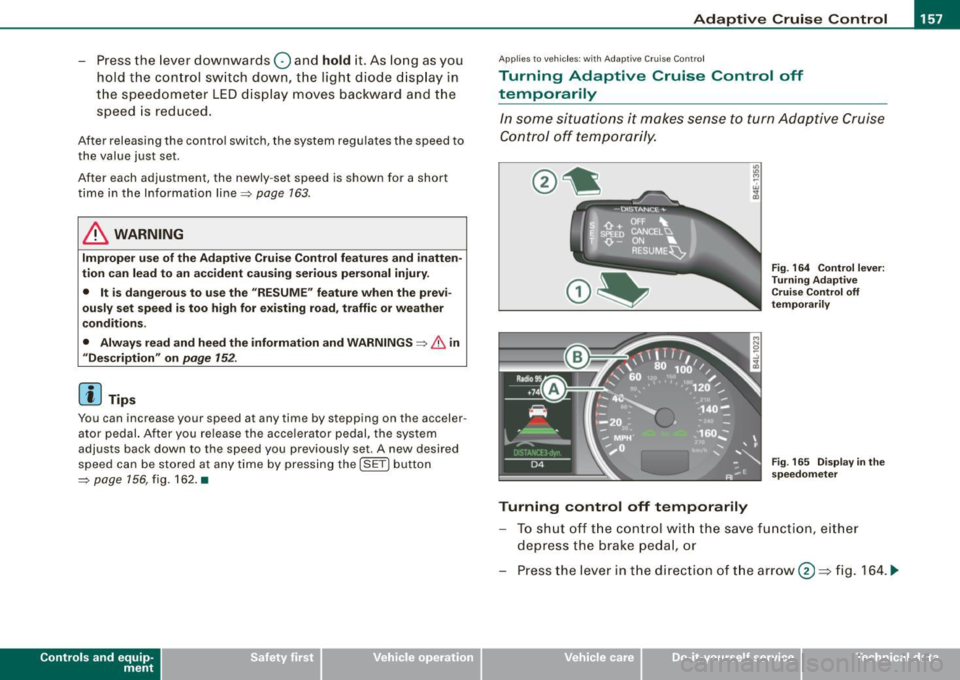
Fig. 164 Control lever:
Turning Adaptive
Cruise Control off
temporarily
Fig . 165 Display in the
speedometer
To shut off the control with the save function, either
depress the brake pedal, or
Press the lever in the direction of the arrow@=> fig. 164 . ._
Vehicle care I I irechnical data