lights AUDI Q7 2009 Owner´s Manual
[x] Cancel search | Manufacturer: AUDI, Model Year: 2009, Model line: Q7, Model: AUDI Q7 2009Pages: 426, PDF Size: 97.13 MB
Page 307 of 426

Trailer towing
Driving with a trailer
Genera l information
Your Audi was designed primarily for passenger transpor
ta tion.
If you plan to tow a trailer, please remember that the add itional load
wi ll affect durability, economy and performance.
Trai ler towing no t only places more s tress on the vehicle, it a lso ca lls
for more concentration from the driver.
F or this reaso n, always fol low the operating and driving instructions
prov ided and use common sense.
(D Note
If you are going to tow a tra iler, you must activate the trailer opera
tion mode =>
page 211, "Towing a trailer".
Technical requirements
Trailer hitch
Use a we ight-carry ing hitch conforming to the gross tra iler weig ht.
T he hitch must be suitable for your vehic le and trailer and must be
m ounted secure ly on the veh icle's chassis at a
technically sound
location. Use only a trailer hitch with a removable ball mount.
Always check with the trai ler hitch ma nufacturer to make sure that
you are using the correct hitch .
Do not use a bumper hitch.
The hitch must be instal led in such a way that it does not in terfere
with the impact-absorbing bumper system. No modifications shou ld be made to the vehicle exhaust and b rake systems . Fro m
Controls and equip
ment Safety first Vehicle operation
Tr
aile r t owing
time to time, check that all hitch mounting bolts remain securely
fastened .
When you are not towing a trai ler, rem ove the t railer hi tch bal l
mount. This prevents the hitch from causing damage should your
vehicle be struck from behind =>
&.
Trailer bra kes
If your trai ler is equipped with a b raking system, check to be sure
that it conforms to all regulations.
The tra iler hydraul ic bra ke system must not be directly co nnecte d to
the veh icle's hydrau lic brake system=> &.
Safety chains
Always use safety chains between your vehicle and the trailer.
Trail er lights
Trai ler lights must meet a ll regulations. Be sure to check with your
au thorized Audi dea ler for correct wiring, switches, an d relays.
Mirrors
If you are unab le to see the traff ic behind you using the regular
outside mirrors, then you
must instal l extended mirrors. It is impor
t ant that you
always have clear v isi on to the rear.
& WARNING
• If a trailer has electrical brake s please note that the se brakes
are not act ivated by the fa ctory-fitted control unit -ris k of acci
dent!
• After removing the trailer hitch , do not store it in your vehicle.
In case of sudden braking , the hitch could fly forward and injure
you or your passengers .
Vehicle care Do-it-yourself service Technical data
Page 309 of 426
pillar. On Canada vehicles, the tire pressure label is located either on
t he driver's side 8 -pillar or inside the fuel fil ler flap. Inflate trailer
tires to trailer and tire manufacturers' specifications.
L ight s
The head light settings should be checked with the trailer attached
before driving off . Check to make sure both vehicle and trai ler lights
are working properly.
Sa fety c hain s
Be sure trailer safety chains are properly connected from the trailer
to the hitch on the vehicle . Leave enough slack in the chains to
permit turning corners. When you insta ll safety chains, make sure
they will not drag on the road when you are driving .
The chains should cross under the tra iler tongue to prevent it from
dropping in case of separation from the hitch.
0 Note
If you are going to tow a traile r, you must activate the trailer opera
tion mode =>
page 211, "Towing a trailer" .
Driving instructions
Driving with a trailer always requires extra care and
consideration.
To obtain the best possible handling of vehicle and trailer,
please note the fo llow ing:
- Do not tow a loaded trailer when your car i tse lf is not
loaded .
- Be especia lly careful when passing other vehicles .
- Observe speed l imits.
- Do not drive at the maximum permiss ible speed .
Controls and equip
ment Safety first Vehicle operation
Tr
aile r t owing
Always apply brakes early .
- Monitor the temperature gauge .
Weigh t dis tr ibution
Towing a loaded trailer wi th an empty car results in a highly
unstable dis tribution of weight . If this cannot be avoided , drive at
very low speeds only to avoid the risk of losing steering control.
A "balanced" rig is easier to operate and control. This means that
the tow vehicle should be loaded to the extent possible and permis
sib le, while keeping the trailer as light as possib le under the circum
stances . Whenever possible, transfer some cargo to the luggage
compartment of the tow vehicle whi le observing tongue load
requirements and vehicle loading considerations .
Speed
The higher th e speed, the more difficu lt it becomes for the driver to
control the rig . Do not drive at t he maximum pe rmissible speed.
Reduce your speed even more
if load, weather or wind conditions
a re unfavorable -particularly when going downhil l.
Reduce vehicle speed
i mmedi ate ly if the trailer shows the slightest
sign of swaying.
Do not tr y to s top the swaying by accelerating .
Observe speed limits . In some areas, speeds for vehicles towing
trailers are lower than for regular vehicles .
Always apply brakes early. When driving downhill, shift into a lower gear to use the engine braking effect to slow the vehicle. Use of the
brakes alone can cause them to overheat and fa il.
Coo lant t emperatu re
The coolant temperature gauge=> page 13 must be obse rved care
ful ly. If the need le moves close to the upper end of the sca le , reduce
speed immediately and/or turn off the air conditioner .
If the coolant temperature warning light in the instrument cluster
starts f lashing
- f- , pul l off the road, stop and let the engine idle for
about two minutes t o prevent heat build -up.
Vehicle care Do-it-yourself service Technical data
Page 316 of 426
-~_C_ le_ a _ n_i_n ...::g ::....- a_ n_ d_,__ P_r _o _t _e _c_ t_ i_o _n ___________________________________________ _
Use a separate sponge for cleaning the wheels, door sills and other
regions exposed t o road dirt. In this way, you wil l n o t sc ratch the
paint with coarse particles imbedded in the sponge the next time
you wash the car.
& WARNING
• Do not clean the underside of the cha ssis, fender s, wheel
c overs , or other h ard to rea ch part s without prote cting your h and s
and ar ms. You ma y cut your self on sharp -edged met al part s.
• Alw ays re ad and heed all WARNINGS and other inform atio n
=> pa ge 312 .
0 Note
• Never try to remove d irt, mud or dus t if the surface of the vehicle
is dry. Never use a dry cloth o r sponge, since this cou ld scratch your
vehic le's paint or windows .
• Never wash your car in bright sunl ight. Drops of water act as
magnifying lenses and may damage your pain t.
• When you wash your car in the winter: if you rinse your vehic le
with a hose, be careful not to aim the stream of water directly at locks, or at door or hatch openings -they can freeze shut.
• Never use sponges designed to remove insects, or any k itchen
scouring sponges or similar products. They can damage your paint
fi nish.
• Never use a dry cloth or sponge to c lean the head lights. Only use
wet cloths or sponges to preven t scratches . It is best to use soapy
water .
washed in spec ia l wash bays .•
Washing your vehicle with a power washer
Cle aning the exterior of you r ca r with a high- pressure
power washer is safe as long as you observe a few simple rules .
-Before us ing the powe r washer, make su re you have read
and unders tood the WAR NINGS~
& in "General infor
mation" o n
page 312.
Always follow the operat ing instructions fo r th e power
washer.
Make sure t hat the jet o n th e sp ray hose p ro d uces a "fa n
sha ped sp ray".
D o
not hold t he spray n ozzle too close to s oft ma te rials .
When cleani ng the vehicle with a power washer always follow the
operating instructions . T his applies particularly to the operating
pressure and the spraying distance. Maintai n a sufficient distance
to soft materia ls such as rubber hoses and sound/vibration dead
ening materia ls (pa rt icularly on the underside of the engine hood).
Do not use a jet which sprays water in a direct stream or one that
has a rotating jet.
Water temperature shou ld not exceed 140 °F (60 °C).
& WARNING
Never wash tires with a jet that sp ray s water in a direct stream .
Thi s could cause invisible damage to th e tires and weaken them ,
even if the spray i s from a re lat ively long distan ce and for a short
time . Damaged and weakened t ires can f ail and cause accidents
and person al injury .
~
Page 317 of 426

Cleaning and protection --------------------=-----------
•
0 Note
To avoid damaging your vehicle, always make sure that there is
sufficient distance between the spray head and soft materials like
rubber hoses, plastic parts and sound-deadening materials. Never
aim the spray head at the same point for a long time. This also
applies to cleaning headlights and painted bumpers. Remember:
the closer the nozzle is to the surface of the material, the greater the
stress on the material. •
Waxing
Wax protects the vehicle's paint.
- Use a manually applied car wax occasionally to protect
the paint .
A good wax coating protects the vehicle paint to a large extent
against the environmental factors listed under => page 312,
"Washing" and even against slight scratches.
You can use a liquid car wax to protect your paint as soon as one
week after your vehicle has been delivered.
Even if you regularly use a
waxing process in automatic car washes,
we recommend that you manually apply a coat of wax to give the
paint extra protection, particularly if water no longer beads on the
clean paint.
Protect plastic body parts with car wax in the same way as the
vehicle body.
During warm weather dead insects tend to collect on the front
bumper and on the forward area of the hood. They are much easier
to remove from paint that is waxed
often.
& WARNING
Always read and heed all WARNINGS and other information
:=> page 312.
0 Note
Do not use car wax on
• matte or anodized metal trim
• rubber or rubber-like trim. •
Polishing
Polishing restores the gloss to the paint.
Polish your vehicle only if the paint has lost its shine and the gloss
cannot be brought back with wax.
If the polish used does not contain preservative compounds, the
paint must be waxed afterwards=> page 375, "Waxing".
& WARNING
Always read and heed all WARNINGS and other information
=> page 312.
0 Note
Do not treat matte anodized metal trim, plastic or rubber parts with
polish or wax. •
Trim strips
Metal trim needs special care.
For environmental reasons, Audi fabricates the bright trim strips
and trim pieces from pure chromium -free aluminum. ._
Vehicle care I t •
Page 336 of 426
-~_C_ h_e _c _ k_ i_n ...:::g::;...._ a_n_ d_ f_ i_ll _in -'g:::;.._ ___________________________________________ _
current list of oils (manufacturers, brand names etc.) that conform
t o Audi oi l standard VW 502 00 .
Changin g the engine oil
The engine oil and oil filter must be changed according to the
mi leage (ki lometers) and time intervals specified in your vehicle's
Warranty
& Maintenance booklet. Do not exceed these interva ls -
harmful deposits from old engine oil can reduce engine perfor
mance and can lead to expensive engine repairs.
Changing the oi l at the recommended intervals is so very important
because the lubricating prope rties of oi l decrease gradual ly during
normal vehicle use . If you are not sure when you have your oil
changed, ask your author ized Audi Serv ice Advisor.
Under some circumstances the engine oil should even be changed
more frequently. Change oil more often if you dr ive mostly short
distances, operate the vehicle in dusty areas or mostly under stop
and -go t raffic conditions, or when you use your vehicle where
temperatures stay be low freezing point for long per iods.
Detergent additives in the oil will make fresh oil look dark after the
engine has been running for a short time . This is normal and is not
a reason to change the oil more often than recommended.
Damag e or malfunctions due to lack o f mainten anc e
It is essentia l that you change your oi l at the recommended interva ls
using on ly engine oil that complies with Audi oil standard
VW 502 00. Your Limited New Vehicle Warranty does not cover damage or ma lfunctions due to failure to follow recommended
main tenance and use requirements as set forth in the Aud i Owner's
Manual and Warranty
& Maintenance booklet. Your dealer wi ll have
t o deny warranty cove rage unless you present to the dealer p ro o f in
the form of Service or Repair Orders that all schedu led maintenance
was pe rformed in a timely manner. •
Engine oil consumption
The engine in your vehicle depends on an adeq uate
amount of oil t o lubric ate and c ool all of its m oving parts.
In order to provide effective lubrication and coo ling of interna l
engine components, al l interna l combustio n eng ines consume a
certain amount of oil. Oil consumption varies from engine to engine
and may change significant ly over the life of the engine . Typ ically,
engines with a specified break-in period (see=>
page 2971 consume
more oil du ring the break-in period than they consume after oil
consumption has stabi lized .
Unde r normal conditions, the rate of oil consumption depends on
the quality and v iscosity of the oil, the RPM (revolutions per minute)
at which the engine is operated, the ambient temperature and road
cond itions. Fur ther factors are the amount of oil di lu tion from wate r
condensation or fue l residue and the oxidation leve l of the oi l. As
any engine is subject to wear as mileage bu ilds up, t he oil consump
tion may increase over time until replacement of worn components
may become necessa ry .
With all these variables coming into play, no standard rate o f oi l
consumption can be established or specified . There is no alternative
t o regula r and frequent checking of the oil level, see
Note .
If the yel low engine oil level warning symbo l in the instrument
clus ter lights up, yo u should check the oil level as soon as
possible
with the oil dipstick=> page 335. Top off the oil at your
ea rliest convenience =>
page 336.
& WARNING
Before you check anything in the engine compartment , always
read and heed all WARNING S
=> & in "Working in the engine
compartment " on
page 331.
Page 344 of 426
-~_C_ h_e _c _ k_ i_n ...:::g::;...._ a_n_ d_ f_ i_ll _in -'g:::;.._ ___________________________________________ _
& WARN ING (c o ntinued )
• Brake failure can re sult from old or inappr opriate brake fluid .
Ob serve the se precautio ns:
- Use only brake fluid that meets SAE specific ation J 1703 and
c onform s to Fed era l Moto r Vehi cle St anda rd 116. Al ways c heck
with your authori zed Audi dealer to make sure you are u sin g
the corre ct brake fluid. The correct typ e of brake fluid i s also
indicated o n the brake fluid reser vo ir .
- The br ake flu id mu st be ne w. Heavy u se of the brake s can
c au se a vapor lock if the brake fluid i s left in the s ystem too
long. Thi s can seriou sly affect the effi cien cy of the brake s as
w ell a s your safet y. Thi s could re sult in an acci dent .
0 Note
Brake fluid will damage the paint of your vehicle .
For the sake of the environment
Because of the problem of proper disposal of brake fluid as well as
the special too ls required and the necessa ry expertise, we recom
mend that you have the brake fluid changed by your authorized Audi
dea ler .•
Battery
General information
Under normal operating condi tions, the battery in your Audi does
not need any maintenance. With
high outside temperatures or long
daily drives we recommend that you have the e lectrolyte level
checked by an au thorized Audi dealer or qualified workshop . The
e lectrolyte level should also be ch ecked each time the battery is
charged ~
page 344.
Have the battery checked when you take your vehicle in for service .
Yo u are well advised to replace a battery that is o lder than 5 years .
With certain types of airbag dep loyment, the battery is discon
nected from the vehicle electrical system for safety reasons~
& in
"Repair, care and disposal of the airbags" on
page 255.
Disconnecti ng th e batt ery termin als
Some vehicle functions (power window regulators , for example) are
lost if the battery termina ls are disconnected. These functions have
to be relearned after the battery terminals are connected again . To
prevent this, the battery should only be disconnected from the
vehic le electrical sys tem when abso lutely necessary for repairs .
Vehicles not driven for long per iods
If you do not drive your vehicle ove r a period of several days or
weeks, electrical components are gradually cut back or switched off .
T his reduces energy consumption and maintains starting capab ility
over a longer period
~ page 295 .
Take i nto consideration that whe n you u nlock your vehicle, some
convenience functions, such as the master key remote function or
powe r seat adjustme nt, may not be ava ilable. The convenience
functions will be available again when you turn on the ignition and
start the engine .
Wint er op erati on
Duri ng the winter mont hs, batte ry capacity tends to decrease as
temperatures drop . This is because more power is also consumed
whi le star tin g, and the headlights, rear window defogger, etc ., are
used more often.
Avoid unnecessary power consumption, particular ly in city traffic or
when trave li n g o nly short dis tances . Let your authorized Audi dea ler
check the capacity of the vehicle battery before winter sets in
~ page 344. A we ll cha rged battery w ill not only preven t starting
problems when the weather is cold, but will also last longer . ..,_
Page 346 of 426
•---=C:.:h..:. e=-= c..:.k :..:.in :..:.:= g:.....= a..:.n :.:d::....:. f.:.:il .:.:li ..:.n :..::g~ --------------------------------------------
& WARNING (continued )
battery to heat up very quickly, wh ich could lead to damage or
explosion and personal injury .
• When a battery is charged , it produces h ydrogen gas which i s
explosive and could cau se personal injury .
• Always keep the battery well out of the reach of children.
• Before work is done on the electrical system , disconnect the
negative ground cable .
• Before performing any work on the ele ctri cal system , switch off
the engine and ignition as well as any electrical equipment. The negative cable on the battery m ust be disconnected . If you are ju st
going to replace a light bulb , then it is enough to switch off the
lights .
• Before disconnecting the battery , switch off the anti -theft
alarm system! Otherwise you will set off the alarm .
• When disconne cting the battery , first disconnect the negative
c able and then the positive cable .
• Before reconnecting the battery , make sure all electrical
c onsumers are swit ched off . Reconnect the positive cable first and
then the negative cable. Never interchange the cables - this could start a fire !
• Never charge a frozen or a thawed -out battery. It could
explode! If a battery has frozen , then it must be replaced . A
discharged battery can freeze over at 32 °F (0 °Cl.
• Make sure the vent hose is always attached to the opening on
the side of the battery.
• Never use batteries whi ch are damaged . There is the danger of
an explosion! Always replace a damaged battery.
& WARNING
Californ ia Proposition 65 W arning :
& WARNING (continued )
• Battery posts, terminals and related accessories contain lead
and lead compounds, chemicals known to the State of California
to cause can cer and reproductive problems . Wash hands after
handling .
0 Note
• Do not disconnect t he veh icle battery w he n th e ign itio n is
switched on or when the engine is running , otherwise, you will
damage e le ctronic co mponents in the elec trical sys tem.
• I f your vehicle i s going to stand for a long period of time without
b ei ng dr iven, prot ec t the batte ry from "fr ee zing", otherwise it will
be damaged and will then have to be rep laced. •
Battery charging
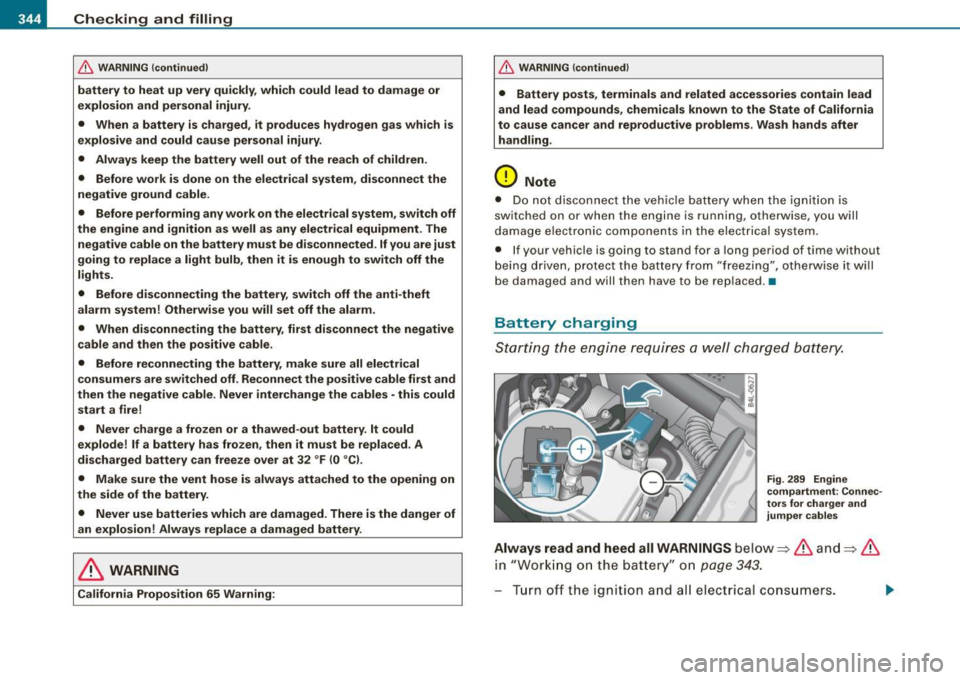
Sta rti ng th e e ngin e req uires a well c harged ba tte ry.
F ig . 289 Engine
compartment : Conne c
tors fo r charge r and
jumper cable s
Always read and heed all WARNINGS be low ~ & and::::} &
in "W orkin g on the b atte ry" on pa ge 34 3.
- Tur n off the ig ni tio n a nd a ll elec tric al co nsum ers.
Page 384 of 426
lllftl.,___F_ u_ s_ e_s _ a_n _ d_ b_ u_lb _ s _______________________________________________ _
[ i J Tips
You are well advised to keep a supply of spare fuses in your vehicle .
Fuses with the proper ampere ratings are available at your autho
rized Audi dealer. •
Fuse Location, Instrument Panel left
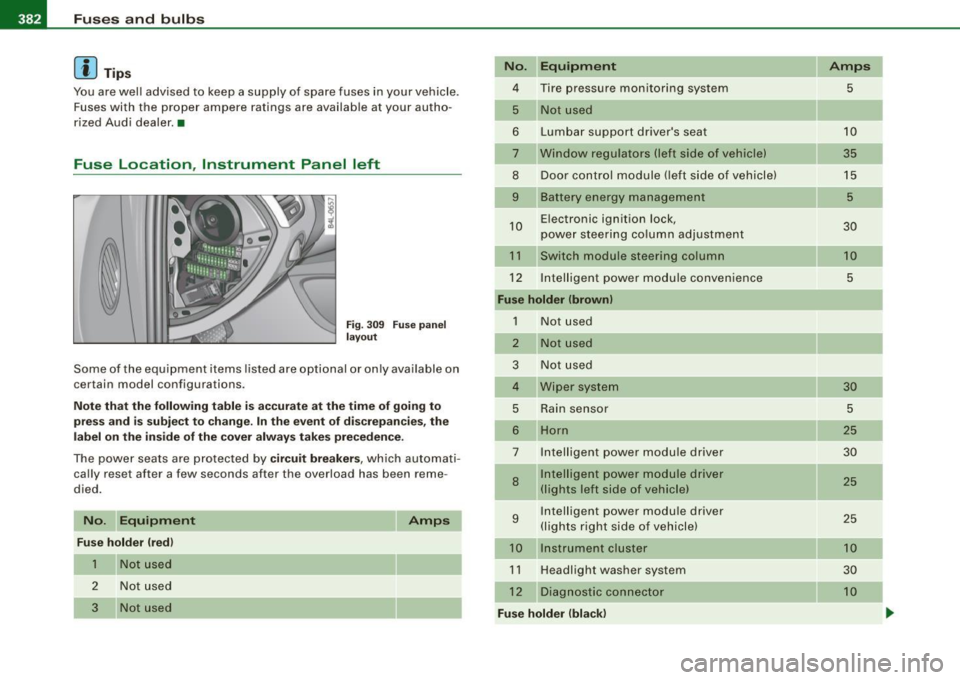
Fig . 309 Fuse panel
layout
Some of the equipment items listed are optional or only available on
certain model configurations .
Note that the following table is accurate at the time of going to
press and is subject to change. In the event of discrepancies, the
label on the inside of the cover always takes precedence.
The power seats are protected by circuit breakers, which automati
cally reset after a few seconds after the overload has been reme
died.
No.
Equipment
Fuse holder (red)
1
2
3
Not used
Not used
Not used
Amps
No. Equipment
4 Tire pressure monitoring system
5 Not used
6 Lumbar support driver's seat
7 Window regulators (left side of vehicle)
8 Door control module (left side of vehicle)
9 Battery energy management
10 Electronic ignition lock,
power steering column adjustment
11 Switch module steering column
12 Intelligent
power module convenience
Fuse holder (brown)
1
2
Not used
Not used
3 Not used
4 Wiper system
5 Rain sensor
6 Horn
7
8
9
Intelligent power module driver
Intelligent power module driver
(lights left side of vehicle)
Intelligent power module driver
(lights right side of vehicle)
10 Instrument cluster
11 Headlight washer system
12 Diagnostic connector
Fuse holder (black) Amps
5
10
35 15
5
30
10 5
30
5
25
30
25 25
10
30
10
-
Page 387 of 426

_________________________________________________ F_ u_ s_ e_s _ a_n _ d_ b_ u_lb _ s __ llll
No . Equipm ent Amps No. Equipm ent Amps
Fuse holder (brow n) 10 Trailer hitch (left side of vehicle) 20
1 Not used 11 Trailer hitch (right side of v ehicle) 20
2
Not used 12 Not used •
3 Not used
4 Not used Bulbs
5 K -box (MMll, antenna amplifier 5
Not used Replacing light bulbs
7 Navigation 5 For your safety, we recommend that you have your autho-
Digital Signal Processing (DSP)/ rized Audi dealer replace burned out bulbs for you .
8 BOSE amplifier 30
It is becoming increasingly more and more difficult to replace --
9 Digital Tuner 5 vehic le light bu lbs since in many cases, other parts of the car must
10 Bang & Olufsen amplifier 30 first be removed before you are able to get to the bulb. This applies
especially to the light bulbs in the front of your car which you can
11 Rear view camera 5 only reach through the engine compartment.
12 Not us ed
Sheet metal and bulb holders can have sharp edges that can cause
Fuse holde r (re d ) serious cuts, and parts must be correctly taken apart and then prop -
1 Not used erly put back together to he
lp prevent breakage of parts and long
term damage from water that can enter housings that have not
2 Not used been properly resealed.
3 Not used For your safety, we recommend that you have your authorized Audi
4 Not used dea
ler replace any bu lbs for you, since your dealer has the proper
tools, the correct bulbs and the expertise.
5 Not used Gas disch arge lamp s (Xeno n ligh ts)*:
6 Soft close 20 Due to the high electrica
l voltage, have the bulbs replaced by a qua I -
7 Power rear lid 30 ified technician. Headlights with Xenon light can be identified by the
8 Power rear lid 30 h igh voltage sticker . .,,,
9 Trailer hitch 15
• Do-it-yourself service
Page 390 of 426
IIIII.___E_ m_ e_r -=g "-e_ n _ c-=y _ s_ i_t _u _a _t_ i_o _n_ s _______________________________________________ _
& WARN ING (c ontinu ed )
• Bef ore you chec k anything in the engin e compartment , always
re ad and h eed all W ARNINGS =>
page 324, "Engine compa rtment".
0 Note
• Applying a higher voltage booster battery wil l cause expensive
damage to sensitive electronic components, such as contro l units,
relays, radio, e tc.
• There must be no electrical contact between the vehicles as
otherwise current could already start to flow as soon as the positive
( + ) terminals are connected .
[ i ] Tip s
• The discharged battery must be properly connected to the
vehic le's e lectrical system. When jump starting or charging the
battery, never connect the negative ground cable to the battery
negative pos t because the battery manager system must be ab le to
detect the battery's state of charge . Always connect the negative
ground cable to the negat ive ground post of the battery manager
control unit. •
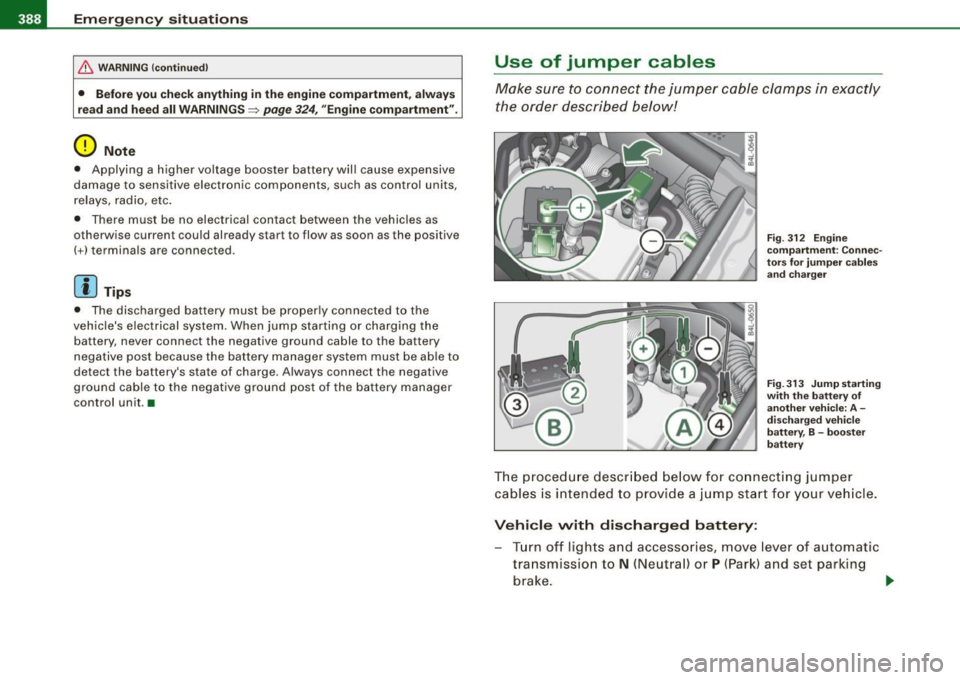
Use of jumper cables
Make sure to connect the jumper c able clamps in exac tly
the order described below!
F ig . 3 12 E ngin e
co mpartm ent : Co nnec
to rs for ju mp er ca ble s
and cha rger
F ig . 3 13 Ju mp st artin g
w it h th e batte ry o f
ano ther v eh icle : A -
d isc harg ed ve h icle
b att ery, B -boo ster
b att ery
The procedure descr ibed below for co nnect ing jumper
cables is intended to provide a j ump star t for your vehi cle .
Vehi cle with discharged battery :
-Turn off lights and accessories, move lever of automatic
tra nsmissio n to
N (Neutral) or P (Par k) and set parking
brake .
~