tow AUDI Q7 2009 Owner´s Manual
[x] Cancel search | Manufacturer: AUDI, Model Year: 2009, Model line: Q7, Model: AUDI Q7 2009Pages: 426, PDF Size: 97.13 MB
Page 308 of 426
llffl!I Trailer towing
------=---------------------------------
& W ARN ING (continued )
• The Gros s Vehicle Weight Rating for your Audi 07 vehicle ,
found on the safety compliance l abel on the driver's side B -pillar ,
must never be ex ceeded under any cir cumstances . E xceeding the
Gross Vehi cle Weight Rating of your vehicle is likely to damage
your vehicle , and such damage w ill not be covered by your Limited
New Vehicle Warranty. Exceeding the Gro ss Vehicle Weight Rating
will also change the performan ce and handling characteristics of
your vehicle , which could cause a crash resulting in serious injury
or death .
• The Gros s Vehicle Weight Rating for your Audi 0 7 would be
e xc eeded if your veh icle is simultaneously equipped with
Panoramic sliding sunroof ; third -row seating ; trailer towing equip
ment (factory or dealer -installed) , and running boards (dealer
installedl. UNDER NO CIRCUMSTANCES MAY ALL SUCH ITEMS BE
INSTALLED ON THE SAME VEHICLE .
a
Operating instructions
---------~--~-------
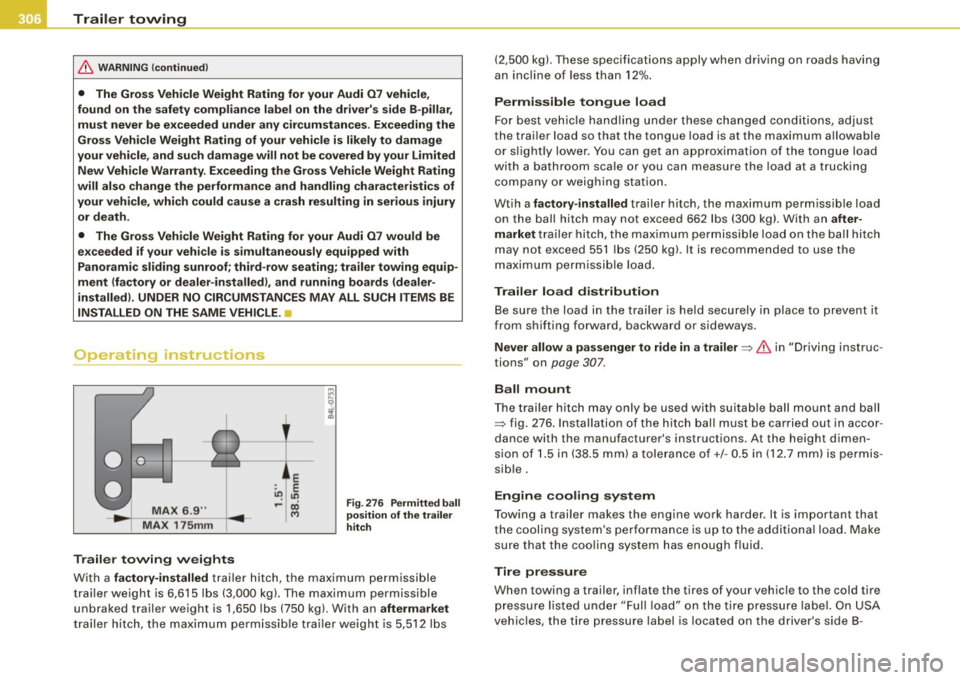
MAX 6.9"
MAX 175mm
Trailer towing weights
Fi g. 2 76 P erm itted ball
po sition of the trailer
hitch
With a factory-installed trai ler hitch, the maximum permissible
trai ler weight is 6,615 lbs (3,000 kg). The maximum permissible
unbraked trailer weight is 1,650 lbs (750 kgl. With an
aftermarket
tr ailer h itch , the maxi mum pe rm iss ib le tra iler weigh t is 5,51 2 lb s (2,500
kg). These specifications apply when driv ing on roads having
an in cli ne of less t han 12% .
Permissible tongue load
Fo r best v ehicle ha ndling under th es e changed con ditio ns, a dju st
the trai ler load so that the tongue load is at the maximum allowable
or s lightly lower. Y ou ca n ge t an ap proxi mati on of the tong ue load
with a bathroom sca le or you can measure the load at a trucking
company or weig hing s tati on.
Wtih a
factory -installed trailer hi tch, the max imum perm issib le load
on the ball hitch may not exceed 66 2 lbs (300 kg) . With an
after
market
t ra iler hitc h, the max imum pe rmi ssible loa d on the ball h itch
may not exceed 55 1 lbs (250 kg). It is recommended to use the
m aximum p ermi ssi ble l oad.
Trailer load distribution B e sure the load in the trai ler is he ld securel y in place to prevent it
from shifting forward, backward or sideways.
Never allow a passenger to ride in a trailer=> & in "D riving ins truc
tions" on page 307.
Ball mount
T he trai ler hitch may only be used with suitab le ball mount and ball
=> fig. 276 . In sta llati on of t he hitch ball must be ca rr ie d o ut i n a ccor
dance with the manufacturer's instructions. At the height dimen
s io n of 1 .5 in (38 .5 mm) a tole ran ce o f+/- 0 .5 in (12 .7 mm) is pe rmis
sib le.
Engine cooling system
T owing a trai ler makes the engine work harder. It is important that
th e c ooli ng system 's per forman ce is u p to the a ddi tiona l loa d. Ma ke
sure that the coo ling s ystem has enough f luid.
Tire pressure
When towing a trailer, inflate the tires of your vehic le to the cold tire
p re ssure l is ted unde r "Full load" on th e tire press ure l abe l. On USA
vehic les, the tire pressure label is located on the driver's side 8 -
Page 309 of 426
pillar. On Canada vehicles, the tire pressure label is located either on
t he driver's side 8 -pillar or inside the fuel fil ler flap. Inflate trailer
tires to trailer and tire manufacturers' specifications.
L ight s
The head light settings should be checked with the trailer attached
before driving off . Check to make sure both vehicle and trai ler lights
are working properly.
Sa fety c hain s
Be sure trailer safety chains are properly connected from the trailer
to the hitch on the vehicle . Leave enough slack in the chains to
permit turning corners. When you insta ll safety chains, make sure
they will not drag on the road when you are driving .
The chains should cross under the tra iler tongue to prevent it from
dropping in case of separation from the hitch.
0 Note
If you are going to tow a traile r, you must activate the trailer opera
tion mode =>
page 211, "Towing a trailer" .
Driving instructions
Driving with a trailer always requires extra care and
consideration.
To obtain the best possible handling of vehicle and trailer,
please note the fo llow ing:
- Do not tow a loaded trailer when your car i tse lf is not
loaded .
- Be especia lly careful when passing other vehicles .
- Observe speed l imits.
- Do not drive at the maximum permiss ible speed .
Controls and equip
ment Safety first Vehicle operation
Tr
aile r t owing
Always apply brakes early .
- Monitor the temperature gauge .
Weigh t dis tr ibution
Towing a loaded trailer wi th an empty car results in a highly
unstable dis tribution of weight . If this cannot be avoided , drive at
very low speeds only to avoid the risk of losing steering control.
A "balanced" rig is easier to operate and control. This means that
the tow vehicle should be loaded to the extent possible and permis
sib le, while keeping the trailer as light as possib le under the circum
stances . Whenever possible, transfer some cargo to the luggage
compartment of the tow vehicle whi le observing tongue load
requirements and vehicle loading considerations .
Speed
The higher th e speed, the more difficu lt it becomes for the driver to
control the rig . Do not drive at t he maximum pe rmissible speed.
Reduce your speed even more
if load, weather or wind conditions
a re unfavorable -particularly when going downhil l.
Reduce vehicle speed
i mmedi ate ly if the trailer shows the slightest
sign of swaying.
Do not tr y to s top the swaying by accelerating .
Observe speed limits . In some areas, speeds for vehicles towing
trailers are lower than for regular vehicles .
Always apply brakes early. When driving downhill, shift into a lower gear to use the engine braking effect to slow the vehicle. Use of the
brakes alone can cause them to overheat and fa il.
Coo lant t emperatu re
The coolant temperature gauge=> page 13 must be obse rved care
ful ly. If the need le moves close to the upper end of the sca le , reduce
speed immediately and/or turn off the air conditioner .
If the coolant temperature warning light in the instrument cluster
starts f lashing
- f- , pul l off the road, stop and let the engine idle for
about two minutes t o prevent heat build -up.
Vehicle care Do-it-yourself service Technical data
Page 310 of 426
ll'I __ T_ r _a_ il_e _r_ t_ o_ vv_ in__... g,_ __________________________________________________ _
& WARNING
Anyone not properly restrained in a moving vehicle is at a much
greater risk
in an accident. Never let anyone ride in your car who
is not properly wearing the restraints provided by Audi .
c:
Trailer towing tips
Important to know
Your vehicle handles differently when towing a trailer because of
the additional weight and different weight distribution. Safety,
performance and economy will greatly depend on how carefully you
load your trailer and operate your rig.
Before you actually tow your trailer, practice turning, stopping and
backing up in an area away from traffic. Keep practicing until you
have become completely familiar with the way your vehicle -trailer
combination behaves and responds.
Backing up is difficult and requires practice. Backing up with a
trailer generally requires steering action opposite to that when
backing up your vehicle without a trailer.
Maintain a greater distance between your vehicle and the one in
front of you. You will need more room to stop. To compensate for
the trailer, you will need a larger than normal turning radius.
When passing, remember that you cannot accelerate as fast as you normally would because of the added load. Make sure you have
enough room to pass. After passing, allow plenty of room for your
trailer before changing lanes again.
Avoid jerky starts, sharp turns or rapid lane changes.
[ i] Tips
• Do not tow a trailer during the break-in period of your vehicle. • If you tow
a trailer, your Audi may require more frequent mainte
nance due to the extra load~
page 401. •
Parking on a s1ope
Do not park on a slope with a trailer. If it cannot be
avoided , do so only after doing the following:
When parking:
-Apply the foot brake.
- Have someone place chocks under both the vehicle and
the trailer wheels.
- With chocks in place, slowly release the brakes until the
wheel chocks absorb the load.
- Turn the wheels towards the curb.
- Apply the parking brake.
- Move the selector lever to
P.
When restarting after parking:
- Apply the foot brake.
- Start the engine.
- Move the selector lever to
D.
-Release the parking brake and slowly pull out and away
from the wheel chocks.
- Stop and have someone retrieve the wheel chocks.
[ i] Tips
I f you move the selector lever of the automatic transmission to P
before applying the parking brake and before blocking the wheels, II-
Page 311 of 426

you may have to use more force later to move the lever out of the P
position .•
Controls and equip
ment Safety first Vehicle operation
Trailer towing
Vehicle care Do-it-yourself service
Technical data
Page 319 of 426
____________________________________________ ...:C :..: l:..: e :.: a::. n:....:..:..: in~ g~ a~n .:..:d::....! p::. r :..:o:::..::. te:::..::: c:..::t ..:..:io ::::.: n:...__,n
•
Windows
Clear vision to all sides.
Clean all windows regularly to remove road film and
carwash wax buildup.
- Remove snow from windows using a brush.
- Use a plastic ice scraper to remove ice from windows and
mirrors.
- Remove other residue on the windows with a spray-on
glass cleaner.
- Wipe the windows dry with a clean piece of cloth or
kitchen paper towel.
The best way to remove snow from windows and mirrors is to use a
brush. Use a non-abrasive plastic ice scraper -better still, a spray
deicer -to remove
ice from windows and mirrors .
The windows must not be cleaned with insect remover or wax since
these can interfere with the function of the windshield wiper blades (chatter).
Oil, grease , or silicone residue can be removed with glass cleaner or
silicone remover. However, wax residue requires the use of a
specially formulated solvent. Please contact your authorized Audi
dealer for advice on safe products for wax removal.
Windows should also be cleaned on the inside at regular intervals.
Never dry windows with the same chamois that you use to dry
painted surfaces. Wax residue on the chamois can impair vision
through the windows .
& WARNING
• Always read and heed all WARNINGS and other information
=> page 312.
& WARNING (continued)
• The windshield must not be treated with water-repellent mate
rials. They can increase glare under poor visibility conditions such
as wetness, darkness, or when the sun is low on the horizon. In
addition, they can cause the windshield wipers to chatter.
0 Note
• Never use warm or hot water to remove snow and ice from
windows and mirrors. This could cause the glass to crack.
• To prevent damage to the wires of the rear defogger, do not place
any adhesive stickers on the inside of the rear window over the
wires.
• To help prevent dirt from scratching the window, always scrape
in a forward direction -pushing the scraper away from you -never
back and forth .•
Weatherstrips
Complete car core includes the weatherstrips as well.
Apply a suitable rubber conditioner to the weatherstrips
from time to time.
To be able seal properly, the weatherstrips around the hood, doors,
rear lid, etc. must remain pliable. Spray the weatherstrips with sili
cone or coat them with talcum powder or glycerine to retain the
flexibility of the rubber and to protect them against freezing in the
winter.
& WARNING
Always read and heed all WARNINGS and other information
=> page 312.
Vehicle care I t •
Page 324 of 426
-Cleaning and prot ection
Pt'l:I-~--------------
Applies to vehicles : with na tura l leather
Cleaning and caring for leather upholstery
and trim
N atural leather requires special care and attention.
Normal cleaning
C lean s oiled areas wi th a s lig htly mo istened cotton o r
w oole n cloth.
Mor e stubborn dirt
- More stubborn dirt can be removed using a cloth satu
rated with a mild soap solution (2 tablespoons m ild
liquid soap) .
- Neve r allow the soap solution to saturate the leathe r, and
make certain that no water soaks into the seams.
Wipe off the soap solution with a soft, dry clot h.
Cleaning spots
-Remove fresh water-based spots (su ch as coffee, tea,
juices, b lo od) with an a bsorbent c loth or paper towel.
- Remove fresh grease or oil-based spots (such as butter,
mayonnaise, choco late) with an absorbent c loth o r paper
towel, or use the cleaner from the leather care k it if t he
spot has not yet penetrated into the su rface of the
l eather.
- Use an oil/grease dissolving spray, if oil/grease spots
have dried on .
- Remove specific kinds of spots (ballpoint pen , fe lt
marker, fingernai l po lish, water -based paint, shoe polish ,
etc.) with a spot remover specifically formulated for lea ther .
Leather car e
-Every half year use a n approved leather care product
(availa ble from your author ized Audi deale r) to care for
t h e lea ther.
- Apply the produc t very spar ingly.
- Wipe i t off wit h a damp cloth.
If you have any questions about c leaning and caring fo r the lea ther
in your vehicle, i t is best to contact your authorized Audi dealer , who
wi ll be glad to help you a nd tell you about our ful l range of leather
care products, such as:
• Le ather cle aning and care kit
• Creams to care for co lored leather
• Spot r emovers for ba llpoint pens, shoe polish, etc .
• Oil/grease disso lving spray
• New and upcoming products .
& WARNING
Always read and heed all WARNINGS and other info rmation
~ page 312 .
0 Note
• Never use ch em ical solvents (e .g . lighter flu id, turpentine),
waxes, shoe po lish or simi lar products on the leather surfaces in
your Aud i.
• To avoid damage , have s tubbo rn stains removed by a commer
cia l cleaning spec ial ist .•
Page 357 of 426
Tires and wheels -_____________ .:.....::...=..____:__:_:_:_=-=----
•
& WARNING (continu ed )
• Incorrect tire pressure and /or under inflation can cause
in creased tire wear and can affect the handling of the vehicle and
stopping ability .
• Incorrect t ire pressures and /o r underinflat ion can also lead to
sudden tire failure, including a blowout and sudden deflation,
causing lo ss of vehicle control .
• The driver is respon sible for the correct tire pressures for all
tires on the vehicle. The applicable pre ssure values are located on
a sticker on the driver 's side 8-pillar or on the inside of the fuel
filler flap .
• Only when all tires on the vehicle are filled to the correct pres
sure , the tire pressure monitoring sy stem can work correctly .
• The use of incorrect tire pressure values can lead to accidents
or other damage . Therefore it is essential that the driver observe
the specified tire pressure value s for the tires and the correct pres
sures for the function of the tire pressure monitoring system.
• Always inflate tires to the re commended and correct tire pres
sure before driving off .
• Driving with underinflated tires bend more , letting them get
too hot resulting in tread separation , sudden tire failure and loss
of control.
• Ex cessive speed and /overloading can cause heat build-up ,
s udden tire failure and lo ss of control .
• If the tire pres sure is too low or too high , the t ires will wear
prematurely and the vehicle will not handle well .
• If the tire is not flat and you do not have to change a wheel
immediately , drive at reduced speed to the nearest service station
to check the t ire pressure and add air as required.
0 Note
Dr iving wi thout valve stem caps ca n cause damage to t he tire
valves. To prevent this, always make sure that factory instal led va lve
stem caps o n all wheels are sec urely mou nted on the va lve .
c£> For the sake of the environment
Underi nflate d tir es w ill a lso inc rease the fue l consu mptio n.•
Tires and vehicle load limits
There are li m its to the a mou nt o f load or weig ht th at any ve hic le and
any tire can carry . A vehicle that is overloaded wil l not handle wel l
and is more diff icu lt to stop . Overload ing ca n no t only lead to loss
of vehic le control, but can also damage important parts of the
ve hicle a nd can lead to sud den tire failu re, i nclu di ng a bl owou t and
sudden deflat ion that can cause the vehic le to crash.
Your safety an d that of your passengers also depends on ma kin g
su re tha t load l imits are not exceeded . Vehicle load includes eve ry
body and everything in and on the vehic le. These load limits are
t echnica lly re ferred to as the ve hicle's
Gross Vehicle Weight Rating
("GVWR"l.
The "GVWR" in clu de s th e we ig ht of t he basi c ve hicle, all fac tory
insta lled accessories, a ful l tank of fuel, oil, coolant and other fluids
plus m aximu m load. The maxi mum l oad inc lude s the n umber of
passen gers that the vehicle is intended to carry !"seating capacity")
with an assumed weight of 150 lbs (68 kg) fo r each passenger at a
designated seating position and the total weight of any lugga ge in
the vehicle. If you tow a trailer, the weight of the trailer hitch and the
to ngue we ig ht of th e loaded tra iler must b e included as par t of th e
vehic le load.
The
Gross Axle Weight Rating ("GAWR") is the m aximum loa d th at
can be applied at each of the vehicle's two ax les. _,,,
Vehicle care I t •
Page 359 of 426
3. Subtract the combined weight of the driver and passengers from
"XXX" kilo
grams or
"XXX" pounds shown on the
sticker=>
page 351, fig. 291.
4. The resulting figure equals the available amount of cargo and luggage load capacity. For example, if the
"XXX"
amount equals 1400 lbs. and there will
be five 150 lbs. passengers in your
vehicle, the amount of available cargo and luggage load capacity is 650 lbs. (1400-750 (5
X 150) = 650 lbs.)
5. Determine the combined weight of luggage and cargo being loaded on the
vehicle. That weight may not safely exceed the available cargo and luggage
load capacity calculated in Step 4.
6. If your vehicle will be towing a trailer, load from your trailer will be transferred
to your vehicle. Consult this manual to determine how this reduces the avail
able cargo and luggage load capacity of
your vehicle.
Tires and wheels -
-Check the tire sidewall (=> page 359,
fig. 295) to determine the designated
load rating for a specific ti re. •
Tire service life
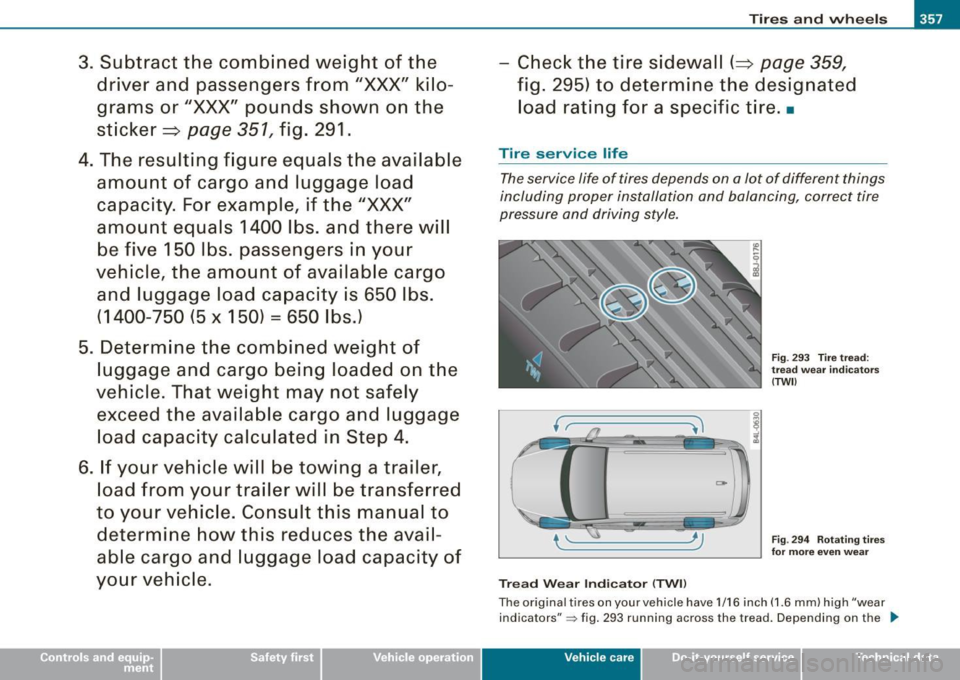
The service life of tires depends on a lot of different things
including proper installation and balancing, correct tire
pressure and driving style.
--
~-----------~
Tread Wear Indicator (TWI)
Fig. 293 Tire tread:
tread wear indicators
(TWI)
Fig. 294 Rotating tires
for more even wear
The original tires on your vehicle have 1 /16 inch (1.6 mm) high "wear
indicators" => fig. 293 running across the tread. Depending on the ._
Vehicle care I I irechnical data
Page 373 of 426
_____________________________________________ W.:..:..; h:..:.= a:.:t ..:.d=-= o:....:... I .::d :.:o :....:.. n:.:o::.. w.:...:.. ?:...___J -
& WARNING !continued)
• If you must work under the vehicle, always use safety stands
specifically designed for this purpose.
• Always make sure the inflatable spare tire and even a flat tire
are secured in place and not loose, otherwise they could fly
forward, causing personal injury to passengers in the vehicle in an
accident or sudden maneuver . •
Tools
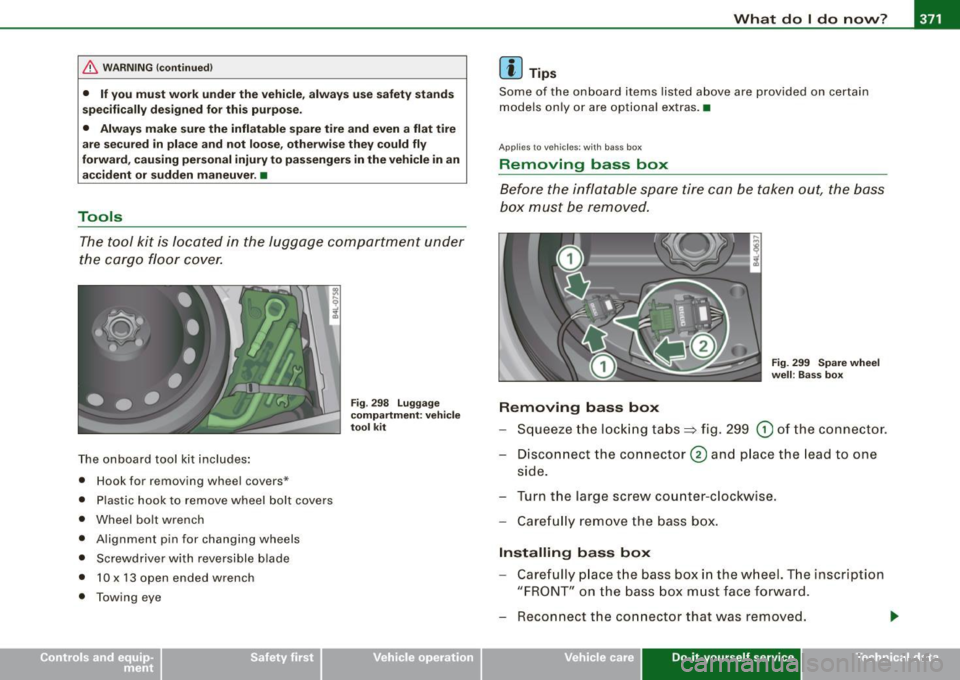
The tool kit is located in the luggage compartment under
the cargo floor cover.
The onboard tool kit includes:
• Hook for removing wheel covers *
• Plastic hook to remove wheel bolt covers
• Wheel bolt wr ench
• Alignment p in for changing wheels
• Screwdriver with reversible blade
• 10
x 13 open ended wrench
• Towing eye
Fig . 298 Luggage
compartment : vehicle
tool kit
[ i] Tips
Some of the on board items listed above are provided on certain
models only or are optional extras .•
A pp lies to ve hicles: w ith bass box
R emoving bass box
Before the inflatable spare tire can be taken out, the bass
box must be removed.
Fig . 299 Spare wheel
well : Bass box
Removing bass box
- Squeeze the locking tabs~ fig. 299 G) of the connector.
- Disconnect the connector @ and place the lead to one
side.
- Turn the large screw counter-clockwise.
- Carefully remove the bass box.
Installing bass box
-Carefully place the bass box in the wheel. The inscription
" FRONT " on the bass box must face forward.
- Reconnect the connector that was removed.
Vehicle care Do-it-yourself service irechnical data
Page 374 of 426

-What do I do novv? PV:f.,___ ______________ _
-Secu re th e bass b ox w it h t he larg e sc re w. •
Inflatable spare t ire
T he i nfla tab le sp are tir e ex pand s to its full di amet er wh en
it is inflated.
Removing inflatable spare tire
Fig . 300 Inflat able
spare t ire with
compres sor
Li ft up th e carg o floo r u sing the handl e.
- T urn t he l arg e scre w:::> fig. 300 coun ter-c loc kwi se.
Re move the bass bo x as req uir e d :::>
page 371.
- Take o ut th e inflatable s pare t ire.
Stowing the inflatable spare tire
Relea se th e air by un screwing the valve st em .
Sc re w the va lv e st em b ack in afte rwards.
Wait a few hours b efo re pl acin g the wh eel in th e sp are
w he el w ell :::>
& .
Install t he bass b ox as require d:::> page 371.
S ec ure the whe el wit h th e large s cre w. - Fo
ld the cargo floor bac k d own.
After using the inflatable spare wheel
The inflatab le spare ti re can be re-used as long as it is not damaged
an d is n ot worn d own to the tre ad wea r indi cato rs=> &.
When you l et the air out of the inflatabl e spare tir e, it do es not
a ss ume it s fo lded shape aga in for severa l hou rs . U ntil then, it
c annot be plac ed bac k in the sp are whe el well and s tow ed sec urel y.
& WARNING
• Never use the spare tire if it is damaged or if it is worn down to
the tread wear indicators.
• If the inflatable spare tire is more than 6 years old, use it only
in an emergency and with extreme caution and careful driving.
• The inflatable spare tire is intended only for temporary and
short-term use. It should be replaced as soon as possible with the
normal wheel and tire .
• Maximum inflation pressure for the inflatable spare tire is
50 PSI (3 .5 bar).
• Maximum permissible speed is 50 mph (80 km /h ).
• Avoid full -throttle acceleration , heavy braking, and fast
cornering .
• When the air is let out of the inflatable spare wheel , it does not
assume its folded shape for several hours . Until then , it cannot be
placed back in the spare wheel well and stowed securely .
• Never drive with more than one inflatable spare tire.
• For technical reasons , the use of tire chains on the inflatable
spare tire is not permitted . If it is necessary to drive with tire
chains, the inflatable spare wheel must be mounted on the front
axle in the event of a flat in a rear tire. The newly available front
wheel must then be installed in place of the rear wheel with the
flat tire . Installing the tire chain before mounting the wheel and
tire is recommended . .,.