engine AUDI Q7 2010 Owner´s Manual
[x] Cancel search | Manufacturer: AUDI, Model Year: 2010, Model line: Q7, Model: AUDI Q7 2010Pages: 390, PDF Size: 93.04 MB
Page 309 of 390

___________________________________________ C_ h _ e_c _k _ i_n -=g .._ a_n _ d_ f_i _ll _i _ n -=g '-- ....... JIII
<£> For the sake of the environment
Dra ined coolant sho uld not be reused. A lways dispose of used coolan t
w hile observing a ll enviro nmental regulations .•
Radiator fan
T he radia tor fa n switc hes on a utoma tically by itself
The radiator fan is driven by the engine via the V-belt. The v iscous
cl utch reg ulates the spee d of t he fan accord ing to t he tem pera ture o f
the coolant.
An aux ili ar y e lec tric r adi ator fan* sw itches on and o ff depend ing o n
coo la nt temperat ure and other vehicle operating conditions.
After you switch the engine off, the auxiliary fan can continue r unning
for up to 10 minutes -eve n w it h t he igni tion o ff.
It can even swit ch on
again later by itse lf => & , if
• t he tem pera ture of the e ngi ne coola nt rises due to the hea t build
up from the eng ine in the engine compa rtment, o r
• th e engine compar tmen t heats up because the ve hicl e is parked in
intense s unlight.
& WARNING
• To reduce the risk of personal injury never touch the radiator
fan .
• The auxiliary electric fan is temperature cont rolled and can
switch on suddenly even when the engine i s not running.
• The auxiliary radiator fan switche s on automatically when the
engine coolant reaches a certain temperatu re and will continue to
run until the coolant temperature drops. •
~ehicle OP-eration
Brake fluid
Checking brake fluid level
The brake flu id l eve l can be checke d with a quick gl ance .
Fig . 236 Engine
compa rtment : Brake
fluid rese rvoir
Before you check a nyt hin g i n th e eng ine compa rtment ,
always read and heed all WARNINGS~ & in " Working in
the e ng ine co mpartmen t" on
page 297.
- Read the brake fluid level f rom t he bra ke flu id reservoir
~ fig. 2 36 . The bra ke fluid leve l must be between the
" MIN " and "MAX" markings.
Th e brake fl uid rese rvoir is located at the rear partition of t he engine
compartment on the left side=>
page 298.
The fluid level may drop slightly after some time due to the auto
m atic adjus tmen t of th e br ake pads. This is no t ca use for alarm .
If the brake fluid level falls
considerably below the "MIN" mark, t he
brake warn ing/i nd icator lig ht ( U.S. models :
BRAKE, Canadian mode ls:
ill ) will come on=> page 20 and=> page 29 . Do not continue to
operate the vehicle . The complete brake system s hould be thorough ly
che cked by an au thori zed Aud i dea le r o r q ua lified wor kshop a nd the
cause corrected.
If t h e brake fl uid leve l is too low, the brake .,,_
Vehicle care Do-it-yourselt service iTechnical data
Page 312 of 390
llft!I __ C_ h_ e_c _k _i _ n _g ~ a_n _d_ f_il _l_in _ g _________________________________________ _
& WARNING (conti nu ed )
• Always wear eye protection. Do not let battery acid or any lead
particles get on your skin or clothing. Shield your eyes. Explo sive
gases can cause blindness or other injury.
• Battery acid contains sulfuric acid. Sulfuric acid can cause
blindnes s and severe burns .
- Always wear gloves and eye protect ion. Do not tilt the
battery because acid could leak out of the ventilation open
ings.
- If you get battery acid in your eyes or on your skin , immedi
atel y rinse with cold water for several minutes and get medical
attention.
- If you should ingest any battery acid, seek medical attention
immediately.
• Do not expose the battery to an open flame, elect ric sparks or
an open light .
• Do not smoke.
• Do not int erchange the positive and negative cab les .
• When working on the battery, be sure not to short-cir cuit the
terminals with tools or other metal obje cts. This would cause the
battery to heat up very quickly, which could lead to damage or
explosion and per sonal injury .
• When a battery is charged , it produces hydrogen gas which i s
e xplosive and could cause personal injury.
• Always keep the battery well out of the reach of children .
• Before work is done on the electrical system, disconnect the
negative ground cable.
• Befo re performing any work on the electrical system , swit ch
off the engine and ignition as well as any electrical equipment .
The negative cable on the battery must be disconnected. If you are
ju st going to replace a light bulb, then it is enough to switch off
the l ights.
& W ARNING (continued )
• Before di sconnecting the battery , switch off the anti-theft
alarm system! Otherwise you w ill set off the alarm .
• When disconnecting the battery, first disconnect the negative
cable and then the po sitive cable .
• Before reconnecting the battery , make su re all electri cal
consumers are sw itched off . Reconnect the positive cable first and
then the negative cable. Never interchange the cables - this could start a fire!
• Never charge a frozen or a thawed-out battery. It could
e x plode! If a battery has frozen, then it must be replaced. A
di scharged battery can freeze o ver at 32 °F (0 °C ).
• Make sure the vent hose is always attached to the open ing on
the side of the battery .
• Never use batte ries which are damaged . There is the danger of
an explosion! Alway s repla ce a damaged battery .
& WARNING
California Proposition 65 Warning:
• Battery posts , terminals and related accessorie s contain lead
and lead compounds, chemicals known to the State of California
to cause cancer and reproductive problems. Wash hands after
handling.
0 Note
• Do not disco nne ct the vehi cle battery when t he ign it ion is
switched on o r when the engine is running, otherwise, you wi ll
da mage e le ctronic compone nts in t he e lec trica l system .
• If your ve hicle is go ing to stan d for a long period of time witho ut
bei ng d rive n, protect the ba tte ry from "freezing", ot herwis e it w ill be
damaged and will then have to be replaced.•
Page 313 of 390
Checking and filling -
-------------------=------=:;______,.J,,...
Battery charging
Starting the engine requires a well charged battery.
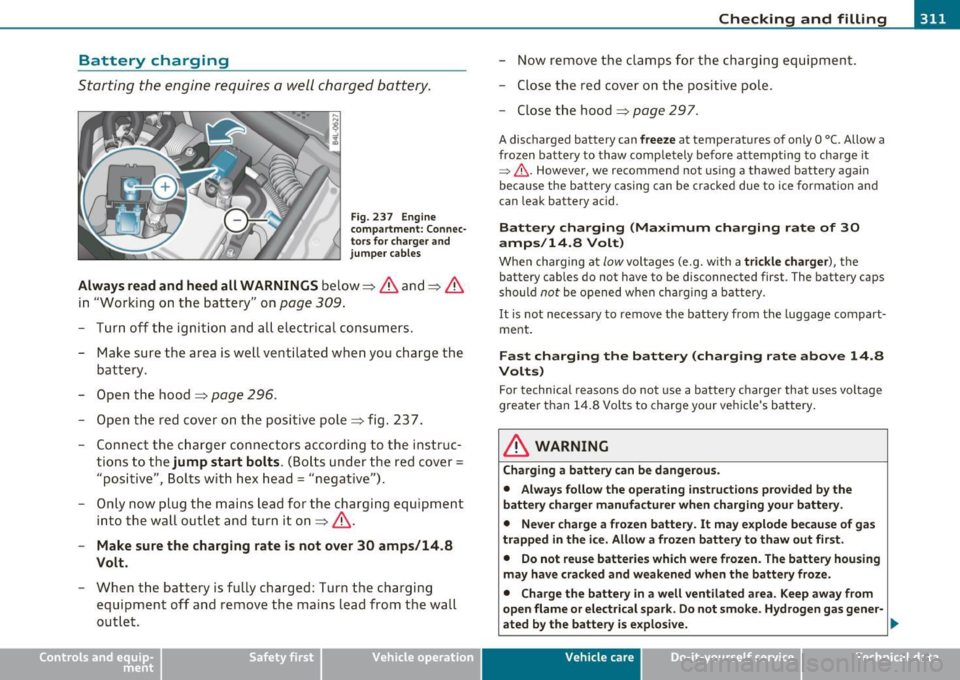
Fig. 237 Engine
compa rtment : Connec
tor s for charger and
jumper cables
Always read and heed all WARNINGS below=> & and => &
in "Working on the battery" on
page 309.
- Turn off the ignition and all electrical consumers.
- Make sure the area is well ventilated when you charge the
battery.
- Open the hood :::::,
page 296.
-Open the red cover on the positive pole =>fig. 23 7.
- Connect the charger connectors according to the instruc-
tions to the
jump start bolts . (Bolts under the red cover=
"positive", Bolts with hex head
= "negative") .
- Only now plug the mains lead for the charging equipment
into the wall outlet and turn it on =>& .
-Make sure the charging rate is not over 30 amps/14.8
Volt.
- When the battery is fully charged: Turn the charging
equipment off and remove the mains lead from the wall
outlet.
Vehicle OP-eration
-Now remove the clamps for the charging equipment.
- Close the red cover on the positive pole.
- Close the hood :::::,
page 297.
A discharged battery can freeze at temperatures of only O 0C. Allow a
frozen battery to thaw completely before attempting to charge it
~ & .However, we recommend not using a thawed battery again
because the battery casing can be cracked due to ice formation and
can leak battery acid.
Battery charging (Maximum charging rate of 30
amps/14.8 Volt)
When charging at low voltages (e.g. with a trickle charger ), the
battery cables do not have to be disconnected first . The battery caps
sho uld
not be opened when charging a battery.
It is not necessary to remove the battery from the luggage com part·
ment.
Fast charging the battery (charging rate above 14.8
Volts)
For technical reasons do not use a battery charger that uses voltage
greater than 14.8 Volts to charge your vehicle's battery .
& WARNING
Charging a battery can be dangerous.
• Always follow the operating instructions provided by the
battery charger manufacturer when charging your battery.
• Never charge a frozen battery. It may explode because of gas
trapped in the ice. Allow a frozen battery to thaw out first.
• Do not reuse batteries which were frozen. The battery housing
may have cracked and weakened when the battery froze.
• Charge the battery
in a well ventilated area. Keep away from
open flame or electrical spark. Do not smoke. Hydrogen gas gener-
ated by the battery is explosive. •
Vehicle care Do-it-yourselt service Technical data
Page 314 of 390
-Checking and filling .,,,, _ _..::::.__-=-----------------
& WARNING (continued)
• To reduce the danger of explosion, never connect or disconnect
charger cables while the charger is operating.
• Fast charging a battery is dangerous and should only be
attempted by a competent technician with the proper equipment.
• Battery acid that may spill during charging should be washed
off with a solution of warm water and baking soda to neutralize
the acid.
0 Note
Never use a fast charger as a booster to start the engine. This will seri
ously damage sens it ive electronic components, such as control units,
relays, radio, etc ., as well as the battery charger.•
Battery replacement
The new battery must have the same specifications and
dimensions as the original equipment battery.
Intelligent energy management in your veh icle is responsible for
distributing the electrical energy throughout your vehicle
~ page 259. T he intelligent energy management system will keep
the engine battery charged better then vehicles without this system .
To make sure the additional electrical energy is available once again
after you have changed the battery, we recommend that you install
batteries of the same type and manufacture only (the same as those
installed at the time your vehicle was delivered). Specifications are
listed on the battery housing. Your authorized Audi dealer will then
code the battery management control unit.
If it is not poss ible to use a battery of this type, the new battery must
have the same capacity, vo ltage (12 volts), amperage, construction
and plug sea ling .
When installing the battery, make sure the ignition and all electrica l
consumers are turned off.
0 Note
Make sure the vent ilation hose on the side of the battery is
connected, otherwise fumes or battery acid can leak out.
mend your authorized Audi dealer change the battery for you.
Batteries contain sulfuric acid and lead and must always be disposed
of properly in compliance with all environmental regulat ions.
Disposing of vehicle batteries improperly is very dangerous to the
environment. •
Windshield/headlight washer
container
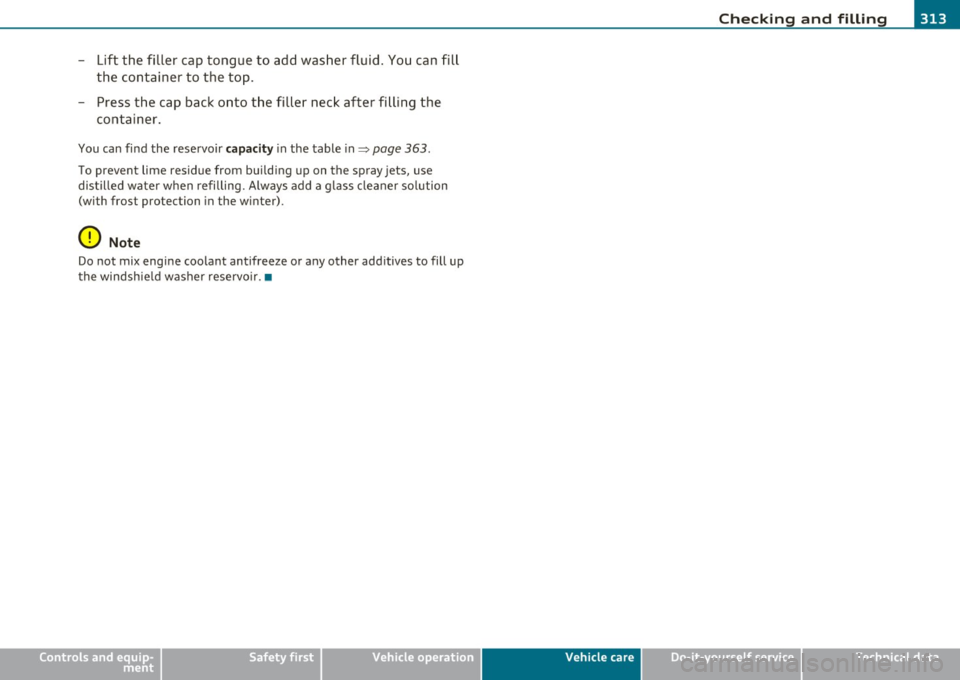
Fig. 238 Engine
com partm ent : Wind·
shield and headlight"
wash er fluid container
The washer fluid container is marked with the symbol~ on
its cap.
- Before you check anything in the engine compartment,
always read and heed all WARNINGS~ & in "Working
in the engine compartment" on page
297. ..,_
Page 315 of 390
Checking and filling --------------~--EMI
- Lift the filler cap tongue to add washer fluid . You can fill
the container to the top .
- Press the cap back onto the filler neck after filling the container.
You can find the reservoir capacit y in the table in=:> page 363.
To prevent lime residue from bu ilding up on the spray jets, use
distilled water when refilling. Always add a g lass cleaner so lution
(with frost protection in the w inter) .
0 Note
Do not mix engine coolant antifreeze or any other additives to fill up
the windshie ld washer reservo ir .•
Safety first Vehicle care Technical data
Page 321 of 390
________________________________________________ T_i_re _ s_ a _ n_d_ w_ h_ e_ e_l_s __ _
If you wish to improve comfort when operating the vehicle at
normal load (up to 3 o ccupant s), you can adjust tire pres sures to
those specified for normal vehicle load . Before operating the
vehicle at maximum lo ad, you must increase the tire p res sures to
those specified for maximum vehicle load=>& .
Bear in mind that the tire press ure monitor ing system can only
mon itor the t ire pressu re s you h ave sto red . T he sys tem does no t
recogn ize the load cond it ion of your vehicle.
Th e effectiveness of t he tire pressu re monitoring system will be
impa ired if you store normal load pressu res but then operate the
vehicle at its maxim um loa d=> & . See the
illustration=> fig. 239 for the location of the label on driver's
side B- pillar (colo r of the act ual la bel and ex act l ocation on the
vehicle will vary slig htly).
N ote that the fo llow ing tab le is accurate at the time of going to press
and is subjec t to change. I n the even t of discrepancies , the tire pres
sure label located on the dr iver's side B-pi llar a lways takes prece
dence .
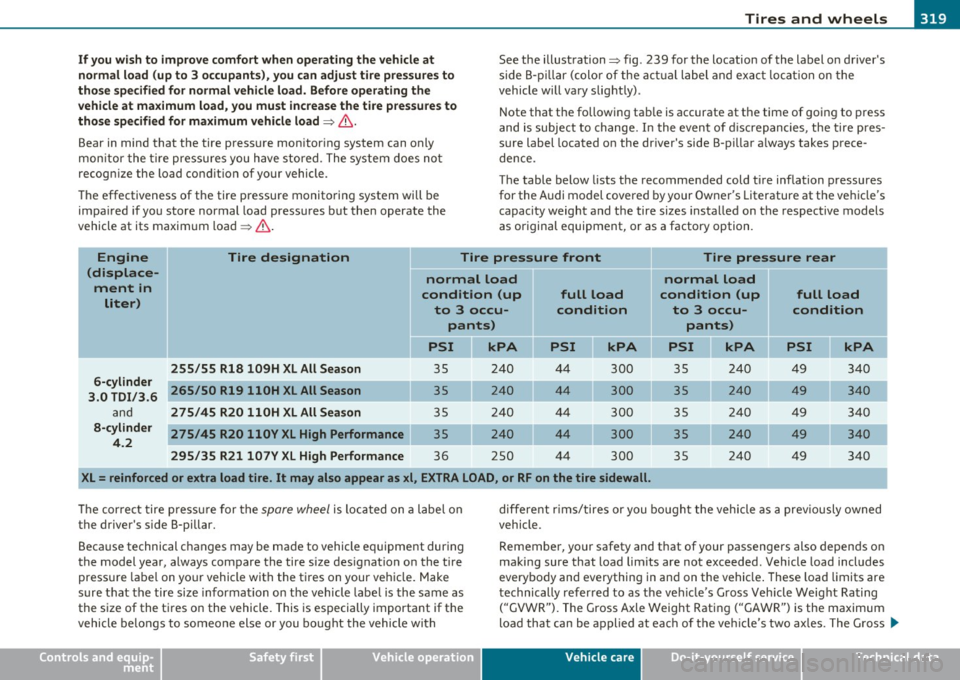
T he table below lists the recommended cold t ire inflation pressures
for the Audi model covered by your Owne r's Literature at t he ve hicle's
capac ity weight and the tire sizes insta lled on the respective models
as original equipment, or as a factory option .
Engine Tire designation Tire pressure front Tire pressure rear
(displace- normal load normal load
ment in
liter) condition
(up
full load condition (up
full load
to
3 occu- condition to 3 occu- condition
pants) pants)
PSI kPA PSI PSI kPA PSI kPA
255/55 R18 109H XL All Season 35 240 44 300
35 240 49 340
6-cylinder
265/50 R19 110H XL All Season
35 240 44 300 35 240 49 340 3.0 TDI/3
.6
and 275/45 R20 110H XL All Season 3 5 24 0 44 3 00 35 240 4 9 340
a-cylinder
275/45 R20 llOY XL High Performance 35 240
44 300
35 240 49 340 4
.2
295/35 R2110 7Y XL High Performance
36 250 44
300 35 240 49 340
XL= reinforced or extra load tire
. It may also appear as xi , EXTRA LOAD, or RF on the tire sidewall .
The correct tire p ress ure for t he spare wheel is loca ted on a labe l o n
the driver 's s ide B-pillar.
Beca use technical c hanges may be made to vehicle equipment dur ing
the model year, always compare the tire size des ignation on the t ire
pressu re labe l on yo ur vehicle with the t ires on your vehicle. Make
sure that the tire size informat ion on t he v ehicle labe l is the same as
the size of the t ires o n the vehicle. This is especially important if the
vehicle belongs to so meone else or you bo ug ht the vehicle with
Safety first
differe nt r im s/ tires or you bo ugh t the vehicle as a prev iously owned
vehicle.
Remember, yo ur safety and t hat of your passengers also depends o n
making sure that load limits are not exceeded. Vehicle load includes
everybody and everything in an d on the vehicle . These load limits are
t e chnically refer red to as the veh icle's G ross Veh icle Weig ht Rating
("GVW R"). The Gross Axle Weight Rati ng ("GAWR") is the maximum
load tha t can be applied at ea ch of the ve hicle's two ax les . T he G ross ..
Vehicle care Technical data
Page 339 of 390
_____________________________________________ W __ h_a _ t_ d_o_ I_ d _ o_ n_o_ w_ ? _ ___.11111
Release the two hook-and-loop fasteners, and remove the two
chocks . To use the chocks, you first have to raise the support plate
=>
page 336, fig . 248 (D and then insert the locking plate with the
two "tabs" into the elongated holes in the base plate @=>& .
& WARNING
• The chock cannot fulfil its function and may lose its stability if
the "tabs" on the support plate are not inserted correctly into the
elo ngated holes in the base plate. If this happens, the vehicle may
start to move while a wheel is being changed.
• Never use the folding chocks if they are damaged or if they
have not been assembled correctly.
& WARNING
Improper use of the vehicle jack can cause serious personal inju
ries.
• Never use the jack supplied with your Audi on another vehicle,
particularly on a heavier one. The jack is only suitable for use on
the vehicle it came with.
• Using a bumper jack to raise the vehicle will damage the
bumper system. The jack may slip, causing injury.
• Never support your vehicle on cinder blocks, bricks or other
objects . These may not be able to support the load and could cause
injury when they fail.
• Never start or run the engine while the vehicle is supported by
the jack.
• If you must work under the vehicle, always use safety stands
specifically designed for this purpose.
• Always make sure the inflatable spare tire and even a flat tire
are secured in place and not loose, otherwise they could fly
forward, causing personal injury to passengers in the vehicle in an
accident or sudden maneuver. •
Vehicle OP-eration
Applies to vehicles : with bass box
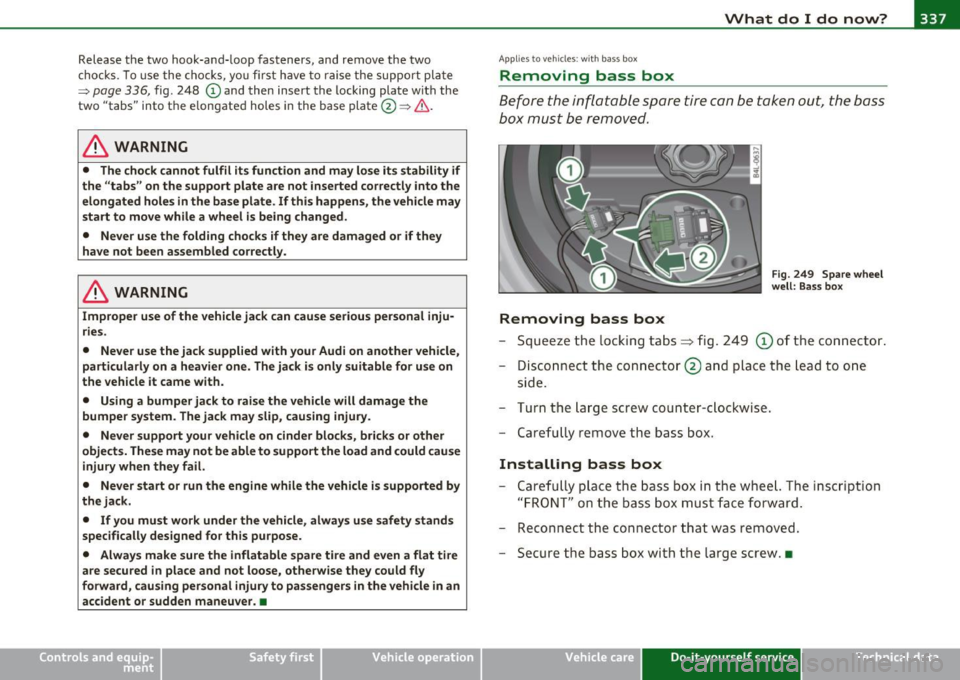
Removing bass box
Before the inflatable spare tire can be taken out, the bass
box must be removed.
Fig. 249 Spare wheel
well: Bass box
Removing bass box
-Squeeze the locking tabs=> fig. 249 (D of the connector.
- Disconnect the connector @ and place the lead to one
side.
- Turn the large screw counter-clockwise.
- Carefully remove the bass box.
Installing bass box
-Carefully place the bass box in the wheel. The inscription
"FRONT" on the bass box must face forward.
- Reconnect the connector that was removed.
- Secure the bass box with the large screw. •
Vehicle care Do-it-yourself service iTechnical data
Page 342 of 390
111.___W_ h_ a_t _ d_ o_ I_d_ o_ n_o _w_ ? ____________________________________________ _
-Block the diagonally opposite wheel with the folding
chocks or other objects.
- Take the
jack and the inflatable spare tire out of the
luggage compartment =>
page 336.
& WARNING
You or your passengers could be injured while changing a wheel if
you do not follow these safety precautions:
• If you have a flat tire, move a safe distance off the road. Turn
off the engine, turn the emergency flashers on and use other
warning devices to alert other motorists.
• Make sure that passengers wait
in a safe place away from the
vehicle and well away from the road and traffic.
• To help prevent the vehicle from moving suddenly and possibly
slipping off the jack, always fully set the parking brake and block
the wheel diagonally opposite the wheel being changed with the
folding chocks or other objects. When one front wheel is lifted off
the ground, placing the Automatic Transmission in "P" (Park) will
not prevent the vehicle from moving.
• Before you change a wheel, be sure the ground is level and
firm. If necessary, use a sturdy board under the jack.
• After installing the inflatable spare tire, make sure that you
replace the flat tire/wheel in its storage area properly and tighten
the knurled retaining screw securely. •
Changing a wheel
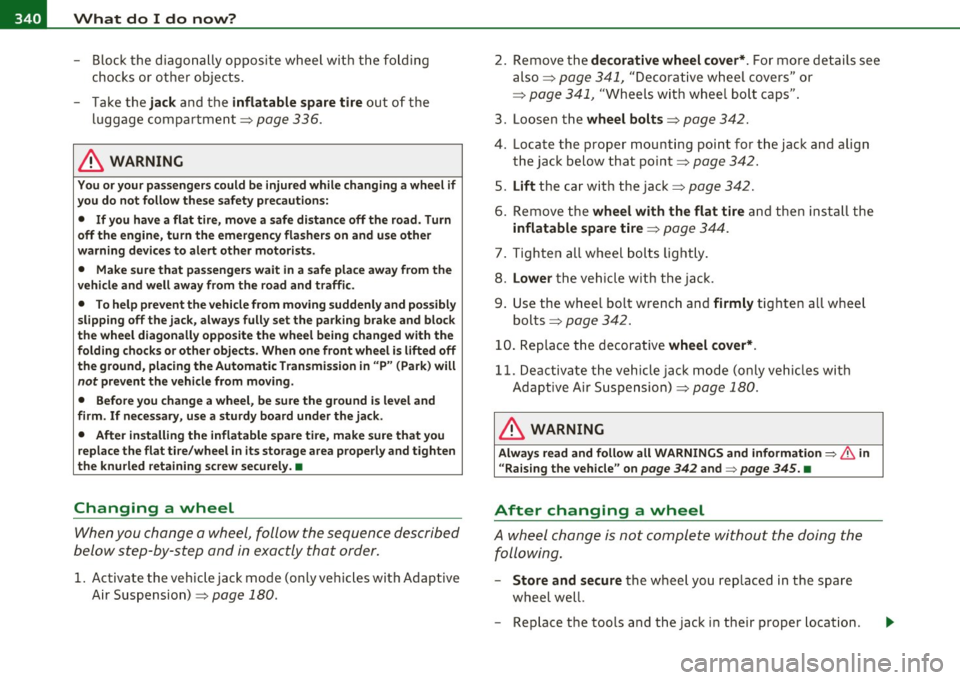
When you change a wheel, follow the sequence described
below step-by-step and in exactly that order .
1. Activate the vehicle jack mode (only vehicles with Adaptive
Air Suspension) =>
page 180.
2. Remove the decorative wheel cover*. For more details see
also =>
page 341, "Decorative wheel covers" or
=>
page 341, "Wheels with wheel bolt caps".
3. Loosen the
wheel bolts=> page 342.
4. Locate the proper mounting point for the jack and align
the jack below that point=>
page 342.
5. Lift the car with the jack=> page 342.
6. Remove the wheel with the flat tire and then install the
inflatable spare tire=> page 344.
7. Tighten all wheel bolts lightly.
8.
Lower the veh icle with the jack .
9. Use the wheel bolt wrench and
firmly tighten all wheel
bolts =>
page 342.
10. Replace the decorative wheel cover*.
11. Deactivate the vehicle jack mode (only vehicles with
Adaptive Air Suspension)=>
page 180.
& WARNING
Always read and follow all WARNINGS and information:::::, & in
"Raising the vehicle" on
page 342 and=> page 345. •
After changing a wheel
A wheel change is not complete without the doing the
following.
- Store and secure the wh eel you replaced in the spare
wheel well.
- Replace the tools and the jack in their proper location .
Page 354 of 390

Ill Emergency situations 1..--=---=;..._ ____________ _
Emergency situations
General
This chapter is intended for trained emergency crew s and working
pe rsonnel who have the necessary tool s and equipment to perform
the se operation s. •
Starting by pushing or towing
0 Note
Yo ur vehicle is equipped with an automatic t ransmission . Conse
quently, the engine ca nnot be started by push ing or tow ing .•
Starting with jumper cables
I f necessary, the engine can be started by connectin g it to
the bat tery of another vehicle.
If the eng ine shou ld fa il to start because of a discharged or weak
battery, the battery can be connected to t he battery of
another
veh icle, us ing a pair of jumper cables to start the eng ine .
Jumper cables
Use only jumper cables of sufficiently large cro ss section to carry the
sta rter cur rent safely . Refer to the m an ufa ct ur er's specificat ions.
Use only j umpe r cab les with
insulated te rm inal clamps wh ich are
distinct ly marked :
plus(+) cable in most cases colored red
minus (-) cable
in most cases colored b lack .
& WARNING
Batterie s contain el ectricity, acid, and gas . Any of the se can cause
very serious or fatal injury. Follow the inst ructions below for safe
handling of your vehicle 's battery.
• Always shield your eyes and avoid leaning over the battery
whenev er po ssible .
• A discharged battery can freeze at temperatures just below
32 °F (0 °C ). Before connecting a jumper cable, you must thaw the
frozen battery completely, otherwise it could explode.
• Do not allow battery acid to contact eyes or sk in . Flush any
contacted area with water immedi ately .
• Improper use of a booste r battery to start a vehicle may cause
an explosion .
• Vehicle batteries generate e xplosive gases. Keep sparks, flame
and lighted cigarettes away from batterie s.
• Do not try to jump start any vehicle with a low acid level in the
battery.
• The voltage of the booster battery must also have a 12-Volt
rating. The capacity (Ah) of the booster battery should not be
lower than that of the discharged battery . Use of batteries of
different voltage or substantially different "Ah " rating may cau se
an e xplosion and personal injury.
• Never charge a frozen battery . Gas trapped in the ice may cause
an explosion.
• Never charge or use a battery that has been frozen. The battery
case may have be weakened .
• Use of batteries of different voltage or substantially different
capacity (Ah) rating may cause an explosion and injury . The
capacity (Ah) of the booster battery should not be lower than that
of the discharged battery. .,_
Page 355 of 390
_____________________________________________ E_ m___;, e_r-=g ~ e_ n_c,_:!y:.__: s_i:..:t ..:..u :..:a;;,. t.:.; i...: o :..: n...:..:. s _ __,J_
& WARNING (continued)
• Before you check anything in the engine compartment, always
read and heed all WARNINGS~
page 286, "Engine compart
ment".
0 Note
• Applying a higher voltage booster battery will cause expensive
damage to sensitive electronic components, such as control units,
relays, radio, etc.
• There must be no electrical contact between the vehicles as other
wise current could already start to flow as soon as the positive(+)
terminals are connected.
[I] Tips
• The discharged battery must be properly connected to the
vehicle's electrical system . When jump starting or charging the
battery, never connect the negative ground cable to the battery nega
tive post because the battery manager system must be able to detect
the battery's state of charge. Always connect the negative ground
cable to the negative ground post of the battery manager control
unit. •
Vehicle OP-eration
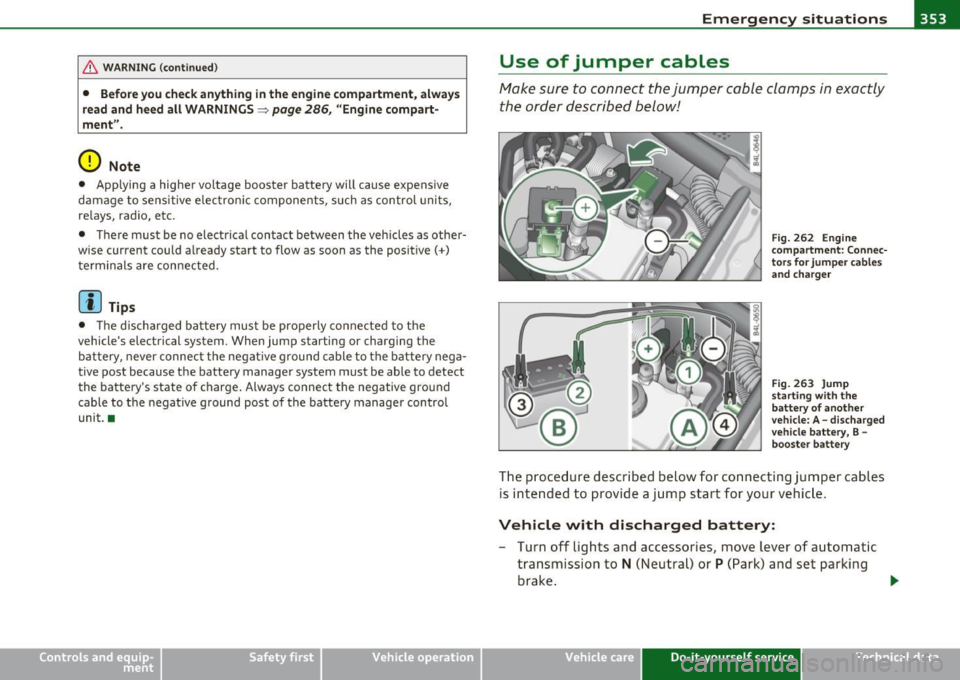
Use of jumper cables
Make sure to connect the jumper cable clamps in exactly
the order described below!
Fig. 262 Engine
compartment: Connec
tors for jumper cables and charger
Fig. 263 Jump
starting with the
battery of another
vehicle: A -discharged
vehicle battery, B -
booster battery
The procedure described below for connecting jumper cables
is intended to provide a jump start for your vehicle.
Vehicle with discharged battery:
- Turn off lights and accessories, move lever of automatic
transmission to
N (Neutral) or P (Park) and set parking
brake.
~
Vehicle care Do-it-yourself service iTechnical data