engine AUDI Q7 2010 Owner´s Manual
[x] Cancel search | Manufacturer: AUDI, Model Year: 2010, Model line: Q7, Model: AUDI Q7 2010Pages: 390, PDF Size: 93.04 MB
Page 356 of 390

llft.___E_ m_ e_r -=g =- e_ n_c -=y ;..._ s_i_t _u _a _ t_ i_ o _ n_ s ____________________________________________ _
Connect POSITIVE(+) to POSITIVE(+) (red)
- Open the red cover on the positive pole=> page 353,
fig. 262.
1. Connect one end of the positive cable (red) on the
jump
start bolt=>
page 353, fig. 263 (D (Bolts under red cover
= "positive") of the vehicle to be started @.
2. Connect the other end to the positive terminal @ of the
booster battery @.
Connect NEGATIVE(-) to NEGATIVE(-)
(black)
3. Connect one end to the negative terminal@ of the
booster battery @.
4. Connect the other end of the negative cable (black) to the
jump start bolt© (Bolts with hex head= "negative ") of
the vehicle to be started
@.
Starting the engine
- Start the engine of the vehicle with the booster battery.
Run the engine at a moderate speed.
- Start engine with discharged vehicle battery in the usual
manner.
- If the engine fails to start: do not keep the starter
cranking for longer than 10 seconds. Wait for about
30 seconds and then try again.
- With engine running, remove jumper cables from both
vehicles in the exact
reverse order.
- Close the red cover on the positive pole.
The battery is vented to the outside to prevent gases from entering
the vehicle interior. Make sure that the jumper clamps are well
connected with their
metal parts in full contact with the battery
terminals.
& WARNING
To avoid serious personal injury and damage to the vehicle, heed all warnings and instructions of the jumper cable manufacturer. If
in doubt, call for road service.
• Jumper cables must be long enough so that the vehicles do not
touch.
• When connecting jumper cables, make sure that they cannot
get caught in any moving parts in the engine compartment.
• Before you check anything in the engine compartment, always
read and heed all WARNINGS~
page 286, "Engine compart
ment".
0 Note
Improper hook-up of jumper cables can ruin the generator.
• Always connect POSITIVE(+) to POSITIVE( +), and NEGATIVE( -)
to NEGATIVE(-) ground post of the battery manager control unit.
• Check that all screw plugs on the battery cells are screwed in
firmly . If not, tighten plugs prior to connecting clamp on negative
battery terminal.
• Please note that the procedure for connecting a jumper cable as
described
above applies specifically to the case of your vehicle being
jump started. When you are giving a jump start to another vehicle, do
not connect the negative(-) cable to the negative(-) terminal on the
discharged battery©~
page 353, fig. 263. Instead, securely
connect the negative(-) cable to either a solid metal component that
is firmly bolted to the engine block or to the engine block itself.
If the
battery that is being charged does not
vent to the outside, escaping
battery gas could ignite and explode! •
Page 357 of 390
Emergency situations --------------=---:.-----JftPII
Emergency towing with
commercial tow truck
General hints
Your Audi requires special handling for towing.
The following information is to be used by commercial tow truck
operators who know how to operate their equipment safely.
• Never tow your Audi, towing will cause damage to the engine
and transmission.
• Never wrap the safety chains or winch cables around the brake
lines.
• To prevent unnecessary damage, your Audi must be transported
with a flat bed truck.
• To load the vehicle on to the flat bed, use the towing loop found
in the vehicle tools and attach to the front or rear anchorage
=> page 355 and=> page 356 .
& WARNING
A vehicle being towed is not safe for passengers. Never allow
anyone to ride in a vehicle being towed, for any reason. •
Vehicle OP-eration
Front towing loop
Do not install the front towing loop until it is needed.
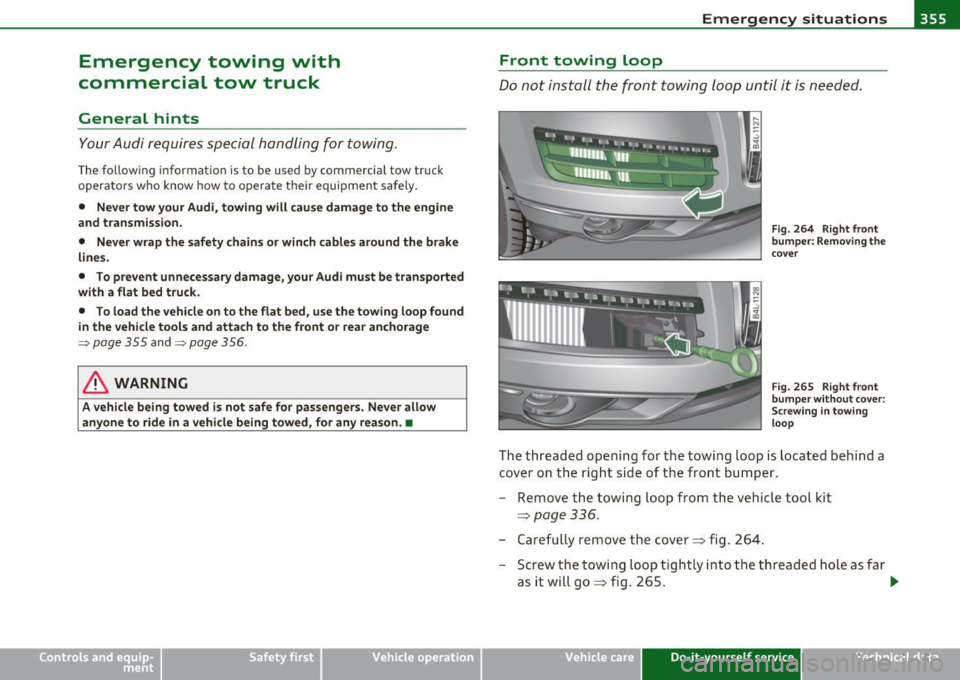
Fig. 264 Right front
bumper: Removing the
cover
Fig. 265 Right front
bumper without cover:
Screwing in towing
loop
The threaded opening for the towing loop is located behind a
cover on the right side of the front bumper.
- Remove the towing loop from the vehicle tool kit
=> page 336.
-Carefully remove the cover:::::, fig. 264.
- Screw the towing loop tightly into the threaded hole as far
as it will go=:> fig. 265 .
~
Vehicle care Do-it-yourself service iTechnical data
Page 360 of 390
ffl.___E_ m_ e_ r-' g=- e_n_ c=-y _ s_it _ u _ a_t_ i_ o _ n_ s ______________________________________________ _
- Insert a rubber pad between the floor jack/workshop hoist
and the lifting points.
If you must lift your vehicle with a floor jack to work underneath,
be sure the vehicle is safely supported on stands intended for this
purpose.
Front lifting point
The lifting point is located on the floor pan reinforcement about at
t he same level as the jack mounting point::::;,
page 357, fig. 269. Do
not lift the vehicle at the vertical sill reinforcement.
Rear lifting point
The lifting point is located on the vertical reinforcement of the lower
sill fo r the onboa rd jack ::::;,
page 357, fig. 270 .
Lifting with vehicle jack
Refer to::::;, page 342.
& WARNING
• To reduce the risk of serious injury and vehicle damage.
-Always lift the vehicle only at the special workshop hoist and
floor jack lift points illustrated::::;,
page 357, fig. 269 and
::::;, page 357, fig. 270.
- Failure to lift the vehicle at these points could cause the
vehicle to tilt or fall from a lift if there is a change in vehicle weight distribution and balance. This might happen, for
example, when heavy components such as the engine block or
transmission are removed.
• When removing heavy components like these, anchor vehicle
to hoist or add corresponding weights to maintain the center of
gravity. Otherwise, the vehicle might tilt or slip off the hoist,
causing serious personal injury.
0 Note
• Be aware of the following points before lifting the vehicle:
- The vehicle should never be lifted or jacked up from under
neath the engine oil pan, the transmission housing, the front or
rear axle or the body side members. This could lead to serious
damage.
- To avoid damage to the underbody or chassis frame, a rubber
pad must be inserted between the floor jack and the lift points.
- Before driving over a workshop hoist, check that the vehicle
weight does not exceed the permissible lifting capacity of the
hoist.
- Before driving over a workshop hoist, ensure that there is sufficient clearance between the hoist and low parts of the
vehicle. •
Page 362 of 390
lffl!I __ G_ e_n_ e_r _a _ l_ in_ f_o _r_ m_ a_ t_io _ n _______________________________________________ _
General information
Explanation of technical data
Some of the technical data listed in this manual requires
further explanation.
The technical data for your vehicle is listed in the charts starting on
~ page 363 . This sect ion prov ides genera l information, notes and
restrictions which app ly to this data .•
Veh icle identification
The key data is given on the vehicle identification number
(VIN) plate and the vehicle data sticker.
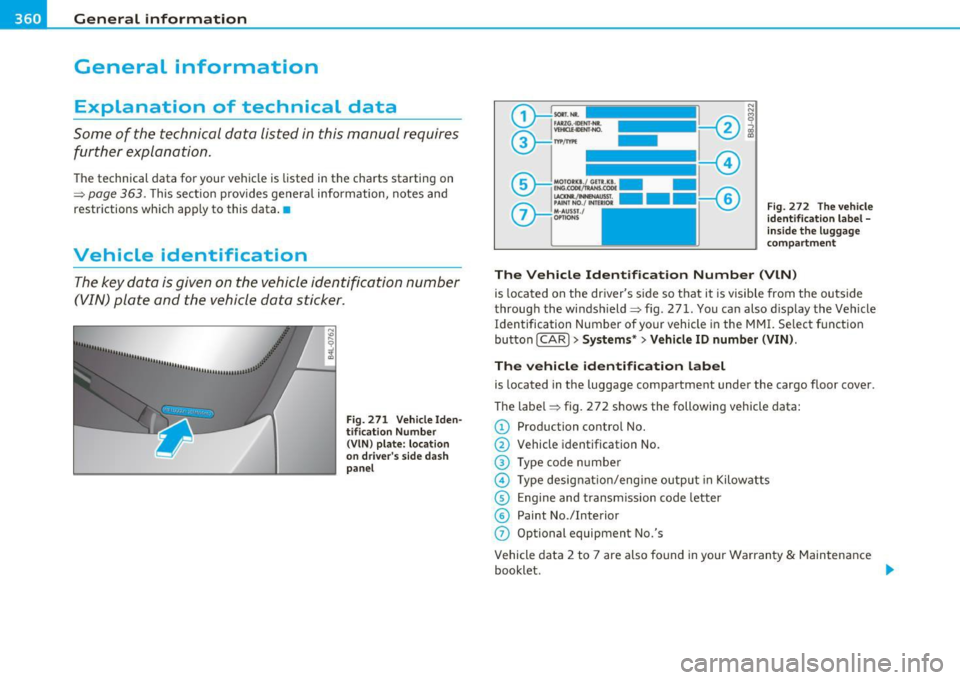
F ig. 27 1 Vehi cle I den
t ifi ca tion Nu mbe r
(V IN ) plate: locat io n
o n d river's s id e d ash
p an el Fi
g. 272 The vehi cle
i d enti ficati on l abel -
in side the l ugga ge
co mpa rtme nt
The Vehicle Id ent ifi cat ion Number (VlN )
is located on the driver's s ide so that it is visible from the outside
through the windshield ~ fig . 271. You can also d isp lay the Vehicle
Identification Number of your vehicle in the MMI. Se lect funct ion
button [CAR]>
S yst em s* > Vehicle ID number (VIN ).
The vehicle identifica tion lab el
is located in the luggage compartment under the cargo floor cover.
The label~ fig . 272 shows the following vehicle data:
© Production control No.
@ Vehicle identification No.
® Type code n umber
@ Type designat io n/eng ine output in Kilow atts
© Engine and transmission code letter
© Paint No./Interior
(j) Optional equipment No.'s
Vehicle data 2 to 7 are also found in your Warranty
& Maintenance
booklet . .,,
Page 365 of 390
____________________________________________________ D_ a_t_ a __ _
Data
280 hp, 6-cylinder engine, with all wheel drive
Engin e data
Maximum output SAE net
Maximum torque SAE net
No. of cy linders
Displacement
Stroke Bore
Compression ratio
Fuel
Dimensions (approx.)
Leng th (wi th l ice nse p la te br acke t)
W idth (w ith outs ide mir rors folded)
He ight (un loaded)
Tu rning circle diameter (curb to curb)
Capacities (approx.)
Fuel tank
- Tota l capacity
- Reserve (of total capacity)
Windshield and headlight* wa sher fluid container
Engine oil
with filter change
Safety first
hp@rpm
lb-ft@ rpm
CID (cm
3 )
in (mm)
in (mm) 280@ 6200
266@2750
6 cylinder
219.5 (3597)
3
.80 (96.4)
3 .50 (89)
12.0: 1
Premium unleaded (91 AKI) Recommended for maximum engine perfo rmance . Fur
th er details~ pag e 287, "Fuel supply"
in (mm)
i n (mm)
in (mm)
f t (m) 2
00 .3 (5089)
78 .1 (1983)
68.4 (1737)
39. 4 (12)
gal (liters)
gal (liters)
quarts (l ite rs)
quarts ( lite rs) 26
.4 (100)
2.6-3.2 (10-12)
4.8 (4. 5)
7.3 (6 .9)
•
Do-it,yourself service Technical data
Page 366 of 390
___ D_ a_t _a _____________________________________________________ _
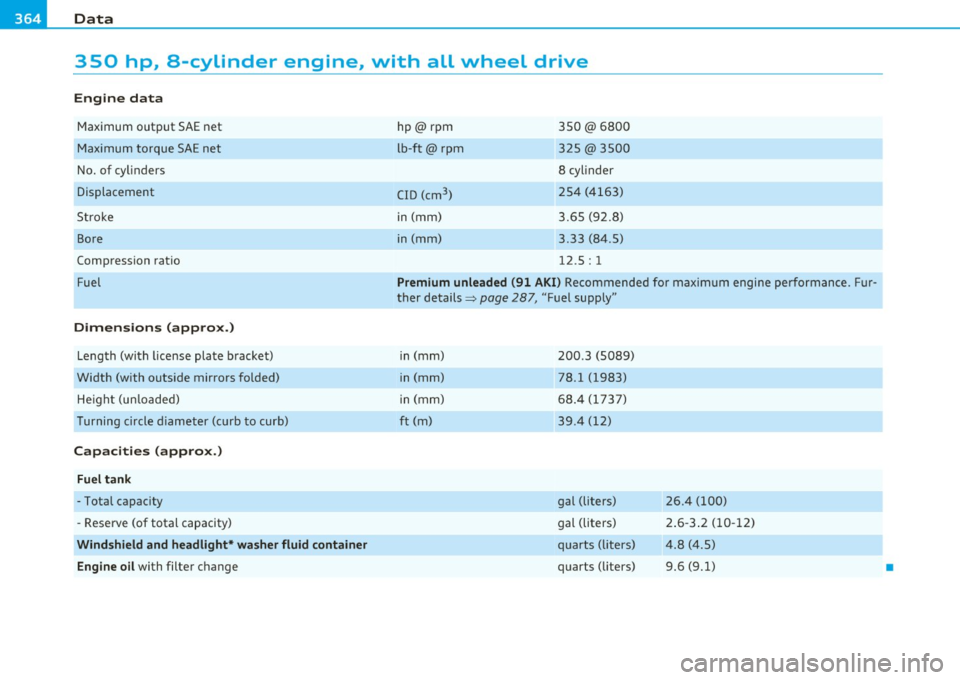
350 hp, a-cylinder engine, with all wheel drive
Engine data
Maximum output SAE net
Maximum torque SAE net
No. of cylinders
Displacement
Stroke
Bore
Compression ratio
Fuel
Dimensions (approx.)
Length (with license plate bracket)
Width (with outside mirrors folded) He ight (unloaded)
Turning circle diameter (curb to curb)
Capacities (approx.)
Fuel tank
-Total capacity
- Reserve (of total capacity)
Windshield and headlight* washer fluid container
Engine oil
with filter change hp @rpm
lb-ft@
rpm
CID (cm
3 )
in (mm)
in (mm) 350@ 6800
325
@3500
8 cylinder
254 (4163)
3.65 (92.8)
3 .33 (84 .5)
12.5: 1
Premium unleaded (91 AKI) Recommended for maximum engine pe rformance . Fur
ther details~
page 287, "Fuel supply"
in (mm)
in (mm)
in (mm)
ft (m) 200
.3 (5089)
78.1 (1983)
68.4 (1737)
39 .4 (12)
gal (liters)
gal (liters)
quarts ( liters)
quarts (liters) 26.4 (100)
2.6-3.2
(10-12)
4 .8 (4.5)
9.6 (9.1)
•
Page 367 of 390
____________________________________________________ D_ a_t_ a __ _
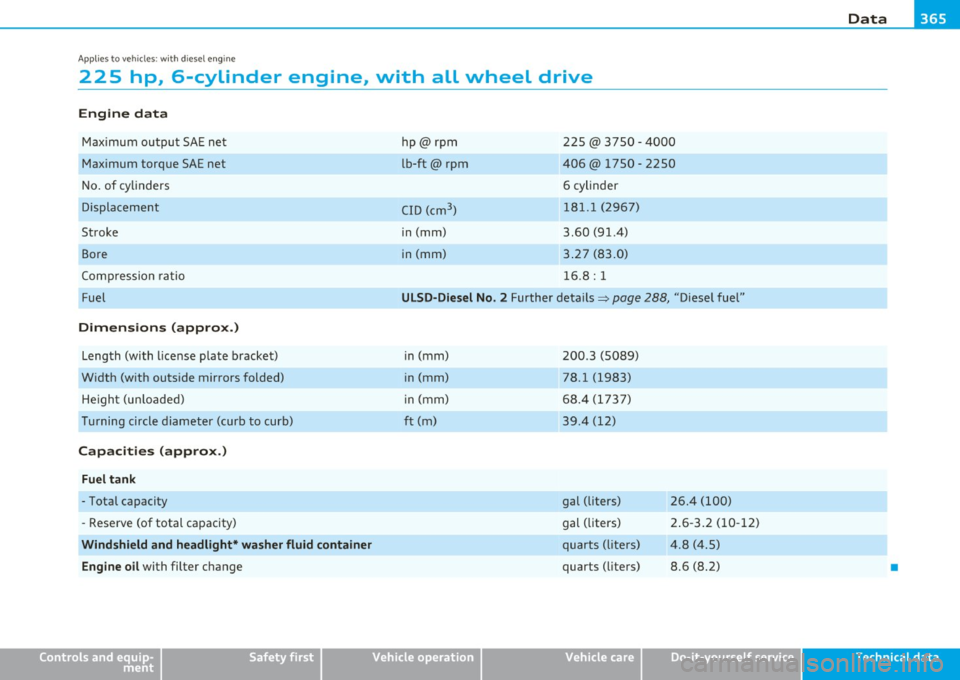
App lies to veh icles : with di esel e ngine
225 hp, 6-cylinder engine, with all wheel drive
Engine data
Max imum outpu t SA E net
Maximum torque SAE net
N o. of cy linders
Displaceme nt
Stroke Bore
Com pression ra tio
Fuel
Dimensions (approx.)
Leng th (with license p late bracke t)
W idth (w ith outs ide mirrors folded)
He igh t (u nloade d)
Turning circle diameter (curb to curb)
Capacities (approx.)
Fuel tank
- Tota l capacity
- R eserve (of total capacity)
Windshield and headlight* washer fluid container
Engine oil
with filter c hange
Safety first
hp@rpm
lb-ft@ rpm
C ID (cm
3
)
in (mm)
in (mm) 22
5@ 3750 - 4000
406@ 1750 - 2250
6 cylinder
181. 1 (2967)
3 .60 (91.4)
3 .27 (83.0)
16 .8: 1
ULSD-Diesel No . 2 Further details=> page 288, "Diese l fuel"
i n (mm)
in (mm)
i n (mm)
ft (m) 200
.3 (5089)
78 .l (1983)
68 .4 (17 37)
39 .4 (12)
gal (liters)
gal ( liters)
qu arts (lite rs)
quarts (liters) 26.4 (100)
2
.6- 3.2 (10 -12)
4.8 (4.5)
8.6 (8.2)
Do-it,yourself service
•
Technical data
Page 368 of 390
___ C_ o_n_ s _ u_m_ e_ r_ I_ n_ f_o _r_ m_ a_ t_io _ n _____________________________________________ _
Consumer Information
Warranty coverages
Your Audi is cov ered by the following warrantie s:
• New Vehicle Limited Warranty
• Limited Warranty Against Corrosion Perforation
• Emissions Control System Warranty
• Emissions Performance Warrant y
• California Emissions Control Warranty (USA vehicles only)
• California Emissions Performance Warranty (USA vehicles only)
Detailed informa tion regarding your warran ties can be fo und in your
Warranty & Maintenance boo klet .•
Operating your vehicle outside the
U.S.A. or Canada
Government regulat ions in the United States and Canada req uire t hat
au tomobiles meet spe cific emi ss ion regula tions and safe ty s tan
dards . There fore, ve hicles bui lt for the U.S.A . and Canada differ from
vehicles so ld in othe r countries.
If you plan to take your vehicle ou tside the continental lim its of the
United States or Canada, the re is the possibility that
• unle aded fue ls for vehicle s w ith c ataly tic converte r may n ot be
available;
• fue l may have a conside rably lower octa ne rat ing . Imp roper f ue l
may cause engine damage;
• serv ice may be inadequate due to lack of proper serv ice fac ilities,
too ls or testing eq uipment;
• replacement parts may not be read ily avai lab le . • N
avigation syst ems for veh icles built fo r th e U.S.A. and Canada
w ill not necessar ily work in Europe, and may not wo rk in other coun
tries outs ide North Ame rica.
0 Note
Audi canno t be responsib le for mech anical dam age th at could res ult
from inadeq uate fue l, se rvice o r parts ava ilability. •
Audi Service Repair Manuals and
Literature
Audi Offic ial Factory Service Manuals are published as soon as
po ssib le afte r mode l in trodu ction . Se rvi ce manu als ar e ava ilable
from :
Audi Technical Literature Ordering Center
Call toll-free:
T e l. : 1 (800) S4 4-80 21
(from 8:00 A M to 8:00 P M, EST, Monday thro ugh Friday)
or access their website
www .audi.ddsltd.com on the Internet to
or der r ep air manual s and othe r A ud i liter atu re .•
Maintenance
General
Your vehicle has been des igned to help keep maintenance req uire
ments to a mi nimum. However, a ce rta in amoun t of regular ma inte
nance is still necessary to assure your vehicle's safety, economy and .,_
Page 369 of 390
_____________________________________________ C_o_ n_s _u_ m __ e_r _ I_ n_ f_o _r_ m_ a_ t_ i _o_ n __ __
reliab ility. For deta iled vehicle maintenance cons ult your Warra nty &
Main tenan ce bookle t.
Under difficult operating conditions, for example at extremely low
outside temperatures, in very dusty regions, when towing a trailer
very frequently, etc., some service wo rk shou ld be performed
between the intervals specified. This app lies particu larly to:
• oil changes, and
• cleaning or rep lacing the air fi lter.
<£> For the sake of the environment
By regular ly maintaining your vehicle, you help make sure that emis
sion standards are mainta ined, t hus mi nimizing adve rse e ffects o n
the environment. •
Important considerations for you and your
vehicle
T he increasing use of electronics, sophisticated fuel injection and
em ission cont rol systems, and t he generally increasing techni cal
complex ity of today's automobiles, have stead ily reduced the scope
of mai ntenan ce and repairs w hich can be ca rried out by ve hicle
owners.
Also , safety and environm ental concerns p lace very strict
limits on the nature of repairs and adjustments to engine and trans
mission parts wh ich an owner can perform.
Maintenance, adj ustments and repairs usua lly req uire specia l tools,
test ing devices and other eq uipment available to specially t rained
workshop personnel in order to assure proper performance, re li
ability and safety of the vehicle and its many systems.
Improper maintenance, adjustments and repairs can impair the oper
ation and reliabili ty of your ve hicle and even void you r vehicle
warranty. Therefore, p roof of servicing in accordance with the main
t enance schedu le may be a condit ion fo r uphold ing a possible
warranty cla im made w it h in the warranty period .
Safety first
Above all, operational safety can be adversely affected, creating
unnecessary r is ks for you and you r passe ngers.
If in doubt about a ny servic ing, have it done by your authorized Audi
dealer or any other properly eq uipped and qualified works hop. We
st rongly urge you to give you r a utho rized Aud i dealer the opportunity
to perform a ll scheduled maintenance and necessary repairs. Your
dealer has t he facilities, o rigina l part s and trained spe ciali sts to keep
your vehicle running properly.
Performing limit ed maint enance yourself
The following pages describe a lim ited number of procedures which
can be perfo rmed on your vehicle w it h ordi na ry tools, should t he need
ar ise and trained personnel be unava ilab le. Before performing any of
t hese p rocedures, always tho roughly read all of the applicable text
and carefu lly follow the instructions given. Always rigorous ly observe
t he
WARNINGS p rov ided .
Before you ch eck anyth ing in the eng ine compartment, alwa ys read
and heed all WARNINGS~
& and~ & in "Working in the engine
compartmen t" on
page 297.
& WARNING
• Seriou s pe rs onal injury may occ ur as a result of improperly
perform ed maintenan ce, adju stments or repair s.
• Always be extremely careful when work ing on the vehicle.
Alway s foll ow commonly acc epted safety practic es and general
c ommon sense . N ever ri sk per son al injury .
• Do not attempt any of the maint enance, che cks or repair s
de scrib ed on the following p ages if you are not fully familiar with
the se or ot her procedure s with re spect to the vehicle , or are uncer
tain how to proceed .
• Do not do any work without the prop er tool s and equipment .
Ha ve the ne cessary work done by your authorized Audi dealer or
an other properly equipped and qu alified workshop. _,.
Do-it,yourself service Technical data
Page 370 of 390
___ C_ o_n_ s _ u_m_ e_ r_ I_ n_ f_o _r_ m_ a_ t_io _ n _____________________________________________ _
& WARNING (conti nu ed )
• The engine compartment of any motor veh icle is a potentially
hazardous area . Never reach into th e area around or touch the
radiator fa n. It is temperature controlled and can switch on
s uddenly -even when the engine is off and the ignition key has
been remo ved. The radiator fan switches on autom atically when
the coolant rea ches a certain temperature and will continue to run
until the coolant tempe rature drops.
• Always remove the ignition key before anyone gets under the
vehicle.
• Always support your vehicle with safety stands if it i s neces sary
to work unde rne ath the vehicle. The jac k supplied with the vehicle
is not adequate for thi s purpose and could collap se cau sing
serious personal injury.
• If you must work underneath the vehicle w ith the wheels on
the ground , always ma ke sure the vehicle is on level ground , th at
the whe els are alway s securely blocked and that the engine cannot
be started .
• Always make sure the transmi ssion selector l ever (automatic
tran smission) is in "P" (Park position ) and the par k brake is firmly
applied.
W For the sake of the environment
• Changing the engine settings will adversely affect e miss io n levels.
Th is is detrimenta l to the environment and increases fuel consump
ti on.
• Always observe enviro nmental regulations when disposing of old
eng ine o il, use d brake fl uid, dirt y engine coo lant, s pent ba tt er ies or
worn out t ires.
• Undep loyed a irbag modules and pretens ioners migh t be classified
as Perchlorate Mater ia l -spec ial handling may apply, see
www.dts c.ca .g ov/h azar douswas te/pe rchlo ra te . When the veh icle or
parts of the rest raint system including a irbag modu les sa fety belts
w ith pretens ioners are sc rapped, all applicable laws and regulat io ns must be observed
. Your authorized Aud i dealer is familiar with these
re qui remen ts and we recomme nd that you have your dealer perfo rm
this serv ice for you .•
Additional accessories,
modifications and parts
replacement
Additional accessories and parts
replacement
A lway s con sul t an autho rized Audi dealer before
purchasi ng a ccess ories.
Your vehicle incorporates the latest safety design feat ures ens uring a
hig h stand ard of active and passive s afe ty.
T hi s safety co uld be compromised by no n-app roved changes to the
vehicle. Fo r this reason, if parts have to be replace d, p lease observe
the following points when installing addit ional accessories :
Approved Audi accessories and genuine Aud i parts are available from
a u thor ized Aud i deal ers.
T hese dea lers a lso have the necessary fac ilities, tools and tra ined
speci alists to inst all the parts and ac cessor ies p ro p er ly.
& WARNING
Using the wrong spar e parts or u sing non-approved ac ce ss ories
can cause damage to the vehicle and serious personal injury .
• Use only acces sories expressly approved by Audi and genuine
Audi spare parts
• The se parts and acces sorie s have been specially designed to be
used on your vehicle . _,.