engine AUDI Q7 2010 Owner´s Manual
[x] Cancel search | Manufacturer: AUDI, Model Year: 2010, Model line: Q7, Model: AUDI Q7 2010Pages: 390, PDF Size: 93.04 MB
Page 263 of 390
Driving and environment
----------------------------------------------'
Driving and environment
The first 1,000 miles (1,500 km)
and afterwards
New engine
The engine needs to be run-in during the first 1,000 miles
(1,50 0 km) .
For the first 600 miles (1,000 kilometers):
Do not use fu ll thrott le .
- Do not drive fas ter t han 3/ 4 of the top speed marked on
t h e speedometer.
- Avo id high engine speeds .
From 600 to 1,000 miles (1,000 to 1,500
kilometers):
- Spe eds can
gradually be i ncr eas ed to the maxi mu m
perm iss ible road or engin e spee d.
During and after break-in period
- Do not rev the eng ine up to high speeds when it is co ld.
This app lies whether t he tra nsmission is in N ( Neutra l) or
1 n gear.
After the break-in period - Do not exceed maximum engi ne s pee d und er any circum
stances .
- Up shift i nto t he next hi ghe r g ear
befor e reach in g the red
area at t he end of the tachometer sc al e=>
pa ge 10 .
Controls and equip
ment Safety first Vehicle operation
During the first few ho
urs of d riving, the engine's interna l fr iction is
highe r than later when all the moving parts have been broken in . How
well th is br eak -in p rocess is done depends to a cons iderab le extent on
the way the veh icle is driven dur ing the f irst 1,000 miles (1,500 kilo
meters).
0 Note
E x tremely high e ngine speeds a re au tomat ically re duced. However,
these rpm limits are programmed for an engine well run -in, not a new
engine .
~ For the sake of the environment
Do not drive with u nnecessa rily high engine s peeds -upshift ing early
saves f uel, reduces no ise and protec ts the environme nt.
New tires
If your v eh icl e is run ning on new t ires, driv e p arti cul ar ly
c a refu l fo r the first 35 0 miles (50 0 kilometers) af ter fit ting.
& WARNING
New tires tend to be slippery and must al so be "broken-in ". Be
sure to remember this during the first 350 m iles (500 kilome
ter s). Brake gently . Avoid following closely behind other vehicles
or other situations that might require sudden, hard braking. •
Vehicle care Do-it-yourself service Technical data
Page 264 of 390
Driving and environment
New brake pads
Remember that new brake pads do not have a f ull braki ng
e ff e ct during the first 250 miles (400 kilometers) after they
are i nsta lle d.
New bra ke pads have to be "b urnished in" before they have opt ima l
grab=> &.
Dur ing the break -in period, you sho uld avoid putting severe loads on
the brakes. Severe loads incl ude, for example, sudden hard braki ng,
in particu lar at very high s peeds or, for examp le, on mountai n passes.
& WARNING
New brake pads don 't have the be st stopping power and must be
" broken -in " during the initial 100 to 150 miles (150 to 200 kilo
meters ) of normal cit y driving. You can compensate for thi s by
pressing th e brak e pedal more firmly. This also applies lat er wh en
new pad s are installed. n
Appli es to ve hicles : w it h g aso line eng ine
Catalytic converter
--
I t is very important th at your emission control system
(ca talytic co n verter) i s func tioning properly to e nsure
that you r vehicle is running in an environmentally sou nd
manner.
- Always us e lead-fr ee gasoli ne ~ page 287, "Gaso line" .
- Never run the tan k down a ll the way to empty.
- Never put too m uch motor oil in your engine~
page 302,
"Add ing e ngi ne o il "t::r.11
•
-Nev er try to p ush- or tow-sta rt yo ur veh icle.
The catalytic converter is an efficient "clean- up" device b uilt into the
exha ust sys te m of the ve hicle. The cat alytic converte r burns many of
t he polluta nts in the exhaust gas before they are released into the
atmosphe re.
Th e e xcl usive use of unleaded fuel is cr itic ally important for the life of
the catalytic converte r and proper f unction ing of the engine.
& WARNING
• Do not park or operate the vehicle in areas where the hot
exhaust system may come in contact with dry grass, brush, fuel
spill or other material which can cause a fire .
• Do not apply additional undercoating or rustproofing on or
near the exhaust manifold , exhaust pipes, catalytic conve rter or
heat shields. During driving, the substance used for undercoating
could overheat and cause a fire .
0 Note
• Be aware that just one tank fi lling wit h leaded fu el wi ll alrea dy
ser iou sly degrade the performan ce of the ca talyt ic co nve rter.
• Do not excee d the correct engine oil leve l=>
page 302 .
• Do not dr ive unti l the f uel tank becomes complete ly empty. The
eng ine could misfire . Unburned fuel could a lso get into the exha ust
system and th is could cause the catalytic converter to overheat.
• Do not t urn o ff the igni tion whi le the ve hicl e is moving.
• Do not contin ue to operate your vehicle under these conditions, as
o therwi se fuel c an reach the cat alytic c onve rter. Th is cou ld resu lt in
over heating of t he converte r, requir ing its rep lacement.
• T o ass ure eff ic ient opera tion of the Emi ssion C ontro l Sy stem:
- Have your vehicle maintaine d properly and in accordance with
t h e se rvice recommenda tions in your Warranty
& M ain tenance
booklet. •
Page 266 of 390
Driving and environment
Drive smoothly and keep a lookout ahead
Vehicles use the most fuel when they are accelerating.
- Avo id unnecessary acce lerating and braking .
Vehicles use the most fuel when they are accelerati ng. If you antici
pate what is going to happen next, you will need to brake less and,
thus , accelerate less. Let the vehicle coast whenever possible - for
example when you see that the next traffic light is red. •
Avoid full throttle
Driving at moderate speeds saves fuel and improves your
mileage.
- Try and keep well below your car's maximum speed.
Accelerating gently reduces fuel consumption, engine wear, and does
not disturb the environment.
Fuel consumption , exhaust emiss ions and eng ine no ise increase
disproportionately at high speeds. If you drive at approximately three
quarters of top speed, fuel consumption w ill be reduced by one ha lf.
Never drive faster than the posted speed limit and weather condi
tions pe rm it. •
Reducing unnecessary idling
Even when your car is just idling it burns up fuel.
- Shut the eng ine off when you are not driving the vehicle.
- Do not warm up the vehicle by letting the eng ine run at
idle .
It makes sense to shu t off t he eng ine in traffic jams, when wa it ing for
tra ins to pass at railroad crossings, or at traffic lights that have long waits on red
. Turning the eng ine off for just 30-40 seconds saves
more f uel than is burned start ing the engine aga in.
It takes a long t ime for the engine to warm up fully when it is ru nning
at idle . However, wear and noxious emissions are especia lly high
when the eng ine is wa rming up. So you shou ld drive away as soon as
you start the engine and avoid running at high rpms while the engine
is still warming up .
0 Note
Do not leave engine idling unattended afte r start ing. If warning
lights should come on to indicate improper operation, they would go
unheeded. Extended idling also produces heat, which cou ld result in
overhea ting or other damage to the vehicle or other property. •
Regular maintenance
A badly tuned engine unnecessarily wastes a lot of fuel.
- Have your vehicle serviced at regular intervals.
By having your vehicle regularly serv iced by an authorized Aud i dealer
helps to ensure that it runs properly and economically. The condition
of your vehicle not only affects its safe ty and ability to hold its value,
it a lso affects fuel con sumption .
Che ck your o il e ach time you fill your t ank.
T he amo unt of oil used is related to engine load and speed.
It is normal for the o il consumption of a new engine to reach its
lowest val ue afte r a certa in m ileage has been d riven.
You must drive your veh icle about 3,000 m iles (5,000 kilometers)
before you can properly assess oi l consumption .
T his also app lies to f uel consumption and engine ou tput. ._
Page 267 of 390
Driving and environment
---------------------------------------------------'
0
Note
• Have you r vehicle ma intained properly and in acco rdance w ith t he
service recommendations in your Warranty
& Maintenance booklet .
Lac k of p roper ma inte nan ce as well as imprope r use of the vehicle wi ll
impair the funct ion of the em ission control system and cou ld lead to
damage.
• Do not alter o r remove any component of the Emission Control
System u nless approved by the manufa ct ur er.
• Do not a lter or remove any device, such as heat shie lds, switches,
ign ition w ires , va lves, which are desig ned to protec t your ve hicle's
Emission Contro l System and other important veh icle components .•
Fewer short trips
F uel consumptio n will always be relatively high on short
trips .
-Try to avoi d drivi ng s ho rt dis tances wit h a cold engine .
The engine and catalytic converter have to reach their optima l oper
ating temperature
t o reduce f uel consum ptio n a nd noxio us em is
sions effectively.
Just after starting, a cold engine in a mid -s ize car on ly achieves a fuel
economy of 6-8 m iles per gallon (30- 40 l/l00km) . After about a ha lf
a mile, fuel economy climbs to 12 mpg (20 l/100 km). After abo ut
2 .5 m iles ( 4 km), t he engine i s at its p rop er operat ing temper ature
and fue l economy has reached a normal level. So yo u can see that you
sho uld avoi d short t rips whenever possible.
T he
out side temperature is a lso c ritical in this regard. Your car
cons umes mo re fue l in the winter than in the summer. •
Controls and equip·
ment Safety first Vehicle operation
Vehicle care Do-it-yourself service Technical data
Page 269 of 390
• Driving off road
------------------------------------------------------'
vary. It is the driver's responsibility to decide whether a vehicle can
overcome a specific situation
=> &-
Gradient angle
The number of meters in altitude gained over a distance of 109 .4
yards or 100 meters (grade) are given as a percentage or degrees.
Information about the gradient the vehicle can climb under its own
power (depends in part on the road surface and engine power).
Maximum permitted grade: 31
°
Lateral angle (slope of vehicle)
Indicates the angle up to which the vehicl e can be driven diagonally
or across the fall line on a slope without the vehicle tipping over s ide
ways (depends on center of gravity). Maximum permitted late ral
angle: 35°
Breakover angle
Indicates the angle up to which the vehicle can dr ive over a ramp at
low speed without the underside of the vehicle hitting the edge of the
ramp.
• Vehicles without air springs: maximum breakove r angle: 21, 1 °
• Vehicles with adaptive air suspension*: maximum breakover
ang le: 19.1 ° (at normal leve l), 23.8° (at high level 2)
Approach /departure angle
Transition from the horizontal plane to a gradient or from a grade
back to level ground. Indicates the angle up to which the vehicle can
drive onto or off a slope at low speed without striking the bumper or
the underbody.
• Vehicles without air springs: maximum approach/departure
ang le: 21.9° (front), 23.4° (rear)
• Vehicles with adaptive air suspension*: maximum
approach/departure angle at normal level 20° (front), 21.9° (rear).
Maximum approach/departure angle at high level 2 (front) 24°,
(rea r) 25.4°
Controls and equip
ment Safety first Vehicle operation
Ground clearance
Th
e distance between the road surface and the lowest point of the
vehicle underbody.
• Vehicles without air springs: Ground clearance 8.1 in
(204 .8 mm)
• Vehicles with adaptive air suspension*: minimum ground clear
ance 7.1 in (179.8 mm) at normal level, maximum ground clearance
9.4 in (239.8 mm) at high level 2
_& WARNING
Exceeding the stated maximum figures can result in severe inju
ries or vehicle damage .
• All the information was gathered on level, firm and non-slip
pery road surfaces, and under dry weather conditions.
• Ideal conditions do not prevail offroad. Never utilize the
maximum readings to their fullest, always leave a safety
reserve. •
Driving tips
On poor road and off road, there is always only one
motto: Plan ahead and drive slowly!
Please observe the follow ing when driving away from paved
roads:
- Drive only on roads and offroad sections which match the
design of your veh icle and your abilities as a driver. Never
ta ke ris ks!
- Drive slowly and plan ahead!
- Take into consideration the
ground clearance of you r
vehicle.
Vehicle care Do-it-yourself service Technical data
Page 270 of 390

Driving off road
- Activate the ESP offroad mode=> page 252 as needed .
- Use the
hill descent control => page 253 when driving
down steep sections on hills.
Unpaved roads and offroad
Drive slowly on unfamiliar roads and unknown offroad sections, and
loo k out for unexpected obstacles (e .g. potho les, rocks, t ree st umps,
etc.).
T o prevent the vehicle from bo ttoming and avoid dam age to the
underbody, you should drive straight across severe bumps in the
gro und with on ly one s ide of the vehicle so tha t on ly two of your
wheels cross the bumps.
Drive brisk ly throug h sandy or marshy offroad sections and do not
stop, if at all poss ible.
Driving through water
Your vehicle ca n drive at maximum wal king speed thro ugh stand ing
water if the gro und is firm enough . The
maximum water depth is
1 9. 7 in o r 500 mm (ve hicles w it h out air spr ings) or 2 1.1 in or
535 mm (vehicles with Adaptive Air Suspension*, at high level 2).
Driving on a slope
If you ever find yourself not able to climb a slope, do not try to t urn
around, drive bac k dow n in
rever se . Ot herw ise, you run t he ris k of
tipping over .
If the vehicle threaten s to tip over when driving a cross a slope , you
must immediately steer downh ill in the direction of the slope .
Do not park your vehicle on steep slopes or gra des .
T o red uce the risk of tipp ing ove r, d rive on s lopes in t he di re ct io n of
the downward slope (fall line) -
not crosswise .
Driving on snow-covered ground
T he standard tires fitted to your vehicle are not snow ti res. So you
should mo unt wheels with snow t ires in good t ime where winter road
conditions prevail. Before driving on unp lowed stretches o f deep snow, install tire chains
. For tech nica l reasons, t ire chains may only
be ins talle d on the re a r wheels - never on the front whee ls.
& WARNING
After driving through water , mud, slush, etc. , the brake s may be
slow to take effect because of wet brake rotors and pads.
Dry the
brake s first by braking carefully to re store the full braking effe ct.
0 Note
Vehicle components such as the engine, trans mission, s uspension or
electrical system can be severely damaged by dr iv ing through water.
W Tips
• Check the dept h of the water before dr iv in g through it.
• Do not stop the vehicle, dr ive in reverse or sw itch the e ngine off
when driving through water .
• Keep in m ind th at on coming vehicles m ay cre ate w aves t hat ra ise
the water level and make it too deep for your vehicle to drive through
safe ly .
• Avoid dr iving through sa lt water because it ca n cause corrosion .•
Page 272 of 390
Trailer towing
~-----------------------------------------
& WARNING (cont inued)
• The Gro ss Vehicle Weight Rating for your Audi Q7 vehicle,
found on the safety compliance label on the driver's side B-pillar, must never be exceeded under any circumstances . Exceeding the
Gross Vehicle Weight Rating of your vehicle is likely to damage
your vehicle, and such damage will not be covered by your Limited
New Vehicle Warranty. Exceeding the Gross Vehicle Weight
Rating will also change the performance and handling character
istics of your vehicle, whi ch could cause a crash resulting in serious
injury or death.
• The Gro ss Vehicle Weight Rating for your Audi Q7 would be
exceeded if your vehicle is simultaneously equipped with
Panoramic sliding sunroof; third-row seating ; trailer towing
equipment (factory or dealer-installed ), and running boards
(dealer-installed) . UNDER NO CIRCUMSTANCES MAY ALL SUCH
ITEMS BE INSTALLED ON THE SAME VEHICLE .•
Operating instructions
M AX 6 .9"
MA X
175mm
Trailer towing weights
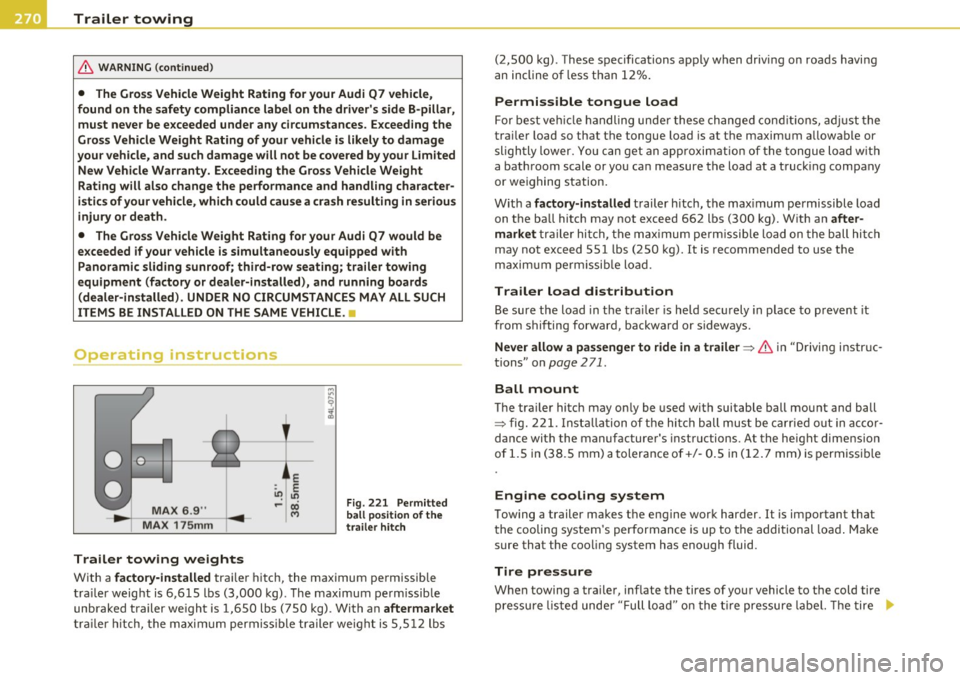
Fig. 221 Permitted
ball position of the
tra iler hit ch
With a factory -installed tra ile r hi tch, the maximum pe rmissib le
t ra iler weig ht is 6,615 lbs (3,000 kg). The maximum pe rmissib le
unbraked trailer we igh t is 1,650 lbs (750 kg) . With an
aftermarket
trail er hi tch, the m axi mum permissibl e traile r weig ht i s 5,5 12 lbs (2,500
kg) . These specifications app ly when driv ing on roads havi ng
an in cline o f less t han 12%.
Permissible tongue load
For best ve hicle handl ing un der t hese ch ange d co ndition s, adju st the
tra ile r l oad so that the tongue load is at the maxim um a llowab le or
sligh tly lower. You can get an app roxim atio n of the tongue load w it h
a bat hroom scale or you ca n measure the load at a t ruc king company
or we ighing st ation.
W it h a
factory-installed trailer h itch, the max imum pe rmissible load
on t he ba ll hitc h may not exceed 662 lbs (300 kg). W it h an
after
market
tra ile r hi tc h, t he ma ximum pe rm issi ble loa d on the b all hi tch
may not exceed 551 lbs (250 kg). It is recommended to use the
maxim um permi ssible loa d.
Trailer load distribution
Be su re the load in t he tra ile r i s held se curely in p lace to p revent it
from shi fting forward, backwa rd or sideways.
Never allow a passenger to ride in a trailer=> & in "Dr ivin g in struc
t ions" on
page 2 71.
Ball mount
The tra ile r hitch may on ly be used w ith suitable ball mount and ball
=> fi g. 221. I nstallat ion of the hi tch b all mus t be c arrie d out in acco r
dance with the manufacturer's instructions . At the height d imension
of 1. 5 in (38 .5 mm) a toler ance of+/- 0.5 in ( 12. 7 mm ) is per miss ible
Engine cooling system
Towing a trailer makes t he eng ine work harder. It is impo rtant that
t he cooling system 's performan ce is up to the addi tional loa d. Mak e
sure that the coo ling system has enough fluid .
Tire pressure
When towing a trailer, inf late the tires ofyourvehicle to the cold tire
pre ssure listed unde r "Full lo ad" on t he tire pre ssu re lab el. Th e tire ...
Page 273 of 390

pressure label is located o n the dr iver's side B-pillar. Inflate trailer
t ires to tra ile r and t ire ma nufacturers' spec ifications.
Lights
T he headl ight settings shou ld be chec ked with the tr ailer attached
before driving off. Check to make sure both vehicle and trailer lights
are wo rking properly.
Safety chains
Be sure tra ile r safety cha ins are p roperly connected from the t rai ler
to the hitch on the vehicle. Leave enough slack in the chains to perm it
tu rning corners . When you install sa fe ty ch ains, ma ke sure they will
not drag on the road when you are driving.
T he chains should cross under the trai ler tongue to prevent it from
dropping in case of separation from the h itch .
0 Note
If you are goi ng to tow a trai ler , you must activate the trai ler opera
tion mode =>
page 180, "Towing a trailer". •
Driving instructior,s
Driving with a trailer always requires e xtra care and
consideration.
To obtain the best possib le handling of ve hicle a nd trailer ,
please note the following :
- Do not tow a loaded trailer when your car itself is not
loaded.
- Be especia lly careful when pass ing other vehicles .
- Observe speed limi ts.
- Do not drive at the maximum pe rmissible speed.
Controls and equip
ment Safety first Vehicle operation
- Always apply brakes early.
- Mo
nitor the temperature gauge.
Weight distri but ion
T owing a loaded trailer with an empty car results in a highly unstable
distribution of we ight . If t his cannot be avoided , drive at very low
speeds only to avoid the risk of losing steering control.
A "balanced" rig is easier to operate and control. This means that the
tow veh icle shou ld be loaded to the extent poss ible and permissib le,
wh ile keeping the tra ile r as lig ht as poss ible unde r the ci rc u mstances.
Whe never possible, transfer some cargo to the luggage compart
me nt o f the tow vehicle while observing tongue load requirements
and vehicle loading considerations.
Speed
The higher the speed, the more d ifficult it becomes for the driver to
control the r ig . Do not dr ive at the maxim um permiss ible speed .
Reduce your speed eve n more if load, weather or w ind conditions are
unfavorable -particular ly when going downhill.
Reduce vehicle speed
immed iately if the tra ile r shows the slightest
sign of swaying.
Do not tr y to stop the s wayi ng by a ccele rating .
Observe speed lim its. In some areas, speeds for veh icles towing
trailers are lowe r than for regular veh icles .
Always apply brakes early. When driving downhi ll, shift into a lower
gear to use the engine brak ing effect to slow t he ve hicle . Use of the
brakes alone can cause them to overheat and fa il.
Coolant temperatur e
The coo lant temperature gauge=> page 10 must be observed care
fu lly. If the needle moves close to the upper end of the sca le, reduce
speed immediately and/or turn off the air conditioner.
If the coo lant temperature warning light in the instrument clus ter
starts flash ing
- F- , pull off the road, stop and let the engine idle for
about two m inutes to prevent hea t buil d-up.
Vehicle care Do-it-yourself service Technical data
Page 274 of 390
Trailer towing
"---------------------------------------------------
in. WARNING
Anyone not properly restrained in a moving vehicle is at a much
greater risk in an a ccident . Never let an yone ride in y our car who i s
not prop erly wearing the re straints provided by Audi. •
Trailer towing tips
Important to know
Your vehicle handles differe ntly when tow ing a tra iler because of the
additiona l weight and different we ight distribution. Safety, perfor
man ce and economy w ill greatly depend on how ca refu lly yo u load
your trailer and operate your rig.
Be fore you actua lly tow your tra ile r, prac tice turning, stopp ing and
back ing u p in a n area away from traffic. Keep pract ic in g until you have
become completely familiar with the way your vehicle -trailer combi
nation behaves and responds .
Backing up is diff icult and requ ires pract ice. Backing up w ith a trailer
gene rally requires s teer ing a ction opposi te to th at when ba cki ng up
your vehicle witho ut a trailer.
Maintain a greate r d istance between your ve hicl e and the one in front
of yo u. You will need more room to stop . T o compensate fo r the
trai ler, you will need a larger than normal turning radius .
W hen p assing, remember that you c annot acceler ate as fast as yo u
normally wou ld because of the added load. Make sure yo u have
enoug h room to pass. After passi ng, allow plen ty of room fo r yo ur
tra iler before changing lanes again .
Avoid jerky starts, sharp turns or rapid lane changes .
[ i ] Tips
• Do not tow a trai ler d uring the brea k-in perio d of your vehicle. •
If you tow a tra iler, your Aud i may require more frequent mai nte
n an ce due to the ex tra load:::::>
page 366. •
Parking on a slope
Do not park on a slope with a trailer. If it cannot be
av oided, do so only after doing the following:
When parking:
- Apply the foot brak e.
- Have someone p lac e chocks un der bo th the vehicle and t he
traile r w he els .
- With c hoc ks i n place, slowly release the brakes u ntil the
wheel c hoc ks absorb t he load.
- Turn the w hee ls towards t he curb .
- A pply the parking brake.
- M ove th e selector le v er to
P.
When restarting after parking:
- A pply the foot brake .
- Start the engine .
- Mov e th e s elector lever to
D .
- Release the par king brake a nd s low ly pull o ut and away
fro m the w heel chocks.
- Stop a nd have someone retr ieve the w heel chocks .
(I) Tips
If you move the se lector lever of the a utomat ic t ransmiss ion to P
befo re applying t he par king br ake an d befo re blo cking the w heels, II-
Page 276 of 390
-~_C_ le_ a_n_ i_ n_ g=- a_ n_d___. p_ ro_ t_e _c_ t_ i_o _n ___________________________________________ _
Cleaning and protection
General information
Regular care preserves vehicl e val ue.
Any automobile is exposed to industria l fumes, co rrosive road salt,
m ud dy dog fee t, e tc. A well c ared for Audi can look like new many
years after p urchase . Regular and correct care will contribute to
m aint aining the bea uty and val ue of your Audi.
Furthermore, good care may be a condition for substantiating a
warranty claim should corrosion damage or paint defects occur.
Y ou r au thor ized Audi d eale r h as a var iety of dedicated vehicle-care
products
and can advise w hich ones to use for clea ning the exterior
a n d inter io r of your ve hicle.
W het her you use products recommended by Aud i or o ther comme r
cia lly availab le cleaning agents , please ma ke sure yo u appl y them
co rrectly .
& WARNING
• Cleaning agents may be poisonous . Keep them out of the reach
of children.
• Heed all caution labels .
• Always read directions on the container before using any
product. Follow the directions carefully.
• Most chemical cleaners are concentrated and have to be
diluted .
• Use spot removing fluids only in well ventilated areas.
• Do not use gasoline, kero sene , diesel fuel , nail polish remover
or other volatile fluids . They may be toxic, flammable or
hazardous in other ways. Do not wash, wax or dry the vehicle with
the ignition on or the engine running.
& WARNING (co ntinued)
• Do not clean the under sides of chassi s, fenders , wheel covers,
etc. without protecting your hands and arms. You may cut your
self on sharp-edged metal parts.
• Moisture and ice on brakes may impair braking efficiency
~ page 255, "General information ". Test the brakes carefully
each time you wash the vehicle .
'£> For the sake of the environment
Select only envir onmenta lly fr iendly clea ning produc ts . Leftover
cleaning pro ducts sho uld not dis posed of i n the household waste .•
Care of exterior
Washing
F re qu ent w ashin g protec ts th e vehicl e.
T he best protection aga inst env ironmental influences is frequent
w ashi ng and w ax ing. How o ften t his is requ ired depen ds on:
• How m uch the vehicle is use d
• Whe re the ve hicle is parke d (gar age, in the o pen un der tr ees, e tc.)
• The seasona l and weather conditions
• E nviron mental influences
T he longer bi rd droppings , insects , tree resin, road and industria l
gr ime, t ar, soo t, road sa lt and o ther ma ter ia ls remain on the veh icle
body, the more lasti ng their destructive effects w ill be. H igh temper
atu res cause d by ex pos ure to intense s unlight int ensify the co rrosive
effect, part icu larly when humid ity is high as we ll.
~