oil AUDI Q7 2010 Owner´s Manual
[x] Cancel search | Manufacturer: AUDI, Model Year: 2010, Model line: Q7, Model: AUDI Q7 2010Pages: 390, PDF Size: 93.04 MB
Page 129 of 390
_________________________________________________ O_ n_ t_ h_ e_ r _o_ a_d _ __.fflll
0 Note
Do not stop the engine immediately after hard or extended driving .
Keep the engine running for approximately two minutes to prevent
excessive heat build-up.•
Starting and stopping the engine
with Convenience key
Applies to veh icle s: with Con venie nce ke y
Starting the engine with the {START) button
This button switches on the ignition and starts the
engine.
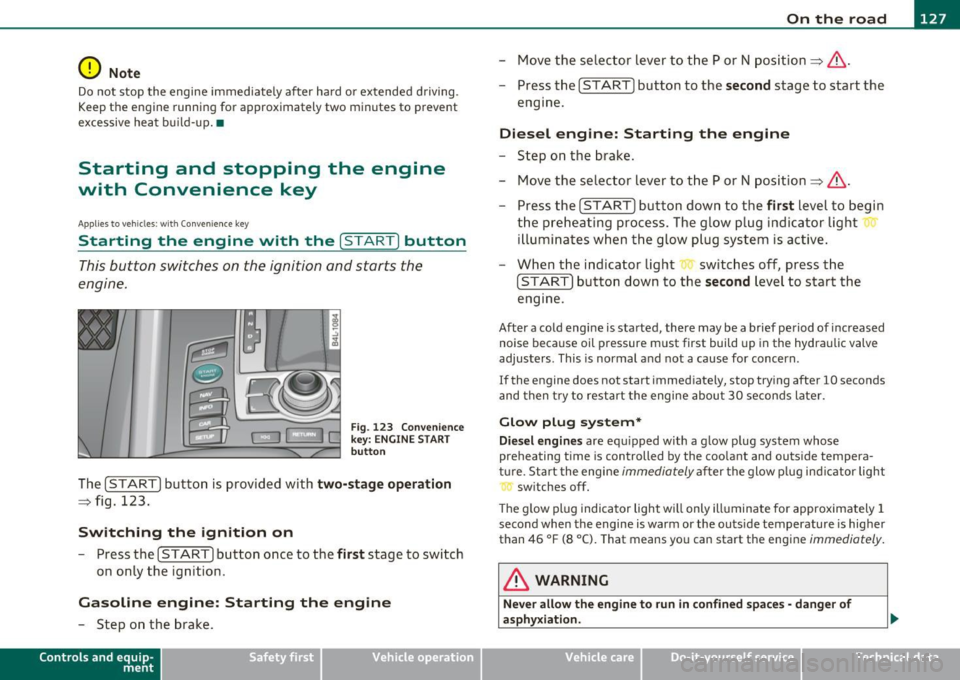
Fig . 123 Convenience
key: ENGINE START
button
The [START] button is provided with two-stage operation
=:> fig. 123.
Switching the ignition on
- Press the [ START] button once to the first stage to switch
on only the ignition .
Gasoline engine: Starting the engine
-Step on the brake.
Contro ls a nd e quip
m en t Vehicle
OP-eration
-Move the selector lever to the P or N position =:>& .
- Press the
[START] button to the second stage to start the
engine.
Diesel engine: Starting the engine
- Step on the brake.
- Move the selector lever to the P or N position =:>& .
- Press the
[START] button down to the first level to begin
the preheating process. The glow plug indicator light
illuminates when the glow plug system is active.
- When the indicator light switches off, press the
[START] button down to the second level to start the
engine.
After a cold engine is started, there may be a brief period of increased
noise because oil pressure must first build up in the hydraulic valve
adjusters . This is normal and not a cause for concern .
If the engine does not start immediately, stop trying after 10 seconds
and then try to restart the engine about 30 seconds later.
Glow plug system*
Diesel engines are equipped with a glow plug system whose
preheating time is controlled by the coolant and outside tempera
ture . Start the engine
immediately after the glow plug indicator light
switches off.
Th e glow plug indicator light will only illuminate for approximately 1
second when the engine is warm or the outs ide temperature is higher
than 46 °F (8 °C). That means you can start the engine
immediately.
& WARNING
Never allow the engine to run in confined spaces· danger of
asphyxiation.
Vehicle care Do-it-yourselt service iTechnical data
Page 133 of 390
On the road -
----------------
& WARNING (co ntinued )
• When parking on hills, always turn the wheel s so that the front
wheels will fir st roll into the curb, if the vehicle should start to
roll.
• Never allow anyone -especially small children -to remain in
the vehicle when it i s locked. Locked door s make it more d ifficult
for rescuer s to acce ss the pa ssenger compartment in the event of
an emergency. Danger to life!
• Never leave children un supervised in the vehicle . Children
could release the parking brake or mo ve the gearshift lever out of
gear . The vehicle could start to roll away and cause an accident .
• No matter what the season is , the temperature in a parked
vehicle can reach dangerou s levels.
0 Note
• Please exerc ise care when you park your vehicle in parking areas
with park ing barriers or c urbs. Pa rking barriers and c urbs vary in
height and co uld damage you r bumpe r and related componen ts as
the front of your vehicle moves over a barrier or curb that is too h igh,
as you par k or a s yo u back out of a p arking s pot. I n or der to be s ure
that no such damage can occ ur, yo u may wish to stop short of having
t he fro nt t ires of you r ca r tou ch the pa rk in g barrier or curb.
• Please a lso exerc ise except ional care when yo u drive up or down
s t eep ram ps or drive ove r curb s or other obst acles, for which t he
vehicle is not designed, because components of the vehicle close to
t he g roun d, s uch as bumpe r cove rs, spoilers and s uspension and
exhaust system components, may become damaged. •
Starting on hills
Hill Hold makes it easier to start on hills.
Controls and equip
ment Safety first
T
he system is activated whe n the brake peda l is depressed for a few
s econds .
For this, t he vehicle mus t be st andi ng in u phill driving direc
t ion .
After releas ing the brake pedal, the brake power is he ld for a
brief
moment to preve nt the vehi cle from rolling back when s tarting. At
this time, you can easi ly begin to move your vehicle .
& WARNING
• If you did not begin moving immediately after releasing the
brake pedal, under certain circumstances, the vehicle wou ld begin
to roll backward. Depress the brake pedal immediately or engage
the parking brake .
• Should the engine stall , depress the brake pedal immediately
or engage the parking brake .
• In order to prevent the vehicle from rolling back unintention
ally when starting in stop-and-go traffic, keep the brake pedal
depressed for a few seconds before driving off .
• When you leave the vehicle -even if only briefly - , sw itch off
the ignition and make sure to remove the ignition key . Also
engage the parking brake to prevent your vehicle from rolling
unintentionally. This particularly applies if children are left in the
vehicle -danger of accident! •
Vehicle care Technical data
Page 155 of 390
Audi side assist Ill
----------------
Deactivating
-Pre ss th e b utton again . Th e ind icator light on the button
goes o ut.
The system works at speeds faster than 19 mph (30 km/h) .
& WARNING
• Improper reliance on the side assist system can cause collisions
and seriou s per sonal injury:
- Never rely only on side assist when changing lanes.
- Alway s check rear view mirrors to make sure that it is safe to
change lanes.
• Side assist cannot detect all vehicles under all condition s
danger of accident!
• Side a ssist cannot detect vehicle s in time to alert you when
they approach from behind at very high speed , or fall drop bac;k
very quickly .
• The radar sensor's
vision can be reduced o r entirely blocked by
rain, snow, and heavy spray . Thi s can result in side a ssist not
adequately detecting vehicles o r, in some cases , not detecting
them at all. Always keep an eye on the direction you are traveling
and the relevant area around the vehicle.
• Plea se note that side assi st indi cates there are approaching
veh icles, or vehicles in your blind spot, only after your vehicle has
reached a driving speed of at lea st 19 mph (30 km/h).
• Side assist signal does not work around tight corners (turning
radius le ss than 328 feet, or 100 m ).
• Side assist is no replacement for the driver's full attention. The
driver alone is respon sible for lane changes and similar driving
maneuvers. Always keep an eye on the direction you are traveling
and the relevant area around the vehicle .
Controls and equip
ment Safety first
0 Note
• T
o ens ure t hat you do not adve rsely affec t side assist, do not blo ck
the area on the rear bumper where the radar sensors are located with
foreign obje cts (s uch as stickers or bicy cle ra cks).
• Make s ure that the s ignal light on the outside mirror is not
blo cked by st ickers or o ther ite ms.
W Tips
• Side assist a utoma tically deact iva tes if it de tects that the rada r
sensors are blocked=>
page 159. The indicator light on the button
goe s out.
• Th e area on the bumpe r w here the ra dar sensors are located must
c o nsistent ly remain free of snow, i ce, a nd heavy soiling so tha t side
assist can funct ion p roper ly. Follow the add itiona l notes on
=>
page 160 .
• F or vehicles with a factory installed towing hitc h* or a tra ile r
hi tc h* that was i nstalled late r according to f actory specifications,
side ass ist is automat ically deact ivated as soon as the electrical
c o nne ct io n to the tra ile r electr ical socket is made=>
page 15 9.
• For vehicles with a trai le r h itch that was not installed accor ding to
fac tory spe cifica tions, sw itch off the s ide ass ist whe n tow ing a tra iler.
• Additiona l t int ing on the front si de windows can make it ha rder to
se e and co rrectly unde rs tand t he signa l light o n the outs ide m irro r.
• For Declaration of Compliance to United States FCC an d Industry
Canada regulations=>
page 369 . •
Vehicle care Technical data
Page 258 of 390
lillill.a._...:I:..: n~ t .::.e::::..::.: ll~igent technology ,_ _______________________________________ _
in. WARNING
• You should perform braking maneuvers for the purpose of
cleaning the brake system only if road condition s permit. Other
road u sers must not b e put at r isk - you may cau se an ac cident!
• Before d esc ending a steep gr ade , redu ce speed and shift t ran s
mission into a lower gear or lower driving range. Do not ride the
brakes or hold the pedal down too long or too often . This could
c ause the brake s to get hot and diminish braking efficiency.
• Do not "ride the brakes " by re sting your foot on the pedal when
you do not intend to brake. Thi s may caus e the brakes to overheat ,
premature wear and increa sed stopping di stance.
• Under certain climatic and operating conditions such as
pas sing through water, driving in heavy rain or after washing the
vehicle, the effectiveness of the brake s can be reduced . In winter,
ice can accumulate on the brake pads , linings , disc s and drums .
Carefully apply brakes for a test. Brake s will dry and ice coatings
will be cleaned off after a few careful brake applications.
• Driving for an extended period of time on salt -cov ered roads
without using your brakes can al so affect braking efficiency. Clean
off accumulated salt coating from brake d iscs and pads with a few
careful brake applications.
• If you damage the front spoiler , or if you install a different
s poiler , be sure the air flow to the front brakes is not obstructed.
Otherwise the brake system could overheat reducing the effective
ness of the entire brake system.
• Failure of one brake circuit will impair the braking capability
resulting in an increased stopping distance. Avoid driving the
vehicle and have it towed to the nearest authorized Audi dealer or
qualified wo rkshop. •
Brake booster
The brake booster adds e xtra brakin g pow er .
The brake booster wor ks with vacuum pressure which is created on ly
w hen the en gine is ru nning =>& .
in. WARNING
• Never let the vehicle roll to a stop with the engine shut off .
• If the brake booster i s not working , for example when towing
your vehicle , or because the brake booster has somehow been
damaged , the b rake pedal must be p ressed considerably harder to
make up for the lack of booster assistan ce.
Functioning of Anti-Lock Brake System
(ABS)
AB S prevents the wheels from locking up under br aking.
T he ABS co ntribu tes effectively to vehicle co ntrol s ince it prevents t he
w hee ls from
locking when the b rakes are a pplied. This means t hat t he
veh icle rema ins steerable and is less likely to s kid .
W ith ABS you do not need to
pump the brake. Just hold the brake
pedal down .
However, do not expect the ABS to shorten braking distance u nder
all
circums tances. When driving on grave l or on newly fa llen snow on top
of icy su rfaces, braking dis tance may be even longer, therefore, under
these c irc umstances, it is especially important that you dr ive slowly
and w it h great care .
How the ABS system works
An automatic check is made when a speed of about 12 mph (20 km/h)
is reached . When this happens, a p umping noise can be hea rd. ._
Page 264 of 390
Driving and environment
New brake pads
Remember that new brake pads do not have a f ull braki ng
e ff e ct during the first 250 miles (400 kilometers) after they
are i nsta lle d.
New bra ke pads have to be "b urnished in" before they have opt ima l
grab=> &.
Dur ing the break -in period, you sho uld avoid putting severe loads on
the brakes. Severe loads incl ude, for example, sudden hard braki ng,
in particu lar at very high s peeds or, for examp le, on mountai n passes.
& WARNING
New brake pads don 't have the be st stopping power and must be
" broken -in " during the initial 100 to 150 miles (150 to 200 kilo
meters ) of normal cit y driving. You can compensate for thi s by
pressing th e brak e pedal more firmly. This also applies lat er wh en
new pad s are installed. n
Appli es to ve hicles : w it h g aso line eng ine
Catalytic converter
--
I t is very important th at your emission control system
(ca talytic co n verter) i s func tioning properly to e nsure
that you r vehicle is running in an environmentally sou nd
manner.
- Always us e lead-fr ee gasoli ne ~ page 287, "Gaso line" .
- Never run the tan k down a ll the way to empty.
- Never put too m uch motor oil in your engine~
page 302,
"Add ing e ngi ne o il "t::r.11
•
-Nev er try to p ush- or tow-sta rt yo ur veh icle.
The catalytic converter is an efficient "clean- up" device b uilt into the
exha ust sys te m of the ve hicle. The cat alytic converte r burns many of
t he polluta nts in the exhaust gas before they are released into the
atmosphe re.
Th e e xcl usive use of unleaded fuel is cr itic ally important for the life of
the catalytic converte r and proper f unction ing of the engine.
& WARNING
• Do not park or operate the vehicle in areas where the hot
exhaust system may come in contact with dry grass, brush, fuel
spill or other material which can cause a fire .
• Do not apply additional undercoating or rustproofing on or
near the exhaust manifold , exhaust pipes, catalytic conve rter or
heat shields. During driving, the substance used for undercoating
could overheat and cause a fire .
0 Note
• Be aware that just one tank fi lling wit h leaded fu el wi ll alrea dy
ser iou sly degrade the performan ce of the ca talyt ic co nve rter.
• Do not excee d the correct engine oil leve l=>
page 302 .
• Do not dr ive unti l the f uel tank becomes complete ly empty. The
eng ine could misfire . Unburned fuel could a lso get into the exha ust
system and th is could cause the catalytic converter to overheat.
• Do not t urn o ff the igni tion whi le the ve hicl e is moving.
• Do not contin ue to operate your vehicle under these conditions, as
o therwi se fuel c an reach the cat alytic c onve rter. Th is cou ld resu lt in
over heating of t he converte r, requir ing its rep lacement.
• T o ass ure eff ic ient opera tion of the Emi ssion C ontro l Sy stem:
- Have your vehicle maintaine d properly and in accordance with
t h e se rvice recommenda tions in your Warranty
& M ain tenance
booklet. •
Page 265 of 390
Driving and environment
------------------------------------------------'
- Lack of proper maintena nce as well as improper use of the
vehicle w ill imp air t he funct io n of t he emission con trol system and
could lead to damage.
<£> For the sake of the environment
Even when the Emiss ion Contro l System is operating properly, the
exhaust gas can have a sulfur-like exhaust gas sme ll under some
operat ing states. This depends on the s ulfur content of the fue l being
used. Using a differe nt brand of fuel may help, or filling the tank with
lead-free supe r grade gasoline. •
Applies to vehicles: w ith diesel eng ine
Diesel particulate filter
The d iese l part iculate filter fi lters nearly all of the soot particles out
of the exhaus t. T he filte r cleans i tself automa ticall y unde r no rm al
driving con dit io ns. If the f ilter cannot clea n itself (for example,
because yo u are on ly driving short dis tances), the f ilter becomes
clogged w it h soot and the symbo l for the diesel particulate fi lter
illuminates ~
page 35.
& WARNING
• Do not park your vehicle over flammable materials such as
grass or leaves because the high temperature of the diese l partic
ulate filter could start a fire .
• Do not apply an underbody protectant in the exhaust system
area or a fire could start .•
Controls and equip ment Safety first Vehicle operation
Avoid damaging the vehicle
Whe
n you are driving on poor roads, or over curbs, steep ramps, etc.,
m ake ce rtain that low-lying p art s s uch as spoilers and e xhaust system
parts do not bottom out and get damaged.
Thi s is espec ia lly t rue for vehicles with low-s lung chassis (sports
chass is) * and f ully loaded vehicles. •
Operate your vehicle economically
and minimize pollution
General
Your personal style of driving will det ermine the economy
of your vehicle, as well as exhaust and noise levels.
Fuel economy, env ironmenta l im pact , and wea r on your e ng ine,
brakes and tires largely depend on t hree factors:
• your person al driv in g style
• operating conditions
• techni cal lim itations
If you anticipate what you need to do next and drive economically,
you can e asily cut you r fu el consum ptio n by 10- 15 pe rcen t. T his
sect io n w ill give you some tips on how you can help the environment
and yo ur po cketbook.
rn Tips
Th e consumption est ima tes as published by E NVIRO NMEN TAL
PROT ECTION AGENCY ( EPA) and Transport Canada may not corre
spond to your act ual consumption on the roa d, which will vary
depend ing upon vehicle load and speed, road and weather co ndit ions,
trip length, etc.•
Vehicle care Do-it-yourself service Technical data
Page 266 of 390
Driving and environment
Drive smoothly and keep a lookout ahead
Vehicles use the most fuel when they are accelerating.
- Avo id unnecessary acce lerating and braking .
Vehicles use the most fuel when they are accelerati ng. If you antici
pate what is going to happen next, you will need to brake less and,
thus , accelerate less. Let the vehicle coast whenever possible - for
example when you see that the next traffic light is red. •
Avoid full throttle
Driving at moderate speeds saves fuel and improves your
mileage.
- Try and keep well below your car's maximum speed.
Accelerating gently reduces fuel consumption, engine wear, and does
not disturb the environment.
Fuel consumption , exhaust emiss ions and eng ine no ise increase
disproportionately at high speeds. If you drive at approximately three
quarters of top speed, fuel consumption w ill be reduced by one ha lf.
Never drive faster than the posted speed limit and weather condi
tions pe rm it. •
Reducing unnecessary idling
Even when your car is just idling it burns up fuel.
- Shut the eng ine off when you are not driving the vehicle.
- Do not warm up the vehicle by letting the eng ine run at
idle .
It makes sense to shu t off t he eng ine in traffic jams, when wa it ing for
tra ins to pass at railroad crossings, or at traffic lights that have long waits on red
. Turning the eng ine off for just 30-40 seconds saves
more f uel than is burned start ing the engine aga in.
It takes a long t ime for the engine to warm up fully when it is ru nning
at idle . However, wear and noxious emissions are especia lly high
when the eng ine is wa rming up. So you shou ld drive away as soon as
you start the engine and avoid running at high rpms while the engine
is still warming up .
0 Note
Do not leave engine idling unattended afte r start ing. If warning
lights should come on to indicate improper operation, they would go
unheeded. Extended idling also produces heat, which cou ld result in
overhea ting or other damage to the vehicle or other property. •
Regular maintenance
A badly tuned engine unnecessarily wastes a lot of fuel.
- Have your vehicle serviced at regular intervals.
By having your vehicle regularly serv iced by an authorized Aud i dealer
helps to ensure that it runs properly and economically. The condition
of your vehicle not only affects its safe ty and ability to hold its value,
it a lso affects fuel con sumption .
Che ck your o il e ach time you fill your t ank.
T he amo unt of oil used is related to engine load and speed.
It is normal for the o il consumption of a new engine to reach its
lowest val ue afte r a certa in m ileage has been d riven.
You must drive your veh icle about 3,000 m iles (5,000 kilometers)
before you can properly assess oi l consumption .
T his also app lies to f uel consumption and engine ou tput. ._
Page 277 of 390
Cleaning and protection Ill
---------------=---------=----
Under certain circumsta nces, weekly was hing may be necessary .
Und er other c ond it ions, a monthl y w ashi ng and waxing m ay be
adequate.
After the winter, the unders ide of the vehicle s hou ld be t horoughly
w ashe d, p refe rably in a pr ofess ional ca r was h.
& WARNING
Always read and heed all WARNINGS and other information
~ page 274. •
Automatic car wash
The ve hicle ca n be w ashed in alm ost any mo dern auto
matic car w ash .
Th e ve hicl e p aint is so du ra ble th at t he vehicle c an nor mally be
washed w itho ut problems in an automatic car wash . H owever, the
effe ct on the pai nt de pend s to a large ex ten t on t he desig n of t he
facili ty, th e fil ter ing of the was h water, t he type of wash and care
material, etc . If t he pa int has a du ll appea rance a fter going throu gh
t he ca r wash o r is sc ratched, bri ng this to the a tte ntion of the ope r
ator immediately . If necessa ry, use a different car wash .
B efo re go ing throu gh a c ar wa sh, be sure to ta ke the us ual pr eca u
t ions such as clos ing the windows and the Panoramic s lid in g su nroof.
Fa ctor y in stall ed a ntenn as mu st not be re moved .
If you have ins talled addit ional accessories on the vehicle -su ch as
spoilers, roof rack, etc . - it is best to ask the car wash ope rato r if these
sho uld be removed.
& WARNING
Please take note of the following points before going through an
automatic car wash with your vehicle , so that you can avoid
damage to your vehicle.
Safety first
& WARNING (co ntinued )
• Compare the track of your vehicle with the distance between
the guide rails of the facility -there is a risk of damage to the
wheels and tires.
• Compare the height and width of your vehicle with the height
and width of the tunnel at the facility.
• Fold the exterior mirrors flat -there is a risk of damaging the
exterior mirrors . Power folding exterior mirrors* must not be
folded in or out by hand. Use the power function!
• Do not allow the wiper blade to fall onto the windshield after
the vehicle is dried · there is a risk of damaging the paint on the
hood .
• Always read and heed all WARNINGS and other information
~page 274. •
Washing the vehicle by hand
A lot of wat er is n eeded when washing a v ehicl e by hand.
- Before yo u sta rt wash ing , m ak e sure you have read and
u nd ers tood the WARN IN GS =>
& in "Gener al in forma
t io n" o n page
274.
- F ir s t soa k all dried dir t until it is soft, t hen rinse i t off.
- A s you cle an yo ur vehi cle, sta rt with the roof and work y our
way down to the bottom , us ing a sponge , a sp onge glove
or a cle an bru sh .
- Rin se the sp ong e or the sp o ng e glo ve often, flu shing it
cl ean each t im e.
- U se s pecia l car shampoo on ly for v ery pe rsiste nt dirt .
- R inse the car thoroug hly wi th wate r.
- U se a ch a m ois le ath er to gently w ipe t he ex ter ior dry. •
Vehicle care Technical data
Page 280 of 390
lffll,.___C_ le_ a_n_ i _n_ g=- a_ n_d__, p_ ro_ t_e _c_ t_ i_ o _ n ___________________________________________ _
Dirt and marks on the trim str ips should be removed with a pH
balanced
cl eani ng agen t (d o no t use a chr ome cleaner). Au thori ze d
Audi dealers carry cleaning products w hich have bee n tested fo r use
on yo ur vehicle an d are not harmful to the environment.
T o avoid co rrosion on the exte rio r trim s trips, o nly a pH-b alanced
so lution should be used for the windshield washer.
& WARNING
Always read and heed all WARNINGS and other information
~ page 274. •
Plastic and vinyl
Plastic nee ds special care.
Use a clean, damp cloth or s ponge to remove d ust and light surface
dirt . For other soil, use a lukewarm all-purpose cleaning solution or a
m ild saddle soap fo r viny l tr im . Remove water spots and traces o f
soap with a clean, damp cloth or sponge. Use a clean, soft cloth to rub
dry.
Grease , tar or oi l stains can be removed with a clean cloth o r sponge
soa ke d wi th all- pur pose cleaner or wi th a so lvent des igned especially
to clean v inyl.
Occas ionally app ly a colorless v inyl or leather p reservative to retain
t he m ateria l's luster and p liabili ty.
& WARNING
Always read and heed all WARNINGS and other information
~ page 274. •
Aluminum trim
Use on ly neutral-pH products to remove spots and depos its from
alum inum su rfaces. Chro m e care produ cts an d alka line cle aners will
attack aluminum surfaces and ca n damage them over t ime .
& WARNING
Always read and heed all WARNINGS and other information
~page 274 . •
Touch-up paint
M inor paint damages should be touched up immedia tely.
- Use e ither a touch-up paint st ick o r spray p ain t to cover
minor scratches a nd nicks.
Your author ized A udi d ea le r has touch- up paint fo r minor scratches
and stone ch ips. Sc ra t ch es should be touched up soon afte r they
occur to preve nt corros ion .
If a s pot start s to ru st, however, a sim ple touch-up job will not be
enoug h. T he affected surface must be sanded smooth and coated
w it h an an ti- rus t pr ime r before the pai nte d finish can be restore d.
Th e number fo r the o rigina l veh icle pain t can be found o n the vehicle
ide ntificat io n label ~
page 360 .
& WARNING
Always read and heed all WARNINGS and other information
~ page 274 . •
Page 281 of 390
____________________________________________ C_l_e _a_ n_ i n--= g=--- a_n_ d----' p,__ r_o _t_ e_ c_ t_ i _o_ n __ _
Windows
Clear vision to all sides.
Clean all windows regularly to remove road film and carwash
wax buildup.
- Remove snow from windows using a brush.
- Use a plastic ice scraper to remove ice from windows and
mirrors.
- Remove other residue on the w indows with a spray-on
glass cleaner .
- Wipe the windows dry with a clean piece of cloth or
kitchen paper towel.
T he best way to remove snow from w indows and mirrors is to use a
brush. Use a non-abrasive plastic ice s craper - be tter st ill, a spray
deicer -to remove ice from windows and mirrors.
Th e w indows must not be cleaned with insect remover or wax since
these can interfere with the function of the w indshield wiper blades
(chatte r) .
Oil, grease, or silicone residue can be removed with glass cleaner or
s ili cone remover. Howeve r, wax residue requires the use of a specially
formulated solvent . Please contact your author ized Aud i dealer for
advice on safe products for wax remova l.
W indows shou ld also be cleaned on the inside at regu lar i nte rvals.
Never dry windows w ith the same chamo is that you use to dry painted
surfaces. Wax res idue on the chamois ca n impa ir v is ion t hrough the
windows .
& WARNING
• Alw ays read and h eed all WARNINGS and other information
~ page 274 .
Safety first
& WARNING (continu ed)
• The windshield must not b e tre ated with w ater-repellent
m aterial s. They c an increa se g lare und er poor visibilit y condit ions
s uch as w etnes s, dar kne ss, or when the sun i s low on the ho rizon .
In addition, they can cau se the wind shi eld wip ers to chatter.
0 Note
• Never use warm o r hot wate r to remove snow and ice from
windows and mirrors . This could cause the glass to crack.
• To prevent damage to the w ires of the rear defogger, do not place
any adhesive stickers on the inside of the rear window over the wires.
• T o help prevent dirt from scratching the w indow, always scrape in
a forward direction - pushing the scraper away from you - never back
and forth .•
Weatherstrips
Complete car care includes the weatherstrips as well .
-Apply a suitable rubber conditioner to the weatherstrips
from time to t ime .
To be able sea l properly, the weatherstrips around the hood, doors,
rear l id, etc. must remain pliable . Spray the weatherstrips with sili
cone or coat t hem with talc um powder or g lycerine to retain the flex
ibility of the rubber and to p ro tect them agai nst free zing in the
winter .
& WARNING
Alway s read and heed all WARNINGS and other inform ation
~ page 274 .
Vehicle care Technical data