stop start AUDI Q7 2010 Owner´s Manual
[x] Cancel search | Manufacturer: AUDI, Model Year: 2010, Model line: Q7, Model: AUDI Q7 2010Pages: 390, PDF Size: 93.04 MB
Page 299 of 390
___________________________________________ C..:...._ h:....:e :....:c:..:. k.::..: i..:.. n .:..:g:!:....:: a....:. n..:.. d~ f:....:. i.:..ll :.:.i:....:n :.:g !....- _1!'11
Closing the engine hood
- Pull the hood down until the pressure from the struts is
reduced.
- Let the hood
drop down and latch in place. Do not try to
push it shut;
it may fail to engage=:> &.
& WARNING
A hood that is not completely latched could fly up and block your
view while driving.
• When you close the engine hood, check it to make sure the
safety catch has properly engaged. The hood should be flush with
the surrounding vehicle body parts.
• If you notice while driving that the hood is not secured prop
erly, stop at once and close it. •
Working in the engine compartment
Be especially careful whenever you work in the engine
compartment.
Whenever you must perform any work in the engine compartment,
for example checking and filling different fluids, there is a risk of injury, burns and accidents. To prevent personal injury always
observe the following WARNINGS. The engine compartment of any
vehicle is a hazardous area=>& .
& WARNING
To help avoid injury, before you check anything under the hood:
• Turn off the engine.
• Remove the ignition key.
• Apply the parking brake.
Safety first
& WARNING (continued)
• Move selector lever to "P" (Park).
• Always let the engine cool down. Hot components will burn
skin on contact.
• To reduce the risk of being burned, never open the hood if you
see or hear steam or coolant escaping from the engine compart
ment. Wait until no steam or coolant can be seen or heard before
carefully opening the hood.
• Keep children away from the engine compartment.
• Never spill fluids on hot engine components. They can cause a
fire. • Never touch the radiator fan. The auxiliary electric fan is
temperature controlled and can switch on suddenly.
• Never open the coolant reservoir cap when the engine is still
warm. The coolant system is pressurized and hot coolant could
spray out.
• Protect your face, hands and arm from steam or hot engine
coolant by placing a thick rag over the cap when you open the
coolant reservoir.
• If work on the fuel system or the electrical system is necessary:
- Always disconnect the battery.
- Never smoke or work near heaters or open flames. Fluids in
the engine compartment could start a fire.
- Keep an approved fire extinguisher immediately available.
• To avoid electrical shock and personal injury while the engine is
running or being started, never touch:
-Ignition cables
- Other components of the high voltage electronic ignition
system.
• If you must perform a check or repair with the engine running:
- First, fully apply the parking brake, move selector lever to
"P" (Park). .,
Vehicle care Technical data
Page 302 of 390
___ C_ h_e _c_ k_ i_ n _ g_ a_ n _ d_ f_il _l _in ____ g ___________________________________________ _
Applies to vehicles with diesel engine only : Only if the level of t he
oil is a t or be low the m inimum m ark o n the o il d ipstick -and no o il
that express ly conforms to A udi o il standard VW 507 00 spec ifica
tions is available -may you top off with a high q ua lity engine oil , that
meets ACEA C3 o r API CF spec ifications, but even then, on ly in
viscosity gra des SAE 5W- 40, SAE SW -30, or SAE OW -40 . However,
dur ing t he e ntire time between o il change i nte rvals, neve r top off
w ith more than a tota l of 0.5 qt/liter engine oil that does not
c onfor m to Audi o il specification VW 5 07 00.
For more information about eng ine oi l th at has been approved for
your vehicle, please con tact either your au thorized A udi dea le r or
Aud i Customer Relations at 1 (800) 822 -2834 or vis it our web site at
www.aud iusa .com or www .aud icanada.ca . He re yo u w ill also find a
cu rrent list of oils (manufactu rers, brand names e tc.) that co nform to
Audi oil standard VW 502 00 (vehicles with gaso line e ngine) or VW
507 00 (vehicles w it h die sel eng ine).
Changing the engine oil
The eng ine oil and oil fi lter mus t be changed according to the mileage
(kilome ters) and t ime intervals specified i n your vehicle 's Warranty &
Ma intenance booklet . Do not exceed these interva ls - harmful
deposi ts from o ld engi ne oil can reduce engine pe rfo rmance and ca n
lead to expensive engine repa irs.
C hangi ng the oil at the recommende d interva ls is so very imp ortant
because the lubricating properties of o il decrease gradually during
normal ve hicl e use. If yo u ar e not sure w hen you have yo ur oil
changed, ask your author ized Audi Service Adv isor .
Under some circumstances the eng ine o il should even be changed
more fr eq uent ly. Chang e oil mor e of ten if you d rive mostly short
distances, operate the veh icle in d usty areas or mostly under stop
and -go t raff ic condi tion s, or when you use yo ur vehicle where tempe r
atures stay be low free zing po int for long periods.
De tergen t ad dit ives in the o il wi ll m ake fres h oil look dark a fter the
eng ine has bee n ru nning for a short t ime . This is normal and is not a
reason to ch ang e the oil mo re of ten t han re commended.
Damage or malfunctions due to lack of maintenance
It is essentia l that you change your o il at the recommended intervals
using only en gine oil th at com plies wi th A udi o il st and ard VW 502 0 0
(vehicles w ith gasoline eng ine) o r VW 507 00 (vehicles with d iesel
eng ine) . Your Limited New Vehicle Wa rranty does not cover damage
or ma lfunct ions due to fa ilure to follow recomm ended maintena nce
and use requirements as set forth in t he Au di Owner's Man ua l and
W arranty
& M aintenance boo klet. Y ou r deale r will have to deny
wa rranty coverage unless yo u present to the dealer proof i n th e form
of Se rvice o r Rep air O rders tha t al l sche dul ed main tena nce was
performed in a time ly ma nner. •
Engine oil consumption
To provide effective lubr ication a nd cooling for interna l eng ine parts,
a ll in ter na l c omb ustion e ngines use some oil. Oil cons umption v aries
from engine to engine and may change over the life of the eng ine .
E ngines te nd to use m ore oi l dur ing the b re a k-i n period t han t hey do
after ward, when oil consumption has stab ilized. Depending on t he
way the vehicle is driven and the operatin g cond itions, oi l cons ump
tion ca n be up to a 1 quart per 1,200 miles
(I lite r per 2,000 km) .
Consumptio n may be higher withi n th e first 3,000 m iles (5, 000 km) .
Under nor mal co ndi tions, the rate o f oi l consu mptio n depe nds o n oil
quality as well as viscosity, engine speed ( rpm), o utside tempe rature,
roa d condi tion s, the amou nt of o il d ilution caused by co nde nsed
water or fu el residue, and oxidation of the oil. O il cons umption may
increase wi th en gine we ar ove r time, un til repl aceme nt of worn
eng ine pa rts may become necessa ry.
Because of all these var ia bles, there is no standa rd o r "norma l" rate
of oil consumption .
We urge you to check the engine oil level at
regular intervals, preferably every time you fill the fuel tank, and
always before a long trip .
The oil pressure warning light
~ is not an indicator of low eng ine
oil level. If the warning light does not go out after starting, or
flashes while driving (above 1500 rpm), a buzzer will sound . It
indicates that the oil pressure is too low. Stop the engine immedi- _.,,
Page 323 of 390
Tires and wheels Ill _____________ --=-=--=.:..:......:..::....:.=----
gauge and keep chec king the press ure until you reach t he press ure
th at i s cor rect fo r t he lo ad ( pass en ge rs and l uggage) and kind of
dr iving you plan to do .
If the press ure i n any t ire is too low, note the difference betwee n th e
pressu re in t he cold tire a nd the pressure you need and add the air
that you need to reach the correct pressure for t he ve hicle load
( pass enge rs and lugg age) f or th e tires on yo ur vehicle as l ist ed on t he
on your vehicle and in this manua l and the kind of driving you p lan to
do.
Never exceed the maximum inflation pressure listed on the tire
sidewall for any reason.
Remember that the ve hicle m anufac tur er, no t the tire manufa cture r,
determines t he correct tire press ure for the t ires on your veh icle.
It is important to check the tire pressure when the t ires a re co ld .
• Read the requ ired t ire pr essure from t he t ire pr essure lab el. T he
tire pressure labe l is locate d on t he driver's side 8- pillar. Th e tire pres
s u re labe l lists t he re com men ded col d tire inflat io n pr essures fo r the
vehicle at its maxim um capac ity we ight and the t ires t hat were on
yo ur vehicle at the t ime it was ma nufact ured. For r ecom mende d tire
pressures fo r norma l load cond it ions, please see chapter
=> page 318.
• Turn the valve stem cap co unter -clockw ise to remove it from the
t ire v alve.
• Place the air press ure gauge on the valve.
• The tire p ressures sho uld on ly be checked and adjusted wh en the
tires are cold. The slightly raised press ures of wa rm tires must not be
re du ced.
• Adjust the tire p ress ure to the loa d you are ca rry ing.
• Reinstall the valve stem cap o n the valve .
When should I check the tire pressure?
The correct tire press ure is especially important at high speeds. The
pressu re shoul d there fore be c hec ke d at least once a mo nth a nd
Safety first
always before start ing a journey . Do not forget to check t he t ire pres
s u re for the spare w heel.
When should I adjust the tire pressures?
Adju st the tir e pre ssure to the load y ou ar e carry ing. A fter ch anging a
wheel
or replac ing wheels you have to adjust t he t ire p ressures on all
w heels. I n addition , you m ust th en s tore the new tire press ures i n the
t ir e pressu re monitoring system=>
page 335.
& WARNING
Incorrect tire pressures and/or underinflation can lead sudden tire
failure, loss of control, collision, serious pers onal injury or even
death.
• When the warning symbol appears in the instrument
cluster, stop and inspect the tires.
• Incorrect tire pressure and/or underinflation can cause
increased tire wear and can affect the handling of the vehicle and
stopping ability.
• Incorrect tire pressure s and/or underinflation can also lead to
sudden tire failure, including a blowout and sudden deflation,
causing loss of vehicle control.
• The driver is responsible for the correct tire pressures for all
tires on the vehicle. The applicable pressure values are located on a sticker on the driver's side B-pillar.
• Only when all tires on the vehicle are filled to the correct pres
sure, the tire pressure monitoring system can work correctly.
• The use of incorrect tire pressure values can lead to accidents or
other damage. Therefore it is essential that the driver observe the
specified tire pressure values for the tire s and the correct pres
sures for the function of the tire pressure monitoring system.
• Always inflate tires to the recommended and correct tire pres-
sure before driving off. .,_
Vehicle care Technical data
Page 335 of 390

Tires and wheels -________________ fWII
• After any impact, immediately inspect your tires or have them
inspected by the nearest authorized Audi dealer. Replace a damaged
tire as soon as possible.
• Inspect your tires every 2,000 miles (3,000 km) for damage and
wear . Damage is not always easy to see . Damage can lead to loss of
air and underinflation, wh ich could eventually cause tire failure. If
you believe that a tire may have been damaged, replace the tire as
soon as possible.
• These tires may wear more quickly than others .
• Please also remember that, while these tires deliver responsive
handling, they may ride less comfortably and make more noise than
other choices.
Reduced performance in winter/cold season
conditions
All tires are designed for certain purposes. The low aspect ratio, ultra high performance tires originally installed on your vehicle are
intended for maximum dry and wet road performance and handling.
Th ey are not su itable for cold, snowy or icy weather conditions. If you
drive under those circumstances, you should equip your vehicle with
all -season or winter tires, which offer better traction under those
conditions. We suggest you use the recommended snow or all-season
tires specified for your vehicle, or their equiva lent.
Refer to~
page 330 for more detailed i nformat ion regard ing w inter
tires. •
Tire pressure monitoring system
General notes I)
Each tire, including the spare (if prov ided), should be checked
month ly when cold and inflated to the inflation pressure recom
mended by the vehicle manufacturer on the vehicle placard or tire
inf lation pressure label. (If your vehicle has tires of a different size
than the size ind icated o n the vehicle p lacard o r tire inflation pressure
Safety first
label, you should determine the proper tire inflation pressure for
t hose tires.)
As an added safety feature, your vehicle has been equipped with a t ire
pressure monitoring system ( TPMS) that illuminates a low tire pres
s ur e telltale when one or more of your tires is significantly under
inflated. According ly, when the low tire pressure te lltale illuminates,
you should stop and check your tires as soon as possible, and inflate
them to the proper pressure. Driving on a sign ificantly under- inflated
tire causes the tire to overheat and can lead to tire failure. Unde r
inflation also reduces fuel efficiency and tire tread life, and may
affect the vehicle's handling and stopping ability.
Please note that the TPMS is not a substitute for proper t ire ma inte
nance, and it is the driver's responsibility to maintain correct tire
pressure, even if unde r-inflation has not reached the level to trigge r
illumination of the TPMS low tire pressure telltale.
Your vehicle has also been eq uipped with a TPMS mal function indi
cator to indicate when the system is not operating properly . The
TPM S malfunction indicator is combined with the low tire pressure
telltale . When the system detects a ma lfunct ion, the telltale will
flash for approximately one minute and then remain continuously
illuminated . T his sequence will continue upon subsequent vehicle
start-ups as long as the malfunction exists.
When the malfunction indica tor is illum inated, the system may not
be able to detect or signal low tire pressure as intended. TPMS
ma lfunctions may occur fo r a variety of reasons, including the instal
lat ion of replacement or alternate tires or wheels on the veh icle that
prevent the TPMS from functioning properly. Always check the TPMS
malfunction telltale after replac ing one or more tires or wheels on
your vehicle to ensure that the rep lacement or a lternate tires and
wheels allow the TPMS to continue to function properly .•
Vehicle care Technical data
Page 377 of 390
Alphabetical index -________________ fWI
Plastic and vinyl .............. ... . 278
Plast ic parts ........... .......... 282
Safety belts ..................... 285
Trim strips ...................... 277
trim strips ... ...... .. ... ........ 278
Cleaning and protection .............. 274
Climate control ........ ........ .. .. . 109
Synchroniz ing ... .. .......... .... 110
Warm and co ld .............. .... 109
Climate controls
Air conditioner on/off .......... .. .
112
Air distr ibution .................. 113
Air outlets ........ ... .. .. .. ..... 114
Air outlets (rear) ........ .... .. .. . 115
Air recirculation .............. ... . 113
AUTO (standard setting) ... ... ..... 112
Basic settings ............. .. ..... 118
Controls ..................... .. . 110
Defrosting/defogging ... .......... 113
Description ............. .. ....... 109
Energy management .............. 109
Fan .. .. ... ....... .. ... .. .. .. .. . 112
Front seat ventilat ion ... .......... 119
Heated seats, front ............ .. . 119
Key coded setting ................ 109
Recirculation mode (automatic) ..... 118
Recommended settings ... ... .. .. . 109
Residual heat ...... ... .. .. .. ..... 111
Setting the temperature ... ... .. .. . 112
Supplementary heater .......... ... 119
Synchronization .................. 118
Turning on and off ................ 111
Using climate control economically .. 115
Clock .................... .......... 11
Controls and equip
ment Safety first
Closing
Panoramic sliding sunroof ..........
60
Coat hooks .. .................... ... 107
Cold tire inflation pressure ... ......... 318
Compass mirror ..................... 81
Compliance ........................ 369
Consumer Information ... .. .. .. . 197, 366
Contacting NH TSA .................. 197
Convenience key ....... ....... .. .. .. . 53
Dr iver messages ................. 129
Locking vehicle .. ............. .... . 54
START button ................. ... 127
Starting engine .. .. . .. ........... 127
STOP button ..................... 128
Switching engine off ... .. ..... .... 128
Switching on ignition ........ .. ... 127
Unlocking vehicle .................. 54
Convertible child safety seats ....... ..
23 7
Convertible locking retractor
Activating .......... .. .. .........
243
Deactivating ..................... 244
Using to secure a chi ld safety seat .. 241,
243
Coolant system .................. ... 304
Cooling box in glove compartment ... .. 106
Cooling System
Expansion tank ..... .. .. .........
305
Cornering light ...................... 68
Cruise control
Changing speed ..... .. .. .. .. .....
132
Presetting your speed ............. 133
Switching off .................... 133
Switching on . ........... ........ 132
Warning/indicator lights ... .. .. .. .. 19
See also Adaptive Cruise Control .... 134
Cruising range ... .... ................ 37
(upholder ............... .. 93, 102, 103
D
Damp ing
See Adapt ive A ir Suspens ion ........ 176
Data ........ .... ... ... ... ...... ... 363
Data recorder .. .. .... ............ .. 252
Date display .... .................... 11
Daytime running lights . . . . . . . . . . . . 65, 66
Declaration of compl iance
Adaptive Cru ise Control ............
369
Audi side assist ................ .. 369
Cell phone package ............... 369
Convenience key ................ . 369
Electronic immobilizer .... ........ 369
Homelink ® universal remote control . 369
Remote control key .. .. .. .. .. . ... . 369
def
What does this mean when it appears in the trip odometer display? .........
12
Defective light bulb warning ........... 24
Defrosting/defogging the windows .. .. . 113
Defrosting/defogging windows ........ 114
Determining correct load limit ....... .. 323
Diesel fuel ...... ........... ... .. .. . 288
Diesel particulate filter . . . . . . . . . . 35, 263
Digital clock ......... ............... 11
Digital compass ..................... 81
Digital speedometer .................. 24
Vehicle operation Vehicle care Do-it-yourself service Technical data
Page 378 of 390
-Alphabetical inde x _ ___,_ ______ .::..:....=.:..:..__ __________________________ _
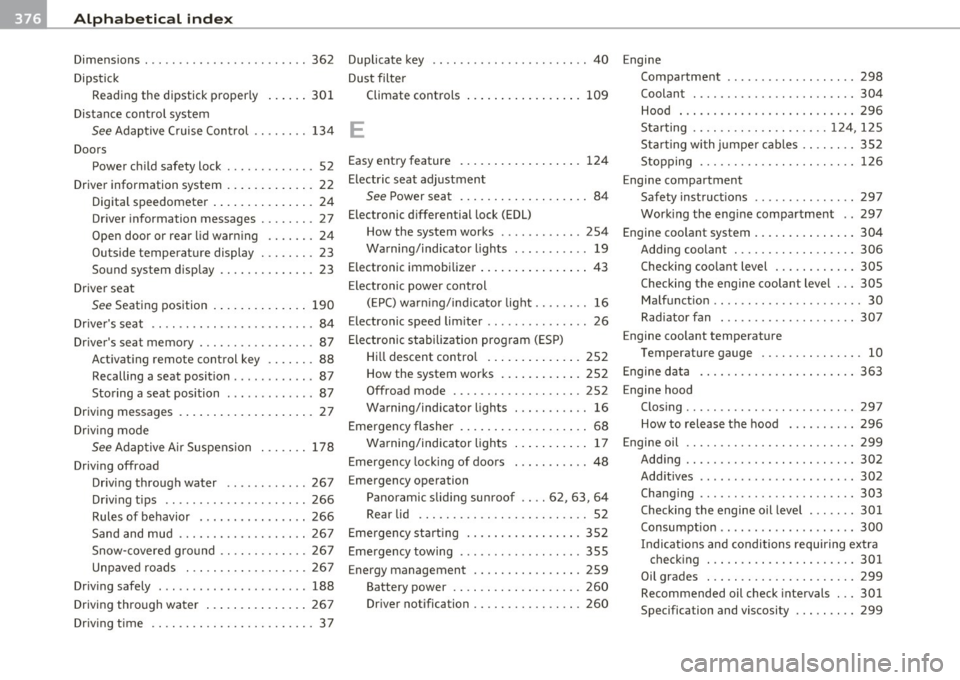
Dimensions ... ............ ....... .. 362
Dipstick
Reading the dipstick properly ......
301
Distance control system
See Adaptive Cruise Control ...... .. 134
Doors
Power child safety lock .............
52
Driver information system ......... .... 22
Digital speedometer ............... 24
Driver information messages ........ 27
Open door or rear lid warning ....... 24
Outside tempera ture display ..... ... 23
Sound system display .. .. ..... ..... 23
Drive r seat
See Seating position .............. 190
D. , river s seat . . . . . . . . . . . . . . . . . . . . . . . . 84
Driver's seat memory .............. ... 87
Activating remote control key .... ...
88
Recalling a seat position ............ 87
Storing a seat position ... .... .. .... 87
Driving messages .................... 27
Driving mode
See Adaptive Air Suspens ion . .... .. 178
Driving offroad
Driving through water .... .. ... ...
267
Dr iving tips .. ............ .... ... 266
Rules of behavior ........ .... .... 266
Sand and mud ................. .. 267
Snow -covered g round .. .. .... ..... 267
Unpaved roads . .. .. .. .. .... ..... 267
Driving safely . .. ..... ... ........... 188
Driving through water ... .. .. .. .... .. 267
D. . t· riving 1me .... .... ...... .......... 37
Duplicate key .. .. .. ..... ..... ... .. .. 40
Dust filter
Climate controls .................
109
E
Easy entry feature 124
Electric seat adjustment
See Power seat . . . . . . . . . . . . . . . . . . . 84
Electronic differential lock (EDL)
How the system works . ......... ..
254
Warning/indicator l ights ... ... ... .. 19
Electronic immobilizer ................ 43
Electronic power control
(EPC) warn ing/indicato r light ...... ..
16
Electronic speed limiter ... ..... ..... .. 26
Electronic stabilization program (ESP)
Hill descent control ........ ... .. . 252
How the system works .......... .. 252
Offroad mode ............ .. ..... 252
Warning/indicator l ights . .. .. .. .. .. 16
Emergency flasher . . . . . . . . . . . . . . . . . . . 68
Wa rning/indicator l ights ... .. .... .. 17
Emergency locking of doors ... .. .. .. .. 48
Emergency operation
Panoramic sliding sunroof .. ..
62, 63, 64
Rear lid ....... .. .... .. .. .. .... .. 52
Emergency start ing ........... ... .. . 352
Emergency towing .... ..... .... .. .. . 355
Energy management ........... .... . 259
Battery power .. .. .. .. .. .... ..... 260
Driver notification ............... . 260
Engine
Compartment ............... .. ..
298
Coolant ................. ... ... . 304
Hood . .. .. ..... .......... .. .. .. 296
Starting .. .... .. .. .. .. .. .... 124, 125
Starting with jumper cables .. .... .. 352
Stopping ........... ...... .... .. 126
Engine compartment
Safety instructions ...............
297
Working the engine compartment .. 297
Engine coolant system ............... 304
Adding coolant ............ .. .. .. 306
Checking coolant level ............ 305
Checking the engine coolant level . .. 305
Malfunction .. .. .. .. .... ... ..... .. 30
Radiator fan . .. .. ............... 307
Engine coolant temperature
Temperature gauge .. .... .. .. .. .. . 10
Engine data ................. .. .. .. 363
Engine hood
Closing ........ ... ... ... .. .. ....
297
How to release the hood .......... 296
Engine oil ............. ...... .... .. 299
Adding ............. .. .... .... .. 302
Additives .. ............ .... ... .. 302
Changing .. ..... ...... ... ... .. .. 303
Checking the engine oil level .... . .. 301
Consumption .. .. .... .. ...... .. .. 300
Indicat ions and conditions requiring extra
checking . .. .. .. .. .............
301
Oil grades . .. .. .... ............. 299
Recommended oil check intervals ... 301
Specifica tion and viscosity ..... .. .. 299
Page 385 of 390
_____________________________________________ A_ L .... p_ h _ a_b_ e_ t_ ic_a_ l_ in_ d_e _ x __ _
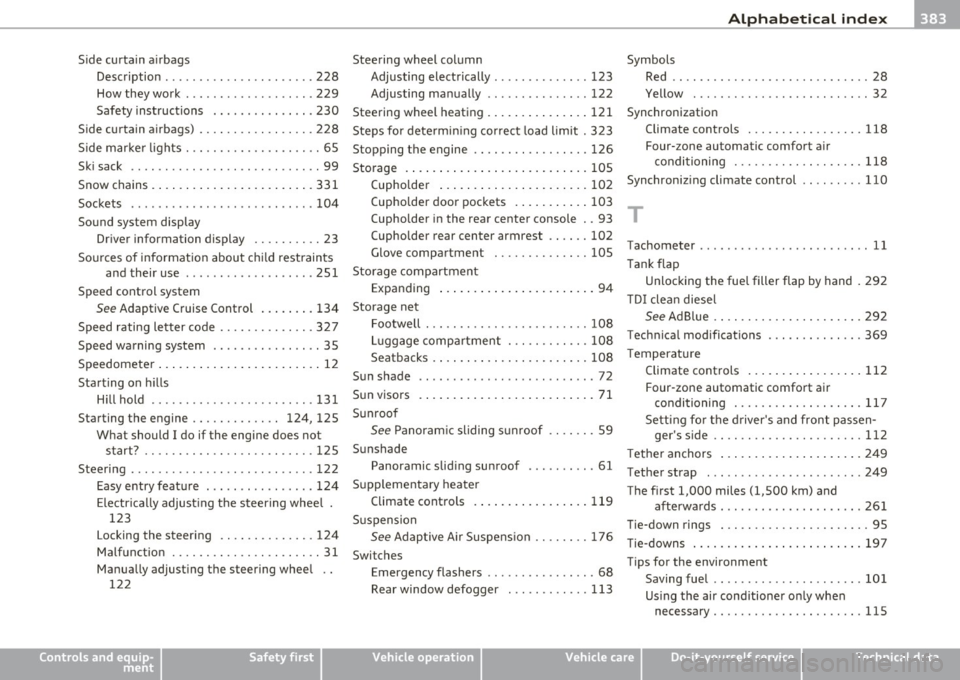
Side curtain airbags
Description ............ ... ... .... 228
How they work ............... .... 229
Safety instructions .. .......... .. . 230
Side curtain airbags) .......... ... ... . 228
Side marke r lights ................ ... . 65
Sk i sack ......... ... ... ... .. .. ... ... 99
Snow chains .... ................ ... . 331
Sockets ..................... ... ... 104
Sound sys tem display
Driver information display .......... 23
Sources of information about child restraints
and their use ........... ... .. .. . 251
Speed control system
See Adaptive Cruise Control ........ 134
Speed rating letter code ........... .. . 327
Speed warning system ........... ... .. 35
Speedometer ... ... ............. ..... 12
Starting on hills
H ill hold ...... ...... ... ... ..... . 131
Starting the engine ........... .. 124, 125
What should I do if the engine does not start? ...... .. .... .. .... .. .... . 125
Steering . ............ .... ... ... .... 122
Easy entry feature . .. .. ........... 124
Electrically adjusting the steering whee l .
123
Locking the steering .... .. ... ..... 124
Malfunction .............. .. .. .. .. 31
Manually adjusting the steering wheel
122
Controls and equip ment Safety first
Steering wheel colum
n Symbols
Adjusting electrically ............ .. 123 Red ..... ........................ 28
Adjusting manually ............... 122 Yellow ................... .... ... 32
Steering wheel heating ........ ..... .. 121 Synchronization
Steps for determining correct load limit . 323 Climate controls ...
.............. 118
Stopping the engine .... .. .. .. .. .. .. . 126
Storage ...... .. ... ... ... .......... 105
(upholder .. . .. .... ... .......... 102 Four-
zone automatic comfort air
conditioning ............ .... .. . 118
Synchronizing climate control . ... .. .. . 110
(upholder door pockets ........... 103
(upholder in the rear center console . . 93
T
(upholder rear center armrest .... .. 102
Glove compartment ...... ...... .. 105
Storage compartment
Expanding ... ..... ............... 94
TOI clean diesel
See Ad Blue .. .. .. .. ............. . 292
Storage net
Footwell . .. .. .... ............... 108 Tachometer
.................. .... ... 11
T ank flap
Unlocking the fuel filler flap by hand . 292
Luggage compartment . .. .. .. ..... 108 Technical modifications
, , , .. , ..... ... 369
Seatbacks .... .. .... ............. 108 T
emperature
Sun shade .. ................ ... .. ... 72 Climate controls
................. 112
Sun visors . ................ .. .... ... 71
Sunroof
See Panoramic sliding sunroof .. .. .. . 59 Four-zone automatic comfort air
conditioning ............ .. .. .. . 117
Setting fo r the driver's and front passen-
ger's side .. .. .. .. .............. 112
Sunshade Tethe r anchors ... ................ .. 249
Panoramic sliding sunroof ......... . 61
Supplementary heater
Climate controls . ..... ........... 119 Tether strap
... .. ... ... ........ .... 249
The first
1,000 miles (1,500 km) and
afterwards ... ......... .. ... ... . 261
Suspension
See Adaptive A ir Suspension ...... .. 176 Tie-down rings
... .. .. .... ........... 95
T ie-downs ......................... 197
Switches
Emergency flashers ... ......... ... . 68
Rear window defogger . ...... ..... 113 Tips for the environment
Saving fuel .. .. .. ................
101
Using the air conditioner on ly when
necessary ............... ...... .
115
Vehicle operation Vehicle care Do-it-yourself service Technical data