seats AUDI Q7 2010 Owner´s Manual
[x] Cancel search | Manufacturer: AUDI, Model Year: 2010, Model line: Q7, Model: AUDI Q7 2010Pages: 390, PDF Size: 93.04 MB
Page 244 of 390
-L-___::C~h...:.: i:.:: l .:::d ~S:::.::: a..:..f .::. e ..::tY L- ___________________________________________ _
& WARNING (continued)
• Forward-facing child safety seats or infant carriers installed on
the front passenger's seat may interfere with the deployment of
the airbag and cause serious injury to the child.
• It is safer to install a forward-facing child safety seat on the
rear seat.
• Always read and heed all WARNINGS whenever using a child
restrained in a vehicle is being used~
page 231. Special precau
tions apply when installing a child safety seat on the front
passenger seat~
page 211, "Child restraints on the front seat -
some important things to know".
& WARNING
Always take special precautions if you must install a forward or rearward-facing child restraint on the front passenger's seat in
exceptional situations:
• Whenever a forward or rearward-facing child restraint is
installed on the front passenger seat, the PASSENGER AIR BAG
OFF light must come on and stay on whenever the ignition is
switched on.
• If the PASSENGER AIR BAG OFF light does not come on and
stay on, perform the checks described~
page 220, "Monitoring
the Advanced Airbag System".
• Take the child restraint off the front passenger seat and install
it properly at one of the rear seat positions if the PASSENGER AIR
BAG OFF light does not stay on whenever the ignition is switched
on.
• Improper installation of child restraints can reduce their effec
tiveness or even prevent them from providing any protection.
• An improperly installed child restraint can interfere with the
airbag as it deploys and seriously injure or even kill the child.
• Always carefully follow the manufacturer 's instructions
provided with the child safety seat or carrier.
& WARNING (continued)
• Never place additional items on the seat that can increase the
total weight registered by the weight-sensing mat and can cause injury in a crash.
& WARNING
Forward-facing child restraints:
• Always make sure the forward-facing seat has been designed
and certified by its manufacturer for use on a front seat with a
passenger front and side airbag.
• Never put the forward-facing child restraint up, against or very
near the instrument panel.
• Always move the passenger seat into its rearmost position in
the seat's fore and aft adjustment range, as far away from the
airbag as possible before installing the forward-facing child
restraint. The backrest must be adjusted to an upright position.
• Make sure that the PASSENGER AIR BAG OFF light comes on
and stays on all the time whenever the ignition is switched on.
& WARNING
Rearward-facing child restraints:
• A child in a rearward-facing child safety seat installed on the
front passenger seat will be seriously injured and can be killed if
the front airbag inflates - even with an Advanced Airbag System.
• The inflating airbag will hit the child safety seat or infant
carrier with great force and will smash the child safety seat and
child against the backrest, center armrest, door or roof.
• Always be especially careful if you must install a rearward
facing child safety seat on the front passenger seat in exceptional
circumstances.
• A tight tether strap on a rearward-facing child restraint
attached to the front passenger seat can put too much pressure on .,
Page 246 of 390
lffll,___C_ h_ il_d _ S_a _ f_ e _ t-= y ;....._ ____________________________________________ _
& WARNING (conti nued)
passenger seat => page 211, "Child restraints on the front seat -
s ome important thing s to know ".•
Deactivating the convertible locking
retractor
The convertible lockin g retractor for child restraints will
be d eac tiv a ted aut omatic all y when the bel t is wou nd all
t he wa y back in to the retrac tor.
-Press the r ed button on the sa fety belt buckl e. T he b elt
t o ngue will po p out of t he buckle .
- Guid e the safety belt a ll the way back into its stowe d posi-
t ion.
Always le t the sa fety be lt retrac t co mple tely i nto i ts s tow ed position .
The safety bel t can now be used as a n or dinary sa fe ty belt withou t the
convert ib le locking ret ractor fo r chi ld rest raints .
If the convertible locking retractor should be activated inadvertently,
t he s afety be lt mus t be unfa stened and guide d comple tely b ack in to
its stowed position to deactivate this feature. If t he convert ib le
lo ckin g ret ractor is no t d eactiv ated , the sa fe ty bel t w ill grad ually
become tighter and uncomfo rtable to wea r.
& WARNING
Imp roperly installed child safety seats increase the risk of serious
personal injury and death in a colli sion.
• Never unfasten the safety belt to deactivate the convertible
locking retractor for child restraints while the vehicle is moving.
You would not be restrained and could be seriously injured
in an
accident.
& WARNING (con tinued )
• Alway s read and heed all WARNINGS whenever u sing a child
restrained in a vehicle is being used
=> page 231. Special precau
tions apply when installing a child safety seat on the front
pass enger seat =:>
page 211, "Child restraints on the front seat -
some impo rtant things to know ".•
LATCH Lower anchorages and
tethers for children
Child Restraint System anchors and how
are they related to child safety
T o prov ide a simpler and more practicable way to attach the child
restrain t on the vehicle seat, Federa l regulat io ns re quire spe cial
lower ancho rages in ve hicles and devices o n new chi ld restraints to
at ta ch to the ve hicle an chor ages.
The combination of the tether anchorages and t he lower anchorages
is now gene rally called the
LATCH system fo r "Lowe r Ancho rages and
T ethers for Childre n."
Forward-fac ing c hild restraints manufactured after Se ptember 1,
199 9, are requ ired by U .S. feder al reg ulat ion s to comp ly w ith new
child head moveme nt performance requirements . These new perfor
m anc e req uire men ts ma ke a tether nece ssary on m ost new child
seats.
Insta lling a child restraint that req uires a top tether w ithout one can
ser iously impair t he p erf or mance of th e chi ld res tra int and its ab ility
to p rotect the ch ild in a collision. Insta llin g a c hild rest raint that
req uires a top te ther w ithout t he top tet her m ay be a v iol at ion of
state law. ..
Page 247 of 390
Child restraint manufacturers offer LATCH lower anchorages on the ir
c hild seats with hook-on or push-on connectors attached to adjust
able straps .
I n addition to the LATCH lower anchorages, these child restraint
systems usually require the use of tet he r straps to he lp keep the child
restra int f irm ly in place.
& WARNING
Improper installation of child restraints will increase the risk of
injury and death in a crash.
• Always follow the instructions provided by the manufacturer
of the child restraint you intend to install in your vehicle.
• Never install a child restraint without a properly attached top
tether strap if the child restraint manufacturer's instructions
require the top tether strap to be used.
• Improper use of child restraint LATCH lower anchorage points
can lead to injury in a colli sion . The LATCH lower anchorage points
are designed to withstand only those loads imposed by correctly
fitted child restraints .
• Never mount two child restraint systems on one LATCH lower
anchorage point .
• Never secure or attach any luggage or other item to the LATCH
lower anchorages .
(I) Tips
• In Canada, the terms "top tether " with " lower universa l anchor
ages" (or "lower universal anchorage bars") are used to describe the
system .
• In other countries, the term "ISO FIX" is used to describe the lower
anchorages. •
Safety first Vehicle OP-eration
Location
Child Safety
Fig. 210 Schematic
overview: LATCH
anchorage point loca
tions
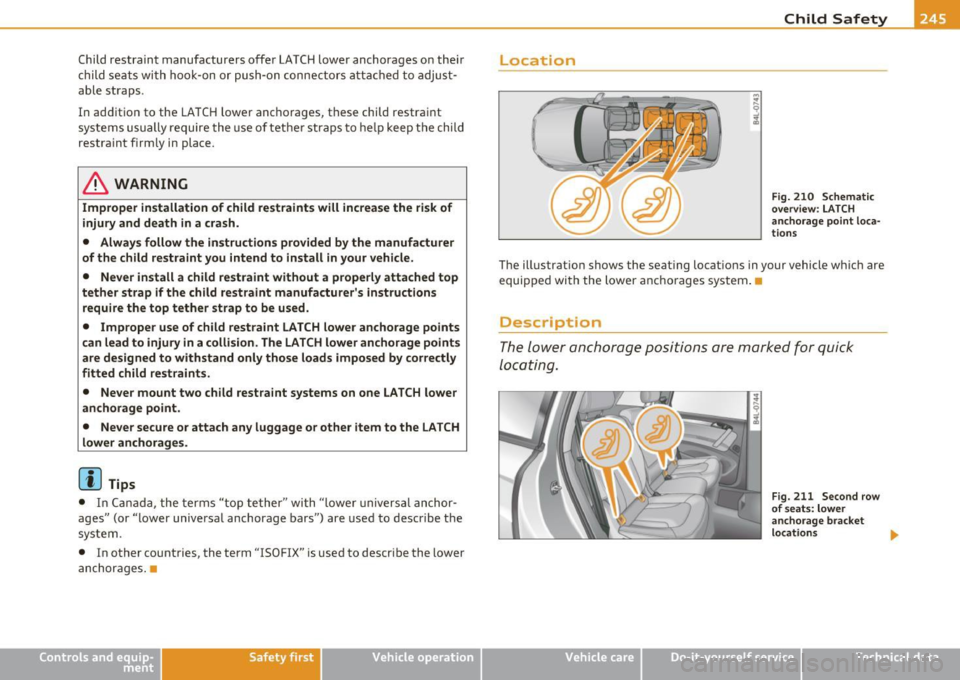
The illustrat ion shows the seating locations in your vehicle whic h are
equipped with the lower anchorages system. •
Description
The lower anchorage positions are marked for quick
locating.
Vehicle care
Fig. 211 Second row
of seats: lower
anchorage bracket
locations ..
Do-it-yourselt service iTechnical data
Page 248 of 390
___ C_h _i_ld _ S_ a_ f_ e_ t_,, y'-----------------------------------------------
Fig. 212 Third row of
seats: locator buttons
for lower anchorages
Attachment locator markers for lower anchorages
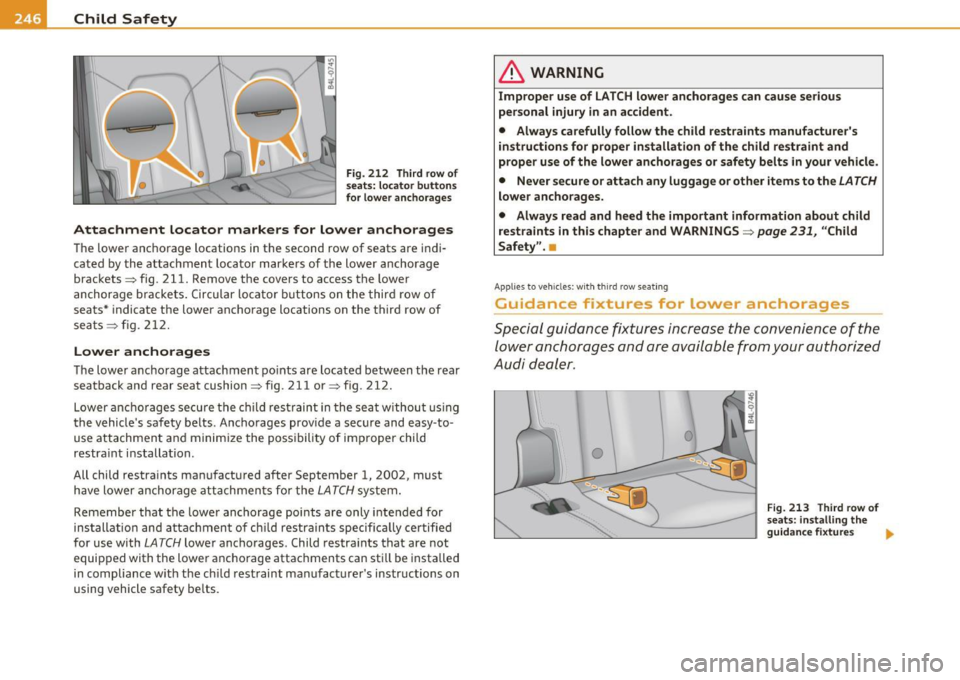
The lower anchorage locations in the second row of seats are indi
cated by the attachment locator markers of the lower anchorage
brackets :::::, fig . 211. Remove the covers to access the lower
anchorage brackets. Circular locator buttons on the third row of
seats * indicate the lower anchorage locations on the third row of
seats :::::, fig. 212.
Lower anchorages
The lower anchorage attachment points are located between the rear
seatback and rear seat cushion:::::, fig. 211 or:::::, fig . 212.
Lower anchorages secure the child restraint in the seat without using
the vehicle's safety belts . Ancho rages prov ide a secure and easy-to
use attachment and minim ize the poss ibility of improper chi ld
restra int installation .
All child restra ints manufactured after September 1, 2002, must
have lower anchorage attachments for the
LATCH system.
Remember that the lower anchorage points are only intended for
ins tallatio n and attachment of child restrain ts specifica lly certified
for use with
LATCH lower anchorages . Child restraints that are not
equipped with the lower anchorage attac hments can still be installed
in compliance w ith the ch ild restraint manufact urer's instructions on
using vehicle safety be lts.
& WARNING
Improper use of LATCH lower anchorages can cause serious
personal injury in an accident.
• Always carefully follow the child restraints manufacturer's
instructions for proper installation of the child restraint and
proper use of the lower anchorages or safety belts in your vehicle.
• Never secure or attach any luggage or other items to the
LATCH
lower anchorages.
• Always read and heed the important information about child
restraints in this chapter and WARNINGS :::::,
page 231, "Child
Safety". •
Applies to veh icles: wi th third row seating
Guidance fixtures for lower anchorages
Special guidance fixtures increase the convenience of the
lower anchorages and are available from your authorized
Audi dealer.
o,
Fig. 213 Third row of
seats: installing the
guidance fixtures ..
Page 249 of 390
I
I I
I I
I I
0
Fig. 214 Close-up:
fitting the guidance
fixture over the lower
anchorage bracket
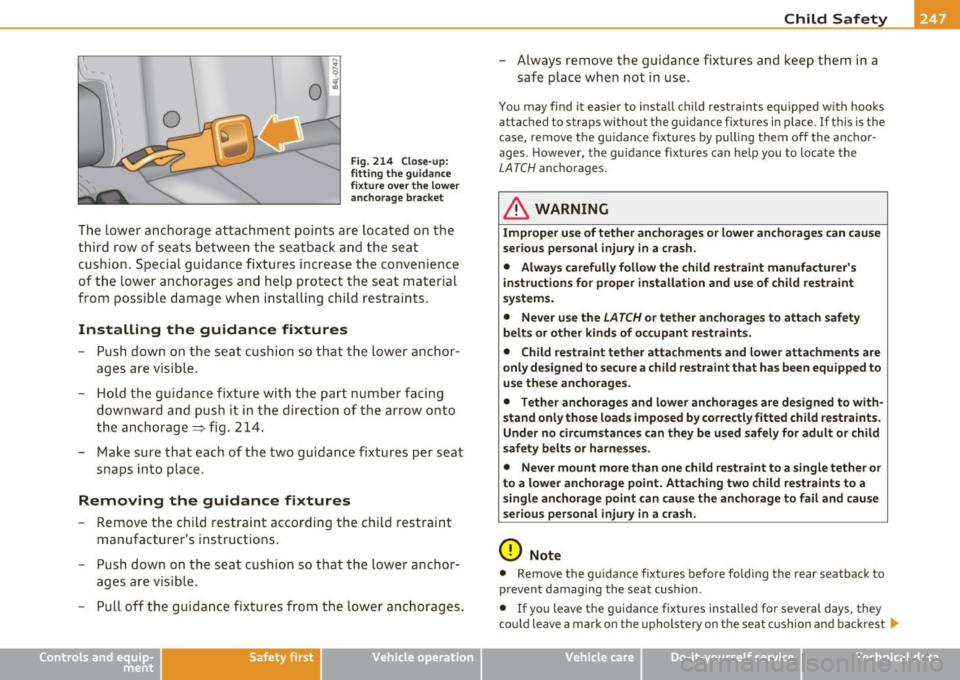
The lower anchorage attachment points are located on the
third row of seats between the seatback and the seat
cushion. Special guidance fixtures increase the convenience
of the lower anchorages and help protect the seat material
from possible damage when installing child restraints.
Installing the guidance fixtures
- Push down on the seat cushion so that the lower anchor
ages are visible.
- Hold the guidance fixture with the part number facing
downward and push it in the direction of the arrow onto
the anchorage => fig. 214.
- Make sure that each of the two guidance fixtures per seat snaps into place.
Removing the guidance fixtures
- Remove the child restraint according the child restraint
manufacturer's instructions.
- Push down on the seat cushion so that the lower anchor
ages are visible.
- Pull off the guidance fixtures from the lower anchorages.
Safety first Vehicle OP-eration
Child Safety
-Always remove the guidance fixtures and keep them in a
safe place when not in use.
You may find it easier to install child restraints equipped with hooks
attached to straps without the guidance fixtures in place. If this is the
case , remove the guidance fixtures by pulling them off the anchor
ages. However , the guidance fixtures can help you to locate the
LATCH anchorages.
& WARNING
Improper use of tether anchorages or lower anchorages can cause
serious personal injury in a crash.
• Always carefully follow the child restraint manufacturer's
instructions for proper installation and use of child restraint
systems.
• Never use the
LATCH or tether anchorages to attach safety
belts or other kinds of occupant restraints.
• Child restraint tether attachments and lower attachments are
only designed to secure a child restraint that has been equipped to
use these anchorages.
• Tether anchorages and lower anchorages are designed to with
stand only those loads imposed by correctly fitted child restraints.
Under no circumstances can they be used safely for adult or child
safety belts or harnesses.
• Never mount more than one child restraint to a single tether or
to a lower anchorage point. Attaching two child restraints to a
single anchorage point can cause the anchorage to fail and cause
serious personal injury in a crash.
0 Note
• Remove the guidance fixtures before folding the rear seatback to
prevent damaging the seat cushion .
• If you leave the guidance fixtures installed for several days, they
could leave a mark on the upholstery on the seat cushion and backrest•
Vehicle care Do-it-yourselt service iTechnical data
Page 250 of 390
• .___C_ h_ il_d _ S_a _ f_ e _ t--= y '------------------------------------------------
in the area that the guidance fixtures were installed . The upholstery
would also be permanently stretched around the guidance fixtures.
This applies especially to leather seats .•
Installing a child restraint with LATCH
lower anchorages
Whenever you install a child restraint always follow the
child restraint manufacturer's instructions.
Mounting
Fig. 215 Lower
anchorages: proper
mounting
- Make sure the seat back of the rear seat bench is in the
upright position and securely latched in place.
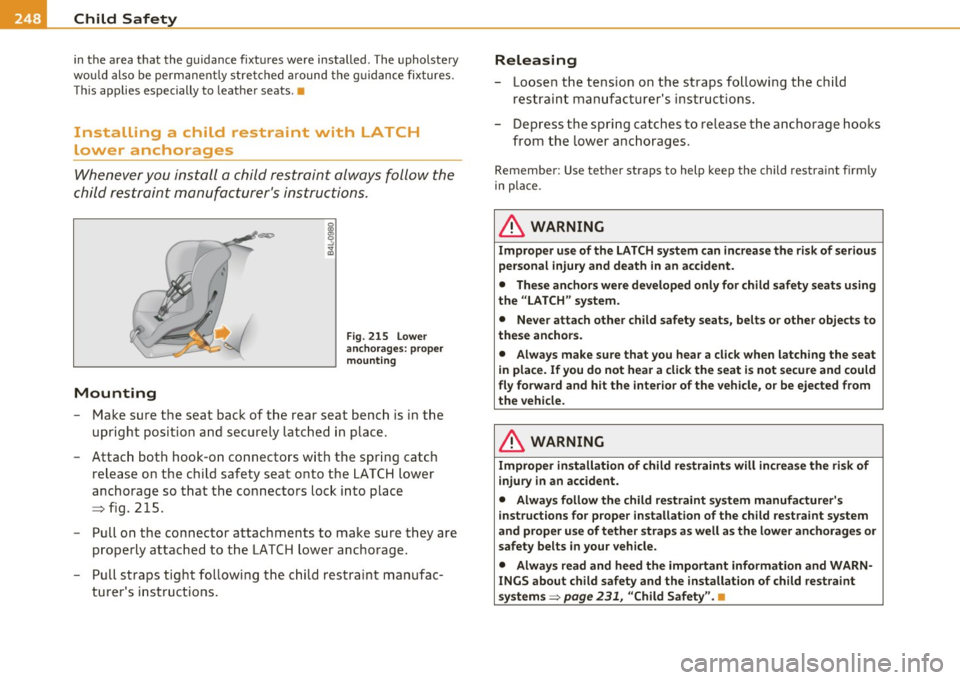
- Attach both hook-on connectors with the spring catch
release on the child safety seat onto the LATCH lower
anchorage so that the connectors lock into place
~ fig. 215.
- Pull on the connector attachments to make sure they are
properly attached to the LATCH lower anchorage.
- Pull straps tight following the child restraint manufac
turer's instructions.
Releasing
- Loosen the tension on the straps following the child
restraint manufacturer's instructions.
- Depress the spring catches to release the anchorage hooks
from the lower anchorages.
Remember: Use tether straps to help keep the child restraint firmly
in place.
& WARNING
Improper use of the LATCH system can increase the risk of serious
personal injury and death in an accident.
• These anchors were developed only for child safety seats using
the "LATCH" system.
• Never attach other child safety seats, belts or other objects to
these anchors.
• Always make sure that you hear a click when latching the seat
in place. If you do not hear a click the seat is not secure and could
fly forward and hit the interior of the vehicle, or be ejected from
the vehicle.
& WARNING
Improper installation of child restraints will increase the risk of
injury in an accident.
• Always follow the child restraint system manufacturer's
instructions for proper installation of the child restraint system
and proper use of tether straps as well as the lower anchorages or
safety belts in your vehicle.
• Always read and heed the important information and WARN
INGS about child safety and the installation of child restraint
systems ~
page 231, "Child Safety". •
Page 251 of 390
Tether anchors and tether straps
Fig. 216 Tether
anc hors fo r second row
of seats: attachment
h ook location s
Fig . 217 T ether
anch ors for third row
of seats: a tt ac hment
h ook location s
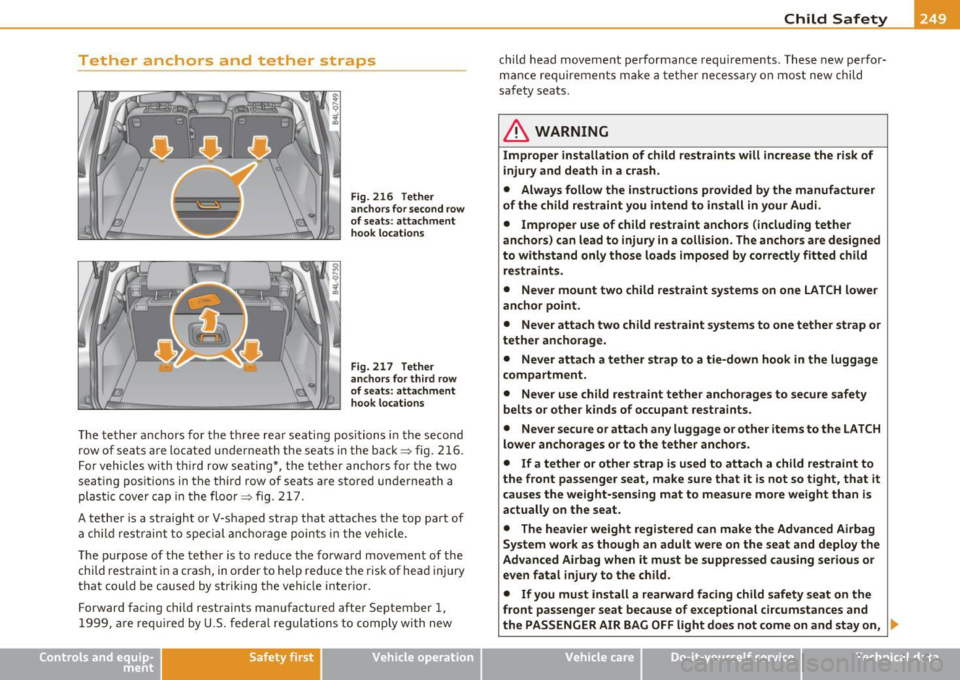
The tether anchors for the three rea r seating positions i n the s econd
row of seats are located u nderneath the seats in the back~ fig. 216.
For vehicles wi th t hir d row seating *, th e tet her anchors for the two
seating pos it io ns in th e third row of seats are stored un derneath a
p lastic co ve r cap in th e floor~ fig. 217 .
A tethe r is a straight o r V-shaped strap that attaches the top part of
a child restra int to special anch o rage points in t he vehicle .
Th e purpose of the te the r is to reduc e the fo rwa rd movemen t of t he
child rest raint in a cras h, in order to help reduce the risk of head injury
th at could be c au se d by striki ng the ve hicle in ter ior.
Forward facing child restraints man ufactured after September 1,
1 99 9, ar e re quir ed b y U.S. feder al regulat ions to co mply wi th new
Safety first Vehicle OP-eration
Child Safety
child head movem ent performance requ ireme nts . These new per for
ma nce re quiremen ts mak e a t eth er nece ssary on m ost new child
sa fety s eats .
& WARNING
Improper installation of child restraints will increase the risk of
injury and death in a crash.
• Always follow the instructions provided by the manufactu rer
of the child restraint you intend to install in your Audi.
• Improper use of child restraint anchors (including tether
anchors) can lead to injury in a collision . The anchors are designed
to withstand only those loads imposed by correctly fitted child
restraints.
• Never mount two child restraint systems on one LATCH lower
anchor point.
• Never attach two child restraint systems to one tether strap or
tether anchorage .
• Never attach a tether strap to a tie-down hook
in the luggage
compartment.
• Never use child restraint tether anchorages to secure safety
belts or other kinds of occupant restraints .
• Never secure or attach any luggage or other items to the LATCH
lower anchorages or to the tether anchors.
• If a tether or other strap is used to attach a child restraint to
the front passenger seat, make sure that it is not so tight, that it
causes the weight-sensing mat to measure more weight than is
actually on the seat.
• The heavier weight regi stered can make the Advanced Airbag
System work as though an adult were on the seat and deploy the
Advanced Airbag when it must be suppressed causing serious or
even fatal injury to the child.
• If you must install a rearward facing child safety seat on the
front passenger seat because of exceptional circumstances and
the PASSENGER AIR BAG
OFF light does not come on and stay on, ..
Vehicle care Do-it-yourselt service iTechnical data
Page 252 of 390
...,. Child Safety Pfl'I ____ _,.__ __________________________ _
& WARN ING (con tin ue d)
immediate ly install the re a r-facing child safe ty se at in a rear
se ating p osition and ha ve th e airbag system in spe cte d by your
Audi deal er. •
Installing the upper tether strap on the
anchorage
Installing the tether strap
F ig. 218 Tethe r strap:
proper routin g and
m ounti ng
F ig. 219 Tether strap
f o r seco nd row s eats:
proper rout in g an d
moun ting
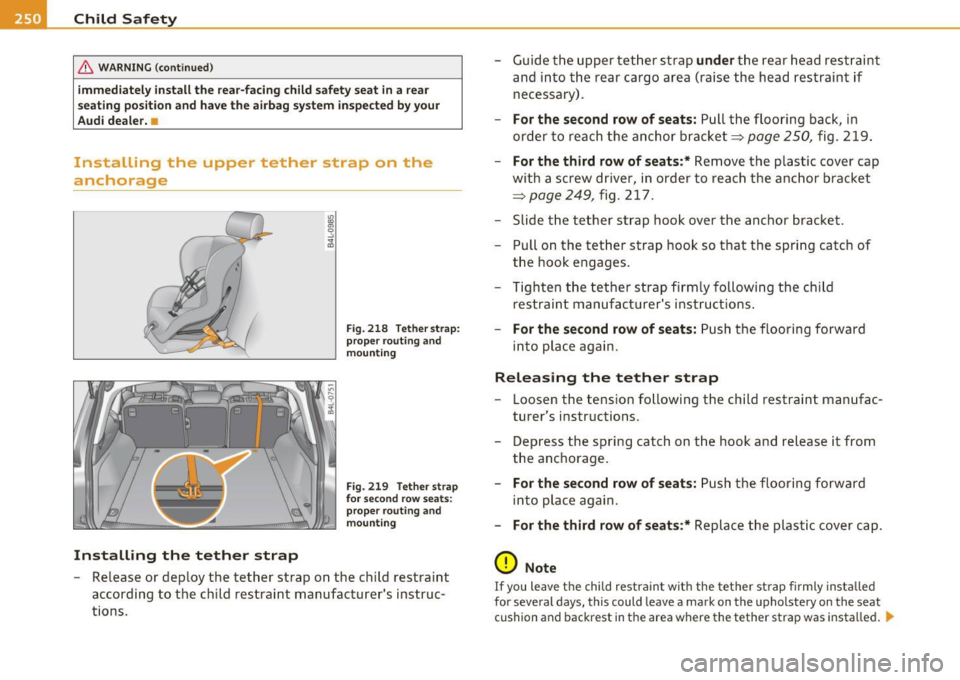
- Release or deploy the tether strap on the child restraint
according to the child restraint manufacturer's instruc
tions . -
Guide the upper tether strap
under the rear head restraint
and into the rear cargo area (raise the head res traint if
necessary).
- For the second row of seats: Pull the flooring back, in
order to reach the anchor bracket=>
page 250, fig. 219 .
-For the third row of seats:* Remove the plastic cover cap
with a screw driver, in order to reach the anchor bracket =>
page 249, f ig . 217 .
Slide the tether strap hook over the anchor bracket .
- Pull on the tether strap hook so that the spring catch of the hook engages .
- Tighten the tether strap firmly following the child
restraint manufacturer's i nstruct ions .
-For the second row of seats: Push the flooring forward
into place again.
Releasing the tether strap
- Loosen the tens ion following the child restraint manufac
turer's i nstructions.
- Depress the spring catch on the hoo k and release it from
the anchorage .
-For the second row of seats: Push the flooring forward
into place again.
- For the third row of seats :* Replace the plastic cover cap.
0 Note
If
you leave the chi ld restrain t with the tether st rap firmly insta lled
for severa l days, this could leave a mark on the upholstery on the seat
cushion and backrest in t he area where the tether strap was insta lled . .,.
Page 262 of 390
Intelligent technology
'-------------------------------------------------
Take into consideration that when you unlock your vehicle, some
convenience functions, such as the remote key or power seat adjust
me nt, may not be available. The convenience functions will be avail
able again when you turn on the ignition and start the engine.
With the engine turned off
If you listen to the radio, for example, with the engine turned off or
use other MMI functions, the battery is being discharged.
If start ing capability is jeopardized due to energy consumption, the
following warning appears in the MMI display:
Please start engine, otherwise system will switch off in
3 minutes .
The warning indicates that the system will be turned off automati
cally after 3 minutes. If you wish to continue using the functions, you
have to start the engine.
With the engine running
Although electrical energy is generated when the vehicle is being
driven, the battery can become discharged. This happens mostly
when little energy is being generated and a great deal consumed and
the battery's state of charge is not optimal.
To bring the energy balance back into equilibr ium, consumers which
require especially large amounts of energy are temporarily cut back
or switched off. Heat ing systems in particular require a great deal of
energy. If you notice, for example, that the heated seats* or the
heated rear window are not heating, they have been temporarily cut
back or switched off. These systems will be available again as soon as
the energy balance has been restored .
You will also notice that engine idle speed has been increased
slightly. This is norma l and not a cause for concern. By increasing
engine idle speed the additional energy required is generated and the
battery is charged.
Driver notification in the instrument
cluster display
If battery power drops into the range where it can limit the ability of
the engine to start, this is shown in the instrument cluster display
with the following driver message:
i...-3 Low battery charge: battery will be charged while driving
This notification reminds you that the starting capability of the
engine may be limited. As soon as you start driving again, the battery
w ill be recharged and the notification will go out.
Driver notification appears and goes out again
If th is driver notification appears after the ignition is turned on or
whi le driving and it goes out again after a while, the battery has been
adequately recharged.
Driver notification appears and does not go out
again
If this driver notification appears after the ignition is turned on o r
wh ile driving and does not go out again, the battery's state of charge
is not in the optimal range. Starting ability is restricted. Have the
battery checked as soon as possible by an authorized Audi dealer or
qualified workshop. •
Page 283 of 390
____________________________________________ C_l_e _a_ n_ i n--= g=--- a_n_ d----' p,__ r_o _t_ e_ c_ t_ i _o_ n __ _
& WARNING (co ntinued )
• Do not apply additional underco ating or rustproofing on or
near th e exhaust manifold, exhaust pipes, catalytic converter or
heat shields. While driv ing, the substance us ed for undercoating
could overheat and cause a fire .
• Always read and heed all WARNINGS and other information
:::>page 274. •
Exhaust tail pipes
Road salt and other co rrosive materials w ill damage the mate rial in
t he exhaus t tai l pipes if they a re not cleaned regula rly. Do no t clean
t he ta il pipes wi th whee l cleaner, pain t po lish , chrome polish o r ot her
abras ive cleaners. C lean the ta il pipes w it h car care products that are
suitable for sta in less stee l.
Your authori zed Audi dealer can provide clean ing products that have
bee n teste d an d a pproved for your ve hicle.•
Care of interior
MMI display
- Clean th e MM I dis pla y w ith a so ft clean clot h and an LCD
cleane r.
T he MM I display ca n be cleaned with a professiona lly available "LCD
cl eaner". The cloth sho uld be sligh tly dampened with the cleaning
fluid to clean t he d isp lay.
0 Note
T o avoid scra tch ing the MMI display, you should never clean it dry .•
Safety first
MMI control console
- First clean t he MMI co ntrol console w it h a bru sh to
r e mov e dust from th e h ousin g.
- Then wi pe the MMI co ntrol co nsole w ith a clea n, soft,
slightly da mp c loth .
The MMI control conso le sho uld be clea ned with a brush first so that
no dirt is trapped betwee n the buttons and the ho usin g. We re com
mend g iv ing t he M MI co ntro l co nsole a final w ipe wi th a cloth mo ist
ened w ith wate r and dish washing detergent .
0 Note
To prevent damage, make s ure that no fluid ever gets into the MMI
contr ol console. •
Aluminum trim
Use only neutral-pH products to remov e spo ts and deposits from
al uminum surfaces . Chrome care pro ducts and al ka line cleaners w ill
a tta ck al umi num su rfaces and c an damage them ove r time .
& WARNING
Always read and heed all WARNINGS and other information
=>page 274. •
Fabrics and fabric coverings
Fabrics and fabr ic coverings (e.g . seats , d oor trim p anels, et c.) s hou ld
be cleaned at regular interva ls with a vacuu m cleaner . T hi s removes
s u rface di rt part icles which co uld become embedded in the fabr ic _,,,
Vehicle care Technical data