wheel AUDI Q7 2010 Owner´s Manual
[x] Cancel search | Manufacturer: AUDI, Model Year: 2010, Model line: Q7, Model: AUDI Q7 2010Pages: 390, PDF Size: 93.04 MB
Page 282 of 390
![AUDI Q7 2010 Owner´s Manual -Cleaning and protection
-----=---=----------------------------------------
(I] Tips
Keep silicone sprays off the windshield to avo id wipe r smear in ra in. •
Cast (light) alloy whe](/img/6/40275/w960_40275-281.png "AUDI Q7 2010 Owner´s Manual -Cleaning and protection
-----=---=----------------------------------------
(I] Tips
Keep silicone sprays off the windshield to avo id wipe r smear in ra in. •
Cast (light) alloy whe")
-Cleaning and protection
-----=---=----------------------------------------
(I] Tips
Keep silicone sprays off the windshield to avo id wipe r smear in ra in. •
Cast (light) alloy wheels
Cast (light) alloy wheels require special care.
- Wash the whee ls with a sponge or hose brush every o ther
wee k.
- For deep cleaning afterwards, use on ly a ded icated
acid
free cast a lloy wheel c leaner .
- Rub a coat of
liquid wax onto the rim s every three m onth .
B e su re to re ach an d treat all part s o f the rim .
To preserve th e decorat ive ap pea rance of the cast a lloy whee ls, some
special care is necessary. In a ddition to road dirt and sa lt, brake dust
is a lso co rro sive . If left o n fo r to o long, brake dust ca n ca use pi tting.
Use only spec ial
acid -free clea ners formulated fo r a lloy r ims . Safe
pro duct s are available at your author iz ed Audi de aler. Neve r leave the
cleaner on t he rims longer than spec ified on t he label. If not rinsed
off promptly , the acid conta ined in some cleaners can attack t he
t hreads on the wheel bolts .
N ever use abrasive or metal po lish ing cleaning agents.
If the protec
t ive c oating ha s b een ch ipped, e.g. by k icked up ro ad dir t, touch it up
as soon as possible.
& WARNING
• Moisture and ice on brakes may affect braking efficiency
=> page 255, "General information ". Test the brakes carefully
each time you wash the vehicle.
• Always read and heed all WARNINGS and other information
=> page 274 . •
Body cavity sealing
Th e body c avity s ealing do es no t n eed to b e chec ked.
All body cavit ies which co uld be affected by cor rosion have been tho r
ough ly pr ote ct ed at th e f actor y.
Thi s sea ling does no t req uire any in spect ion or addit ional t reat men t.
If any wax sho uld seep out of the cavity when t he ambient tempera
ture is high , it can be re m ov ed with a plastic sc rap er and a sui table
solvent.
& WARNING
Solvents can be dangerous.
• Benzine is flammable and toxic. If you use benzine for
removing the wax , keep sparks , flame and lighted cigarettes
away. Never dump benzine on the ground, into open streams or
down sewage drains.
• Be sure to observe all safety and environmental regulations.
Follow all instructions on the container.
• Always read and heed all WARNINGS and other informat ion
:=> page 274 . •
Chassis
H av e t he und erc oat ing ch ecke d for damag e from tim e to
tim e.
Th e lower body sh ell of yo ur A udi is a lso thoro ughly prot ected against
corrosion.
Any d am age to th e u ndercoat ing cau sed by ro ad haz ards sho uld be
repaired promptly.
& WARNING
Too much undercoat ing in the wrong places can cause a fire .
Page 288 of 390
-~_C_ le_ a_n_ i_ n_ g=- a_ n_d___. p_ ro_ t_e _c_ t_ i_o _n ___________________________________________ _
Engine compartment
Be especially careful when cleaning the engine compa rt
men t.
Always switch off the ignition before cleaning the engine=:>& .
Plenum panel
Remove leaves from the plenum panel in front of the win dshi eld
unde r th e eng ine hood . T hi s prevents the water d rain holes from
becoming b locked, and it prevents debris from entering the vehicle
inter io r th rough the heat ing and vent ilation ducts .
Corrosion protection
The eng ine compartment and transmission have been cor rosion
protected at the factory.
Good ant i-cor rosion treatment is very impo rtant , pa rtic ular ly in the
w inter . If the vehicle is frequently driven on sa lt treated roads, the
en tire eng ine compar tment and plenum p anel sho uld be thoroug hly
cleaned at the end of winter and retreated to prevent salt damage. At
t he same t ime, the underside of the vehi cle should be washed as well.
If the e ng ine compartment is clea ned at any t ime with grease
removing so lutions
2l , or i f you have the engine washed , the anti
co rros io n treatment is a lmost a lways removed as w ell.
It is t herefore
essential to have a long-last ing corrosion p rotect ion reapplied to all
surfa ces, seams, jo ints and compo nents in the engi ne co mpa rt ment .
& WARNING
Be aware: The engine compartment of any motor vehicle is a
potentially hazardous area .
• Before working in the engine compartment, be sur e to read the
information =:>
page 286.
2
l Use on ly th e co rr ect clean ing so lut ions. Never use gaso line or diese l fuel.
& WARNING (c on tinued )
• Before reaching into the front plenum panel , alway s remove
the ignition key. Otherwise, the windshield wiper system could unintentionally be switched on , possibly causing personal injury
from the moving wiper linkage.
• Never reach into the area around or touch the radiator fan. The
auxiliary fan is temperature controlled and can switch on suddenly
· ev en when the ignition is off.
• Do not wash, wax or dry the engine with th e engine running.
Moving or hot pa rts could injure you.
• Do not clean the underside of the chass is, fenders, wheel
covers, or other hard to reach part s without protecting your hands
and arm s. You may cut yourself on sharp-edged metal parts.
• Always read and heed all WARNINGS and other information
=:> page 274. •
Page 316 of 390
-~_T_ ir_e_ s_ a_ n_ d_ w_ h_e_ e_ ls _______________________________________________ _
Tires and wheels
Tires
General notes
Tires may be the least appreciated and most abused
parts of a motor vehicle.
T ir es may be the least apprec iated and most abused pa rts of a moto r
vehicle. Tires are, however, one of the most important parts of a
veh icle, parti cularly conside ring the comparative ly small patch of
rubber on eac h tire that assu res that all- important co ntact between
you , your ve hicle and the road .
Ma inta in ing t he correct t ire pressu re, making s ure that your veh icle
and i ts tires do not have to carry more weight than they can safely
hand le, avoid ing damage from road ha za rds and reg ula rly inspect ing
tires for damage incl ud ing c uts, s lashes irregular wea r and overall
condi tion are the mos t important th ings that you can do to help avoi d
sudden tire fa ilure includ ing t read separation and blowouts .
Avoiding damage
If you have to drive over a curb or sim ilar obstacle, drive very s lowly
and as close as poss ible at a right angle to the cu rb .
Always keep chemicals including grease, oil , gasoline and bra ke fl uid
o ff the t ires .
Inspect the ti res regularly for damage (cuts, crac ks o r bl ist ers, e tc .).
Remove any foreign bodies embed ded in the trea ds.
Storing tires
M ar k tires when yo u remove t hem to indica te the d irect ion of rota
tion . This ens ures yo u to be able to mo unt them co rrectly whe n you
re insta ll them.
Wh en r emoved, t he wheels or tires s hould be sto red in a c ool, dry and
preferably da rk p lace. Sto
re tires in a ver tica l pos it ion if they a re not mounted on rims, in a
hor izonta l position if they are mo unted on r ims.
New tires
N ew tires have to be bro ken in~ & .
Th e tread dep th of new tires may v ary, ac cor ding to t he type an d
make of t ire and the tread pattern.
Hidden damage
Dama ge to t ires and rims is often not readi ly visible . If yo u notice
unusu al v ib rat ion o r the veh icle pulls to one sid e, t his may i ndicate
that one of the tires has been damaged. The tires must be c hecke d
i m medi ately by an a uthor ized A udi deale r or quali fied w or ksh op .
Unidirectional tires
A u nidirectional tire can be identified by arrows on the sidewall, that
point in the d irect io n the tire is des igned to rotate. Yo u m ust follow
t he s peci fied dire ction of ro tation . T his is nece ssary so th at t hese
tires can develop the ir optimum c haracter istics regarding gr ip, road
noise, we ar and hy dropl aning res istance. For more informa tion
~page 344 .
& WARNING
New tires or tires that are old , worn or damaged cannot provide
maximum control and braking ability.
• New tires tend to be slippery and must be broken in. To reduce
the risk of losing control, a collision and serious personal injuries, drive with special care for the first 350 miles (560 km) .
• Driving with worn or damaged tires can lead to loss of control,
sudden tire failure , including a blowout and sudden deflation ,
crashes and serious personal injuries. Have worn or damaged tires
replaced immediately. .,_
Page 317 of 390
Tires and wheels -________________ fWII
& WARNING (co ntinued )
• Tires age even if they are not be ing used and can fail suddenly ,
e specially at high speeds . Tires that are more than 6 year s old can
only be used in an emergency and then with special care and at low
s peed .
Glossary of tire and loading terminology
Accessory weight
means the combined weigh t (in excess of those sta ndard items wh ich
may be replaced) of automatic transmission, power steer ing, power
bra kes, powe r win dows, power sea ts, radio, and heate r, to the exte nt
that these items are available as factory-insta lled equipment
(whet her i ns ta lled or no t).
Aspect ratio
means the r atio of t he he ight to t he widt h of the t ire in percent.
N umbers of 55 or lower indicate a low sidewa ll for improved steer ing
res ponse and bet ter over all h andling on dry p avemen t.
Bead
means the part of the t ire that is made of stee l wi res, w rapped or
re in forced by ply cords and that is shaped to fit the rim.
Bead separation
means a brea kdown of the bond between components in the bead.
Cord
means the st rands forming the plies in the ti re.
Safety first
& W ARNING (co ntinued )
• Never mount u sed tires on your vehicle if you are not sure of
their "previous history ." Old u sed tires may have been damaged
eventhoughthedamagecannotbeseenthatcanleadtosudden
tire failure and loss of vehicle control.
• If you notice unusual vibr ation or if the vehicle pulls to one side
when driving, always stop as soon as it is safe to do so and check
the wheels and tires for damage. •
Cold tire inflation pressure
means the t ire pressu re recom mended by the vehicle manufa ctu rer
for a tire of a desig nate d size that has not been driven for more than
a couple of m iles ( kilomete rs) a t low speeds in the t hree hour per io d
before the tire pressu re is measured or adjusted.
Curb weight
means the weight of a moto r vehicle wit h standard equipment
incl uding the max imum ca pac it y of fue l, o il, and coo lan t, air condi
tioning and additiona l weig ht of optional eq uipment.
Extra load tire
means a tire design to operate at higher loads and at higher inflat ion
pressures than t he co rresponding sta ndard t ire. Extra load tires may
be identif ied as "XL", "xl", "EXTRA LOAD", or "RF" on the sidewa ll.
Gross Axle Weight Rating ( "GAWR ")
means the loa d-carrying capac ity of a sing le ax le system, measure d at
the t ire-grou nd interfaces.
Gross Vehicle Weight Rating ("GVWR")
mea ns the maximum tota l loaded we ig ht of the vehicle .
Vehicle care Technical data
Page 318 of 390
-~_T_ ir_e_ s_ a_ n_ d_ w_ h_e_ e_ ls _______________________________________________ _
Groove
means the space between two adjacent tread ribs.
Load rating (code)
means the maximum load that a tire is rated to carry for a given infla
tion pressure. You may not find this information on all tires because
it is not required by law.
Maximum load rating
means the load rating fo r a tir e at the maximum permissible inflation
pressure for that tire.
Maximum loaded vehicle weight
means the sum of:
(a) Curb weight
(b) Accessory weight
(c) Vehicle capacity weight, and
(d) Production options weight
Maximum (permissible) inflation pressure
means the maximum cold inflation pressure to which a tire may be
inflated. Also called "maximum inflation pressure."
Normal occupant weight
means 150 lbs. (68 kilograms) times the number of occupants seated
in the vehicle up to the total seating capacity of your vehicle.
Occupant distribution
means distr ibution of occupants in a vehicle .
Outer diameter
means the overall diameter of an inflated new tire.
Overall width
means the linear distance between the exteriors of the sidewalls of
an inflated tire, including elevations due to labeling, decorations, or
protective bands or ribs.
Ply
means a layer of rubber -coated paralle l cords.
Production options weight
means the combined weight of those installed regular production
options weigh ing over 5 lbs. (2.3 kg) in excess of those standard
items which they replace, not previously considered in curb weight or
accessory weight, including heavy duty brakes, ride levelers, roof
rack, heavy duty battery, and special trim.
Radial ply tire
means a pneumatic tire in which the ply cords that extend to the
beads are laid at substantially 90 degrees to the centerline of the
tread .
Recommended inflation pressure
see=> page 315, "Cold tire inflation pressure".
Reinforced tire
means a tire design to operate at higher loads and at higher inflation
pressures than the corresponding standard tire. Reinforced t ires may
be identified as "XL ", "x l", "EXTRA LOAD", or "RF" on the sidewall.
Rim
means a metal support for a tire or a tire and tube assembly upon
wh ich the tire beads are seated .
Rim diameter
means nominal diameter of the bead seat . If you change your wheel
size, you w ill have to purchase new tires to match the new rim diam
eter .
Rim size designation
means rim diameter and width.
Rim width
means nom inal distance between rim flanges.
Page 321 of 390
________________________________________________ T_i_re _ s_ a _ n_d_ w_ h_ e_ e_l_s __ _
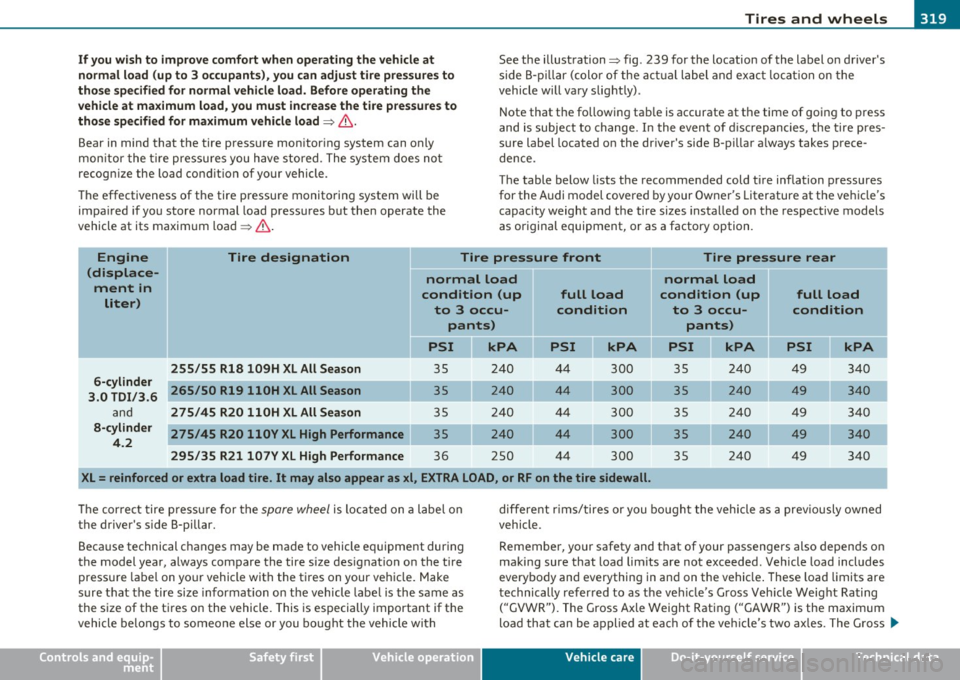
If you wish to improve comfort when operating the vehicle at
normal load (up to 3 o ccupant s), you can adjust tire pres sures to
those specified for normal vehicle load . Before operating the
vehicle at maximum lo ad, you must increase the tire p res sures to
those specified for maximum vehicle load=>& .
Bear in mind that the tire press ure monitor ing system can only
mon itor the t ire pressu re s you h ave sto red . T he sys tem does no t
recogn ize the load cond it ion of your vehicle.
Th e effectiveness of t he tire pressu re monitoring system will be
impa ired if you store normal load pressu res but then operate the
vehicle at its maxim um loa d=> & . See the
illustration=> fig. 239 for the location of the label on driver's
side B- pillar (colo r of the act ual la bel and ex act l ocation on the
vehicle will vary slig htly).
N ote that the fo llow ing tab le is accurate at the time of going to press
and is subjec t to change. I n the even t of discrepancies , the tire pres
sure label located on the dr iver's side B-pi llar a lways takes prece
dence .
T he table below lists the recommended cold t ire inflation pressures
for the Audi model covered by your Owne r's Literature at t he ve hicle's
capac ity weight and the tire sizes insta lled on the respective models
as original equipment, or as a factory option .
Engine Tire designation Tire pressure front Tire pressure rear
(displace- normal load normal load
ment in
liter) condition
(up
full load condition (up
full load
to
3 occu- condition to 3 occu- condition
pants) pants)
PSI kPA PSI PSI kPA PSI kPA
255/55 R18 109H XL All Season 35 240 44 300
35 240 49 340
6-cylinder
265/50 R19 110H XL All Season
35 240 44 300 35 240 49 340 3.0 TDI/3
.6
and 275/45 R20 110H XL All Season 3 5 24 0 44 3 00 35 240 4 9 340
a-cylinder
275/45 R20 llOY XL High Performance 35 240
44 300
35 240 49 340 4
.2
295/35 R2110 7Y XL High Performance
36 250 44
300 35 240 49 340
XL= reinforced or extra load tire
. It may also appear as xi , EXTRA LOAD, or RF on the tire sidewall .
The correct tire p ress ure for t he spare wheel is loca ted on a labe l o n
the driver 's s ide B-pillar.
Beca use technical c hanges may be made to vehicle equipment dur ing
the model year, always compare the tire size des ignation on the t ire
pressu re labe l on yo ur vehicle with the t ires on your vehicle. Make
sure that the tire size informat ion on t he v ehicle labe l is the same as
the size of the t ires o n the vehicle. This is especially important if the
vehicle belongs to so meone else or you bo ug ht the vehicle with
Safety first
differe nt r im s/ tires or you bo ugh t the vehicle as a prev iously owned
vehicle.
Remember, yo ur safety and t hat of your passengers also depends o n
making sure that load limits are not exceeded. Vehicle load includes
everybody and everything in an d on the vehicle . These load limits are
t e chnically refer red to as the veh icle's G ross Veh icle Weig ht Rating
("GVW R"). The Gross Axle Weight Rati ng ("GAWR") is the maximum
load tha t can be applied at ea ch of the ve hicle's two ax les . T he G ross ..
Vehicle care Technical data
Page 323 of 390
Tires and wheels Ill _____________ --=-=--=.:..:......:..::....:.=----
gauge and keep chec king the press ure until you reach t he press ure
th at i s cor rect fo r t he lo ad ( pass en ge rs and l uggage) and kind of
dr iving you plan to do .
If the press ure i n any t ire is too low, note the difference betwee n th e
pressu re in t he cold tire a nd the pressure you need and add the air
that you need to reach the correct pressure for t he ve hicle load
( pass enge rs and lugg age) f or th e tires on yo ur vehicle as l ist ed on t he
on your vehicle and in this manua l and the kind of driving you p lan to
do.
Never exceed the maximum inflation pressure listed on the tire
sidewall for any reason.
Remember that the ve hicle m anufac tur er, no t the tire manufa cture r,
determines t he correct tire press ure for the t ires on your veh icle.
It is important to check the tire pressure when the t ires a re co ld .
• Read the requ ired t ire pr essure from t he t ire pr essure lab el. T he
tire pressure labe l is locate d on t he driver's side 8- pillar. Th e tire pres
s u re labe l lists t he re com men ded col d tire inflat io n pr essures fo r the
vehicle at its maxim um capac ity we ight and the t ires t hat were on
yo ur vehicle at the t ime it was ma nufact ured. For r ecom mende d tire
pressures fo r norma l load cond it ions, please see chapter
=> page 318.
• Turn the valve stem cap co unter -clockw ise to remove it from the
t ire v alve.
• Place the air press ure gauge on the valve.
• The tire p ressures sho uld on ly be checked and adjusted wh en the
tires are cold. The slightly raised press ures of wa rm tires must not be
re du ced.
• Adjust the tire p ress ure to the loa d you are ca rry ing.
• Reinstall the valve stem cap o n the valve .
When should I check the tire pressure?
The correct tire press ure is especially important at high speeds. The
pressu re shoul d there fore be c hec ke d at least once a mo nth a nd
Safety first
always before start ing a journey . Do not forget to check t he t ire pres
s u re for the spare w heel.
When should I adjust the tire pressures?
Adju st the tir e pre ssure to the load y ou ar e carry ing. A fter ch anging a
wheel
or replac ing wheels you have to adjust t he t ire p ressures on all
w heels. I n addition , you m ust th en s tore the new tire press ures i n the
t ir e pressu re monitoring system=>
page 335.
& WARNING
Incorrect tire pressures and/or underinflation can lead sudden tire
failure, loss of control, collision, serious pers onal injury or even
death.
• When the warning symbol appears in the instrument
cluster, stop and inspect the tires.
• Incorrect tire pressure and/or underinflation can cause
increased tire wear and can affect the handling of the vehicle and
stopping ability.
• Incorrect tire pressure s and/or underinflation can also lead to
sudden tire failure, including a blowout and sudden deflation,
causing loss of vehicle control.
• The driver is responsible for the correct tire pressures for all
tires on the vehicle. The applicable pressure values are located on a sticker on the driver's side B-pillar.
• Only when all tires on the vehicle are filled to the correct pres
sure, the tire pressure monitoring system can work correctly.
• The use of incorrect tire pressure values can lead to accidents or
other damage. Therefore it is essential that the driver observe the
specified tire pressure values for the tire s and the correct pres
sures for the function of the tire pressure monitoring system.
• Always inflate tires to the recommended and correct tire pres-
sure before driving off. .,_
Vehicle care Technical data
Page 324 of 390
-Tires and wheels Pffl,.____ ______________ _
& WARNING (conti nu ed )
• Driv ing with underinflated tire s bend more , letting them get
too hot re sulting in tread separation , sudden tire failure and lo ss
of control.
• Exce ssive speed and /overloading can cause heat build-up,
s udden tire failure and loss of control.
• If the tire pressure is too low or too high , the tires will wear
prematurely and the vehicle will not handle well.
• If the tire is not flat and you do not have to change a wheel
immediately, drive at reduced speed to the nearest service station
to check the tire pressure and add air as required .
0 Note
Driving without valve s tem caps can cause damage to the tire valves .
T o prevent this, a lways make sure that factory ins talled valve stem
caps on al l wheels are secure ly mounted on the valve .
<£> For the sake of the environment
Underinflated t ires will also inc rease t he f uel consumption .•
Tires and vehicle load limits
T here are lim its to the amo unt of load or weight that any veh icle and
any tire can carry . A veh icle that is overloade d will not handle well and
is more difficult to stop . Overload ing can not on ly lead to loss of
vehicle contro l, but can also damage important parts of the vehicle
and can le ad t o su dden t ire failure, including a b lowo ut and s udden
def lation that can ca use the vehicle to c rash .
Yo ur safety a nd t hat of your passengers also de pends o n mak ing s ure
that load limits are not exceeded . Vehicle load incl udes everybody
and everything in and on the vehicle . These loa d limits are technically
referred to as the ve hicle's
Gross Vehicle Weight Rating ("GVWR") . The
"GVWR" includes the weight o f the basic vehicle, all factory
ins talled accessories, a f ull tank of f uel, oil, coolan t and other fl uids
plus maxim um load . The max imum load i ncludes the numbe r of
passenge rs that the vehicle is intended to carry ("seating capacity")
w ith an ass umed we ight of 150 lbs (68 kg) for each passenger at a
designate d seati ng position and the total weig ht of any luggage in
the vehicle. If yo u tow a trai le r, the weight of t he t railer hitch and the
tongue weight of the loaded trailer must be included as part of the
veh icle loa d.
The
Gross Axle We ight Rating ("GAWR") is the max imum load that
can be a pplied at each o f the ve hicle 's two axles .
Th e Gross Vehicle Weight Rat ing and the Gross Axle Weight Rat ing
are listed on the safety compliance sticker label located on the
dr iver 's side B-pillar. Your A udi has 5 seat ing pos it ions, 2 in the front
and 3 in the rear for tota l seat ing capacity of 5. On vehicles with six
sea ts*, yo ur vehicl e has two fron t seat s, two se a ts i n the se co nd row
seating and two seats in the t hird row seating. On ve hicles with seven
sea ts*, yo ur veh icle has two fron t se ats , th ree seats in the se cond row
seat ing and two seats in the third row seating. Eac h seating posit io n
has a seat belt=>
page 199, "Safety bel ts" .
Th e fact that there is an upper lim it to your veh icle 's Gross Vehicle
We ight Rating means that the total weight of whatever is being
c arried in t he veh icle ( inclu ding t he weight of a tra ile r hi tch and the
tongue weight of the loaded tra iler) is limited . The more passengers
in the vehi cle or passenge rs who are heavier th an the stan dard
we ights assumed mean that less we ight can be carried as luggage.
Th e tire pressure labe l on yo ur Audi a lso lis ts the max imum combined
we igh t of all of the occupants and luggage or o ther cargo that the
vehicle ca n carry. For t he locat ion of the label=>
page 318, fig. 239.
& WARNING
Overloading a vehicle can cause loss of vehicle control, a crash or
other accident, serious personal injury, and even death. ._
Page 325 of 390
& WARNING (continued)
• Carrying more weight than your vehicle was designed to carry
will prevent the vehicle from handling properly and increase the risk of the loss of vehicle control.
• The brakes on a vehicle that has been overloaded may not be
able to stop the vehicle within a safe distance.
• Tires on a vehicle that has been overloaded can fail suddenly,
including a blowout and sudden deflation, causing loss of control
and a crash.
• Always make sure that the total load being transported -
including the weight of a trailer hitch and the tongue weight of a
loaded trailer -does not make the vehicle heavier than the
vehicle's Gross Vehicle Weight Rating. •
Determining correct Load Limit
Use the example below to calculate the
total weight of the passengers and luggage or other things that you plan to transport so
that you can make sure that your vehicle
will not be overloaded.
Safety first
Tires and wheels 11111
Steps for Determining Correct
Load Limit
1.Locate the statement "THE COMBINED
WEIGHT OF OCCUPANTS AND CARGO
SHOULD NEVER EXCEED XXX KG OR XXX LBS"on your vehicle's placard (tire infla
tion pressure label)==>
page 318,
fig. 239.
2. Determine the combined weight of the driver and passengers that will be riding
in your vehicle.
3. Subtract the combined weight of the driver and passengers from
"XXX" kilo
grams or
"XXX" pounds shown on the
sticker==>
page 318, fig. 239.
4. The resulting figure equals the available amount of cargo and luggage load
capacity. For example, if the
"XXX"
amount equals 1400 lbs. and there will be five 150 lbs. passengers in your
vehicle, the amount of available cargo
and luggage load capacity is 650 lbs.
(1400-750 (5
X 150) = 650 lbs.) •
Vehicle care Technical data
Page 326 of 390

-Tires and wheels
5. Determine the combined weight of
luggage and cargo being loaded on the
vehicle. That weight may not safely
exceed the available cargo and luggage
load capacity calculated in Step 4.
6. If your vehicle will be towing a trailer,
load from your trailer will be transferred
to your vehicle. Consult this manual to
determine how this reduces the available
cargo and luggage load capacity of your
vehicle.
Check the tire sidewall(=>
page 3267
fig. 243) to determine the designated
load rating for a specific tire .•
Tire service life
The service life of tires depends on a lot of different
things including proper installation and balancing,
correct tire pressure and driving style.
~------------~
Tread Wear Indicator (TWI)
Fig. 241 Tire tread:
tread wear indicators
(TWI)
Fig. 242 Rotating
tires for more even
wear
Th e original tires on your vehicle have 1/16 inch (1. 6 mm) high "wear
ind icators"~ fig. 241 ru nning across the tread . Depend ing on the
make, there will be six to eight of them even ly placed around the tire.
Marks on the tire sidewall (for example "TWI" or other symbols) indi
cate the positions of the tread wear indicators. Worn tires must be
replaced. Different figures may apply in other countries ~& . ._,.