ignition AUDI Q7 2010 Owner´s Manual
[x] Cancel search | Manufacturer: AUDI, Model Year: 2010, Model line: Q7, Model: AUDI Q7 2010Pages: 390, PDF Size: 93.04 MB
Page 228 of 390
-Airbag system -
--=---=----------------
is below the reference va lue programmed into the cont rol unit, the
side airba gs w ill no t be triggered, even though t he car may be b ad ly
damaged as a result of the collision. It is not possible to define an
airbag tr iggering range that w ill cover every possible angle of impact,
since the circumstances will vary considerably between one collision
and another . Important factors include, for example, the nature
(hard or soft) of the impacting object, the angle of impact, vehicle
speed, etc.~
page 227, "Important safety instructions on the side
airbag system" .
Aside from the ir normal safety function, safety be lts work to help
keep the d river or front passenger in posit ion in the event of a side
co llision so that the side airbags can provide protection.
The airbag system is
not a substitute for your safety belt. Rather, it is
part of the ove rall occupant restraint system in your veh icle. Always
remember that the side airbag system can only help to protect you if
you a re wearing your safety belt and wearing it p rope rly. This is
another reason why you shou ld always wear your safety belts, not just
because the law requires you to do so~
page 199, "General no tes" .
It is important to remembe r that wh ile the supp lemental s ide airbag
system is designed to reduce the likelihood of se rious injuries, ot her
injuries, fo r examp le, swe lling, bru ising, and minor abras ions can
also be associated with deployed side airbags . Remember too, side
airbags will dep loy only once and only in certai n kinds of accidents -
your safety belts are always there to offer protection.
Vehicle damage, repair costs or even the lack of veh icle damage a re
not necessar ily an ind ication of over-sensitive or failed airbag activa
t ion . In some collisions, both front a nd side airbags may inflate .
Remember too, that a irbags will deploy only once and only in certa in
kinds of collisions -your safety belts are a lways there to offer protec
tion in those acc idents in w hich airbags a re not supposed to deploy or
when they have already deployed.
The side airbag system will not deploy :
• when the ignition is turned off
• in side collisions when the acceleration measured by the sensor is
too low •
in front-end collis ions
• in rea r-end collisions
• in rollovers .
In some types of accidents the front a irbags, side curtain airbags and
side airbags may be triggered together.
& WARNING
• Safet y belts and the airbag s ystem will only provide protection
when o ccupants are in the proper seating position ~
page 227.
• If the airbag indicator light comes on when the vehicle i s being
used, have th e system inspe cted immediately by your authoriz ed
Audi dealer. The airbag may not work prope rly when the vehicle
a cceleration in a side collision is high enough to activate the
ai rbag. •
How supplemental side airbags work
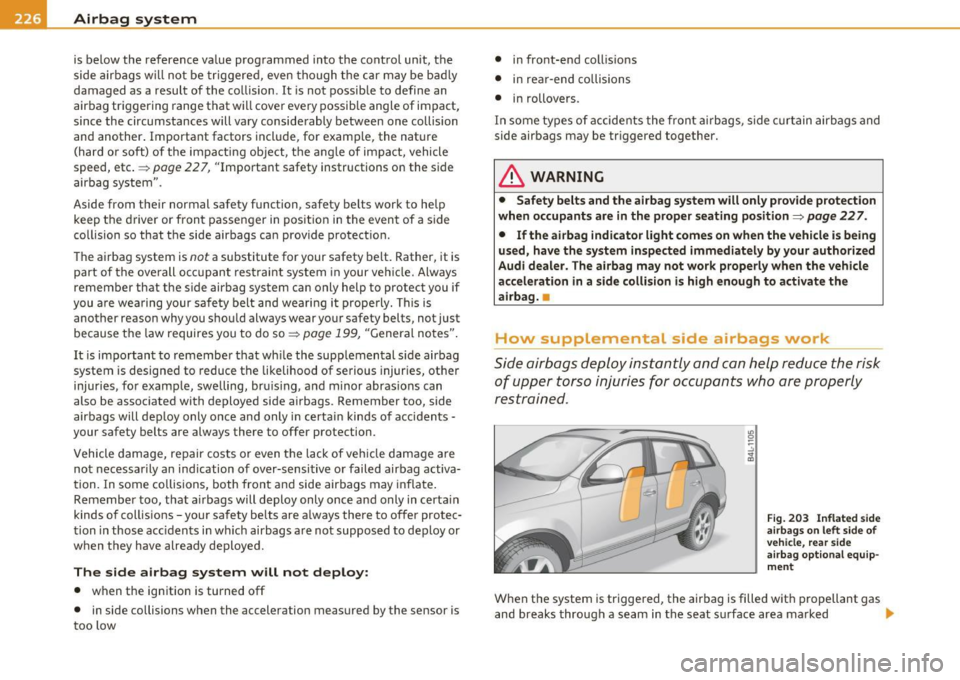
Side airbags deploy instantly and can help reduce the risk
of upper torso injuries for occupants who are pro perly
restrained.
Fig. 20 3 Inflated side
ai rba gs on left side of
v eh icle, rea r side
a irba g opti onal e quip
m ent
When the system is triggered, the airbag is filled wit h propellant gas
and breaks thro ugh a seam in the seat s urface area marked
~
Page 231 of 390

Aside from their norma l safety function, safety be lts work to he lp
kee p th e dr iver or fron t p asse n ger in posi tion in t he even t of a c olli
sion so that the side cu rtain a irbags can provide protection.
T he a irbag system is not a substitute for your safety belt . Rathe r, it is
par t of the ove rall o ccu pan t res traint syste m in your vehicle . A lw ay s
remember t hat the airba g system can on ly help to protect you if you
a re we ari ng your safety bel t and wearing it prop erly. Thi s is ano ther
reaso n why you s hou ld always wea r your safety be lts, not just because
th e law requi re s you to do so=>
page 199, "G ene ral not es".
It is i mpo rtant to re m ember that while the s ide curta in airbag system
is des igned to help re duce the likelih ood of serious injuries, ot her
i n jur ies, fo r exa mple, sw elling, br uising, a nd m inor ab rasions can
also be assoc iated wit h these airbags upo n dep loyment . Remembe r
t o o , these a irbags w ill d eploy only on ce an d on ly in ce rt ain kinds of
acc idents -yo ur safety belts are always there to offer protection.
The side curtain airbag system basically consists of:
• Th e electronic co ntro l mo dule an d external side impact sensors
• The side c urtai n airbags above the fro nt an d rea r side windows
• Th e airba g indic ator ligh t in the ins trumen t panel
Th e a irbag system is monitored elec tron ically to make certai n it i s
functioning prope rly at a ll times . Each time yo u turn on the ignition,
t h e airbag sys tem indicator ligh t w ill com e on for a few seconds (s elf
diagnostics) .
The side curtain airbag is not activated:
• if the ignition is tu rned off
• in side co llisions when the accelerati on measured by the sens or is
t o o low
• in fro nt-e nd coll isio ns
• in re ar -end co llisions.
Safety first Vehicle OP-eration
Airbag system
& WARNING
• Safety belts and the airbag system will only provide protection
when occupants are in the proper seating position =>
page 83,
"General recommendations ".
• If the airbag indicator light comes on when the vehicle is being
used, have the system inspected immediately by your authorized
Audi dealer. The side curtain airbag may not work properly even
when the vehicle acceleration in a side collision is high enough to activate the airbag.~
How side curtain airbags work
Side cu rtain ai rbags c an wo rk to gethe r w it h sid e airba gs
to h elp r ed uce the risk of h ead and upp er tors o inju rie s f or
o cc u pan ts who are pr operly restr ained.
Fig . 205 Illu str ation
of principle: Inflated
side curt ain airbag s on
the left side
Th e side curtain airbags in flate between the oc cupan t and t he
w indows on the side of the vehicle t hat is struck in a sid e co llision
=> fig. 205.
Wh en the sys tem is tr igg ered, the side curta in airbag is filled w ith
pro pell ant gas and breaks th rough a seam above the front and rear
s ide w indow s iden tifi ed b y the AIRBAG label. In or der to help pro vid e
this additional protection, the side c urta in airbag must inflate with in
th e bl ink of an eye at very hi gh speed and wi th gre at force. The side ._
Vehicle care Do-it-yourselt service iTechnical data
Page 234 of 390
lffll.,___C_h_ i_ ld _ S_ a_ f_ e_ t_:!, y :...._ _________________________________________ _
& WARNING (conti nued)
• Always install rear-facing child safet y seat s on the rear seat.
• If you must install a rearward facing child safety seat on the
front passenger seat in exceptional circumstances and the
PASSENGER AIR BAG
OFF light do es not come on and stay on,
immediately in stall the rear-facing child safety seat in a rea r
seating position and have the airbag system inspected immedi
ately by you r Audi deale r.
& WARNING
If, in exceptional circumstances , you must in stall a forward-facing
child restraint on the front passenger' s seat:
• Always make sure the forward-facing seat has been designed
and certified by its manufacturer for use on a front seat with a
pas senger front and side airbag.
• Always follow the manufacturer 's instructions p rovided with
the child safety seat or carrier.
• Always move the passenger seat into its rearmost position
in
the seat's fore and aft adjustment range, as far away from the
airbag as possible before install ing the child restra int . The back
re st must be adju sted to an upright position .
• Always make sure that the PASSENGER AIR BAG OFF light
c omes on and stays on all the time whenever the ignition is
switched on .•
Advanced front airbag system and children
Your vehicle is equipped with an "Advanced Airbag System" in compli
ance wi th Uni ted St ates Federa l Mo to r Vehicle Safety St andar d
(FMVSS) 208 as applicable at the time your veh icle was manufac
tu red . The Advanced A
irbag system in yo ur vehicle has been certif ied to
mee t the "low -r is k" requiremen ts fo r 3-and 6-ye ar old ch ildre n on
t he passenger side and small adults on the dr iver side . The low risk
dep loyment criteria are inten ded to reduce the risk of injury through
interaction with the a irbag t hat can occur, for example, by being too
close to the stee ring wheel an d instr ument panel when the airbag
inflates. In addi tion, the sy stem has been certified to comp ly with t he
"suppression" requirements of the Safety Standa rd, to t urn off the
fron t air bag for infan ts u p to 1 2 months who a re res tra ined on the
front passenger seat in child restrai nts that are listed in the Stan
d ar d.
Even thoug h your vehicle is equipped with an Advanced Airbag
system , a ll ch ildren, especially those 12 years and yo unger, should
always r ide in t he back seat p roperly restrained for t heir ag e and si ze .
Th e ai rbag on the passenge r si de makes the front seat a potentia lly
dange rous p lace for a child to r ide. Th e front seat is not th e safest
place fo r a child in a forward- facing c hild safety seat. It can be a very
d an ge rous p lace for a n infan t or a large r chil d i n a re arwa rd-facing
seat. •
Advanced Airbags and the weight-sensing
mat in the front seat
Th e Advanced A irbag System i n your ve hicle de tects t he p resence o f
an infa nt o r ch ild in a child rest rai nt on the fro nt passenger sea t using
the we ight-sens ing mat in the seat cushion and the senso r be low the
saf ety belt la tch o n th e front passenge r seat tha t measur es t he
tension on the safety belt.
Th e weigh t-sens ing ma t me asures tot al we ight of the child and the
child safety seat and a child blanket on the fro nt passe nger seat . The
we ight on the fro nt passenger se at is re late d t o the desi gn of the
child res traint and i ts "footpri nt", the size and shape of t he bottom
of the ch ild restraint as it sits o n the seat . The weight of a child
restrain t an d its "foo tpr int" vary for differe nt kinds of child res tra ints .,_
Page 236 of 390
ffl,___C_ h_ il_d _ S_a _ f_ e _ t-= y ;....._ ____________________________________________ _
C. Forward-facing convertible child restraint
systems, manufactured on or after September 1,
2004:
• Britax Roundabout 161
• Century Encore 4612
• Century STE 1000 4416
• Cosco Olympian 02803
• Cosco Touriva 02519
• Evenflo Horizon V 425
• Evenflo Medallion 254
• Safety First Comfort Ride 22-400
& WARNING
To reduce the risk of serious injury, make sure that the
PASSENGER AIR BAG OFF light comes on and stays on whenever a
child restraint is installed on the front passenger seat and the ignition is switched on.
• Take the child restraint off the front passenger seat and install
it properly at one of the rear seat positions if the PASSENGER AIR BAG OFF light does not stay on.
• Have the airbag system inspected by your authorized Audi
dealer immediately.
W Tips
The child seats listed in categories A to C have been tested by Audi
only for the Advanced Airbag function. •
Important safety instructions for using
child safety seats
Correct use of child safety seats substantially reduces the
risk of injury in an accident!
As the driver, you are responsible for the safety of everybody
in the vehicle, especially children:
Always use the right child safety seat for each child and
always use it properly~
page 236.
-Always carefully follow the child safety seat manufac
turer's instructions on how to route the safety belt prop
erly through the child safety seat.
- When using the vehicle safety belt to install a child safety
seat, you must first activate the convertible locking retractor on the safety belt to prevent the child safety seat
from moving ~
page 241.
-Push the child safety seat down with your full weight to
get the safety belt really tight so that the seat cannot
move forward or sideways more than one inch (2.5 cm).
- If a strap or tether is being used to tie the child safety seat
to the front passenger seat, make sure that it is not so
tight that it causes the weight-sensing mat to measure more weight than is actually on the seat.
Always remember: Even though your vehicle is equipped with an
Advanced Airbag system, all children, especially those 12 years and
younger, should always ride in the back seat properly restrained for
their age and size . _,,
Page 241 of 390
& WARNING (continued)
• Make sure the forward-facing seat has been designed and certi·
fied by its manufacturer for use
on a front seat with a passenger
front and side airbag.
• Always follow the manufacturer's instructions provided with
the child safety seat or infant carrier.
• Always move the front passenger seat into the rearmost posi
tion of the passenger seat's fore and aft adjustment range, and as
far away from the airbag as possible before installing the child
restraint.
• Always make sure that nothing prevents the front passenger's
seat from being moved to the rearmost position in its fore and aft
adjustment range.
• Always make sure the backrest is in an
upright position.
• Make sure that the PASSENGER AIR BAG
OFF light comes on
and stays on all the time whenever the ignition is switched
on.
• If the light does not stay on, perform the checks => page 220,
"Monitoring the Advanced Airbag System".
• Take the child restraint off the front passenger seat and install
it properly at one of the rear seat positions if the PASSENGER AIR
BAG
OFF light does not stay on whenever the ignition is switched
on. a
Safety first Vehicle OP-eration
Child Safety
Booster seats and safety belts
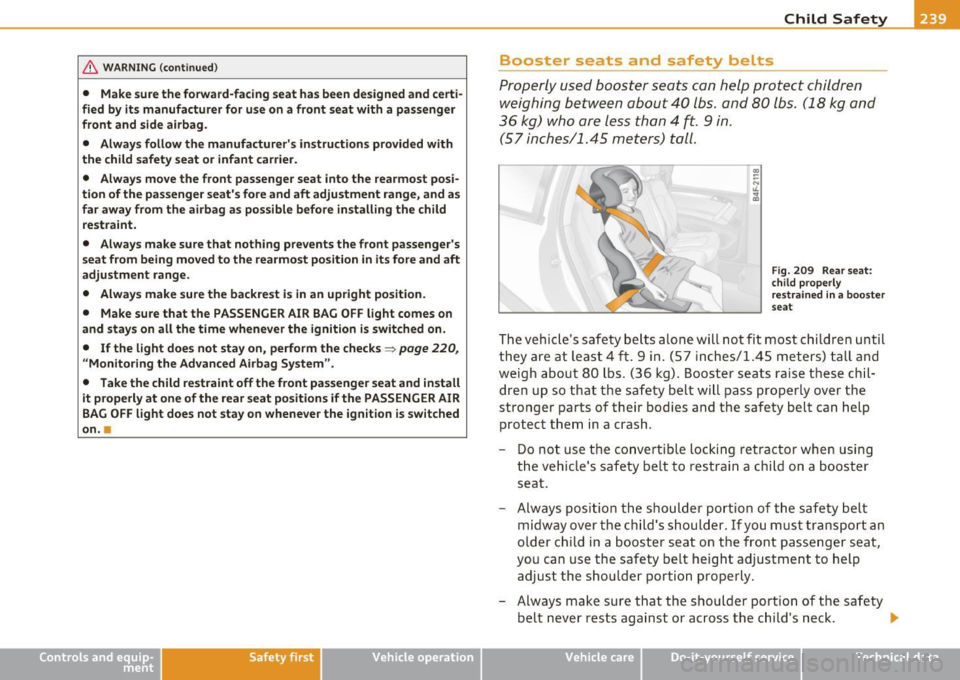
Properly used booster seats can help protect children
weighing between about 40 lbs. and 80 lbs. (18 kg and
36 kg) who are less than 4 ft.
9 in.
(57 inches/1.45 meters) tall .
Fig. 209 Rear seat:
child properly
restrained in a booster
seat
The vehicle's safety belts alone will not fit most children until
they are at least 4 ft. 9 in. (57 inches/1.45 meters) tall and
weigh about 80 lbs. (36 kg). Booster seats raise these chil
dren up so that the safety belt will pass properly over the
stronger parts of their bodies and the safety belt can help
protect them in a crash.
- Do not use the convertible locking retractor when using
the vehicle's safety belt to restrain a child on a booster
seat.
- Always position the shoulder portion of the safety belt
midway over the child's shoulder. If you must transport an
older child in a booster seat on the front passenger seat,
you can use the safety belt height adjustment to help
adjust the shoulder portion prop erly.
- Always make sure that the shoulder portion of the safety
belt never rests against or across the child's neck.
9'>
Vehicle care Do-it-yourselt service iTechnical data
Page 243 of 390
_____________________________________________ C _h_i_ld _ S_ a_ f_ e_ t__. y'--- __
& WA RNING (c on tinued )
by a deploying airbag . This will result in se rious personal injury or
death.
• If you must install a booste r seat on the front passenger seat
because of exceptional cir cumstance s the PASSENGER AIR BAG
OF F light must come on and stay on , whenever the ign ition is
s wit ched on .
• If the PASSENGER
AIR BAG OFF light does not come on and
stay on, perform the checks described => page 220, " Monitoring
the Advanced Airbag System".
• Take the child re straint off the front passenger seat and install
it prope rly at one of the rear seat positions if the PASSENGER AIR
BAG OFF light does not stay on whenever the ignition i s sw itched
on.
• Always read and heed all WARNINGS whenever u sing a child
restrained in a vehicle is being used=>
page 199 , "Safety belts",
=> page 209, "Airbag sy ste m " and => page 231, "Important
things to know ".•
Installing a child safety seat
Securing a child safety seat using a safety
belt
S afet y belts f or t he rear se ats a nd the fr ont pa ssenger
can be l ocke d wit h the co nverti ble lockin g retract or to
p ro p erly sec ure chi ld safety seats .
The safety be lts emergency lo ck ing retractors for the rear seats
safety belts and fo r the fron t passe nger's seat safety belt have a
convertib le locking retractor for child restraints . The safety be lt must
be locked so that belt webbing cannot u nreel. The retractor can be
activated to lock the safety be lt and prevent the safety belt webbing
from loose ning up du ring normal dr iv ing. A child safety seat can only
Controls and equip ment Safety first Vehicle operation be properly
installed when the safety belt is locked so that the child
and child s afety se at will s tay in place.
Always remember: Even though yo ur vehicle is equipped w ith a n
Advanced Airbag system, all chi ldren, especia lly those 12 yea rs and
younger, should a lways ride in th e back sea t pro perly res train ed fo r
their age and size .
& WARNING
Improperly installed child safety seats increase the risk of serious
personal injury and death in a collision.
• Always make sure that the safety belt retractor is locked when
installing a child safety seat . An unlocked safety belt retractor
cannot hold the child safety seat in place during normal driving o r
in a crash.
• Always buckle the child safety seat firmly in place even if a
child is not sitting in it . A loose child safety seat can fly around
during a sudden stop or in a collision.
• Always make sure that the rear seat backrest to which the
center rear safety belt is attached is securely latched whenever the
rear center safety belt is being used to secure a child restraint .
• If the backrest is not securely latched, the child and the child
restraint will be thrown forward together with the backrest and
will strike parts of the vehicle interior. The child can be seriously
injured or killed.
• Never install rear -facing child safety seat s or infant carrier s on
the front passenger seat . A child will be seriously injured and can
be killed when the pa ssenger airbag inflates.
• The inflating airbag will hit the child safety seat or infant
carrier with great force and will sma sh the child safety seat and
child against the backrest, center armrest, door or roof .
• Always in stall rear-facing child safety seats or infant carrier s
on the rear seat. _,.
Vehicle care Do-it-yourself service Technical data
Page 244 of 390
-L-___::C~h...:.: i:.:: l .:::d ~S:::.::: a..:..f .::. e ..::tY L- ___________________________________________ _
& WARNING (continued)
• Forward-facing child safety seats or infant carriers installed on
the front passenger's seat may interfere with the deployment of
the airbag and cause serious injury to the child.
• It is safer to install a forward-facing child safety seat on the
rear seat.
• Always read and heed all WARNINGS whenever using a child
restrained in a vehicle is being used~
page 231. Special precau
tions apply when installing a child safety seat on the front
passenger seat~
page 211, "Child restraints on the front seat -
some important things to know".
& WARNING
Always take special precautions if you must install a forward or rearward-facing child restraint on the front passenger's seat in
exceptional situations:
• Whenever a forward or rearward-facing child restraint is
installed on the front passenger seat, the PASSENGER AIR BAG
OFF light must come on and stay on whenever the ignition is
switched on.
• If the PASSENGER AIR BAG OFF light does not come on and
stay on, perform the checks described~
page 220, "Monitoring
the Advanced Airbag System".
• Take the child restraint off the front passenger seat and install
it properly at one of the rear seat positions if the PASSENGER AIR
BAG OFF light does not stay on whenever the ignition is switched
on.
• Improper installation of child restraints can reduce their effec
tiveness or even prevent them from providing any protection.
• An improperly installed child restraint can interfere with the
airbag as it deploys and seriously injure or even kill the child.
• Always carefully follow the manufacturer 's instructions
provided with the child safety seat or carrier.
& WARNING (continued)
• Never place additional items on the seat that can increase the
total weight registered by the weight-sensing mat and can cause injury in a crash.
& WARNING
Forward-facing child restraints:
• Always make sure the forward-facing seat has been designed
and certified by its manufacturer for use on a front seat with a
passenger front and side airbag.
• Never put the forward-facing child restraint up, against or very
near the instrument panel.
• Always move the passenger seat into its rearmost position in
the seat's fore and aft adjustment range, as far away from the
airbag as possible before installing the forward-facing child
restraint. The backrest must be adjusted to an upright position.
• Make sure that the PASSENGER AIR BAG OFF light comes on
and stays on all the time whenever the ignition is switched on.
& WARNING
Rearward-facing child restraints:
• A child in a rearward-facing child safety seat installed on the
front passenger seat will be seriously injured and can be killed if
the front airbag inflates - even with an Advanced Airbag System.
• The inflating airbag will hit the child safety seat or infant
carrier with great force and will smash the child safety seat and
child against the backrest, center armrest, door or roof.
• Always be especially careful if you must install a rearward
facing child safety seat on the front passenger seat in exceptional
circumstances.
• A tight tether strap on a rearward-facing child restraint
attached to the front passenger seat can put too much pressure on .,
Page 245 of 390
_____________________________________________ C _h_i_ld _ S_ a_ f_ e_ t ... Y'--- __
& WARNING (continued)
the weight-mat in the seat and register a heavier weight in the
Advanced Airbag System. The heavier weight registered can make
the system work as though an adult were on the seat and deploy
the Advanced Airbag when it must be suppressed causing serious
or even fatal injury to the child.
• Make sure that the PASSENGER AIR BAG OFF light comes on
and stays on all the time whenever the ignition is switched on.
• If the PASSENGER AIR BAG OFF light does not come on and
stay on, immediately install the rear-facing child safety seat in a
rear seating position and have the airbag system inspected by
your Audi dealer. •
Activating the convertible locking retractor
Use the convertible locking retractor to secure a child
restraint.
Always heed the child safety seat manufacturer 's instruc
tions when installing a child restraint in your vehicle. To acti
vate the convertible locking retractor:
- Place the child restraint on a seat, preferably on the rear
seat .
- Slowly pull the belt
all the way out.
- Route it around or through the child restraint belt path
=>& .
- Push the child safety seat down with your full weight to
get the safety belt really tight.
- Insert the belt tongue into the buckle for that seating
position.
Controls and equip ment Safety first Vehicle operation
-
Guide the safety belt back into the retractor until the belt
lies flat and snug on the child safety seat.
- You should hear a "clicking" noise as the belt winds back into the inertia reel. Test the convertible lock ing retractor
by pulling on the belt. You should no longer be able to pull
the belt out of the retractor. The convertible lock ing
retractor is now activated.
- Make sure that the red release button is facing away from the child restraint so that it can be unbuckled quickly .
- Pull on the belt to make sure the safety belt is properly tight and fastened so that the seat cannot move forward
or sideways more than one inch (2 .5 cm) .
& WARNING
Using the wrong child restraint or an improperly installed child
restraint can cause serious personal injury or death in a crash.
• Always make sure that the safety belt retractor is locked when
installing a child safety seat. An unlocked safety belt retractor
cannot hold the child safety seat in place during normal driving or
in a crash.
• Always buckle the child safety seat firmly in place even if a
child is not sitting in it. A loose child safety seat can fly around
during a sudden stop or in a crash.
• Always make sure the seat backrest to which the child restraint
is installed is in an upright position and securely latched into place
and cannot fold forward. Otherwise, the seat back with the child
safety seat attached to it could fly forward in the event of an acci
dent or other emergency situation.
• Always read and heed all WARNINGS whenever using a child
restrained in a vehicle is being used=>
page 231. Special precau-
tions apply when installing a child safety seat on the front
lill-
Vehicle care Do-it-yourself service Technical data
Page 261 of 390
_________________________________________ I_ n_ t_ e_ ll_,igent technology ,__E~-
& WA RNING (c on tinued )
planing ). If this should occur, you will have no warning from a
sudden in crease in e ngine speed as with a front -wheel drive
veh icle. Always drive at speeds which are suited to the road condi
tions - risk of crash .•
Energy management
Starting ability is optimized
E nergy ma nagement co ntr ols the distribution of elec
trical energy and thus optimizes the availa bility of elec
trical energy for s tarting the engine.
If a vehicle with a convention al ene rgy sys tem is not driven fo r a lo ng
pe riod of time, the battery is d ischarged by idling cu rr ent consumers
(e.g. immo bilizer) . In ce rtain c ircumstances it can result i n there
being insufficien t energy avai lab le to start the engine .
Inte llige nt ene rgy management in your ve hicl e han dles the dist ribu
ti on of e lectr ica l energy. Sta rting ability is m arkedly improved a nd
the life of the battery is extended.
B as ically , energy managemen t consis ts of
battery diagno sis , idling
current management
and dynamic energy management .
Battery diagnosis
Battery d iagnosis continuously determ ines the state of the battery .
Sensors de term ine ba tte ry vo ltage, ba ttery curren t and batte ry
temperature. Th is determines t he current state of charge and the
powe r of th e battery .
Idling current management
Idli ng cu rrent m anageme nt reduc es ene rgy consu mptio n while the
vehicle is standing. W ith the ignition switc hed off, it controls the
ene rgy su ppl y to the v ari ou s ele ct rical com pone nts. Da ta fr om
battery diagnosis is considered .
Controls and equip
ment Safety first Vehicle operation
Depend
ing on the battery 's state of charge, individual consumers are
gr adu ally t urned o ff to prevent excess ive disch arge of the bat tery an d
t hus maintain start ing capability .
Dynamic energy management
While the vehicle is being dr iven, dynamic energy management
dis tributes the energy gene rated a ccording to the needs o f the in d i
vidua l compo nen ts. It regulates consumpt io n, so that more electr ica l
energy is no t be ing use d th an is being gene ra ted and ensures an
op timal state of charge for the battery .
(I) Tips
• But even energy ma nagement cannot negate the limits o f phys ics .
Consider that t he power and life o f a battery are limited.
• If starting ab ility is threatened, yo u are informed by a warn ing
~ page 260, "D river notification i n the instrument cluste r display" .
What you should know
The high est priorit y is g iv e n to maintaining starting capa
bility .
The b att ery i s seve rely t axed in short -dist ance d riving, in city t raffic
and dur ing the cold time of year . Ab undant electr ica l energy is
re quir ed, bu t on ly a li ttle is generate d. It is also crit ical if t he engine
is not run ning and electr ica l compone nts ar e turn ed on. In this
instance energy is being cons umed but none is being ge ne rated.
It is i n pre cise ly these s itu ations t hat yo u will notice energy m anage
ment act ive ly regulat ing the d istribut ion of ene rgy .
Vehicle stands for an extended period
If yo u do not drive your ve hicle over a period of several days or wee ks,
elect rical compo nents are g radually cut bac k or switched off. This
red uces ene rgy cons umption and ma inta ins start ing capability ove r a
l o nger pe riod.
Vehicle care Do-it-yourself service Technical data
Page 262 of 390
Intelligent technology
'-------------------------------------------------
Take into consideration that when you unlock your vehicle, some
convenience functions, such as the remote key or power seat adjust
me nt, may not be available. The convenience functions will be avail
able again when you turn on the ignition and start the engine.
With the engine turned off
If you listen to the radio, for example, with the engine turned off or
use other MMI functions, the battery is being discharged.
If start ing capability is jeopardized due to energy consumption, the
following warning appears in the MMI display:
Please start engine, otherwise system will switch off in
3 minutes .
The warning indicates that the system will be turned off automati
cally after 3 minutes. If you wish to continue using the functions, you
have to start the engine.
With the engine running
Although electrical energy is generated when the vehicle is being
driven, the battery can become discharged. This happens mostly
when little energy is being generated and a great deal consumed and
the battery's state of charge is not optimal.
To bring the energy balance back into equilibr ium, consumers which
require especially large amounts of energy are temporarily cut back
or switched off. Heat ing systems in particular require a great deal of
energy. If you notice, for example, that the heated seats* or the
heated rear window are not heating, they have been temporarily cut
back or switched off. These systems will be available again as soon as
the energy balance has been restored .
You will also notice that engine idle speed has been increased
slightly. This is norma l and not a cause for concern. By increasing
engine idle speed the additional energy required is generated and the
battery is charged.
Driver notification in the instrument
cluster display
If battery power drops into the range where it can limit the ability of
the engine to start, this is shown in the instrument cluster display
with the following driver message:
i...-3 Low battery charge: battery will be charged while driving
This notification reminds you that the starting capability of the
engine may be limited. As soon as you start driving again, the battery
w ill be recharged and the notification will go out.
Driver notification appears and goes out again
If th is driver notification appears after the ignition is turned on or
whi le driving and it goes out again after a while, the battery has been
adequately recharged.
Driver notification appears and does not go out
again
If this driver notification appears after the ignition is turned on o r
wh ile driving and does not go out again, the battery's state of charge
is not in the optimal range. Starting ability is restricted. Have the
battery checked as soon as possible by an authorized Audi dealer or
qualified workshop. •